

 Download PDF
 Download PDF
Market Overview
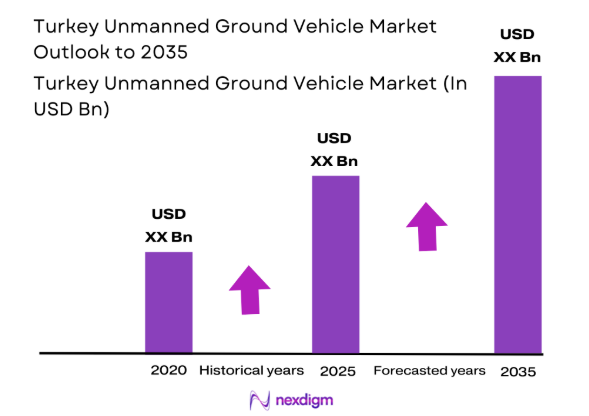
The Turkey Unmanned Ground Vehicle market current size stands at around USD ~ million, reflecting sustained defense procurement momentum and indigenous platform development activity. Deployment volumes expanded across multiple defense formations, with ~ units operational during the assessment period. Increased testing cycles, field trials, and operational readiness programs supported higher system utilization rates. Domestic manufacturing capacity expanded through modular production lines and localized component sourcing. Integration of autonomy software accelerated platform maturity. Procurement cycles remained aligned with multi-year defense modernization planning.
The market is concentrated across Ankara, Istanbul, and Konya due to defense industrial clustering and testing infrastructure availability. These regions benefit from mature supplier ecosystems, defense research centers, and command-level operational units. Strong logistics connectivity supports rapid deployment and maintenance cycles. Government-backed innovation programs enhance ecosystem maturity. Border security priorities and terrain diversity drive regional demand variations. Regulatory frameworks emphasize domestic sourcing and technology sovereignty.
Market Segmentation
By Application
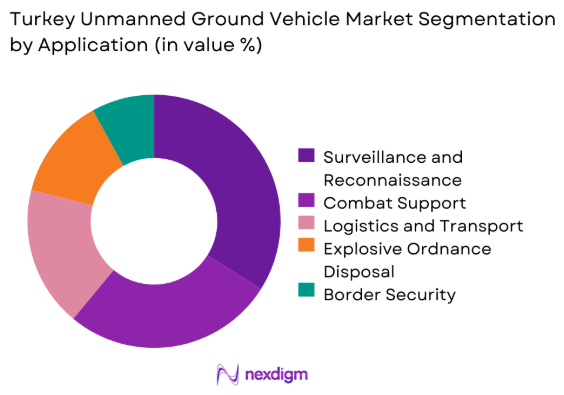
Combat and reconnaissance applications dominate demand due to persistent border security needs and asymmetric operational environments. Surveillance missions account for substantial deployment volumes because of continuous monitoring requirements across sensitive regions. Logistics and support roles are expanding as autonomy reliability improves. Explosive ordnance disposal platforms remain critical for urban and conflict-zone operations. Homeland security adoption is increasing through centralized procurement. Mission-specific customization drives segmentation depth across applications.
By Technology Architecture
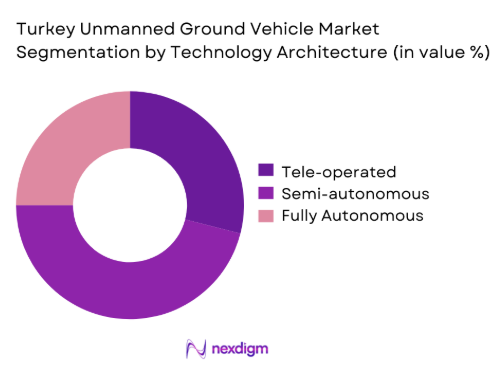
Semi-autonomous systems dominate due to balanced operational control and regulatory acceptance. Tele-operated platforms remain relevant for high-risk missions requiring human oversight. Fully autonomous systems are expanding gradually as validation frameworks mature. Integration of artificial intelligence enhances navigation and target recognition capabilities. Hybrid architectures enable flexibility across mission profiles. Interoperability with existing command systems drives architecture selection decisions.
Competitive Landscape
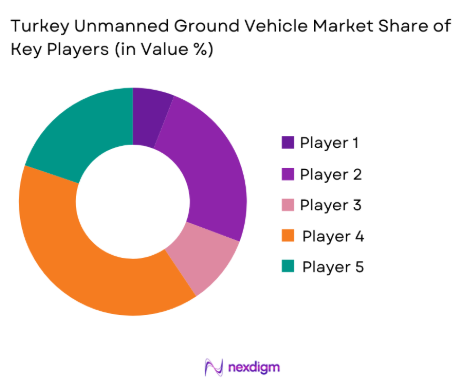
The competitive environment is characterized by strong domestic manufacturing capabilities and vertically integrated system development. Companies focus on modularity, indigenous component sourcing, and defense compliance. Collaboration with defense agencies strengthens validation cycles. Competitive positioning emphasizes reliability, mission adaptability, and long-term service support.
| Company Name | Establishment Year | Headquarters | Formulation Depth | Distribution Reach | Regulatory Readiness | Service Capability | Channel Strength | Pricing Flexibility |
| ASELSAN | 1975 | Ankara | ~ | ~ | ~ | ~ | ~ | ~ |
| FNSS | 1988 | Ankara | ~ | ~ | ~ | ~ | ~ | ~ |
| Otokar | 1963 | Sakarya | ~ | ~ | ~ | ~ | ~ | ~ |
| BMC | 1964 | Izmir | ~ | ~ | ~ | ~ | ~ | ~ |
| HAVELSAN | 1982 | Ankara | ~ | ~ | ~ | ~ | ~ | ~ |
Turkey Unmanned Ground Vehicle Market Analysis
Growth Drivers
Rising defense modernization initiatives
Defense modernization programs continue prioritizing unmanned platforms to enhance operational efficiency across diverse terrain conditions. Strategic investments strengthen domestic production capabilities while reducing dependency on imported systems. Procurement cycles increasingly favor modular unmanned platforms with scalable payload integration. Military modernization roadmaps emphasize digital battlefield integration and autonomous support functions. Continuous platform upgrades enhance survivability and mission adaptability. National defense strategies allocate resources toward unmanned force multiplication concepts. Testing programs validate performance in varied operational scenarios. Local manufacturing incentives accelerate technology adoption cycles. System interoperability remains a central design objective. These initiatives collectively sustain consistent demand growth.
Increasing asymmetric warfare requirements
Operational environments increasingly demand unmanned platforms capable of operating under asymmetric threat conditions. Urban conflict scenarios drive demand for remote reconnaissance and engagement systems. UGVs reduce personnel exposure during high-risk missions. Border security challenges amplify the need for persistent ground surveillance. Tactical flexibility becomes essential for counterinsurgency operations. Autonomous mobility improves response times in complex terrain. Data-driven decision support enhances mission effectiveness. Rapid deployment capabilities remain critical for tactical superiority. System resilience supports extended operational endurance. These factors reinforce sustained platform adoption.
Challenges
High development and integration costs
Advanced sensor integration increases overall system development complexity and resource requirements. Testing and certification cycles demand significant technical validation efforts. Localization of critical subsystems elevates engineering investment burdens. Integration with legacy command systems introduces compatibility challenges. High-performance mobility platforms require extensive durability testing. Budget constraints can delay procurement timelines. Lifecycle support costs remain substantial. Specialized workforce requirements elevate operational expenses. Extended development timelines affect deployment schedules. These constraints collectively impact market scalability.
Limited interoperability standards
Absence of unified interoperability protocols complicates multi-platform coordination during operations. Proprietary communication architectures restrict cross-platform data exchange. Integration with allied systems requires additional adaptation layers. Standardization gaps increase system customization requirements. Interoperability testing extends validation timelines. Cross-agency coordination faces technical barriers. Limited common frameworks reduce deployment flexibility. Software harmonization remains resource intensive. Operational efficiency suffers without unified command interfaces. Addressing interoperability remains a structural challenge.
Opportunities
Export potential to allied and emerging markets
Growing demand for unmanned ground systems across allied nations creates export expansion opportunities. Competitive pricing enhances attractiveness in emerging defense markets. Modular designs allow customization for diverse operational requirements. Strategic partnerships facilitate international market entry. Defense cooperation agreements support technology transfer frameworks. Export approvals strengthen global market presence. Field-proven platforms increase buyer confidence. Regional security dynamics stimulate procurement interest. Long-term service contracts enhance revenue stability. Export growth supports domestic industry scaling.
Integration with unmanned aerial systems
Cross-domain integration enhances situational awareness and mission coordination capabilities. Combined air-ground operations improve reconnaissance effectiveness. Data fusion strengthens real-time decision-making processes. Autonomous coordination reduces operator workload. Interoperable command systems enable synchronized mission execution. Network-centric warfare doctrines support integrated deployments. Joint testing programs validate system compatibility. Operational efficiency improves through coordinated asset utilization. Enhanced mission success rates drive adoption. Integration potential expands operational value propositions.
Future Outlook
The Turkey unmanned ground vehicle market is expected to maintain steady expansion through advancing autonomy, indigenous innovation, and sustained defense modernization programs. Increased focus on multi-domain operations will drive system integration. Policy support and export diversification are likely to strengthen long-term market resilience and technological depth.
Major Players
- ASELSAN
- FNSS
- Otokar
- BMC
- HAVELSAN
- Baykar
- Roketsan
- STM
- Nurol Makina
- Katmerciler
- Meteksan Defense
- Sarsılmaz
- Albayrak Defense
- Ermaksan
- Titra Technology
Key Target Audience
- Turkish Ministry of National Defense
- Turkish Armed Forces Command Units
- Presidency of Defence Industries
- Border Security and Gendarmerie Commands
- Homeland Security Agencies
- Defense System Integrators
- Investments and venture capital firms
- Government procurement and regulatory bodies
Research Methodology
Step 1: Identification of Key Variables
The study identifies platform types, deployment environments, operational roles, and technology maturity indicators. Defense procurement structures and capability roadmaps are mapped. Market boundaries are defined through application relevance. Key influencing parameters are established for analysis.
Step 2: Market Analysis and Construction
Data is structured through demand-side assessment and supply-side mapping. Platform deployment trends are evaluated across operational segments. Technology penetration levels are analyzed. Regional adoption dynamics are incorporated.
Step 3: Hypothesis Validation and Expert Consultation
Insights are validated through domain expert interactions and operational feedback loops. Assumptions are refined using deployment patterns. Cross-validation ensures consistency across datasets. Market logic is aligned with defense planning cycles.
Step 4: Research Synthesis and Final Output
Findings are consolidated into structured insights. Analytical consistency is maintained across sections. Market dynamics are interpreted through strategic frameworks. Final outputs reflect realistic industry positioning.

- Executive Summary
- Research Methodology (Market Definitions and Scope Alignment, Platform and Mission-Type Taxonomy Mapping, Bottom-Up Fleet and Procurement-Based Market Estimation, Revenue Attribution Across Defense and Dual-Use Programs, Primary Validation with Defense Integrators and Program Offices, Data Triangulation Using Contracts and Deployment Records, Assumptions and Limitations Based on Indigenous Development Programs)

- Definition and Scope
- Market evolution
- Usage and operational deployment landscape
- Ecosystem structure
- Supply chain and integration framework
- Regulatory and defense procurement environment

- Growth Drivers
Rising defense modernization initiatives
Increasing asymmetric warfare requirements
Expansion of indigenous defense manufacturing
Growing emphasis on force protection and unmanned missions
Integration of AI and autonomy in ground systems - Challenges
High development and integration costs
Limited interoperability standards
Operational reliability in complex terrains
Cybersecurity and electronic warfare vulnerabilities
Procurement and testing delays - Opportunities
Export potential to allied and emerging markets
Integration with unmanned aerial systems
Adoption in internal security and border patrol
Development of swarm and cooperative UGVs
Advancements in autonomous navigation technologies - Trends
Shift toward modular UGV platforms
Rising demand for multi-mission payloads
Increased use of AI-based perception systems
Growing emphasis on indigenous software stacks
Integration with network-centric warfare doctrines

- By Value, 2020–2025
- By Volume, 2020–2025
- By Installed Base, 2020–2025
- By Average Selling Price, 2020–2025

- By Fleet Type (in Value %)
Tracked UGVs
Wheeled UGVs
Hybrid mobility platforms - By Application (in Value %)
Surveillance and reconnaissance
Combat and fire support
Logistics and supply transport
Explosive ordnance disposal
Border and perimeter security - By Technology Architecture (in Value %)
Tele-operated systems
Semi-autonomous systems
Fully autonomous systems - By End-Use Industry (in Value %)
Defense forces
Homeland security
Border control agencies
Critical infrastructure protection - By Connectivity Type (in Value %)
Line-of-sight communication
Satellite communication
Hybrid communication systems - By Region (in Value %)
Marmara
Central Anatolia
Aegean
Mediterranean
Eastern and Southeastern Anatolia

- Market structure and competitive positioning
- Market share snapshot of major players
- Cross Comparison Parameters (Platform capability, Autonomy level, Payload capacity, Combat readiness, Integration flexibility, Export presence, After-sales support, Pricing strategy)
- SWOT Analysis of Key Players
- Pricing and Commercial Model Benchmarking
- Porter’s Five Forces
- Detailed Profiles of Major Companies
ASELSAN
FNSS
Otokar
BMC
HAVELSAN
Baykar
Roketsan
Nurol Makina
Katmerciler
Meteksan Defense
STM
Yapı Savunma
Erkunt Defense
Sarsılmaz
Albayrak Defense

- Demand and utilization drivers
- Procurement and tender dynamics
- Buying criteria and vendor selection
- Budget allocation and financing preferences
- Implementation barriers and risk factors
- Post-purchase service expectations

- By Value, 2026–2035
- By Volume, 2026–2035
- By Installed Base, 2026–2035
- By Average Selling Price, 2026–2035


 Request a Sample
 Ask for Customization
 Get a Quote
 Enquire Now