

 Download PDF
 Download PDF
Market Overview
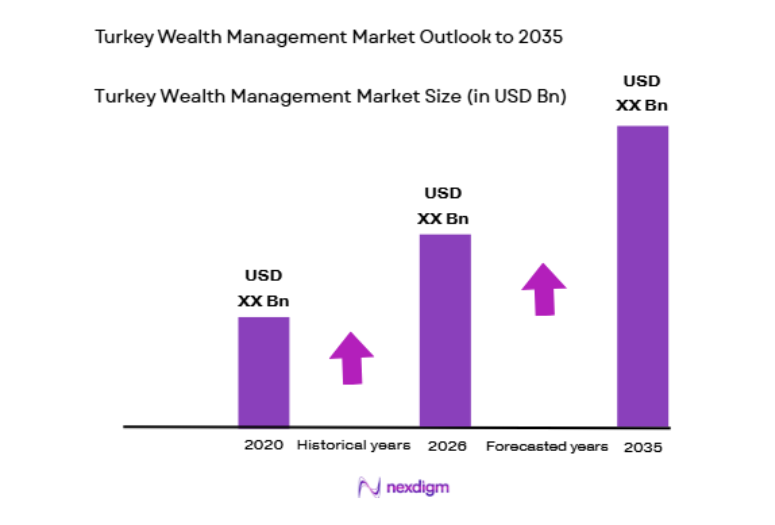
Based on a recent historical assessment, the Turkey wealth management market oversees approximately USD ~ billion in assets under management, according to data published by the Capital Markets Board of Türkiye and the Turkish Institutional Investment Managers’ Association, expressed in USD equivalent terms. The market is driven by expanding mutual fund participation, rising private pension assets, increasing high-net-worth individual portfolios, and strong retail investor engagement in capital markets supported by domestic banks and brokerage platforms.
Istanbul remains the dominant financial hub due to its concentration of commercial banks, brokerage houses, portfolio management companies, and capital market infrastructure including Borsa İstanbul. Ankara plays a regulatory and institutional oversight role through supervisory bodies, while Izmir contributes through regional banking and investment activity. Türkiye benefits from a growing investor base, digitized brokerage systems, and structured private pension schemes that reinforce the development of professional asset and wealth advisory services.
Market Segmentation
By Client Type
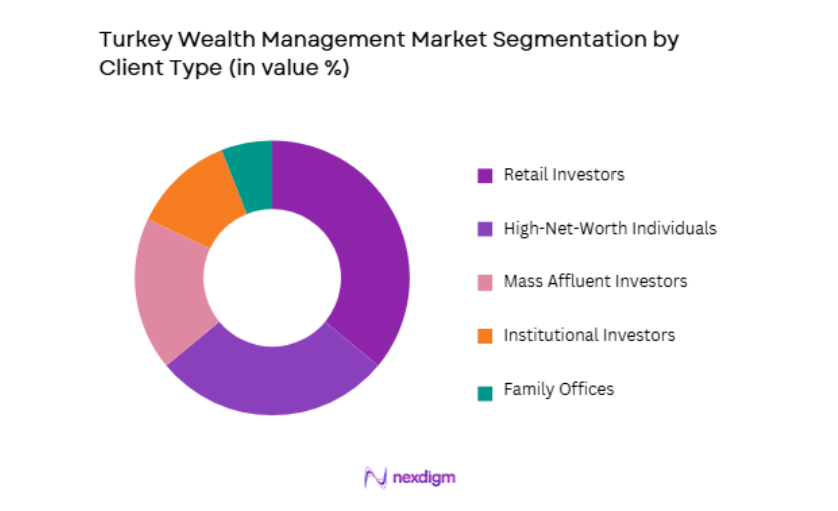
Turkey Wealth Management market is segmented by client type into High-Net-Worth Individuals, Mass Affluent Investors, Retail Investors, Institutional Investors, and Family Offices. Recently, Retail Investors has a dominant market share due to strong participation in mutual funds, equity trading, and private pension schemes supported by digital brokerage platforms and mobile banking applications. High inflationary conditions and currency volatility have encouraged households to diversify savings into professionally managed capital market instruments. Domestic banks actively promote investment funds and structured savings products to broaden financial inclusion.
 By Lender Type
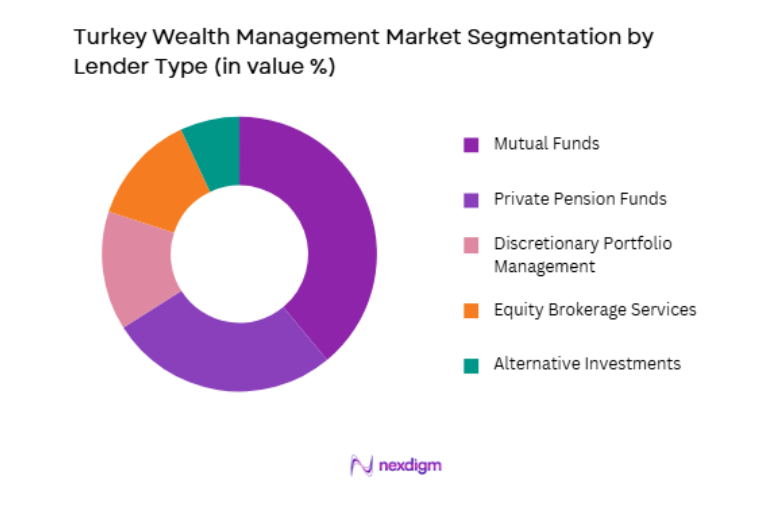
Turkey Wealth Management market is segmented by product type into Mutual Funds, Private Pension Funds, Discretionary Portfolio Management, Equity Brokerage Services, and Alternative Investments. Recently, Mutual Funds has a dominant market share due to their accessibility, diversified risk exposure, regulatory transparency, and integration with digital banking channels. Investors increasingly prefer professionally managed collective investment vehicles to mitigate volatility and inflation risks. Portfolio management companies affiliated with major banks distribute mutual funds extensively through branch networks and online platforms. Structured fund categories including money market, equity, and gold funds attract significant household savings.
Competitive Landscape
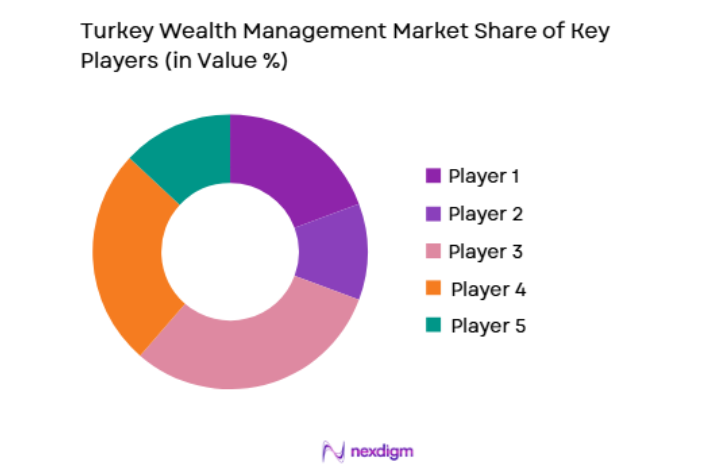
The Turkey wealth management market is characterized by strong participation from bank-affiliated portfolio management companies and brokerage subsidiaries. Major commercial banks leverage extensive branch networks and digital platforms to distribute mutual funds and pension products. Market concentration is influenced by regulatory capital requirements and distribution capabilities. Independent asset managers operate alongside bank-backed entities but face competitive pressure from integrated financial groups with broad customer bases and established brand recognition.
| Company Name | Establishment Year | Headquarters | Technology Focus | Market Reach | Key Products | Revenue | Assets Under Management (USD) |
| İş Portföy Yönetimi | 2000 | Istanbul, Türkiye | ~ | ~ | ~ | ~ | ~ |
| Garanti BBVA Asset Management | 1997 | Istanbul, Türkiye | ~ | ~ | ~ | ~ | ~ |
| Ak Portföy | 2000 | Istanbul, Türkiye | ~ | ~ | ~ | ~ | ~ |
| Yapı Kredi Portföy | 2001 | Istanbul, Türkiye | ~ | ~ | ~ | ~ | ~ |
| Ziraat Portföy | 2002 | Ankara, Türkiye | ~ | ~ | ~ | ~ | ~ |
Turkey Wealth Management Market Analysis
Growth Drivers
Expansion of Domestic Capital Markets and Retail Investor Participation
Rapid growth in domestic capital market participation has become a primary structural driver of the Turkey wealth management market, supported by rising brokerage account openings and increased engagement with mutual fund products. Household savings behavior has shifted toward capital market instruments as investors seek protection against inflationary pressures and currency volatility. Digitized brokerage applications and mobile investment platforms have significantly lowered entry barriers for retail investors across diverse income segments. Government-backed private pension schemes further channel long-term savings into professionally managed portfolios, increasing total assets under management. Strong equity market activity on Borsa İstanbul enhances investor awareness and portfolio diversification strategies. Bank-affiliated asset management companies leverage existing customer relationships to distribute structured investment products efficiently. Enhanced financial literacy initiatives and simplified onboarding processes reinforce participation. Institutional infrastructure improvements including central clearing and custody systems strengthen investor confidence. These combined developments underpin sustained asset growth within the Turkey wealth management ecosystem.
Growth of Private Pension System and Long-Term Savings Incentives
The structured expansion of Türkiye’s private pension system has significantly strengthened the foundation of the Turkey wealth management market by promoting disciplined long-term savings accumulation. Government contribution mechanisms and tax incentives encourage voluntary participation, increasing recurring inflows into pension-linked investment funds. Automatic enrollment frameworks enhance coverage across salaried employees, broadening the investor base. Pension fund assets are professionally managed by licensed portfolio management companies, creating stable fee-based revenue streams. The long-duration nature of pension savings supports diversified allocations across equities, fixed income, and alternative instruments. Demographic trends including a growing working-age population contribute to sustained contribution levels. Financial institutions integrate pension advisory services within broader wealth management offerings. Regulatory oversight by capital markets authorities reinforces transparency and governance standards. This structured and incentivized pension ecosystem provides a resilient growth platform for Turkey’s professional asset management industry.
Market Challenges
Macroeconomic Volatility and Currency Fluctuation Risks
Persistent macroeconomic volatility and currency depreciation present structural challenges for the Turkey wealth management market by affecting asset valuations and investor sentiment. Rapid shifts in exchange rates influence portfolio performance, particularly for foreign currency denominated investments. Inflationary pressures alter real return expectations and complicate long-term asset allocation strategies. Market instability can lead to abrupt capital flow movements and liquidity pressures within equity and bond markets. Wealth managers must continuously adjust risk management frameworks to maintain portfolio resilience. High volatility environments may discourage conservative investors from engaging in capital market products. International diversification opportunities are sometimes constrained by regulatory and currency considerations. Funding costs and operational expenses may rise during economic instability. These conditions collectively create uncertainty that wealth managers must actively navigate through disciplined portfolio construction and client communication strategies.
Regulatory Tightening and Capital Market Compliance Requirements
The Turkey wealth management market operates under comprehensive oversight by the Capital Markets Board, imposing strict licensing, disclosure, and reporting standards on portfolio management companies. Compliance with evolving regulations requires ongoing investment in governance systems and qualified personnel. Enhanced transparency obligations increase operational complexity for smaller asset managers. Distribution rules governing fund marketing and advisory services shape product design and sales practices. Anti-money laundering frameworks require robust customer due diligence procedures. Regulatory adjustments responding to macroeconomic conditions can impact permissible investment structures. Capital adequacy requirements influence expansion strategies for independent managers. Cross-border investment regulations may limit access to certain foreign instruments. These regulatory factors elevate compliance costs while reinforcing systemic stability within the Turkish financial ecosystem.
Opportunities
Development of Shariah-Compliant and Participation-Based Investment Products
Expanding demand for participation-based financial products presents a significant opportunity within the Turkey wealth management market, particularly among investors seeking Shariah-compliant structures. Participation banks and asset management firms can design equity and sukuk-based funds aligned with Islamic finance principles. Rising awareness of ethical investing enhances interest in structured participation portfolios. Regulatory recognition of participation finance frameworks strengthens product credibility. Integration of gold-based and asset-backed instruments supports diversification within compliant structures. Distribution through digital banking platforms increases accessibility to broader demographics. Institutional investors including participation pension funds expand asset pools aligned with faith-based criteria. Cross-border collaboration with Gulf-based Islamic finance institutions enhances capital inflows. This segment offers differentiated growth potential within the broader wealth management landscape.
Digital Advisory Expansion and Cross-Border Wealth Solutions
The continued digital transformation of Turkey’s financial services industry creates opportunities to expand advisory services through robo-advisory models and hybrid wealth platforms. Automated portfolio allocation tools enhance accessibility for younger and tech-savvy investors. Cross-border investment capabilities enable Turkish investors to diversify internationally within regulated frameworks. Strategic partnerships with global custodians broaden asset class access. Enhanced cybersecurity systems strengthen trust in digital wealth solutions. Data analytics enable personalized portfolio construction based on investor risk profiles. Mobile-first platforms facilitate continuous engagement and performance monitoring. Expansion of English-language advisory services may attract expatriate and foreign investors. These digital and cross-border innovations provide scalable growth avenues for Turkey’s wealth management providers.
Future Outlook
The Turkey wealth management market is expected to demonstrate sustained structural expansion over the next five years, supported by retail investor growth and pension asset accumulation. Digital investment platforms will deepen market penetration across younger demographics. Regulatory oversight will continue reinforcing transparency and governance. Diversification into participation finance and international asset allocation is anticipated to broaden product offerings and strengthen long-term asset growth dynamics.
Major Players
- İşPortföy Yönetimi
- Garanti BBVA Asset Management
- Ak Portföy
- Yapı Kredi Portföy
- Ziraat Portföy
- QNB Finans Portföy
- TEB Portföy
- Halk Portföy
- Deniz Portföy
- Vakıf Portföy
- Ata Portföy
- Ünlü Portföy
- Azimut Portföy Türkiye
- Re-Pie Portföy
- Albaraka Portföy
Key Target Audience
- High-Net-Worth Individuals
- Retail Investors
- Mass Affluent Investors
- Pension Fund Administrators
- Participation Banks
- Brokerage Houses
- Investments and venture capitalist firms
- Government and regulatory bodies
Research Methodology
Step 1: Identification of Key Variables
Core indicators including assets under management, pension fund balances, investor segmentation, product distribution channels, and regulatory frameworks were identified through official capital markets publications and financial disclosures.
Step 2: Market Analysis and Construction
A bottom-up aggregation of mutual fund, pension, and discretionary portfolio assets was conducted to structure the overall Turkey wealth management market framework and segmentation.
Step 3: Hypothesis Validation and Expert Consultation
Preliminary findings were validated through consultation with portfolio managers, compliance officers, and capital market specialists to ensure alignment with prevailing regulatory and operational realities.
Step 4: Research Synthesis and Final Output
Quantitative metrics and qualitative insights were synthesized into a structured analytical report integrating segmentation, competitive positioning, and forward-looking evaluation.

- Executive Summary
- Research Methodology (Definitions, Scope, Industry Assumptions, Market Sizing Approach, Primary & Secondary Research Framework, Data Collection & Verification Protocol, Analytic Models & Forecast Methodology, Limitations & Research Validity Checks)

- Market Definition and Scope
- Value Chain & Stakeholder Ecosystem
- Regulatory / Certification Landscape
- Sector Dynamics Affecting Demand

- Growth Drivers
Rising High Net Worth Population and Entrepreneurial Wealth
Increasing Demand for Diversified Asset Allocation
Expansion of Digital Investment and Advisory Platforms - Market Challenges
Macroeconomic Volatility and Currency Fluctuations
Regulatory Compliance and Capital Market Oversight
Limited Depth of Domestic Capital Markets - Market Opportunities
Growth of Islamic and Participation Banking Investment Products
Cross Border Wealth Structuring and Offshore Advisory
Adoption of Artificial Intelligence in Portfolio Analytics - Trends
Shift Toward Foreign Currency and International Asset Exposure
Growing Adoption of Digital Portfolio Monitoring Tools - Government Regulations
- SWOT Analysis
- Porter’s Five Forces

- By Market Value, 2020-2025
- By Installed Units, 2020-2025
- By Average System Price, 2020-2025
- By System Complexity Tier, 2020-2025

- By System Type (In Value%)
Discretionary Portfolio Management
Non-Discretionary Advisory Services
Private Banking and Asset Allocation
Islamic Wealth Management Solutions
Alternative Investment Advisory - By Platform Type (In Value%)
Bank Based Wealth Platforms
Independent Asset Management Firms
Brokerage Houses
Digital Investment Platforms
Hybrid Advisory Models - By Fitment Type (In Value%)
Fee Based Advisory Model
Commission Based Brokerage
Hybrid Fee Commission Structure
Sharia Compliant Advisory Frameworks - By End User Segment (In Value%)
High Net Worth Individuals
Ultra High Net Worth Individuals
Mass Affluent Investors

- Market Share Analysis
- Cross Comparison Parameters (Assets Under Management, Fee Structure Model, Minimum Investment Requirement, Sharia Compliance Capability, Digital Advisory Integration)
- SWOT Analysis of Key Competitors
- Pricing & Procurement Analysis
- Key Players
Isbank Private Banking
Garanti BBVA Private Banking
Yapi Kredi Private Banking
Akbank Private Banking
Ziraat Bank Private Banking
Halkbank Private Banking
QNB Finansbank Private Banking
DenizBank Private Banking
TEB Private Banking
Turkiye Finans Participation Bank
Kuveyt Turk Participation Bank
Albaraka Turk Participation Bank
Oyak Yatirim
Ata Yatirim
Tacirler Yatirim

- Increasing Preference for Capital Preservation Strategies
- Higher Allocation to Gold and Foreign Currency Assets
- Demand for Sharia Compliant Investment Structures
- Rising Interest in International Diversification

- Forecast Market Value, 2026-2035
- Forecast Installed Units, 2026-2035
- Price Forecast by System Tier, 2026-2035
- Future Demand by Platform, 2026-2035


 Request a Sample
 Ask for Customization
 Get a Quote
 Enquire Now