
 Download PDF
Market Overview
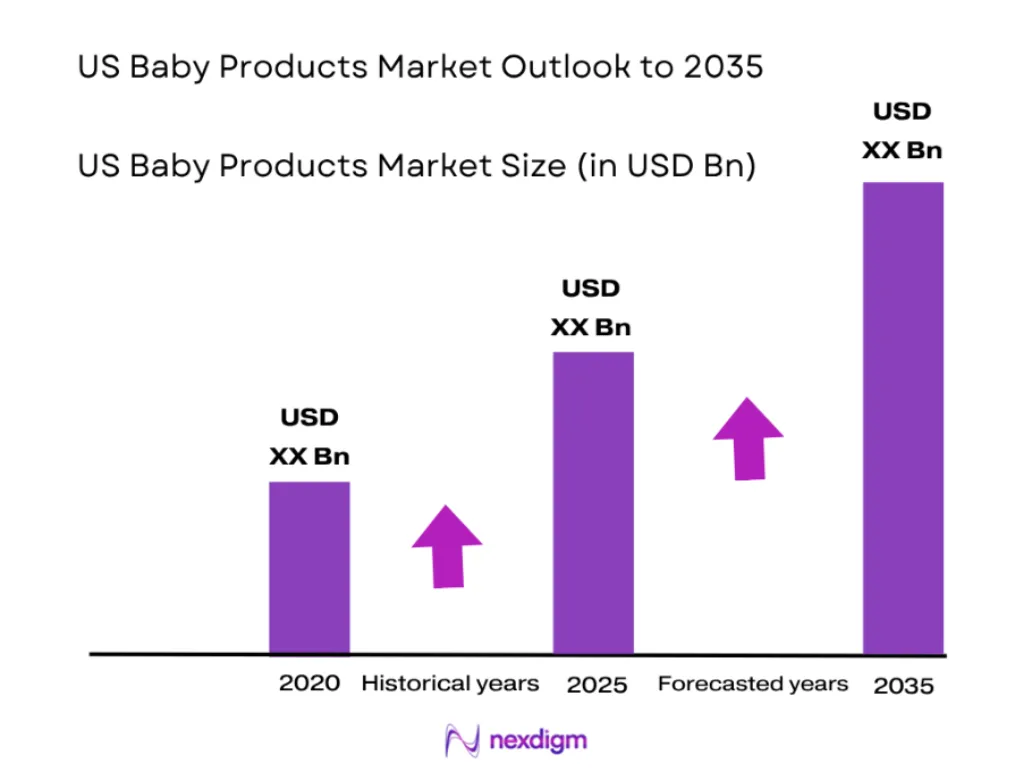
The U.S. baby products market is valued at approximately USD ~ billion, supported by consistent consumer spending across essential and premium categories. According to the U.S. Census Bureau, the number of births reached 3.66 million, while consumer expenditure on infant care products continues to rise through premiumization and safety-driven purchasing behavior. The Bureau of Labor Statistics highlights increased household spending on personal care and infant-related goods, reinforcing demand stability across both durable and consumable baby product categories.
The market is primarily concentrated in metropolitan regions such as New York, California, Texas, and Florida, where higher disposable incomes and urban lifestyles drive premium product adoption. Cities like Los Angeles and New York act as trend hubs due to strong retail ecosystems, higher awareness of organic and safe baby products, and early adoption of innovative parenting solutions. Additionally, the U.S. benefits from a strong domestic manufacturing base and global brand presence, making it a dominant player in the global baby products ecosystem.
Market Segmentation
By Product Type
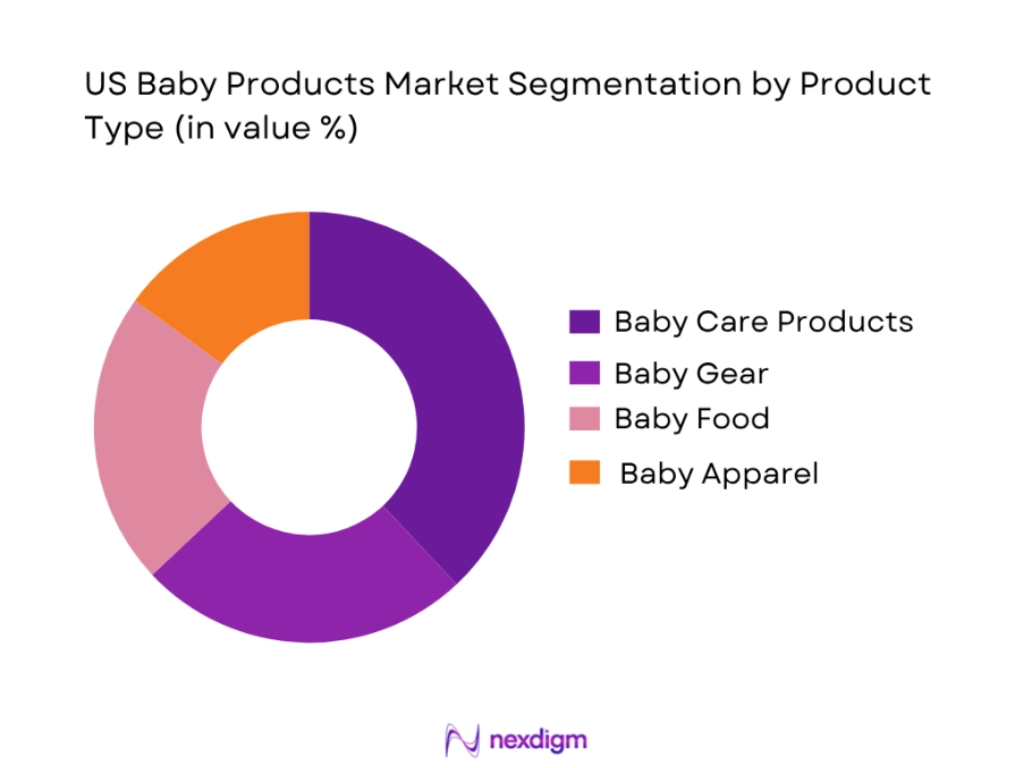
The U.S. baby products market is segmented by product type into baby care products, baby gear, baby food, and baby apparel. Recently, baby care products have a dominant market share in the U.S. market under the segmentation product type, it is due to their essential nature and high frequency of usage. Products such as lotions, wipes, shampoos, and diapers are purchased repeatedly, unlike durable goods such as strollers and cribs. The increasing awareness regarding baby hygiene, skin sensitivity, and safety has significantly boosted demand for baby care products. Additionally, the rise of organic and hypoallergenic formulations has further strengthened this segment. Leading brands have also expanded their portfolios with premium and dermatologically tested products, driving higher consumer spending and reinforcing dominance of this segment.
By Distribution Channel
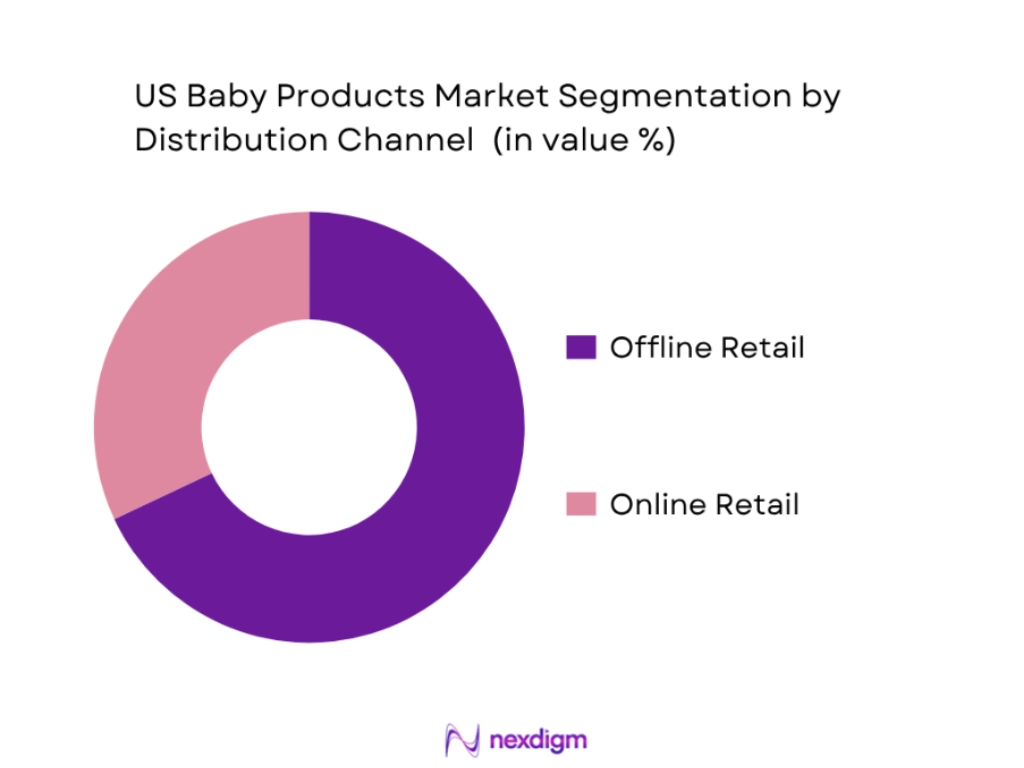
The market is segmented by distribution channel into offline retail and online retail. Recently, offline retail has a dominant market share in the U.S. baby products market under the segmentation distribution channel, it is due to strong presence of large retail chains such as Walmart, Target, and specialty baby stores. Parents prefer offline channels for baby products as they allow physical inspection, especially for safety-critical items like strollers and car seats. Additionally, pharmacies and supermarkets play a crucial role in the distribution of daily-use baby care products. However, online retail is rapidly growing due to convenience, subscription-based purchasing, and wider product availability, particularly for premium and niche brands.
Competitive Landscape
The U.S. baby products market is dominated by a mix of global conglomerates and specialized baby care brands, including Procter & Gamble, Johnson & Johnson, Kimberly-Clark, Unilever, and Newell Brands. This consolidation highlights the strong influence of established players with extensive distribution networks, brand equity, and diversified product portfolios. Emerging clean-label and premium brands are also gaining traction, intensifying competition.
| Company | Establishment Year | Headquarters | Product Portfolio | Distribution Strength | Pricing Strategy | Brand Positioning | Innovation Focus | Market Presence |
| Procter & Gamble | 1837 | Cincinnati, USA | – | – | – | – | – | – |
| Johnson & Johnson | 1886 | New Jersey, USA | – | – | – | – | – | – |
| Kimberly-Clark | 1872 | Texas, USA | – | – | – | – | – | – |
| Unilever | 1929 | London, UK | – | – | – | – | – | – |
| Newell Brands | 1903 | Georgia, USA | – | – | – | – | – | – |
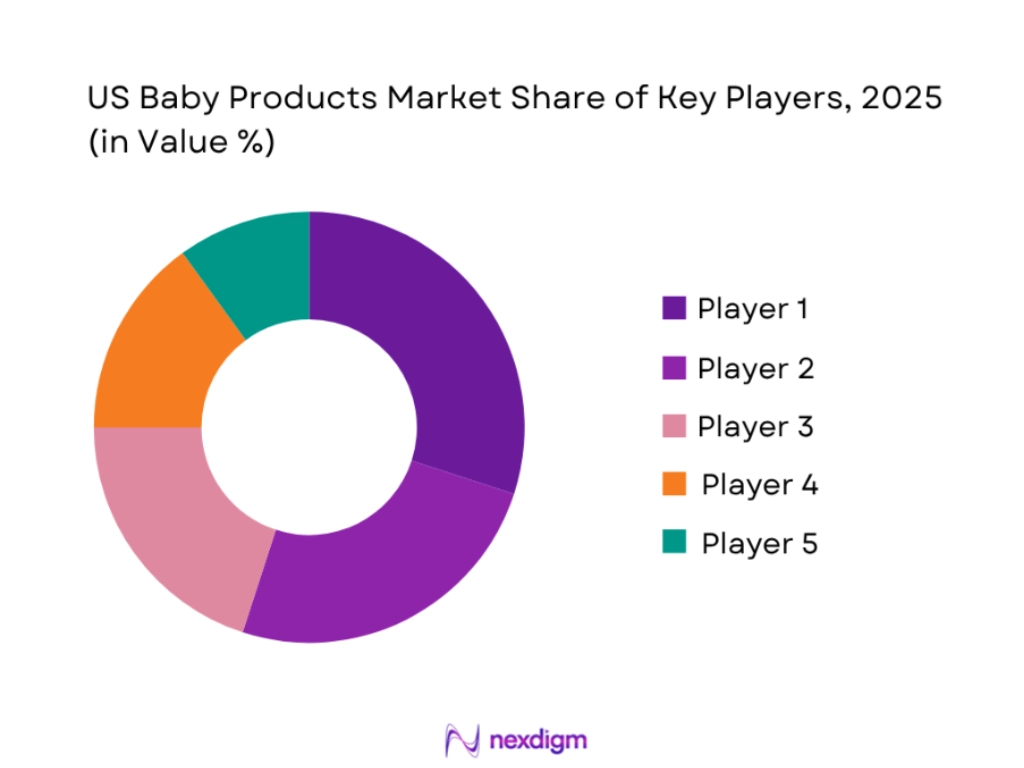
U.S. Baby Products Market Analysis
Growth Drivers
Premiumization Across Core Baby Gear and Care Categories
Premiumization in the U.S. baby products market is being supported by a consumer base that still has spending capacity for higher-trust, higher-specification products. The U.S. economy expanded by 2.8 in real terms in 2024, while average income before taxes reached USD 104,207 and average annual household expenditure reached USD 78,535. Spending dispersion also remained wide, with the highest income quintile averaging USD 150,342 in annual expenditures versus USD 35,046 in the lowest quintile, giving premium baby brands a large addressable upper-income pool. At the same time, the birth base remained substantial at 3,622,673 live births, which keeps demand flowing into daily-use care products and higher-value durables. In practical terms, this supports trading up from basic to premium strollers, car seats, monitors, clean-label skincare, and dermatologist-positioned baby care, because parents are often optimizing for safety, convenience, product life, and perceived quality rather than buying only at the lowest ticket.
Rising Demand for Safety-Certified and Compliance-Backed Products
Safety compliance is a core purchase driver in U.S. baby products because the category is closely regulated and injury visibility is high. The CPSC currently lists 28 durable infant and toddler product categories that require performance, labeling, and registration compliance, ranging from strollers and cribs to bath seats, carriers, swings, and nursing pillows. This regulatory intensity is reinforced by incident data: CPSC estimated 60,400 emergency-department-treated nursery-product injuries among children under age five in 2023, and its nursery products report identified 523 deaths associated with nursery products across 2019–2021, an annual average of 174. Enforcement has also remained active: in FY 2024, CPSC completed 333 cooperative recalls, with 166 processed under the Fast-Track program. For U.S. parents, this keeps compliance visible at the point of purchase and strengthens demand for products that explicitly signal tested materials, updated standards, traceability, registration cards, and safer sleep or transport certifications.
Market Challenges
Slower Birth Growth and Demand Normalization
The largest structural challenge for the U.S. baby products market remains the slow growth of the birth base. CDC provisional data show 3,622,673 births in 2024 and a general fertility rate of 54.6 births per 1,000 women aged 15–44, while the total fertility rate was 1,626.5 births per 1,000 women. Although births increased modestly from 2023, the underlying demand pool is not expanding rapidly. The age pattern also matters: the birth rate for women aged 20–24 fell to 56.7, while women aged 25–29 were at 91.4 and women aged 30–34 at 95.4, confirming that childbearing continues to shift older rather than broadening overall volume. The CDC natality dashboard further shows the 12-month ending general fertility rate moved from 54.6 in 2024 Q3 to 53.6 in 2025 Q3. For the baby products market, that means a more mature, replacement-driven cycle and less automatic category expansion from population momentum alone.
High Product Liability and Recall Sensitivity
Product liability and recall exposure are unusually high in the U.S. baby products market because the consequence of product failure is severe and public. CPSC’s FY 2024 annual report shows 333 cooperative recalls, with 166 handled through the Fast-Track program and 98.08 of Fast-Track recalls initiated within 20 days of a firm report. The same agency estimated 60,400 nursery-product-related emergency-department injuries in 2023 and identified 523 deaths associated with nursery products across 2019–2021. CPSC also notes that cribs and mattresses accounted for 126 of those deaths, bassinets and cradles 115, and playpens and play yards 91. For manufacturers and retailers, this raises compliance, testing, traceability, insurance, and post-sale monitoring requirements. For consumers, frequent recall headlines raise risk awareness and make brand trust more fragile. In a market where parent communities share safety concerns quickly online, even isolated incidents can materially affect category sell-through and retailer acceptance.
Market Opportunities
Smart Monitors, Connected Safety, and Tech-Enabled Parenting
Smart monitors and connected-safety products have a clear runway in the U.S. because digital readiness is already mainstream. NTIA reports that 83 of people age three and older used the internet in 2023, 72 lived in households with both fixed and mobile internet, and only 12 lived in households with no internet connection. Census adds that e-commerce already represented 16.1 of total retail sales in 2024. That infrastructure matters for baby monitors, app-linked movement trackers, smart bottle prep, room-environment sensors, and connected sleep systems because these products rely on broadband-enabled setup, software updates, app engagement, and online education. The opportunity is strengthened by the category’s safety orientation: CPSC’s regulation and recall environment keeps parents attentive to monitoring and prevention. With 3,622,673 births recorded in 2024, the market continues to generate a large annual cohort of new caregivers who are comfortable discovering, purchasing, and managing connected parenting products through digital channels.
Dermatologist-Tested, Fragrance-Free, and Sensitive-Skin Baby Care
Sensitive-skin baby care is one of the strongest opportunities in the U.S. market because the underlying clinical need is visible in government health data. CDC reported that in 2024, 29.5 of children had at least one of three diagnosed allergic conditions examined, and 12.7 had eczema. FDA guidance also explicitly notes that consumers worried about fragrance sensitivities may prefer fragrance-free products and should review ingredient labels carefully. On the regulatory side, FDA updated guidance on cosmetic product facility registration and product listing in December 2024 under MoCRA, raising the compliance bar for marketed baby skincare and haircare products. FDA also reported in April 2024 that asbestos was not detected in 50 talc-containing cosmetic samples tested in 2023, and in December 2024 proposed standardized asbestos testing methods for talc-containing cosmetics. Together, these indicators support growth for dermatologist-tested, hypoallergenic, fragrance-free, and ingredient-transparent baby skincare lines sold through pediatric, pharmacy, and premium retail channels.
Future Outlook
Over the next decade, the U.S. baby products market is expected to show steady growth driven by rising consumer awareness, premiumization trends, and increasing demand for safe and organic products. The market is also benefiting from innovation in product design, including multifunctional baby gear and dermatologically tested baby care products. Growth in e-commerce and subscription-based purchasing models is expected to further enhance accessibility and convenience. The market is projected to grow at a CAGR of approximately ~ during 2026–2035, supported by strong consumer spending and product innovation. Increasing focus on sustainability, eco-friendly packaging, and clean-label formulations will further shape market dynamics. Additionally, technological integration such as smart baby monitors and connected devices is expected to open new growth avenues.
Major Players in the Market
- Procter & Gamble
- Johnson & Johnson
- Kimberly-Clark
- Unilever
- Newell Brands
- Artsana Group (Chicco)
- Dorel Industries
- Goodbaby International
- Carter’s Inc.
- The Honest Company
- Babyganics
- Mustela
- California Baby
- UPPAbaby
Key Target Audience
- Baby product manufacturers and brand owners
- Retail chains and e-commerce platforms
- Pediatric healthcare providers and hospitals
- Investments and venture capitalist firms
- Government and regulatory bodies (U.S. Food and Drug Administration (FDA), Consumer Product Safety Commission (CPSC))
- Distributors and supply chain operators
- Private label and contract manufacturers
- Parenting platforms and subscription service providers
Research Methodology
Step 1: Identification of Key Variables
The initial phase involves constructing an ecosystem map of the U.S. baby products market, identifying key stakeholders such as manufacturers, retailers, and consumers. Secondary research is conducted using databases, industry reports, and government publications to define market variables influencing growth.
Step 2: Market Analysis and Construction
Historical data is analyzed to assess market size, segmentation, and revenue generation. Factors such as consumer spending patterns, product adoption rates, and retail penetration are evaluated to construct a reliable market model.
Step 3: Hypothesis Validation and Expert Consultation
Market hypotheses are validated through interviews with industry experts, including manufacturers, distributors, and pediatric specialists. These insights provide real-world validation of trends, pricing strategies, and demand drivers.
Step 4: Research Synthesis and Final Output
The final stage involves synthesizing all collected data and insights into a structured format. Cross-verification ensures accuracy and reliability, resulting in a comprehensive and actionable market report.

- Executive Summary
- Research Methodology (Market Definitions, Product Scope, Ingredient Classification Framework, Dermatological Benchmarking, Pricing Analysis Methodology, Retail Audit Framework, Consumer Cohort Analysis, Brand Positioning Mapping, Regulatory Mapping, Forecast Assumptions, Data Triangulation, Limitations)

- Definition and Scope
- Market Evolution: From Functional to “Clean + Safe + Premium”
- Role of Dermatological Validation and Pediatric Endorsement
Ingredient Landscape (Natural, Organic, Hypoallergenic, Fragrance-Free) - Consumer Purchase Journey (Awareness → Trust → Trial → Repeat)
- Value Chain Analysis
- Supply Chain (Raw Materials, Contract Manufacturing, Packaging, Retail Distribution)
- Product Lifecycle by Infant Age Group

- By Value (INR Billion), 2020-2025
- By Volume (Units Sold), 2020-2025
- By Average Selling Price (Category-wise SKU Pricing), 2020-2025
- By Premium vs Mass Market Share, 2020-2025

U.S. Baby Skin Care Market Segmentation
- By Product Type (In Value %)
Baby Lotions and Moisturizers
Baby Oils
Baby Creams (Diaper Rash, Healing, Multi-purpose)
Baby Powder
Baby Wipes (Sensitive, Organic, Antibacterial)
Sunscreen and UV Protection
Baby Bath and Body Wash
Massage and Therapeutic Oils - By Ingredient Type (In Value %)
Organic and Plant-Based
Hypoallergenic and Dermatologist-Tested
Synthetic / Conventional Formulations
Fragrance-Free / Sensitive Skin Formulations - By Skin Type Targeting (In Value %)
Normal Skin
Sensitive Skin
Dry Skin
Eczema-Prone Skin - By Price Tier (In Value %)
Mass Market
Mid-Premium
Premium
Organic / Luxury - By Distribution Channel (In Value %)
E-commerce Platforms
Mass Retailers
Pharmacies and Drugstores
Specialty Baby Stores
D2C / Brand-Owned Channels - By Consumer Type (In Value %)
First-Time Parents
Repeat Buyers
Gift Buyers
U.S. Baby Skin Care Market Analysis
- Growth Drivers
Rising Demand for Organic and Clean-Label Baby Care
Increased Pediatric and Dermatological Awareness
Growth of Premium and Niche Brands
Higher Spending by First-Time Parents - Challenges
Product Safety Concerns and Recalls
Ingredient Transparency and Regulatory Scrutiny
Price Sensitivity in Mass Segment - Opportunities
Eczema and Sensitive Skin Treatment Segment Expansion
Subscription-Based Skincare Bundles
Sustainable Packaging and Eco-Friendly Products - Trends
Fragrance-Free and Hypoallergenic Formulations
Pediatrician-Endorsed Branding
Clean Beauty and Ingredient Transparency - Pricing Analysis
- Value Chain and Supply Chain
- Regulatory Landscape (FDA, CPSIA, Ingredient Compliance)
- Porter’s Five Forces
- SWOT Analysis
- Stakeholder Ecosystem
U.S. Baby Skin Care Competitive Intelligence
- Market Share Analysis (By Value %, Category-wise Share, Domestic vs International Players)
- Cross Comparison Parameters (Product Safety Certifications, Ingredient Transparency Score, Organic Product Portfolio %, Average SKU Pricing Range, Distribution Reach (Retail Touchpoints), Online Sales Contribution %, Brand Trust Index among Parents, Pediatrician Recommendation Score)
- Pricing Analysis (SKU-Level Pricing Across Lotions, Oils, Creams, Wipes)
- Detailed Company Profiles
Johnson & Johnson
Procter & Gamble (Pampers, Luvs)
Kimberly-Clark
The Honest Company
Burt’s Bees Baby
Aveeno Baby
Mustela
Babyganics
Pipette
Earth Mama Organics
California Baby
Cetaphil Baby
Aquaphor Baby
SheaMoisture Baby
CeraVe Baby

U.S. Baby Hair Care Market Segmentation
- By Product Type (In Value %)
Baby Shampoo
2-in-1 Shampoo and Body Wash
Baby Conditioner
Hair Oils
Detanglers and Leave-in Products - By Hair Type (In Value %)
Fine Hair
Curly Hair
Thick Hair
Sensitive Scalp - By Ingredient Type (In Value %)
Natural and Organic
Sulfate-Free and Tear-Free
Conventional Formulations - By Price Tier (In Value %)
Mass
Mid-Premium
Premium
Organic / Luxury - By Distribution Channel (In Value %)
E-commerce
Mass Retail
Pharmacies
Specialty Stores
D2C Channels
U.S. Baby Hair Care Market Analysis
- Growth Drivers
Demand for Tear-Free and Gentle Formulations
Growth in Organic and Sulfate-Free Products
Expansion of Premium Hair Care Brands - Challenges
Low Product Differentiation
Price Sensitivity
Ingredient Compliance Pressure - Opportunities
Curly Hair and Ethnic Hair Care Segment
Multi-functional Products (2-in-1 Formulations)
Premium and Dermatological Hair Care - Trends
Sulfate-Free and Paraben-Free Formulations
Pediatrician-Recommended Products
Minimalist Ingredient-Based Branding - Pricing Analysis
- Value Chain and Supply Chain
- Regulatory Landscape
- Porter’s Five Forces
- SWOT Analysis
U.S. Baby Hair Care Competitive Intelligence
- Market Share Analysis (By Value %, Product Category Share, Domestic vs International Players)
- Cross Comparison Parameters (Hair Care Product Portfolio Depth, Tear-Free Formulation Index, Organic Oil Portfolio %, Average SKU Pricing, Distribution Reach, Online Sales Share %, Brand Recall Score, Pediatrician Recommendation Index)
- Pricing Analysis (SKU-Level Pricing Across Shampoo, Oil, Conditioner)
- Detailed Company Profiles
Johnson’s Baby (Kenvue)
Procter & Gamble
Unilever (Baby Dove)
Kimberl
The Honest Company
Babyganics
Pipette
Aveeno Baby
CeraVe Baby
Cetaphil Baby
Noodle & Boo
Tubby Todd Bath Co.
California Baby
SheaMoisture Baby

- By Value (INR Billion), 2026-2035
- By Volume (Units Sold – Lotions, Creams, Oils, Powders), 2026-2035
- By Average Selling Price (Category-wise SKU Pricing), 2026-2035
- By Premium vs Mass Market Share, 2026-2035


 Request a Sample
 Ask for Customization
 Get a Quote
 Enquire Now