
 Download PDF
Market Overview
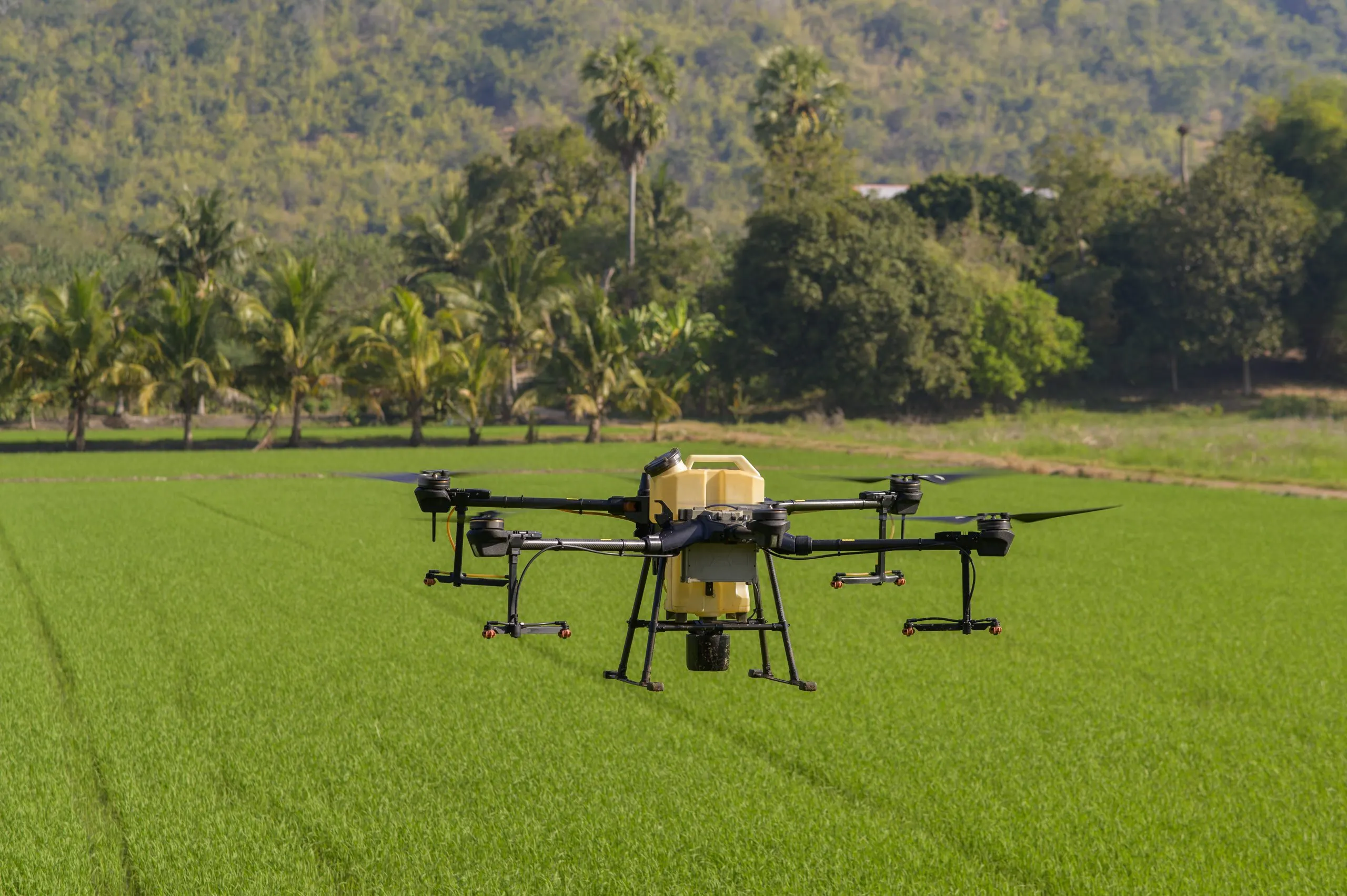
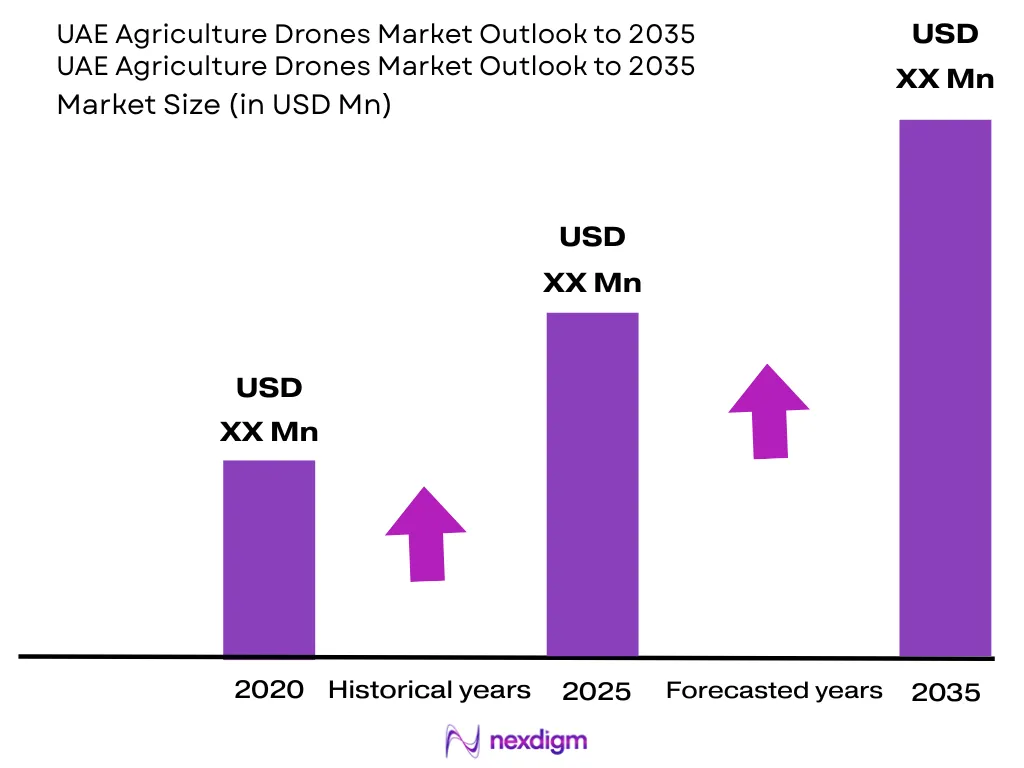
The UAE Agriculture Drones Market is valued at approximately USD ~ Million in 2024, supported by the country’s increasing focus on agricultural technology, food security, and sustainable farming. According to the UAE Ministry of Climate Change and Environment, domestic agricultural production exceeded 3.5 million tonnes while controlled-environment agriculture projects continued expanding across the country. The UAE Food Security Strategy, smart farming initiatives, and increasing investments in agri-tech have accelerated drone adoption for crop monitoring, precision spraying, irrigation management, and greenhouse surveillance. Growing deployment of AI-enabled farming systems and resource-efficient agriculture technologies further strengthens market demand.
Market Segmentation
By Drone Type
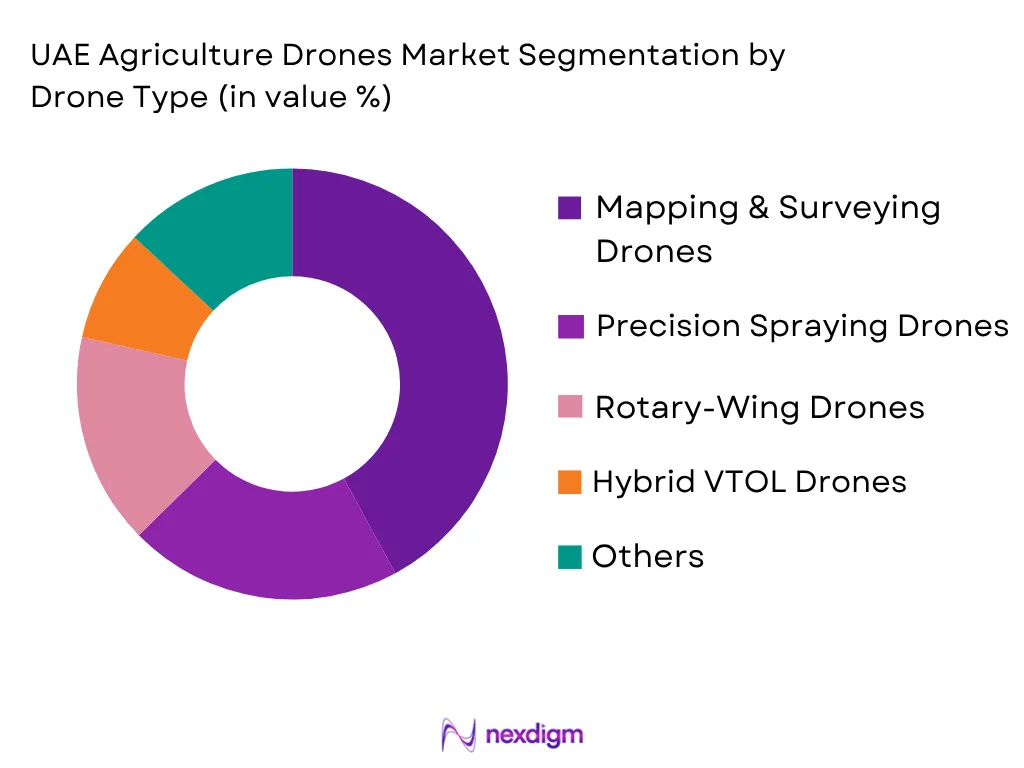
UAE Agriculture Drones Market is segmented by drone type into Fixed-Wing Drones, Rotary-Wing Drones, Hybrid VTOL Drones, Precision Spraying Drones, Mapping & Surveying Drones, and Autonomous Agricultural Drones. Recently, Mapping & Surveying Drones have held the dominant market share under this segmentation. Their dominance is primarily driven by the UAE’s strong focus on precision agriculture, resource optimization, and smart farming initiatives. Agricultural operators increasingly utilize mapping drones equipped with multispectral, thermal, and RGB imaging sensors to monitor crop health, assess irrigation performance, identify soil variability, and generate detailed field maps. These capabilities are particularly important in greenhouse farms, hydroponic facilities, date palm plantations, and controlled-environment agriculture projects where efficient resource management is critical. Mapping drones enable rapid collection of high-resolution data across large agricultural areas while minimizing labor requirements. Furthermore, government-supported smart agriculture programs and increasing adoption of digital farm management platforms have accelerated the use of aerial mapping technologies. Their ability to provide actionable insights for crop planning, water conservation, and productivity enhancement continues to position Mapping & Surveying Drones as the leading segment within the UAE Agriculture Drones Market.
By Application
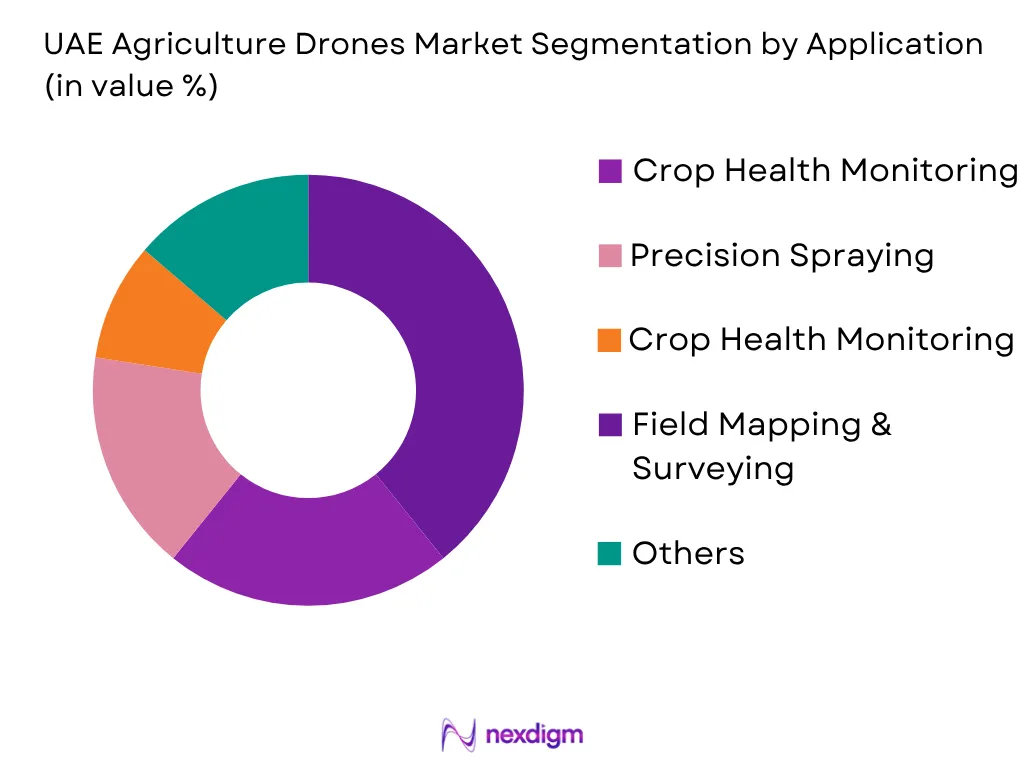
UAE Agriculture Drones Market is segmented by application into Crop Health Monitoring, Precision Spraying, Irrigation Monitoring, Field Mapping & Surveying, Greenhouse Monitoring, Soil Health Assessment, Yield Forecasting, Livestock Monitoring, and Disease Detection. Recently, Crop Health Monitoring has emerged as the dominant segment. The UAE’s challenging climatic conditions and limited arable land make crop productivity optimization a critical priority for agricultural operators. Drone-based crop monitoring solutions equipped with multispectral and thermal imaging technologies allow farmers to detect stress, nutrient deficiencies, and pest infestations at an early stage. This capability is particularly valuable in greenhouse operations, hydroponic farms, and date palm plantations where crop quality directly influences profitability. Increasing government support for smart farming and precision agriculture initiatives has further strengthened the adoption of crop monitoring applications. The ability to improve yields while reducing water consumption and chemical inputs continues to make crop health monitoring the leading application area within the UAE Agriculture Drones Market.
Competitive Landscape
The UAE Agriculture Drones Market is characterized by the presence of global drone manufacturers, precision agriculture technology providers, software developers, and regional agri-tech companies. Competition is increasingly driven by technological innovation, AI-powered analytics, autonomous flight systems, precision irrigation capabilities, and integration with smart farming ecosystems. Strategic collaborations with government agencies and agricultural technology programs continue shaping the competitive environment.
| Company | Establishment Year | Headquarters | Agriculture Drone Portfolio | Max Payload Capacity | Precision Spraying Capability | AI Analytics Integration | UAE Distribution Network | Precision Agriculture Solutions |
| DJI Agriculture | 2006 | ~ | ~ | ~ | ~ | ~ | ~ | ~ |
| XAG | 2007 | ~ | ~ | ~ | ~ | ~ | ~ | ~ |
| Sentera | 2014 | ~ | ~ | ~ | ~ | ~ | ~ | ~ |
| AgEagle Aerial Systems | 2010 | ~ | ~ | ~ | ~ | ~ | ~ | ~ |
| DroneDeploy | 2013 | ~ | ~ | ~ | ~ | ~ | ~ | ~ |
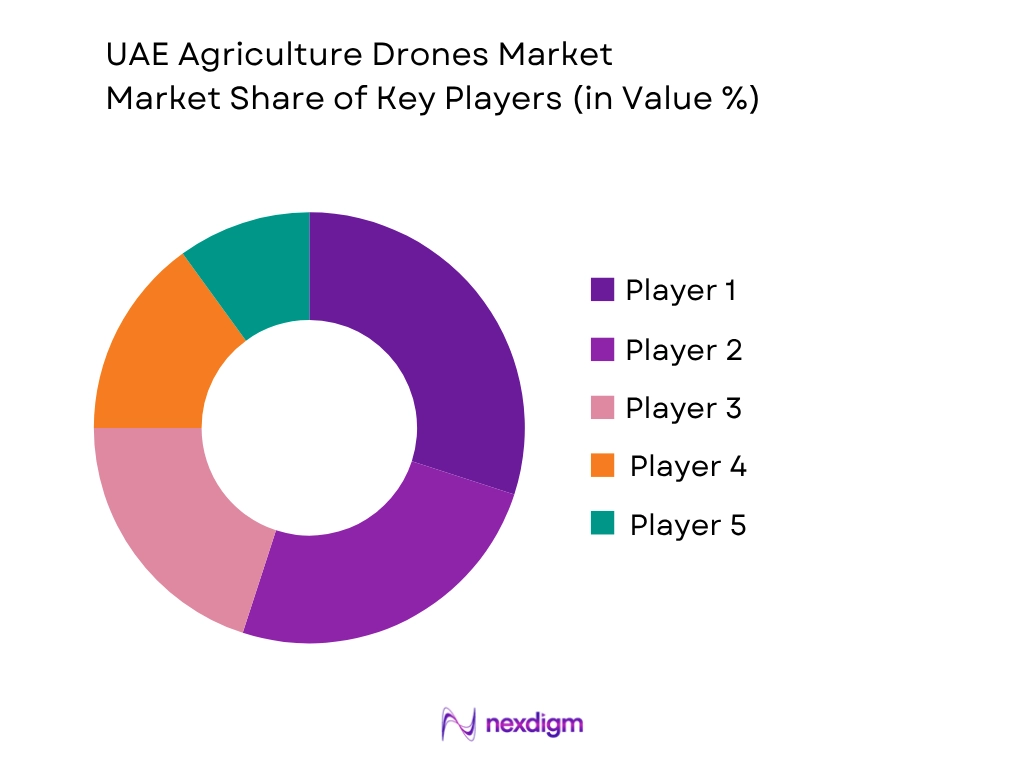
UAE Agriculture Drones Market Analysis
Growth Drivers
Government-Led Food Security and Smart Agriculture Initiatives
The UAE’s focus on strengthening domestic food production and reducing dependence on imported food products has become a major growth driver for the Agriculture Drones Market. According to the UAE Ministry of Climate Change and Environment, the country has more than 38,000 agricultural holdings, while food and agriculture remain central components of the National Food Security Strategy. The UAE’s population exceeded 11 million people, increasing pressure on domestic food production systems. Agriculture contributes to supporting food demand despite arable land representing less than 1 million hectares of total land resources. To improve agricultural productivity under challenging climatic conditions, government authorities continue supporting precision agriculture, controlled-environment farming, hydroponics, and digital agriculture solutions. Agriculture drones enable farmers to monitor crop health, assess irrigation efficiency, identify pest infestations, and optimize resource utilization across large cultivation areas. Drone-generated data is increasingly integrated with smart farming platforms and artificial intelligence-based decision support systems. The government’s broader investments in AgriTech, sustainable agriculture, and climate-resilient food systems continue encouraging the deployment of advanced drone technologies. These initiatives create a favorable environment for drone adoption, particularly among greenhouse operators, hydroponic farms, and commercial agricultural enterprises seeking to improve productivity and resource efficiency.
Increasing Demand for Water Efficiency and Precision Irrigation
Water scarcity remains one of the most significant challenges facing agriculture in the UAE, creating strong demand for drone-enabled precision irrigation solutions. According to the World Bank, renewable freshwater resources in the UAE remain among the lowest globally on a per-capita basis, while agriculture continues to account for a substantial share of water consumption. The UAE’s agricultural sector operates under extreme climatic conditions where summer temperatures frequently exceed 45°C, increasing irrigation requirements across farms and greenhouse facilities. Agriculture drones equipped with thermal imaging and multispectral sensors allow operators to identify water stress, irrigation leakages, and uneven moisture distribution with high precision. The UAE has also expanded investments in hydroponic and greenhouse agriculture to improve water-use efficiency while increasing food production. Precision agriculture technologies, including drones, support these objectives by providing real-time field intelligence that enables targeted irrigation management. As water conservation remains a national priority, agricultural operators increasingly deploy drones to optimize water utilization, reduce wastage, and improve crop performance. The combination of environmental constraints and sustainability goals continues to accelerate demand for drone-based irrigation monitoring systems throughout the UAE agricultural sector.
Market Challenges
Limited Agricultural Land and Scale Constraints
One of the major challenges affecting the UAE Agriculture Drones Market is the limited availability of arable land. According to the World Bank, agricultural land represents a relatively small portion of the country’s total geographic area, while desert landscapes dominate most of the territory. Although the UAE maintains more than 38,000 agricultural holdings, a significant proportion consists of small and medium-sized farms operating under fragmented cultivation structures. Compared to major agricultural economies with extensive field crop production, the UAE’s agricultural footprint remains concentrated in greenhouse farming, date palm cultivation, horticulture, and hydroponics. This limits the scale advantages often associated with large-scale drone deployments. Many agricultural operators may not generate sufficient utilization rates to justify direct ownership of advanced agricultural drone systems. As a result, adoption often depends on service-based models or government-supported technology programs. Furthermore, the concentration of agricultural activity within specific regions restricts market expansion opportunities compared to countries with larger cultivated land bases. While precision agriculture technologies offer significant efficiency benefits, the limited scale of agricultural operations remains a structural challenge that can influence the pace of drone adoption across certain farming segments.
Technical Expertise and Operational Skill Gaps
The successful deployment of agricultural drones requires expertise in flight operations, sensor calibration, data processing, geospatial analytics, and agronomic interpretation. However, the availability of specialized agricultural drone operators remains a challenge within the UAE market. The country’s agriculture sector has historically relied on conventional farming methods, and many producers are still transitioning toward digital agriculture platforms. Advanced drone systems generate large volumes of multispectral, thermal, and imaging data that must be converted into actionable insights. This often requires trained personnel capable of interpreting aerial intelligence and integrating findings into farm management practices. Additionally, operators must comply with aviation regulations and drone licensing requirements governed by UAE authorities. The increasing complexity of artificial intelligence-powered agriculture solutions further elevates the need for technical expertise. While the UAE has invested heavily in technology development and innovation ecosystems, workforce development remains essential for broader adoption of precision agriculture solutions. The shortage of skilled drone operators, precision agriculture specialists, and agricultural data analysts can create implementation challenges for farming enterprises seeking to maximize the value of drone-based technologies.
Market Opportunities
Expansion of Controlled-Environment Agriculture
The rapid growth of controlled-environment agriculture presents a significant opportunity for the UAE Agriculture Drones Market. The UAE continues expanding investments in greenhouse farming, hydroponics, vertical farming, and climate-controlled cultivation systems to improve food security and reduce dependency on imported produce. Controlled-environment agriculture enables year-round production while optimizing water consumption and reducing exposure to harsh climatic conditions. Agriculture drones are increasingly being deployed within these systems to monitor crop health, evaluate environmental conditions, assess irrigation performance, and detect early signs of disease or nutrient deficiencies. Unlike traditional open-field agriculture, greenhouse and hydroponic operations generate high-value crops that require continuous monitoring and precision management. Drone-based data collection helps operators improve productivity while minimizing resource consumption. The government’s support for agricultural innovation and sustainable food production continues encouraging investments in advanced farming technologies. As the number of greenhouse and hydroponic projects expands across Abu Dhabi, Dubai, and Al Ain, the demand for drone-enabled monitoring and precision agriculture solutions is expected to strengthen substantially.
Integration of Artificial Intelligence and Smart Farming Platforms
The UAE’s broader vision for digital transformation and artificial intelligence adoption creates strong opportunities for the Agriculture Drones Market. The country has positioned itself as a regional leader in smart technologies, investing heavily in AI, data analytics, IoT infrastructure, and digital innovation. Agriculture drones generate large volumes of operational data related to crop health, irrigation efficiency, environmental conditions, and resource utilization. When integrated with artificial intelligence platforms, this information can be transformed into predictive insights that support more effective farm management decisions. Smart farming ecosystems increasingly combine drones, sensors, automated irrigation systems, and cloud-based analytics platforms to create highly connected agricultural operations. The UAE’s emphasis on innovation-driven economic diversification and sustainable development supports continued adoption of these technologies. As agricultural operators seek greater productivity, resource efficiency, and climate resilience, AI-powered drone solutions are becoming increasingly attractive. The convergence of drones, artificial intelligence, and precision agriculture technologies represents one of the most promising growth opportunities for the UAE Agriculture Drones Market.
Future Outlook
The UAE Agriculture Drones Market is expected to experience robust growth over the next decade due to increasing investment in smart farming technologies and national food security initiatives. The adoption of precision agriculture solutions is anticipated to expand across greenhouse farming, hydroponics, vertical farming, and open-field agriculture. Advancements in artificial intelligence, autonomous navigation systems, multispectral imaging, and precision irrigation technologies are expected to improve operational efficiency and farm productivity. Government-backed agricultural modernization programs and sustainability initiatives will likely continue supporting long-term market expansion.
Major Players
- DJI Agriculture
- XAG
- AgEagle Aerial Systems
- Sentera
- PrecisionHawk
- DroneDeploy
- Trimble Agriculture
- Delair
- Quantum Systems
- Parrot
- Yamaha Motor
- Hylio
- Guardian Agriculture
- AeroVironment
- ABZ Innovation
Key Target Audience
- Agriculture Drone Manufacturers
- Precision Agriculture Technology Providers
- Greenhouse Farm Operators
- Hydroponic Farming Companies
- Agri-Tech Solution Providers
- Agricultural Cooperatives
- Investments and Venture Capitalist Firms
- Government and Regulatory Bodies (Ministry of Climate Change and Environment, Abu Dhabi Agriculture and Food Safety Authority, UAE General Civil Aviation Authority)
Research Methodology
Step 1: Identification of Key Variables
The initial phase involves constructing an ecosystem map encompassing all major stakeholders within the UAE Agriculture Drones Market. This step is supported by extensive secondary research using government publications, aviation regulations, agricultural databases, company disclosures, and agri-tech industry resources. The objective is to identify the key variables influencing technology adoption, investment activity, regulatory developments, and competitive dynamics.
Step 2: Market Analysis and Construction
In this phase, historical information related to agricultural drone deployments, smart farming initiatives, greenhouse agriculture, hydroponics, and precision agriculture adoption is compiled and analyzed. Demand-side and supply-side assessments are conducted to estimate market performance across key segments, regions, and applications. Operational metrics and adoption patterns are also evaluated.
Step 3: Hypothesis Validation and Expert Consultation
Market hypotheses are developed and validated through computer-assisted telephone interviews (CATIs) and consultations with drone manufacturers, agricultural technology providers, farm operators, agronomists, distributors, and regulatory stakeholders. These interactions provide valuable operational insights and support validation of market assumptions and segmentation analysis.
Step 4: Research Synthesis and Final Output
The final phase involves synthesizing findings obtained from both primary and secondary research. Data triangulation methodologies are applied to validate market sizing, competitive positioning, segmentation structures, and forecast assumptions. This process ensures a comprehensive and reliable assessment of the UAE Agriculture Drones Market.

- Executive Summary
- Research Methodology (Market Definitions and Assumptions, Abbreviations, Market Sizing Approach, Top-Down Analysis, Bottom-Up Analysis, Demand-Side Assessment, Supply-Side Assessment, Precision Agriculture Adoption Assessment, Smart Farming Ecosystem Analysis, Primary Industry Interviews, Data Triangulation, Forecasting Framework, Limitations and Future Conclusions)

- Definition and Scope
- Market Evolution and Industry Genesis
- Timeline of Major Industry Developments
- Precision Agriculture Value Chain Analysis
- Agriculture Drone Supply Chain Analysis

- Growth Drivers (Food Security Initiatives, Smart Farming Adoption, Water Conservation Requirements, Government Agri-Tech Investments, Precision Irrigation Demand)
- Market Challenges (Limited Arable Land Availability, High Technology Adoption Costs, Regulatory Compliance Requirements, Harsh Climatic Conditions, Technical Skill Gaps)
- Market Opportunities (Expansion of Controlled Environment Agriculture, AI-Powered Farm Analytics, Drone-as-a-Service Growth, Desert Agriculture Innovation, Smart Irrigation Integration)
- Market Trends (Autonomous Flight Systems, Precision Irrigation Monitoring, Greenhouse Drone Deployment, AI-Based Crop Intelligence, Digital Farm Management Integration)
- Government Regulations (UAE General Civil Aviation Authority Drone Regulations, Ministry of Climate Change and Environment Policies, Agricultural Drone Licensing Requirements, Data Privacy Compliance, Environmental Sustainability Standards)
- SWOT Analysis
- Porter’s Five Forces Analysis
- PESTLE Analysis
- Competitive Ecosystem

- By Market Value (2020-2025)
- By Volume (2020-2025)
- By Average Selling Price (2020-2025)


- Market Share of Major Players (By Value, Drone Units, Installed Base, Agricultural Coverage, Application Segment)
- Cross Comparison Parameters (Agriculture Drone Portfolio Breadth, Precision Spraying Capability, Water Management Analytics Capability, Sensor & Imaging Technology Strength, AI & Farm Analytics Integration, Greenhouse Farming Compatibility, Drone-as-a-Service Capability, Regional Service & Support Network Reach)
- SWOT Analysis of Major Players
- Pricing Analysis by Payload Category, Flight Endurance and Sensor Configuration
- Detailed Profiles of Major Companies
DJI Agriculture
XAG
AgEagle Aerial Systems
Sentera
PrecisionHawk
DroneDeploy
Trimble Agriculture
Delair
Quantum Systems
Parrot
Yamaha Motor
Hylio
Guardian Agriculture
AeroVironment
ABZ Innovation

- Market Demand and Utilization Analysis
- Smart Farming Adoption Assessment
- Purchasing Power and Budget Allocation Analysis
- Regulatory Compliance Assessment
- Needs, Desires and Pain Point Analysis

- By Market Value (2026-2035)
- By Volume (2026-2035)
- By Average Selling Price (2026-2035)


 Request a Sample
 Ask for Customization
 Get a Quote
 Enquire Now