

 Download PDF
 Download PDF
Market Overview
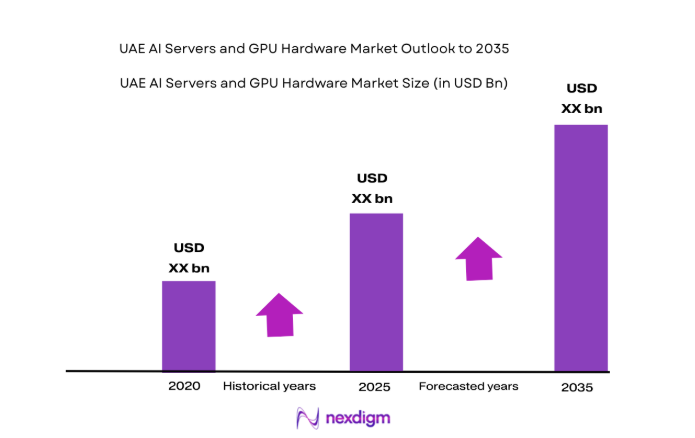
The UAE AI servers and GPU hardware market reached approximately USD ~ billion based on a recent historical assessment, driven by sovereign AI infrastructure programs, hyperscale cloud expansion, and enterprise AI adoption across energy, finance, and public sector domains. Large scale procurement of GPU clusters and accelerated servers for generative AI training, digital twins, and national compute platforms has increased system value density, while regional data center investments and localization mandates are accelerating high performance AI hardware deployment across the country.
Abu Dhabi and Dubai dominate the UAE AI servers and GPU hardware market due to concentration of hyperscale data centers, sovereign cloud infrastructure, and government backed AI programs, including national supercomputing and smart city initiatives. Abu Dhabi leads through state funded AI research clusters and energy sector digitalization, while Dubai drives demand through global cloud regions and enterprise AI deployments. The UAE also functions as a regional AI compute hub serving Middle East and Africa digital services and cloud workloads.
By Product Type
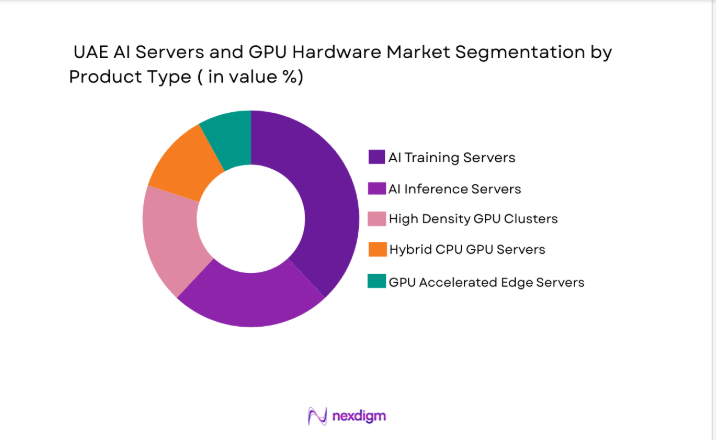
UAE AI Servers and GPU Hardware market is segmented by product type into AI training servers, AI inference servers, GPU accelerated edge servers, high density GPU clusters, and hybrid CPU GPU servers. Recently, AI training servers has a dominant market share due to factors such as demand patterns, brand presence, infrastructure availability, or consumer preference.
By Platform Type
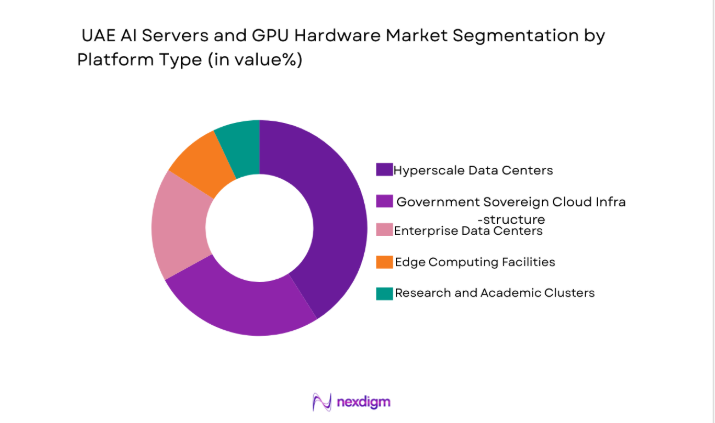
UAE AI Servers and GPU Hardware market is segmented by product type into hyperscale data centers, enterprise data centers, edge computing facilities, research and academic clusters, and government sovereign cloud infrastructure. Recently, hyperscale data centers has a dominant market share due to factors such as demand patterns, brand presence, infrastructure availability, or consumer preference.
Competitive Landscape
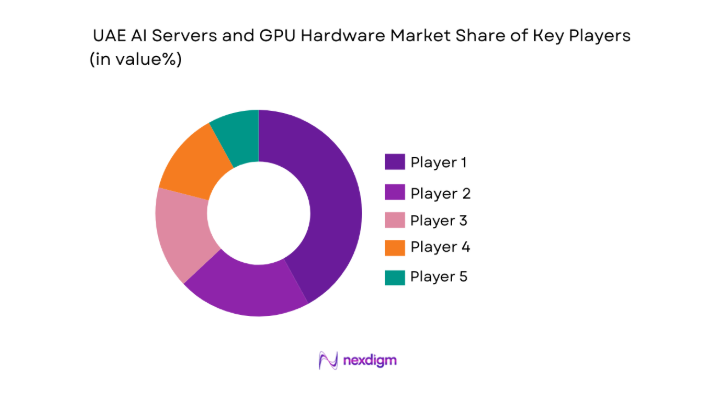
The UAE AI servers and GPU hardware market is moderately consolidated, with global accelerator and server OEM vendors dominating supply while regional system integrators and sovereign cloud operators shape procurement channels. Leading firms control advanced GPU technology, liquid cooling platforms, and AI optimized architectures, creating high entry barriers. Strategic partnerships with government AI initiatives and hyperscale cloud deployments strongly influence competitive positioning and market expansion across national and regional AI infrastructure programs.
|
Company Name |
Establishment Year | Headquarters | Technology Focus | Market Reach | Key Products | Revenue | AI Accelerator Platform |
| NVIDIA | 1993 | USA | ~ | ~ | ~ | ~ | ~ |
| Advanced Micro Devices | 1969 | USA | ~ | ~ | ~ | ~ | ~ |
| Intel | 1968 | USA | ~ | ~ | ~ | ~ | |
| Dell Technologies | 1984 | USA | ~ | ~ | ~ | ~ | ~ |
| Hewlett Packard Enterprise | 2015 | USA | ~ | ~ | ~ | ~ | ~ |
UAE AI servers and GPU hardware market Analysis
Growth Drivers
National Sovereign AI Infrastructure Investments and Hyperscale Compute Expansion
The UAE government has positioned advanced computing infrastructure as a strategic national capability, allocating multi billion dollar funding toward sovereign AI clouds, national supercomputers, and large scale GPU clusters supporting generative AI, digital twins, climate modeling, and energy optimization initiatives. This state backed demand has catalyzed procurement of high density GPU servers and liquid cooled AI clusters at unprecedented scale relative to regional markets, significantly increasing total system value and accelerating hardware refresh cycles across public and quasi public entities. Concurrently, global hyperscale cloud providers have established regional cloud and AI regions in Abu Dhabi and Dubai to serve Middle East and Africa workloads with low latency and regulatory compliance, driving continuous deployment of AI optimized servers and accelerators. The concentration of hyperscale compute zones, submarine cable connectivity, and energy availability has reinforced the UAE’s role as a regional AI hosting hub, attracting enterprise AI workloads from finance, logistics, and digital services sectors across neighboring economies. Enterprise adoption of generative AI, large language models, and advanced analytics across oil and gas, utilities, aviation, and financial services has further expanded demand for on premises and sovereign AI infrastructure, particularly where data residency and latency requirements prevent reliance on offshore cloud capacity. The convergence of public investment, hyperscale infrastructure, and enterprise AI adoption has created a self reinforcing cycle of hardware demand, ecosystem growth, and technology localization, sustaining strong expansion of AI server and GPU hardware deployment across the UAE.
Enterprise AI Adoption Across Energy, Smart City, and Digital Economy Sectors
The UAE economy is characterized by high digitalization intensity across energy, transport, urban infrastructure, and financial systems, creating large scale enterprise demand for AI computing platforms capable of processing sensor data, simulation models, and predictive analytics workloads. Energy and industrial enterprises are deploying AI servers and GPU clusters for reservoir modeling, predictive maintenance, autonomous operations, and carbon optimization, requiring high performance parallel compute infrastructure within secure national environments. Smart city initiatives across Abu Dhabi and Dubai are generating massive urban data streams from IoT networks, digital twins, surveillance analytics, and mobility systems, driving procurement of GPU accelerated data platforms to support real time AI inference and planning models. Financial institutions and digital economy firms are adopting generative AI, fraud detection, algorithmic trading, and customer analytics platforms, requiring scalable GPU infrastructure integrated with national cloud and data sovereignty frameworks. Government agencies are deploying AI supercomputing platforms for national security analytics, healthcare modeling, climate forecasting, and language AI development aligned with Arabic and regional datasets, further expanding demand for advanced AI hardware. The breadth of sectoral adoption across critical industries ensures diversified and sustained consumption of AI servers and accelerators beyond hyperscale cloud providers, reinforcing long term structural growth of the UAE AI compute hardware ecosystem.
Market Challenges
Extreme Capital Intensity and Rapid Obsolescence Cycles in AI Hardware Infrastructure
AI servers and GPU hardware represent one of the most capital-intensive segments of digital infrastructure due to the high cost of advanced accelerators, high bandwidth memory, liquid cooling systems, and specialized interconnect architectures required for large scale AI training clusters. Organizations deploying AI infrastructure face substantial upfront expenditure per rack and rapid technology refresh requirements as new GPU generations deliver significant performance gains, shortening economic life cycles and increasing depreciation risk. Government and enterprise buyers must continuously reinvest to maintain competitive AI capability, creating budget pressure and procurement complexity, particularly for sovereign and on premises deployments where hardware ownership remains local. The pace of innovation in AI accelerators, including new architectures, chiplet designs, and memory technologies, creates risk of technological lock in and stranded assets for early adopters deploying large clusters. Supply constraints in advanced semiconductor manufacturing and packaging further elevate cost volatility and procurement lead times, complicating infrastructure planning for UAE entities scaling AI compute capacity. The combination of high capital intensity, rapid obsolescence, and supply concentration presents a structural barrier to widespread deployment beyond large state and hyperscale organizations, limiting participation by mid sized enterprises and regional institutions in advanced AI computing.
Power Density, Cooling Constraints, and Data Center Infrastructure Limitations
AI GPU clusters generate extremely high power density per rack compared to traditional servers, requiring advanced cooling technologies such as direct liquid cooling and immersion systems that are not yet widely deployed across legacy data centers in the UAE. Retrofitting existing facilities to support AI hardware involves significant upgrades to power distribution, thermal management, and floor loading capacity, increasing total cost of ownership and slowing infrastructure scaling timelines. Regional climate conditions characterized by high ambient temperatures further intensify cooling demand and energy consumption for AI compute facilities, challenging sustainability targets and operational efficiency objectives. Data center operators must secure stable high capacity power supply and water resources to support liquid cooling, creating infrastructure planning complexity in urban environments. Grid capacity and energy pricing considerations influence the location and expansion of hyperscale and sovereign AI facilities, potentially constraining rapid deployment in certain regions. These infrastructure and environmental constraints create technical and economic barriers to large scale AI server deployment across the UAE, requiring coordinated investment across power, cooling, and data center ecosystems to sustain market growth.
Opportunities
Sovereign AI Cloud Platforms and National Supercomputing Ecosystems
The global shift toward data sovereignty and trusted AI environments has created strong opportunity for the UAE to develop sovereign AI cloud platforms and national supercomputing infrastructure serving government, defense, healthcare, and regulated industries across the Middle East and Africa. By investing in domestically hosted GPU clusters, AI clouds, and national compute utilities, the UAE can position itself as a regional provider of secure AI services compliant with local data residency requirements and geopolitical considerations. Such platforms require large scale procurement of AI servers, accelerators, and advanced interconnect infrastructure, creating sustained hardware demand beyond domestic consumption. Sovereign AI clouds also enable development of regional language models, climate analytics, and sector specific AI solutions tailored to regional datasets, further expanding compute requirements. The UAE’s strategic geographic connectivity, stable regulatory environment, and capital availability provide favorable conditions for establishing trusted AI hosting hubs attracting regional workloads. Expansion of sovereign AI infrastructure thus represents a major structural growth opportunity for AI server and GPU hardware deployment across national and cross border digital ecosystems.
AI Infrastructure for Energy Transition, Industrial Automation, and Digital Twin Applications
The UAE’s economic strategy emphasizes energy transition, advanced manufacturing, and digital infrastructure modernization, all of which require high performance AI computing platforms capable of supporting simulation, optimization, and real time analytics. Energy transition initiatives such as carbon capture modeling, renewable integration, and grid optimization depend on large scale AI training and simulation workloads requiring GPU clusters and accelerated HPC systems. Industrial automation and autonomous operations across ports, logistics hubs, and manufacturing facilities require edge and centralized AI servers processing sensor and operational data at scale. Digital twin models of cities, infrastructure, and industrial assets demand continuous AI simulation and visualization compute resources, expanding demand for both training and inference hardware. These applications extend AI infrastructure deployment beyond cloud and IT sectors into core physical economy domains, broadening the addressable market for AI servers and accelerators in the UAE. Integration of AI computing into national infrastructure and industrial transformation programs creates long term demand pipelines for advanced hardware platforms supporting the country’s digital and sustainability ambitions.
Future Outlook
The UAE AI servers and GPU hardware market is expected to expand rapidly over the next five years as sovereign AI infrastructure programs, hyperscale cloud regions, and enterprise AI adoption accelerate simultaneously. Advances in GPU architectures, liquid cooling, and modular AI server design will enable higher density deployments across national data center ecosystems. Strong regulatory support for data sovereignty and national AI capability will sustain government investment, while energy, smart city, and digital economy sectors will drive diversified enterprise demand for advanced AI computing platforms.
Major Players
- NVIDIA
- Advanced Micro Devices
- Intel
- Dell Technologies
- Hewlett Packard Enterprise
- Lenovo
- Supermicro
- ASUS
- Gigabyte Technology
- Inspur
- Cisco Systems
- Atos
- Huawei
- NEC
- Fujitsu
Key Target Audience
- Hyperscale cloud providers
- Sovereign wealth funds
- Government and regulatory bodies
- Investments and venture capitalist firms
- Data center developers
- AI platform providers
- Energy and industrial enterprises
- Financial services firms
Research Methodology
Step 1: Identification of Key Variables
Key variables include AI server deployments, GPU shipments, data center capacity expansion, hyperscale and sovereign cloud investments, and enterprise AI adoption across energy, finance, and public sector domains. Regional infrastructure programs and procurement pipelines are mapped to quantify demand drivers and market scale.
Step 2: Market Analysis and Construction
Supply side analysis evaluates global AI server OEM shipments, GPU accelerator availability, and regional deployment patterns across UAE data center corridors. Demand side modeling integrates hyperscale, government, and enterprise procurement to construct market size and segmentation estimates.
Step 3: Hypothesis Validation and Expert Consultation
Market assumptions are validated through consultations with data center operators, AI infrastructure integrators, and regional technology procurement specialists. Technology adoption trends, pricing benchmarks, and deployment timelines are cross verified with industry experts and infrastructure planners.
Step 4: Research Synthesis and Final Output
Validated data streams and analytical models are synthesized into market size estimates, segmentation shares, competitive analysis, and outlook projections. Findings are structured into a comprehensive market report aligned with UAE AI infrastructure development trends and technology evolution pathways.

- Executive Summary
- Research Methodology (Definitions, Scope, Industry Assumptions, Market Sizing Approach, Primary & Secondary Research Framework, Data Collection & Verification Protocol, Analytic Models & Forecast Methodology, Limitations & Research Validity Checks)

- Market Definition and Scope
- Value Chain & Stakeholder Ecosystem
- Regulatory / Certification Landscape
- Sector Dynamics Affecting Demand
- Strategic Initiatives & Infrastructure Growth

- Growth Drivers
National AI and digital economy strategies driving sovereign compute investment
Hyperscale and cloud region expansion across UAE data center corridors
Rising enterprise adoption of generative AI and analytics workloads
Government backed smart city and digital twin initiatives
Strategic localization of critical compute infrastructure - Market Challenges
High capital cost of advanced GPU and AI server infrastructure
Power density and cooling constraints in regional data centers
Supply chain concentration in advanced semiconductor components
Rapid technology obsolescence cycles in AI hardware
Talent and integration capability gaps in specialized AI infrastructure - Market Opportunities
Localized sovereign AI cloud platforms and national compute clusters
AI infrastructure for energy transition and industrial automation
Regional AI hosting hubs serving Middle East and Africa markets - Trends
Shift toward liquid cooled high density GPU server architectures
Deployment of AI supercomputing clusters in government programs
Integration of AI accelerators in edge and telecom infrastructure
Adoption of composable and modular AI server platforms
Growing preference for sovereign and trusted AI compute environments - Government Regulations & Defense Policy
National AI strategy and sovereign compute mandates
Data residency and digital sovereignty regulations
Government funding for advanced computing infrastructure - SWOT Analysis
- Stakeholder and Ecosystem Analysis
- Porter’s Five Forces Analysis
- Competition Intensity and Ecosystem Mapping

- By Market Value, 2020-2025
- By Installed Units, 2020-2025
- By Average System Price, 2020-2025
- By System Complexity Tier, 2020-2025

- By System Type (In Value%)
AI Training Servers
AI Inference Servers
GPU Accelerated Edge Servers
High Density GPU Clusters
Hybrid CPU GPU Servers - By Platform Type (In Value%)
Hyperscale Data Centers
Enterprise Data Centers
Edge Computing Facilities
Research and Academic Clusters
Government Sovereign Cloud Infrastructure - By Fitment Type (In Value%)
Rack Scale Integrated Systems
Blade GPU Servers
Modular GPU Expansion Units
Preconfigured AI Appliances
Custom Built AI Clusters - By End User Segment (In Value%)
Cloud Service Providers
Government and Smart City Programs
Energy and Industrial Enterprises
Financial and Digital Economy Firms
Research Institutions and Universities - By Procurement Channel (In Value%)
Direct OEM Procurement
System Integrator Contracts
Government Technology Tenders
Cloud and Infrastructure Partnerships
Specialized AI Hardware Distributors - By Material / Technology (in Value %)
Advanced GPU Accelerators
High Bandwidth Memory Systems
Liquid Cooling Infrastructure
AI Optimized Interconnect Fabrics
ARM and Heterogeneous Processing Architectures

- Market structure and competitive positioning
Market share snapshot of major players - Cross Comparison Parameters (GPU Density, Cooling Technology, Interconnect Bandwidth, System Scalability, Power Efficiency, AI Framework Optimization, Deployment Model, Price per TFLOP)
- SWOT Analysis of Key Competitors
- Pricing & Procurement Analysis
- Key Players
NVIDIA
Advanced Micro Devices
Intel
Supermicro
Dell Technologies
Hewlett Packard Enterprise
Lenovo
ASUS
Gigabyte Technology
Inspur
Cisco Systems
Atos
Huawei
NEC
Fujitsu

- Cloud providers expanding AI regions to serve regional digital services demand
- Government entities deploying national AI compute infrastructure
- Energy and industrial firms adopting AI for optimization and automation
- Research institutions scaling high performance AI computing capacity

- Forecast Market Value, 2026-2035
- Forecast Installed Units, 2026-2035
- Price Forecast by System Tier, 2026-2035
- Future Demand by Platform, 2026-2035


 Request a Sample
 Ask for Customization
 Get a Quote
 Enquire Now