Global Partner. Integrated Solutions.

    More results...

    Generic selectors
    Exact matches only
    Search in title
    Search in content
    Post Type Selectors

UAE Air Taxi Market Outlook to 2035

The UAE air taxi market is becoming increasingly competitive, with several major players driving innovation and deployment. The competitive landscape is characterized by global players like Volocopter, Joby Aviation, and Lilium, which are actively involved in shaping the market in partnership with local authorities and stakeholders.

pexels-valera-evane-79377410-11384934-1-scaled

Market Overview 

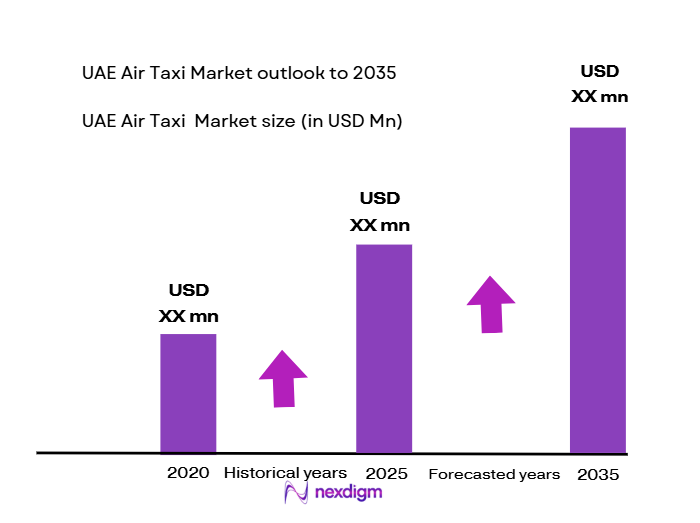
The UAE air taxi market is expected to see significant growth due to advancements in urban air mobility (UAM) technology, particularly electric vertical takeoff and landing (eVTOL) aircraft. The market is currently valued at USD~ million, driven by major investments in aircraft development, infrastructure, and the regulatory framework aimed at integrating air taxis into the country’s transport ecosystem. As the UAE government seeks to become a global leader in the emerging urban air mobility sector, substantial infrastructure development, including vertiports and air traffic management systems, is supporting the market’s expansion. The market growth is primarily driven by the demand for faster, more efficient transportation solutions amidst rising urbanization and traffic congestion in key cities like Dubai and Abu Dhabi. 

Dubai and Abu Dhabi are the dominant players in the UAE air taxi market due to their extensive infrastructure investments and government-backed initiatives. Dubai, with its ambitious plan to become a global hub for urban air mobility, is actively deploying pilot projects and forging partnerships with leading air taxi manufacturers like Volocopter and Joby Aviation. The city is integrating air taxis into its transport network, facilitated by the development of smart cities and vertical urban development. Abu Dhabi, through the government-backed company Skyports, is also a key player, supporting air taxi development with a focus on transportation solutions for business and tourism, complementing its growing status as a major economic center. Both cities benefit from their high-level infrastructure, governmental support, and a growing demand for premium transportation services.
UAE-air-taxi-market-size

Market Segmentation 

By Vehicle Type 

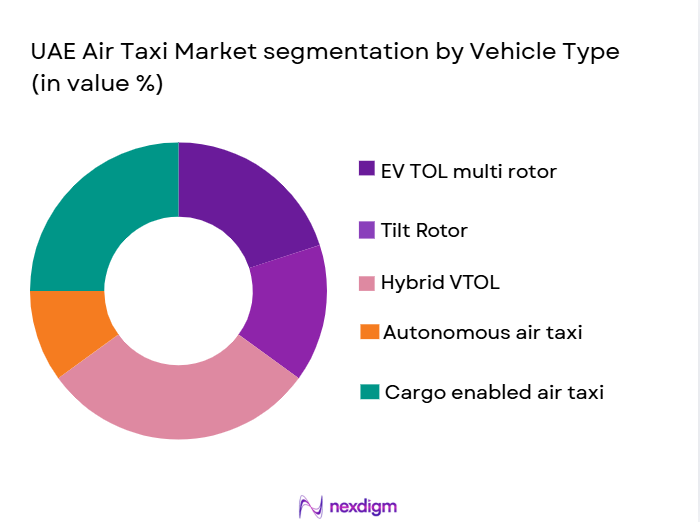
The UAE air taxi market is segmented by vehicle type, with several distinct categories driving the market. These include eVTOL multi-rotor vehicles, tilt-rotor aircraft, hybrid-VTOL, autonomous air taxis, and cargo-enabled air taxis. Among these, eVTOL multi-rotor vehicles dominate the market, primarily due to their scalability and efficient use of airspace in congested urban environments. These vehicles are capable of vertical takeoff and landing, making them ideal for densely populated cities. Major manufacturers like Volocopter and Joby Aviation have focused their efforts on developing multi-rotor eVTOLs, which have the advantage of being simpler to operate compared to tilt-rotor aircraft or hybrids. These vehicles are also favored for their relatively lower operational costs and high passenger capacity, providing an excellent balance between cost-efficiency and market demand for air mobility services in urban settings.
 UAE-Air-Taxi-Market-segmentation-by-Vehicle-Type

By Powertrain 

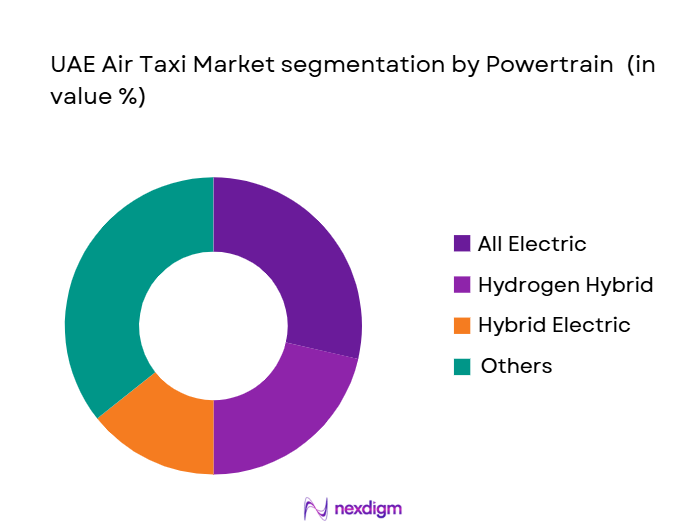
In terms of powertrain, the air taxi market is segmented into all-electric, hydrogen hybrid, and hybrid electric vehicles. Among these, all-electric vehicles are expected to have the largest market share due to their sustainability and reduced operational costs. These vehicles are powered entirely by electric motors, with zero emissions, aligning with the UAE’s vision to reduce carbon footprints and advance sustainability in transport. All-electric eVTOLs are gaining prominence due to advancements in battery technology, reducing charging times and increasing flight ranges. Furthermore, the growing support from the UAE government for green technologies and incentives for companies developing electric vehicles are crucial factors that drive this market segment. All-electric air taxis are particularly suited for urban air mobility due to their environmental benefits and the cost-effectiveness of operating in a region with abundant solar power availability.
UAE-Air-Taxi-Market-segmentation-by-Powertrain

Competitive Landscape 

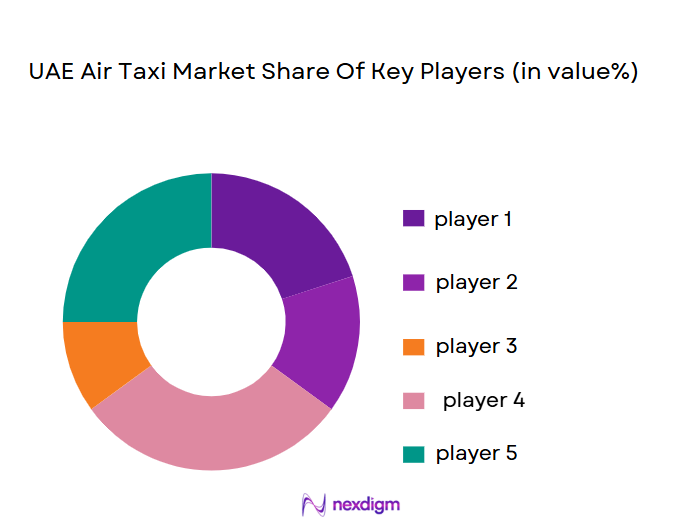
The UAE air taxi market is becoming increasingly competitive, with several major players driving innovation and deployment. The competitive landscape is characterized by global players like Volocopter, Joby Aviation, and Lilium, which are actively involved in shaping the market in partnership with local authorities and stakeholders. Dubai, being a major hub for technological innovation and a pioneer in the urban air mobility space, provides a fertile ground for these companies. The market is dominated by a few leading players who have already established significant investments in infrastructure, including vertiports and air traffic management systems. The competition is intensifying as manufacturers compete to secure contracts and pilots with government and private operators. 

Company  Year Established  Headquarters  Product Focus  Key Partnerships  Fleet Size (2024)  Market Focus 
Volocopter  2011  Germany  ~  ~  ~  ~ 
Joby Aviation  2009  United States  ~  ~  ~  ~ 
Lilium  2015  Germany  ~  ~  ~  ~ 
Skyports  2018  United Kingdom  ~  ~  ~  ~ 
Urban Aeronautics  2006  United States  ~  ~  ~  ~ 

UAE-Air-Taxi-Market-Share-Of-Key-Players


UAE Air Taxi Market Analysis 

Growth Drivers 

Urbanisation & Traffic Congestion Indices 

Urbanization in the UAE continues to rise significantly, particularly in major cities like Dubai and Abu Dhabi. The UAE’s population is expected to grow by over ~% annually, reaching approximately ~ million by 2026, increasing the demand for more efficient transport solutions. Traffic congestion, especially in cities like Dubai, is a major concern. In Dubai, commuters spend an average of ~ hours per year in traffic jams, according to the World Bank. This congestion is driving the need for alternative transport solutions, such as air taxis, which promise to reduce travel time and alleviate pressure on ground transportation systems. 

Smart City Integration 

The UAE government has heavily invested in building smart cities, particularly in Dubai, which is considered a leader in the region. Dubai has launched various projects that integrate technology into public infrastructure, including intelligent traffic management systems and smart mobility solutions, which align with the development of urban air mobility. By 2024, Dubai will have completed over ~ smart city initiatives, supporting the integration of air taxis into a broader urban mobility ecosystem. These developments include automated vehicle infrastructure, smart traffic lights, and sensor-based solutions, which help in real-time data collection for efficient management of air and ground transport.  

Market Challenges 

High Capital Intensity 

The air taxi market in the UAE faces high capital investment requirements due to the need for advanced technologies, infrastructure, and regulatory compliance. The development of eVTOL aircraft involves complex engineering and significant R&D costs, with manufacturers spending over USD ~ million per project on vehicle development. Additionally, establishing vertiports, air traffic management systems, and integrating them with existing infrastructure requires billions of dollars in investments. According to the UAE Ministry of Economy, the country’s total capital investment in sustainable mobility infrastructure is projected to be around USD ~ billion by 2025, putting a strain on both public and private finances.  

Airspace Regulatory Complexity 

Navigating the complex airspace regulatory environment is one of the key challenges for the air taxi market in the UAE. The integration of air taxis into the country’s existing air traffic management system requires significant adjustments. In 2024, the UAE is in the process of expanding its national airspace by introducing new air corridors specifically for eVTOL operations. This process involves multi-agency coordination, including the GCAA, RTA, and Dubai Airports, which poses regulatory challenges that could slow the rollout of air taxi services. The need for international regulatory alignment also adds a layer of complexity as global airspace policies are still evolving.  

Opportunities 

Vertiport Infrastructure Expansion 

Vertiport infrastructure development is a significant opportunity for the UAE air taxi market. With several new vertiports planned across Dubai, Abu Dhabi, and Sharjah, the region is poised to become a leader in vertical urban mobility. In 2024, Dubai is preparing to build over ~ vertiports by 2026, aimed at creating an integrated air taxi network. The expansion of vertiport infrastructure will not only support air taxi services but also create jobs and stimulate economic activity in the region. These developments will provide a strong foundation for scaling up air taxi operations across the UAE.  

Integrated Mobility Services 

The integration of air taxis with other forms of transportation, such as metro, buses, and ride-sharing services, presents a huge opportunity for growth. In 2024, Dubai’s RTA is working on integrating air taxis into its public transportation system, offering a seamless travel experience for commuters. The introduction of smart city transport solutions, including multimodal transit options, will boost the use of air taxis as a reliable form of transport for the public. This opportunity is further enhanced by government incentives and ongoing technological advancements in mobility services.

Future Outlook 

Over the next decade, the UAE air taxi market is expected to experience rapid growth driven by the increasing adoption of eVTOL technologies, ongoing government initiatives, and rising consumer demand for efficient and eco-friendly transportation options. The UAE’s ambition to integrate air taxis into its public transport system by 2030 aligns with global trends in urban air mobility. With continued advancements in battery technology, aircraft design, and regulatory support, the market is poised to expand significantly. Key cities like Dubai and Abu Dhabi will continue to be central hubs for this transformative transportation sector, fostering a competitive yet collaborative environment for technological advancements.

Major Players in the UAE Air Taxi Market 

  • Volocopter 
  • Joby Aviation 
  • Lilium 
  • Skyports 
  • Urban Aeronautics 
  • Vertical Aerospace 
  • EHang Holdings 
  • Boeing NeXt 
  • Embraer – Eve Air Mobility 
  • Textron Aviation 
  • HybriFlyer 
  • Terrafugia (Geely) 
  • Vertical Flight Innovations 
  • Transcend Air 
  • AeroMobil

Key Target Audience 

  • Investments and Venture Capitalist Firms 
  • Government and Regulatory Bodies (UAE Civil Aviation Authority, Dubai Roads & Transport Authority, Abu Dhabi Airports) 
  • Private Operators 
  • Airport Authorities (Dubai International Airport, Abu Dhabi International Airport) 
  • Tourism and Hospitality Providers 
  • Logistics and Delivery Companies 
  • Air Mobility Technology Providers 
  • Fleet Management Companies

Research Methodology 

Step 1: Identification of Key Variables 

The initial phase involves constructing an ecosystem map encompassing all major stakeholders within the UAE air taxi market. This step includes extensive desk research utilizing secondary databases to gather industry-level insights. The primary goal is to identify the key market variables driving growth and competition, including government regulations, technological advancements, and investment patterns. 

Step 2: Market Analysis and Construction 

We will analyze historical data concerning the UAE air taxi market. This includes assessing market penetration rates, adoption curves for different vehicle types, and the associated infrastructure development. The market size estimates will be based on an analysis of service adoption trends and projected infrastructure spending by both the private and public sectors. 

Step 3: Hypothesis Validation and Expert Consultation 

Hypotheses regarding the market’s future trajectory will be validated through expert interviews. These interviews will involve senior executives from major air taxi operators, government regulators, and technology providers to provide real-world operational insights and refine assumptions regarding growth drivers and barriers.

Step 4: Research Synthesis and Final Output 

The final phase involves synthesizing all collected data, validating the insights through direct consultation with manufacturers, and finalizing the report based on a bottom-up approach. This will ensure comprehensive and accurate market projections for the UAE air taxi sector, with key data points on market share, adoption rates, and future growth opportunities. 

  • Executive Summary 
  • Research Methodology (Market Definitions and Assumptions (Air Taxi vs UAM vs eVTOL), Abbreviations, Data Sources, Primary/Secondary Research Framework, Forecasting Approach (Bottom‑Up & Top‑Down), Sample Size & Interview Demographics, Limitations.) 
  • Definition and Scope
  • Air Taxi Service Models
  • eVTOL Platforms
  • Operational Models
  • Service Geography
  • Growth Drivers
    Urbanisation & Traffic Congestion Indices
    Smart City Integration
    Technology Cost Curves
    Regulatory Incentives. 
  • Market Challenges
    High Capital Intensity
    Airspace Regulatory Complexity
    Vertiport Permitting
    Safety & Public Perception 
  • Trends
    Autonomous Operations
    Digital Booking Platforms
    Air Traffic Management Integrations
    Battery & Propulsion Innovations 
  • Opportunities
    Vertiport Infrastructure Expansion
    Integrated Mobility Services
    B2B Logistics Air Taxi Services
    Tourism Fly‑Through Experiences 
  • Government & Regulatory Landscape
    GCAA Standards
    Vertiport Licensing
    Operator Certification
    Air Corridor Protocols 
  • SWOT Analysis
    UAE Contextualised Strengths/Weaknesses/Opportunities/Threats. 
  • Porter’s Five Forces Analysis
    Supplier Power (OEM tech), Buyer Negotiation (Cities/Operators), Substitutes (Ground Mobility), New Entrants, Competitive Rivalry. 
  • By Value, 2020–2025 
  • By Volume, 2020–2025 
  • By Average Price, 2020–2025

      By Vehicle Types (In Value %)

  • eVTOL multi-rotor (urban hops)
  • Tilt-rotor (airport transfers)
  • Hybrid-VTOL (intercity routes)
  • Autonomous air taxis (future fleets)
  • Cargo-enabled air taxis (last-mile logistics)
  • Medical/emergency variants

       By Powertrain Types (In Value %)

  • All-electric (zero-emission urban ops)
  • Hybrid-electric (extended range)
  • Hydrogen hybrid (long-term sustainability)
  • Battery-dominant systems (short routes)
  • Multi-energy systems (operational flexibility)

       By Service Modes (In Value %)

  • On-demand urban rides (city commuting)
  • Airport shuttle services (scheduled links)
  • Tourism air shuttles (sightseeing routes)
  • Premium charter services (VIP travel)
  • Emergency/medical services (air ambulance)
  • Inter-emirate connectivity

       By End-User Categories (In Value %)

  • Private air taxi operators
  • Government & public safety agencies
  • Ride-sharing mobility platforms
  • Tourism & hospitality providers
  • Logistics & cargo integrators
  • Corporate/business users

       By Infrastructure Deployment (In Value %)

  • Operational vertiports
  • Vertiports under construction
  • Planned vertiports
  • Airport-integrated vertiports
  • Rooftop/commercial vertiports

       By Pricing Tiers (In Value %)

  • Premium pricing (luxury users)
  • Mass-market pricing (urban commuters)
  • B2B pricing (enterprise contracts)
  • Subscription models (frequent users)
  • Dynamic pricing (peak demand)
  • Market Share of Major Players 
    Service implementations, flight operations, chosen city deployments (Dubai, Abu Dhabi). 
  • Cross‑Comparison Parameters ( Fleet Type Mix (eVTOL / Hybrid), Regulatory Certifications Held Vertiport Access & Network Footprint, Strategic Partnerships (Cities / RTA / Investors) Deployment Readiness Index, Pricing / Fare Strategy
     Revenue Streams Commercial / Government, Technology Differentiators ) 
  • SWOT Analysis of Key Players 
  • Pricing Analysis of Major Players 
    Fare structures, cost per Km, dynamic pricing trends, incentive pricing models for early adopters.  
  • Detailed Profiles of Major Players
    Volocopter GmbH
    Joby Aviation
    Lilium GmbH
    Archer Aviation
    EHang Holdings Limited
    Airbus Urban Mobility
    Boeing NeXt
    Vertical Aerospace
    Embraer – Eve Air Mobility
    Pipistrel / Textron eAviation
    Skyports Infrastructure
    Falcon Aviation Services
    Dubai Roads & Transport Authority (RTA) – Air Taxi Division
    Abu Dhabi Airports Company – UAM Operations
    Hyundai Motor Group – Supernal 
  • User Adoption Barriers, Price Sensitivity, Safety Confidence Index, Service
  • Expectation Profiles, Decision‑Making Criteria
  • User Adoption Barriers
  • Regulatory, technological, and reliability concerns. 
  • Price Sensitivity
  • Affordability affects mass-market adoption. 
  • Safety Confidence Index
  • By Value, 2026–2035 
  • By Volume, 2026–2035 
  • By Average Pricing, 2026–2035 
The UAE air taxi market is valued at USD ~ million, driven by government-backed initiatives and substantial investments in infrastructure. The market has been further supported by Dubai and Abu Dhabi’s aggressive expansion plans in the urban air mobility sector. 
Challenges include regulatory hurdles, high capital investment requirements, and public safety concerns. The development of vertiports and airspace management systems also remains a complex issue, requiring coordination across various sectors. 
Key players in the UAE air taxi market include Volocopter, Joby Aviation, Lilium, Skyports, and Urban Aeronautics, which are leading the charge in aircraft development and infrastructure expansion in Dubai and Abu Dhabi. 
The market’s growth is fueled by technological advancements in eVTOL aircraft, rising urban congestion, and government initiatives aimed at improving transportation efficiency. Additionally, the increasing demand for sustainable mobility solutions is a key driver. 
Over the next decade, the UAE air taxi market is expected to grow significantly due to advancements in eVTOL technology, the development of necessary infrastructure, and the government’s commitment to transforming urban transport systems. This market is poised to become a global leader in urban air mobility. 
Product Code
NEXMR5989Product Code
pages
80Pages
Base Year
2025Base Year
Publish Date
November , 2026Date Published
Buy Report
Multi-Report Purchase Plan

A Customized Plan Will be Created Based on the number of reports you wish to purchase

Enquire NowEnquire Now
Report Plan
whatsapp