

 Download PDF
Market Overview
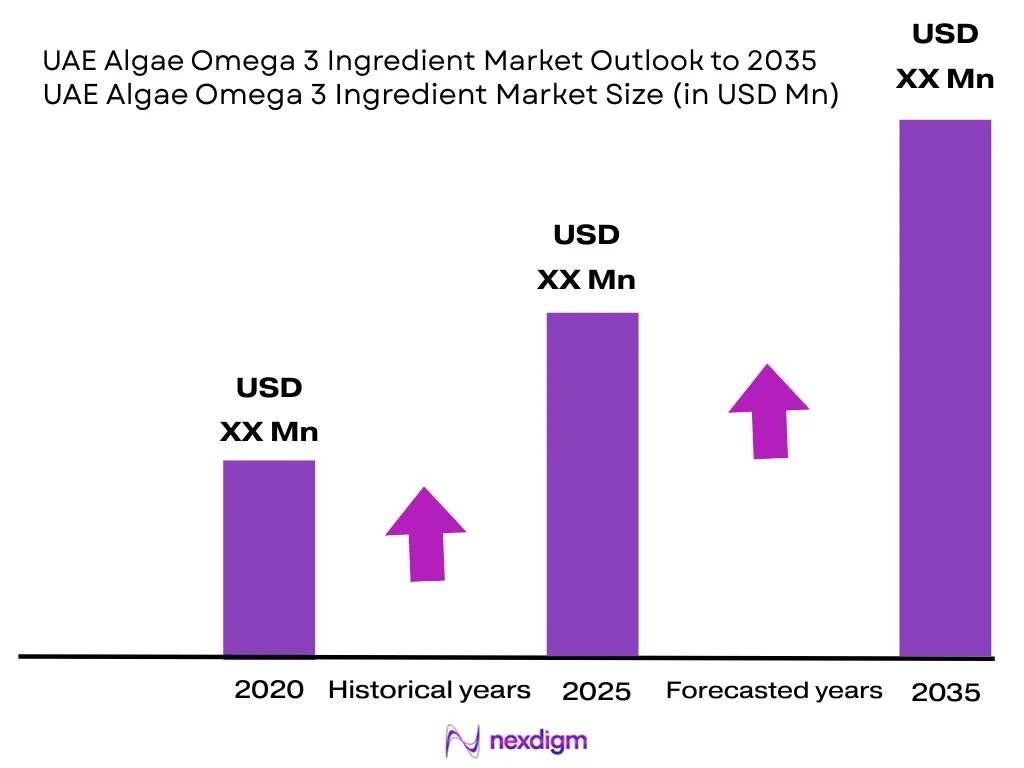
The UAE Algae Omega-3 Ingredient Market is assessed at USD ~ million, using the closest publicly disclosed UAE omega-3 market benchmark, while the global algae omega-3 ingredients market was valued at USD 1.19 billion. Demand is driven by supplement-grade DHA/EPA, Halal-certified fish-free omega-3, infant nutrition, clinical nutrition, and functional food use. The UAE’s macro base supports premium nutrition, with GDP at USD 552.32 billion and GDP per capita at USD 50,273.5. Dubai and Abu Dhabi dominate the UAE Algae Omega-3 Ingredient Market because Dubai concentrates importers, pharmacies, e-commerce wellness brands, free-zone distributors, and re-export routes, while Abu Dhabi supports food security, aquaculture, healthcare, and nutrition innovation. The UAE imported around USD 23 billion in agricultural and related products, showing high import reliance for food and nutrition inputs. Abu Dhabi licensed aquaculture facilities produced 505 tonnes of seafood, compared with 367 tonnes, supporting feed-grade algae omega-3 relevance.
Market Segmentation
By Ingredient Type
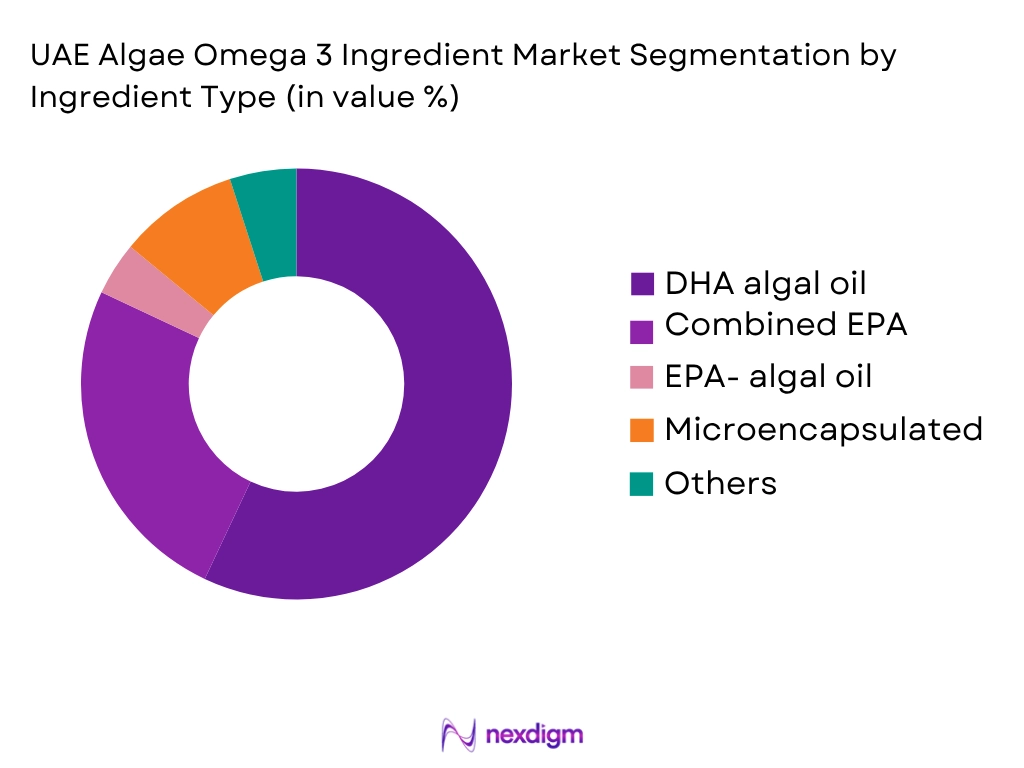
UAE Algae Omega-3 Ingredient Market is segmented by ingredient type into DHA-dominant algal oil, combined EPA+DHA algal oil, microencapsulated algal omega-3 powder, EPA-dominant algal oil, and algal biomass and meal. DHA-dominant algal oil holds the dominant market share because it is commercially strongest across infant nutrition, pregnancy supplements, children’s DHA drops, eye-health supplements, cognition products, and premium wellness capsules. UAE demand is concentrated in imported nutraceuticals, pharmacy retail, Halal-certified formulations, and clean-label supplements, where DHA is easier to position than technical EPA-rich ingredients. DHA-rich algal oil also has wider supplier documentation, food-grade dossiers, and formulation history. This supports faster product registration, especially for brands targeting mothers, children, expatriate consumers, and premium preventive-health buyers.
By Application
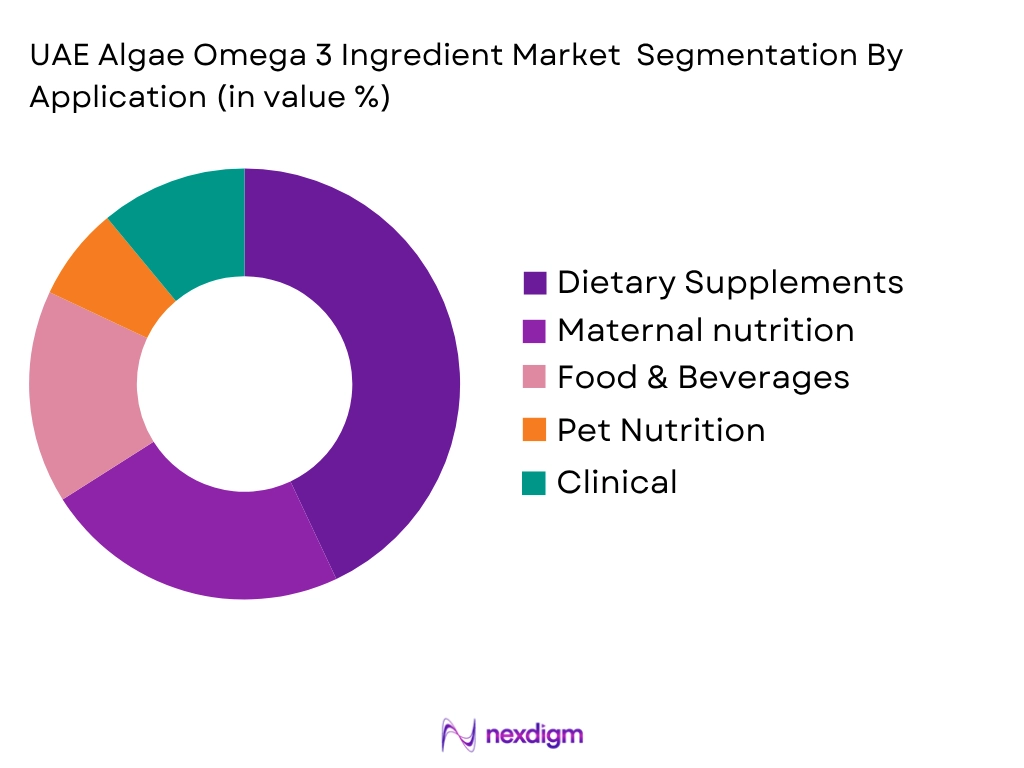
UAE Algae Omega-3 Ingredient Market is segmented by application into dietary supplements, infant and maternal nutrition, functional food and beverages, clinical and medical nutrition, pet nutrition, and aquafeed. Dietary supplements hold the dominant market share because algal DHA/EPA can be commercialised directly through capsules, softgels, gummies, drops, and prenatal products with limited reformulation complexity. UAE pharmacies, online wellness platforms, clinics, and premium supermarkets support imported supplement formats, while Halal, vegan, fish-free, and contaminant-controlled claims improve differentiation against fish oil. Supplements also allow clearer DHA/EPA dosage communication than functional foods. Infant and maternal nutrition follows closely because DHA has strong positioning in pregnancy and child development products, particularly among high-income households and imported premium milk powder buyers.
Competitive Landscape
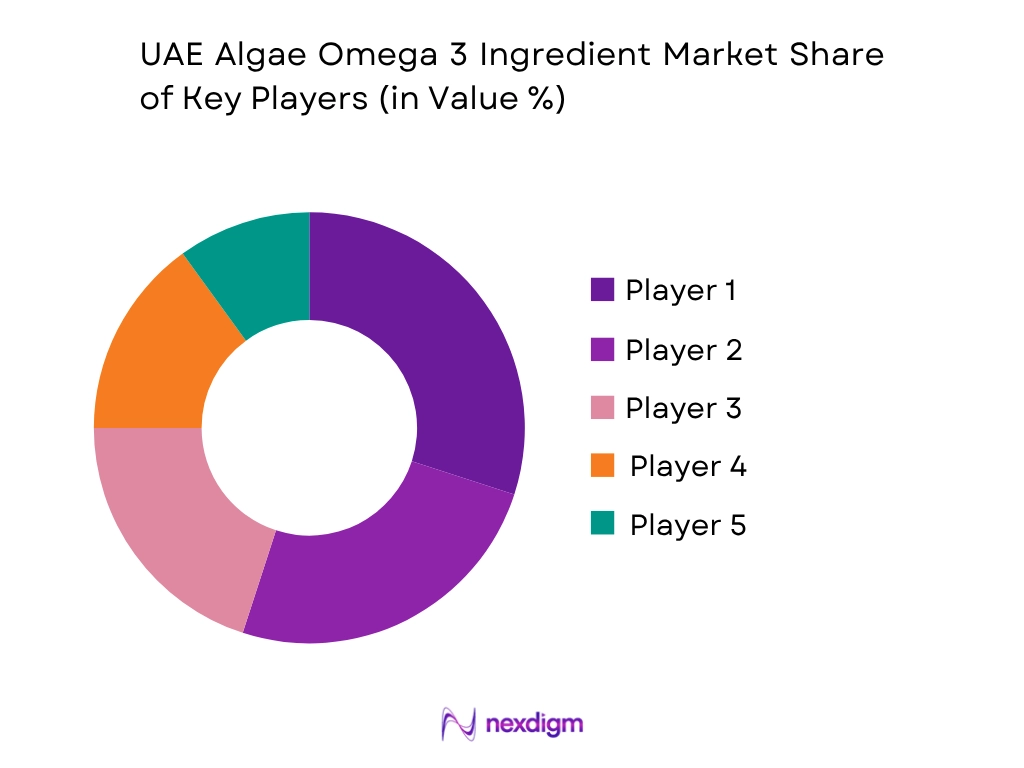
The UAE Algae Omega-3 Ingredient Market is import-led and moderately consolidated at the upstream supplier level. Global producers such as dsm-firmenich, Corbion, Veramaris, BASF, and Mara Renewables shape ingredient availability through branded DHA/EPA oils, feed-grade algae omega-3, and speciality nutrition lipids. UAE-based competition is stronger in distribution, registration support, private-label supplement manufacturing, Halal documentation, and re-export handling rather than large-scale algal oil production. Competitive advantage depends on DHA/EPA concentration, oxidation stability, Halal suitability, regulatory dossier readiness, GCC distribution access, and technical support.
| Company | Establishment Year | Headquarters | UAE-Relevant Ingredient | Technology Base | Core UAE Application | DHA/EPA Capability | Certification / Quality Position | UAE Relevance |
| dsm-firmenich | 2023 | Kaiseraugst, Switzerland / Maastricht, Netherlands | ~ | ~ | ~ | ~ | ~ | ~ |
| Corbion | 1919 | Amsterdam, Netherlands | ~ | ~ | ~ | ~ | ~ | ~ |
| Veramaris | 2018 | Delft, Netherlands | ~ | ~ | ~ | ~ | ~ | ~ |
| BASF | 1865 | Ludwigshafen, Germany | ~ | ~ | ~ | ~ | ~ | ~ |
| Mara Renewables | 2012 | Halifax, Canada | ~ | ~ | ~ | ~ | ~ | ~ |
UAE Algae Omega-3 Ingredient Market Analysis
Growth Drivers
Premium Nutrition Demand Supports Algal DHA/EPA Adoption
The UAE Algae Omega-3 Ingredient Market is supported by premium nutrition demand across supplements, maternal DHA, children’s nutrition, clinical nutrition and functional foods. The World Bank reports UAE GDP at USD 552.32 billion, GDP per capita at USD 50,273.5, and population at 10,986,400 in 2024, giving nutrition brands a high-income consumer base for fish-free DHA/EPA ingredients. Algal omega-3 fits UAE demand because it supports Halal-suitable, vegan, contaminant-controlled and no-fish-aftertaste positioning in capsules, gummies, drops and fortified powders. These indicators justify stronger uptake among pharmacies, premium retailers and e-commerce wellness brands.
Import-Based Food and Nutrition Supply Creates Ingredient Access
The UAE Algae Omega-3 Ingredient Market benefits from the country’s established import infrastructure for food, nutrition and speciality ingredients. USDA’s FAIRS report states that UAE agricultural and related imports were USD 25 billion in 2024, compared with USD 23 billion in 2023, showing a large import channel for nutrition inputs such as algal DHA/EPA oils, powders and premixes. This matters because commercial algae omega-3 supply is mostly sourced from global producers. Dubai’s distributor, free-zone, warehousing and re-export ecosystem enables supplement, infant nutrition and functional food companies to access imported DHA/EPA ingredients with certificates of analysis, origin documents and Halal files.
Market Challenges
Product Registration and Documentation Increase Launch Complexity
The UAE Algae Omega-3 Ingredient Market faces a regulatory documentation challenge because algal DHA/EPA ingredients enter different pathways depending on whether they are used in supplements, foods, infant nutrition, medical nutrition or feed. Dubai Municipality issued its technical guidelines for health supplements in 2024, while USDA notes that import approval is subject to UAE rules as interpreted by customs officials at entry. This creates risk for brands without complete DHA/EPA specifications, certificates of analysis, origin documents, stability files and compliant labels. The challenge is material because the UAE serves 10,986,400 residents and an import system handling USD 25 billion in agricultural and related imports.
Hot-Climate Handling and Oxidation Risk Limit Smaller Brand Adoption
The UAE Algae Omega-3 Ingredient Market faces technical barriers from oxidation-sensitive oil handling in a Gulf logistics environment. Algal DHA/EPA oils require controlled packaging, short clearance cycles, nitrogen flushing, antioxidant systems and temperature-managed warehousing to protect active lipid quality. The UAE’s role as an import market intensifies this issue because USDA reports USD 25 billion in agricultural and related imports in 2024, requiring multiple clearance, warehousing and distribution steps. The World Bank also reports UAE population at 10,986,400, meaning brands need stable national distribution, not only small-batch launches. Smaller supplement and functional food manufacturers may struggle without in-house stability testing and technical formulation support.
Market Opportunities
Halal-Certified Vegan Omega-3 Ingredients Can Scale Across Supplements
The UAE Algae Omega-3 Ingredient Market has an opportunity in Halal-certified vegan DHA/EPA supplements because algae oil avoids fish-origin concerns while supporting premium Muslim, vegan and expatriate consumer positioning. MoIAT states that the Halal National Mark verifies that the full Halal product supply chain aligns with Islamic Sharia and product conformity requirements, and it supports movement of Halal food products into UAE and global markets. This aligns with a 2024 macro base of USD 552.32 billion GDP and USD 50,273.5 GDP per capita. Suppliers with Halal files can target capsules, gummies, prenatal DHA, children’s drops and pharmacy-channel omega-3 products.
Aquaculture and Food Security Create Feed-Grade Algae Omega-3 Potential
The UAE Algae Omega-3 Ingredient Market has a future opportunity in feed-grade algal DHA/EPA because aquaculture is linked to food security and sustainable seafood development. The Environment Agency–Abu Dhabi reported fisheries and aquaculture output of 1,861 tonnes in 2024, while licensed Abu Dhabi aquaculture facilities produced 505 tonnes of seafood. The UAE Federal Competitiveness and Statistics Centre identifies aquaculture farm product data in tonnes from the Ministry of Climate Change and Environment. This supports demand for algal marine lipids in hatchery feed, broodstock nutrition and fish feed. The World Bank’s USD 552.32 billion GDP base supports investment capacity for higher-value controlled aquaculture inputs.
Future Outlook
The UAE Algae Omega-3 Ingredient Market is expected to expand steadily as premium nutrition brands shift from conventional fish oil toward algae-derived DHA/EPA. The market is forecast to grow at 9.82% CAGR for 2026-2035, aligned with the closest publicly disclosed UAE omega-3 market forecast, while global algae omega-3 ingredients are forecast to grow at 7.20% in the near-term outlook.
Growth will be led by Halal-certified vegan supplements, premium maternal DHA, children’s nutrition, clinical nutrition, and functional beverage fortification. Dubai will remain the key import and re-export hub, while Abu Dhabi will support food security, aquaculture, and health-sector applications. Ingredient suppliers with Halal documentation, low oxidation values, active DHA/EPA clarity, Arabic-English labelling support, and GCC distributor access will be better positioned than generic fish-oil suppliers.
Major Players
- dsm-firmenich
- Corbion
- BASF
- Archer Daniels Midland
- Cargill
- Veramaris
- Mara Renewables
- Fermentalg
- Polaris Nutritional Lipids
- AlgiSys BioSciences
- Cellana
- Cyanotech Corporation
- Algarithm Ingredients
- DKSH Middle East
- Brenntag UAE
Key Target Audience
- Nutraceutical and dietary supplement manufacturers
- Infant formula and maternal nutrition companies
- Functional food and beverage manufacturers
- Aquafeed and aquaculture nutrition companies
- Pet nutrition and veterinary supplement companies
- Specialty ingredient importers and distributors
- Investments and venture capitalist firms
- Government and regulatory bodies: Ministry of Health and Prevention, Emirates Drug Establishment, Dubai Municipality, Ministry of Industry and Advanced Technology, Ministry of Climate Change and Environment, Abu Dhabi Agriculture and Food Safety Authority
Research Methodology
Step 1: Identification of Key Variables
The initial phase involves constructing an ecosystem map for the UAE Algae Omega-3 Ingredient Market. This includes global algal oil manufacturers, UAE ingredient importers, supplement brands, private-label manufacturers, pharmacy chains, infant nutrition players, aquafeed producers, Halal certifiers, and regulators. Key variables include DHA/EPA type, ingredient form, certification status, regulatory pathway, application, and distribution channel.
Step 2: Market Analysis and Construction
In this phase, current and historical data is compiled from omega-3 market disclosures, global algae omega-3 ingredient benchmarks, UAE macroeconomic indicators, import regulation documents, aquaculture production statistics, and supplier product portfolios. The market structure is assessed across supplements, infant nutrition, functional foods, clinical nutrition, pet nutrition, and aquafeed.
Step 3: Hypothesis Validation and Expert Consultation
Market hypotheses are validated through structured discussions with ingredient distributors, supplement manufacturers, pharmacy-channel participants, regulatory specialists, Halal compliance officers, food formulators, and aquafeed buyers. These interviews help verify adoption barriers, DHA/EPA preference, import dependency, shelf-life concerns, certification requirements, and application-level demand.
Step 4: Research Synthesis and Final Output
The final phase integrates desk research, company benchmarking, application mapping, import-route assessment, and expert validation. Outputs are triangulated through top-down and bottom-up checks so that market size, segmentation, competitor positioning, and outlook reflect UAE-specific commercial realities rather than generic omega-3 or algae ingredient trends.

- Executive Summary
- Research Methodology (market definitions and assumptions, abbreviations, ingredient inclusion and exclusion criteria, algal oil equivalent conversion, active DHA/EPA normalisation, supplement-grade and feed-grade differentiation, top-down sizing approach, bottom-up supplier triangulation, importer and distributor interviews, pharmacy-channel validation, nutraceutical brand interviews, aquafeed buyer interviews, infant nutrition formulation validation, Halal certification review, Dubai Municipality and MOHAP regulatory mapping, import documentation assessment, forecast sensitivity framework)

- Definition and Scope
- Overview Genesis
- Evolution of Algae-Based DHA/EPA Ingredients
- Business Cycle
- Supply Chain and Value Chain Analysis

- Growth Drivers (premium wellness consumption, high expatriate population, Halal-certified nutrition demand, infant DHA demand, sustainable fish-oil replacement, food security agenda, pharmacy retail growth, e-commerce wellness expansion)
- Market Challenges (high import dependency, regulatory registration burden, oxidation sensitivity, Halal documentation gaps, price premium versus fish oil, limited local algae oil production, small domestic aquaculture scale)
- Opportunities (Halal algal DHA/EPA, GCC re-export, functional nutrition, clinical nutrition, aquafeed sustainability, pet premiumisation, local blending, algae biotech investment)
- Market Trends (plant-based omega-3 transition, Halal and vegan dual-certification, DHA/EPA ratio differentiation, clean-label softgels, powder formats, pharmacy premiumisation, sustainability communication)
- SWOT Analysis
- Porter’s Five Forces

- By Value (2020-2025)
- By Volume (2020-2025)
- By Average Ingredient Realisation (2020-2025)

- By Omega-3 Type (In Value %)
DHA-Dominant Algal Oil
EPA-Dominant Algal Oil
Combined EPA+DHA Algal Oil
High-Potency Algal Omega-3 Concentrates - By Application (In Value %)
Dietary Supplements
Infant and Maternal Nutrition
Functional Food and Beverages
Aquafeed - By Distribution Channel (In Value %)
Direct Sales from Global Ingredient Manufacturers
UAE Specialty Ingredient Distributors
Supplement Contract Manufacturers and Private-Label Producers
B2B Importers and Nutritional Lipid Traders - By Emirate (In Value %)
Dubai
Abu Dhabi
Sharjah
Ras Al Khaimah

- Market Share of Major Players by Value and Volume (bulk algal oil sales, active DHA equivalent, active EPA equivalent, powder equivalent, feed-grade equivalent)
- Cross Comparison Parameters (DHA/EPA concentration range, Halal certification readiness, UAE regulatory dossier support, oxidation quality metrics, ingredient form portfolio, GCC distribution access, hot-climate logistics capability, aquafeed and functional food application support)
- SWOT Analysis of Major Players
- Detailed Profiles of Major Companies
dsm-firmenich
Corbion
BASF
Archer Daniels Midland
Cargill
Veramaris
Mara Renewables
Fermentalg
Polaris Nutritional Lipids
AlgiSys BioSciences
Cellana
Cyanotech Corporation
Algarithm Ingredients
DKSH Middle East
Brenntag UAE

- Market Demand and Utilisation
- Purchasing Power and Budget Allocation
- Regulatory and Compliance Requirements
- Needs, Desires and Pain Point Analysis
- Decision-Making Process

- By Value (2026-2035)
- By Volume (2026-2035)
- By Average Ingredient Realisation (2026-2035)


 Request a Sample
 Ask for Customization
 Get a Quote
 Enquire Now