

 Download PDF
Market Overview
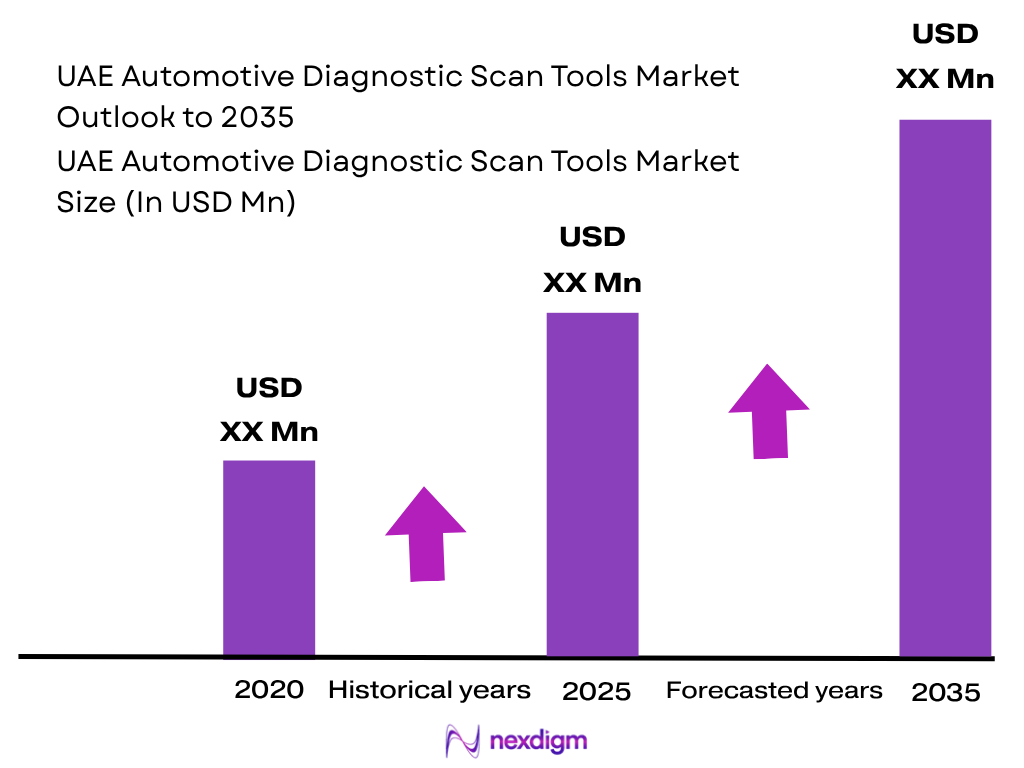
The UAE Automotive Diagnostic Scan Tools Market was valued at USD ~XX million in 2024, compared with USD ~XX million in 2023, supported by the expansion of electronically controlled vehicles, increasing diagnostic requirements for premium and luxury vehicles, growth in independent automotive workshops, and rising adoption of connected diagnostic equipment. The market encompasses professional diagnostic scanners, OBD readers, ECU programming tools, TPMS diagnostic equipment, EV diagnostic systems and ADAS calibration solutions. Increasing vehicle electronic content is strengthening demand for advanced multi-brand diagnostic platforms.
The UAE market is concentrated around Dubai, Abu Dhabi and Sharjah, which represent the country’s principal automotive retail, servicing, logistics and commercial activity centers. Dubai benefits from a large premium and imported vehicle ecosystem, extensive independent workshop activity and a strong automotive aftermarket. Abu Dhabi is supported by government, corporate and commercial fleets, while Sharjah has a substantial concentration of automotive parts trading and repair businesses. The UAE’s position as a regional vehicle-import and re-export hub further supports demand for multi-brand diagnostic equipment.
Market Segmentation
By Diagnostic Tool Type
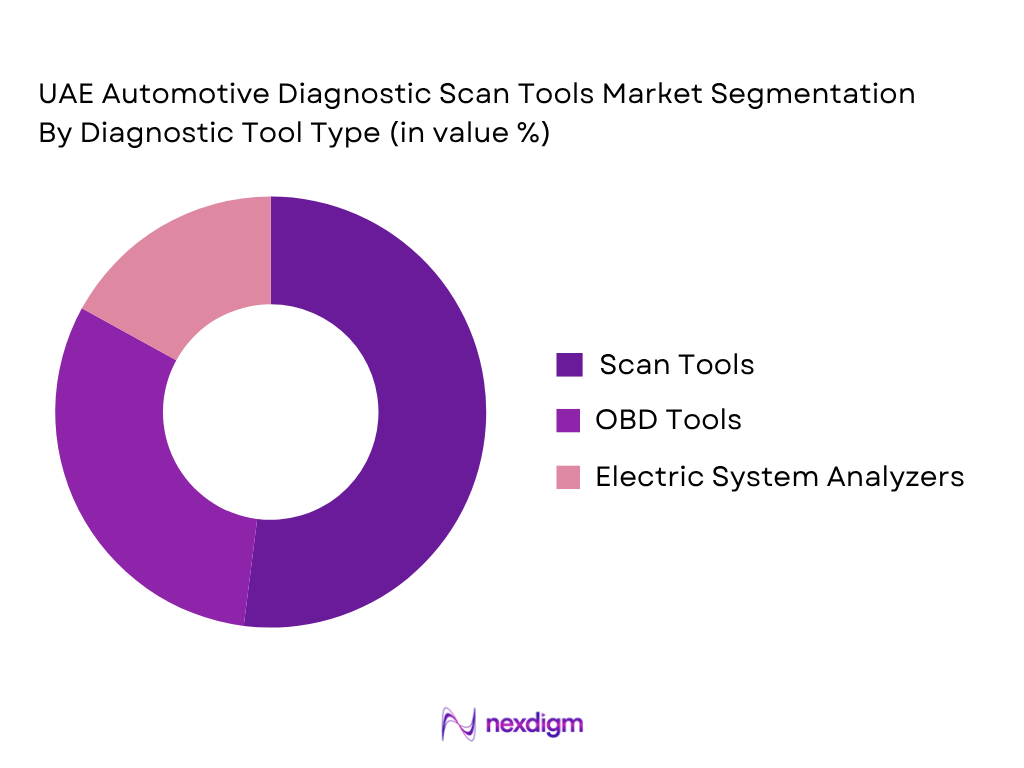
The UAE Automotive Diagnostic Scan Tools Market is segmented by diagnostic tool type into professional multi-brand diagnostic scanners, OEM-specific diagnostic tools, OBD-II code readers, ECU coding and programming tools, heavy-duty vehicle diagnostic scanners, TPMS diagnostic tools, battery and electrical system testers, and ADAS diagnostic and calibration systems. Professional multi-brand diagnostic scanners are expected to account for the dominant share of the segment because UAE workshops service diverse vehicle brands, including European, Japanese, Korean, American and Chinese manufacturers. These systems provide broad vehicle coverage while combining fault-code reading, live-data monitoring, actuator testing, service resets and advanced ECU functions within a single platform. Demand is further supported by independent workshops seeking capabilities comparable to authorized service centers. Increasing vehicle electronic complexity is also encouraging workshops to upgrade from basic OBD readers toward professional systems capable of accessing multiple control modules. The growing presence of premium vehicles, connected vehicles, hybrids and EVs is additionally increasing requirements for advanced software coverage, secure gateway access, ECU coding and manufacturer-specific diagnostic functions.
By Vehicle Type
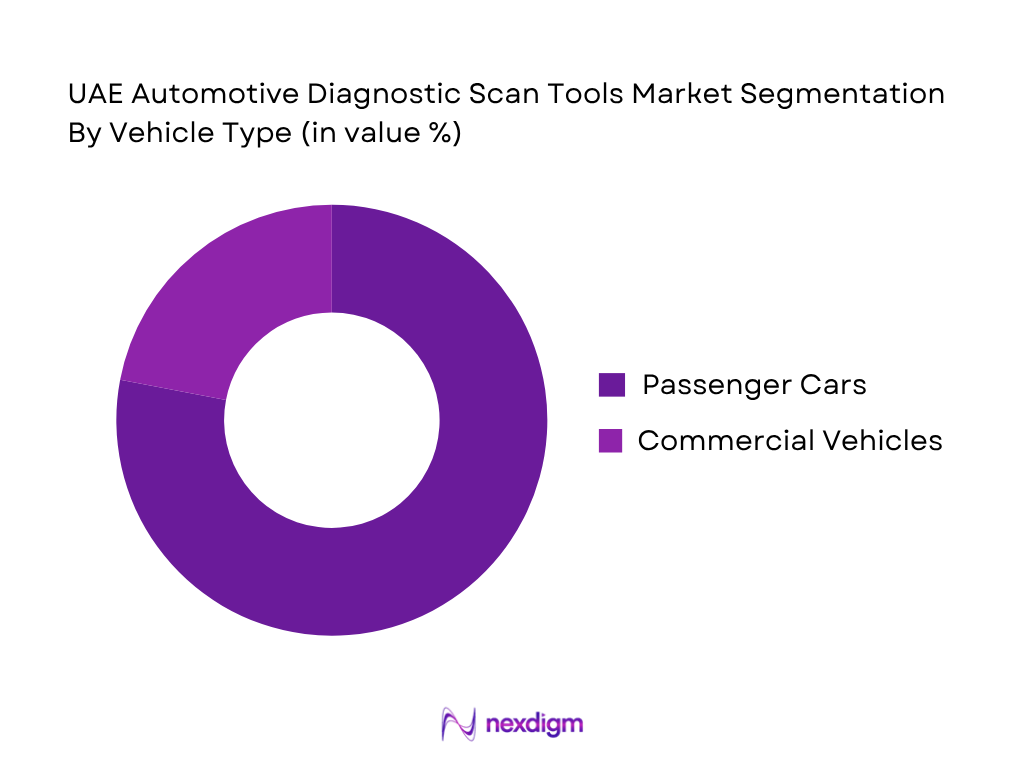
The UAE Automotive Diagnostic Scan Tools Market is segmented by vehicle type into passenger cars, luxury and premium passenger cars, light commercial vehicles, heavy commercial vehicles, buses and coaches, hybrid electric vehicles and battery electric vehicles. Passenger cars represent the dominant vehicle category because they constitute the largest addressable base for routine diagnostics, periodic servicing, electronic fault detection and component replacement across UAE workshops. The country’s large imported vehicle population also creates a requirement for diagnostic systems supporting multiple brands and model years. Premium and luxury vehicles further increase demand for advanced diagnostic functions because of their greater electronic architecture, ADAS content, sophisticated powertrain systems and extensive body-control modules. At the same time, commercial fleets require diagnostics to minimize downtime and support preventive maintenance. Hybrid and battery-electric vehicles are creating an additional technology layer involving battery-management systems, high-voltage components, inverters, electric motors and charging systems. Consequently, diagnostic suppliers with broad passenger-car coverage combined with EV and premium-vehicle functionality are positioned to capture increasing workshop equipment demand.
Competitive Landscape
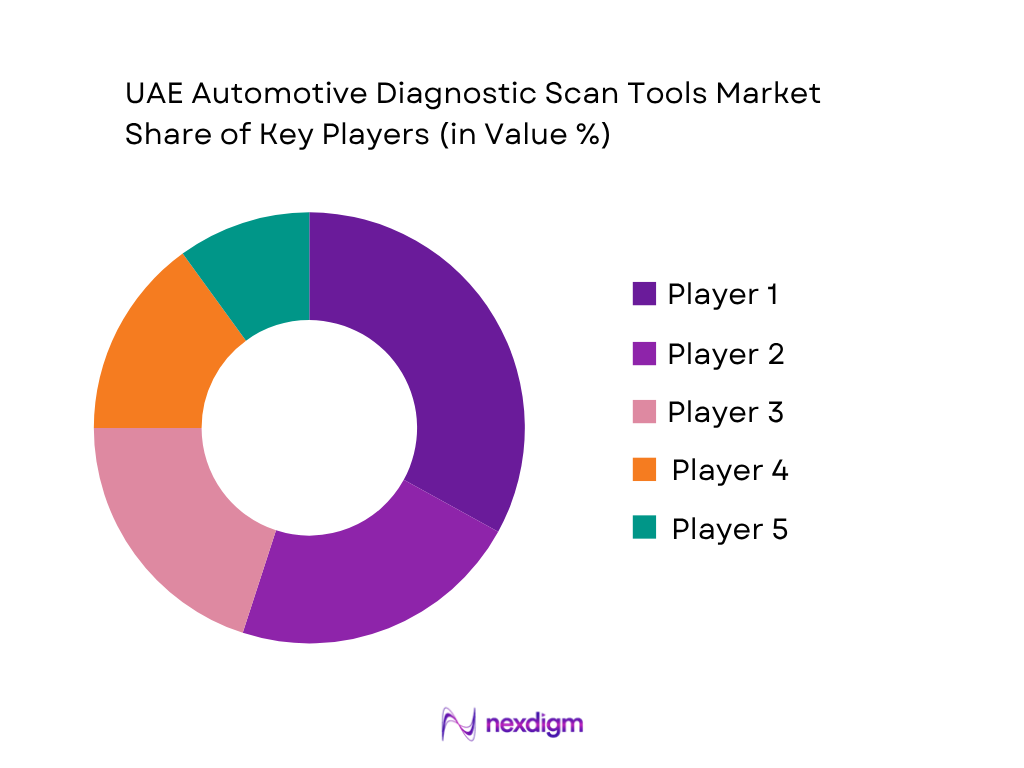
The UAE Automotive Diagnostic Scan Tools Market is characterized by competition among established global automotive equipment manufacturers, professional diagnostic technology suppliers and specialized Asian diagnostic-tool manufacturers. Companies compete primarily through vehicle coverage, diagnostic depth, ECU coding and programming capabilities, EV functionality, ADAS calibration, software updates, connectivity and distributor support. The market also contains differentiated positions across professional workshop equipment, OEM-level diagnostic platforms, entry-level OBD devices and specialized systems for commercial vehicles.
| Company | Establishment Year | Headquarters | Product Portfolio | OEM-Level Diagnostic Capability | EV Diagnostic Capability | ADAS Capability | ECU Coding / Programming |
| Bosch | 1886 | Gerlingen, Germany | ~ | ~ | ~ | ~ | ~ |
| Snap-on | 1920 | Kenosha, USA | ~ | ~ | ~ | ~ | ~ |
| Autel | 2004 | Shenzhen, China | ~ | ~ | ~ | ~ | ~ |
| LAUNCH | 1992 | Shenzhen, China | ~ | ~ | ~ | ~ | ~ |
| TEXA | 1992 | Monastier di Treviso, Italy | ~ | ~ | ~ | ~ | ~ |
UAE Automotive Diagnostic Scan Tools Market Analysis
Growth Drivers
Rising Vehicle Parc
The expanding vehicle base in the UAE is directly increasing the addressable requirement for automotive diagnostic scan tools across dealerships, independent workshops, fleet maintenance centers and inspection facilities. Dubai alone recorded 2.5 million registered vehicles in 2024, representing approximately half of the vehicles registered across the UAE, according to the Dubai Roads and Transport Authority (RTA). The broader economic environment supports continued automotive utilization: the World Bank recorded UAE population at 10,986,400 in 2024, while GDP reached USD 552.32 billion, creating a large consumer and commercial activity base. Dubai also recorded more than 18 million tourists in 2024, according to RTA, adding rental, taxi and mobility demand that requires recurring vehicle diagnostics. RTA further reported 71,040 vehicles in Dubai’s rental fleet in 2024, compared with 49,725 in 2023, increasing the need for periodic fault-code scanning, electronic-system testing and preventive maintenance. The diagnostic opportunity therefore extends beyond new-vehicle servicing into used vehicles, rental fleets and high-utilization commercial applications. As the vehicle parc becomes larger and more electronically complex, workshops increasingly require multi-brand scanners capable of accessing engine, transmission, ABS, airbag, body-control and other electronic systems.
Increasing Electronic Content per Vehicle
Rising electronic complexity is strengthening demand for sophisticated diagnostic equipment because modern vehicles require substantially more electronic-system inspection than conventional mechanical vehicles. The UAE’s automotive environment is supported by strong economic activity: World Bank data places UAE GDP at USD 552.32 billion in 2024, while GDP per capita reached USD 50,273.5, supporting continued adoption of technology-intensive passenger and commercial vehicles. Dubai’s registered vehicle population reached 2.5 million in 2024, according to RTA, creating a substantial installed base requiring diagnostics for engine-control units, transmission controllers, safety systems, body electronics, sensors and connected functions. The transition toward electrified mobility further expands the diagnostic scope. The UAE Ministry of Energy and Infrastructure reported that EV charging infrastructure had reached 1,000 charging points by the end of 2024, demonstrating the increasing presence of electronically managed vehicles and charging systems. In addition, the International Monetary Fund recorded UAE real GDP growth of 4.0 in 2024, reflecting broad economic expansion across manufacturing, transportation, construction and services. These conditions encourage investment in diagnostic platforms that can support multiple vehicle architectures, software protocols and electronic control systems, particularly where workshops need advanced scanning, coding, programming and system-reset capabilities.
Market Challenges
High Cost of Advanced Diagnostic Systems
The UAE automotive diagnostic environment is becoming more technology-intensive as workshops must increasingly support electronic control units, connected vehicles, EV architectures and advanced driver-assistance functions. This creates a financial challenge because professional diagnostic platforms require hardware, software, vehicle-specific coverage and continuing technical updates. The scale of the underlying vehicle ecosystem makes this particularly important: Dubai had 2.5 million registered vehicles in 2024, according to RTA, while the city’s rental fleet reached 71,040 vehicles, creating demand for equipment capable of servicing diverse vehicle brands and configurations. At the macroeconomic level, the World Bank recorded UAE GDP of USD 552.32 billion in 2024 and GDP per capita of USD 50,273.5, indicating a high-value automotive environment but also one in which workshops increasingly compete on technical capability and service quality. Advanced equipment becomes more expensive when diagnostic functions extend from basic OBD fault-code retrieval to ECU coding, programming, secure-gateway access, battery management and ADAS calibration. The challenge is particularly relevant for smaller independent workshops that need broad vehicle coverage but may not have the same equipment budgets as authorized dealerships. Consequently, purchasing decisions increasingly require balancing diagnostic coverage, update requirements, technician capability and equipment utilization against available workshop investment capacity.
Software and Subscription Dependency
Diagnostic scan tools are increasingly dependent on software databases, firmware updates, vehicle-specific communication protocols and subscription-enabled functions, creating an ongoing operational challenge for UAE workshops. The issue is relevant because the country’s vehicle ecosystem is highly internationalized: DP World handled 1.3 million vehicles across its UAE terminals in 2024, with nearly 960,000 units handled at Jebel Ali Port, according to Emirates News Agency/WAM. China represented nearly 25% of vehicle volumes, followed by Japan, Korea and India, illustrating the diversity of vehicle origins that diagnostic equipment must accommodate. The IMF recorded UAE goods imports of approximately USD 368 billion in 2024, reinforcing the country’s role as a major trade and vehicle-import hub. Diagnostic providers therefore need to maintain coverage across numerous manufacturers, communication architectures and model generations. Software dependency becomes particularly important when security gateways, ECU coding, online programming or cloud-based diagnostics require authenticated access. Workshops may consequently face recurring requirements for software updates and manufacturer-specific functionality rather than relying solely on a one-time hardware purchase. This increases operational complexity and can create compatibility risks when older diagnostic hardware or operating systems cannot support newly introduced vehicle architectures.
Market Opportunities
AI-Assisted Diagnostics
AI-assisted diagnostics represents a significant opportunity for the UAE Automotive Diagnostic Scan Tools Market because the country’s large vehicle ecosystem creates substantial demand for faster fault identification, predictive maintenance and technician-support functions. Dubai recorded 2.5 million registered vehicles in 2024, according to RTA, providing a substantial installed base for AI-enabled diagnostic applications. The opportunity is further supported by the country’s expanding digital infrastructure and economic capacity: the World Bank reported UAE GDP of USD 552.32 billion in 2024 and population of 10,986,400, while the IMF reported real GDP growth of 4.0 in 2024. AI-enabled platforms can use diagnostic trouble codes, live sensor parameters, historical repair records and vehicle operating data to help technicians identify probable root causes rather than simply displaying individual fault codes. This is particularly valuable for multi-brand workshops dealing with complex electronic systems and diverse imported vehicles. The country’s international automotive ecosystem also reinforces the opportunity. DP World handled 1.3 million vehicles in UAE terminals during 2024, demonstrating the scale and diversity of vehicles entering the market. AI-supported diagnostic platforms can therefore differentiate themselves through automated fault interpretation, guided troubleshooting, predictive alerts and technician workflow assistance, moving scan tools from basic code readers toward intelligent vehicle-health platforms.
EV Battery Diagnostics
EV battery diagnostics offers a developing opportunity as electrification expands and the UAE builds supporting charging infrastructure. The UAE Ministry of Energy and Infrastructure reported 1,000 EV charging points across the country by the end of 2024, while the ministry has established national policies supporting EV adoption and charging infrastructure development. The increasing electrification of the vehicle base creates requirements beyond conventional engine diagnostics, including battery-state assessment, cell-level monitoring, battery-management-system fault detection, insulation monitoring, charging-system diagnostics and thermal-management evaluation. The opportunity is reinforced by the country’s sizeable automotive ecosystem. Dubai recorded 2.5 million registered vehicles in 2024, according to RTA, while the UAE population reached 10,986,400, according to the World Bank. The country’s economic capacity also supports investment in specialized workshop technology, with World Bank GDP recorded at USD 552.32 billion in 2024. Diagnostic suppliers can address this transition by developing platforms capable of combining conventional OBD functions with high-voltage battery diagnostics and EV-specific electronic-system testing. As workshops increasingly service mixed fleets containing internal-combustion, hybrid and battery-electric vehicles, multifunctional diagnostic equipment can become more valuable than separate single-purpose tools. This creates an opportunity for suppliers to position EV battery health assessment and high-voltage system diagnostics as core capabilities within next-generation workshop platforms.
Future Outlook
The UAE Automotive Diagnostic Scan Tools Market is expected to undergo a technology-driven transformation through the forecast period. Increasing vehicle electronics, connected-car adoption and the growing presence of hybrid and battery-electric vehicles will raise the need for deeper diagnostic capabilities. ADAS penetration will increase demand for integrated diagnostic and calibration platforms, while workshops will increasingly require cloud-connected tools and regular software updates. ECU coding, secure gateway access and EV battery diagnostics are expected to become increasingly important competitive differentiators.
The transition from conventional fault-code reading toward software-driven diagnostics is expected to reshape purchasing decisions. Professional workshops are likely to prioritize platforms capable of supporting multiple vehicle architectures, while fleet operators will increasingly use diagnostic information for preventive maintenance and vehicle uptime management. The expansion of Chinese automotive brands in the UAE is also expected to increase demand for broader multi-brand vehicle coverage.
Major Players
- Bosch
- Snap-on
- Autel Intelligent Technology
- LAUNCH Tech
- TEXA
- HELLA GUTMANN SOLUTIONS
- TOPDON
- THINKCAR Tech
- OBDSTAR
- ACTIA Group
- PHINIA / Delphi
- FCAR Technology
- XTOOL
- ANCEL
- Innova Electronics
Key Target Audience
- Automotive Diagnostic Equipment Manufacturers
- Automotive Workshop Equipment Distributors
- Authorized Automotive Dealership Service Networks
- Independent Automotive Workshop Groups
- Luxury and Premium Vehicle Service Centers
- Commercial Fleet Operators and Fleet Maintenance Companies
- Investments and Venture Capitalist Firms (Automotive Technology Investors, Mobility-Focused Venture Capital Funds)
- Government and Regulatory Bodies (UAE Ministry of Energy and Infrastructure, Emirates Authority for Standardization and Metrology, Dubai Roads and Transport Authority, Abu Dhabi Mobility)
Research Methodology
Step 1: Identification of Key Variables
The initial phase involves mapping the UAE automotive diagnostic ecosystem, covering vehicle manufacturers, importers, dealerships, independent workshops, diagnostic equipment suppliers, distributors and fleet operators. Secondary databases and industry sources are used to identify variables influencing diagnostic-equipment demand. Key variables include vehicle parc, vehicle age, electronic-system complexity, workshop density, diagnostic-tool penetration, EV adoption and equipment replacement cycles.
Step 2: Market Analysis and Construction
Historical market information is compiled to evaluate diagnostic equipment adoption across passenger vehicles, commercial vehicles, luxury vehicles, hybrids and EVs. The assessment considers diagnostic-device installations, equipment replacement, software subscriptions, workshop expansion and technology upgrades. A bottom-up model is constructed using workshop-level demand, product-category penetration and distributor-level sales indicators, while a top-down model validates the overall market structure.
Step 3: Hypothesis Validation and Expert Consultation
Market hypotheses are developed around vehicle-electronics complexity, professional scanner adoption, ECU programming demand, EV diagnostics and ADAS calibration requirements. These hypotheses are validated through interviews with diagnostic-equipment distributors, automotive workshop operators, service-center managers, fleet-maintenance professionals and technology suppliers. Industry consultations provide operational insights that help validate equipment adoption patterns and competitive positioning.
Step 4: Research Synthesis and Final Output
The final stage triangulates secondary research, industry interviews, vehicle-parc indicators, workshop activity and supplier information to establish the market assessment. Diagnostic-tool categories are cross-checked against vehicle technology and end-user requirements. The resulting analysis is used to determine market segmentation, competitive positioning, growth drivers, challenges, opportunities and the long-term outlook for the UAE Automotive Diagnostic Scan Tools Market.

- Executive Summary
- Research Methodology (Market Definition and Scope, Diagnostic Scan Tool Ecosystem Mapping, Top-Down Market Sizing, Bottom-Up Market Construction, Vehicle-Parc Assessment, Workshop Census Framework, Import and Distribution Validation, Demand-Side Analysis, Supply-Side Analysis, Primary Industry Interviews, Distributor and Workshop Mapping, Data Triangulation, Forecasting Methodology, Assumptions and Limitations)

- Definition and Scope
- UAE Automotive Diagnostic Ecosystem
- Evolution of Vehicle Diagnostic Technology in the UAE
- Automotive Diagnostic Value Chain
- UAE Automotive Aftermarket Structure
- Vehicle Electronics and ECU Complexity Landscape
- OBD-II and CAN-Based Diagnostic Environment

- Growth Drivers (Rising Vehicle Parc, Increasing Electronic Content per Vehicle, Luxury Vehicle Penetration, Expansion of Independent Workshops, Growing Fleet Operations, Increasing EV and Hybrid Diagnostics Requirements)
- Market Challenges (High Cost of Advanced Diagnostic Systems, Skilled Technician Shortage, Software and Subscription Dependency, Grey-Market Equipment, Multi-Brand Compatibility Limitations, Cybersecurity and Secure-Gateway Restrictions)
- Market Opportunities (AI-Assisted Diagnostics, EV Battery Diagnostics, ADAS Calibration, Cloud-Based Workshop Diagnostics, ECU Programming and Coding, Connected Fleet Diagnostics, Remote Diagnostic Services)
- Market Trends (Wireless Diagnostic Scanners, Cloud-Connected Diagnostics, AI-Based Fault Detection, Secure Gateway Diagnostics, Remote Vehicle Diagnostics, EV Battery Health Assessment, ADAS Calibration Integration)
- Regulatory and Standards Environment (UAE Vehicle Inspection Framework, Roadworthiness Requirements, Emissions Diagnostics, Vehicle Modification Requirements, Automotive Cybersecurity, Data Connectivity Requirements)
- Porter’s Five Forces Analysis
- PESTLE Analysis
- SWOT Analysis
- Stakeholder Ecosystem Analysis

- By Market Value (2020-2025)
- By Unit Volume (2020-2025)
- By Installed Diagnostic Equipment Base (2020-2025)
- By Professional and Consumer Diagnostic Equipment (2020-2025)
- By Workshop Deployment Volume (2020-2025)
- By Diagnostic Device Replacement and Upgrade Demand (2020-2025)
- By Diagnostic Software and Subscription Revenue (2020-2025)

- By Diagnostic Tool Type (In Value %)
Professional Multi-Brand Diagnostic Scanners
OEM-Specific Diagnostic Tools
OBD-II Code Readers
ECU Coding and Programming Tools
Heavy-Duty Vehicle Diagnostic Scanners
TPMS Diagnostic and Programming Tools
Battery and Electrical System Testers
ADAS Diagnostic and Calibration Systems - By Vehicle Type (In Value %)
Passenger Cars
Luxury and Premium Passenger Cars
Light Commercial Vehicles
Heavy Commercial Vehicles
Buses and Coaches
Hybrid Electric Vehicles
Battery Electric Vehicles - By Diagnostic Function (In Value %)
Engine and Powertrain Diagnostics
Transmission Diagnostics
ABS and Brake Diagnostics
Airbag and SRS Diagnostics
Body Control Module Diagnostics
ECU Coding and Programming
Battery and Charging-System Diagnostics
ADAS Diagnostics and Calibration
TPMS Diagnostics
Vehicle Network and CAN Diagnostics - By Connectivity Technology (In Value %)
Wired Diagnostic Interfaces
Bluetooth-Enabled Diagnostic Systems
Wi-Fi-Enabled Diagnostic Systems
USB-Connected Diagnostic Systems
Cloud-Connected Diagnostic Platforms
Pass-Thru Diagnostic Interfaces - By End User (In Value %)
Independent Automotive Workshops
Authorized Dealership Service Centers
Premium and Luxury Vehicle Service Centers
Automotive Repair Chains
Commercial Fleet Maintenance Facilities
Vehicle Rental and Leasing Fleets
Mobile Diagnostic Service Providers
Vehicle Inspection and Testing Facilities - By Sales Channel (In Value %)
Authorized Distributors
Automotive Equipment Dealers
Specialized Diagnostic Equipment Retailers
Online Automotive Equipment Platforms
OEM and Dealer Procurement
Direct Manufacturer Sales

- Market Share Analysis of Major Players (By Value, Unit Volume, Diagnostic Tool Type, Vehicle Type, Diagnostic Function, End User, Sales Channel)
- Cross Comparison Parameters (Multi-Brand Vehicle Coverage, ECU Coding and Programming Capability, EV and Hybrid Diagnostic Capability, ADAS Calibration Support, Heavy-Duty Vehicle Coverage, Secure Gateway and OEM-Level Access, Cloud and Wireless Connectivity, UAE Distribution and Technical Support Network)
- Competitive Pricing Positioning (Entry-Level Devices, Professional Scanners, OEM-Level Platforms, ECU Programming Systems, ADAS Equipment)
- SWOT Analysis of Major Players
- Detailed Profiles of Major Companies
Robert Bosch GmbH
Snap-on Incorporated
Autel Intelligent Technology Corp.
LAUNCH Tech Co., Ltd.
TOPDON
THINKCAR Tech
OBDSTAR Technology Co., Ltd.
TEXA S.p.A.
HELLA GUTMANN SOLUTIONS
PHINIA Inc.
ACTIA Group
FCAR Technology
XTOOL
ANCEL
Innova Electronics Corporation

- Workshop Diagnostic Requirements
- Independent Workshop Adoption Analysis
- Authorized Dealership Requirements
- Luxury Vehicle Service Requirements
- Fleet Operator Diagnostic Requirements
- EV Workshop Requirements
- Purchasing Decision Parameters

- By Market Value (2026-2035)
- By Unit Volume (2026-2035)
- By Installed Diagnostic Equipment Base (2026-2035)
- By Professional and Consumer Diagnostic Equipment (2026-2035)
- By Workshop Deployment Volume (2026-2035)
- By Diagnostic Device Replacement and Upgrade Demand (2026-2035)
- By Diagnostic Software and Subscription Revenue (2026-2035)


 Request a Sample
 Ask for Customization
 Get a Quote
 Enquire Now