

 Download PDF
Market Overview
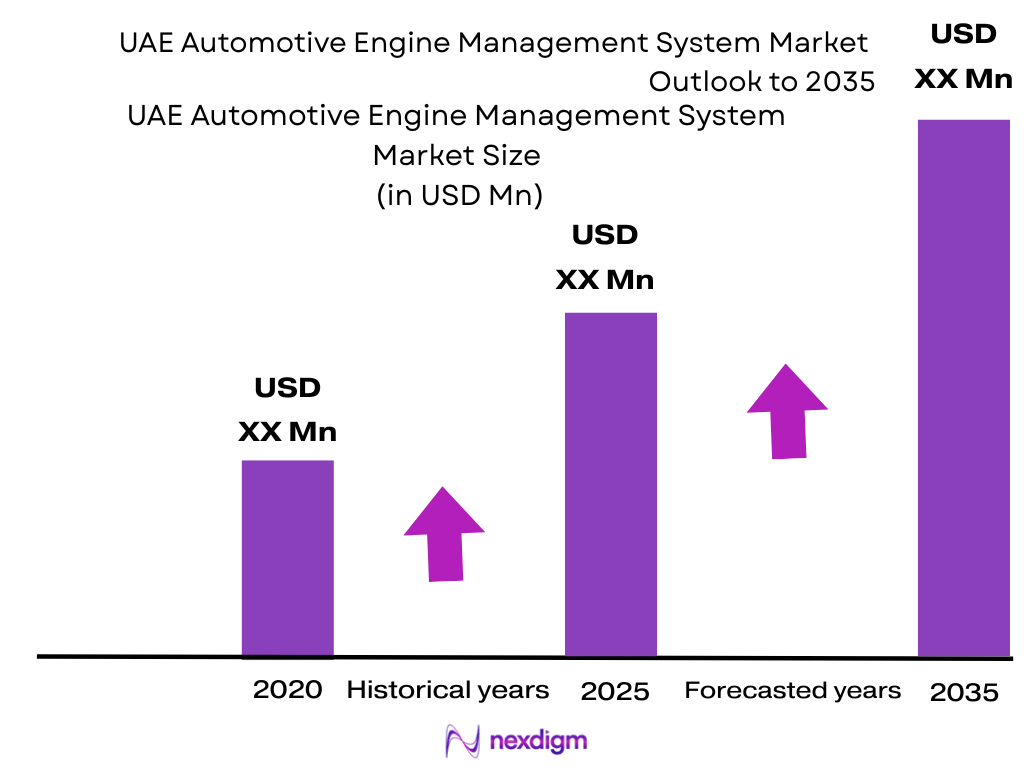
The UAE Automotive Engine Management System Market is valued at ~ million under the requested placeholder framework. Demand is supported by the country’s high-value passenger-car, SUV, pickup and commercial-vehicle fleet and by extensive aftermarket servicing. The wider economic base expanded from roughly USD 506 billion to USD 552.32 billion, while GDP per capita reached USD 50,273.5, supporting vehicle ownership, premium powertrains and higher electronic content per vehicle. Dubai, Abu Dhabi and Sharjah dominate UAE Automotive Engine Management System demand because they combine dense vehicle fleets, authorized dealerships, fleet operators, industrial workshops and parts-distribution channels. Dubai additionally functions as the regional aftermarket and re-export hub: DENSO operates its MENA engine-management business from Jebel Ali Free Zone, while Bosch maintains its Middle East operation in Dubai. This infrastructure concentrates ECU diagnostics, sensors, diesel-injection components and replacement electronics around the three emirates.
Market Segmentation
By Component Type
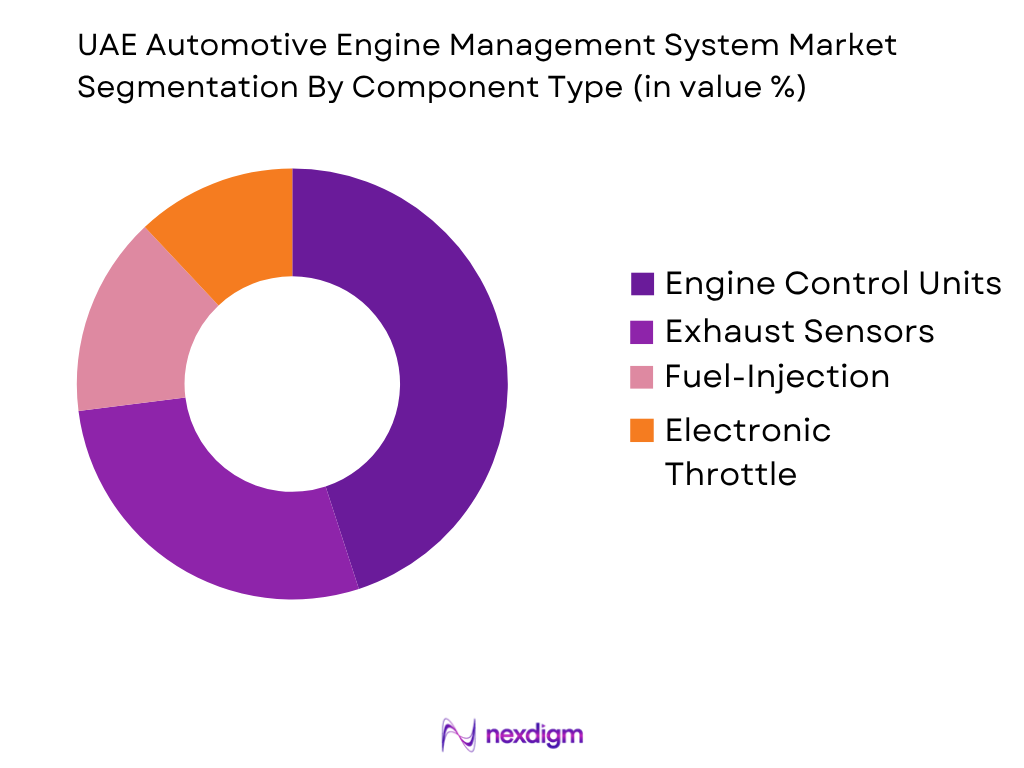
The UAE Automotive Engine Management System Market is segmented into engine control units and powertrain control modules, engine and exhaust sensors, fuel-injection components, ignition-management systems, electronic throttle and air-management systems, and other engine electronics. Engine control units and powertrain control modules dominate the value mix because they coordinate fuel injection, ignition, electronic throttle, turbocharger operation, emissions functions and diagnostics. UAE vehicle demand is particularly favorable to advanced controllers because SUVs, premium vehicles and turbocharged gasoline engines carry relatively sophisticated powertrain electronics. Engine and exhaust sensors form the second major pool, encompassing lambda, MAP, crankshaft, camshaft, exhaust-temperature and EGR-related sensing. DENSO’s UAE aftermarket portfolio explicitly covers camshaft and crankshaft sensors, EGR valves, exhaust-gas-temperature sensors, lambda sensors and MAP sensors, demonstrating the breadth of EMS component demand in the local aftermarket.
By Powertrain Type
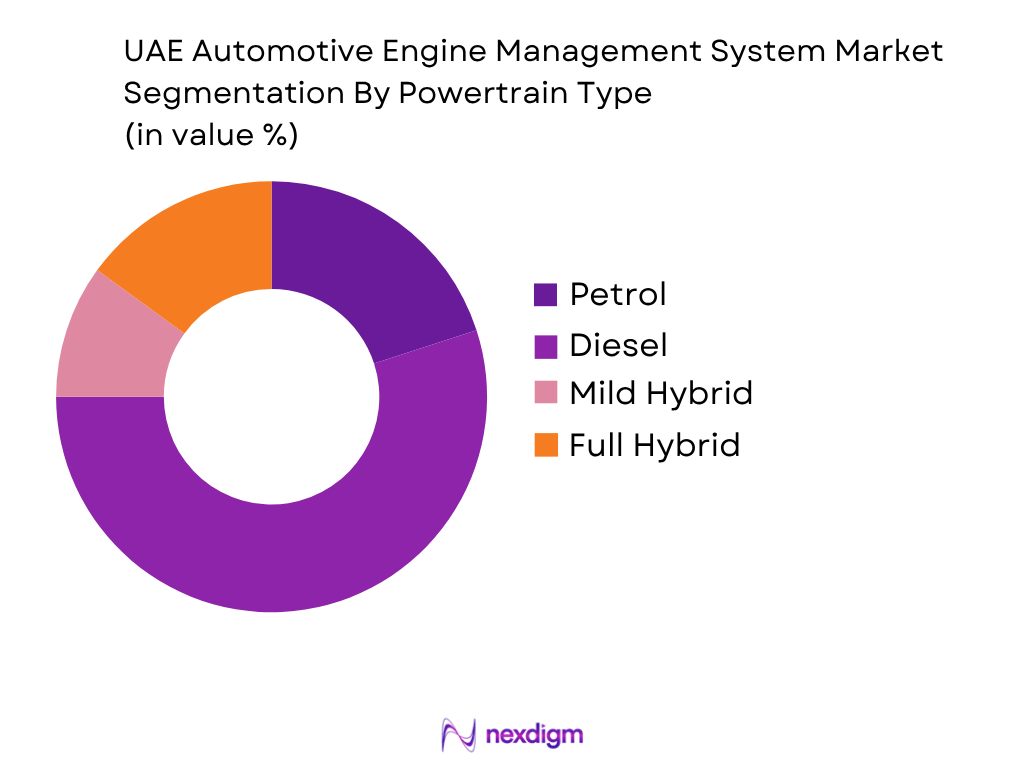
The UAE Automotive Engine Management System Market is segmented into conventional petrol, conventional diesel, mild hybrid, full hybrid, plug-in hybrid and other combustion-assisted powertrains. Conventional petrol vehicles currently represent the dominant EMS segment because the UAE passenger-car fleet has substantial exposure to gasoline-powered sedans, SUVs, crossovers and performance vehicles. Petrol systems require ignition control, lambda sensing, throttle management, knock detection, fuel-pressure control and increasingly direct-injection and turbocharger management. Diesel remains particularly relevant in pickups, commercial vehicles, buses and logistics fleets, where common-rail injection, EGR, turbocharger control, DPF monitoring and SCR systems increase electronic content. Hybrid systems remain smaller but strategically important because they retain combustion-engine control while adding supervisory coordination between the engine, electric motor, battery and transmission. The UAE’s National Electric Vehicles Policy means this mix will progressively move toward hybrid and fully electric architectures.
Competitive Landscape
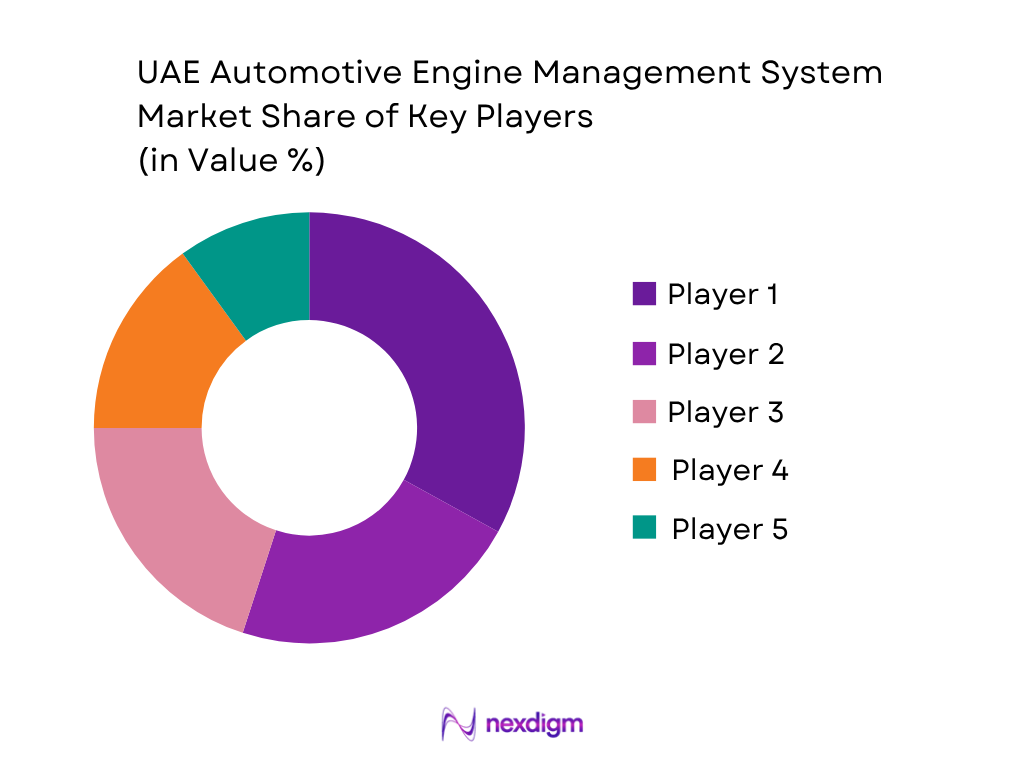
The UAE Automotive Engine Management System Market is supplied primarily by global Tier-1 manufacturers supported by authorized distributors, dealer networks, diesel specialists and independent workshops. Bosch and DENSO have direct UAE footprints, while other international suppliers compete through OE fitment and regional aftermarket channels. DENSO’s Jebel Ali operation explicitly markets engine-management systems, diesel components and ignition products, while Bosch maintains a Dubai Middle East entity and UAE diesel-service workshops in Dubai and Abu Dhabi.
| Company | Established | Headquarters | ECU / Controller Capability | Engine Sensor Portfolio | Fuel-System Capability | Diesel EMS Capability | Hybrid/Powertrain Electronics | UAE/GCC Presence |
| Bosch | 1886 | Gerlingen, Germany | ~ | ~ | ~ | ~ | ~ | ~ |
| DENSO | 1949 | Kariya, Japan | ~ | ~ | ~ | ~ | ~ | ~ |
| AUMOVIO | 2025 as independent company | Frankfurt, Germany | ~ | ~ | ~ | ~ | ~ | ~ |
| BorgWarner | 1928 | Auburn Hills, USA | ~ | ~ | ~ | ~ | ~ | ~ |
| Valeo | 1923 | Paris, France | ~ | ~ | ~ | ~ | ~ | ~ |
UAE Automotive Engine Management System Market Analysis
Growth Drivers
Large Vehicle Base, High Road Utilization and Intensive Fleet Operations
The UAE Automotive Engine Management System Market benefits from a dense, high-utilization vehicle ecosystem in which passenger cars, SUVs, taxis, limousines, buses, delivery fleets and commercial vehicles generate recurring demand for ECUs, oxygen sensors, crankshaft and camshaft sensors, fuel-injection electronics, ignition modules, throttle controls and diesel-management components. Dubai’s Roads and Transport Authority reported that its road network was accommodating more than 3.5 million vehicles per day by the end of 2024, while its regulated mobility fleet included more than 31,000 taxis and limousines and over 1,300 public buses. These are particularly relevant EMS demand pools because high-mileage fleet vehicles accumulate engine operating hours more rapidly than privately used vehicles, accelerating diagnostic requirements and replacement cycles for sensors, injectors, ignition coils, throttle bodies and emissions-related components. The macroeconomic base also supports high-value vehicle ownership and aftermarket expenditure. IMF data place nominal UAE GDP at approximately AED 1,919 billion in 2024, expanding to around AED 2,028 billion in 2025, while the IMF’s latest country profile lists a population of 11.465 million. This combination of a relatively small population and very high road-vehicle utilization creates unusually high automotive electronic intensity per resident. UAE driving conditions also favor large-displacement gasoline engines, turbocharged SUVs and commercial diesel platforms, which carry more complex engine-management requirements than basic naturally aspirated passenger cars. Turbocharged engines require boost-pressure monitoring, electronic wastegate control, knock sensing and precise lambda management; modern diesels require common-rail injection control, EGR coordination, DPF monitoring and exhaust-temperature sensing. The country’s large taxi and limousine fleet additionally favors frequent preventive maintenance and rapid replacement of faulty electronics because vehicle downtime directly affects fleet economics. For suppliers, the implication is that UAE EMS demand is not driven only by new vehicle additions. The installed fleet itself produces a continuous aftermarket requirement for electronic diagnosis and replacement. This creates recurring opportunities for multi-brand sensor suppliers, ECU specialists, fuel-system distributors and workshops equipped to diagnose electronically controlled engines.
Automotive Import, Re-Export and Distribution Hub Strengthening EMS Product Availability
The UAE’s position as a regional automotive import and re-export center is another major growth driver for the Automotive Engine Management System Market because it brings a wide range of Japanese, German, Korean, American and Chinese vehicle platforms into the domestic aftermarket and creates regional distribution opportunities for ECUs, sensors, injectors, ignition systems and diesel electronics. DP World reported that its Dubai terminals handled a record 1.3 million vehicles in 2024, demonstrating the extraordinary scale of automotive logistics passing through the emirate. The Central Bank of the UAE reported total imports of AED 1,177 billion during the first nine months of 2024, while re-exports reached AED 458.4 billion over the same period; motor vehicles were identified among the leading categories in both import and re-export flows. This logistics infrastructure is highly relevant to engine-management systems because the UAE has limited domestic vehicle manufacturing and therefore depends extensively on imported vehicle architectures and replacement components. A diverse imported fleet expands the SKU requirement for oxygen sensors, MAP sensors, MAF sensors, fuel-pressure sensors, throttle bodies, injectors, ECU modules, ignition coils and turbocharger actuators. It also raises the importance of application databases and diagnostic compatibility, because a workshop may service Toyota, Nissan, Mercedes-Benz, BMW, Hyundai, Ford and emerging Chinese platforms within the same operating environment. Dubai’s role extends beyond domestic consumption. In 2024, the UAE government directed development of a new Dubai Car Market intended to reinforce the emirate’s position as an international automotive trading center, further strengthening the distribution environment surrounding automotive parts and electronics. For global Tier-1 and aftermarket EMS suppliers, the UAE can therefore operate as both an end market and a redistribution center covering neighboring GCC and Middle Eastern countries. The presence of Jebel Ali, specialized vehicle terminals, free-zone logistics and established parts distributors lowers the commercial friction associated with stocking numerous electronically differentiated vehicle applications. It also makes the UAE attractive for regional warehouses, technical support centers, ECU programming operations and diesel-service facilities. Consequently, automotive trade infrastructure directly increases the accessibility, breadth and turnover of engine-management components across OEM replacement and independent aftermarket channels.
Market Challenges
Accelerating Electric-Vehicle Infrastructure Reducing Long-Term ICE Electronics Demand
The principal structural challenge for the UAE Automotive Engine Management System Market is the progressive substitution of internal-combustion powertrains by battery-electric vehicles. A full BEV removes the conventional engine ECU together with fuel injectors, ignition coils, oxygen sensors, crankshaft and camshaft engine sensors, throttle-control functions associated with combustion, common-rail diesel systems and most exhaust-aftertreatment electronics. This means electrification does not merely reduce one EMS component category; it eliminates a large cluster of engine-specific electronics simultaneously. The pace of infrastructure development indicates that this substitution risk is becoming commercially material. The Ministry of Energy and Infrastructure reported in July 2024 that UAEV intended to deploy 100 EV chargers during 2024, establishing a national charging foundation for electric mobility. By May 2025, the Ministry stated that the UAE’s electric charging infrastructure had exceeded 700 stations nationwide, showing rapid development of the ecosystem required to support larger electric-vehicle fleets. The federal National Electric Vehicles Policy further formalizes the transition by promoting national charging infrastructure and a broader shift toward electric road transport. For EMS suppliers, the problem is strategic timing. The UAE still operates millions of combustion-powered cars, SUVs, pickups, taxis and commercial vehicles, so conventional engine sensors, injectors and control modules remain commercially important. At the same time, investment must increasingly shift toward technologies that survive electrification, including thermal sensors, vehicle domain controllers, power electronics interfaces, hybrid supervisory software and broader diagnostic systems. Suppliers focused narrowly on ignition coils, oxygen sensors or fuel injection face greater exposure because these products have no direct equivalent in full BEVs. Hybrid vehicles partly mitigate this challenge because they retain the combustion engine, but full electrification ultimately moves electronic value toward battery-management systems, traction inverters and motor controllers. The UAE’s relatively affluent vehicle market may also accelerate technology turnover because consumers and fleet operators can adopt newer propulsion architectures faster than in markets where vehicle replacement cycles are longer. For business professionals evaluating the EMS industry, the key challenge is therefore not an immediate collapse of conventional demand but a gradual reduction in the lifetime value of combustion-specific product portfolios. Suppliers that diversify electronics capability before BEV penetration becomes dominant will have a more defensible position.
Import Dependence and Increasing Multi-Platform Diagnostic Complexity
The UAE Automotive Engine Management System Market also faces structural complexity arising from heavy dependence on imported vehicles and components. The Central Bank of the UAE recorded AED 1,177 billion of imports during the first nine months of 2024, while the country generated AED 458.4 billion of re-exports, reflecting its role as a highly open trading economy. Motor vehicles were among the country’s most important imported and re-exported product categories. The same trade structure continued through 2025, when UAE imports reached AED 1,843.1 billion, compared with AED 1,469.8 billion in 2024, according to the Central Bank’s balance-of-payments analysis. For engine management, this creates two related challenges. First, ECU hardware, microcontrollers, fuel-injection assemblies, precision engine sensors and advanced diagnostic equipment remain exposed to international supply chains. Automotive-grade electronics cannot always be substituted quickly because controllers and sensors require vehicle-specific validation, calibration and communication compatibility. Second, imported vehicle diversity creates an exceptionally fragmented aftermarket. A UAE workshop may encounter European turbocharged direct-injection systems, Japanese naturally aspirated gasoline engines, Korean GDI platforms, American large-displacement engines, Chinese turbo-petrol vehicles and diesel commercial fleets. Each architecture can use different sensor characteristics, ECU communication protocols, immobilizer coding procedures and diagnostic routines. This increases inventory requirements and raises the technical skill threshold for aftermarket repair. An incorrect MAP sensor, oxygen sensor or crankshaft sensor may physically fit yet produce improper signal behavior, while ECU replacement can require immobilizer synchronization, software flashing and vehicle-specific coding. The scale of automotive movement magnifies the issue: DP World handled 1.3 million vehicles at its Dubai terminals in 2024, feeding an already diverse domestic and regional fleet. Diagnostic complexity therefore becomes a market constraint because workshops need advanced scan tools, technical databases, secure programming access and technicians capable of distinguishing electrical faults from mechanical engine problems. Parallel imports can make this more difficult when vehicle specifications differ from officially supported GCC configurations. For EMS suppliers, market success increasingly requires technical support rather than simple parts availability. Manufacturers and distributors able to provide VIN-based application identification, fault-code interpretation, programming support and training have a stronger competitive position than commodity suppliers.
Market Opportunities
Hybrid Powertrains as a Transitional Growth Platform for Advanced Engine Management
Hybrid vehicles represent one of the strongest forward opportunities for the UAE Automotive Engine Management System Market because they support the country’s decarbonization strategy without eliminating combustion-engine electronics. Unlike a full BEV, a hybrid retains the engine ECU, injectors, ignition system, crankshaft and camshaft sensors, oxygen sensors, throttle-control hardware and catalyst-management functions. It then adds supervisory electronics for engine-motor torque coordination, rapid engine restart, thermal optimization and communication with battery and transmission controllers. The present UAE mobility transition provides a strong foundation for these systems. The Ministry of Energy and Infrastructure reported in 2025 that the country already had more than 700 electric charging stations, while its mobility strategy explicitly supports both electric and lower-emission vehicle technologies. At the same time, Dubai’s existing transport system continues to accommodate more than 3.5 million vehicles per day, including over 31,000 taxis and limousines and a public-bus fleet exceeding 1,300 units. These current fleet volumes provide an important base for hybridization because taxis, ride-hailing fleets, premium passenger cars and urban commercial vehicles benefit operationally from reduced idling and optimized engine usage. From an EMS perspective, hybridization can increase electronic value per applicable combustion vehicle rather than merely preserving existing component demand. A conventional engine ECU may manage injection, ignition and emissions; a hybrid powertrain requires those same functions plus coordinated start-stop logic, torque arbitration, catalyst-temperature control, engine restart synchronization and thermal interaction with electrified components. Hybrid systems also increase the importance of reliable CAN communication between engine, transmission, battery and motor controllers. UAE operating conditions create additional engineering requirements because high ambient temperatures place stress on engine cooling, battery thermal systems and electronic modules simultaneously. Suppliers able to integrate conventional EMS capability with hybrid supervisory software can therefore address the transition more effectively than firms selling standalone engine components. This opportunity is especially relevant to Japanese and Korean vehicle platforms, which have extensive hybrid technology portfolios and substantial representation in the UAE. For market entrants, hybrid-compatible sensors, integrated powertrain controllers, electronic throttle systems and diagnostic software represent practical growth areas because they remain relevant throughout the gradual shift away from conventional ICE vehicles.
ECU Diagnostics, Smart Sensors and Regional Aftermarket Distribution
The UAE offers substantial forward opportunity in ECU diagnostics, smart engine sensors, remanufacturing and regional aftermarket distribution because its automotive ecosystem combines large vehicle throughput with extensive cross-border trade. DP World handled 1.3 million vehicles through Dubai terminals in 2024, while UAE re-exports reached AED 458.4 billion during the first nine months of 2024. These figures demonstrate that Dubai is not merely a domestic vehicle market; it is a logistics gateway through which automotive products move into the GCC, Middle East, Africa and South Asia. This structure creates opportunities for EMS suppliers to establish warehouses, calibration centers and multi-brand technical support operations that serve a much larger addressable region. Smart sensors are particularly attractive because modern powertrains use increasing numbers of oxygen, pressure, temperature, position and exhaust sensors. Turbocharged petrol engines need boost-pressure and intake-temperature sensing; direct-injection engines require precise fuel-pressure measurement; diesel engines need exhaust-temperature, DPF differential-pressure and NOx-related sensing. Each sensor adds replacement demand as the installed fleet ages. ECU remanufacturing offers another opportunity because control modules can often be repaired through replacement of damaged power stages, memory components or circuit-board elements rather than complete vehicle-system replacement. However, successful remanufacturing increasingly requires software flashing, immobilizer adaptation and coding capability. The UAE’s digital infrastructure supports this move toward software-intensive service. Dubai RTA recorded 679.6 million digital transactions in 2024, including 13.4 million transactions through smart applications, demonstrating a highly digitized transport-administration environment in which electronic vehicle services are already normal. In 2025, RTA digital-channel revenue reached AED 5.3 billion, illustrating the continuing expansion of digitally enabled mobility services. For EMS businesses, this broader digitization supports connected diagnostics, electronic service histories, remote fault assessment and digitally managed parts distribution. Dubai’s vehicle logistics strength further permits regional scale that can justify deeper inventories of specialized sensors and control modules. Suppliers that combine parts distribution with programming tools, technical training, fault-code libraries and ECU repair capability can capture more value than companies competing solely on replacement hardware.
Future Outlook
The UAE Automotive Engine Management System Market is forecast to expand at ~ CAGR during 2026–2035 under the requested placeholder framework. Future demand will increasingly depend on electronic content per combustion or hybrid vehicle, aftermarket replacement and diagnostic complexity rather than straightforward expansion of conventional ICE volumes. Turbocharged gasoline engines, gasoline direct injection, sophisticated emissions sensing and hybrid powertrains should support higher-value controller and sensor applications. The wider economic backdrop remains favorable. World Bank data place UAE GDP at USD 552.32 billion and GDP per capita at USD 50,273.5, while the IMF expects the economy to continue expanding after approximately 4.0 units of real growth in the preceding period. The IMF’s current UAE profile lists a population of about 11.465 million, sustaining a comparatively affluent domestic market for premium and high-electronic-content vehicles.
Hybridization will be one of the strongest opportunities for EMS suppliers. Hybrid vehicles retain an internal-combustion engine and therefore continue using ECUs, injectors, crankshaft and camshaft sensors, oxygen sensors, electronic throttle controls and emissions systems. They simultaneously introduce engine-motor torque arbitration, rapid engine restart, thermal optimization and supervisory powertrain software, raising the value of control electronics per vehicle. Luxury and performance vehicles will continue to support advanced gasoline engine-management demand. Turbocharged and twin-turbo engines require precise boost control, direct injection, knock detection, lambda management, charge-air temperature monitoring and catalyst protection. Extreme UAE ambient temperatures further increase the importance of robust coolant, intake-air, oil and exhaust-temperature sensing, as well as heat-tolerant electronic packaging. The replacement market will remain structurally important. DENSO’s UAE engine-management range includes lambda, MAP, camshaft, crankshaft and exhaust-gas-temperature sensors alongside EGR products. Bosch also maintains diesel workshop coverage in Dubai and Abu Dhabi. These established channels illustrate the ongoing demand generated by sensor failures, injector servicing, ECU faults and commercial-fleet maintenance.
Major Players
- Robert Bosch GmbH / Bosch Middle East
- DENSO Corporation / DENSO MENA
- AUMOVIO
- BorgWarner Inc.
- Valeo
- PHINIA Inc. / Delphi
- FORVIA HELLA
- Marelli
- Astemo Ltd.
- Schaeffler Group
- Mitsubishi Electric Automotive
- AISIN Corporation
- Hyundai Mobis
- Niterra Co., Ltd.
- Standard Motor Products / Intermotor
Key Target Audience
- Automotive OEMs and Authorized Vehicle Distributors
- Engine ECU, Sensor and Fuel-Injection Component Manufacturers
- Automotive Tier-1 and Tier-2 Suppliers
- Automotive Parts Importers, Distributors and Re-Export Companies
- Fleet Operators and Automotive Service Networks
- Automotive Semiconductor and Embedded Software Companies
- Investments and Venture Capitalist Firms
- Government and Regulatory Bodies (Ministry of Energy and Infrastructure, Ministry of Industry and Advanced Technology, Roads and Transport Authority Dubai, Integrated Transport Centre Abu Dhabi)
Research Methodology
Step 1: Identification of Key Variables
The first phase develops a UAE Automotive Engine Management System ecosystem covering international Tier-1 suppliers, vehicle distributors, luxury dealers, parts importers, diesel specialists, fleet operators and workshops. Key variables include vehicle parc, petrol-diesel-hybrid mix, ECU content, sensor count, direct-injection penetration, turbocharger penetration, vehicle age, ambient-temperature exposure and aftermarket replacement behavior.
Step 2: Market Analysis and Construction
The top-down approach maps applicable passenger vehicles, SUVs, pickups and commercial vehicles against representative powertrain technologies. The bottom-up model builds market demand from engine ECUs, powertrain modules, lambda sensors, pressure sensors, injectors, ignition components, throttle systems and exhaust-management electronics. OEM and replacement channels are assessed separately because the UAE is primarily an import- and aftermarket-led automotive economy.
Step 3: Hypothesis Validation and Expert Consultation
Market assumptions are validated through CATIs with Tier-1 suppliers, authorized automotive distributors, independent parts importers, premium workshops, diesel specialists and commercial-fleet maintenance operators. Interviews test vehicle-platform coverage, sensor replacement patterns, ECU repair frequency, direct-injection penetration, diesel common-rail servicing, high-temperature component failures and hybrid-system adoption.
Step 4: Research Synthesis and Final Output
The final phase triangulates company data, government and macroeconomic indicators, distributor information and primary interviews. Forecast scenarios incorporate vehicle-fleet growth, premiumization, turbocharging, hybridization, aftermarket replacement, ECU diagnostic complexity, EV substitution and Dubai’s role as a GCC automotive-parts distribution center to generate validated market and segment forecasts.

- Executive Summary
- Research Methodology (Market Definitions and Assumptions, Abbreviations, Engine Management System Market Boundary, Vehicle-in-Operation Mapping, New Vehicle Registration Assessment, ECU Content-per-Vehicle Assessment, Engine Sensor Content Analysis, Fuel Injection Mapping, Petrol-Diesel-Hybrid Powertrain Mapping, Luxury Vehicle Electronics Assessment, OEM versus Aftermarket Assessment, Vehicle Age and Replacement Cycle Analysis, Top-Down Analysis, Bottom-Up Analysis, Demand-Side Assessment, Supply-Side Assessment, Distributor-Workshop-Tier-1 Interviews, Data Triangulation, EV Substitution Scenarios, Forecasting Framework, Limitations and Future Conclusions)

- Definition and Scope
- Evolution of Electronic Engine Management in the UAE
- Transition from Mechanical Fuel Systems to Electronic Fuel Injection
- Luxury and Performance Vehicle Engine Management Evolution
- SUV and Off-Road Vehicle Powertrain Electronics Evolution

- Growth Drivers (High Passenger Vehicle Ownership, Large SUV and Luxury Vehicle Base, Strong Automotive Aftermarket, Turbocharged Engine Penetration, Direct-Injection Adoption, Commercial Vehicle Fleet Demand, Engine Sensor Replacement, Hybrid Vehicle Adoption)
- Market Challenges (Battery-Electric Substitution, Imported Electronics Dependence, Parallel Parts Channels, Counterfeit Components, High ECU Software Complexity, Heat-Related Component Stress, Vehicle Platform Fragmentation)
- Market Opportunities (Hybrid Engine Management, Premium Vehicle Diagnostics, Smart Sensors, ECU Remanufacturing, Diesel Fleet Electronics, Thermal-Resistant Sensors, GDI Components, Software Diagnostics)
- Market Trends (Turbo-Petrol Engines, Direct Injection, Hybridization, Connected Diagnostics, ECU Reprogramming, Smart Sensors, PHEV Growth, Chinese Vehicle Platform Entry)
- SWOT Analysis
- Porter’s Five Forces Analysis
- PESTLE Analysis

- By Market Value (2020-2025)
- By Engine Management System Unit Volume (2020-2025)
- By Engine ECU/ECM Unit Volume (2020-2025)

- By Component Type (In Value %)
Engine Control Unit / Engine Control Module
Powertrain Control Module
Engine and Exhaust Sensors
Fuel Injectors
High-Pressure Fuel Pumps - By Vehicle Type (In Value %)
Passenger Cars
Luxury Passenger Cars
SUVs and Crossovers
Large SUVs
Pickup Trucks - By Powertrain Type (In Value %)
Conventional Petrol
Conventional Diesel
Mild Hybrid
Full Hybrid - By Application (In Value %)
Fuel Injection Management
Ignition Timing Management
Electronic Throttle Control
Air-Fuel Ratio Management
Turbocharger Boost Control - By Emirate (In Value %)
Dubai
Abu Dhabi
Sharjah
Ajman
Ras Al Khaimah

- Market Share of Major Players by Value
- Cross Comparison Parameters (Engine ECU and Powertrain Controller Portfolio Breadth, Petrol-Diesel-Hybrid Control Capability, Engine Sensor and Fuel-Injection Portfolio Depth, Luxury-Performance-SUV Vehicle Coverage, High-Temperature and Harsh-Environment Product Capability, UAE/GCC Authorized Distribution and Workshop Reach, Diagnostic Software and ECU Programming Capability, Hybrid and Software-Defined Powertrain Readiness)
- SWOT Analysis of Major Players
- Detailed Profiles of Major Companies
Robert Bosch GmbH / Bosch Middle East
DENSO Corporation / DENSO Sales Middle East & North Africa
AUMOVIO
BorgWarner Inc.
Valeo
PHINIA Inc. / Delphi
FORVIA HELLA
Marelli
Astemo Ltd.
Schaeffler Group
Mitsubishi Electric Automotive
AISIN Corporation
Hyundai Mobis
Niterra Co., Ltd.
Standard Motor Products / Intermotor

- Private Passenger Vehicle EMS Demand
- Luxury Vehicle Owner Demand
- SUV and Off-Road User Demand
- Taxi Fleet EMS Demand
- Ride-Hailing Fleet Demand

- By Market Value (2026-2035)
- By Engine Management System Unit Volume (2026-2035)
- By Engine ECU/ECM Volume (2026-2035)


 Request a Sample
 Ask for Customization
 Get a Quote
 Enquire Now