
 Download PDF
Market Overview
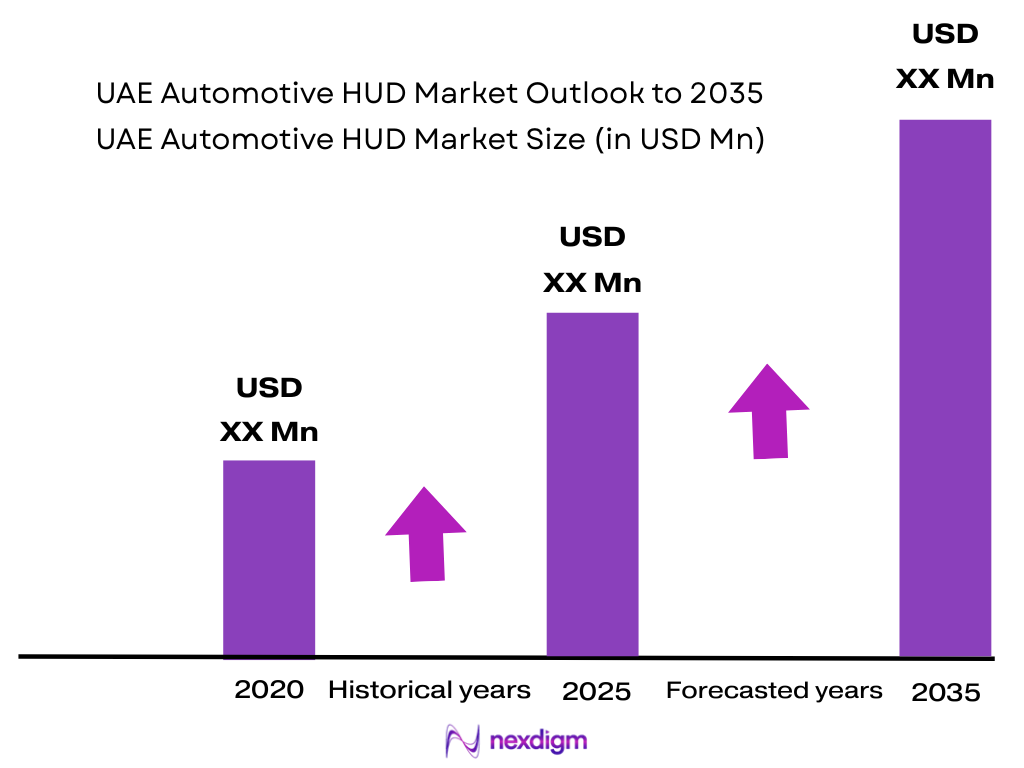
The UAE Automotive HUD Market was valued at approximately USD 42.6 million in 2024 and is projected to reach around USD 154.8 million by 2035, registering a CAGR of approximately 15.5% during 2026-2035. The market size is derived from OEM-installed HUD systems, aftermarket HUD solutions, premium vehicle penetration, and automotive digital cockpit adoption trends. The UAE automotive cockpit electronics market, which includes HUD systems, instrument clusters, infotainment systems, and connected displays, was valued at USD 800 million in 2024, creating a strong ecosystem for HUD adoption. (Verified Market Research) The global automotive HUD market was valued at approximately USD 1.8 billion in 2024, highlighting increasing integration of HUD technology into modern vehicles. (Emergen Research). The UAE Automotive HUD Market is primarily concentrated across Dubai, Abu Dhabi, and Sharjah due to strong luxury vehicle sales, premium automotive dealership networks, and advanced mobility infrastructure. Dubai represents the largest automotive technology hub because the city recorded approximately ~1.8 million registered vehicles in recent years, supported by high ownership of premium brands such as Mercedes-Benz, BMW, Porsche, Lexus, and Range Rover. Abu Dhabi contributes through government fleet modernization, smart mobility initiatives, and higher adoption of connected vehicles. The UAE luxury automotive ecosystem, valued at approximately USD 4 billion in 2023, supports demand for advanced features including HUD systems, ADAS interfaces, and digital cockpit solutions.
Market Segmentation
By HUD Technology Type
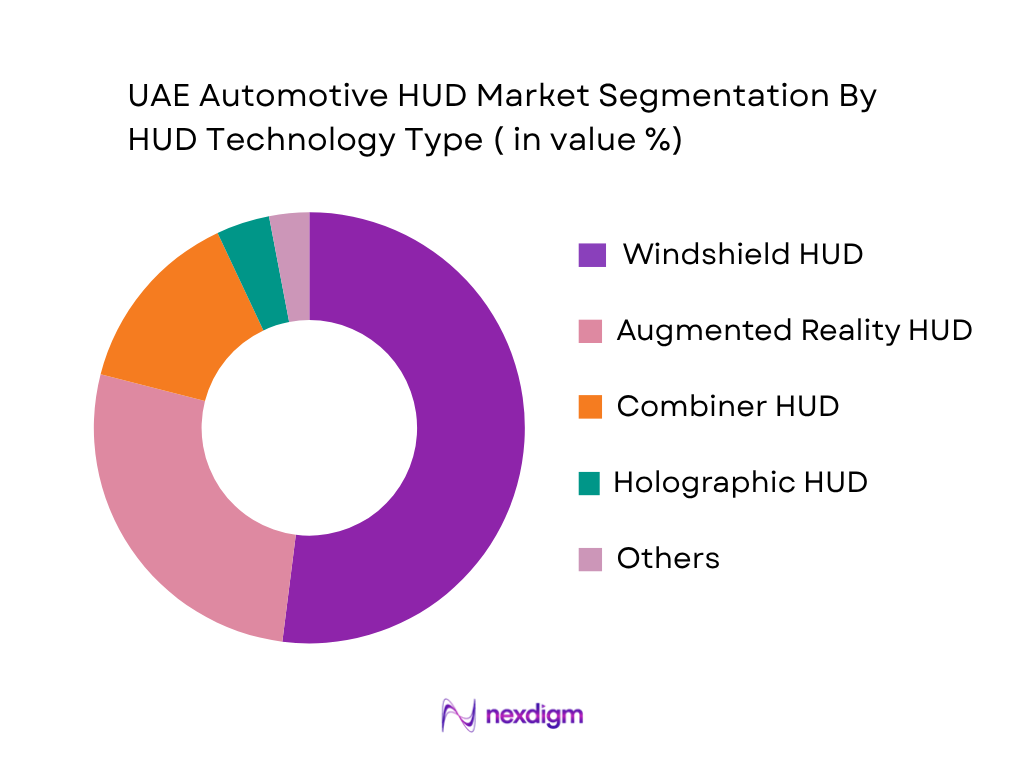
The UAE Automotive HUD Market is segmented into Windshield HUD, Combiner HUD, Augmented Reality HUD, Holographic HUD, and Laser-Based HUD. Windshield HUD dominated the market with approximately 52% share in 2024 due to its widespread adoption among luxury sedans and premium SUVs. Windshield HUD provides a larger projection area, improved visibility, and better integration with navigation and driver assistance systems. Luxury vehicle manufacturers operating in the UAE increasingly offer windshield HUD systems as factory-installed features. AR-HUD accounted for approximately 27% share in 2024 and is expected to witness the fastest growth due to its ability to project navigation arrows, ADAS warnings, and real-time driving information directly onto the driver’s field of view. The UAE Automotive HUD market segmentation by technology is also tracked through AR-HUD and conventional HUD categories by industry research providers.
By Vehicle Type
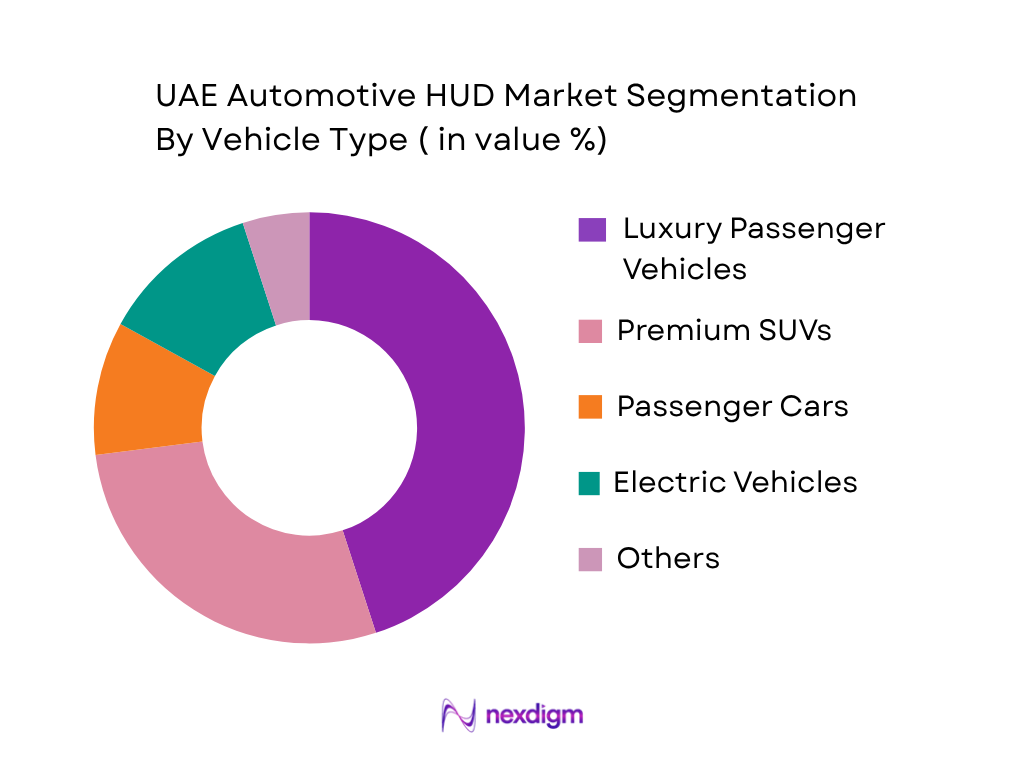
The UAE Automotive HUD Market is segmented into Luxury Passenger Vehicles, Premium SUVs, Electric Vehicles, Passenger Cars, Sports Vehicles, and Commercial Vehicles. Luxury passenger vehicles dominated with approximately 45% market share in 2024 due to the UAE’s strong premium vehicle ownership base and consumer preference for advanced automotive features. Premium SUVs represented around 28% share, supported by strong demand for vehicles from brands such as Range Rover, Mercedes-Benz, BMW, and Porsche. Electric vehicles accounted for approximately 12% share, driven by increasing adoption of Tesla, Mercedes EQ models, BMW i-series, and other premium EV platforms equipped with digital cockpit technologies. Commercial vehicle adoption remains limited because HUD systems are primarily positioned as premium driver-assistance features.
Competitive Landscape
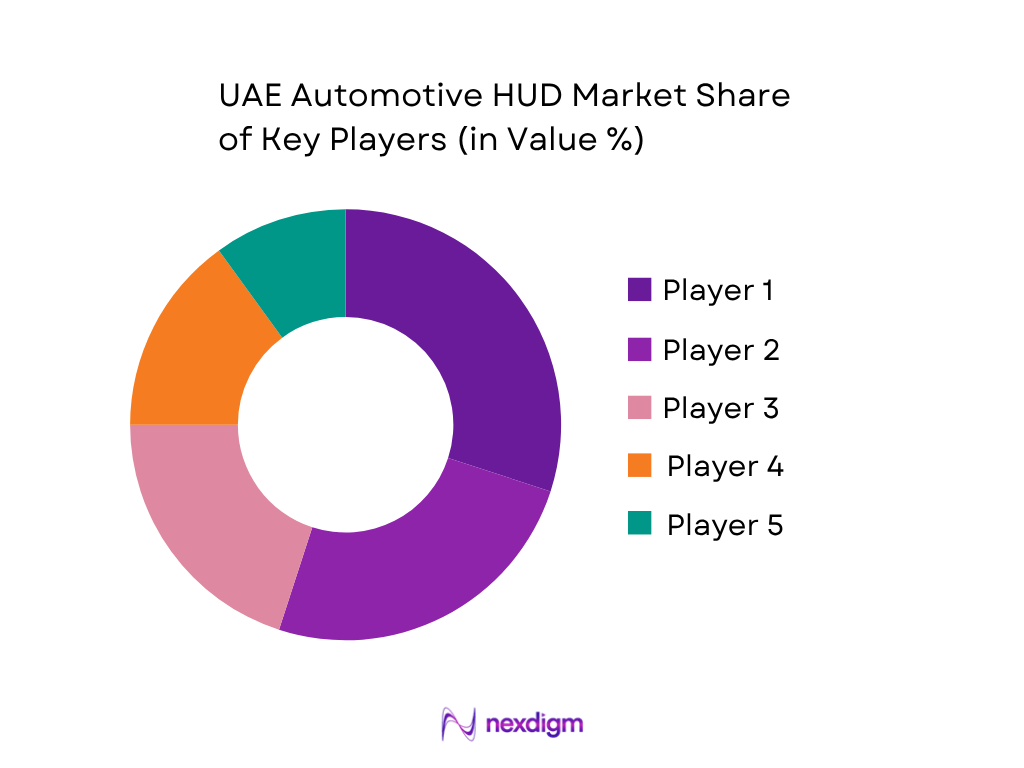
The UAE Automotive HUD Market is dominated by global automotive electronics suppliers including Continental AG, Bosch, Visteon, DENSO, Panasonic Automotive Systems, and Nippon Seiki. These companies supply HUD solutions to international vehicle manufacturers and compete through optical technology innovation, AR projection capability, software integration, and OEM partnerships. The competitive environment is highly technology-driven because HUD systems require integration between display modules, sensors, navigation platforms, and vehicle operating systems.
| Company | Establishment Year | Headquarters | HUD Technology Focus | OEM Partnership Scale | Product Capability | Manufacturing Presence | Key Strength |
| Continental AG | 1871 | Hanover, Germany | ~ | ~ | ~ | ~ | ~ |
| Bosch | 1886 | Gerlingen, Germany | ~ | ~ | ~ | ~ | ~ |
| DENSO Corporation | 1949 | Kariya, Japan | ~ | ~ | ~ | ~ | ~ |
| Visteon Corporation | 2000 | Michigan, USA | ~ | ~ | ~ | ~ | ~ |
| Panasonic Automotive Systems | 2022 | Yokohama, Japan | ~ | ~ | ~ | ~ | ~ |
UAE Automotive HUD Market Analysis
Market Growth Drivers
Luxury Vehicle Ownership Expansion
The UAE Automotive HUD Market is strongly supported by the expansion of luxury vehicle ownership, as premium vehicles are among the earliest adopters of advanced cockpit technologies such as head-up displays, digital dashboards, and driver assistance interfaces. The UAE automotive ecosystem benefits from high-income consumers and a strong premium vehicle base. According to the World Bank, the UAE recorded a GDP per capita of approximately USD 50,000 in 2024, reflecting strong consumer purchasing capacity for technologically advanced vehicles. The International Monetary Fund reported that the UAE economy expanded with continued strength in non-oil sectors, including transportation, trade, and mobility-related services. Dubai Roads and Transport Authority reported that Dubai had more than 4 million registered vehicles in 2024, creating a large installed vehicle base for premium technology adoption. Luxury vehicle brands including Mercedes-Benz, BMW, Porsche, Lexus, and Range Rover continue to introduce HUD-equipped models across premium sedans and SUVs. The UAE’s position as a regional automotive trading hub, combined with high demand for feature-rich vehicles, supports increasing integration of HUD systems as manufacturers enhance in-vehicle digital experiences.
Rising Demand for Advanced Driver Assistance Systems
Increasing adoption of advanced driver assistance systems is accelerating demand for Automotive HUD solutions in the UAE, as HUD technology enables safer and more intuitive presentation of navigation, speed information, lane guidance, and collision warnings. The UAE government has prioritized road safety and smart transportation infrastructure, supporting the integration of advanced automotive technologies. According to the UAE Ministry of Interior, the country recorded approximately 4.5 million registered vehicles in 2024, creating a significant opportunity for safety-enhancing technologies. Dubai’s Roads and Transport Authority continues to expand intelligent transportation systems, including connected mobility solutions and smart road infrastructure. The World Bank reported that the UAE maintained high urbanization levels, with approximately 87% of the population living in urban areas in 2024, increasing demand for efficient and technology-enabled mobility solutions. Automotive manufacturers are increasingly integrating HUD systems with ADAS platforms, particularly in premium SUVs and electric vehicles sold in UAE markets. The combination of government road safety initiatives, urban mobility development, and increasing consumer preference for assisted driving features is supporting wider HUD adoption.
Market Challenges
High HUD System Cost
High technology complexity remains a major challenge for the UAE Automotive HUD Market, particularly because HUD systems require integration of optical components, display modules, sensors, processors, and vehicle software platforms. Premium HUD systems are generally introduced first in luxury vehicles, limiting adoption among mid-range vehicle categories. The challenge is amplified by the UAE’s dependence on imported automotive electronics, as the country imports a significant portion of vehicles and automotive components. According to the UAE Ministry of Economy, the country’s automotive sector relies heavily on international supply chains due to limited domestic vehicle manufacturing capabilities. The World Bank reported that the UAE’s merchandise trade value remained above USD 500 billion in 2024, highlighting the economy’s strong dependence on global trade networks. Global semiconductor supply conditions and logistics disruptions can influence availability of automotive electronic components required for HUD production. Additionally, integration of HUD technology requires compatibility with vehicle software architecture, windshield specifications, and dashboard systems, increasing technical complexity for manufacturers and aftermarket providers operating in the UAE.
Limited Consumer Awareness and Aftermarket Installation Limitations
Limited consumer awareness and technical barriers associated with aftermarket installation represent key challenges for broader Automotive HUD adoption in the UAE. While luxury vehicle owners are familiar with advanced automotive technologies, awareness among mainstream vehicle users regarding HUD benefits remains comparatively limited. The UAE Ministry of Industry and Advanced Technology has highlighted the importance of technology adoption and digital transformation across industrial sectors, but automotive electronics integration remains largely dependent on original equipment manufacturers. The UAE recorded a population of approximately 11 million people in 2024, according to World Bank demographic data, with a highly urbanized consumer base concentrated in cities such as Dubai and Abu Dhabi. However, aftermarket HUD installation faces challenges related to windshield calibration, driver visibility alignment, vehicle electronics compatibility, and software integration. Dubai Roads and Transport Authority’s focus on smart mobility emphasizes the importance of integrated vehicle technologies rather than standalone aftermarket solutions. As a result, factory-installed HUD systems remain more reliable and scalable compared with independent installation solutions, limiting aftermarket expansion.
Market Opportunities
AR-HUD Adoption and Autonomous Vehicle Interface Development
Augmented Reality HUD adoption represents a significant opportunity for the UAE Automotive HUD Market as vehicle manufacturers increasingly transition toward advanced digital cockpit systems and autonomous driving interfaces. AR-HUD technology enables real-time projection of navigation directions, hazard warnings, lane guidance, and driver assistance information directly within the driver’s viewing area. The opportunity is supported by the UAE’s rapid development of smart mobility infrastructure and autonomous transportation initiatives. Dubai Roads and Transport Authority has been actively implementing smart transportation programs, including autonomous mobility strategies and intelligent road systems. According to the International Energy Agency, global electric vehicle adoption exceeded 17 million electric car sales in 2024, accelerating demand for advanced digital vehicle interfaces. The UAE has also expanded EV infrastructure, with charging networks increasing across major urban areas. Government initiatives such as Dubai Autonomous Transportation Strategy and smart city development programs create favorable conditions for advanced vehicle technologies. As premium and electric vehicles increasingly adopt software-driven cockpit systems, AR-HUD solutions can become an important interface between drivers, vehicles, and connected mobility infrastructure.
Digital Cockpit Integration and Smart Mobility Initiatives
Digital cockpit integration provides a major growth opportunity for the UAE Automotive HUD Market as vehicle manufacturers increasingly combine HUD systems with infotainment platforms, connected services, navigation systems, and driver assistance technologies. The UAE’s advanced digital infrastructure and strong smart city ecosystem support adoption of connected vehicle technologies. According to the World Bank, the UAE maintained internet penetration above 99% of the population in 2024, creating a strong foundation for connected mobility services and cloud-based automotive applications. The UAE government’s Smart Mobility initiatives encourage integration of digital technologies across transportation systems, supporting demand for intelligent vehicle solutions. Dubai’s Roads and Transport Authority continues investments in connected transportation infrastructure, autonomous mobility solutions, and smart road technologies. The UAE also recorded continued growth in electric vehicle adoption supported by government sustainability programs and charging infrastructure expansion. Automotive manufacturers are increasingly using HUD systems as part of complete digital cockpit architectures, allowing seamless integration of navigation, connectivity, and safety information. This shift creates opportunities for HUD suppliers to collaborate with OEMs and mobility technology providers operating in the UAE.
Future Outlook
The UAE Automotive HUD Market is expected to experience strong expansion during the forecast period due to increasing premium vehicle sales, rising EV adoption, and integration of advanced driver assistance technologies. The transition toward software-defined vehicles and digital cockpit architectures will accelerate HUD implementation across luxury and electric vehicle segments. AR-HUD technology is expected to become a major growth contributor as manufacturers focus on immersive navigation and autonomous driving interfaces. The market is projected to grow from USD 42.6 million in 2024 to USD 154.8 million by 2035, supported by a CAGR of 15.5% during 2026-2035.
Major Players
- Continental AG
- Robert Bosch GmbH
- DENSO Corporation
- Visteon Corporation
- Panasonic Automotive Systems
- Harman International
- Nippon Seiki Co., Ltd.
- LG Electronics Vehicle Component Solutions
- Samsung Electronics
- WayRay
- MicroVision Inc.
- Garmin Ltd.
- Yazaki Corporation
- Furukawa Electric Co., Ltd.
- HUDWAY
Key Target Audience
- Automotive OEMs (Mercedes-Benz Middle East, BMW Middle East, Toyota UAE, Tesla Middle East, Porsche Middle East)
- Tier-1 Automotive Suppliers (HUD manufacturers, ADAS suppliers, automotive electronics providers)
- Display Technology Companies (AR display manufacturers, optical component suppliers, micro-display providers)
- Investments and Venture Capitalist Firms (Automotive technology funds, mobility-focused venture capital firms, private equity investors)
- Government and Regulatory Bodies (Roads and Transport Authority Dubai, Department of Municipalities and Transport Abu Dhabi, UAE Ministry of Industry and Advanced Technology)
- Automotive Dealership Groups (Luxury vehicle dealership networks and premium automotive distributors)
- Fleet Operators (Government fleets, corporate mobility operators, transportation companies)
- Electric Vehicle and Smart Mobility Companies (EV manufacturers, autonomous mobility providers)
Research Methodology
Step 1: Identification of Key Variables
The initial research phase involves developing a comprehensive ecosystem map of the UAE Automotive HUD Market covering vehicle manufacturers, HUD technology suppliers, Tier-1 automotive electronics companies, display manufacturers, dealership networks, and smart mobility stakeholders. This stage uses extensive secondary research from automotive databases, company filings, industry associations, vehicle registration reports, and technology publications to identify critical variables such as HUD penetration rate, OEM integration trends, technology adoption, vehicle segment demand, pricing structures, and competitive positioning.
Step 2: Market Analysis and Construction
This stage focuses on constructing the UAE Automotive HUD Market model through detailed analysis of historical automotive sales, premium vehicle registrations, luxury vehicle adoption, digital cockpit penetration, and HUD installation trends. Revenue estimation is performed through a combination of bottom-up and top-down approaches by evaluating HUD system pricing, OEM factory-fit volumes, aftermarket installations, supplier revenues, and vehicle segment adoption rates. Market sizing is further validated using regional automotive electronics benchmarks.
Step 3: Hypothesis Validation and Expert Consultation
Market assumptions and analytical hypotheses are validated through consultations with automotive industry stakeholders including OEM representatives, HUD technology suppliers, automotive electronics distributors, dealership executives, and mobility technology providers. Computer-assisted telephone interviews (CATIs), expert discussions, and supplier assessments are conducted to understand HUD adoption patterns, technology preferences, procurement strategies, and future demand outlook within the UAE automotive ecosystem.
Step 4: Research Synthesis and Final Output
The final research stage integrates primary and secondary findings to create a detailed UAE Automotive HUD Market assessment. Direct industry interactions are used to validate market size calculations, segmentation analysis, competitive landscape evaluation, and growth forecasts. The final output combines quantitative analysis with qualitative insights to provide actionable intelligence for automotive manufacturers, technology providers, investors, and mobility stakeholders.

- Executive Summary
- Research Methodology (Market Definition and Scope, Automotive HUD Classification Framework, Market Boundary and Inclusion Criteria, Research Assumptions, Abbreviations, Market Sizing Methodology, Revenue Estimation Approach, Volume Estimation Approach, Top-Down Market Assessment, Bottom-Up Market Assessment, OEM Production Analysis, Vehicle Registration Analysis, Demand-Side Assessment, Supply-Side Assessment, Primary Interviews with Automotive OEMs, Tier-1 Suppliers and Technology Providers, Secondary Research Framework, Data Triangulation Model, Forecasting Framework, Market Validation Process, Research Limitations)

- Definition and Scope
- Automotive HUD Technology Evolution and Industry Development Timeline
- UAE Automotive Display Technology Adoption Landscape
- Automotive HUD Ecosystem Analysis

- Market Growth Drivers (Luxury Vehicle Ownership Expansion, Rising Demand for Advanced Driver Assistance Systems, Premium Vehicle Feature Adoption, Increasing EV Sales, Connected Vehicle Development, Road Safety Technology Demand, High Purchasing Power)
- Market Challenges (High HUD System Cost, Limited Consumer Awareness, Complex Vehicle Integration Requirements, Dependence on Imported Components, Windshield Compatibility Issues, Aftermarket Installation Limitations)
- Market Opportunities (AR-HUD Adoption, EV Manufacturer Expansion, Autonomous Vehicle Interface Development, Smart Mobility Initiatives, Premium Vehicle Customization Demand, Digital Cockpit Integration)
- Market Trends (Augmented Reality Navigation, Large Field-of-View HUD Systems, AI-Based Driver Assistance Display, Connected Navigation Projection, Personalized Driver Interfaces, Digital Cockpit-HUD Integration)
- Regulatory and Industry Standards Analysis (UAE Vehicle Safety Regulations, ADAS Compliance Requirements, Automotive Electronics Standards, Data Connectivity Regulations, Vehicle Modification Guidelines)
- SWOT Analysis
- Porter’s Five Forces Analysis
- PESTLE Analysis

- By Market Value (2020-2025)
- By HUD System Installation Volume (2020-2025)
- By Average Selling Price of HUD Systems (2020-2025)
- By Vehicle Integration Rate (2020-2025)
- By OEM Factory-Fitted HUD Penetration (2020-2025)
- By Aftermarket HUD Adoption Rate (2020-2025)

- By HUD Technology Type (In Value %)
Windshield-Based Head-Up Display (W-HUD)
Combiner Head-Up Display (C-HUD)
Augmented Reality Head-Up Display (AR-HUD)
Holographic Head-Up Display
Laser-Based HUD Systems - By Display Technology (In Value %)
TFT-LCD Based HUD
DLP-Based HUD
LCOS-Based HUD
OLED-Based HUD
MicroLED-Based HUD - By Vehicle Type (In Value %)
Passenger Cars
Luxury Passenger Vehicles
Premium SUVs
Sports and Performance Vehicles
Electric Vehicles
Commercial Vehicles - By Vehicle Price Category (In Value %)
Entry Premium Vehicles
Mid-Premium Vehicles
Luxury Vehicles
Ultra-Luxury Vehicles - By Application Type (In Value %)
Navigation Projection
Driver Assistance Information
Vehicle Speed Display
Safety Alerts and Warning Notifications
Infotainment Integration
Autonomous Driving Interface - By End User Category (In Value %)
Individual Vehicle Owners
Fleet Operators
Luxury Vehicle Buyers
Corporate Mobility Providers
Government and Security Fleets

- Market Share Analysis of Major Players (By Revenue, HUD Shipments, Vehicle OEM Partnerships, Technology Segment, Vehicle Segment)
- Cross Comparison Parameters (Display Technology Capability, AR-HUD Development Capability, Field of View Performance, Virtual Image Distance Range, Brightness and Visibility Performance, OEM Partnership Strength, HUD Software Integration Capability, Production and Manufacturing Capacity)
- Pricing Analysis (By HUD Technology Type, Vehicle Segment, OEM Integration Level, Aftermarket Category)
- SWOT Analysis Of Major Players
- Major Companies Operating in UAE Automotive HUD Market
Continental AG
DENSO Corporation
Panasonic Automotive Systems
Robert Bosch GmbH
Visteon Corporation
Harman International
Nippon Seiki Co., Ltd.
Yazaki Corporation
Furukawa Electric Co., Ltd.
LG Electronics Vehicle Component Solutions
Samsung Electronics
WayRay
MicroVision, Inc.
Garmin Ltd.
HUDWAY

- Luxury Vehicle Buyer Behaviour Assessment
- Automotive Technology Adoption Analysis
- Vehicle Segment-Wise HUD Demand Assessment
- Consumer Purchase Decision Analysis
- Willingness to Pay Analysis for HUD Features

- By Market Value (2026-2035)
- By HUD System Installation Volume (2026-2035)
- By Average Selling Price of HUD Systems (2026-2035)
- By Vehicle Integration Rate (2026-2035)
- By OEM Factory-Fitted HUD Penetration (2026-2035)
- By Aftermarket HUD Adoption Rate (2026-2035)


 Request a Sample
 Ask for Customization
 Get a Quote
 Enquire Now