

 Download PDF
Market Overview
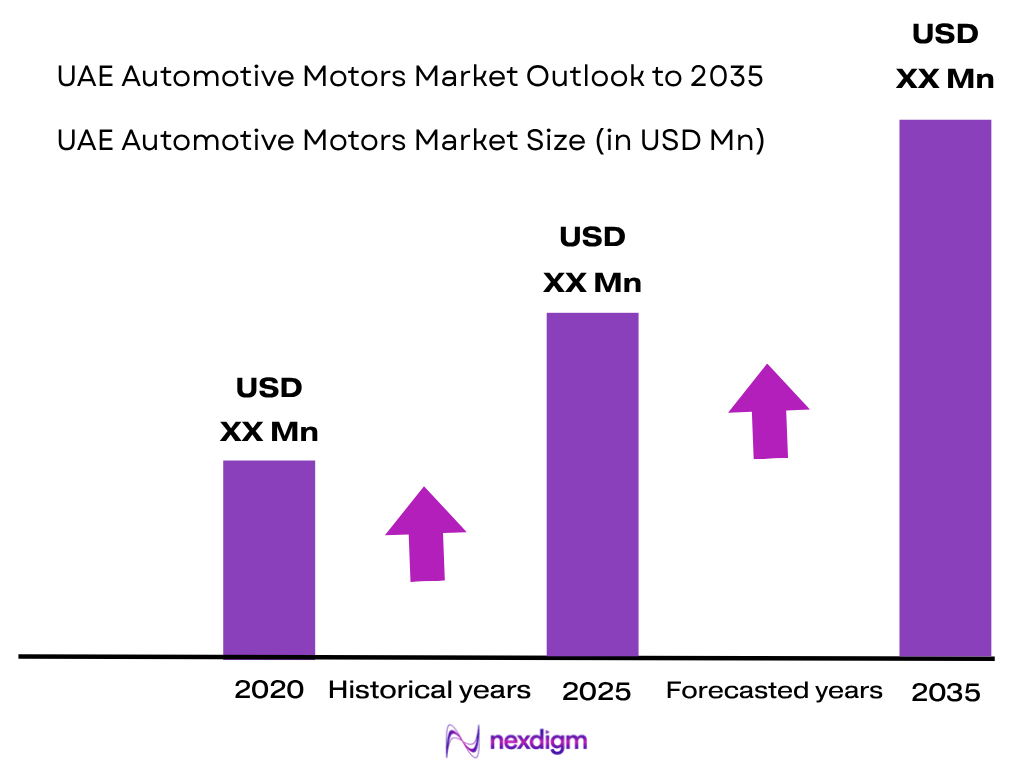
The UAE Automotive Motors Market is valued at approximately ~USD XX million, based on the requested placeholder valuation. Demand is supported by a large and expanding vehicle parc: Dubai alone reached 2.5 million registered vehicles, representing roughly half of vehicles registered across the UAE, while its rental fleet expanded from 49,725 vehicles to 71,040 vehicles between the preceding and latest reporting periods. Rising vehicle ownership increases installed and replacement demand for starter, alternator, auxiliary and traction motors.
Dubai and Abu Dhabi form the principal demand centres for the UAE Automotive Motors Market because of their vehicle populations, dealership networks, fleet operators, premium-car concentration and expanding electrification infrastructure. Dubai’s electric vehicle parc increased from 25,929 vehicles to 37,486 vehicles across the two relevant reporting periods, while registered vehicles reached 2.5 million. Dubai additionally functions as a regional automotive import and re-export gateway, while Abu Dhabi’s large government, corporate, commercial and private vehicle fleets reinforce automotive-component demand.
Market Segmentation
By Motor Type
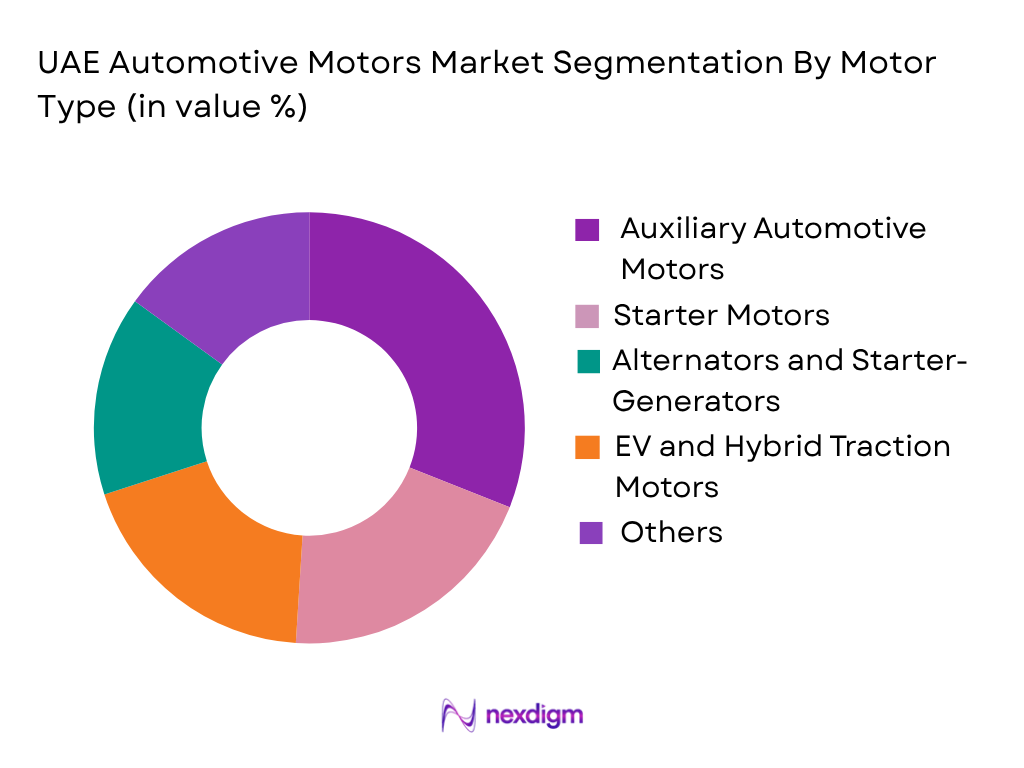
The UAE Automotive Motors Market is segmented by motor type into starter motors, alternators and starter-generators, traction motors, HVAC and cooling motors, electric power steering motors, pump motors, and other auxiliary motors. Auxiliary automotive motors hold the dominant analytical market share, primarily because modern passenger vehicles contain numerous small electric motors supporting thermal management, cabin comfort, steering, pumps, windows, seats, wipers and other electrically operated systems. This is particularly relevant in the UAE, where high ambient temperatures make air-conditioning, cooling fans and thermal-management systems critical vehicle functions. Starter motors and alternators retain substantial demand because the UAE vehicle parc remains predominantly combustion-engine based, creating recurring replacement requirements through independent garages and authorized workshops. Traction motors are a smaller installed segment but are becoming strategically important as Dubai’s EV parc expands. The emirate recorded 37,486 EVs at the end of 2024, compared with 25,929 at the end of 2023, increasing the addressable base for permanent-magnet motors, integrated e-drives and associated high-voltage components.
By Vehicle Type
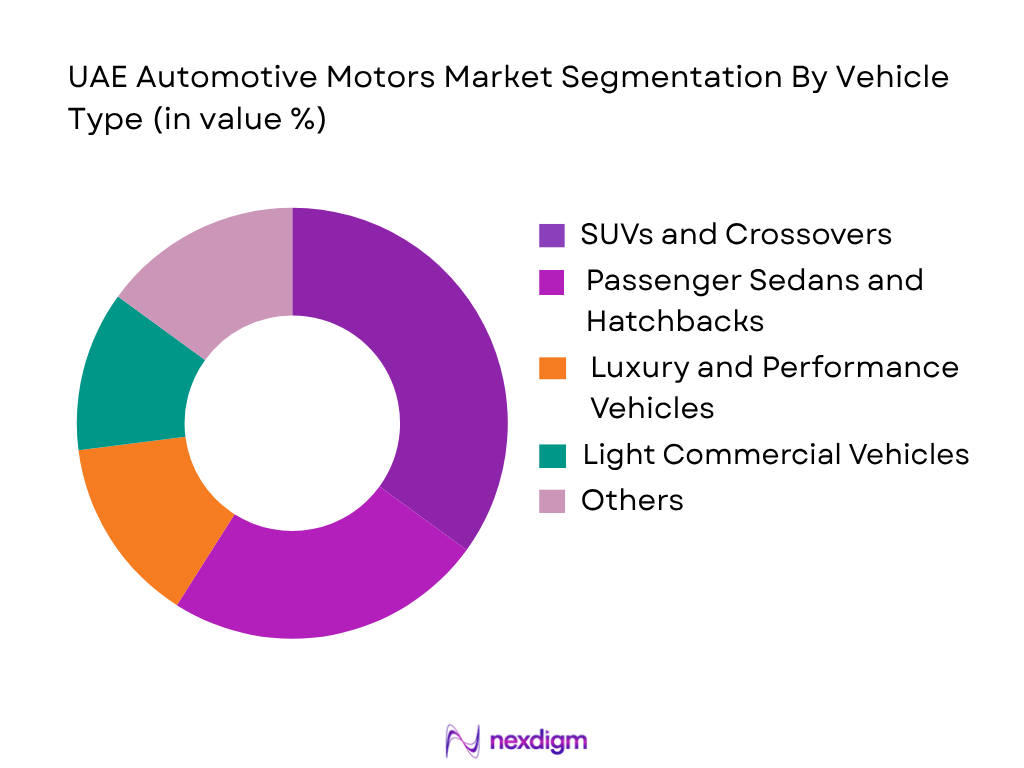
The UAE Automotive Motors Market is segmented by vehicle type into SUVs and crossovers, passenger sedans and hatchbacks, luxury and performance vehicles, light commercial vehicles, medium and heavy commercial vehicles, buses and coaches, and specialist vehicles. SUVs and crossovers account for the dominant analytical share, reflecting their strong suitability for UAE driving conditions, high purchasing power, extensive availability of Japanese, Korean, American, European and Chinese models, and strong demand for larger premium vehicles. These vehicles also incorporate substantial electrical content, including high-capacity HVAC blowers, cooling fans, electric steering, seat motors, window motors, pumps and increasingly hybrid or electric traction systems. Dubai’s 2.5 million registered vehicles demonstrate the scale of the addressable automotive base, while the rental fleet reached 71,040 vehicles, compared with 49,725 previously. Rental fleets create particularly high vehicle utilisation and maintenance intensity, supporting replacement demand for starters, alternators, cooling motors and other electrical components. Commercial and fleet vehicles further diversify motor demand across 12V, 24V and high-voltage architectures.
Competitive Landscape
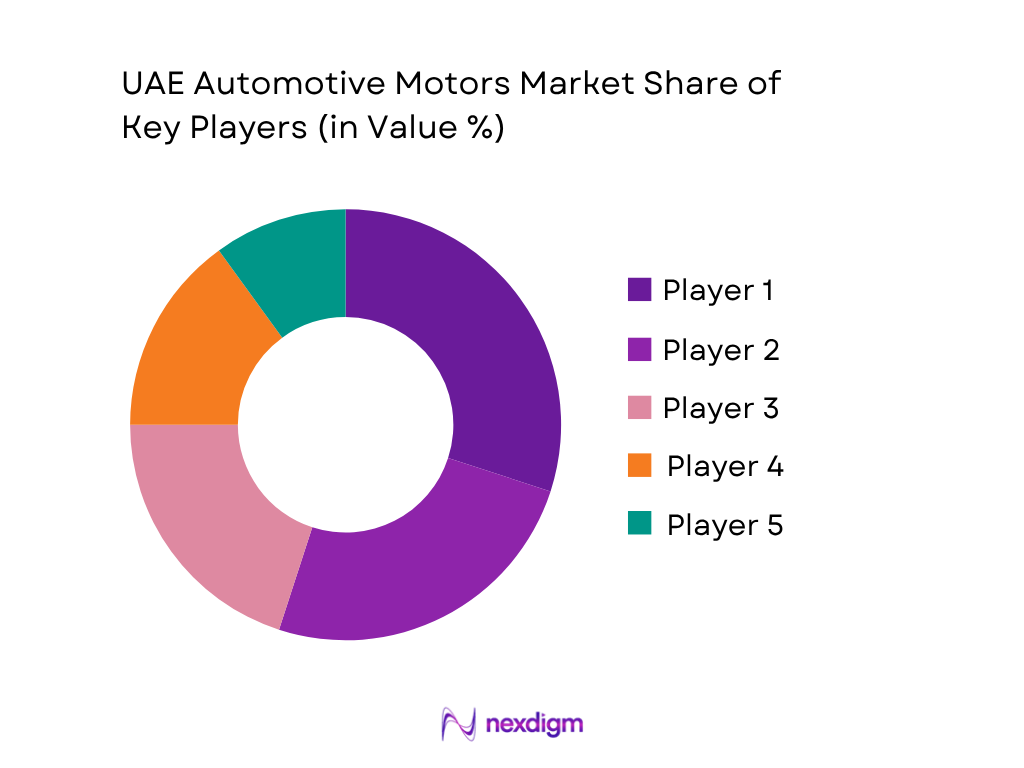
The UAE Automotive Motors Market is characterised by global automotive Tier-1 suppliers supplying starter motors, alternators, auxiliary motors, electrification systems and traction motors through OEM and aftermarket channels. Bosch, DENSO, Valeo, Mitsubishi Electric and Nidec represent important participants across conventional and electrified automotive systems. Competition is increasingly shifting from conventional starter-alternator portfolios toward brushless motors, 48V systems, permanent-magnet traction motors, integrated e-axles and power electronics. UAE distribution capability is especially important because the market relies heavily on imported vehicles and components and serves as a regional aftermarket and re-export hub. DENSO, for example, established its Dubai operation in 2010 and uses it to manage aftermarket sales and service across 47 countries, demonstrating the UAE’s strategic regional distribution role.
| Company | Establishment Year | Headquarters | Starter & Alternator Capability | Traction Motor / E-Drive Capability | Auxiliary Motor Capability | Hybrid / 48V Capability | UAE / Middle East Distribution | Aftermarket Capability |
| Robert Bosch GmbH | 1886 | Gerlingen, Germany | ~ | ~ | ~ | ~ | ~ | ~ |
| DENSO Corporation | 1949 | Kariya, Japan | ~ | ~ | ~ | ~ | ~ | ~ |
| Valeo SE | 1923 | Paris, France | ~ | ~ | ~ | ~ | ~ | ~ |
| Mitsubishi Electric Corporation | 1921 | Tokyo, Japan | ~ | ~ | ~ | ~ | ~ | ~ |
| Nidec Corporation | 1973 | Kyoto, Japan | ~ | ~ | ~ | ~ | ~ |
UAE Automotive Motors Market Analysis
Growth Drivers
Expanding Vehicle Parc and High-Utilisation Fleet Base Strengthen Automotive Motor Replacement Demand
The UAE Automotive Motors Market is supported by a large installed vehicle base that generates recurring requirements for starter motors, alternators, cooling motors, HVAC blowers, electric pumps, window motors and other auxiliary systems. Dubai Roads and Transport Authority reported 2.5 million registered vehicles in Dubai in 2024, equivalent to around half of all registered vehicles across the UAE, demonstrating the scale of the addressable motor-replacement base. Fleet-intensive applications are adding further demand: Dubai’s vehicle-rental fleet expanded from 49,725 vehicles in 2023 to 71,040 vehicles in 2024, while active rental companies increased from 2,627 to 3,494 and 867 new rental companies entered the market during 2024. Rental, taxi, logistics and corporate vehicles generally accumulate mileage faster than privately operated cars, increasing utilisation of starters, alternators, cooling fans and cabin-comfort motors. This automotive demand is supported by a sizeable national economy; World Bank data record UAE GDP at USD 552,324,919,095.9 in 2024, compared with USD 522,622,268,401.1 in 2023. The combination of millions of operating vehicles and expanding high-utilisation fleets creates sustained OEM replacement and aftermarket opportunities for automotive motor suppliers.
Rapid Electric Vehicle Adoption Expands Traction and Auxiliary Motor Content
Vehicle electrification is becoming a direct growth driver for the UAE Automotive Motors Market because electric vehicles replace conventional starter-alternator systems with substantially higher-value traction motors while simultaneously requiring electric coolant pumps, battery-cooling fans, compressors and other electronically controlled auxiliary drives. Dubai Electricity and Water Authority recorded 37,486 electric vehicles at the end of 2024, increasing to 47,944 vehicles at the end of 2025, meaning more than 10,000 additional EVs entered the emirate’s operating parc within one year. Supporting infrastructure expanded alongside this vehicle base: Dubai provided more than 740 public charging points in December 2024, while the network exceeded 1,860 charging points by January 2026. DEWA also reported 23,600 registered Green Charger users and more than 55,200 MWh of electricity supplied through the initiative by January 2026, sufficient for over 276 million kilometres of EV travel. The underlying macroeconomic environment provides significant purchasing capacity, with World Bank data recording UAE GDP at USD 552,324,919,095.9 in 2024. Increasing EV penetration therefore enlarges the installed base for permanent-magnet traction motors, integrated e-axles, high-voltage auxiliary motors and motor-control electronics.
Market Challenges
High Import Dependence Exposes Automotive Motor Supply to International Supply-Chain Disruptions
The UAE Automotive Motors Market remains highly dependent on imported vehicles, electrical components and drivetrain technologies because domestic production of starter motors, alternators, permanent-magnet traction motors and integrated electric-drive systems remains limited. UAE government trade data show that non-oil imports reached AED 1.701 trillion in 2024, with automobiles explicitly identified among the country’s major imported product categories. Total non-oil foreign trade reached approximately AED 2.997 trillion, while re-export activity reached AED 734.4 billion, illustrating the scale of goods flowing through an import-led trading ecosystem. For automotive motor suppliers, this structure creates exposure to international shipping disruptions, component availability, sourcing lead times and changing availability of copper, electrical steel, bearings, semiconductors and permanent magnets. The challenge becomes more complex as distributors must support conventional starter and alternator products alongside newer high-voltage traction motors and integrated e-drive components. World Bank data record UAE GDP at USD 552,324,919,095.9 in 2024, confirming that this import dependency exists within a large, high-income economy with substantial vehicle demand rather than a small automotive base. Consequently, maintaining diversified supplier relationships, regional inventory and reliable parts availability remains critical for UAE distributors and workshops serving both domestic customers and re-export markets.
Dual ICE-EV Technology Requirements Increase Inventory and Technical-Service Complexity
The UAE Automotive Motors Market faces increasing complexity because suppliers must simultaneously support a very large combustion-engine vehicle parc and a rapidly expanding electric-vehicle base. Dubai recorded 2.5 million registered vehicles in 2024, while only 37,486 electric vehicles were recorded at the end of the same period, meaning conventional and hybrid vehicles continue to represent the overwhelming majority of vehicles requiring starter motors, alternators and traditional auxiliary components. However, Dubai’s EV count increased to 47,944 vehicles in 2025, while its charging network expanded beyond 1,860 points by January 2026. This transition requires distributors and repair networks to hold inventories across fundamentally different electrical architectures, including 12V starter systems, alternators, 48V starter-generators, brushless auxiliary motors and high-voltage traction systems. Workshops must also adapt diagnostic equipment and technical capabilities to service integrated motor-inverter systems rather than only traditional automotive electrical components. The wider economic base remains substantial, with World Bank data placing UAE GDP at USD 552,324,919,095.9 in 2024. The market challenge therefore lies in managing a prolonged technology overlap in which conventional motor demand remains large while high-voltage electrification requirements rise rapidly.
Market Opportunities
Expanding EV Parc Creates Future Opportunity for Traction Motors, E-Axles and High-Voltage Auxiliary Systems
The expanding electric-vehicle installed base provides one of the clearest future opportunities for UAE Automotive Motors Market participants. Current adoption already provides a tangible foundation: Dubai had 37,486 electric vehicles at the end of 2024, rising to 47,944 vehicles at the end of 2025, adding more than 10,000 electric vehicles to the operating fleet in one year. Supporting charging infrastructure grew from more than 740 charging points in December 2024 to over 1,860 points in January 2026, while the number of registered Green Charger users reached 23,600. DEWA had supplied more than 55,200 MWh through its EV charging initiative by January 2026, supporting over 276 million kilometres of electric mobility. These current indicators create future addressable demand for permanent-magnet synchronous motors, induction motors, integrated e-axles, motor-inverter assemblies, electric coolant pumps, battery cooling fans and electrically driven compressors. The opportunity is reinforced by the UAE’s economic capacity, with World Bank data recording GDP of USD 552,324,919,095.9 in 2024. Suppliers establishing high-voltage product distribution, diagnostics, replacement capability and technical support can therefore position themselves for a progressively larger electrified drivetrain ecosystem.
Automotive Aftermarket and Re-Export Hub Offers Regional Expansion Opportunity
The UAE’s position as a major regional trading and logistics hub creates a significant future opportunity for automotive motor manufacturers and distributors seeking to serve the GCC, Africa and wider Middle East from a centralized inventory base. UAE government figures show that non-oil foreign trade reached approximately AED 2.997 trillion in 2024, while re-exports reached AED 734.4 billion and non-oil imports totalled AED 1.701 trillion. Automobiles were specifically listed among the country’s major imported commodities, reinforcing the importance of automotive products within the trade ecosystem. Domestic aftermarket demand adds another layer: Dubai alone contained 2.5 million registered vehicles in 2024, while its vehicle-rental fleet reached 71,040 vehicles across 3,494 active rental companies. This combination allows distributors to aggregate demand from local workshops, authorized dealers, fleet operators and regional re-export customers for starter motors, alternators, auxiliary motors and increasingly electrified drivetrain components. World Bank data place UAE GDP at USD 552,324,919,095.9 in 2024, supporting the country’s broader logistics and consumption base. Companies developing Dubai-based warehousing, cross-border distribution, broad vehicle-fitment catalogues and regional technical support can therefore use existing trade infrastructure to expand automotive motor sales beyond domestic UAE demand.
Future Outlook
The UAE Automotive Motors Market is forecast to expand at approximately ~X.X% CAGR during 2026–2035, using the requested placeholder forecast. Market development will be shaped by simultaneous demand from the large installed combustion-engine vehicle fleet and the expanding hybrid and battery-electric vehicle population. Conventional starter motors, alternators, HVAC motors, cooling fans, power-window motors and other auxiliary products will remain important because millions of vehicles already operate across the country. The aftermarket will consequently remain a significant demand channel even as new-vehicle powertrains progressively electrify.
Electrification will create the strongest structural change in product mix. Dubai’s EV population increased to 47,944 vehicles by the end of 2025, from 37,486 vehicles at the end of 2024, while its public charging ecosystem expanded to more than 1,860 charging points. This growing installed base supports future requirements for traction motors, e-axles, electric pumps, battery-cooling motors, electric compressors and high-voltage power electronics. The UAE’s role as a regional trade hub will provide another growth pathway. National re-exports reached AED 734.4 billion in 2024, while non-oil imports reached AED 1.701 trillion. The country’s established logistics infrastructure creates a platform for automotive motor suppliers to serve not only domestic workshops and distributors but also customers across the GCC, Africa and wider Middle East.
Major Players
- Robert Bosch GmbH – Starter Motors / Alternators / Auxiliary Motors / Electrified Drive Systems
- DENSO Corporation – Starter Motors / Alternators / Small Automotive Motors / Electrification Systems
- Valeo SE – Starter-Alternators / 48V Systems / Electric Motors / Electrified Powertrains
- Mitsubishi Electric Corporation – Starter Motors / Alternators / Electric Powertrain Systems
- Nidec Corporation – Traction Motors / E-Axle Systems / EPS and Auxiliary Automotive Motors
- BorgWarner Inc. – High-Voltage Traction Motors / Integrated Drive Modules / E-Mobility Systems
- ZF Friedrichshafen AG – Electric Motors / E-Drive Systems / Integrated Electric Axles
- MAHLE GmbH – Electric Traction Motors / Auxiliary Drives / Thermal-Electrification Systems
- SEG Automotive Germany GmbH – Starter Motors / Alternators / 48V Electrification Systems
- Magna International Inc. – Electric Motors / E-Drive Systems / Integrated Electric Powertrains
- Schaeffler AG – Electric Motors / Hybrid Modules / Electric Axle Drives
- Astemo, Ltd. – Electric Motors / Inverters / Integrated Electrified Drivetrain Systems
- Hyundai Mobis Co., Ltd. – Traction Motors / Electric Drive Systems / Integrated EV Power Electronics
- AISIN Corporation – Electric Drive Modules / E-Axles / Hybrid and Electrified Drivetrain Systems
- YASA Limited / Mercedes-Benz Group – Axial Flux Electric Motors / High-Performance EV Drive Systems
Key Target Audience
- Automotive Motor and Electric Drive Manufacturers
- Passenger Vehicle and Commercial Vehicle OEMs
- Automotive Component Importers and Authorized Distributors
- Automotive Aftermarket Parts Distributors and Workshop Networks
- Electric Vehicle, Hybrid Powertrain and E-Axle Manufacturers
- Fleet, Rental, Taxi and Mobility Operators
- Investments and Venture Capitalist Firms
- Government and Regulatory Bodies (Ministry of Industry and Advanced Technology, Ministry of Energy and Infrastructure, Ministry of Interior, Dubai Roads and Transport Authority, Dubai Electricity and Water Authority, Abu Dhabi Mobility)
Research Methodology
Step 1: Identification of Key Variables
The initial phase involves constructing an ecosystem map encompassing automotive motor manufacturers, vehicle OEMs, distributors, component importers, aftermarket traders, workshops, fleet operators and electric-drive suppliers within the UAE Automotive Motors Market. Secondary and proprietary databases are assessed to identify vehicle parc, motor type, propulsion architecture, replacement cycles, electrification, import dependency, distribution channels and other variables influencing market demand.
Step 2: Market Analysis and Construction
Historical data relating to UAE vehicle registrations, passenger and commercial vehicle activity, electric vehicle adoption, component imports and aftermarket demand are compiled and analysed. The market is constructed using top-down and bottom-up methods, including motor content per vehicle, replacement requirements and propulsion-specific motor architecture, with separate assessments for starter motors, alternators, traction motors and auxiliary electrical motors.
Step 3: Hypothesis Validation and Expert Consultation
Market hypotheses are validated through computer-assisted telephone interviews with automotive component distributors, vehicle dealers, workshop operators, fleet managers, electrical-component specialists and industry professionals. These consultations evaluate product fitment, replacement frequency, brand preferences, distribution structures, high-temperature performance requirements, EV servicing capabilities and aftermarket purchasing behaviour to refine and corroborate the market framework.
Step 4: Research Synthesis and Final Output
The final phase reconciles vehicle-side demand with supplier-side automotive motor availability. OE fitment, aftermarket replacement, EV traction motor adoption, auxiliary motor requirements and import-distribution activity are triangulated to produce the final analysis. Particular attention is given to Dubai’s regional distribution role, UAE electrification, harsh-climate performance requirements and the transition from conventional starter-alternator systems toward integrated electric-drive architectures.

- Executive Summary
- Research Methodology (Market Definition and Scope, UAE Automotive Motor Taxonomy, Starter Motor and Alternator Classification, Traction Motor and E-Drive Classification, Auxiliary Automotive Motor Mapping, Vehicle Parc Assessment, New Vehicle Registration Assessment, EV and Hybrid Vehicle Mapping, OEM Fitment Assessment, Aftermarket Replacement Assessment, Automotive Motor Import and Re-Export Mapping, Distributor and Workshop Network Assessment, Market Sizing Framework)

- Definition and Scope
- UAE Automotive Motor Industry Evolution and Electrification Development
- Automotive Motor Manufacturing and Assembly Process
- Automotive Motor Value Chain Analysis
- UAE Automotive Motor Supply Chain Analysis
- Rotor, Stator, Copper Winding, Permanent Magnet, Bearing and Power Electronics Ecosystem Analysis
- UAE Automotive Motor Import, Distribution and Re-Export Footprint Assessment
- OEM, Authorized Distributor, Independent Aftermarket and Automotive Workshop Framework

- Growth Drivers (Expansion of UAE Vehicle Parc, High Passenger Vehicle and SUV Penetration, Growth of Electric and Hybrid Vehicles, Large Automotive Aftermarket Base, Increasing Auxiliary Motor Content per Vehicle, Expansion of Rental and Fleet Vehicles, Dubai Automotive Trading and Re-Export Hub, Increasing Vehicle Electrical and Comfort Loads)
- Market Challenges (High Dependence on Imported Automotive Motors, Extreme Heat and Dust Operating Conditions, Counterfeit and Non-Genuine Replacement Components, Permanent Magnet and Copper Supply Exposure, Fragmented Independent Aftermarket, EV Motor Repair Skill Gaps, High-Voltage Service Capability Constraints, Rapid Powertrain Technology Transition)
- Market Opportunities (EV Traction Motor and E-Axle Demand, 48V Starter-Generator Systems, Hybrid Vehicle Motor Systems, High-Efficiency Auxiliary Motors, Electric Commercial Vehicle Drivetrains, Automotive Motor Remanufacturing, EV Motor Diagnostics and Repair, UAE-to-GCC and Africa Automotive Component Re-Exports)
- Market Trends (Permanent Magnet Traction Motor Adoption, 800V Electric Architectures, Integrated E-Axles, Axial Flux Motor Development, Starter-Generator Integration, Brushless Auxiliary Motor Adoption, Increasing Motor Content per Vehicle, Integrated Motor-Inverter Systems)
- Regulatory and Standards Landscape (Ministry of Industry and Advanced Technology Automotive Conformity Requirements, UAE.S Automotive Standards, Ministry of Interior Vehicle Registration Requirements, Dubai RTA Vehicle Testing Requirements, Abu Dhabi Vehicle Licensing Requirements, Electric Vehicle Technical Compliance, Automotive Spare Parts Conformity Requirements, UAE In-Country Value Framework, Operation 300Bn Industrial Strategy)
- SWOT Analysis
- Porter’s Five Forces Analysis
- PESTLE Analysis
- Stakeholder Ecosystem
- Competition Ecosystem

- By Market Value (2020-2025)
- By Automotive Motor Installation Volume (2020-2025)
- By Starter Motor Volume (2020-2025)
- By Alternator and Starter-Generator Volume (2020-2025)
- By Traction Motor Volume (2020-2025)
- By Auxiliary Automotive Motor Volume (2020-2025)

- By Motor Type (In Value %)
Starter Motors
Alternators
Integrated Starter Generators
Belt Starter Generators
EV Traction Motors
Hybrid Traction Motors
Electric Power Steering Motors
Cooling Fan Motors
HVAC Blower Motors
Electric Water Pump Motors
Electric Oil Pump Motors
Power Window Motors
Power Seat Motors
Windshield Wiper Motors
Other Auxiliary Automotive Motors - By Vehicle Type (In Value %)
Passenger Sedans
Hatchbacks
SUVs and Crossovers
Luxury and Performance Vehicles
Pickup Trucks
Light Commercial Vehicles
Medium and Heavy Commercial Vehicles
Buses and Coaches
Taxi and Ride-Hailing Vehicles
Rental Fleet Vehicles
Government and Municipal Vehicles
Special-Purpose Vehicles - By Propulsion Type (In Value %)
Gasoline Internal Combustion Vehicles
Diesel Internal Combustion Vehicles
Mild Hybrid Vehicles
Full Hybrid Vehicles
Plug-In Hybrid Vehicles
Battery Electric Vehicles
Fuel Cell Electric Vehicles
Other Electrified Powertrains - By Motor Technology (In Value %)
Brushed DC Motors
Brushless DC Motors
Permanent Magnet Synchronous Motors
AC Induction Motors
Switched Reluctance Motors
Wound Rotor Synchronous Motors
Axial Flux Motors
Integrated Motor-Generator Systems
Other Automotive Motor Technologies - By Sales Channel (In Value %)
OEM and Vehicle Manufacturer Fitment
Authorized Automotive Distributors
Authorized Dealer Service Networks
Independent Automotive Parts Distributors
Independent Workshops and Garages
Fleet Maintenance Networks
Automotive Parts Trading Companies
Online Automotive Parts Platforms
Free-Zone Importers and Re-Exporters - By Emirate (In Value %)
Dubai
Abu Dhabi
Sharjah
Ajman
Ras Al Khaimah
Fujairah
Umm Al Quwain

- Market Share of Major Players (By Revenue, Motor Type, Vehicle Application, Propulsion Type, OEM Fitment, Aftermarket Channel, Emirate, Electrification Capability)
- Cross Comparison Parameters (UAE OE and Aftermarket Automotive Motor Portfolio Breadth, Starter Alternator and Starter-Generator Capability, EV Traction Motor and Integrated E-Drive Capability, Auxiliary Motor Application Coverage, High-Temperature and Harsh-Climate Performance Capability, Passenger SUV Commercial and Luxury Vehicle Fitment Coverage, UAE Distributor Aftermarket Parts and Technical Support Network)
- SWOT Analysis of Major Players
- Competitive Positioning Matrix
- Product and Technology Portfolio Benchmarking
- Pricing and Distribution Network Benchmarking
- Market Entry Strategy Assessment
- Detailed Profiles of Major Companies
Robert Bosch GmbH – Starter Motors / Alternators / Auxiliary Motors / Electrified Drive Systems
DENSO Corporation – Starter Motors / Alternators / Small Automotive Motors / Electrification Systems
Valeo SE – Starter-Alternators / 48V Systems / Electric Motors / Electrified Powertrains
Mitsubishi Electric Corporation – Starter Motors / Alternators / Electric Powertrain Systems
Nidec Corporation – Traction Motors / E-Axle Systems / EPS and Auxiliary Automotive Motors
BorgWarner Inc. – High-Voltage Traction Motors / Integrated Drive Modules / E-Mobility Systems
ZF Friedrichshafen AG – Electric Motors / E-Drive Systems / Integrated Electric Axles
MAHLE GmbH – Electric Traction Motors / Auxiliary Drives / Thermal-Electrification Systems
SEG Automotive Germany GmbH – Starter Motors / Alternators / 48V Electrification Systems
Magna International Inc. – Electric Motors / E-Drive Systems / Integrated Electric Powertrains
Schaeffler AG – Electric Motors / Hybrid Modules / Electric Axle Drives
Astemo, Ltd. – Electric Motors / Inverters / Integrated Electrified Drivetrain Systems
Hyundai Mobis Co., Ltd. – Traction Motors / Electric Drive Systems / Integrated EV Power Electronics
AISIN Corporation – Electric Drive Modules / E-Axles / Hybrid and Electrified Drivetrain Systems
YASA Limited / Mercedes-Benz Group – Axial Flux Electric Motors / High-Performance EV Drive Systems

- Automotive Motor Buyer Segmentation
- OEM and Distributor Procurement Behaviour
- Automotive Motor Supplier Selection Criteria
- Buyer and Workshop Pain Points
- Motor Technology and Electrification Adoption Assessment
- Replacement and Repurchase Behaviour

- By Market Value (2026-2035)
- By Automotive Motor Installation Volume (2026-2035)
- By Starter Motor Volume (2026-2035)
- By Alternator and Starter-Generator Volume (2026-2035)
- By Traction Motor Volume (2026-2035)
- By Auxiliary Automotive Motor Volume (2026-2035)


 Request a Sample
 Ask for Customization
 Get a Quote
 Enquire Now