
 Download PDF
Market Overview
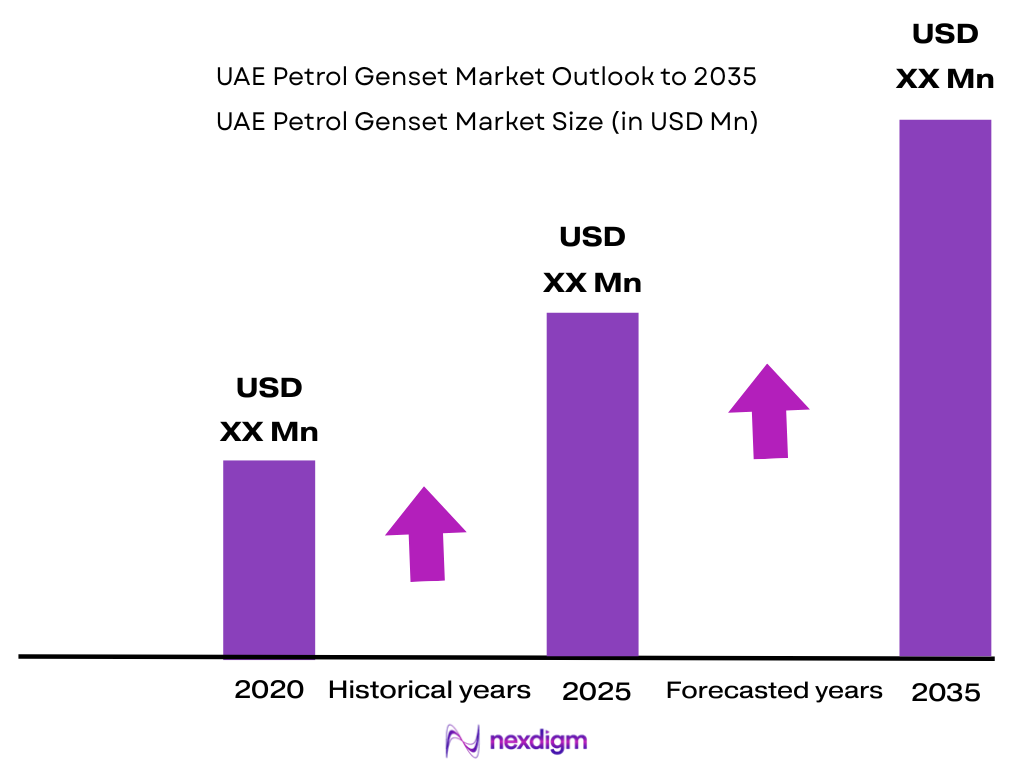
The UAE Petrol Genset Market is valued at approximately ~ million, supported by construction activity, outdoor commercial operations, workshops, mobile service units and temporary-power requirements. ADNOC Distribution’s domestic network expanded from 518 service stations to 543 service stations on a comparable nine-month basis, improving gasoline accessibility for portable generators. Construction, real estate, transportation and manufacturing also remained important contributors to non-hydrocarbon economic activity, sustaining demand for mobile and compact power equipment. Dubai and Abu Dhabi dominate UAE petrol genset demand because they contain the country’s deepest construction, commercial, logistics, hospitality and facilities-management ecosystems. Dubai’s ADNOC Distribution network expanded from 43 stations to 54 stations, while electricity customer interruption duration improved from 1.06 minutes to 0.94 minutes. Despite exceptional grid reliability, portable gensets remain relevant for construction sites, outdoor events, mobile workshops, remote desert activities and temporary loads where direct grid connections are unavailable or impractical.
Market Segmentation
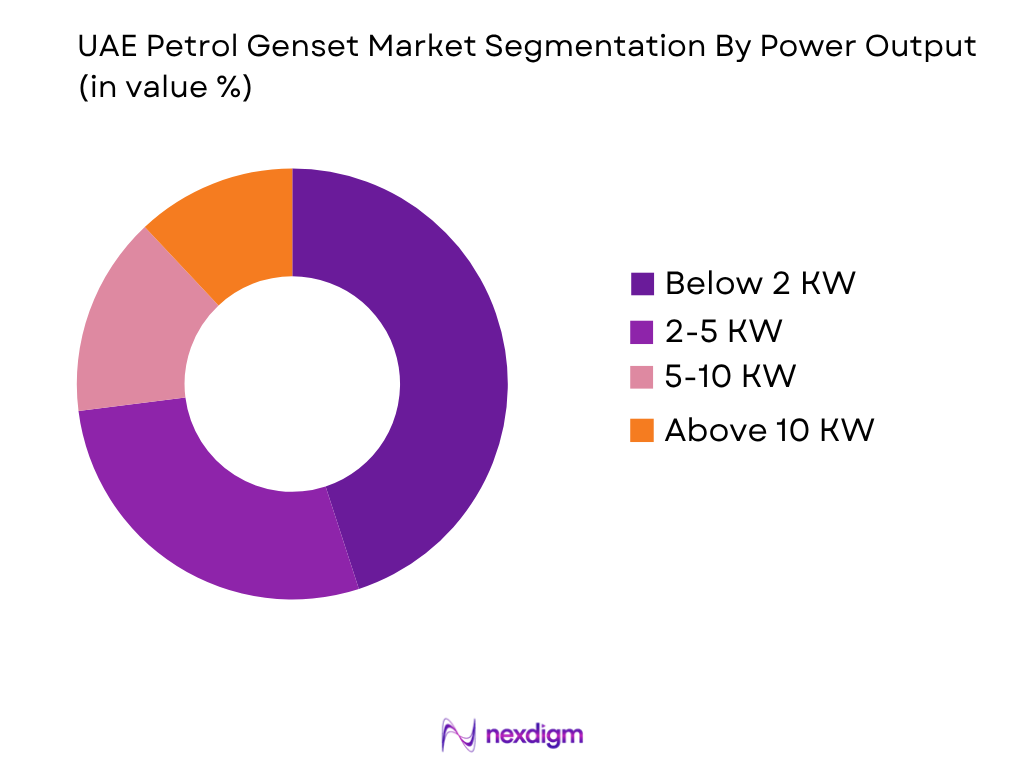
By Power Output
The UAE Petrol Genset Market is segmented into below 2 kW, 2–5 kW, 5–10 kW and above 10 kW petrol generator sets. The 2–5 kW category holds the dominant position because it balances portability, electrical capacity and fuel consumption for the UAE’s most common petrol-genset applications. Units in this range can support power tools, lighting, small pumps, refrigeration equipment, outdoor catering, camping equipment and emergency household appliances without requiring the larger footprint associated with industrial generating sets. They are particularly suited to contractors, maintenance teams, workshops and mobile businesses operating where temporary electrical supply is required. The UAE’s extensive gasoline retail infrastructure further supports easy refuelling of compact petrol gensets. Honda’s Middle East generator portfolio demonstrates the commercial relevance of portable generator formats, including conventional and inverter models targeted at mobile power applications. The segment also benefits from relatively straightforward transport, manual or electric starting systems and broad availability through equipment dealers.
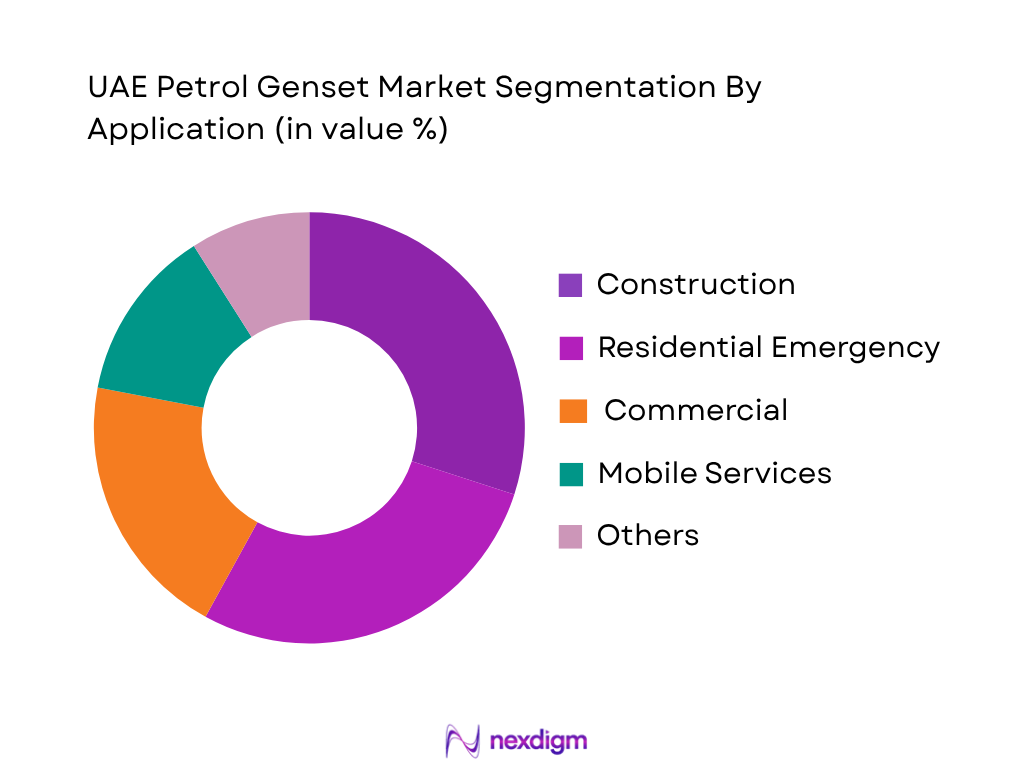
By Application
The UAE Petrol Genset Market is segmented into construction and contracting, residential emergency backup, commercial and retail establishments, automotive workshops and mobile service vehicles, outdoor recreation and events, and other temporary-power applications. Construction and contracting represent the dominant application segment because portable petrol gensets can be deployed quickly for temporary lighting, small power tools, cutting equipment, pumps, site offices and work areas awaiting permanent electrical connections. The Central Bank of the UAE identifies construction and real estate among the sectors supporting non-hydrocarbon economic activity, while real estate and construction together accounted for a significant portion of non-hydrocarbon output. Petrol gensets are especially useful for smaller subcontractors and maintenance crews that require portable rather than stationary prime-power installations. Their compactness allows contractors to move equipment between sites, while inverter variants also support sensitive electronics used by engineering and field-service teams.
Competitive Landscape
The UAE Petrol Genset Market includes established international engine and generator manufacturers alongside regional power-equipment distributors. Honda maintains a dedicated UAE power-products presence and offers conventional and inverter generators, while Generac, PRAMAC, Hyundai Power Products and Kohler participate through Middle East offices, distributors and equipment dealers. Competition centres on power output, portability, engine reliability, inverter capability, fuel efficiency, starting system, acoustic performance and availability of local servicing and spare parts.
| Company | Establishment Year | Headquarters | Petrol Generator Portfolio | Inverter Technology | Starting Options | Portability Focus | UAE Distribution / Support | Key User Segment |
| Honda Motor Co. | 1948 | Tokyo, Japan | ~ | ~ | ~ | ~ | ~ | ~ |
| PRAMAC | 1966 | Siena, Italy | ~ | ~ | ~ | ~ | ~ | ~ |
| Generac Power Systems | 1959 | Wisconsin, USA | ~ | ~ | ~ | ~ | ~ | ~ |
| Hyundai Power Products | 1976* | Seoul, South Korea | ~ | ~ | ~ | ~ | ~ | ~ |
| Kohler | 1873 | Wisconsin, USA | ~ | ~ | ~ | ~ | ~ | ~ |
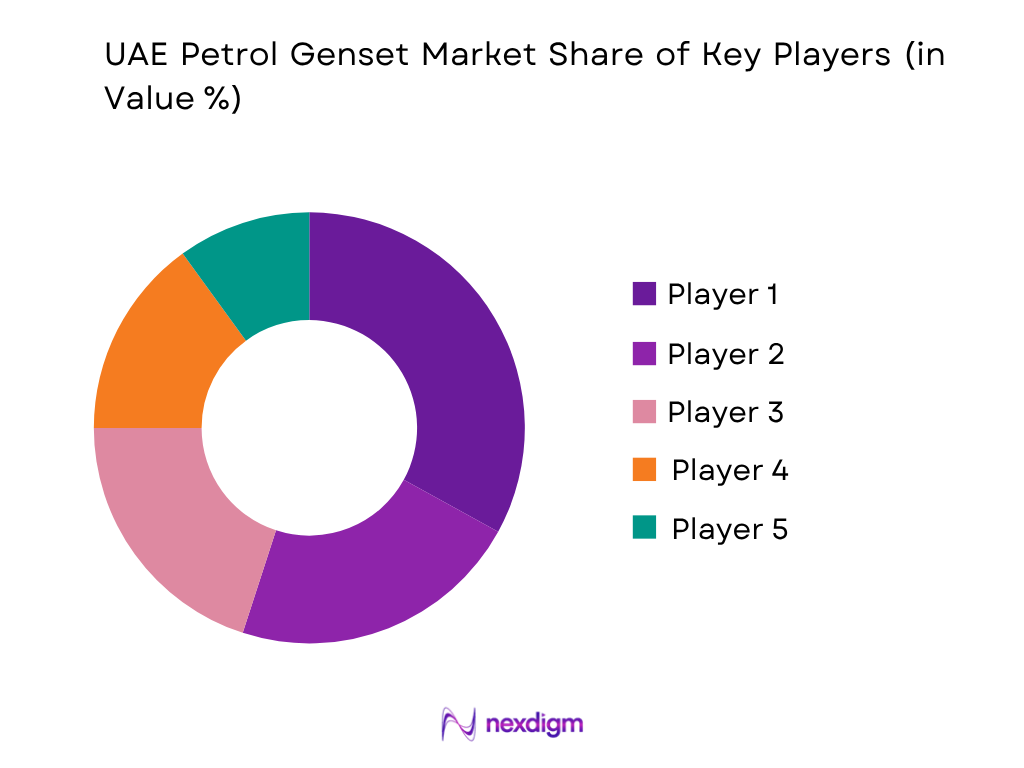
UAE Petrol Genset Market Analysis
Growth Drivers
Expanding Construction, Real Estate and Temporary Power Requirements
The UAE Petrol Genset Market is supported by continued expansion across construction, real estate, infrastructure and small-site contracting activities where portable gasoline generators provide temporary or mobile electricity before permanent grid connections are available. The macroeconomic foundation for this demand remains substantial. The World Bank recorded UAE GDP at approximately USD 552.32 billion in 2024, while GDP per capita stood at USD 50,273.5, indicating a high-income economy capable of sustaining large volumes of construction, property development, infrastructure upgrading and commercial investment. The IMF reported that the UAE economy expanded by approximately 4.0 points on a 100-point base in 2024 and projected total output growth of 4.8 points in 2025 and 5.0 points in 2026, with non-hydrocarbon activities, including real estate and other diversified sectors, remaining important contributors. These conditions are directly relevant to petrol gensets because compact gasoline-powered units are frequently suited to construction tools, lighting systems, pumps, temporary cabins, mobile maintenance activities and small contracting sites where diesel generating systems can be unnecessarily large. Petrol gensets typically occupy the lower and medium portable-power bands, making them suitable for contractors requiring easily transportable electricity rather than permanent standby installations. The opportunity is reinforced by continued expansion of electricity infrastructure itself. Dubai Electricity and Water Authority served more than 1.27 million customer accounts around the end of 2024 and continued adding grid infrastructure to meet new property and economic activity. The network’s expansion reflects the continuing addition of residential, commercial and industrial electricity connections, but the construction phase preceding these permanent connections can create temporary generator requirements. The UAE’s wider infrastructure programme also operates alongside substantial diversification investment, tourism development, warehouses, logistics facilities, residential communities and commercial projects. Petrol generators are particularly applicable to subcontractors undertaking finishing work, road maintenance, electrical installation, landscaping, event construction and equipment servicing where power must move between work areas. Small engines also provide operational flexibility because they can run standard power tools and equipment without requiring major installation. The market benefits from the UAE’s fragmented construction workflow, where multiple subcontractors can operate independently on the same project and require portable electrical supply at different stages. High temperatures additionally increase electricity requirements for temporary ventilation, fans and worker-support equipment at construction sites. However, demand is not based primarily on weakness in the national grid; Dubai’s grid is exceptionally reliable. Instead, the commercial case comes from electricity requirements before connection, away from connection points or at mobile sites. This distinction is important because it positions petrol gensets as construction and mobility equipment rather than substitutes for an unreliable national power network. The strength of the UAE economy, continued non-oil expansion and development of new electricity accounts therefore provide a clear data-supported foundation for temporary-power requirements. Principal supporting sources are the World Bank, International Monetary Fund and Dubai Electricity and Water Authority.
Mobile Backup Demand Across Workshops, Events, Recreation and Small Businesses
A second growth driver for the UAE Petrol Genset Market is the requirement for compact mobile power across automotive workshops, roadside operations, events, outdoor recreation, small businesses and service contractors. Unlike large diesel generators primarily used for high-load commercial or industrial backup, petrol gensets can address intermittent applications where portability, rapid deployment and moderate electrical output are more important than long continuous runtime. The UAE provides a strong macroeconomic environment for this form of equipment demand. The World Bank recorded national economic output of approximately USD 552.32 billion in 2024, while the IMF expects continued economic expansion through 2025 and 2026 as non-hydrocarbon activity remains resilient. This diversified economic base includes automotive repair, tourism, hospitality, entertainment, logistics, outdoor events and contractor services—all activities capable of using portable petrol-powered electricity. Automotive workshops can require gensets for field repair, mobile diagnostic equipment, lighting, compressors and electrically powered service tools where mains power is unavailable. Roadside-recovery operators and vehicle-support contractors similarly benefit from units that can be transported in vans or utility vehicles. The petrol-genset proposition is particularly strong where use lasts for several hours rather than continuous multi-day operation. UAE tourism and event activity also creates temporary-power requirements for outdoor installations, catering facilities, desert camps, sports events and mobile commercial equipment. Smaller inverter generators are suited to applications requiring relatively stable current for electronics, lighting, audio equipment and sensitive appliances. The UAE’s economic diversification strategy reinforces this demand because commercial growth extends beyond oil production into tourism, real estate and service industries. The IMF’s 2025 assessment specifically noted continuing expansion across non-oil sectors, including real estate and tourism. Energy-sector development further illustrates the scale of power consumption across the economy. The Ministry of Energy and Infrastructure stated that installed clean-energy capacity had surpassed 12 gigawatts in 2024, consisting of approximately 6.8 gigawatts of renewable power and 5.6 gigawatts of nuclear capacity. This massive investment means petrol gensets do not compete with the national grid on base-load electricity economics. Instead, the relevant demand is highly localised, portable and temporary. That differentiation protects specific applications even as utility infrastructure improves. For automotive and mobile-service users, petrol generators remain practical because compact units can be loaded into light commercial vehicles and moved between locations. Recreation is another application because the UAE’s desert environment supports camping, overlanding and off-grid leisure activities where users may require electricity for lighting, cooling devices, small appliances and charging equipment. The increasing availability of inverter architecture, lower-noise enclosures and multi-mode engine controls further improves product suitability for these non-industrial customers. Petrol generator manufacturers able to address automotive workshops, mobile mechanics, outdoor businesses, leisure users and short-duration contractor demand can therefore operate in a market supported by both a USD 552.32 billion economy and continuing non-oil diversification. Principal supporting sources are the World Bank, International Monetary Fund and UAE Ministry of Energy and Infrastructure.
Market Challenges
Extremely High Grid Reliability Limits Conventional Emergency-Backup Demand
One of the most important constraints facing the UAE Petrol Genset Market is the exceptionally high reliability of electricity infrastructure, particularly in Dubai, which reduces the need for petrol generators as routine household or commercial outage-backup equipment. Dubai Electricity and Water Authority reported electricity Customer Minutes Lost of approximately 0.94 minutes per customer annually around 2024–2025 and subsequently reduced this metric to 0.82 minutes in 2025, equivalent to approximately 49 seconds per customer during an entire year. DEWA also reported electricity transmission and distribution losses of only 2 units for every 100 units supplied, reflecting a highly efficient grid. This is structurally different from markets in which frequent grid interruptions create widespread residential generator ownership. In the UAE, particularly in Dubai and other highly developed urban areas, users generally cannot justify petrol genset purchases solely on the basis of ordinary electricity outages. The challenge becomes more pronounced as utility infrastructure continues expanding. DEWA’s customer base exceeded 1.27 million accounts around 2024 and surpassed 1.3 million accounts in 2025, after nearly 57,000 new electricity and water accounts were added during that year. New users are therefore being connected to an increasingly reliable utility network rather than creating a population structurally dependent on self-generation. The UAE is also investing heavily in generation infrastructure. The Ministry of Energy and Infrastructure reported more than 12 gigawatts of clean-energy capacity in 2024, including 6.8 gigawatts of renewables and 5.6 gigawatts of nuclear capacity, strengthening the country’s long-term electricity-supply position. For petrol genset suppliers, these conditions narrow the addressable use case. Growth must come principally from portable, temporary, recreational, construction and mobile-service requirements rather than conventional urban backup power. High reliability also creates customer expectations for convenience: generator systems that are noisy, difficult to start, fuel intensive or maintenance intensive may struggle to attract occasional users when grid failure is extremely rare. Battery power stations and portable energy-storage systems further challenge petrol gensets in light-duty applications because customers needing only short-duration backup for electronics, lighting or communications can increasingly consider battery alternatives. Solar-plus-storage deployment adds another layer of substitution. The Ministry of Energy and Infrastructure reported renewable capacity of 6.1 gigawatts in its September 2024 update before subsequent expansion, demonstrating rapid investment in cleaner power technologies. Consequently, petrol generators must compete on mobility, rapid refuelling, higher continuous output and independence from charging infrastructure rather than basic access to electricity. The UAE’s macroeconomic strength does support purchasing power—GDP reached USD 552.32 billion in 2024—but strong purchasing capacity does not automatically translate into genset demand when the electrical grid already achieves almost uninterrupted service. Manufacturers therefore need to identify customer groups whose operating environments fall outside normal grid availability: construction contractors, outdoor events, automotive service fleets, remote roadworks, mobile maintenance teams, camps and specialised recreational users. This market structure makes the UAE less dependent on emergency residential generators and more dependent on professional portable-power applications. Principal supporting sources are the Dubai Electricity and Water Authority, UAE Ministry of Energy and Infrastructure and World Bank.
Clean-Energy Transition and Emissions Compliance Pressure on Petrol Equipment
The UAE Petrol Genset Market also faces increasing structural pressure from the country’s rapid clean-energy transition and tightening environmental expectations surrounding combustion-powered equipment. The Ministry of Energy and Infrastructure reported that UAE clean-energy capacity exceeded 12 gigawatts in 2024, including approximately 6.8 gigawatts of renewable capacity and 5.6 gigawatts of nuclear power, giving non-fossil generation an increasingly substantial role in national electricity supply. An earlier 2024 Ministry update reported renewable-energy capacity of 6.1 gigawatts, illustrating how rapidly the underlying clean-power system was expanding. For petrol genset manufacturers, this direction creates several challenges. Gasoline engines emit carbon dioxide and local pollutants during operation, meaning petrol gensets can conflict with corporate sustainability policies, low-emission procurement requirements and the UAE’s broader clean-energy objectives. The issue is particularly relevant for large contractors, government-linked entities, hospitality operators and event organisers that increasingly monitor environmental performance within procurement decisions. Battery power stations, mobile battery storage and solar-supported portable systems therefore become stronger alternatives for light-load applications. Petrol gensets retain advantages in runtime and immediate refuelling, but suppliers must increasingly demonstrate improvements in combustion efficiency, engine management, noise control and emissions performance. Product certification is another consideration because imported electrical and mechanical equipment entering the UAE must comply with applicable technical and conformity requirements. This places a greater burden on suppliers of low-cost portable generators that cannot demonstrate suitable electrical safety, engine quality and emissions characteristics. The environmental challenge also interacts with the extraordinary quality of the UAE grid. DEWA achieved electricity network losses of 2 units per 100 units transmitted and distributed and customer interruption levels below one minute per customer annually. Where grid electricity is both reliable and increasingly supplied through cleaner technologies, a small petrol generator becomes harder to justify for stationary applications that could remain grid-connected. This reinforces the requirement for manufacturers to focus on genuine mobility and temporary-power niches. Macroeconomic data shows why the transition matters commercially. The UAE’s economy was approximately USD 552.32 billion in 2024, and the IMF expects diversified non-hydrocarbon growth to continue through 2025 and 2026. This expanding economy is capable of purchasing more sophisticated alternatives, including lithium-based portable power systems and hybrid power configurations. Consequently, petrol generators cannot rely solely on lower technological complexity. Manufacturers will increasingly need inverter technology, electronically controlled engines, eco-throttle operation, automatic shutdown systems and lower-noise enclosures to remain competitive. Dual-fuel architectures may also become strategically useful because they give users greater flexibility than pure petrol units. Service organisations will need better engine tuning and emissions-related maintenance capabilities to ensure equipment continues operating efficiently under high-temperature and dust-heavy UAE conditions. The underlying challenge is therefore not an immediate disappearance of petrol gensets but a progressive rise in the minimum technical standard required to justify combustion equipment. Principal supporting sources are the UAE Ministry of Energy and Infrastructure, Dubai Electricity and Water Authority, World Bank and International Monetary Fund.
Market Opportunities
High-Efficiency Inverter and Low-Noise Portable Petrol Gensets
A major growth opportunity in the UAE Petrol Genset Market lies in replacing conventional constant-speed portable generators with high-efficiency inverter-based systems designed for, contractor, camping, event and mobile-service applications. This opportunity does not depend on weak utility infrastructure. Dubai’s electricity network already records customer interruption levels below one minute per customer annually, so successful petrol-generator products must offer value when users operate away from fixed electricity connections rather than simply serving as emergency home backup. Inverter generators address this requirement because they can provide cleaner electrical output for modern electronic equipment, variable engine operation under changing loads and lower operating noise than traditional open-frame designs. These characteristics are commercially important for mobile mechanics using diagnostic equipment, contractors powering electronics and precision tools, outdoor event operators using sound and communications systems and leisure users operating laptops, charging systems and recreational appliances. The opportunity is reinforced by the scale and income level of the UAE economy. World Bank data reports GDP of approximately USD 552.32 billion and GDP per capita of USD 50,273.5 in 2024, supporting consumer and business capacity to purchase technologically advanced equipment rather than only entry-level gensets. The IMF’s continuing expectation of robust non-hydrocarbon economic activity during 2025 and 2026 supports demand from service, real estate, tourism and related business segments in which portable power can be required intermittently. The UAE climate further strengthens the argument for upgraded generator engineering. Equipment operating outdoors must withstand heat, dust and extended sun exposure, creating demand for effective cooling, engine protection, air-filtration systems and durable enclosures. Suppliers can differentiate through automatic low-oil shutdown, overload protection, electric starting, remote starting, parallel operation and digital displays showing load, runtime and maintenance intervals. Lower acoustic output is particularly valuable in residential communities, outdoor hospitality venues and camping environments where traditional open-frame generators can be disruptive. Compact size and reduced weight also matter because the automotive use case often requires units to be transported in SUVs, pickups, vans or service vehicles. Manufacturers can further build premium product tiers around electronically controlled engines capable of adjusting revolutions according to load, reducing unnecessary fuel consumption during partial-load operation. Multi-unit parallel capability creates another opportunity because customers can operate one small genset during low-load conditions and combine two units when higher output is needed. This gives users more flexibility than transporting a single heavy generator. Cleaner inverter output also improves suitability for modern power electronics compared with basic conventional units. As the UAE’s main grid becomes increasingly clean and technologically sophisticated—with more than 12 gigawatts of clean-energy capacity reported for 2024—portable combustion equipment will need to demonstrate similarly visible technology progression. High-quality inverter gensets therefore represent an opportunity to shift the category away from basic emergency machinery and toward premium mobile-energy equipment. Principal supporting sources are the World Bank, International Monetary Fund, Dubai Electricity and Water Authority and UAE Ministry of Energy and Infrastructure.
Construction, Desert Mobility and Hybrid Portable-Power Solutions
The UAE Petrol Genset Market has a second major opportunity in hybrid portable-power configurations serving construction sites, automotive service fleets, desert activities and temporary commercial applications. Current economic indicators provide a strong base for these applications. UAE GDP reached approximately USD 552.32 billion in 2024, while the IMF expects overall economic activity to continue expanding through 2025 and 2026, supported by resilient non-hydrocarbon sectors including tourism and real estate. These industries create thousands of temporary electricity requirements that are not adequately represented by national outage statistics. Construction sites, mobile maintenance teams, outdoor events and remote camps often need electricity precisely because they operate before grid connection or away from permanent electrical infrastructure. Rather than viewing batteries as purely competitive with petrol gensets, suppliers can use hybrid architectures to expand genset relevance. A petrol generator can provide high-output charging or sustained power when required, while a battery pack can handle low-load periods silently without keeping the combustion engine running continuously. This configuration can reduce engine operating hours, noise and unnecessary idle operation while retaining the rapid refuelling capability of gasoline. Such systems are particularly suited to overnight camping, film production, outdoor hospitality, roadside maintenance and contractor sites where electrical load varies considerably during the day. The UAE’s clean-energy transition supports this hybrid positioning. The Ministry of Energy and Infrastructure reported more than 12 gigawatts of installed clean-energy capacity in 2024, including 6.8 gigawatts of renewables and 5.6 gigawatts of nuclear generation. Portable-power manufacturers that integrate battery storage with efficient petrol engines can align more closely with this broader direction than suppliers offering only basic constant-speed generators. Construction remains especially attractive because each project moves through stages where permanent utility service may not yet reach all operating areas. Portable units can power drilling, cutting, lighting, pumps and small machinery, while vehicle-mounted or wheeled systems can move between work zones. Automotive businesses can similarly use compact gensets in mobile service vans, tyre-support vehicles, roadside recovery fleets and off-site repair operations. Desert mobility creates another distinctive UAE opportunity. Recreational and commercial activity outside urban electricity networks requires dependable portable power under high ambient temperatures. Manufacturers can adapt products with larger air-cleaning capacity, temperature-resistant components, protected electrical outlets, wheel kits, reinforced frames and engine-management systems calibrated for demanding operating conditions. The highly reliable urban grid actually strengthens the need for this targeted product strategy: DEWA recorded only 0.82 minutes of electricity interruption per customer during 2025, meaning genset suppliers should focus investment on use cases where grid access is physically absent rather than unreliable. Distribution can consequently centre on automotive accessory retailers, construction-equipment dealers, tool suppliers, outdoor and camping stores, e-commerce platforms and specialist generator distributors. Bundling generators with transfer accessories, battery packs, weather-resistant covers and maintenance packages can further raise product differentiation. The future opportunity is therefore not simply selling more conventional petrol generators; it lies in engineering integrated portable-energy solutions around mobility, temporary worksites and off-grid use. Principal supporting sources are the World Bank, International Monetary Fund, UAE Ministry of Energy and Infrastructure and Dubai Electricity and Water Authority.
Future Outlook
The UAE Petrol Genset Market is expected to expand at approximately ~ CAGR during 2026–2035, with future demand increasingly concentrated in portable, fuel-efficient and electronically controlled units rather than basic open-frame generators. Construction, property development, tourism, outdoor events, automotive servicing and infrastructure maintenance will continue to create applications in which temporary electricity is required despite the UAE’s exceptionally reliable permanent grid. Inverter generators are likely to become more prominent because they provide cleaner electrical output for electronic equipment while operating more efficiently at variable loads. Noise control will also become increasingly relevant, particularly for equipment deployed close to residential, hospitality and mixed-use developments. Competition from battery power stations and hybrid temporary-power systems will intensify, encouraging manufacturers to improve engine efficiency, acoustic enclosures, carbon-monoxide protection, electronic controls and remote monitoring. Petrol gensets are nevertheless expected to retain a role where long operating periods, rapid refuelling and high portable power density are required.
Major Players
- Honda Motor Co.
- PRAMAC
- Generac Power Systems
- Hyundai Power Products
- Kohler
- Yamaha Motor Co.
- Champion Power Equipment
- FIRMAN Power Equipment
- Briggs & Stratton
- Westinghouse Outdoor Power Equipment
- A-iPower
- Elemax
- Kipor Power Equipment
- Lutian Machinery
- SENCI Power
Key Target Audience
- Petrol generator manufacturers and engine manufacturers
- Generator importers, distributors and equipment dealers
- Construction contractors and infrastructure developers
- Automotive workshops and mobile vehicle-service operators
- Equipment-rental and temporary-power companies
- Facilities-management, hospitality and outdoor-event operators
- Investments and venture capitalist firms
- Government and regulatory bodies (Ministry of Energy and Infrastructure, Ministry of Industry and Advanced Technology, Dubai Municipality, Abu Dhabi Department of Energy)
Research Methodology
Step 1: Identification of Key Variables
The initial phase involves constructing an ecosystem map covering petrol genset manufacturers, engine suppliers, UAE importers, distributors, equipment-rental businesses, contractors, automotive workshops, fuel suppliers and end users. Key variables include rated and maximum output, engine displacement, fuel-tank capacity, runtime, starting technology, inverter capability, acoustic performance, portability, duty cycle, regulatory compliance and application-specific power requirements.
Step 2: Market Analysis and Construction
Historical market demand is constructed using a bottom-up assessment of imported and locally distributed petrol generators across major output categories. The analysis evaluates construction activity, portable-power utilisation, workshop demand, residential backup applications, equipment-rental fleets and outdoor activities. Supply-side assessment covers available models, dealership networks, importer activity, local servicing capabilities and product turnover by power-output category.
Step 3: Hypothesis Validation and Expert Consultation
Market hypotheses are validated through CATIs and structured interviews with generator distributors, construction contractors, rental companies, equipment dealers and professional end users. Discussions focus on preferred output ranges, petrol-versus-diesel selection criteria, inverter adoption, runtime requirements, acoustic limits, fuel availability, repair frequency, spare-parts availability and brand-selection considerations.
Step 4: Research Synthesis and Final Output
Demand-side findings are reconciled with manufacturer portfolios, distributor feedback, power-equipment availability and macroeconomic activity. Construction and real-estate indicators, fuel-infrastructure information and electricity-reliability data are triangulated to separate standby-grid applications from temporary off-grid requirements. The final model then develops market estimates by power capacity, application, technology, distribution channel and emirate before generating the long-term outlook.

- Executive Summary
- Research Methodology (Market Definitions and Assumptions, Petrol/Gasoline Genset Scope, kVA-to-kW Conversion Framework, Top-Down Market Sizing, Bottom-Up Unit Demand Assessment, Import and Distributor Analysis, Dealer Checks, End-User Interviews, Construction-Site Demand Mapping, Residential Backup Assessment, SKU Benchmarking, Primary Interviews, Data Triangulation, Forecasting Framework, Limitations and Future Conclusions)

- Definition and Scope
- Market Evolution and Industry Genesis
- Portable Power Equipment Ecosystem
- Petrol Genset Product Architecture
- Automotive-Type Petrol Engine and Alternator Configuration

- Growth Drivers (Construction Activity, Portable Temporary Power Demand, Outdoor Event Ecosystem, Small Commercial Backup Requirements, Mobile Maintenance Operations)
- Market Challenges (High Ambient Temperature, Petrol Storage Restrictions, Carbon Monoxide Risk, Noise Constraints, Limited Continuous-Duty Suitability, Competition from Diesel and Battery Systems)
- Market Opportunities (Inverter Technology, Low-Noise Products, Electronic Fuel Management, Hybrid Power Systems, Rental Applications, Compact Construction Equipment)
- Market Trends (Inverter Adoption, Portable Form Factors, Electronic Start Systems, Fuel-Efficiency Optimization, Parallel Operation, Smart Monitoring)
- Government Regulations (Electrical Installation Requirements, Temporary Construction Power Requirements, Generator Connection Rules, Fire and Fuel Storage Compliance, Noise Requirements, Occupational Safety)
- SWOT Analysis
- Porter’s Five Forces Analysis
- PESTLE Analysis

- By Market Value (2020-2025)
- By Unit Sales Volume (2020-2025)
- By Installed Portable Genset Base (2020-2025)

- By Power Output (In Value %)
Below 2 kW Compact Generators
2–3 kW Portable Generators
3–5 kW Medium-Duty Petrol Generators
5–7.5 kW Heavy-Duty Portable Generators
7.5–10 kW High-Output Petrol Generators - By Generator Technology (In Value %)
Conventional Open-Frame Petrol Generators
Inverter Petrol Generators
Automatic Voltage Regulation Generators
Parallel-Capable Inverter Generators
Silent and Enclosed Petrol Generators - By Application (In Value %)
Residential Emergency Backup
Small Construction Sites
Building Maintenance and Repair Operations
Automotive and Mechanical Workshops
Outdoor Events and Temporary Installations - By Emirate (In Value %)
Dubai
Abu Dhabi
Sharjah
Ajman
Ras Al Khaimah

- Market Share of Major Players (By Unit Sales, Market Value, Portable Segment, Inverter Segment, Power Output Band)
- Cross Comparison Parameters (Rated Output Capacity, Maximum Output Capacity, Fuel Tank Capacity, Runtime at Rated Load, Noise Level in dBA, Generator Weight and Portability, Inverter/AVR Technology, UAE After-Sales and Spare-Parts Network)
- SWOT Analysis of Major Players
- Detailed Profiles of Major Companies
Honda Motor Co. – Honda Power Products
Yamaha Motor Co.
Sawafuji Electric – ELEMAX
Generac Power Systems
PRAMAC / Generac Group
Hyundai Power Products
FIRMAN Power Equipment
DEWALT Power Equipment
KIPOR Power Equipment
Daishin Industries
Loncin Motor
Lutian Machinery
Green Power Systems
Eagle Power Equipment
Turbomax Power Equipment

- Residential Backup Power Analysis
- Construction Contractor Demand Analysis
- Automotive and Mechanical Workshop Analysis
- Event and Temporary Power Analysis
- Outdoor Recreation Demand Analysis

- By Market Value (2026-2035)
- By Unit Sales Volume (2026-2035)
- By Installed Portable Genset Base (2026-2035)


 Request a Sample
 Ask for Customization
 Get a Quote
 Enquire Now