
 Download PDF
Market Overview
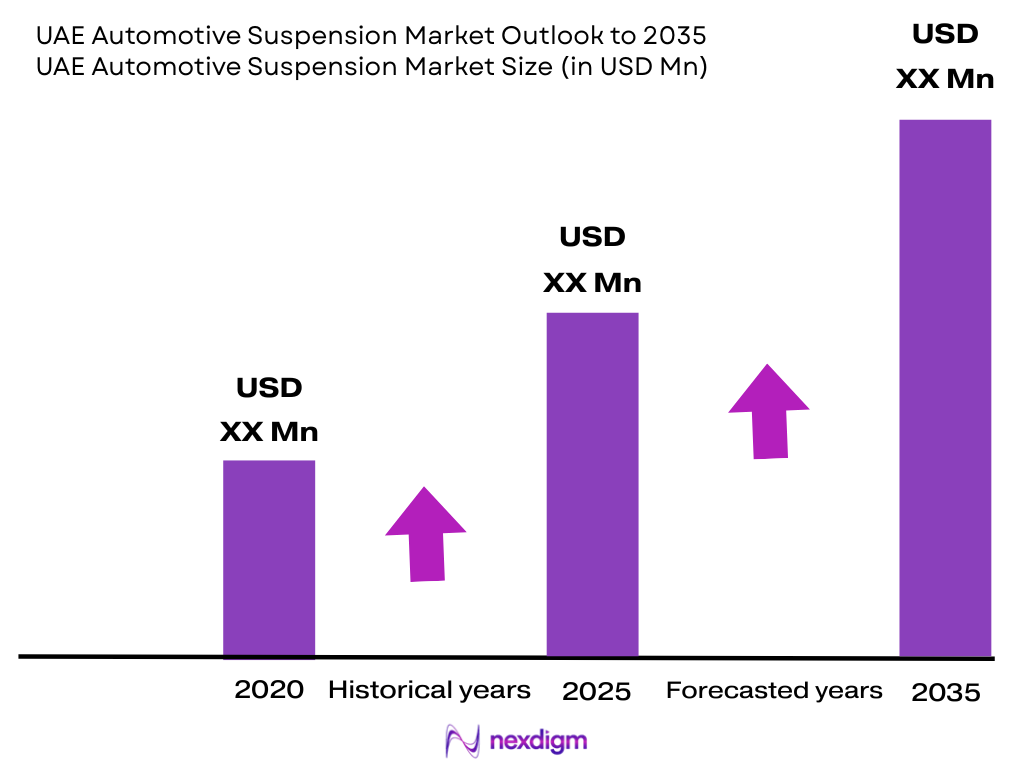
The UAE Automotive Suspension Market is valued at approximately USD ~ million, supported by the country’s large SUV, 4×4, premium-car, rental and commercial-vehicle population. Dubai’s rental fleet expanded from 49,725 vehicles to 71,040 vehicles, while registered electric vehicles in Dubai increased from 25,929 to more than 30,000 vehicles. These expanding vehicle cohorts support recurring demand for shock absorbers, control arms, air springs, electronic dampers and off-road suspension products. Dubai, Abu Dhabi and Sharjah dominate the UAE Automotive Suspension Market due to their concentration of vehicles, dealerships, fleets, premium cars and specialist workshops. Dubai’s rental companies increased from 2,627 to 3,494, while the associated rental fleet expanded from 49,725 to 71,040 vehicles. Dubai also accommodates approximately 3.5 million vehicles during daytime hours, making it the country’s primary aftermarket distribution, workshop, luxury-vehicle service and suspension-upgrade hub.
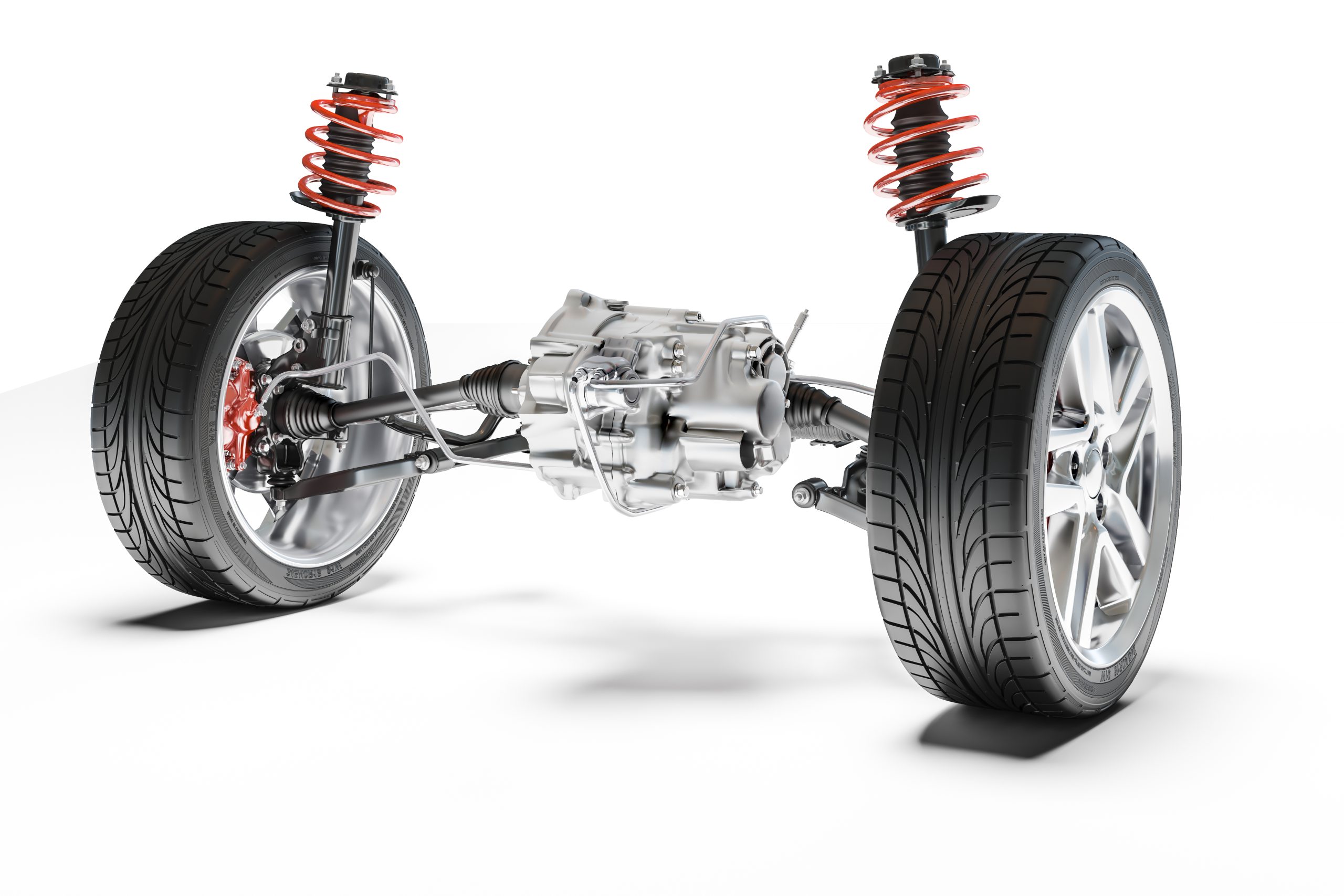
The UAE suspension ecosystem differs materially from conventional mass-market automotive markets. Vehicle demand is strongly influenced by SUVs, full-size 4x4s, premium European vehicles, high-performance cars, rental fleets and logistics vehicles. Desert driving and high ambient temperatures create requirements for greater suspension travel, thermal stability, seal durability and robust bushings, while luxury vehicles generate significant demand for air suspension and electronic damping.
Dubai functions as the principal parts-distribution hub, supported by Ras Al Khor, Al Aweer, Jebel Ali and neighbouring Sharjah Industrial Areas. ZF Services Middle East operates in Dubai and specifically supports suspension, steering and shock-absorber products, confirming the emirate’s role as a regional aftermarket centre.
Market Segmentation
By Vehicle Type
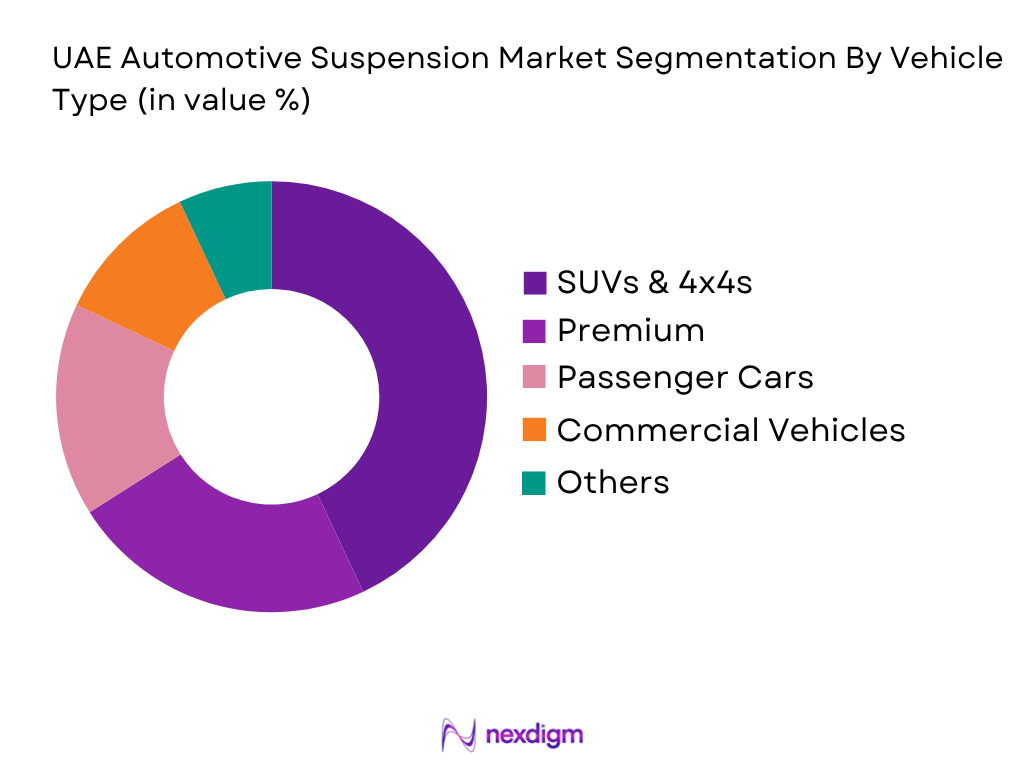
The UAE Automotive Suspension Market is segmented into SUVs and 4x4s, premium and luxury vehicles, passenger cars, commercial vehicles, and electric vehicles. SUVs and 4x4s hold the dominant market share because the UAE vehicle ecosystem strongly favours models designed for highway, desert and recreational off-road use. Vehicles such as large body-on-frame SUVs and pickups require higher-capacity dampers, long-travel suspension, heavy-duty springs and stronger chassis linkages. Desert users additionally purchase lift kits, remote-reservoir shocks and upgraded control arms. Premium SUVs further expand value per vehicle through electronically controlled dampers, adaptive air suspension and active ride-height systems. This combination of high vehicle mass, desert operation and premium specification makes the SUV/4×4 segment commercially more valuable than conventional passenger-car suspension demand.
By Suspension Technology
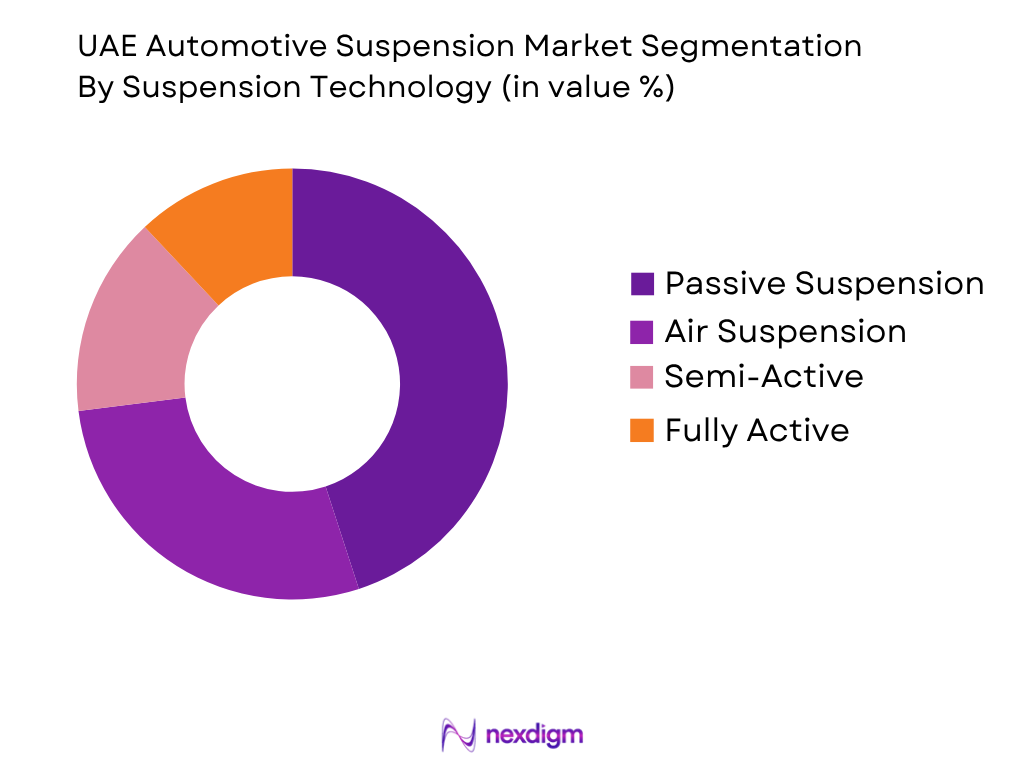
The UAE Automotive Suspension Market is segmented into passive suspension, air suspension, semi-active/electronically controlled suspension and fully active suspension. Passive suspension remains dominant because hydraulic shocks, struts and mechanical springs are extensively used across Japanese SUVs, pickups, passenger cars and commercial vehicles. However, the UAE has an unusually important premium air-suspension segment because large numbers of luxury SUVs and executive vehicles use self-levelling and adaptive ride systems. Semi-active systems are also becoming more commercially relevant as premium cars and newer EVs use electronically variable damping. Air suspension has a significant replacement opportunity because compressors, air springs, valve blocks and height sensors are exposed to prolonged heat and demanding operating conditions. Active suspension remains concentrated in technologically advanced luxury platforms.
Competitive Landscape
The UAE Automotive Suspension Market is characterised by global OE suspension companies, established Japanese replacement brands, European premium suppliers and specialist off-road manufacturers. ZF, KYB, Tenneco/Monroe, BILSTEIN and ARB/Old Man Emu compete across different demand pools rather than through identical product portfolios. ZF has a formal UAE aftermarket operation, BILSTEIN serves road and performance applications through its global dealer network, while ARB operates directly in Dubai and targets the region’s distinctive off-road requirements.
| Major Player | Established | Headquarters | UAE Presence | Core Suspension Portfolio | SUV / 4×4 Capability | Air / Electronic Capability | Aftermarket Position | UAE-Specific Strength |
| ZF Friedrichshafen AG | 1915 | Friedrichshafen, Germany | ~ | ~ | ~ | ~ | ~ | ~ |
| KYB Corporation | 1919 | Tokyo, Japan | ~ | ~ | ~ | ~ | ~ | ~ |
| Tenneco / Monroe | 1999 current structure | Northville, USA | ~ | ~ | ~ | ~ | ~ | ~ |
| thyssenkrupp BILSTEIN | 1873 heritage | Ennepetal, Germany | ~ | ~ | ~ | ~ | ~ | ~ |
| ARB / Old Man Emu | 1975 | Melbourne, Australia | ~ | ~ | ~ | ~ | ~ | ~ |
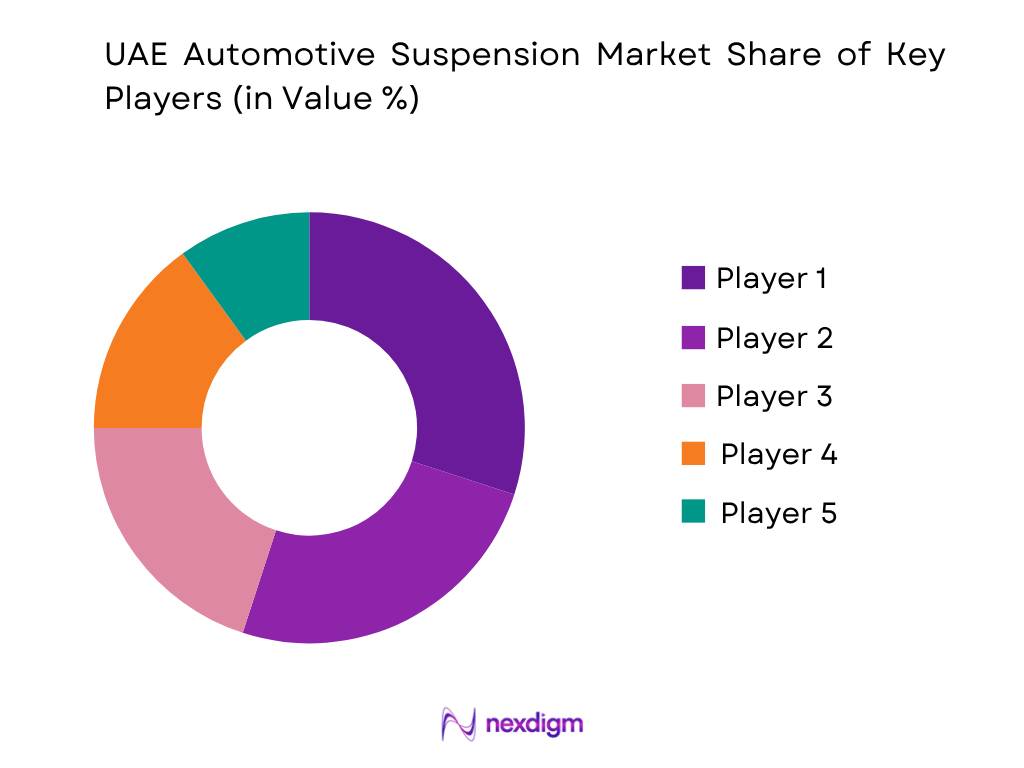
UAE Automotive Suspension Market Analysis
Growth Drivers
High SUV, 4×4 and Fleet Vehicle Intensity
The UAE Automotive Suspension Market is structurally supported by the unusually high concentration of SUVs, 4x4s, premium vehicles, rental cars and commercial fleets operating under demanding road and desert conditions. Dubai’s Roads and Transport Authority reported that the number of vehicles present in Dubai during daytime hours reached 3.5 million vehicles in 2024, demonstrating the exceptional intensity of road mobility in the country’s largest automotive aftermarket hub. Fleet activity creates an additional recurring suspension requirement. Dubai’s rental vehicle fleet expanded to 71,040 vehicles in 2024, from 49,725 vehicles in 2023, while the number of active rental companies increased to 3,494 from 2,627. Commercial and logistics transport represents another major wear-intensive segment: more than 400,000 vehicles were registered in Dubai’s commercial and logistics transport sector in 2024 after the fleet expanded by more than 100,000 vehicles. These applications create sustained demand for shock absorbers, struts, control arms, bushings, leaf springs, ball joints and air-suspension components because fleet vehicles accumulate mileage rapidly and frequently operate under passenger, cargo or towing loads. The UAE’s SUV and 4×4 culture further increases suspension content because large body-on-frame vehicles require stronger dampers, greater suspension travel and more robust linkages than compact passenger cars. Desert driving adds repeated compression and rebound cycles, high damper-fluid temperatures and significant dust exposure, supporting demand for mono-tube shocks, remote-reservoir systems, heavy-duty springs and upgraded suspension bushings. Premium SUVs introduce an additional value layer through adaptive air suspension, electronically controlled dampers and automatic ride-height systems. The macroeconomic environment reinforces this large addressable vehicle base. World Bank data place UAE GDP at USD 552.32 billion in 2024 and GDP per capita at USD 50,273.5, indicating substantial purchasing power for vehicle ownership, premium cars, fleet operations and preventive maintenance. The IMF subsequently places the country’s population at approximately 11.465 million people, while current-price GDP is projected to reach approximately USD 621.55 billion in 2026, supporting continued mobility and automotive-service activity. For suspension suppliers, the key implication is that demand comes from several high-utilisation channels simultaneously: everyday SUV replacement, premium electronic suspension repair, rental-fleet maintenance, logistics vehicles and recreational desert upgrades. Suppliers with wide vehicle coverage, local stock availability and specialist workshop partnerships are therefore positioned to capture recurring demand independent of new vehicle manufacturing.
Growth of EVs and Electronically Controlled Ride Systems
Electrification is creating a second major growth driver because EVs impose different load, ride-comfort and chassis-control requirements from conventional internal-combustion vehicles. Dubai Electricity and Water Authority reported 37,486 electric vehicles in Dubai at the end of 2024, increasing to 47,944 vehicles by the end of 2025. By mid-2025, the number had already passed 40,600 EVs, confirming that the addressable EV suspension base is expanding rapidly rather than remaining a niche category. Charging infrastructure is also widening alongside the vehicle population: DEWA reported more than 1,860 charging points across Dubai by the end of 2025, while the federal UAEV programme had announced installation of 100 charging units during 2024 as part of a national network build-out. For suspension manufacturers, electrification changes component requirements rather than simply replacing one powertrain with another. Battery packs increase vehicle mass, change axle loads and place significant weight low in the chassis, requiring revised coil-spring rates, damper calibration, bump-stop characteristics, anti-roll systems and suspension bushing stiffness. Premium electric SUVs are especially relevant in the UAE because buyers in this market often select vehicles fitted with adaptive air suspension, variable damping and automatic ride-height management. These systems use electronic valves, height sensors, compressors, reservoirs and chassis controllers, substantially increasing suspension content per vehicle compared with basic passive systems. EVs also generate less powertrain noise, which makes tyre impact, road harshness and suspension friction more noticeable inside the cabin. This supports demand for low-friction dampers, refined elastomer bushings, active damping and better isolation at suspension top mounts. The broader economic environment supports the adoption of these higher-value systems. World Bank data show UAE GDP of USD 552.32 billion in 2024, with GDP per capita at USD 50,273.5, while IMF data indicate a population of approximately 11.465 million and current-price economic output approaching USD 621.55 billion in 2026. Those macro indicators are important for the suspension market because high-income vehicle buyers are more capable of purchasing premium EVs and maintaining electronically complex suspension systems after warranty. The UAE’s transport policy is also becoming increasingly electrification-oriented. The Ministry of Energy and Infrastructure has established a national EV-charging framework and coordinated public-private charging expansion, creating infrastructure that supports a larger EV parc. For suspension suppliers and workshops, this creates an opportunity to move beyond conventional shocks and struts into EV-specific springs, electronic dampers, air-suspension systems, lightweight aluminium control arms and chassis diagnostics.
Market Challenges
Import Dependence, Vehicle Brand Diversity and Inventory Complexity
The UAE Automotive Suspension Market faces a structural sourcing challenge because it is predominantly an import-led automotive ecosystem with an unusually broad mixture of Japanese, German, American, Korean, British, Chinese and other European vehicle brands. This creates large SKU complexity across shock absorbers, struts, air springs, control arms, bushings, electronic dampers and suspension sensors. Dubai alone accommodates 3.5 million vehicles during daytime hours, while more than 400,000 vehicles operated within its commercial and logistics transport sector in 2024. Rental companies controlled another 71,040 vehicles, meaning distributors must serve private cars, premium SUVs, commercial vans, taxis, logistics vehicles and fleet cars through one highly fragmented parts network. Suspension fitment is particularly sensitive because visually similar components can differ in length, damping curves, spring rates, electronic connectors or ride-height programming. A German luxury SUV equipped with adaptive air suspension may require an air spring, compressor, valve block and electronically coded damper, while a Japanese 4×4 may require conventional heavy-duty shocks and coil springs, and an American off-road model may use remote-reservoir or long-travel systems. Maintaining local inventory for such varied applications can tie up working capital and increase dependence on international supply chains. Long lead times become especially problematic for electronic or premium suspension components that are not stocked in high volume. The rapid entry of EVs adds further product fragmentation. Dubai’s EV fleet reached 37,486 vehicles at the end of 2024 and 47,944 vehicles at the end of 2025, introducing new platform-specific suspension calibrations and electronic architectures into the replacement market. Import dependence also increases exposure to authenticity and quality risks because high-value suspension components can attract counterfeit or low-specification substitutes. This matters for safety: incorrect damping, spring rates or electronically incompatible suspension components can affect body control, tyre contact and vehicle stability. The UAE’s macroeconomic scale intensifies expectations for product availability. World Bank data place national GDP at USD 552.32 billion in 2024, with GDP per capita of USD 50,273.5, while the IMF records a population of about 11.465 million people. A high-income vehicle parc tends to contain more premium and technologically complex models, raising the number of high-value suspension SKUs that distributors must support. The challenge for established brands is therefore operational as much as technological. Competitive advantage increasingly depends on accurate digital fitment catalogues, VIN-based identification, regional warehouses, authenticated product supply and rapid replenishment from Europe, Japan, the United States and Asia. Companies without strong local inventory and distributor networks risk losing demand to immediately available lower-quality alternatives.
Extreme Operating Conditions and Increasing Diagnostic Complexity
UAE operating conditions create a significant technical challenge for suspension systems because vehicles are exposed to sustained heat, airborne dust, sand, high-speed road use and, in many SUV applications, repeated desert driving. These conditions place substantial thermal and mechanical loads on dampers, bushings, seals and air-suspension hardware. National Center of Meteorology bulletins in 2024 repeatedly recorded dusty conditions, suspended dust and daily temperatures approaching 39°C even during April, well before peak summer conditions. For suspension systems, high ambient temperature raises shock-absorber fluid temperature and can increase the risk of damping fade under repeated compression cycles. Elastomer bushings, seals and air-spring bellows also experience accelerated heat ageing, while fine sand and dust can contaminate exposed shafts and sealing surfaces. Off-road vehicles introduce even greater loads because dune driving produces rapid suspension cycling, large wheel travel and elevated shock temperatures. The challenge is becoming more complex as premium and EV fleets adopt air suspension and electronically controlled damping. Dubai had 37,486 EVs at the end of 2024, rising to 47,944 by the end of 2025, while the wider premium vehicle parc includes substantial numbers of models using ride-height sensors, adaptive dampers, air compressors and chassis ECUs. Diagnosing these systems requires more than checking for an oil leak or damaged spring. Workshops need electronic scan tools, pressure testing, ride-height calibration and correct software-compatible replacement components. A failed air spring may overload a compressor; a faulty height sensor can incorrectly alter ride level; an electronic damper mismatch can generate chassis fault codes. The challenge is particularly significant for independent garages competing with authorised dealer networks because specialist equipment and technician capability are unevenly distributed. Fleet volume amplifies the problem. Dubai’s rental vehicle fleet reached 71,040 vehicles in 2024, while commercial and logistics vehicles surpassed 400,000, increasing the number of high-mileage vehicles that require fast diagnosis and minimal downtime. Macroeconomic conditions support a large service industry but also create demanding customer expectations. World Bank data put UAE GDP at USD 552.32 billion in 2024 and GDP per capita at USD 50,273.5, while the IMF places population at 11.465 million. Owners of high-value vehicles are less tolerant of repeat repairs, ride-quality deterioration or warning lights following suspension work. Consequently, suspension brands increasingly need to support workshops with diagnostic data, installation instructions, electronic calibration procedures and temperature-resistant product specifications. Products engineered for milder climates may underperform in UAE conditions, creating a clear differentiation challenge between generic imported suspension and systems validated for high-temperature, dust-intensive operation.
Market Opportunities
Premium Air Suspension, Electronic Damping and EV-Specific Ride Control
The UAE provides a strong opportunity for suppliers of premium air suspension and electronically controlled ride systems because the vehicle parc combines luxury SUVs, executive vehicles and a rapidly growing population of EVs. Dubai’s EV fleet increased from 37,486 vehicles at the end of 2024 to 47,944 at the end of 2025, while the number exceeded 40,600 vehicles by the middle of 2025. These vehicles are increasingly equipped with sophisticated chassis systems designed to manage battery mass, maximise ride comfort and adjust vehicle height automatically. For suspension suppliers, the commercially attractive products extend far beyond conventional replacement shocks. Air springs, air compressors, valve blocks, height sensors, adaptive dampers, suspension ECUs and lightweight structural components all increase aftermarket content per vehicle. Premium SUVs are especially relevant because air suspension allows drivers to combine highway comfort with greater ground clearance for off-road use, an unusually useful feature in the UAE. Electronic damping similarly allows one vehicle to switch between comfort, sport and off-road ride modes without replacing mechanical components. As these vehicles age beyond manufacturer warranty periods, a larger share of repairs should migrate toward independent premium workshops, creating demand for OE-equivalent electronic components and specialised diagnostics. The expanding charging ecosystem reinforces this installed-base opportunity. DEWA reported more than 1,860 charging points across Dubai by the end of 2025, while federal infrastructure programmes continue to expand charging availability. Current economic capacity provides a supportive environment for such premium replacement categories. World Bank data show UAE GDP of USD 552.32 billion in 2024 and GDP per capita of USD 50,273.5, while IMF data indicate current-price output approaching USD 621.55 billion in 2026 and a population of approximately 11.465 million. Rather than relying on future-market projections, these existing indicators demonstrate that the country already has both the purchasing power and installed vehicle infrastructure necessary to support advanced suspension. The strongest opportunity for suppliers is to create UAE-specific premium programmes combining locally stocked air springs, compressors and electronic dampers with diagnostic tools and technical training. Distributors can further differentiate using VIN-based component identification and warranties designed specifically for high-temperature use. As the EV and luxury parc ages, independent service channels capable of repairing sophisticated suspension systems without dealer-level replacement costs should become increasingly important.
Fleet Maintenance, 4×4 Performance and Regional Distribution Expansion
A second major opportunity lies in combining high-utilisation fleet maintenance with the UAE’s specialised desert and 4×4 suspension ecosystem. Dubai’s rental fleet reached 71,040 vehicles in 2024, compared with 49,725 vehicles in 2023, while the number of active rental operators increased to 3,494 companies. The commercial and logistics transport fleet exceeded 400,000 vehicles in 2024 and surpassed 500,000 vehicles during 2025, demonstrating the scale of high-mileage road transport requiring shocks, bushings, ball joints, control arms, leaf springs and other wear components. Unlike private cars, these vehicles experience intense duty cycles and fleet managers place greater value on predictable maintenance intervals, component durability and reduced vehicle downtime. Suspension manufacturers can therefore develop fleet-specific programmes using scheduled shock and bushing inspection, bulk procurement, standardised replacement kits and vehicle-specific maintenance histories. At the same time, recreational and professional desert use supports a separate premium market for remote-reservoir dampers, mono-tube shocks, bypass systems, lift kits, progressive springs and reinforced control arms. These products need high thermal capacity and extended suspension travel rather than only basic OE-equivalent performance. The opportunity is strengthened by Dubai’s role as a distribution hub. The concentration of automotive wholesalers and logistics infrastructure allows brands to hold regional stock in the UAE and distribute suspension products into neighbouring GCC and wider Middle Eastern markets without relying on individual country inventories. Dubai’s 3.5 million daytime vehicle population provides a strong domestic demand base while also supporting distributor scale. Future regional distribution can build on a macroeconomy already valued by the World Bank at USD 552.32 billion in 2024, with GDP per capita of USD 50,273.5. IMF data indicate a national population of about 11.465 million, while current-price GDP is projected near USD 621.55 billion in 2026, supporting continued logistics and automotive-service expansion. Commercial transport infrastructure is also becoming increasingly digitised, with RTA developing platforms connecting customers directly with registered transport providers, indicating a broader movement toward organised fleet management. Suspension companies can participate in this formalisation through digital maintenance records, fleet contracts and predictive replacement schedules. The most attractive strategy combines three capabilities: high-volume OE-equivalent products for rental and logistics fleets, premium desert-performance products for 4×4 customers, and regional warehousing capable of serving UAE and export demand. This diversification reduces dependence on any single vehicle segment and leverages the country’s distinctive position as both a high-consumption automotive market and a regional parts-distribution centre.
Future Outlook
The UAE Automotive Suspension Market is forecast to expand at approximately ~ CAGR during 2026–2035. Future value creation will increasingly come from suspension sophistication rather than basic replacement volumes alone. Adaptive damping, premium air suspension, off-road systems, EV-specific components and digitally diagnosed chassis systems should progressively increase content per vehicle. SUV and 4×4 demand will remain central because UAE operating conditions create clear use cases for higher ground clearance, heavy-duty dampers and long-travel suspension. Specialist products such as remote-reservoir shocks and lift systems are especially relevant to recreational desert driving; ARB’s dedicated UAE operation illustrates the commercial depth of this segment. Electrification will create another layer of demand. Dubai’s EV population has risen from 25,929 vehicles to more than 30,000 vehicles, while subsequent official data show continued expansion beyond that level. Higher battery mass requires revised springs, dampers and bushings, while premium EVs increasingly integrate adaptive ride control and air suspension. Fleet activity should also strengthen replacement demand. Dubai’s rental vehicle population expanded sharply, increasing suspension exposure to high annual mileage and intensive utilisation. Fleet operators therefore represent an important customer group for predictable replacement programmes, standardised procurement and preventive chassis maintenance.
Major Players
- ZF Friedrichshafen AG / ZF Services Middle East
- KYB Corporation
- Tenneco / Monroe Ride Solutions
- thyssenkrupp BILSTEIN
- HL Mando Corporation
- BWI Group
- Astemo Ltd. / SHOWA–TOKICO
- Gabriel / MAT Holdings
- Sogefi Group
- BENTELER International
- Magna International
- Fox Factory Holding Corp.
- ARB / Old Man Emu
- KW automotive
- Eibach
Key Target Audience
- Automotive Suspension and Chassis Component Manufacturers
- SUV, 4×4 and Performance Automotive Parts Companies
- Automotive Spare Parts Importers and Distributors
- Luxury and Premium Vehicle Dealer Groups
- Fleet, Rental and Commercial Vehicle Operators
- Automotive Workshop and Service Network Operators
- Investments and Venture Capitalist Firms
- Government and Regulatory Bodies (Ministry of Energy and Infrastructure, Roads and Transport Authority Dubai, Dubai Electricity and Water Authority, Integrated Transport Centre Abu Dhabi, Ministry of Industry and Advanced Technology)
Research Methodology
Step 1: Identification of Key Variables
The initial phase involves constructing the complete UAE Automotive Suspension Market ecosystem covering vehicle dealers, global suspension brands, importers, distributors, specialist workshops, fleet operators and 4×4 modification companies. Core variables include vehicle parc, SUV concentration, suspension technology, replacement frequency, imported product mix, fleet utilisation and premium-vehicle penetration. Secondary research combines government transport records, economic data and manufacturer information to distinguish conventional replacement demand from air suspension, electronic damping and desert-performance applications.
Step 2: Market Analysis and Construction
The top-down model assesses UAE automotive parts expenditure before isolating suspension and ride-control categories. The bottom-up model maps shock absorbers, struts, springs, control arms, air-suspension components and electronic dampers against relevant vehicle categories. Independent aftermarket demand is separated from authorised dealer replacement, fleet maintenance and specialist off-road upgrades. Dubai, Abu Dhabi and Sharjah are modelled separately to account for differences in distribution, premium-vehicle density and workshop structure.
Step 3: Hypothesis Validation and Expert Consultation
Market hypotheses are validated through computer-assisted telephone interviews with suspension distributors, spare-parts importers, authorised dealers, independent workshops, off-road specialists and commercial fleet operators. Primary discussions validate replacement intervals, product-origin preferences, premium versus economy demand, failure patterns in air suspension, desert-driving requirements and the role of extreme temperatures in suspension-component life.
Step 4: Research Synthesis and Final Output
Primary findings are triangulated with official UAE and Dubai transport indicators, supplier disclosures and macroeconomic statistics. Market demand is structured by vehicle type, suspension technology, component category, sales channel and emirate. Forecast scenarios incorporate SUV concentration, EV expansion, fleet utilisation, air-suspension penetration, off-road modification demand and the transition from low-cost replacement parts toward authenticated premium components.

- Executive Summary
- Research Methodology (Market Definitions and Assumptions, Suspension Market Boundary, Abbreviations, Top-Down Market Sizing, Bottom-Up Vehicle Parc Mapping, Vehicle Registration Assessment, Suspension Units per Vehicle, Replacement-Cycle Modelling, OE Fitment Assessment, Imported Parts Assessment, SUV and 4×4 Demand Assessment, Premium Vehicle Assessment, Fleet and Commercial Vehicle Assessment, Workshop Interviews, Parts Distributor Interviews, Dealer Interviews, Supply-Side Assessment, Demand-Side Assessment, Data Triangulation, Forecasting Framework, Scenario Analysis, Limitations and Future Conclusions)

- Definition and Scope
- Market Evolution and Industry Genesis
- Evolution of UAE Automotive Suspension Demand
- UAE Vehicle Parc and Mobility Ecosystem
- SUV and 4×4 Suspension Ecosystem

- Growth Drivers (SUV and 4×4 Demand, Premium Vehicle Parc, Desert Driving, Fleet Utilisation, Replacement Cycles, EV Adoption, Aftermarket Distribution)
- Market Challenges (Import Dependency, Counterfeit Parts, Heat Stress, Electronic Complexity, Air Suspension Failure, SKU Fragmentation, Price Competition, Technician Capability)
- Market Opportunities (Off-Road Suspension, Premium Air Suspension, EV Suspension, Electronic Damping, Fleet Maintenance, E-Commerce, Re-Export, High-Temperature Products)
- Market Trends (Air Suspension, Adaptive Damping, Lift Kits, Remote Reservoir Dampers, Digital Diagnostics, EV Calibration, Premiumisation, E-Commerce)
- SWOT Analysis
- Porter’s Five Forces Analysis
- PESTLE Analysis

- By Market Value (2020-2025)
- By Suspension Component Units (2020-2025)
- By Shock Absorber and Strut Units (2020-2025)

- By Suspension Technology (In Value %)
Passive Suspension Systems
Semi-Active Suspension Systems
Fully Active Suspension Systems
Air Suspension Systems
Adaptive Air Suspension Systems - By Vehicle Type (In Value %)
Compact SUVs
Mid-Size SUVs
Large SUVs
Luxury SUVs - By Vehicle Origin (In Value %)
Japanese Vehicles
German Vehicles
American Vehicles
Korean Vehicles
Chinese Vehicles - By Emirate (In Value %)
Dubai
Abu Dhabi
Sharjah
Ajman
Ras Al Khaimah

- Market Share of Major Players by Market Value
- Cross Comparison Parameters (UAE Vehicle Parc and SKU Coverage, SUV–4×4–Luxury Vehicle Suspension Portfolio, Air and Electronic Suspension Capability, Desert and High-Temperature Product Capability, UAE Distributor–Workshop–Dealer Reach, Product Availability and Local Inventory Depth, Off-Road and Performance Suspension Portfolio, OE-Equivalent Quality–Warranty–Product Authentication Capability)
- SWOT Analysis of Major Players
- Detailed Profiles of Major Companies
ZF Friedrichshafen AG / ZF Services Middle East LLC
KYB Corporation
Tenneco / Monroe Ride Solutions
thyssenkrupp BILSTEIN
HL Mando Corporation
BWI Group
Astemo Ltd. / SHOWA–TOKICO
Gabriel / MAT Holdings
Sogefi Group
BENTELER International
Magna International
Fox Factory Holding Corp.
Old Man Emu / ARB
KW automotive
Eibach

- Ride Comfort Preference
- SUV Ground-Clearance Requirement
- Desert Driving Requirement
- Dune-Bashing Suspension Requirement
- Luxury Ride Quality Expectations

- By Market Value (2026-2035)
- By Suspension Component Units (2026-2035)
- By Shock Absorber and Strut Units (2026-2035)


 Request a Sample
 Ask for Customization
 Get a Quote
 Enquire Now