
 Download PDF
Market Overview
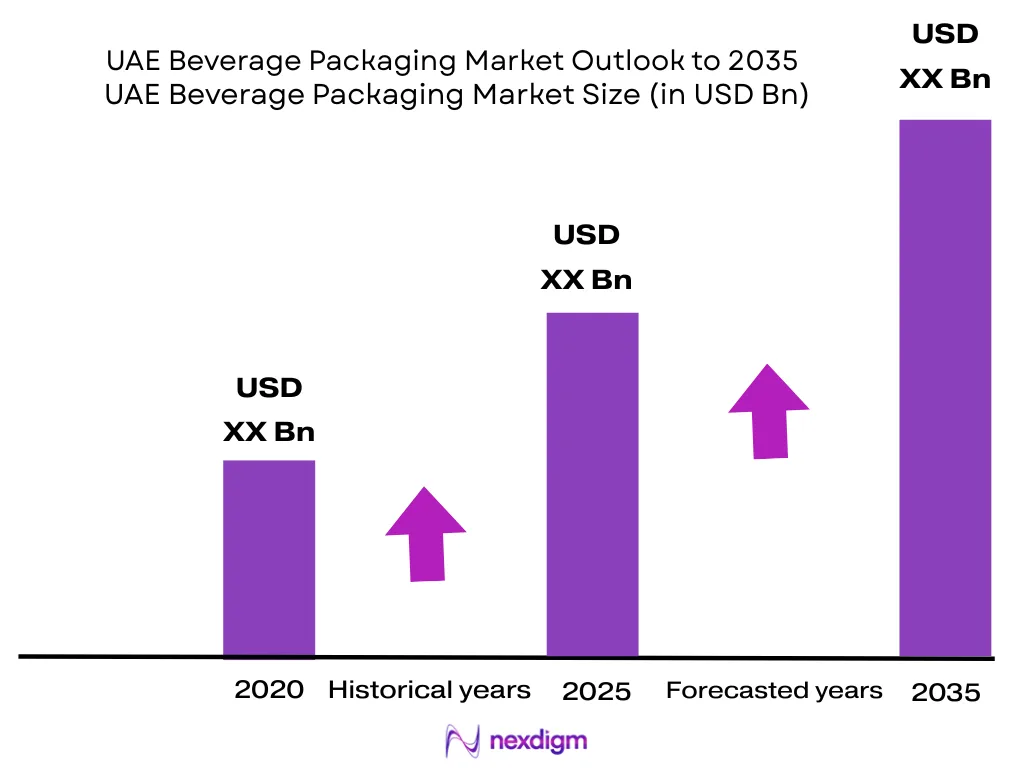
The UAE Beverage Packaging Market is valued at approximately USD ~ billion and is forecast to expand at a CAGR of % during 2026–2035. The two latest annual readings reflect an economy exceeding AED 1.7 trillion and a resident population above 11 million people. Demand is sustained by packaged water, soft drinks, dairy beverages, juice, energy drinks, hospitality, aviation, tourism, foodservice, modern retail, outdoor consumption, and the country’s regional beverage re-export infrastructure. Dubai, Abu Dhabi, Sharjah, Ras Al Khaimah and Ajman dominate the UAE Beverage Packaging Market. Dubai combines beverage consumption, tourism, hospitality, airport traffic, ports, retail headquarters and packaging conversion around Jebel Ali and Dubai Industrial City. Abu Dhabi supports water, dairy, soft-drink and recycling investments through KEZAD, Musaffah and Al Ain. Sharjah and Ajman accommodate converters and logistics operators, while Ras Al Khaimah contributes glass, industrial manufacturing and export-oriented production.
Market Segmentation
By Packaging Material
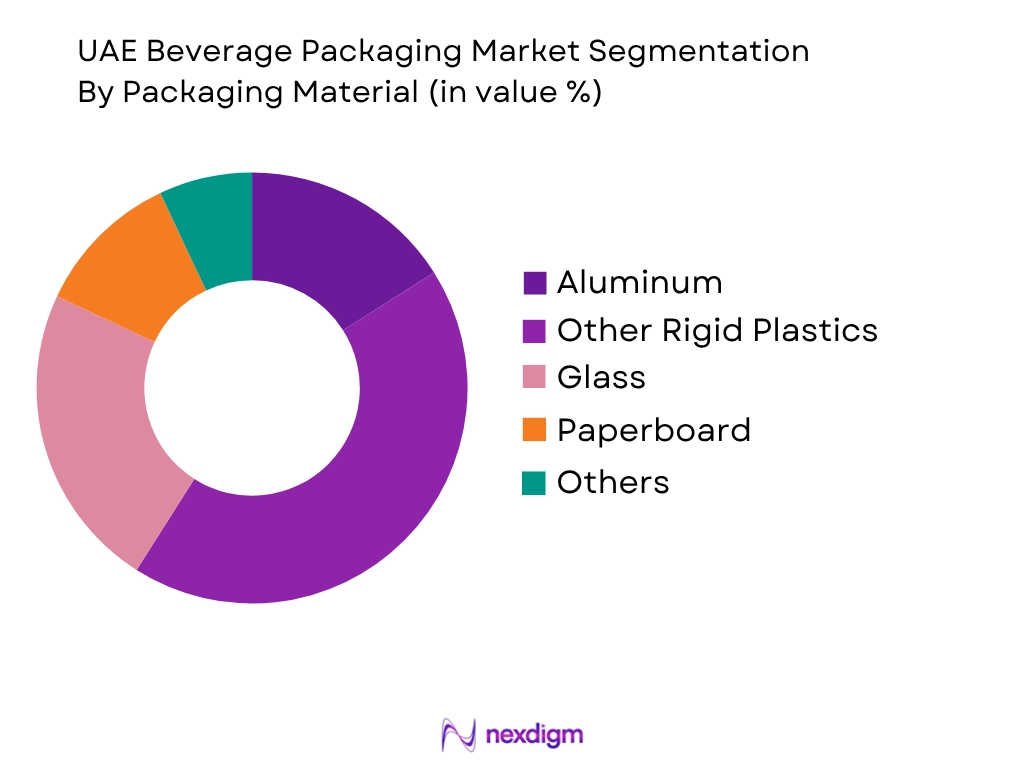
The UAE Beverage Packaging Market is segmented into PET and other rigid plastics, aluminium and steel, glass, paperboard beverage cartons, and flexible or composite packaging. PET and other rigid plastics hold the dominant indicative share because packaged drinking water represents a major beverage-packaging application across retail, workplaces, hotels, schools, construction sites, airlines, events and residential delivery. PET bottles provide low transport weight, clarity, reclosure and compatibility with high-speed filling. Large refillable water jars also support home and office delivery. Aluminium cans are widely used for carbonated soft drinks, energy drinks, sparkling water, malt beverages and ready-to-drink products. Glass remains essential for premium water, juice, hotels, restaurants, beer, wine and spirits. Aseptic cartons serve dairy, laban, juice, plant-based beverages and shelf-stable products, while flexible packaging is concentrated in beverage concentrates, pouches and bag-in-box systems.
By Beverage Category
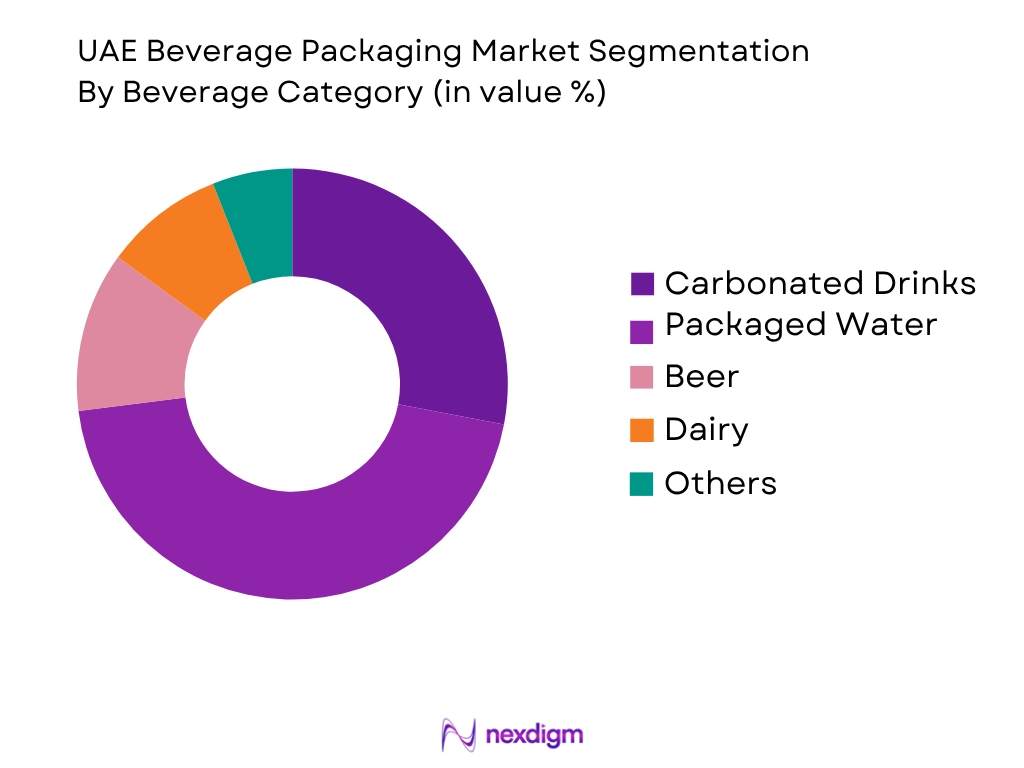
The UAE Beverage Packaging Market is segmented into packaged drinking water, carbonated soft drinks, juices and nectars, dairy and laban beverages, energy and sports drinks, ready-to-drink tea and coffee, alcoholic beverages, plant-based beverages, and functional products. Packaged drinking water holds the dominant indicative share because climatic conditions, outdoor activity, tourism, hospitality and workplace consumption generate recurring demand for single-serve PET bottles, multi-serve bottles, five-gallon jars, caps, labels, shrink film and corrugated cases. Carbonated drinks and energy products support can and PET consumption across supermarkets, petrol stations and convenience stores. Dairy, laban and juice products sustain HDPE, PET and aseptic-carton demand. Hotels and premium restaurants create a separate market for glass water bottles, decorative closures and customised labels. Airlines and catering operators favour lightweight, portion-controlled and tamper-evident beverage formats.
Competitive Landscape
The UAE Beverage Packaging Market combines locally established plastic, metal, paper and flexible-packaging manufacturers with multinational carton, closure and rigid-container suppliers. Competition is influenced by proximity to beverage fillers, food-contact conformity, high-temperature package performance, regional distribution, import substitution, recycled-content capability, short production lead times and the ability to serve hospitality, aviation and export customers. Arabian Can Industry, ALPLA Middle East, Hotpack Global, Tetra Pak Arabia and RAK Ghani Glass represent major positions across cans, plastics, foodservice packaging, cartons and glass.
| Company | Establishment Year | Headquarters | Core Beverage Portfolio | Material Capability | Principal Applications | UAE Footprint | Circularity Capability | Strategic Differentiation |
| Arabian Can Industry | 1993 | Dubai, UAE | ~ | ~ | ~ | ~ | ~ | ~ |
| ALPLA Middle East | 1955 group heritage | Hard, Austria | ~ | ~ | ~ | ~ | ~ | ~ |
| Hotpack Global | 1995 | Dubai, UAE | ~ | ~ | ~ | ~ | ~ | ~ |
| Tetra Pak Arabia | 1951 group heritage | Pully, Switzerland | ~ | ~ | ~ | ~ | ~ | ~ |
| RAK Ghani Glass | 2007 | Ras Al Khaimah, UAE | ~ | ~ | ~ | ~ | ~ | ~ |
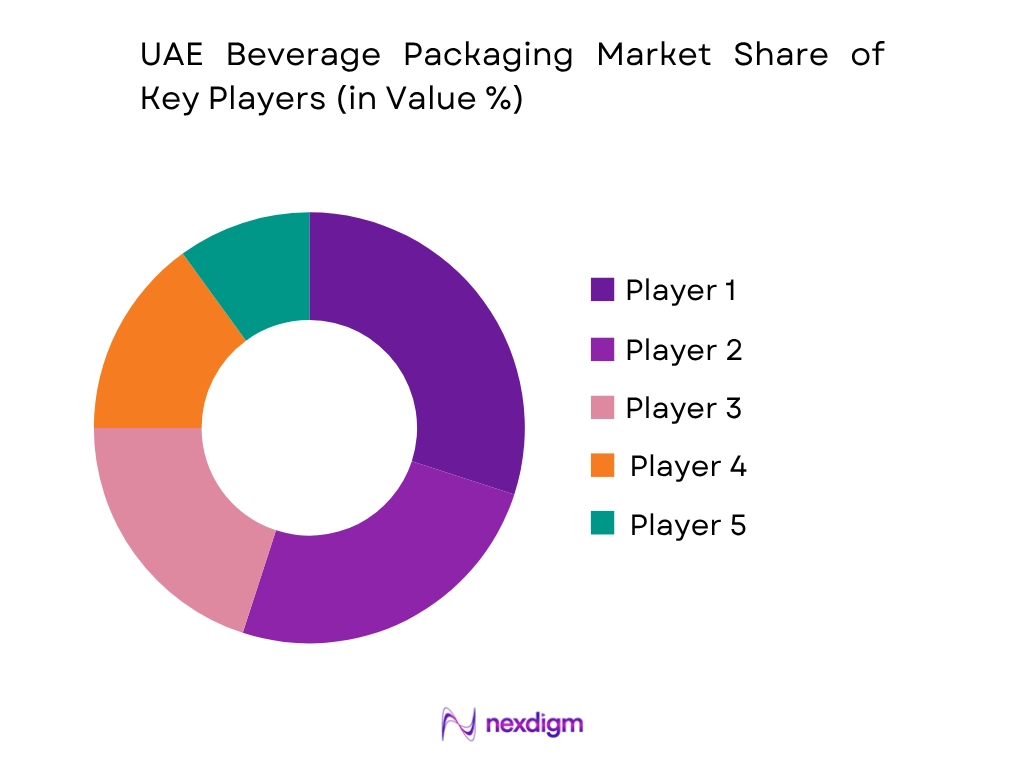
UAE Beverage Packaging Market Analysis
Growth Drivers
Packaged-Water, Hospitality, and On-the-Go Beverage Consumption
The UAE’s beverage-packaging demand is supported by a large urban consumer economy, extensive packaged-water usage, international tourism, aviation, hospitality, modern retail, food delivery, and outdoor consumption. World Bank data places UAE GDP at USD 552.32 billion in 2024, GDP per capita at USD 50,273.5, and real GDP growth at 4.0 points for every 100 points of output. The IMF records a national population of approximately 11.465 million people, while its April 2026 database places current-price GDP at USD 621.55 billion in 2026. These macroeconomic indicators support high beverage throughput across Dubai, Abu Dhabi, Sharjah, Ajman, Ras Al Khaimah, Fujairah, and Umm Al Quwain. Packaged drinking water generates recurring demand for small PET bottles, standard single-serve bottles, family-size containers, five-gallon refillable jars, closures, labels, shrink films, reusable racks, and corrugated cases. Hotels, resorts, airlines, airports, restaurants, cafés, offices, schools, construction sites, hospitals, sporting venues, and outdoor events all require different container sizes and service formats. Carbonated soft drinks and energy beverages use aluminium cans and pressure-resistant PET bottles, while dairy products, laban, juices, plant-based beverages, and nutritional drinks support HDPE bottles, PET containers, chilled cartons, and aseptic packs. Premium hotels and restaurants also generate demand for decorated glass bottles, metal closures, tamper-evident seals, and customised labels. The UAE’s high-income consumption base allows suppliers to serve both mass-market water requirements and premium beverage applications without relying on a single packaging material. Dubai’s global tourism, airport, retail, and foodservice infrastructure supports high volumes of compact, tamper-evident packages, while Abu Dhabi and Al Ain provide significant water, dairy, institutional, and industrial demand. Jebel Ali, Khalifa Port, Dubai Industrial City, KEZAD, Hamriyah Free Zone, and Ras Al Khaimah Economic Zone connect local packaging production with imported raw materials and regional re-export routes. The climate also raises beverage-consumption frequency and increases the importance of portable hydration formats. Packaging suppliers therefore compete through bottle lightweighting, closure integrity, high-temperature performance, pallet stability, short lead times, and the ability to provide multiple pack configurations. The interaction between USD 552.32 billion in 2024 economic output, more than 11 million residents, strong visitor flows, and diversified hospitality channels creates a structural growth driver for beverage containers, closures, labels, multipacks, dispensing systems, and filling machinery. Sources: World Bank and International Monetary Fund.
Regulation-Led Transition Toward Collection, Recycled Content, and Reuse
The UAE’s beverage-packaging system is being reshaped by restrictions on selected single-use products, recycled-plastic regulation, reverse-vending deployment, and government-backed collection infrastructure. Dubai Municipality introduced its single-use product restrictions in stages, beginning with plastic bags on 1 January 2024, expanding the scope on 1 June 2024, and prohibiting additional products such as polystyrene cups, plastic straws, plastic stirrers, and other service items from 1 January 2025. The final phase became effective on 1 January 2026, covering products including single-use plastic beverage cups, lids, plates, and cutlery. Although standard PET beverage bottles are not equivalent to all prohibited foodservice items, the policy directly affects the broader beverage-service ecosystem in hotels, cafés, restaurants, catering operations, airports, events, and quick-service outlets. Beverage companies and packaging suppliers must therefore redesign cup, lid, straw, stirrer, takeaway, and secondary-packaging systems around reusable, fibre-based, aluminium, or other approved alternatives. Abu Dhabi’s collection infrastructure provides a second regulatory and operational driver. Environment Agency–Abu Dhabi reported that more than 130 million bottles had been collected through approximately 150 reverse-vending machines, smart bins, and door-to-door collection points by December 2024, representing around 2,000 tonnes of recyclable plastic. The agency stated that 67 million bottles were returned during 2024 alone. An earlier deployment included 70 reverse-vending machines and 26 smart bins at airports, malls, sports facilities, academic institutions, and other high-footfall locations. These systems create cleaner PET and aluminium streams than mixed municipal collection and provide digital data on container returns. The Ministry of Industry and Advanced Technology has also supported food-grade recycled PET development, including plans for a 12,000-tonne annual PET recycling facility on a 40,000-square-metre site in Abu Dhabi. The project was associated with approximately 100 jobs and potential avoidance of 18,000 tonnes of carbon-dioxide emissions annually at full operation. Together, these measures encourage beverage producers to specify clear PET, smaller labels, washable adhesives, compatible closures, lighter containers, and traceable recycled resin. They also support hotel refill systems, reusable glass bottles, five-gallon water-jar networks, aluminium beverage packaging, and fibre-based multipacks. Suppliers offering food-contact conformity, recycled-content documentation, heat-performance testing, collection partnerships, and digital traceability will become more valuable than suppliers providing isolated containers without end-of-life support. The regulatory driver is therefore broader than a ban: it links package design, serviceware substitution, material recovery, consumer incentives, recycling investment, and procurement requirements across the beverage value chain. Sources: Dubai Municipality, Environment Agency–Abu Dhabi, and Ministry of Industry and Advanced Technology.
Market Challenges
High-Temperature Distribution and Packaging Performance Requirements
The UAE’s climate creates unusually demanding operating conditions for beverage bottles, cans, cartons, labels, closures, corrugated cases, shrink films, and pallet systems. Products may move between air-conditioned filling plants, non-temperature-controlled warehouses, outdoor loading areas, delivery vehicles, convenience stores, beaches, construction sites, airport ramps, hospitality locations, and consumer vehicles. PET bottles exposed to elevated temperatures may experience panel deformation, reduced top-load strength, base instability, altered internal pressure, or closure leakage if resin, preform, bottle geometry, and cap systems are not correctly matched. Carbonated beverages require additional pressure resistance because internal container pressure increases as product temperature rises. Aluminium cans need consistent seam integrity, suitable internal coatings, end performance, and resistance to handling damage. Glass bottles must withstand thermal transitions, impact, pallet vibration, and breakage during transport. Aseptic cartons and flexible laminates must preserve barrier performance and seal integrity under prolonged heat exposure, while labels must resist adhesive failure, edge lifting, ink degradation, and condensation when chilled products move into humid environments. Corrugated cases can lose stacking strength when exposed to moisture, and stretch film must maintain load stability during long-distance distribution. The economic consequences of packaging failure are significant because the UAE operates a high-value retail, aviation, and hospitality economy. World Bank data records USD 552.32 billion in GDP in 2024, while the IMF places current-price GDP at USD 621.55 billion in 2026. Beverage filling and distribution systems serving this economy operate at large scale and under strict service requirements. A small closure defect, label failure, can-seam deviation, bottle-collapse issue, or damaged pallet can result in beverage losses, retail rejection, delayed hotel deliveries, flight-catering disruption, or customer complaints. Suppliers must therefore conduct heat-aging, accelerated shelf-life, pressure, top-load, drop, vibration, seal, cap-torque, seam, migration, and pallet-stability testing. They also need to validate packaging across multiple distribution routes rather than relying on laboratory conditions designed for cooler markets. Lightweighting adds complexity. Reducing PET, glass, aluminium, or paperboard usage can lower material demand, but excessive reduction may weaken the package and increase damage or product waste. Recycled content can also change colour, mechanical performance, thermal behaviour, and processing consistency. Five-gallon refillable jars require repeated washing, inspection, cap replacement, route handling, and asset tracking, while hotel refill bottles require controlled sanitisation and return logistics. Smaller beverage producers and hospitality operators may lack internal packaging-engineering expertise, increasing dependence on converters, laboratories, equipment suppliers, and contract fillers. The market challenge is therefore not simply selecting a recyclable package; it is producing a package that survives extreme heat, preserves the beverage, performs on high-speed filling lines, meets food-contact requirements, and remains economically transportable throughout the UAE’s distribution environment. Sources: World Bank and International Monetary Fund.
Uneven Recovery Infrastructure and Limited Food-Grade Recycled Feedstock
The UAE has developed visible recycling initiatives, but beverage-container recovery remains uneven across emirates, customer channels, building types, tourism locations, foodservice operations, and residential communities. Abu Dhabi’s collection system demonstrates the potential of structured recovery: more than 130 million bottles were collected through approximately 150 recovery points by December 2024, with 67 million bottles returned during 2024 and around 2,000 tonnes of recyclable plastic recovered. However, these numbers also illustrate the scale of infrastructure required to create dependable secondary-material supply. Reverse-vending machines and smart bins need suitable locations, electricity, digital connectivity, maintenance, compaction, cleaning, collection schedules, storage, consumer incentives, fraud controls, and recycler contracts. Containers discarded outside these systems may enter mixed municipal waste, commercial waste streams, landfill, or export-oriented scrap channels. Hotels, restaurants, cafés, airlines, airport caterers, schools, offices, construction sites, beaches, and events generate large volumes of beverage packaging, but collection practices vary considerably. PET bottles may be contaminated with liquids, food, labels, sand, oils, or mixed plastics. Aluminium cans may be combined with foil, steel, aerosols, and non-packaging scrap. Glass bottles require separation by colour and removal of ceramics, stones, metals, and unsuitable glass. Beverage cartons require specialist hydrapulping, while multilayer pouches and barrier films remain difficult to process mechanically. Food-grade recycled PET requires a particularly clean and controlled stream. Bottles must be sorted, washed, decontaminated, filtered, pelletised, tested, and traced to ensure suitability for food-contact applications. The planned 12,000-tonne annual PET recycling facility in Abu Dhabi can strengthen domestic supply, but its effectiveness depends on consistent access to appropriate feedstock. The facility’s proposed 40,000-square-metre footprint and expected 100 jobs indicate the industrial resources required to create beverage-grade recycled resin. Domestic recycling also competes with imported virgin resin, exported scrap, non-food recycled-plastic applications, and inconsistent bottle collection. Glass recycling is affected by transport weight and limited local furnace options for certain container specifications, while paperboard and flexible materials require different processing routes. The UAE’s population of approximately 11.465 million and GDP of USD 552.32 billion in 2024 generate substantial beverage consumption, but consumption volume does not automatically translate into closed-loop recovery. Packaging companies may be capable of incorporating recycled material yet unable to secure enough traceable resin or cullet with stable colour and quality. Further development will require additional reverse-vending networks, hotel and airline collection, retailer take-back, commercial sorting, bottle baling, direct brand-recycler contracts, and harmonised material-quality specifications across emirates. Sources: Environment Agency–Abu Dhabi, Ministry of Industry and Advanced Technology, World Bank, and International Monetary Fund.
Market Opportunities
Food-Grade rPET, Closed-Loop Water Bottles, and Smart Recovery Systems
The UAE has a strong opportunity to develop closed-loop PET systems connecting bottled-water producers, hotels, retailers, airports, offices, reverse-vending operators, recyclers, preform manufacturers, and bottle fillers. Current collection data provides a measurable foundation. Abu Dhabi recovered more than 130 million bottles through approximately 150 reverse-vending machines, smart bins, and door-to-door collection points by December 2024, including 67 million bottles during 2024. Approximately 2,000 tonnes of recyclable plastic were collected through the broader initiative. These figures show that high-volume return systems can operate in the UAE when machines are placed at airports, malls, sports facilities, schools, petrol stations, and other high-footfall locations. The next opportunity is to connect this collection activity more directly with food-grade bottle production. The Ministry of Industry and Advanced Technology supported plans for a 12,000-tonne-per-year PET recycling plant in Abu Dhabi. The proposed project included a 40,000-square-metre site, approximately 100 jobs, and potential annual avoidance of 18,000 tonnes of carbon-dioxide emissions. Such capacity can provide locally processed resin for packaged-water, soft-drink, juice, dairy, and functional-beverage bottles if feedstock, processing, testing, and traceability requirements are met. A closed-loop system begins with package design. Clear PET, reduced colour, smaller labels, wash-off adhesives, compatible caps, and reduced use of full-body sleeves improve sorting and washing. Reverse-vending equipment can identify container material, shape, barcode, and brand before compacting accepted bottles. Digital platforms can record the producer, container specification, deposit or reward transaction, collection point, bale batch, recycler output, preform manufacturer, and final bottle application. Hotels and airlines can contribute high-quality feedstock because beverage containers are consumed in controlled environments and can be collected separately from general waste. Retail chains and petrol stations can integrate return machines into loyalty applications, while schools and workplaces can use digital rewards to increase participation. Five-gallon jar systems offer a parallel opportunity through RFID or QR tracking, controlled washing, cap replacement, and route optimisation. The UAE’s USD 552.32 billion economy and population above 11 million provide the beverage demand required to support recycling, equipment servicing, laboratory testing, and preform production. The opportunity therefore extends beyond resin production to machine deployment, consumer-reward software, collection logistics, bottle-design services, food-contact testing, and long-term brand procurement agreements. Current bottle-return volumes and planned domestic recycling capacity provide evidence for future growth without depending on speculative market-size forecasts. Sources: Environment Agency–Abu Dhabi, Ministry of Industry and Advanced Technology, World Bank, and International Monetary Fund.
Aluminium Cans, Refill Systems, and Fibre-Based Hospitality Packaging
The UAE’s beverage and hospitality ecosystem creates a broad opportunity for aluminium cans, reusable water systems, premium refillable glass, fibre-based service packaging, and advanced container decoration. Aluminium cans are well suited to energy drinks, sparkling water, carbonated soft drinks, ready-to-drink coffee, malt beverages, functional products, and premium non-alcoholic beverages because they provide complete light protection, pressure resistance, rapid chilling, efficient pallet density, and a large printable surface. Sleek, slim, mini, and resealable formats can support product differentiation across convenience stores, petrol stations, airports, hotels, resorts, beaches, and sporting events. Digital printing and shrink-sleeve decoration can reduce minimum production quantities and enable short-run seasonal, event-specific, hotel-branded, or regional export products. Aluminium also complements reverse-vending systems because cans can be identified, compacted, transported, and recycled through established metal-recovery channels. Dubai’s final single-use product restrictions, effective 1 January 2026, create a parallel opportunity in beverage service. The prohibited products include single-use plastic cups and lids, in addition to cutlery, plates, and other foodservice items. Hotels, cafés, quick-service restaurants, events, and caterers therefore need reusable cups, paper and fibre alternatives, aluminium containers, dispensing equipment, and packaging systems that avoid restricted accessories. The policy followed earlier phases introduced on 1 January 2024, 1 June 2024, and 1 January 2025, giving suppliers a clear regulatory pathway for product conversion. Refill systems can also expand in hotels, offices, schools, hospitals, airports, and government buildings. Central water filtration, reusable glass bottles, returnable aluminium bottles, five-gallon jars, and on-premise dispensing can reduce one-way packaging where hygiene, washing, and logistics are controlled. Technology can support these systems through automated washing, bottle inspection, QR tracking, cap management, route optimisation, and refill-volume reporting. Fibre-based multipacks and beverage-service items create additional opportunities. Paperboard clip carriers, moulded-fibre trays, coated paper cups, and lightweight corrugated cases can replace selected plastic rings, lids, trays, and shrink-film applications, provided they withstand condensation, cold storage, and high humidity. Premium glass will remain important in luxury hotels, fine dining, premium water, juices, wine, and spirits, particularly when bottles are locally washed and refilled or collected for glass recycling. The UAE’s GDP of USD 552.32 billion in 2024, IMF population of 11.465 million, and current-price GDP of USD 621.55 billion in 2026 provide a strong consumption and investment base. The future opportunity lies in supplying complete systems—container, closure, label, filling compatibility, return logistics, cleaning, and recovery—rather than isolated packaging products. Sources: Dubai Municipality, World Bank, and International Monetary Fund.
Future Outlook
The UAE Beverage Packaging Market is expected to develop through 2035 as packaged-water consumption, tourism, hospitality, aviation, foodservice, premium beverages and regional re-exports support container demand. PET bottles, aluminium cans, aseptic cartons, premium glass, large refillable water jars and fibre-based secondary packaging will remain central to market development. Food-grade recycled PET represents an important future opportunity. The UAE introduced a regulatory framework allowing the controlled trade and use of recycled plastic water bottles, supported by technical requirements for recycled material intended for food-contact applications. The Ministry of Industry and Advanced Technology has promoted investment and compliance in recycled plastic food packaging and announced plans for a 12,000-tonne-per-year PET recycling facility in Abu Dhabi. The proposed plant was designed for a 40,000-square-metre site, with the potential to create 100 jobs and avoid 18,000 tonnes of carbon-dioxide emissions annually at full capacity.
Major Players
- Arabian Can Industry
- Emirates Glass
- RAK Ghani Glass
- Al Bayader International
- Hotpack Global
- Falcon Pack
- Amber Packaging Industries
- Taghleef Industries
- Interplast
- Precision Plastic Products Company
- ALPLA Middle East
- Tetra Pak Arabia
- SIG Middle East
- Bericap Middle East
- Arabian Packaging Company
Key Target Audience
- Beverage-container and packaging-material manufacturers
- Packaged-water, soft-drink, dairy, juice and energy-beverage producers
- Contract beverage fillers and co-packaging companies
- Hotels, resorts, airlines, airports, retailers and foodservice operators
- Waste-management companies, recyclers and reverse-vending infrastructure providers
- Investments and venture capitalist firms
- Private-equity and strategic packaging investors
- Government and regulatory bodies
Research Methodology
Step 1: Identification of Key Variables
The first phase constructs an ecosystem map covering resin suppliers, bottle and preform manufacturers, can companies, glass producers, carton suppliers, closure companies, beverage fillers, hotels, retailers, waste contractors and recyclers. Critical variables include container units, package weight, beverage volume, recycled content, heat performance, filling technology, import dependence and collection route.
Step 2: Market Analysis and Construction
Historical data is compiled by material, container format, beverage category, pack size, filling process, distribution channel and emirate. Bottom-up analysis evaluates plant capacity, container shipments, beverage filling, material tonnage and company revenues. Top-down analysis reviews GDP, population, tourism, retail, beverage imports, re-exports and recycling flows.
Step 3: Hypothesis Validation and Expert Consultation
Market hypotheses are validated through computer-assisted telephone interviews with converters, beverage manufacturers, packaged-water companies, dairy processors, contract fillers, hotels, retailers, airlines, recyclers and regulatory specialists. Consultations assess heat resistance, package qualification, rPET availability, customer procurement, regulatory compliance and regional logistics.
Step 4: Research Synthesis and Final Output
Supply-side and demand-side findings are triangulated to reconcile local production, imports, filling volumes, recycled-feedstock availability and customer procurement. Segment shares and forecasts are tested against package weights, plant footprints, conformity requirements, hospitality demand, company disclosures and primary-industry feedback.

- Executive Summary
- Research Methodology (Market Definitions and Assumptions, Beverage Packaging Inclusion and Exclusion Criteria, Abbreviations, Market Sizing Approach, Top-Down Analysis, Bottom-Up Analysis, Beverage Filling Volume Model, Container Unit Conversion Model, Material Tonnage Assessment, Domestic Production Analysis, Import and Re-Export Assessment, Demand-Side Interviews, Supply-Side Interviews, Data Triangulation, Emirate-Level Scenario Modelling, Forecasting Framework, Limitations and Future Conclusions)

- Definition and Scope
- Market Evolution and Industry Genesis
- Evolution of Beverage Container Materials
- Development of PET Bottled-Water Packaging
- Expansion of Aluminium Beverage Cans

- Growth Drivers (Packaged-Water Dependence, Population Expansion, Tourism, Hospitality, Aviation, Modern Retail, Foodservice, Beverage Imports and Regional Re-Exports)
- Market Challenges (High-Temperature Distribution, Recycled Feedstock Availability, Import Dependence, Glass Freight Intensity, Multilayer Recovery, Emirate-Level Regulation and Limited Collection Consistency)
- Market Opportunities (Food-Grade rPET, Aluminium Can Expansion, Premium Glass, Refill Systems, Reverse-Vending Infrastructure, Aseptic Packaging, Fibre-Based Multipacks and Smart Closures)
- Market Trends (PET Lightweighting, Can Premiumisation, Recycled Content, Water Refill Stations, Digital Printing, Premium Glass, Smart Collection and Packaging Carbon Disclosure)
- SWOT Analysis
- Porter’s Five Forces Analysis
- PESTLE Analysis

- By Market Value (2020-2025)
- By Beverage Container Units (2020-2025)
- By Packaged Beverage Volume (2020-2025)

- By Packaging Material (In Value %)
PET
HDPE
Polypropylene
Polyethylene Films
Aluminium
Steel and Tinplate
Glass - By Beverage Category (In Value %)
Packaged Drinking Water
Natural Mineral Water
Flavoured and Enhanced Water
Carbonated Soft Drinks
Energy Drinks
Sports and Isotonic Drinks
Fruit Juices - By Distribution Channel (In Value %)
Supermarkets and Hypermarkets
Convenience Stores
Petrol-Station Stores
Traditional Grocery Stores
Wholesale Markets
Beverage Distributors
Liquor Retailers
Online Grocery - By Emirate (In Value %)
Abu Dhabi
Dubai
Sharjah
Ajman
Ras Al Khaimah
Fujairah
Umm Al Quwain

- Market Share of Major Players
- Cross Comparison Parameters (Beverage Container Material and Format Breadth, Annual Beverage Container and Closure Manufacturing Capacity, UAE Plant Footprint and Proximity to Filling and Port Clusters, Food-Grade rPET and Closed-Loop Material Capability, High-Temperature Performance and Filling-Line Technical Support, Beverage Category and Pack-Size Coverage, Food-Contact Single-Use Regulation and Arabic-Labelling Compliance Support, Lightweighting and New-Format Commercialisation Capability)
- SWOT Analysis of Major Players
- Detailed Profiles of Major Companies
Arabian Can Industry
Emirates Glass
RAK Ghani Glass
Al Bayader International
Hotpack Global
Falcon Pack
Amber Packaging Industries
Taghleef Industries
Interplast
Precision Plastic Products Company
ALPLA Middle East
Tetra Pak Arabia
SIG Middle East
Bericap Middle East
Arabian Packaging Company

- Packaged-Water Producer Analysis
- Carbonated Soft Drink Producer Analysis
- Energy and Sports Drink Producer Analysis
- Juice and Nectar Producer Analysis
- Dairy and Laban Producer Analysis

- By Market Value (2026-2035)
- By Beverage Container Units (2026-2035)
- By Packaged Beverage Volume (2026-2035)


 Request a Sample
 Ask for Customization
 Get a Quote
 Enquire Now