

 Download PDF
Market Overview
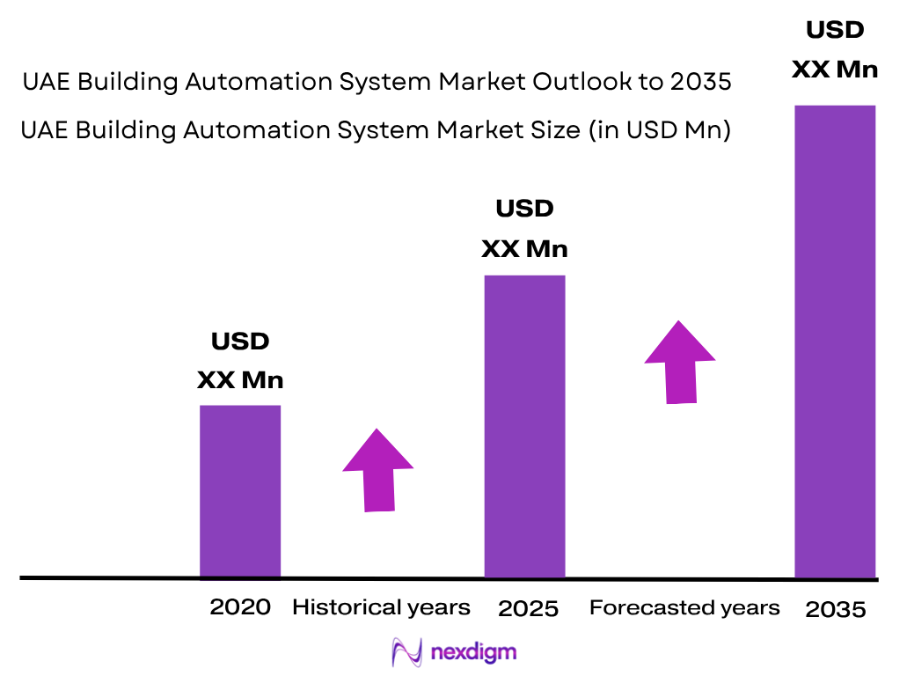
The UAE Building Automation System Market is driven by continued economic expansion, commercial construction, hospitality development, energy-intensive cooling requirements and increasing digitalization of facility operations. The UAE’s real GDP reached AED 1,776 billion, while non-oil GDP reached AED 1,342 billion, establishing a broad economic base for commercial and industrial building investment. Dubai’s electricity demand increased from 56,516 GWh to 59,594 GWh, while peak demand increased from 10.41 GW to 10.76 GW, strengthening the need for automated HVAC optimization, energy monitoring, load management and centralized controls.
Dubai and Abu Dhabi dominate the UAE Building Automation System Market because they combine large commercial property inventories, high-rise developments, hospitality assets, government facilities, airports, industrial infrastructure and data-intensive buildings. Dubai’s utility infrastructure supplied 59.19 TWh of electricity generation and supported 1,270,285 customer accounts, while its generation capacity reached 17.179 GW. Abu Dhabi complements this demand through major government, energy, industrial, healthcare and mixed-use developments. The concentration of large, centrally managed facilities makes both cities primary markets for integrated BMS, HVAC, energy and security controls.
Market Segmentation
By System Type
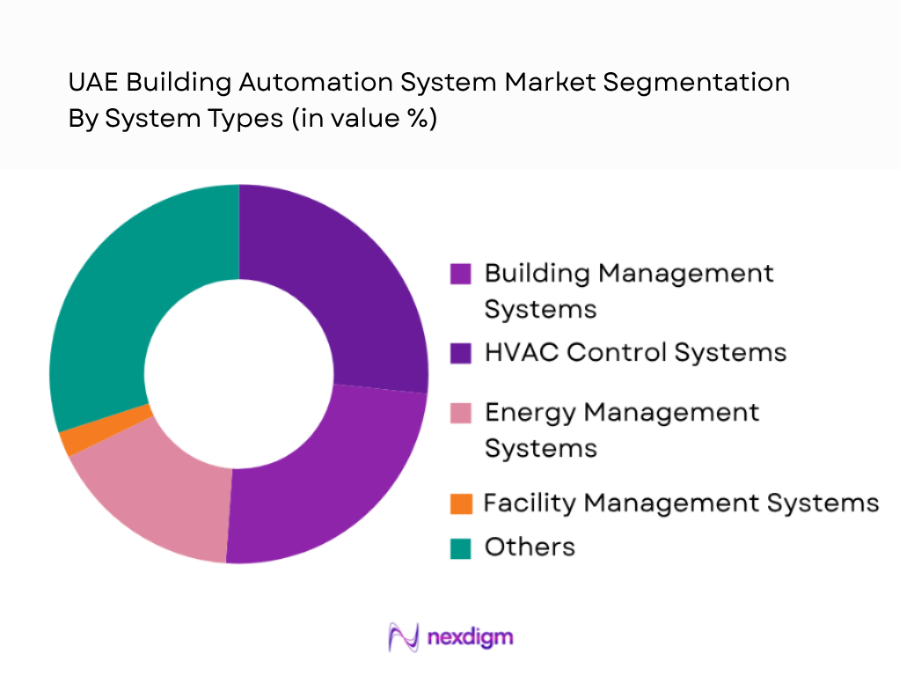
The UAE Building Automation System Market is segmented by system type into building management systems, facility management systems, energy management systems, HVAC control systems, lighting control systems, security and access control systems, fire and life-safety integration systems, smart metering systems and integrated automation platforms. Facility management systems represent a leading segment because UAE buildings frequently require centralized monitoring of HVAC, electrical systems, security, alarms, maintenance and building services. The importance of this segment is reinforced by Dubai’s substantial utility infrastructure, with DEWA reporting 1,270,285 customer accounts, 17,179 MW of installed generation capacity and 10.76 GW of peak electricity demand. These operating conditions encourage building owners and facility managers to use centralized systems to monitor equipment performance and manage energy-intensive assets. Dubai’s mandatory Al Sa’fat green-building framework also promotes technologies that improve energy performance and the efficiency of electrical and mechanical systems, strengthening the relevance of integrated automation.
By Application
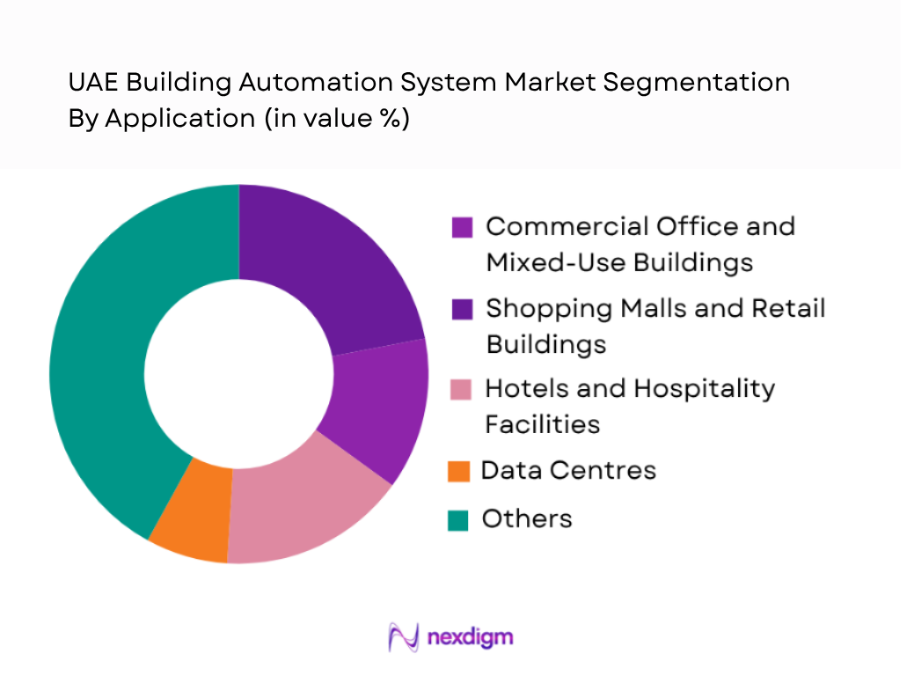
The UAE Building Automation System Market is segmented by application into commercial office buildings, residential towers and communities, shopping malls and retail complexes, hotels and hospitality facilities, mixed-use developments, industrial and manufacturing facilities, warehouses and logistics facilities, data centres, hospitals and healthcare facilities, airports and transportation facilities, government buildings, sports and entertainment facilities, banking and financial facilities, and educational buildings. Commercial office buildings represent a leading application because Dubai and Abu Dhabi contain substantial concentrations of high-rise offices and mixed-use developments requiring centralized HVAC, lighting, security and energy management. The intensity of electricity consumption further supports BAS deployment. Dubai recorded 59,594 GWh of electricity demand and 10.76 GW of peak demand, while the emirate’s clean-energy generation reached 6.62 TWh. Al Sa’fat is mandatory for new buildings in Dubai, with the framework explicitly targeting reduced energy consumption and improved efficiency of electrical and mechanical systems. These conditions favor BAS solutions capable of coordinating HVAC, lighting, metering, occupancy and energy-management functions.
Competitive Landscape
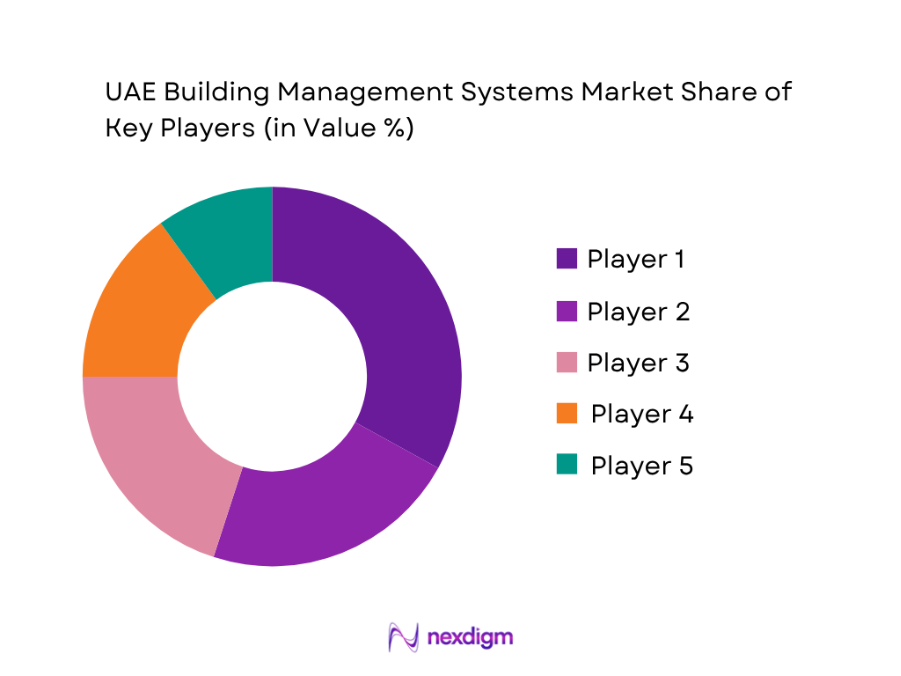
The UAE Building Automation System Market is characterized by multinational building-technology companies with portfolios covering HVAC controls, BMS software, energy management, IoT connectivity, security, fire protection and system integration. Honeywell, Siemens, Schneider Electric, Johnson Controls and ABB are among the major competitive participants because they can supply both individual automation components and integrated building platforms. Competition is increasingly based on interoperability, HVAC optimization, cloud connectivity, energy analytics, cybersecurity and local engineering capabilities rather than hardware alone. Dubai’s mandatory Al Sa’fat framework further strengthens the importance of energy-performance capabilities in building technology solutions.
| Company | Establishment Year | Headquarters | BAS Portfolio | HVAC & Chiller Controls | Energy Management | Cloud / IoT Platform | System Integration | UAE Market Capability |
| Honeywell | 1906 | Charlotte, USA | ~ | ~ | ~ | ~ | ~ | ~ |
| Siemens | 1847 | Munich, Germany | ~ | ~ | ~ | ~ | ~ | ~ |
| Schneider Electric | 1836 | Rueil-Malmaison, France | ~ | ~ | ~ | ~ | ~ | ~ |
| Johnson Controls | 1885 | Cork, Ireland | ~ | ~ | ~ | ~ | ~ | ~ |
| ABB | 1988 | Zurich, Switzerland | ~ | ~ | ~ | ~ | ~ | ~ |
UAE Building Automation System Market Analysis
Growth Drivers
Real Estate & Smart Buildings
The UAE Building Automation System Market is being supported by continued expansion of commercial, residential, hospitality and mixed-use buildings, particularly in Dubai and Abu Dhabi. The World Bank records UAE GDP at USD 552.32 billion and GDP per capita at USD 50,273.5, while GDP expanded by 4.0% in 2024. The Statistics Centre Abu Dhabi recorded 299,360 buildings and 783,970 real-estate units in 2024, compared with 281,780 buildings and 754,555 units in 2023. This expanding building stock increases the addressable requirement for HVAC controls, lighting automation, access management, energy monitoring and integrated building management platforms. Abu Dhabi’s construction sector reached AED 107.4 billion in 2024 and expanded by 11.3%, demonstrating strong construction activity that can support new BAS installations. Dubai is another major demand centre because its electricity demand reached 59,594 GWh, compared with 56,516 GWh in 2023, according to DEWA. Rising electricity consumption strengthens the operational case for automated HVAC scheduling, chiller optimization, occupancy-based controls and centralized energy management. District cooling, smart-city programs and green-building requirements further encourage developers and facility owners to integrate automation into building design and modernization projects.
Energy & HVAC Optimization
Energy-intensive building operations represent a major structural driver for the UAE Building Automation System Market because cooling requirements remain substantial across commercial, residential, hospitality and institutional properties. DEWA reported Dubai electricity demand of 59,594 GWh in 2024, compared with 56,516 GWh in 2023, while peak electricity demand reached 10,763 MW. DEWA also reported that demand for cooling services increased by 7.4% in 2024. These figures create a strong operational requirement for automated HVAC sequencing, chiller optimization, temperature scheduling, variable-speed control and real-time energy monitoring. The UAE Government has also established mandatory green-building requirements in Dubai, while Ras Al Khaimah’s Barjeel framework targets buildings designed to consume 30% less energy and water than a typical building. Dubai’s Clean Energy Strategy targets 100% clean energy generation by 2050, creating a longer-term requirement for buildings to coordinate distributed energy, storage, electrification and controllable loads. Building automation platforms can connect HVAC, lighting, metering, solar generation, EV charging and occupancy systems into centralized control environments. Consequently, energy-intensive properties increasingly have an operational incentive to deploy BAS technologies that convert building data into automated control actions and measurable energy-management improvements.
Market Challenges
Legacy Systems & Integration
Legacy infrastructure and fragmented control architectures remain significant challenges for the UAE Building Automation System Market because many existing properties were developed with separate HVAC, lighting, access, metering and facility-management systems. Integrating these assets can require protocol conversion, gateway deployment, control-panel replacement and engineering redesign rather than straightforward software installation. The scale of the existing building base makes this issue particularly relevant. Abu Dhabi recorded 299,360 buildings and 783,970 real-estate units in 2024, with 281,780 buildings and 754,555 units recorded in 2023, according to the Statistics Centre Abu Dhabi. The 17,580-building increase illustrates the continuing expansion of the built environment while simultaneously increasing the number of installed systems requiring lifecycle management. Commercial buildings accounted for 18.3% of Abu Dhabi’s building stock, while residential buildings represented 70.5%, creating diverse technical requirements across property types. BAS vendors therefore need to support BACnet, Modbus, KNX, LonWorks and proprietary protocols while maintaining reliable integration with existing MEP systems. Retrofit work can also require access during occupied periods, coordination with facility operators and careful commissioning. These technical requirements increase project complexity and can lengthen deployment cycles, particularly where building owners operate multiple generations of equipment across the same property portfolio.
Cybersecurity & Skills
Cybersecurity, specialist skills and system complexity create persistent execution challenges for the UAE Building Automation System Market as BAS platforms increasingly connect building equipment with IP networks, cloud services, remote monitoring and enterprise software. The scale of digital infrastructure and economic activity makes secure building connectivity increasingly important. The UAE recorded GDP of USD 552.32 billion in 2024, while the World Bank reported GDP per capita of USD 50,273.5, reflecting an economy with substantial commercial and digitally enabled infrastructure. Abu Dhabi’s labour force reached 2.76 million employees in 2024, compared with 2.53 million in 2023, according to the Statistics Centre Abu Dhabi, but BAS deployment requires specialized capabilities in controls engineering, HVAC systems, networking, cybersecurity and commissioning. Modern projects therefore require teams capable of configuring controllers, validating sensor data, securing communication pathways and integrating multiple vendors. Data management also becomes more complicated when hundreds or thousands of sensors continuously generate temperature, occupancy, equipment-status and energy information. Facility operators must determine which data should be stored locally, transferred to cloud platforms or integrated into enterprise systems. These requirements can increase commissioning complexity and create additional training needs for facility-management teams, particularly when sophisticated AI-enabled optimization or digital-twin functions are introduced into existing buildings.
Market Opportunities
Data Centres & Smart HVAC
Data centres, commercial retrofits and intelligent HVAC optimization represent important opportunities for the UAE Building Automation System Market because the country is simultaneously expanding digital infrastructure and managing substantial building energy requirements. Abu Dhabi’s information and communication sector reached AED 32.2 billion in 2024, while the sector grew by 6.6%, according to the Statistics Centre Abu Dhabi. The emirate’s construction sector also reached AED 107.4 billion, providing a broad project pipeline for integrated building technologies. In Dubai, electricity demand reached 59,594 GWh and peak demand reached 10,763 MW in 2024, according to DEWA. These conditions support demand for BAS platforms capable of coordinating cooling equipment, electrical distribution, environmental monitoring and operational schedules. Data centres offer particularly attractive applications because cooling systems operate continuously and require precise monitoring of temperature, humidity, airflow and equipment performance. Cloud-based BAS can additionally allow owners to manage geographically distributed properties from centralized operations centres. Predictive maintenance creates another opportunity by combining sensor readings with equipment operating histories to identify abnormal chiller, pump, fan and air-handling-unit performance. Commercial retrofits can similarly use connected sensors, automated scheduling and occupancy analytics to modernize older properties without requiring complete replacement of building infrastructure.
Smart Energy & Digital Twins
The UAE’s transition toward more connected and electrified buildings creates opportunities for advanced Building Automation System solutions that coordinate energy generation, consumption and flexible electrical loads. DEWA reported that Dubai invested AED 11.2 billion in 2024 to expand renewable generation, desalination and transmission and distribution infrastructure, while clean generation represented 18% of its installed generation capacity. Dubai also recorded 1,225,639 electricity accounts at the end of 2024, compared with 1,173,631 in 2023. These figures indicate an expanding electricity network and customer base that can support more sophisticated building-level energy-management applications. BAS platforms can integrate rooftop solar generation, battery systems, EV chargers, smart meters, HVAC equipment and controllable lighting into coordinated operating strategies. Grid-interactive buildings can use automated controls to shift flexible loads while maintaining occupant comfort and equipment performance. Digital twins provide another opportunity by creating a continuously updated representation of building systems that can support commissioning, fault detection and operational optimization. Multi-site facility management is particularly relevant for hotel groups, retail portfolios, banks, property operators and government estates that require centralized visibility across numerous facilities. The UAE Government’s clean-energy strategy and building-efficiency initiatives further strengthen the strategic relevance of these technologies, creating opportunities for BAS vendors to move beyond conventional automation toward integrated energy and asset-management platforms.
Future Outlook
The UAE Building Automation System Market is expected to benefit from continued smart-building development, commercial real-estate activity, energy-efficiency initiatives and increasing adoption of connected facility-management technologies. Dubai’s electricity demand reached 59,594 GWh, while installed generation capacity reached 17.179 GW, creating a substantial environment for energy optimization. Al Sa’fat provides a regulatory foundation for improving building energy and mechanical-system efficiency. Future demand is expected to increasingly shift toward cloud-connected BAS, AI-enabled optimization, predictive HVAC maintenance, digital twins, occupancy analytics and integrated energy-management platforms.
Major Players
- Honeywell
- Siemens
- Schneider Electric
- Johnson Controls
- ABB
- Emerson Electric
- Carrier
- KONE
- Azbil Corporation
- Beckhoff Automation
- Distech Controls
- Delta Controls
- Tridium
- Legrand
- Mitsubishi Electric
Key Target Audience
- Commercial Real Estate Developers and Building Owners
- Data Centre Operators and Digital Infrastructure Developers
- Hotel and Hospitality Facility Operators
- Industrial and Manufacturing Facility Owners
- Facility Management and Integrated Facilities Services Providers
- Investments and Venture Capitalist Firms
- Government and Regulatory Bodies (Dubai Municipality, Dubai Electricity and Water Authority, Abu Dhabi Department of Municipalities and Transport, Abu Dhabi Department of Energy)
- BAS Manufacturers, HVAC Companies and MEP System Integrators
Research Methodology
Step 1: Identification of Key Variables
The initial phase involves mapping BAS manufacturers, HVAC equipment suppliers, controls providers, system integrators, MEP contractors, facility-management companies, property developers and building owners. Key variables include BAS hardware, software, HVAC controls, energy management, IoT devices, security integration, connected floor area and retrofit activity.
Step 2: Market Analysis and Construction
Historical market information is compiled by evaluating BAS deployment across commercial, residential, hospitality, industrial, healthcare, data-centre and government buildings. The assessment considers system type, application, technology architecture, new-build installation, retrofit activity and recurring maintenance services.
Step 3: Hypothesis Validation and Expert Consultation
Market hypotheses are validated through consultations with BAS manufacturers, HVAC specialists, MEP contractors, system integrators, facility managers and building operators. Discussions focus on procurement models, project pipelines, technology preferences, integration requirements, retrofit activity, competitive positioning and customer decision criteria.
Step 4: Research Synthesis and Final Output
The final stage triangulates company disclosures, government regulations, utility statistics, construction indicators, real-estate activity and building-technology information. Top-down and bottom-up assessments are reconciled to develop the market structure, segmentation, competitive assessment and future outlook.

- Executive Summary
- Research Methodology (Market Definitions and Assumptions, UAE BAS Classification, Building Automation System Scope, Building Management System Scope, HVAC Control Mapping, Lighting Automation Mapping, Energy Management System Mapping, Security and Access Control Integration, Fire and Life Safety Integration, IoT and Sensor Architecture, BACnet and KNX Protocol Assessment, Cloud and Edge Architecture Assessment, AI and Analytics Assessment, Smart Building Readiness Assessment, New-Build Assessment, Retrofit Assessment, Demand-Side Assessment, Supply-Side Assessment, Top-Down Market Sizing, Bottom-Up Market Sizing, Primary Interviews, Project Pipeline Assessment, Data Triangulation, Forecasting Framework)

- Definition and Scope
- UAE Building Automation System Industry Evolution and Development of Building Management Systems, HVAC Automation, Digital Controls, Intelligent Chiller Management, Centralized Energy Management, Smart Metering, IoT-Based Building Controls, Integrated Security Systems, Automated Lighting Controls, Cloud-Based Building Management, AI-Enabled Building Optimization, Digital Twin Applications, Smart Facility Management
- UAE Building Automation System Value Chain Analysis
- UAE Building Automation System Supply Chain Analysis
- HVAC Equipment Manufacturers, Chiller Manufacturers, Air Handling Unit Manufacturers, Building Controls Manufacturers, Sensor and Field Device Suppliers, Automation Controller Suppliers, Smart Meter Manufacturers, Lighting Control Providers, Fire and Life Safety System Providers, Access Control Providers, Building Management Software Providers, IoT Platform Providers, System Integrators, MEP Contractors, Facility Management Companies, Property Developers, Building Owners, Real Estate Operators, Government Entities, Utilities and Energy Service Providers

- Growth Drivers (Commercial Real Estate Development, Smart Building Adoption, Dubai Smart City Development, Abu Dhabi Smart City Development, HVAC Energy Optimization, District Cooling Integration, Data Centre Expansion, Hospitality Development, Green Building Requirements, Al Sa’fat Compliance, Estidama Requirements, Energy Management Adoption, IoT Sensor Deployment, Chiller Optimization, Digital Facility Management, Building Electrification)
- Market Challenges (Legacy BAS Infrastructure, Proprietary Control Platforms, Interoperability Constraints, Protocol Compatibility Issues, Retrofit Complexity, Skilled BAS Engineer Requirements, Cybersecurity Vulnerabilities, Fragmented System Integration Ecosystem, Existing HVAC Integration Constraints, Long Equipment Replacement Cycles, Building Data Management Complexity, High System Customization Requirements, Multi-Vendor Integration Constraints, Facility Manager Training Requirements)
- Market Opportunities (Data Centre BAS, Cloud-Based Building Automation, AI-Enabled Energy Optimization, Predictive HVAC Maintenance, Smart Chiller Controls, Commercial Building Retrofits, Green Building Modernization, Industrial Facility Automation, Indoor Air Quality Monitoring, Occupancy Analytics, Grid-Interactive Buildings, Demand Response Integration, Digital Twin-Based Building Management, Multi-Site Facility Management, Building Electrification Controls, EV Charging and Building Energy Management, Solar and BMS Integration)
- Market Trends (Open-Protocol BAS Adoption, Cloud-Connected Building Management, AI-Based Building Analytics, IoT Sensorization, Smart Chiller Optimization, Occupancy-Based HVAC Controls, Digital Energy Monitoring, Integrated BMS and Security, Predictive Maintenance, Digital Twin Integration, Building-to-Grid Connectivity, Renewable Energy Integration, Centralized Multi-Site Monitoring)
- Government Regulations and Standards (Dubai Building Code, Al Sa’fat Dubai Green Building System, Estidama Pearl Rating System, Abu Dhabi International Building Code Requirements, UAE Fire and Life Safety Code, DEWA Green Building Specifications, Dubai Municipality Building Regulations, Energy Efficiency Requirements, HVAC Efficiency Requirements, Smart Metering Requirements, Electrical Installation Requirements, Cybersecurity and Data Protection Requirements)
- SWOT Analysis
- Porter’s Five Forces Analysis
- PESTLE Analysis
- Stakeholder Ecosystem

- By Market Value (2020-2025)
- By BAS Hardware Revenue (2020-2025)
- By BAS Software Revenue (2020-2025)
- By System Integration Revenue (2020-2025)
- By Installation and Commissioning Revenue (2020-2025)
- By Maintenance and Managed Services Revenue (2020-2025)

- By Component (In Value %)
Sensors and Field Devices
Temperature and Humidity Sensors
Occupancy and Motion Sensors
Indoor Air Quality Sensors
Pressure and Airflow Sensors
Light and Daylight Sensors
Energy and Power Meters
Controllers and Automation Servers
DDC Controllers
Programmable Controllers
Room Controllers
Automation Servers
Actuators and Control Valves
HVAC Actuators
Damper Actuators
Control Valves
Variable Frequency Drives
Communication and Networking Devices
Gateways
Routers and Network Controllers
Protocol Converters
BAS Software and Platforms
Building Management Software
Energy Management Software
Cloud-Based BAS Platforms
Analytics and Visualization Platforms - By Building Type (In Value %)
Commercial Office Buildings
Shopping Malls and Retail Complexes
Hotels and Hospitality Facilities
Residential Towers and Communities
Mixed-Use Developments
Industrial and Manufacturing Facilities
Warehouses and Logistics Facilities
Data Centres
Hospitals and Healthcare Facilities
Schools and Educational Facilities
Airports and Transportation Facilities
Government Buildings
Sports and Entertainment Facilities
Mosques and Religious Buildings
Banking and Financial Facilities - By System Application (In Value %)
HVAC and Chiller Automation
Lighting Automation
Energy Monitoring and Management
Power Monitoring and Control
Indoor Air Quality Management
Occupancy and Space Management
Fire and Life Safety Integration
Access Control and Security Integration
Elevator and Vertical Transportation Integration
Water and Utility Monitoring
Renewable Energy Integration
EV Charging Management
Demand Response and Load Management
Centralized Facility Management - By Deployment Model (In Value %)
New-Build BAS Installation
BAS Retrofit and Modernization
BAS System Expansion
BAS Replacement
Cloud-Based BAS Deployment
On-Premise BAS Deployment
Hybrid BAS Deployment
Multi-Site Building Management - By Protocol and Connectivity (In Value %)
BACnet
KNX
Modbus
LonWorks
OPC and OPC UA
MQTT
Ethernet/IP-Based Connectivity
Wireless IoT Connectivity

- Market Share of Major Players (By BAS Revenue, Hardware Portfolio, Software Portfolio, HVAC Controls, Energy Management, System Integration, Building Type, Project Type, Geographic Coverage, Installed Base, Service Network, Technology Portfolio)
- Cross Comparison Parameters (BAS Product Portfolio Breadth, HVAC and Chiller Control Capability, Open Protocol and Interoperability Capability, IoT and Sensor Portfolio, Cloud and AI Analytics Capability, Energy Management Capability, System Integration and Engineering Capability, UAE Service and Maintenance Network)
- SWOT Analysis of Major Players
- Major Companies
Honeywell
Siemens
Schneider Electric
Johnson Controls
ABB
Emerson Electric
Carrier
KONE
Azbil Corporation
Beckhoff Automation
Distech Controls
Delta Controls
Tridium
Legrand
Mitsubishi Electric

- Commercial Real Estate Developer BAS Requirement Assessment
- Hotel and Hospitality BAS Requirement Assessment
- Data Centre BAS Requirement Assessment
- Industrial Facility BAS Requirement Assessment
- Healthcare Facility BAS Requirement Assessment
- Retail and Shopping Mall BAS Requirement Assessment

- By Market Value (2026-2035)
- By BAS Hardware Revenue (2026-2035)
- By BAS Software Revenue (2026-2035)
- By System Integration Revenue (2026-2035)
- By Installation and Commissioning Revenue (2026-2035)
- By Maintenance and Managed Services Revenue (2026-2035)


 Request a Sample
 Ask for Customization
 Get a Quote
 Enquire Now
