
 Download PDF
Market Overview
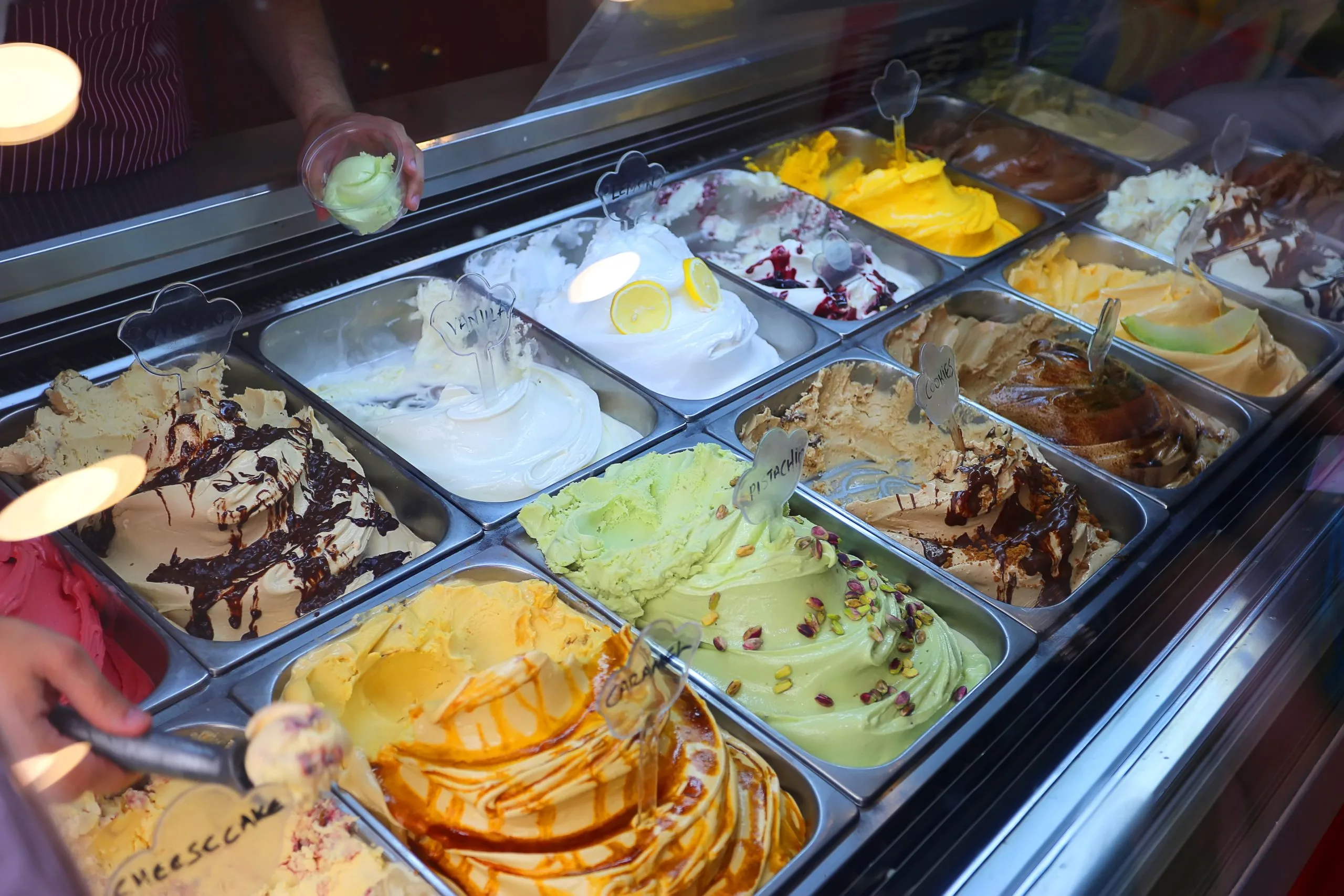
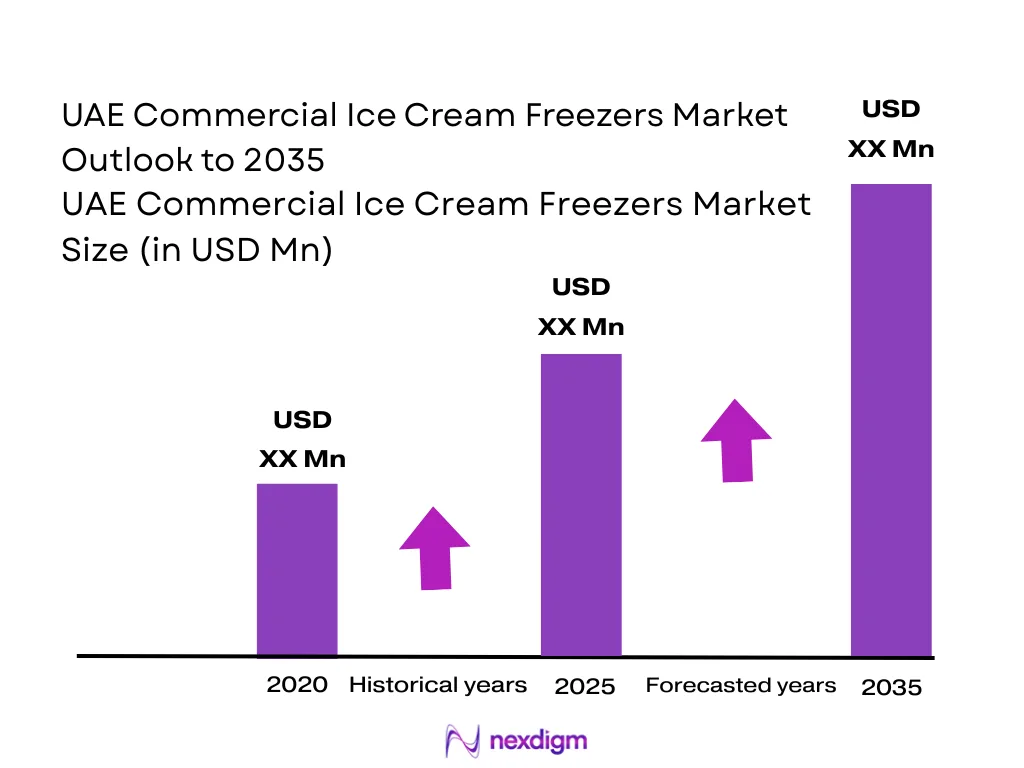
The UAE ice cream market—the primary demand base for commercial ice cream freezers—is valued at USD ~ in 2024, reflecting broad consumption across retail and foodservice channels driven by high disposable income, tourism, expatriate consumption, and year‑round hot climate conditions. Urban centers like Dubai and Abu Dhabi, with dense retail networks and hospitality activity, have extensive deployment of refrigerated display and storage units. Growth in impulse, take‑home, and artisanal ice cream formats accelerates demand for commercial freezers in supermarkets, convenience stores, and HoReCa outlets as retail assortment expands and cold‑chain logistics strengthens. Within the UAE, Dubai, Abu Dhabi, and Sharjah dominate consumption and, consequently, freezer demand due to concentrated population, tourism scale, and retail density. Dubai attracts over 18.72 million international visitors annually, generating substantial seasonal and year‑round food and dessert consumption activity across malls, hotels, and leisure venues, reinforcing the need for high‑performance freezer installations in multiple channel formats. Abu Dhabi’s strong expatriate households and organized retail footprint bolster freezer deployment across supermarkets and family‑oriented outlets, while Sharjah’s residential clusters contribute to high retail stocking of frozen products.
Market Segmentation
By Freezer Type
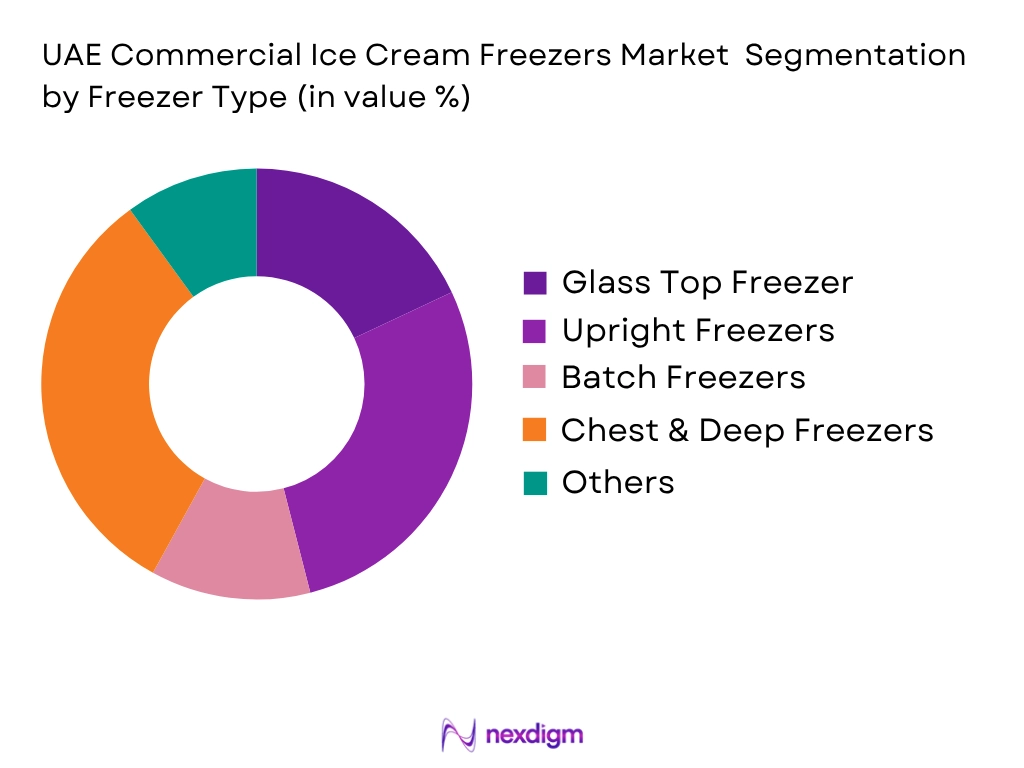
By freezer type, chest & deep freezers dominate the UAE market due to their cost‑effectiveness and capacity advantages for impulse and bulk stock formats sold in supermarkets and convenience stores. These units support large volume storage of single‑serve tubs, sticks, and take‑home packs that are prevalent in the UAE’s hot climate, where year‑round demand necessitates reliable frozen storage capacity. Upright displays are widely adopted in modern trade and retail chains for end‑cap merchandising and visibility of ice cream products, contributing to significant placement in Abu Dhabi and Dubai hypermarkets. Glass‑top units are preferred at convenience retail, petrol forecourts, and impulse outlets due to their ease of access and merchandising appeal. Soft‑serve and batch freezers are prominent in foodservice and QSR segments where on‑site dessert production enhances menu offerings, while customized walk‑in solutions serve large hotel chains and franchise operators requiring high storage volumes for multi‑line frozen products.
By End‑User Channel
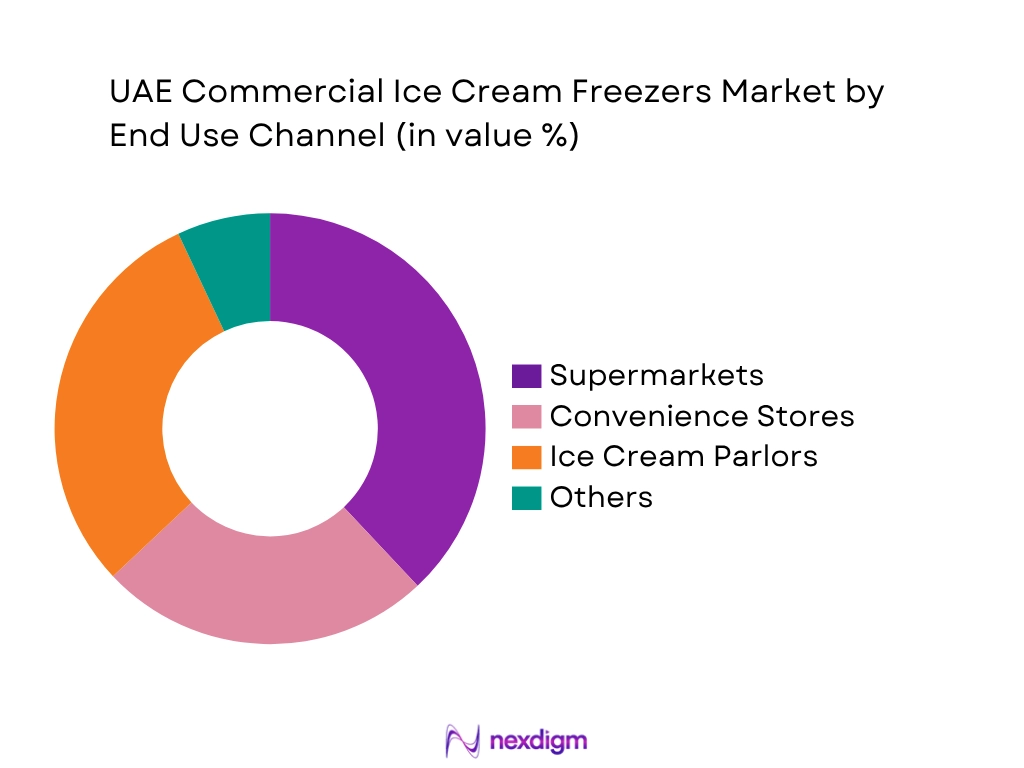
Under end‑user segmentation, supermarkets and hypermarkets command the largest share as primary deployment zones for commercial ice cream freezers. UAE retailers such as Carrefour, Lulu, Spinneys, and Choithrams invest in high‑visibility freezers to support a wide ice cream SKU mix—from impulse single serves to family packs—catering to both residents and visitors. Convenience stores and petrol forecourt outlets are the second largest channel due to rapid urban mobility and consumer desire for on‑the‑go purchases; their freezer formats focus on quick‑serve frozen novelties positioned near checkouts. The HoReCa segment (hotels, restaurants, cafés) drives demand for soft‑serve and batch freezers, especially in Dubai’s tourism‑intensive hospitality sector where dessert menus are a revenue contributor. Ice cream parlors and gelaterias leverage specialized freezers to maintain premium textures, while e‑commerce fulfilment—though smaller—is an emerging channel demanding optimized cold storage for last‑mile delivery.
Competitive Landscape
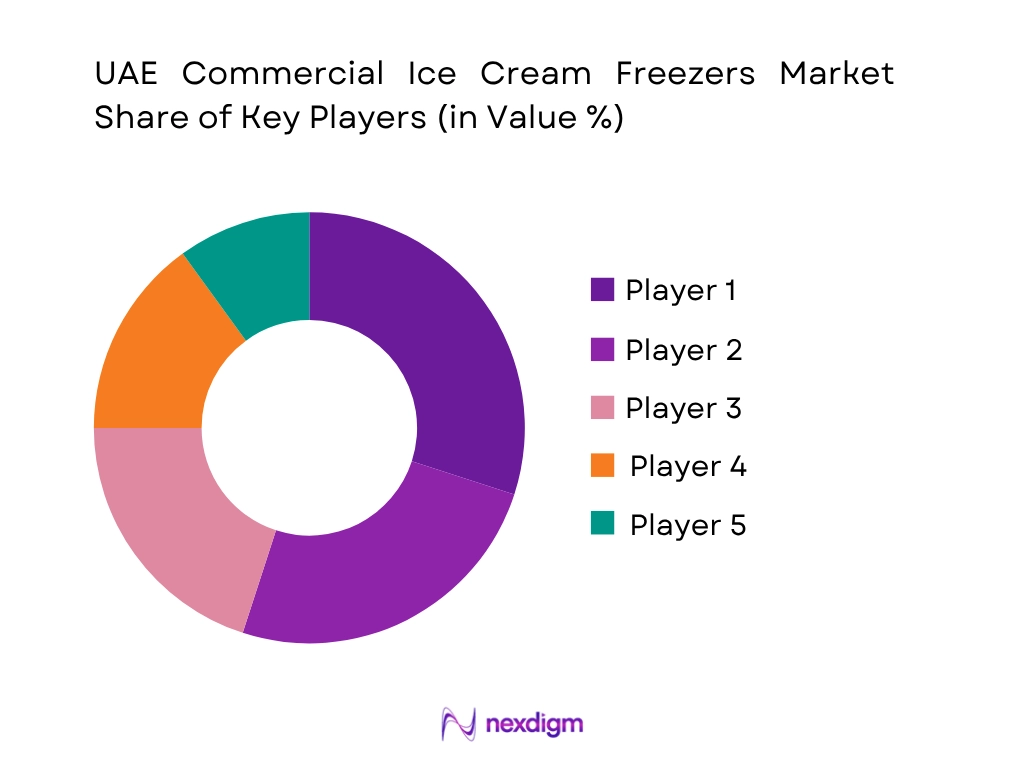
The UAE commercial ice cream freezer market is shaped by international OEMs and regional distributors who cater to broad retail and foodservice segments. Competition hinges on product reliability under extreme climatic conditions, energy efficiency, service support, and cold‑chain integration. The UAE’s commercial refrigeration landscape features a mix of global refrigeration manufacturers and regional suppliers focusing on market‑specific solutions capable of withstanding high ambient temperatures and heavy throughput demands. Competition is influenced by service responsiveness, energy‑efficient technologies, and after‑sales capabilities in both organized retail and HoReCa sectors.
| Company | Establishment Year | Headquarters | Freezer Type Breadth | Cooling Technology | Energy Efficiency Compliance | Service Network | Regional Presence |
| Hussmann | 1907 | USA | ~ | ~ | ~ | ~ | ~ |
| Electrolux Professional | 1919 | Sweden | ~ | ~ | ~ | ~ | ~ |
| True Manufacturing | 1945 | USA | ~ | ~ | ~ | ~ | ~ |
| AHT Cooling Systems | 1945 | Austria | ~ | ~ | ~ | ~ | ~ |
| Haier Commercial Refrigeration | 1984 | China | ~ | ~ | ~ | ~ | ~ |
UAE Commercial Ice Cream Freezers Market Outlook to 2035
Growth Drivers
Strong Economic Base and Retail Consumption Environment
The UAE’s broad economic foundation supports sustained consumer spending and retail development, which in turn drives demand for commercial ice cream freezers across modern trade and foodservice channels. The UAE’s real gross domestic product (GDP) reached AED 1,776 billion in 2024, reflecting a robust economy with significant purchasing power that underpins consumer expenditure on discretionary goods and services including frozen desserts and impulse food purchases. The non‑oil sector accounted for AED 1,342 billion of this economic activity, highlighting diversified consumption patterns beyond hydrocarbons, especially in retail, hospitality and food services where freezers are essential for product display and storage. Retail trade as a component of non‑oil GDP remains a major conduit for frozen dessert products, requiring a stable stock of freezing and refrigeration infrastructure. UAE’s population of approximately 11.29 million adds scale to domestic consumption, and high per capita incomes support elevated demand for premium and impulse frozen products. These macroeconomic indicators reflect the underlying consumer environment that encourages grocery chains, convenience stores, and HoReCa outlets to invest in ice cream freezers to keep pace with broad retail activity.
Robust Tourism and Hospitality Activity Supporting Year‑Round Demand
Tourism and hospitality are key engines of demand for commercial ice cream freezers in the UAE because they generate large volumes of food and beverage consumption in hotels, theme parks, airports, and leisure venues where chilled dessert offerings are highly trafficked. The UAE welcomed approximately 28.4 million international overnight visitors in 2024, generating an estimated USD 49.2 billion in direct tourism revenues—figures that underscore deep multisector spending on food and beverages by international visitors. Tourism’s direct GDP contribution in 2024 was approximately 11.8 per cent of the economy, with broader travel and tourism accounting for about 15.6 per cent of total output, according to UAE tourism statistics. As visitor numbers grow, so too does demand for impulse food items and dessert consumption at retail checkpoints, food courts, and hospitality venues, supporting continued deployment of commercial freezers. In airports handling 147.8 million passengers, convenience retail and duty‑free outlets integrate ice cream and frozen novelty products into consumer offerings, necessitating reliable freezer units. These tourism dynamics—backed by structured data on arrivals and tourism revenues—strengthen the case for year‑round demand of commercial ice cream freezers across luxury and mass‑market foodservice channels in the UAE.
Market Challenges
High Operational Costs Linked to Energy and Refrigeration Infrastructure
One of the foremost challenges for the UAE Commercial Ice Cream Freezers Market stems from operational expenses associated with refrigeration in a hot, energy‑intensive environment that influences deployment decisions by retailers and foodservice operators. The UAE’s extreme temperatures and prolonged heat periods require commercial freezers to run constantly at high capacity, which increases electricity consumption and total cost of ownership for operators. While exact energy usage statistics for freezers are not published by UAE authorities, the national economic context with inflation at 1.66 per cent in 2024 and a robust GDP base suggests that utility costs remain a significant input cost for businesses that rely heavily on refrigeration. According to federal statistics, the unemployment rate stood at 1.9 per cent, indicating full employment and associated wage pressures that further elevate labor costs for maintenance and service of refrigerated equipment. Retailers and hospitality outlets must factor in elevated utility bills and skilled technical support expenses in their operating models, especially when freezers run continually to support frozen dessert and chilled consumer goods assortments. These cost pressures—amplified by imported refrigeration technologies and servicing parts—represent a structural drag on bottom lines for smaller operators in secondary markets outside major cities, potentially slowing new freezer installations and optimization of cold‑chain assets in remote or less densely populated emirates.
Cold‑Chain and Logistics Complexity in a Distributed Marketplace
The commercial ice cream freezer market in the UAE also faces challenges due to cold‑chain and logistics complexities inherent in maintaining product quality from import or production to final retail or foodservice end points. The UAE’s position as a major global trade hub underscores the reliance on imported frozen products and cold‑chain inputs, and while tourism and trade volumes are high, sustaining consistent cold‑chain integrity across inland distribution networks requires specialized infrastructure. According to federal trade statistics, non‑oil foreign trade was valued at AED 2.8 trillion in 2024—an indicator of large quantities of goods moving through the economy that depend on temperature‑controlled logistics. Perishables and frozen goods such as ice cream require stable cold storage and transportation systems; lapses in these can lead to product spoilage and loss, which discourages inventory build‑up for retailers. The complexity of maintaining precise temperature ranges across inbound shipments, warehouse storage, and final retail freezer units increases operational coordination costs. This fragmentation can lead to service disruptions for supermarket chains and HoReCa outlets that rely on consistent freezer performance, particularly during peak seasonal demand when supply chains are stressed by increased product throughput.
Market Opportunities
Expansion of Modern Retail Channels and Urban Consumption Nodes
Urban modernization in the UAE presents a significant opportunity for commercial ice cream freezer deployment, as rapid growth in supermarket chains, convenience stores, and mixed‑use retail nodes increases the need for effective frozen goods display and storage infrastructure. Retail trade remains an important component of non‑oil GDP, and supermarkets such as Carrefour, Lulu, and Spinneys extend freezer deployment as part of broader product offerings. While specific retail spending data is limited in government sources, macroeconomic conditions such as a population of 11.29 million, high household purchasing capacity, and a strong GDP base create broad consumer demand for impulse and take‑home ice cream purchases. Expansion of urban commercial districts—particularly in Dubai and Abu Dhabi where tourism, expatriate residency, and modern infrastructure converge—supports diversified retail formats that integrate ice cream freezers across multiple points of sale. Additionally, convenience store networks embedded in high‑traffic transport hubs reflect consumer preferences for chilled and frozen snacks, enhancing commercial freezer requirements. As urban populations and retail footprints expand, the range of micro‑retail formats representing retail cold‑goods demand grows, providing freezer OEMs and distributors with sustained adoption opportunities.
Rising Household Spending and Diversified Consumption Patterns
Another notable opportunity for the UAE Commercial Ice Cream Freezers Market arises from diversified household consumption patterns supported by strong macroeconomic fundamentals. The UAE economy’s real GDP of AED 1,776 billion and high average household incomes underpin strong consumer spending on food and discretionary items, including premium and artisanal ice cream products. Households with strong purchasing capacity are engaging in frequent purchases of frozen dessert products spanning impulse, take‑home, and specialty categories. The hospitality and foodservice sector’s performance is also reflected in the UAE’s non‑oil sector strength, where accommodation and food services contribute to overall economic output. Rising consumer sophistication and willingness to pay for diverse frozen dessert formats—including low‑fat or premium offerings—expand the freezer deployment landscape beyond traditional bulk storage to include specialized display solutions. Growth in home‑prepared frozen product demand also encourages retailers and distributors to increase freezer inventory and capacity across urban and suburban zones. This evolving consumption trend provides an opportunity for integrated cold‑chain and retail equipment strategies that leverage diversified freezer formats, thereby expanding total freezer adoption across multi‑segment food retail and service environments.
Future Outlook
The UAE Commercial Ice Cream Freezers Market is poised for steady expansion guided by sustained tourism inflows, diversified retail innovation, and climate‑driven year‑round frozen dessert consumption. Economic fundamentals remain robust with UAE’s GDP at USD 552.32 billion and GDP per capita at USD 50,273.5, reflecting strong purchase power supporting discretionary food purchases. Tourism remains a core driver, with Dubai attracting over 18.72 million international visitors, fueling HoReCa and impulse retail requiring reliable freezer deployment across channels. Rising expatriate and local populations amplify weekly retail purchases of frozen desserts, encouraging freezer growth across modern trade, convenience retail, and digital delivery ecosystems. Technological innovation around energy efficiency and low‑GWP refrigerants will further optimize operational costs, improving adoption rates among independent and chain operators.
Major Players
- Hussmann
- Electrolux Professional
- True Manufacturing
- AHT Cooling Systems
- Haier Commercial Refrigeration
- TurboAir
- Tecfrigo
- Metalfrio Solutions
- Beverage Air
- Gram Commercial
- Summit Commercial
- Samsung Commercial Appliances
- LG Commercial Refrigeration
- Carrier Commercial Refrigeration
- Local Multi‑Brand Distributors & Cold‑Chain Integrators
Key Target Audience
- Retail Chain Procurement Heads
- Foodservice & Hospitality Facility Equipment Buyers
- Quick‑Service Restaurant Equipment Planners
- Cold‑Chain Logistics & Distribution Directors
- Freeze Equipment OEM Product Strategy Teams
- Investments and Venture Capitalist Firms
- Government and Regulatory Bodies
- Large Independent Retail & Franchise Group Owners
Research Methodology
Step 1: Identification of Key Variables
The first phase involved mapping stakeholders across the UAE ice cream consumption ecosystem to identify drivers influencing commercial freezer demand, using government statistics, industry publications, and macroeconomic indicators such as UAE GDP and tourism arrivals.
Step 2: Market Analysis and Construction
Historical ice cream consumption trends and retail deployment data were compiled to represent underlying demand. Retail channel analysis included supermarkets, convenience stores, and HoReCa freezers to gauge freezer penetration and utilization dynamics.
Step 3: Hypothesis Validation and Expert Consultation
Market insights were validated via structured interviews with UAE retail equipment distributors, procurement leads at key retail chains, and cold‑chain logistics specialists. These consultations refined assumptions around equipment preferences, seasonal demand, and adoption barriers.
Step 4: Research Synthesis and Final Output
A synthesis of secondary data and expert insights yielded an integrated analysis of the commercial ice cream freezer market. This included category scaling, competitive environment evaluation, and demand forecasting aligned with macroeconomic growth and consumption trends in the UAE.

- Executive Summary
- Research Methodology (Market Definitions & Assumptions, Abbreviations, UAE Industry Classification, Data Sources & Validation Protocols, Macroeconomic Benchmarking, Primary Interview Approach, Bottom‑Up Market Construction, Limitations & Outlook Synthesis)

- Definition and Scope
- Market Genesis and Climatic Influence
- Consumer Consumption Dynamics
- Retail & Foodservice Deployment Cycle
- Supply Chain & Value Chain Analysis

- Growth Drivers (Retail modernization, tourism effect, hot climate effect on consumption, disposable income influence)
- Market Challenges (Cold‑chain cost pressures, import dependence on refrigeration hardware, energy costs)
- Technology & Trends (Smart control systems, energy‑efficient compressors, low‑GWP refrigerants)
- Regulatory & Compliance Landscape(Food safety standards, refrigerant regulations, energy performance labeling)
- Porter’s Five Forces
- SWOT Analysis
- Stakeholder Ecosystem Mapping

- UAE Refrigeration Equipment Market Supporting Ice Cream Freezers (2020-2025)
- Ice Cream Consumption & Freezer Demand Nexus (2020-2025)
- Unit Shipments & Market Value (2020-2025)

- By Freezer Type (In Value %)
Chest & Deep Freezers
Glass‑Top Display Freezers
Upright Display Freezers
Batch/Soft‑Serve Freezers
Walk‑In / Custom Freezer Systems - By End‑User Channel (In Value %)
Supermarkets & Hypermarkets
Convenience Stores & Petrol Forecourt Retailers
Ice Cream Parlors & Gelaterias
Quick‑Service Restaurants (QSR) & Café Chains - By Sales & Distribution Channel (In Value %)
Manufacturer OEM Direct Sales
Dealer & Multi‑Brand Distributors
Retail Equipment Leasing & Rental Contracts
E‑commerce & B2B Procurement Portals
Project & Architectural Integration Partners - By Cooling Technology (In Value %)
Static/Direct Expansion
Glycol/Remote Loop Systems
Forced‑Air Circulation
IoT‑Enabled Monitoring & Alert Systems
Low‑GWP Refrigerant Platforms

- Cross Comparison Parameters (Company Overview, Product Portfolio Breadth, Cooling Technology Stack, Refrigerant Standards Compliance, Energy Efficiency Ratings, After‑Sales Service Network, Installed Base Concentration, Warranty & Spare Parts Support)
- Pricing & Value Proposition Benchmarks by Size/Capacity
- Competitive SWOT Profiles
- Detailed OEM & Supplier Profiles
- Key Profiles Market Participants
Hussmann (Commercial Refrigeration Solutions)
True Manufacturing (Ice Cream & Freezer Specialist)
Electrolux Professional (Display & Refrigerated Freezers)
AHT Cooling Systems (Premium Display & Freezer Units)
Haier (Commercial Freezer Lines)
TurboAir (Energy Efficient Freezers)
Tecfrigo (Specialized Display Freezers)
Metalfrio Solutions (Freezer OEM)
Beverage Air (Global Refrigeration)
Samsung Commercial Appliances (Middle East Units)
LG Commercial Refrigeration
Carrier Commercial Refrigeration
Danfoss / Secop (Compressor & Control Systems)
Local UAE Refrigeration Distributors (Multi‑Brand)
Integrated Cold‑Chain Solution Providers (Freezer + Logistics

- Retail Demand Patterns
- Foodservice & Hospitality Demand
- Distribution & After‑Sales Service Expectations
- Procurement Decision Criteria
- Usage Intensity & Life‑Cycle Cost Drivers

- By Freezer Revenue Demand (2026-2035)
- By Unit Deployment (2026-2035)
- By End‑User Channel Expansion (2026-2035)


 Request a Sample
 Ask for Customization
 Get a Quote
 Enquire Now