

 Download PDF
Market Overview
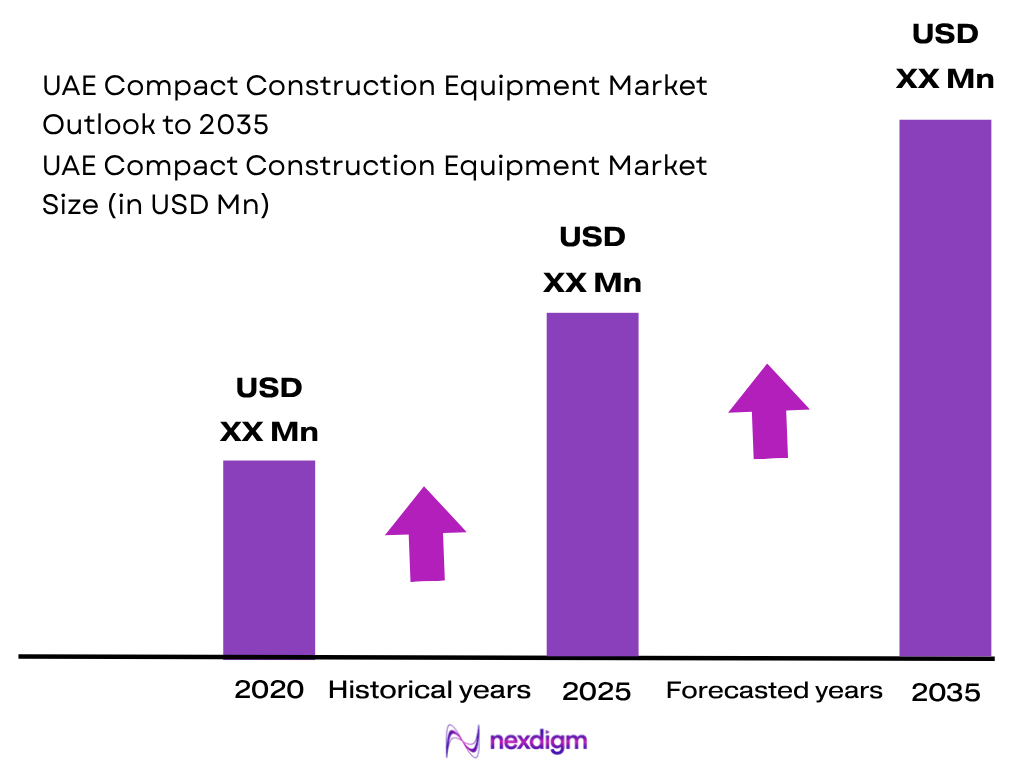
The UAE Compact Construction Equipment Market is supported by continued construction activity, infrastructure development, urban redevelopment, and increasing mechanization of site operations. UAE economic activity provides a broad equipment-demand base, while Dubai and Abu Dhabi remain important centers for commercial construction, infrastructure, industrial development, utilities, and large-scale projects. Compact equipment is particularly relevant where contractors require maneuverability, transportability, attachment flexibility, and lower site disruption. Demand is also supported by rental fleets, replacement of aging machinery, and greater adoption of telematics-enabled equipment.
Dubai and Abu Dhabi represent the principal demand centers for the UAE Compact Construction Equipment Market because they combine large construction pipelines with extensive infrastructure, commercial development, municipal projects, logistics facilities, industrial activity, and landscaping requirements. Dubai’s concentration of high-density urban projects creates demand for compact excavators, skid-steer loaders, loaders, and compact rollers capable of operating in confined environments. Abu Dhabi provides additional demand through infrastructure, industrial, energy, utilities, and large development projects. Sharjah, Ajman, and Ras Al Khaimah contribute through residential construction, industrial development, logistics, and municipal works.
Market Segmentation
By Equipment Type
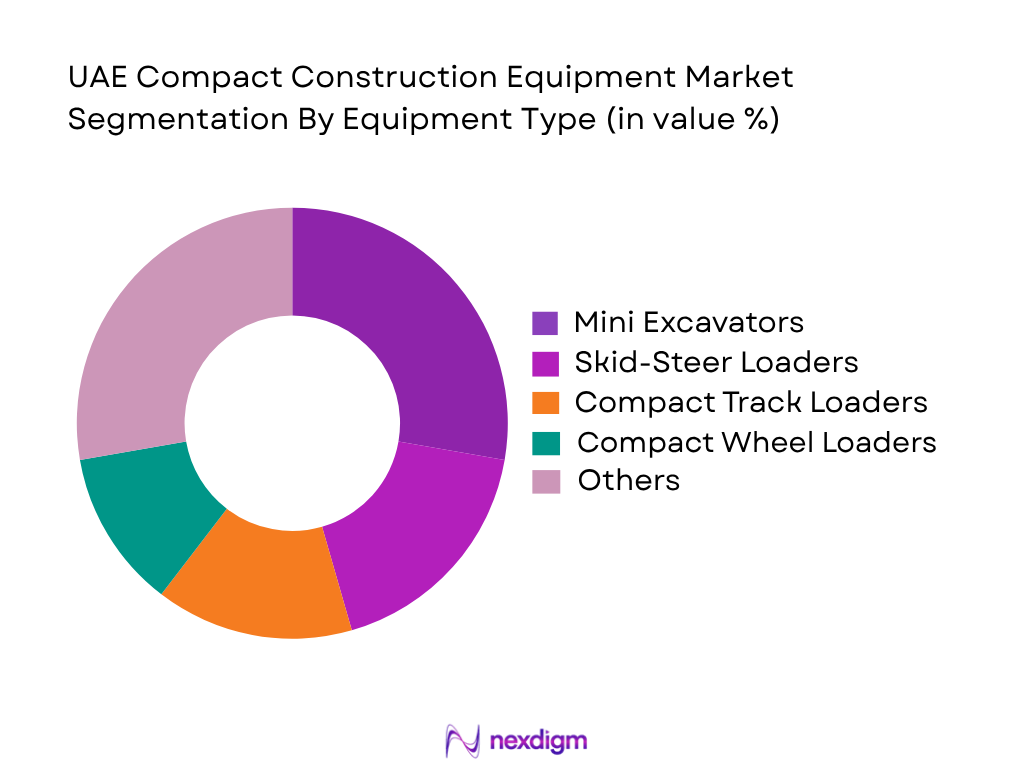
The UAE Compact Construction Equipment Market is segmented by equipment type into mini excavators, skid-steer loaders, compact track loaders, compact wheel loaders, compact backhoe loaders, mini loaders, compact rollers, and small articulated loaders. Mini excavators represent the leading segment in the report framework because their compact footprint, maneuverability, digging capability, and attachment compatibility make them suitable for residential construction, utility installation, landscaping, road maintenance, and urban infrastructure projects. Their ability to operate in restricted spaces is particularly relevant in densely developed areas where larger excavators can create access and transportation constraints. Skid-steer and compact track loaders also maintain significant demand because they can perform loading, grading, excavation, demolition, sweeping, and material-handling tasks through interchangeable attachments. Compact track loaders provide additional traction on soft or uneven surfaces, while compact wheel loaders offer mobility for material handling and site logistics. Rental companies also influence demand because versatile machines can serve multiple contractors and project types.
By Application
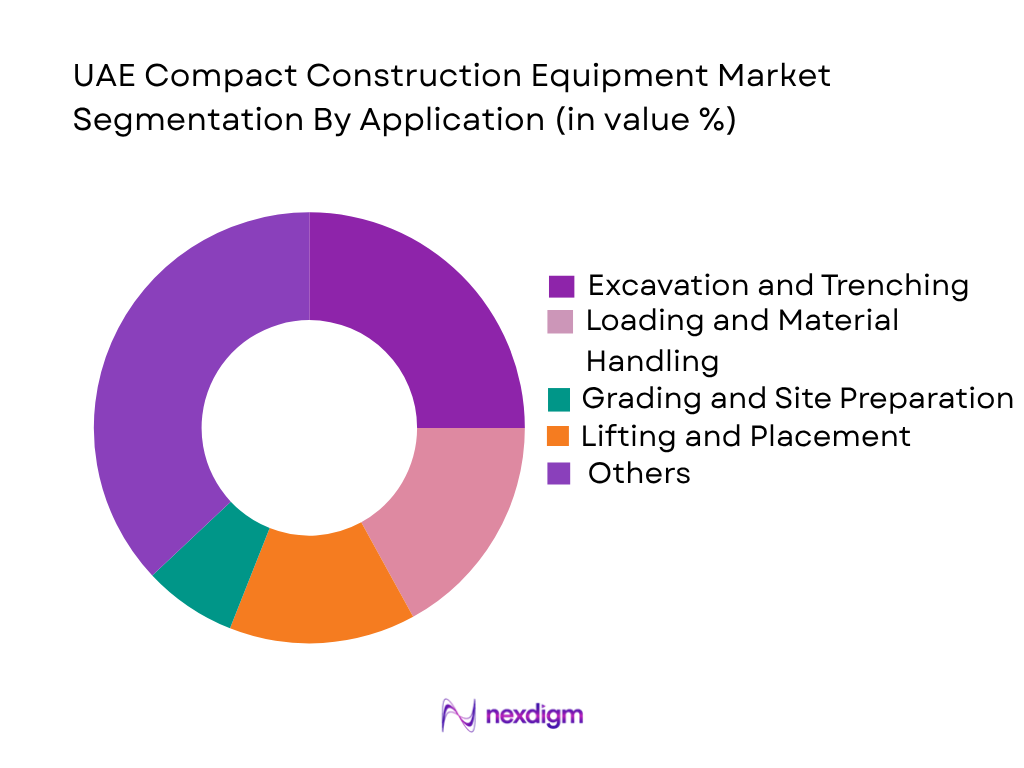
The UAE Compact Construction Equipment Market is segmented by application into excavation and trenching, loading and material handling, grading and site preparation, lifting and placement, demolition, landscaping and grounds development, compaction, road construction and maintenance, utility installation and maintenance, and agricultural and land development. Excavation and trenching represent the leading application in the report framework because underground utilities, foundations, drainage systems, landscaping works, and site preparation require compact digging equipment capable of operating around existing structures. Mini excavators are particularly applicable because they combine digging depth with a relatively small operating footprint. Loading and material handling represents another significant application, supported by construction materials movement, logistics activities, landscaping operations, and site preparation. Grading and site preparation benefit from compact loaders and attachment-based machines, while road maintenance creates demand for compact rollers and loaders. Utility installation is also important because telecommunications, water, electricity, and drainage projects frequently require machinery capable of working in narrow corridors and developed urban areas.
Competitive Landscape
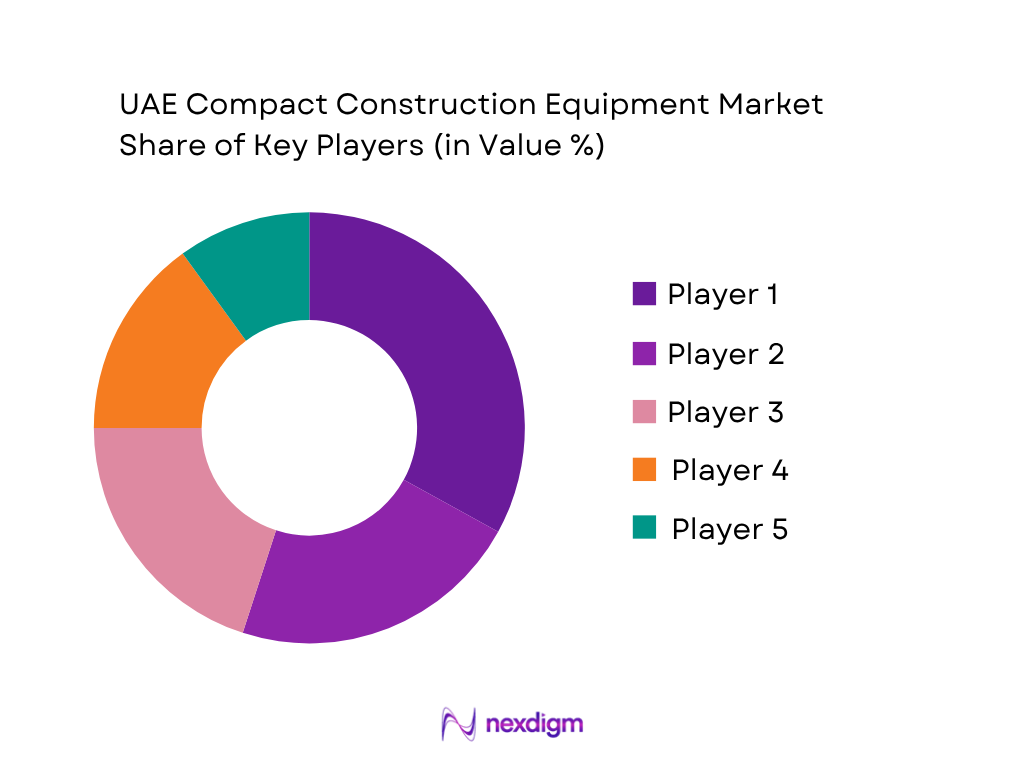
The UAE Compact Construction Equipment Market comprises global construction-equipment manufacturers operating through authorized dealers, distributors, rental companies, and equipment-service networks. Competition is influenced by equipment breadth, machine productivity, hydraulic performance, attachment compatibility, fuel efficiency, after-sales support, spare-parts availability, financing solutions, telematics capabilities, and dealer coverage. Established international OEMs compete across excavators, loaders, compact track loaders, rollers, and related equipment, while rental companies and used-equipment channels influence purchasing decisions among contractors seeking flexible fleet utilization.
| Company | Establishment Year | Headquarters | Compact Equipment Portfolio | Dealer Network | Equipment Rental Presence | Telematics Capability | Attachment Portfolio | After-Sales Support |
| Caterpillar Inc. | 1925 | Irving, Texas, USA | ~ | ~ | ~ | ~ | ~ | ~ |
| Bobcat Company | 1947 | West Fargo, North Dakota, USA | ~ | ~ | ~ | ~ | ~ | ~ |
| JCB | 1945 | Rocester, Staffordshire, UK | ~ | ~ | ~ | ~ | ~ | ~ |
| Komatsu Ltd. | 1921 | Tokyo, Japan | ~ | ~ | ~ | ~ | ~ | ~ |
| Volvo Construction Equipment | 1832 | Gothenburg, Sweden | ~ | ~ | ~ | ~ | ~ | ~ |
UAE Compact Construction Equipment Market Analysis
Growth Drivers
Expansion of Construction, Infrastructure, and Urban Development
The UAE Compact Construction Equipment Market is being supported by the continued expansion of construction, real estate, infrastructure, transportation, and urban-development activity. UAE real GDP reached AED 1.776 trillion in 2024, while non-oil GDP reached AED 1.342 trillion, demonstrating the scale of economic activity supporting construction-related demand. Construction and real-estate activities together accounted for 17.3% of real non-hydrocarbon GDP in 2024. The construction ecosystem also remained active in 2025, when UAE construction recorded 11.1% growth, making it the fastest-growing major economic sector reported by the national statistics authority. Dubai provides a particularly important demand center: projects under construction increased to 937 in 2025, while sold property units reached 147,500 units. These conditions support requirements for mini excavators, skid-steer loaders, compact track loaders, compact wheel loaders, and compact rollers across foundations, utility installation, landscaping, road preparation, material handling, and site development. Compact machines are especially relevant to urban projects because they can maneuver around existing buildings, utilities, roads, and restricted work areas while supporting attachment-based operations. Continued diversification of UAE economic activity therefore creates multiple construction end-use environments rather than relying on a single project category.
Strong Non-Oil Economic Activity and Equipment-Intensive Industrial Development
The UAE Compact Construction Equipment Market is supported by the country’s expanding non-oil economy, which is generating construction requirements across logistics, manufacturing, tourism, commercial real estate, industrial zones, transportation, and infrastructure. The UAE recorded 4.0% real GDP growth in 2024, while non-hydrocarbon GDP expanded by 5.0%. The economy subsequently recorded 6.2% GDP growth in 2025, with non-oil GDP increasing by 6.8%. Construction expanded by 11.1% in 2025, while transportation and storage grew by 7.8%, creating additional requirements for site preparation, warehouses, logistics facilities, access roads, utilities, and associated infrastructure. Non-oil foreign trade also reached AED 2.8 trillion in 2024, reinforcing the country’s position as a logistics and commercial hub and supporting continued development of industrial and distribution facilities. Compact equipment benefits from these activities because contractors require machines that can perform excavation, loading, grading, compaction, landscaping, and material movement across different project environments. The equipment’s transportability and attachment compatibility are particularly relevant for contractors operating multiple small and medium-sized projects. Increasing economic diversification therefore broadens the addressable application base for compact machinery across construction, industrial development, logistics infrastructure, municipal works, and property development.
Market Challenges
High Dependence on Imported Equipment, Components, and Specialized Aftermarket Supply
The UAE Compact Construction Equipment Market faces supply-chain challenges because many compact machines, engines, hydraulic components, tracks, attachments, electronic systems, and replacement parts are sourced through international OEM and distributor networks. This creates exposure to shipping schedules, international manufacturing disruptions, exchange-rate movements, inventory availability, and geopolitical conditions. The importance of international trade to the UAE economy is substantial: non-oil foreign trade reached AED 2.8 trillion in 2024, while the country’s population reached 11.29 million, creating a relatively concentrated domestic market compared with major global construction-equipment markets. For compact-equipment users, parts availability is particularly important because excavators, loaders, rollers, and hydraulic attachments depend on specialized components that may not be interchangeable across manufacturers. Delays involving tracks, hydraulic pumps, electronic controllers, filters, undercarriage components, or attachment interfaces can extend equipment downtime and affect contractor productivity. The challenge is amplified for smaller contractors operating limited fleets because the unavailability of one machine can materially affect project scheduling. Consequently, OEMs and distributors need sufficient local inventories, technical-service capabilities, trained technicians, and structured aftermarket networks to maintain equipment availability and reduce dependence on long international replenishment cycles.
Operating Conditions, Equipment Utilization, and Financing Constraints
The UAE Compact Construction Equipment Market also faces challenges associated with demanding operating environments, equipment utilization, financing, and lifecycle management. Construction equipment can operate under high temperatures, dust, abrasive site conditions, and intensive utilization, increasing requirements for cooling systems, filtration, hydraulic maintenance, undercarriage management, and preventive servicing. These requirements can influence the lifecycle economics of compact excavators, loaders, rollers, and other machines even when the equipment itself is technically suitable for the application. The UAE’s macroeconomic environment remained relatively stable, with consumer inflation at 1.7% in 2024, but contractors still need to manage financing, labor, maintenance, transportation, and fleet-utilization expenses. Construction growth reached 11.1% in 2025, creating opportunities but also requiring contractors to maintain sufficient equipment availability during periods of high project activity. Rental fleets can help address capital constraints, but rental operators face their own requirements for machine utilization, preventive maintenance, replacement scheduling, and residual-value management. Equipment that remains underutilized can generate financing and depreciation burdens, while excessively intensive utilization can accelerate component wear. These considerations make lifecycle support, equipment monitoring, operator training, preventive maintenance, and flexible procurement models important competitive factors within the UAE market.
Market Opportunities
Expansion of Data-Driven, Telematics-Enabled, and Multi-Functional Compact Equipment
The UAE Compact Construction Equipment Market has an opportunity to expand through equipment equipped with telematics, machine monitoring, attachment management, operator-assistance technologies, and advanced hydraulic systems. The country’s digitalization environment provides a relevant foundation: UAE digital and technology investment has become an important component of economic diversification, while national GDP reached AED 1.9 trillion in 2025 and non-oil GDP reached AED 1.5 trillion. Construction itself expanded by 11.1% in 2025, increasing the operational importance of productivity and fleet-management tools. Compact machines equipped with telematics can provide information on operating hours, machine location, fuel consumption, maintenance intervals, utilization, fault codes, and idle time. For rental companies, these capabilities can support fleet allocation and maintenance planning, while contractors can use machine data to improve equipment utilization across multiple worksites. Attachment compatibility creates an additional opportunity because one compact machine can perform excavation, grading, loading, sweeping, demolition, landscaping, drilling, and material-handling activities when equipped with suitable work tools. This multifunctionality can increase the practical utilization of individual machines and support demand among contractors managing diverse project portfolios. Integration of digital monitoring with compact equipment therefore creates an opportunity to move procurement decisions beyond basic machine specifications toward measurable productivity and lifecycle-management capabilities.
Electrification and Low-Emission Compact Equipment for Urban and Specialized Applications
Electrification creates an emerging opportunity within the UAE Compact Construction Equipment Market, particularly for compact machines operating in urban projects, indoor facilities, landscaping, municipal environments, and locations where noise and local emissions need to be minimized. The UAE’s economic diversification agenda is increasingly connected with technology, sustainability, clean energy, and advanced infrastructure. The national economy recorded 6.2% GDP growth in 2025, while construction expanded by 11.1%, providing a broad base of active construction environments in which alternative powertrains can be evaluated. Compact electric excavators, loaders, and other machines can be particularly relevant where equipment operates for shorter duty cycles, requires frequent movement between nearby work areas, or works close to occupied buildings. Electric equipment can also complement conventional diesel machinery rather than immediately replacing it, with contractors selecting powertrains according to operating hours, duty cycle, charging availability, and project requirements. The opportunity extends to rental companies, which can introduce electric machines into selected fleets and gather utilization data across controlled applications. Growth in digitally enabled infrastructure and technology-intensive development further creates opportunities for equipment manufacturers to integrate battery monitoring, remote diagnostics, charging management, and telematics into compact machines. These developments can expand the UAE market toward specialized low-emission equipment applications while maintaining demand for conventional compact machinery in heavy-duty environments.
Future Outlook
Over the forecast period, the UAE Compact Construction Equipment Market is expected to develop alongside construction modernization, infrastructure expansion, urban redevelopment, industrial investment, and increasing fleet professionalization. Demand is likely to remain focused on machines capable of performing multiple tasks while operating within restricted urban and project environments. Equipment rental models can further support access to compact machinery without requiring contractors to maintain large owned fleets. Electrification, telematics, remote monitoring, advanced hydraulics, and attachment-based productivity are expected to influence future equipment specifications and procurement decisions.
The market’s future development will also depend on the pace of construction activity, infrastructure investment, equipment replacement cycles, financing conditions, import availability, and contractor utilization rates. Compact machines with higher attachment compatibility can increase equipment utilization by allowing one base machine to undertake excavation, grading, loading, demolition, landscaping, and material-handling tasks. Electric compact equipment may gain relevance in applications where reduced local emissions, lower noise, and indoor or semi-enclosed operation are important.
Major Players
- Caterpillar Inc.
- Bobcat Company
- Deere & Company
- Kubota Corporation
- JCB
- CASE Construction Equipment
- Takeuchi
- Volvo Construction Equipment
- Wacker Neuson
- Yanmar Compact Equipment
- Komatsu Ltd.
- New Holland Construction
- Manitou Group
- SANY Group
- Hitachi Construction Machinery
Key Target Audience
- Construction Equipment Manufacturers and OEMs
- Authorized Construction Equipment Dealers and Distributors
- Construction and Infrastructure Contractors
- Equipment Rental and Fleet Management Companies
- Construction Equipment Financing and Leasing Providers
- Investments and Venture Capitalist Firms
- Government and Regulatory Bodies (Ministry of Energy and Infrastructure, Dubai Municipality, Abu Dhabi Department of Municipalities and Transport)
- Industrial, Infrastructure and Real Estate Developers
Research Methodology
Step 1: Identification of Key Variables
The initial phase involves constructing an ecosystem map covering OEMs, equipment dealers, rental companies, contractors, infrastructure developers, financing providers, component suppliers, and end users within the UAE Compact Construction Equipment Market. The assessment identifies equipment categories, applications, operating weights, power classes, ownership models, rental utilization, and regional demand variables relevant to market development.
Step 2: Market Analysis and Construction
This phase involves compiling historical information for the UAE Compact Construction Equipment Market across equipment sales, installed fleet, rental purchases, replacement demand, applications, and distribution channels. Equipment-level analysis covers mini excavators, skid-steer loaders, compact track loaders, compact wheel loaders, compact rollers, and related categories to establish a bottom-up market structure.
Step 3: Hypothesis Validation and Expert Consultation
Market hypotheses are validated through discussions with equipment manufacturers, authorized distributors, rental fleet operators, construction contractors, infrastructure companies, and equipment-service providers. Interviews focus on equipment procurement, fleet utilization, replacement cycles, application preferences, attachment demand, financing practices, maintenance requirements, and customer preferences.
Step 4: Research Synthesis and Final Output
The final stage integrates primary findings with secondary industry information to establish a validated UAE Compact Construction Equipment Market framework. Bottom-up equipment calculations are reconciled against demand indicators, construction activity, rental fleet developments, import patterns, and regional project activity. The resulting analysis supports segmentation, competitive assessment, market forecasting, and strategic interpretation.

- Executive Summary
- Research Methodology (Market Definition and Scope, UAE Compact Construction Equipment Market Classification, Equipment Technology Mapping, Compact Equipment Category Assessment, Operating Weight Classification, Rated Operating Capacity Assessment, Engine Power Assessment, Diesel Powertrain Evaluation, Battery-Electric Equipment Assessment, Hydraulic System Evaluation, Attachment Compatibility Assessment, Equipment Productivity Analysis, Rental Fleet Assessment, Equipment Utilization Analysis, Dealer Network Mapping, Aftermarket and Service Assessment, Import Dependency Assessment, Regional Demand Assessment, Supply-Side Assessment, Demand-Side Assessment, Top-Down Market Sizing, Bottom-Up Market Sizing, Primary Industry Interviews, Data Triangulation, Forecasting Framework)

- Definition and Scope
- UAE Compact Construction Equipment Industry Evolution and Development of Compact Excavators, Skid-Steer Loaders, Compact Track Loaders, Compact Wheel Loaders, Compact Backhoe Loaders, Mini Loaders, Compact Rollers, Small Articulated Loaders, Zero-Tail-Swing Equipment, Attachment-Based Compact Machines, Low-Emission Equipment, Battery-Electric Compact Equipment, Telematics-Enabled Equipment, Grade-Control-Enabled Machines, Advanced Compact Construction Equipment Technologies
- Compact Construction Equipment Value Chain Analysis
- Compact Construction Equipment Supply Chain Analysis
- Powertrain Suppliers, Hydraulic Component Manufacturers, Track and Tire Suppliers, Steel and Structural Component Suppliers, Battery and Electric Powertrain Suppliers, Attachment Manufacturers, Compact Construction Equipment OEMs, Equipment Importers, Authorized Equipment Dealers, Independent Equipment Dealers, Equipment Rental Companies, Equipment Financing Providers, Used Equipment Dealers, Auction Platforms, General Contractors, Infrastructure Contractors, Landscaping Contractors, Utility Contractors, Municipal Authorities, Industrial End Users

- Growth Drivers (Infrastructure Development, Urban Construction Activity, Equipment Rental Expansion, Industrial Development, Landscaping and Urban Development Projects, Utility Infrastructure Expansion, Increasing Construction Mechanization, Demand for Confined-Site Equipment)
- Market Challenges (Import Dependence, Harsh Operating Conditions, Equipment Financing Requirements, Skilled Operator Requirements, Spare Parts Availability, Equipment Maintenance Requirements, Used Equipment Competition, Fleet Utilization Constraints)
- Market Opportunities (Equipment Rental Fleet Expansion, Electric Compact Equipment Adoption, Smart Telematics Integration, Urban Infrastructure Development, Utility Construction Expansion, Low-Emission Equipment Adoption, Automated Site Operations, Advanced Attachment Utilization)
- Market Trends (Battery-Electric Compact Equipment, Telematics-Enabled Fleets, Remote Equipment Monitoring, Low-Emission Engines, Multi-Functional Attachments, Rental-Oriented Procurement, Lightweight Equipment Design, Operator-Assistance Technologies)
- Government Regulations and Standards (UAE Construction Equipment Safety Requirements, Machinery Import Requirements, Environmental Compliance Standards, Occupational Health and Safety Requirements, Dubai Municipality Requirements, Abu Dhabi Construction Regulations, Equipment Emission Requirements, Machinery Quality Standards)
- SWOT Analysis
- Porter’s Five Forces Analysis
- PESTLE Analysis
- Stakeholder Ecosystem
- Competition Ecosystem

- By Market Value (2020-2025)
- By New Equipment Unit Sales (2020-2025)
- By Installed Equipment Base (2020-2025)
- By Average Selling Price per Equipment Unit (2020-2025)
- By Compact Excavator Unit Sales (2020-2025)
- By Skid-Steer Loader Unit Sales (2020-2025)
- By Compact Track Loader Unit Sales (2020-2025)
- By Compact Wheel Loader Unit Sales (2020-2025)
- By Equipment Rental Fleet Purchases (2020-2025)
- By Attachment and Work-Tool Revenue (2020-2025)

- By Equipment Type (In Value %)
Mini Excavators
Skid-Steer Loaders
Compact Track Loaders
Compact Wheel Loaders
Compact Backhoe Loaders
Mini Loaders
Compact Rollers
Small Articulated Loaders - By Application (In Value %)
Excavation and Trenching
Loading and Material Handling
Grading and Site Preparation
Lifting and Placement
Demolition
Landscaping and Grounds Development
Compaction
Road Construction and Maintenance
Utility Installation and Maintenance
Agricultural and Land Development - By End-Use Industry (In Value %)
Residential Construction
Commercial Construction
Infrastructure and Civil Construction
Road and Transportation Construction
Utility Construction
Landscaping and Grounds Maintenance
Oil and Gas
Industrial Construction
Municipal and Public Works
Equipment Rental - By Sales Channel (In Value %)
OEM-Authorized Dealers
Independent Equipment Dealers
Direct and Fleet Sales
Equipment Rental Companies
Used Equipment Dealers
Equipment Auctions
Digital Equipment Marketplaces - By Operating Weight (In Value %)
Below 2 Tons
2-4 Tons
4-6 Tons
6-10 Tons
Above 10 Tons - By Region (In Value %)
Dubai
Abu Dhabi
Sharjah
Ajman
Ras Al Khaimah
Fujairah
Umm Al Quwain
Rest of UAE

- Market Share of Major Players (By UAE Revenue, Compact Equipment Unit Sales, Compact Excavator Portfolio, Skid-Steer Loader Portfolio, Compact Track Loader Portfolio, Manufacturing and Supply Capacity, Dealer Network Coverage, Rental Fleet Presence, Attachment Portfolio, Electric Equipment Capability, Telematics Capability, Aftermarket Support, Installed Equipment Base)
- Cross Comparison Parameters (Rated Operating Capacity and Lift Performance, Auxiliary Hydraulic Flow and Attachment Compatibility, Compact Equipment Product Portfolio Breadth, Battery-Electric Equipment Capability, Telematics and Machine-Control Capability, Dealer and Service Network Coverage, Rental Fleet Penetration, Aftermarket Parts and Lifecycle Support)
- SWOT Analysis of Major Players
- Competitive Positioning Matrix
- Compact Construction Equipment Technology and Application Benchmarking
- Hydraulic System and Attachment Compatibility Assessment
- Equipment Productivity and Operational Performance Assessment
- UAE Equipment Import, Distribution and Rental Assessment
- Major Companies
Caterpillar Inc.
Bobcat Company
Deere & Company
Kubota Corporation
JCB
CASE Construction Equipment
Takeuchi
Volvo Construction Equipment
Wacker Neuson
Yanmar Compact Equipment
Komatsu Ltd.
New Holland Construction
Manitou Group
SANY Group
Hitachi Construction Machinery

- General Contractor Equipment Requirement Assessment
- Specialty Contractor Equipment Demand Analysis
- Residential Construction Equipment Requirement Assessment
- Infrastructure Contractor Application Assessment
- Utility Construction Equipment Requirement Assessment
- Landscaping Contractor Application Assessment
- Equipment Rental Fleet Procurement Assessment
- Municipal and Public Works Equipment Assessment
- Oil and Gas Contractor Equipment Assessment
- Equipment Performance Requirement Assessment (Rated Operating Capacity, Lift Height, Digging Depth, Breakout Force, Auxiliary Hydraulic Flow, Operating Weight, Transportability, Fuel Efficiency)

- By Market Value (2026-2035)
- By New Equipment Unit Sales (2026-2035)
- By Installed Equipment Base (2026-2035)
- By Average Selling Price per Equipment Unit (2026-2035)
- By Mini Excavator Unit Sales (2026-2035)
- By Skid-Steer Loader Unit Sales (2026-2035)
- By Compact Track Loader Unit Sales (2026-2035)
- By Compact Wheel Loader Unit Sales (2026-2035)
- By Electric Compact Equipment Unit Sales (2026-2035)
- By Rental Fleet Equipment Purchases (2026-2035)


 Request a Sample
 Ask for Customization
 Get a Quote
 Enquire Now