
 Download PDF
Market Overview
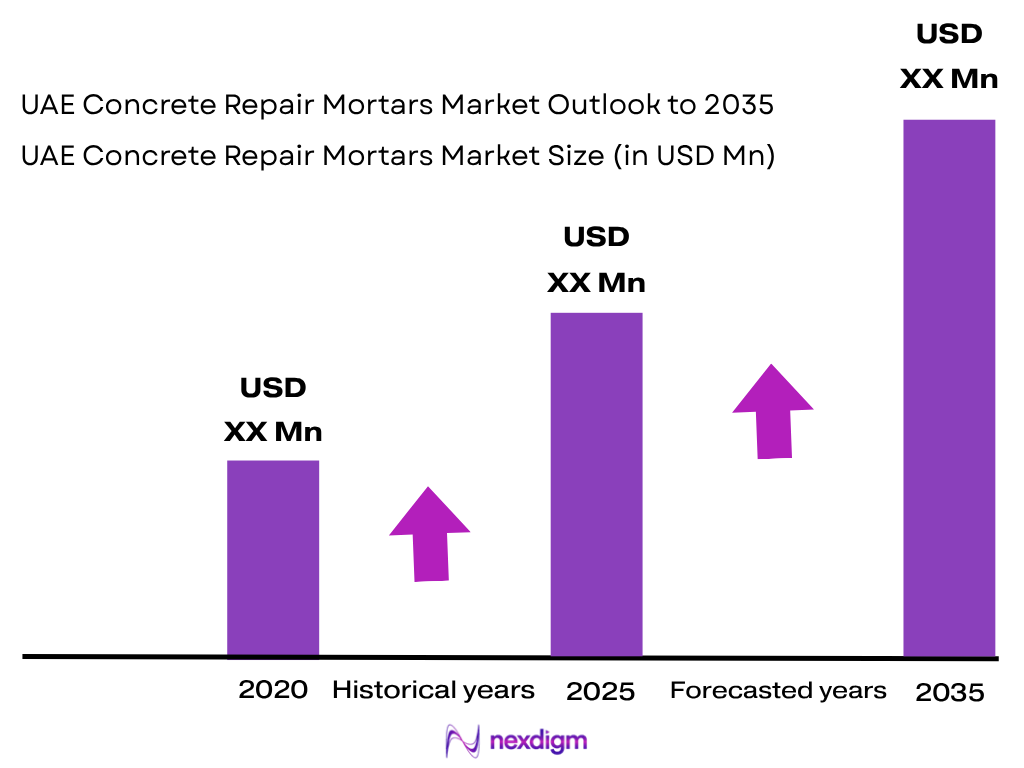
The UAE Concrete Repair Mortars Market is valued at approximately USD ~XX million, supported by an expanding installed base of concrete buildings, transport infrastructure and utility assets. Abu Dhabi’s construction-sector value increased from more than AED 97 billion to AED 107.4 billion, while Dubai’s construction output advanced from AED 27.086 billion to AED 27.690 billion. This activity supports recurring demand for structural repair, spall reinstatement, corrosion remediation, micro-concrete and high-build polymer-modified mortars.
Dubai and Abu Dhabi dominate the UAE Concrete Repair Mortars Market because both emirates combine large reinforced-concrete building stocks with transport, commercial and infrastructure assets requiring periodic rehabilitation. Dubai construction output increased from AED 27.086 billion to AED 27.690 billion, while Abu Dhabi construction value increased from more than AED 97 billion to AED 107.4 billion. Dubai’s high-rise environment and road infrastructure support repair demand, whereas Abu Dhabi adds substantial industrial, utility and institutional concrete assets.
Market Segmentation
By Mortar Type
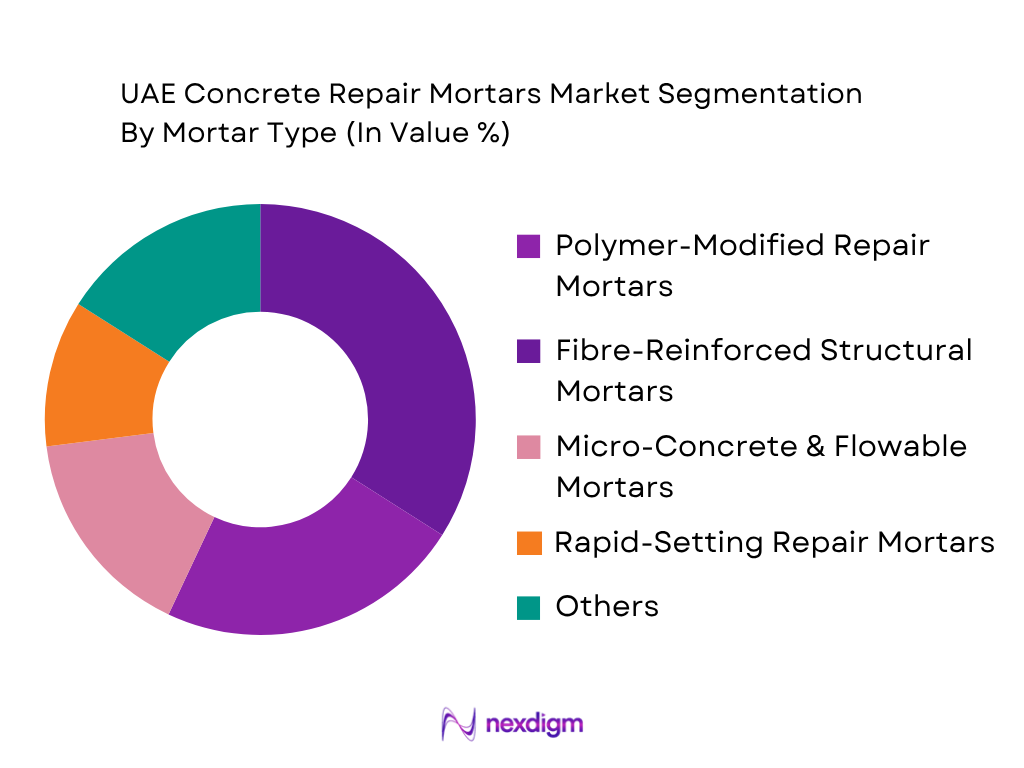
The UAE Concrete Repair Mortars Market is segmented into polymer-modified repair mortars, fibre-reinforced structural mortars, micro-concrete and flowable mortars, rapid-setting mortars, fairing and reprofiling mortars, and other specialty systems. Polymer-modified repair mortars hold the dominant position because they combine cementitious compatibility with improved adhesion, reduced permeability and enhanced durability, making them suitable for widespread vertical, horizontal and overhead repair applications. They are used for restoring spalled concrete, damaged beams, columns, slabs and infrastructure elements where conventional cement mortar may not provide sufficient bond or durability. UAE suppliers also offer high-build, shrinkage-controlled and fibre-enhanced variants for demanding site conditions. MAPEI’s UAE portfolio includes polymer-modified, low-shrinkage, thixotropic and fibre-reinforced products, while broader concrete-repair systems from international suppliers combine mortars with reinforcement protection and surface coatings. The versatility of polymer-modified systems across buildings and infrastructure supports their leading position.
By End-Use Sector
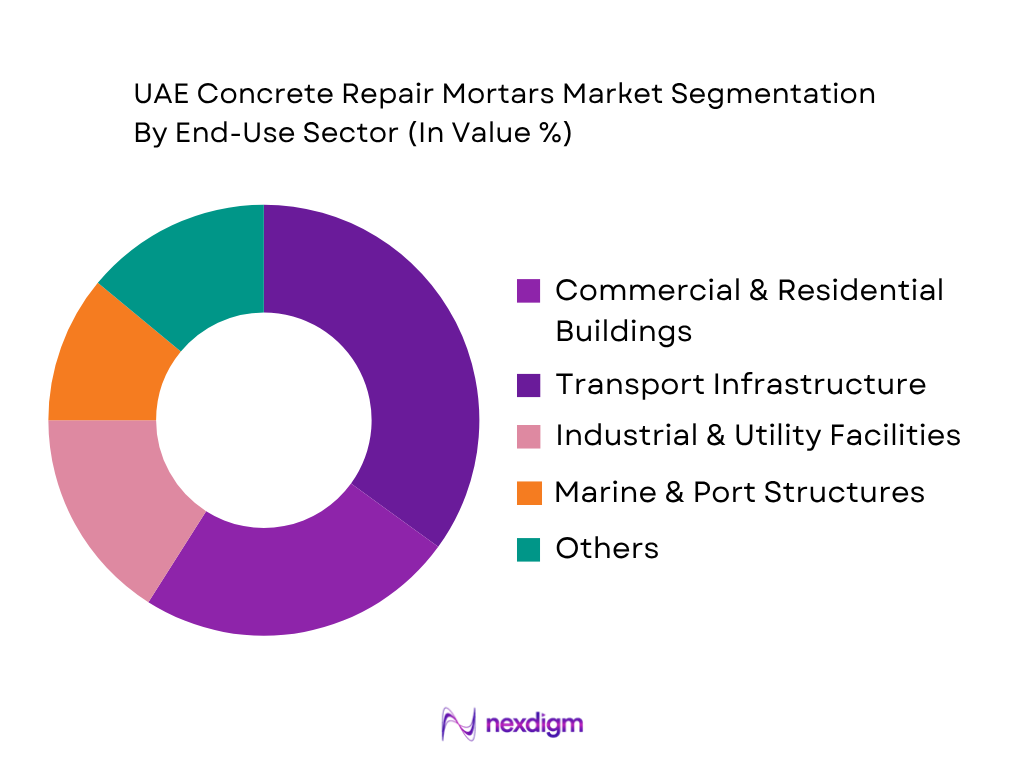
The UAE Concrete Repair Mortars Market is segmented into commercial and residential buildings, transport infrastructure, industrial and utility facilities, marine and port structures, hospitality assets, and government and institutional facilities. Commercial and residential buildings hold the dominant share because Dubai and Abu Dhabi have extensive stocks of high-rise towers, mixed-use properties, villas, parking structures and aging reinforced-concrete developments requiring recurring façade, balcony, slab, column and basement repairs. Abu Dhabi added 29,415 residential and commercial units, taking its stock to 783,970 units, while its total number of buildings reached 299,360, demonstrating the scale of the addressable building base. Repair mortars are also required for construction-defect rectification before handover and during subsequent maintenance cycles. High occupancy expectations and the importance of maintaining premium real-estate assets further support demand for rapid, durable and visually compatible concrete restoration systems.
Competitive Landscape
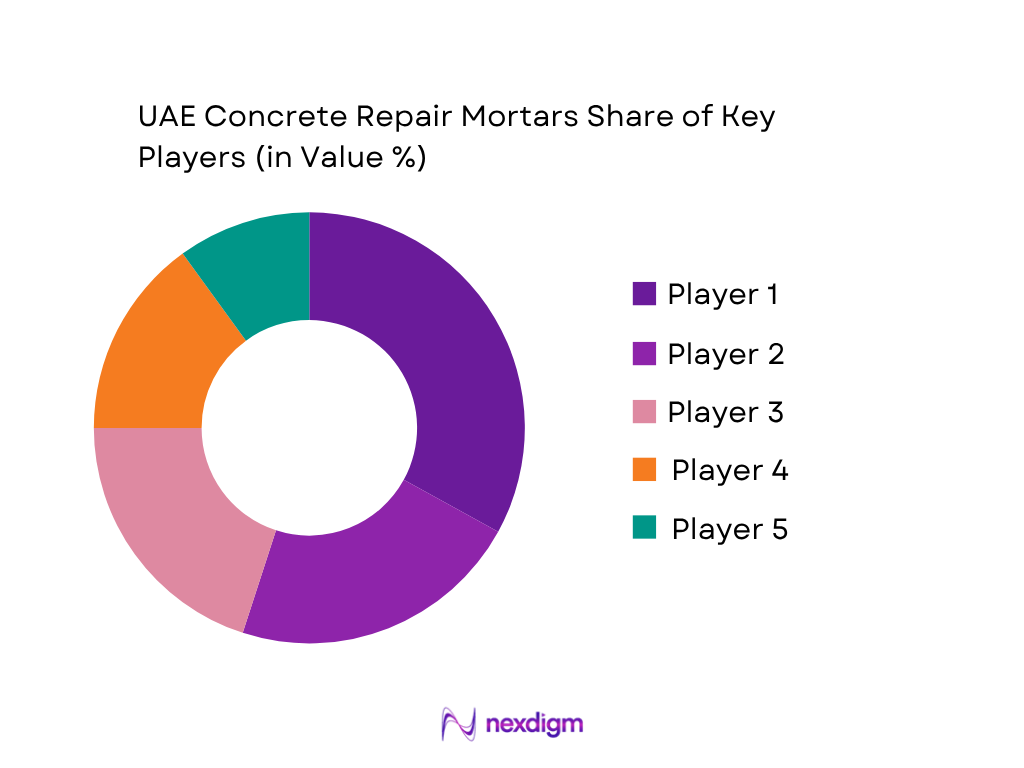
The UAE Concrete Repair Mortars Market comprises international construction-chemical manufacturers and regionally established dry-mix suppliers competing through structural-performance classes, local product availability, consultant approvals, application support and contractor relationships. Sika, Fosroc, MAPEI, Saint-Gobain and Saveto are prominent participants across concrete restoration and adjacent construction-chemical systems. Competition is particularly strong in polymer-modified repair mortars, R3 and R4 structural mortars, micro-concrete, rapid-repair products and systems designed for chloride, sulphate and hot-climate exposure. Product performance is increasingly assessed as part of a complete rehabilitation system involving reinforcement treatment, mortar reinstatement and protective coatings.
| Company | Established | Headquarters | Core Repair Mortar Capability | Structural Repair Positioning | Application Technologies | Marine/Chloride Capability | UAE Market Relevance | Technical Positioning |
| Sika AG | 1910 | Baar, Switzerland | ||||||
| Fosroc International | 1972 | Tamworth, United Kingdom | ||||||
| MAPEI Group | 1937 | Milan, Italy | ||||||
| Saint-Gobain | 1665 | Courbevoie, France | ||||||
| Saveto Group | 1981 | Riyadh, Saudi Arabia |
UAE Concrete Repair Mortars Market Analysis
Growth Drivers
Large Reinforced-Concrete Building Stock and Rehabilitation Demand
The UAE Concrete Repair Mortars Market is supported by a substantial and continuously expanding reinforced-concrete building base that requires structural reinstatement, spall repair, façade rehabilitation and preventive maintenance. Statistics Centre – Abu Dhabi recorded 299,360 buildings and 783,970 real-estate units in Abu Dhabi in 2024, compared with 281,780 buildings and 754,555 units in 2023. The 2024 inventory included 17,100 high-rise buildings, 154,565 villas, 82,600 low-rise buildings, 211,185 residential buildings and 54,640 commercial buildings. This large stock creates recurring opportunities for polymer-modified mortars, fibre-reinforced systems, high-build vertical mortars and concrete reprofiling products where cracking, spalling, corrosion or water ingress develops during asset operation. Building owners also have strong incentives to maintain structural integrity and asset usability in dense urban environments. The macroeconomic base strengthens this demand environment: according to the World Bank, UAE GDP reached US$552.32 billion and GDP per capita reached US$50,273.51 in 2024. These economic and built-environment indicators support sustained refurbishment expenditure and recurring consumption of specialized concrete repair mortars across residential, commercial and institutional properties.
Transport, Marine and Heavy-Infrastructure Maintenance
Expansion and intensive use of UAE transport and marine infrastructure are increasing the installed base of concrete structures requiring lifecycle repair. Dubai Roads and Transport Authority reported in 2026 that the Dubai Harbour access project comprises a 1,500-metre bridge, where construction had already consumed more than 45,000 cubic metres of concrete and 8,273 tonnes of steel, illustrating the scale of concrete-intensive transport assets entering the operational stock. RTA also approved 31 pedestrian bridges and tunnels under its 2026–2030 mobility programme, adding further structures requiring future inspection and maintenance. Marine exposure creates another specialized repair channel. AD Ports Group reported that Khalifa Port’s container capacity reached 7.8 million TEUs in 2024 after the addition of 2.6 million TEUs through a new terminal, increasing the extent and utilisation of port infrastructure exposed to seawater, chlorides and operational loads. Such environments support demand for R4 mortars, low-permeability systems, fibre reinforcement and corrosion-compatible repair solutions. According to the World Bank, UAE GDP stood at US$552.32 billion in 2024, providing the macroeconomic capacity to sustain large-scale infrastructure development and systematic asset maintenance.
Market Challenges
Extreme Heat, Moisture Loss and Application-Control Requirements
The UAE’s climatic conditions create a direct technical challenge for concrete repair mortar application because high substrate and ambient temperatures can accelerate water evaporation, shorten workable time and increase the importance of substrate conditioning, curing and application sequencing. Federal Competitiveness and Statistics Centre data show that the UAE recorded maximum monthly temperatures of 48.9°C in May 2024, 51.7°C in June, 50.8°C in July, 50.7°C in August and 47.6°C in September. These temperatures create demanding conditions for cementitious repair mortars, particularly high-build vertical, overhead and large-area repairs where water retention, shrinkage control and bond development are critical. Contractors must therefore manage substrate saturation, mixing water, placement intervals and curing more carefully, while manufacturers need formulations capable of maintaining workability and mechanical performance under hot-climate conditions. The challenge applies across a large construction economy rather than isolated projects. The World Bank recorded UAE GDP at US$552.32 billion and GDP per capita at US$50,273.51 in 2024, indicating the scale of high-value infrastructure and real-estate assets where repair quality must meet demanding lifecycle expectations. Hot-weather suitability therefore becomes a core product-selection and applicator-performance issue for the UAE Concrete Repair Mortars Market.
Complex Asset Base and Specialist Application Quality
Maintaining repair quality across the UAE’s diverse concrete asset base represents another important market challenge because product performance depends heavily on deterioration diagnosis, substrate preparation, reinforcement treatment, mortar selection, application thickness and curing. Statistics Centre – Abu Dhabi recorded 299,360 buildings in 2024, including 17,100 high-rise buildings, 82,600 low-rise buildings and 154,565 villas, while the emirate contained 783,970 real-estate units. These assets differ considerably in age, concrete condition, access constraints and exposure, preventing a single repair mortar from addressing every application. Infrastructure adds further complexity. Dubai RTA reported in 2026 that a single Dubai Harbour bridge project required more than 45,000 cubic metres of concrete, 8,273 tonnes of steel, 1,400 engineers and workers, and 12 project teams, showing the technical coordination associated with large concrete structures. Repair work on such assets requires compatible compressive strength, modulus, build thickness and durability rather than indiscriminate use of high-strength products. According to the World Bank, UAE GDP reached US$552.32 billion in 2024. The combination of a high-value economy and diverse asset stock increases expectations for approved applicators, technical supervision and product-specific repair methodologies, making workmanship consistency a persistent challenge for mortar suppliers and contractors.
Market Opportunities
High-Performance R4, Fibre-Reinforced and Rapid Structural Repair Systems
The growing scale of operational transport infrastructure creates a strong future opportunity for R4 structural mortars, fibre-reinforced formulations, high-build products and rapid-strength systems that minimize disruption during rehabilitation. Dubai RTA reported in 2026 that the Dubai Harbour access bridge extends 1,500 metres and had already used more than 45,000 cubic metres of concrete and 8,273 tonnes of reinforcing steel. In the same year, RTA approved construction of 31 pedestrian bridges and tunnels, demonstrating continued expansion of Dubai’s concrete mobility infrastructure. These structures will progressively require localized repair of parapets, deck edges, piers, soffits and other reinforced-concrete elements as they move through their operating lives. Rapid-setting mortars are particularly relevant where road closures or access restrictions must be minimized, while fibre-reinforced and R4 systems provide the mechanical characteristics required for structural reinstatement. The opportunity is supported by national economic capacity: the World Bank recorded UAE GDP at US$552.32 billion and GDP per capita at US$50,273.51 in 2024. Suppliers that combine high-performance mortars with site training, spray-application capability and consultant specification support can therefore position themselves for increasingly sophisticated infrastructure rehabilitation requirements across the UAE.
Marine, Chloride-Resistant and Locally Available Repair Mortars
The UAE’s major port infrastructure provides a significant future opportunity for low-permeability, chloride-resistant, sulphate-resistant and fibre-reinforced concrete repair mortars designed for aggressive coastal conditions. AD Ports Group reported that Khalifa Port reached 7.8 million TEUs of container capacity in 2024 after commissioning additional capacity of 2.6 million TEUs. The port also has 37 million freight-tonnes of general-cargo capacity, an alongside depth of 18.5 metres and 33 ship-to-shore cranes, illustrating the physical scale of marine infrastructure exposed to saltwater, humidity, loading and operational wear. In 2024, Autoterminal Khalifa Port added 90,000 square metres of yard storage capacity, further expanding the concrete-intensive operational footprint. As these assets undergo preventive and corrective maintenance, repair specifications can favour mortars with reduced permeability, controlled shrinkage, reinforcement compatibility and resistance to chloride ingress. Local production and stocking also offer advantages because marine maintenance frequently requires dependable material availability and coordinated site delivery. According to the World Bank, UAE GDP was US$552.32 billion in 2024. The combination of extensive marine assets and strong economic capacity supports long-term opportunities for locally available, high-durability repair systems targeted at ports, jetties, quay structures and coastal infrastructure.
Future Outlook
The UAE Concrete Repair Mortars Market is expected to expand at approximately ~X.X% CAGR during 2026–2035, driven by the increasing requirement to maintain a growing stock of buildings and infrastructure. Demand is expected to shift toward higher-performance R3 and R4 mortars, fibre-reinforced products, spray-applied systems and rapid-setting formulations. Marine exposure and corrosion-related concrete deterioration will also support specialized low-permeability and chloride-resistant mortars. Local manufacturing, consultant approvals and specialist applicator support are expected to become increasingly important competitive differentiators.
Major Players
- Sika GCC / Sika UAE
- Fosroc UAE
- MAPEI Construction Chemicals LLC
- Saveto Group UAE
- Terraco Gulf
- Saint-Gobain Construction Chemicals / Weber
- Corrotech Construction Chemicals / MCT Group
- Don Construction Products
- ARDEX Middle East
- LATICRETE Middle East
- H.B. Fuller
- Henkel
- Five Star Products / Petrocoat Construction Chemicals Trading
- Pidilite Industries / Dr. Fixit
- Tremco CPG / RPM International
Key Target Audience
- Concrete Repair Mortar Manufacturers
- Construction Chemical Distributors and Importers
- Specialist Concrete Repair Contractors
- Infrastructure and Civil Engineering Contractors
- Real Estate Developers and Facility Owners
- Investments and Venture Capitalist Firms
- Industrial, Marine and Utility Asset Operators
- Government and Regulatory Bodies (Dubai Municipality, Abu Dhabi City Municipality, Roads and Transport Authority, Department of Municipalities and Transport, Ministry of Energy and Infrastructure)
Research Methodology
Step 1: Identification of Key Variables
The initial phase involves constructing an ecosystem map encompassing manufacturers, dry-mix producers, importers, distributors, repair contractors, developers, infrastructure authorities and asset owners active in the UAE Concrete Repair Mortars Market. Desk research identifies critical variables including repair type, mortar performance class, application method, exposure condition, repair depth, end-use sector and regional consumption.
Step 2: Market Analysis and Construction
Historical market demand is analyzed using top-down and bottom-up approaches. The top-down process evaluates construction activity, concrete building stock, infrastructure assets and maintenance intensity, while the bottom-up process assesses mortar consumption per repair area, repair thickness, application method, manufacturer sales, distributor movement and major project requirements across the UAE Concrete Repair Mortars Market.
Step 3: Hypothesis Validation and Expert Consultation
Market hypotheses are validated through computer-assisted telephone interviews and structured discussions with concrete-repair mortar manufacturers, distributors, specialist applicators, infrastructure contractors and procurement professionals. These consultations help establish product preferences, R3 and R4 adoption, repair-depth patterns, application methods, local-versus-imported supply dynamics and competitive positioning within the UAE Concrete Repair Mortars Market.
Step 4: Research Synthesis and Final Output
Primary findings are triangulated with official construction statistics, infrastructure project data, manufacturer product specifications and supplier distribution information. Top-down estimates are reconciled with product-level bottom-up analysis to build a consistent market framework. The resulting UAE Concrete Repair Mortars Market assessment provides validated segmentation, competitive benchmarking and a long-term demand outlook.

- Executive Summary
- Research Methodology (Market Definitions and Assumptions, UAE Concrete Repair Mortars Market Classification, Structural Repair Mortar Scope, Non-Structural Repair Mortar Assessment, Polymer-Modified Mortar Assessment, Fibre-Reinforced Mortar Assessment, Shrinkage-Compensated Mortar Assessment, Thixotropic Mortar Assessment, Flowable Repair Mortar Assessment, Rapid-Setting Repair Mortar Assessment, Micro-Concrete Assessment, Fairing Mortar Assessment, Hand-Applied Repair Assessment, Spray-Applied Repair Assessment, Vertical Repair Assessment, Overhead Repair Assessment, Marine Repair Assessment, Chloride Exposure Assessment, Sulphate Resistance Assessment, Concrete Reinstatement Assessment, EN 1504-3 Classification Assessment, R2 Repair Mortar Assessment, R3 Structural Mortar Assessment, R4 Structural Mortar Assessment, Substrate Compatibility Assessment, Reinforcement Corrosion Assessment, Repair Depth Assessment, Application Thickness Assessment, Demand-Side Assessment, Supply-Side Assessment, Top-Down Analysis, Bottom-Up Analysis, Primary Industry Interviews, Data Triangulation, Forecasting Framework)

- Definition and Scope
- UAE Concrete Repair Mortars Industry Evolution and Development of Conventional Cementitious Repair Mortars, Polymer-Modified Repair Mortars, Shrinkage-Compensated Mortars, Fibre-Reinforced Structural Mortars, Thixotropic Mortars, Flowable Repair Mortars, Micro-Concrete, Fast-Setting Repair Mortars, Sulphate-Resistant Mortars, Chloride-Resistant Mortars, Vertical Repair Mortars, Overhead Repair Mortars, Spray-Applied Mortars, Fairing Coats, Marine Repair Mortars, Industrial Repair Mortars, High-Strength Structural Mortars and Low-Permeability Rehabilitation Systems
- Concrete Repair Mortars Value Chain Analysis
- Concrete Repair Mortars Supply Chain Analysis
- Cement Suppliers, Specialty Cement Suppliers, Graded Aggregate Suppliers, Polymer Modifier Suppliers, Redispersible Polymer Powder Suppliers, Fibre Suppliers, Shrinkage-Compensating Additive Suppliers, Corrosion Inhibitor Suppliers, Plasticizer Suppliers, Mineral Filler Suppliers, Dry-Mix Mortar Manufacturers, Local Blenders, Imported Repair Mortar Suppliers, Construction Chemical Distributors, Specialist Concrete Repair Contractors, General Contractors, Infrastructure Contractors, Marine Contractors, Facility Maintenance Contractors, Consultants, Structural Engineers, Asset Owners

- Growth Drivers (Large Reinforced Concrete Building Stock, Façade and Structural Rehabilitation, Marine and Chloride-Induced Concrete Deterioration, Bridge and Infrastructure Maintenance, High-Rise Building Refurbishment, Parking Structure Repair, Hospitality Asset Renovation, Industrial Concrete Maintenance, Water Infrastructure Rehabilitation, Defect Rectification in New Construction, Asset Life-Extension Requirements, Preventive Concrete Maintenance)
- Market Challenges (Extreme Heat During Application, Rapid Moisture Loss, Repair Mortar Shrinkage Risk, Substrate Preparation Requirements, Bond Failure Risk, Reinforcement Corrosion Recurrence, Chloride Contamination, Skilled Applicator Availability, Incorrect Repair Material Selection, Thickness Limitations, Curing Requirements, Imported Raw Material Dependence, Project Approval Complexity, Competitive Dry-Mix Mortar Market)
- Market Opportunities (R4 Structural Repair Mortars, Fibre-Reinforced Repair Systems, Marine and Port Rehabilitation, Bridge Concrete Repair, Rapid-Setting Mortars for Operational Assets, Flowable Micro-Concrete, Spray-Applied Repair Systems, High-Build Vertical Mortars, Low-Permeability Mortars, Sulphate and Chloride-Resistant Systems, Building Refurbishment, Parking Structure Rehabilitation, Infrastructure Life-Extension, Locally Manufactured Repair Mortars)
- Market Trends (Polymer-Modified Mortar Adoption, Fibre Reinforcement, EN 1504-3 Classification, R3 and R4 Performance Specification, Shrinkage Compensation, Sprayable Repair Mortars, Rapid Strength Development, High-Build Single-Layer Application, Low-Permeability Mortars, Hot-Climate Formulations, Chloride-Resistant Systems, Consultant-Specified Repair Systems, Integrated Corrosion Protection and Mortar Systems, Local Dry-Mix Manufacturing)
- Government Regulations and Standards (Dubai Building Code Requirements, Abu Dhabi Building Regulations, UAE Fire and Life Safety Requirements Where Applicable, EN 1504-3 Concrete Repair Product Classification, EN 1504 Concrete Repair Principles, ASTM Concrete Repair Test Methods, Repair Mortar Compressive Strength Requirements, Bond Strength Requirements, Chloride Content Requirements, Carbonation Resistance Requirements, Capillary Absorption Requirements, Elastic Modulus Requirements, Product Technical Submittal Requirements, Municipality Material Approval Requirements, Consultant Product Approval Requirements)
- SWOT Analysis
- Porter’s Five Forces Analysis
- PESTLE Analysis

- By Market Value (2020-2025)
- By Repair Mortar Consumption Volume (2020-2025)
- By Structural Repair Mortar Consumption (2020-2025)
- By Non-Structural Repair Mortar Consumption (2020-2025)
- By Polymer-Modified Repair Mortar Consumption (2020-2025)
- By Fibre-Reinforced Repair Mortar Consumption (2020-2025)

- By Mortar Type (In Value %)
Structural Cementitious Repair Mortars
Polymer-Modified Repair Mortars
Fibre-Reinforced Repair Mortars
Shrinkage-Compensated Repair Mortars
Thixotropic Repair Mortars
Flowable Repair Mortars
Micro-Concrete
Rapid-Setting Repair Mortars
Fairing and Reprofiling Mortars
Marine Repair Mortars
Other Specialty Repair Mortars - By Performance Classification (In Value %)
R1 Non-Structural Repair Mortars
R2 Non-Structural Repair Mortars
R3 Structural Repair Mortars
R4 Structural Repair Mortars
High-Strength Structural Repair Mortars
Low-Permeability Repair Mortars
Sulphate-Resistant Repair Mortars
Chloride-Resistant Repair Mortars
Rapid-Strength Repair Mortars - By Application Method (In Value %)
Hand-Applied Repair Mortars
Trowel-Applied Repair Mortars
Wet-Spray Repair Mortars
Dry-Spray Repair Mortars
Pump-Applied Repair Mortars
Pourable Repair Mortars
Flowable Micro-Concrete
Machine-Applied Repair Mortars - By Repair Orientation (In Value %)
Horizontal Repairs
Vertical Repairs
Overhead Repairs
Soffit Repairs
Column Repairs
Beam Repairs
Slab Repairs
Parapet Repairs
Precast Element Repairs - By Repair Depth (In Value %)
Thin-Layer Repairs
Medium-Build Repairs
High-Build Repairs
Deep-Section Repairs
Full-Section Concrete Reinstatement
Large-Volume Micro-Concrete Repairs - By End-Use Sector (In Value %)
Residential Buildings
Commercial Buildings
Hospitality and Tourism Assets
Transport Infrastructure
Bridges and Flyovers
Airports
Ports and Marine Structures
Industrial Facilities
Oil and Gas Facilities
Power and Utility Assets
Water and Wastewater Infrastructure
Government and Institutional Buildings
Parking Structures
Warehouses and Logistics Facilities

- Market Share of Major Players (By Value, Repair Mortar Volume, Structural Mortar Portfolio, R3 Mortar Portfolio, R4 Mortar Portfolio, Polymer-Modified Mortar Portfolio, Fibre-Reinforced Mortar Portfolio, Micro-Concrete Portfolio, Marine Repair Exposure, Infrastructure Repair Exposure, UAE Manufacturing Capacity, Distributor Coverage, Technical Support, Consultant Specification Presence, Project Reference Base)
- Cross Comparison Parameters (Structural Repair Mortar Portfolio Breadth, EN 1504-3 R3 and R4 Performance Capability, High-Build Vertical and Overhead Application Capability, Fibre-Reinforced and Polymer-Modified Technology Breadth, Marine Chloride and Sulphate Resistance Capability, UAE Manufacturing and Stock Availability, Spray-Applied and Flowable Repair System Capability, Technical Support Applicator Training and Consultant Specification Reach)
- SWOT Analysis of Major Players (Repair Portfolio, Local Presence, Technical Capability, Distribution Reach)
- Detailed Profiles of Major Companies
Sika GCC / Sika UAE
Fosroc UAE
MAPEI Construction Chemicals LLC
Saveto Group UAE
Terraco Gulf
Saint-Gobain Construction Chemicals / Weber
Corrotech Construction Chemicals / MCT Group
Don Construction Products
ARDEX Middle East
LATICRETE Middle East
H.B. Fuller
Henkel
Five Star Products / Petrocoat Construction Chemicals Trading
Pidilite Industries / Dr. Fixit
Tremco CPG / RPM International

- Specialist Concrete Repair Contractor Requirement Assessment
- Main Contractor Procurement Assessment
- Infrastructure Contractor Requirement Assessment
- Marine Contractor Requirement Assessment
- Facility Management Requirement Assessment
- Real Estate Developer Requirement Assessment
- Hotel and Hospitality Asset Owner Requirement Assessment
- Industrial Asset Owner Requirement Assessment
- Structural Engineer Specification Assessment

- By Market Value (2026-2035)
- By Repair Mortar Consumption Volume (2026-2035)
- By Structural Repair Mortar Consumption (2026-2035)
- By Non-Structural Repair Mortar Consumption (2026-2035)
- By Polymer-Modified Repair Mortar Consumption (2026-2035)
- By Fibre-Reinforced Repair Mortar Consumption (2026-2035)


 Request a Sample
 Ask for Customization
 Get a Quote
 Enquire Now
