
 Download PDF
Market Overview
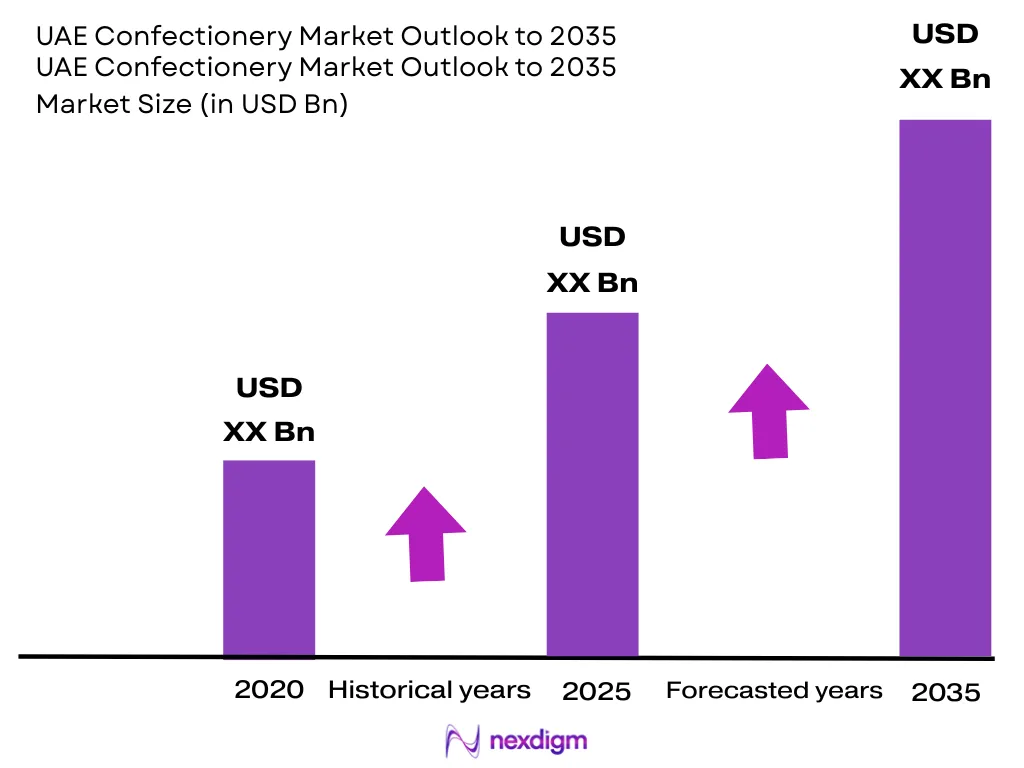
The UAE confectionery market was valued at USD ~ billion in 2024 and is projected to expand at a CAGR of ~% during the 2026–2035 forecast period. According to industry statistics published by the Federal Competitiveness and Statistics Centre (FCSC), the UAE’s food and beverage manufacturing sector continues to expand alongside the country’s broader non-oil economy, while confectionery remains one of the most actively traded processed food categories given the country’s role as a regional re-export and distribution hub. Data from industry associations indicates that chocolate and sugar confectionery imports continue to rise steadily, while confectionery sales continued to benefit from premiumization, gifting culture, tourism-driven retail spending, and expanding modern retail networks. Growth is supported by rising disposable income, wider product availability, product innovation, and rising demand for premium chocolates, sugar confectionery, and functional sweets.
Market Segmentation
By Product Type
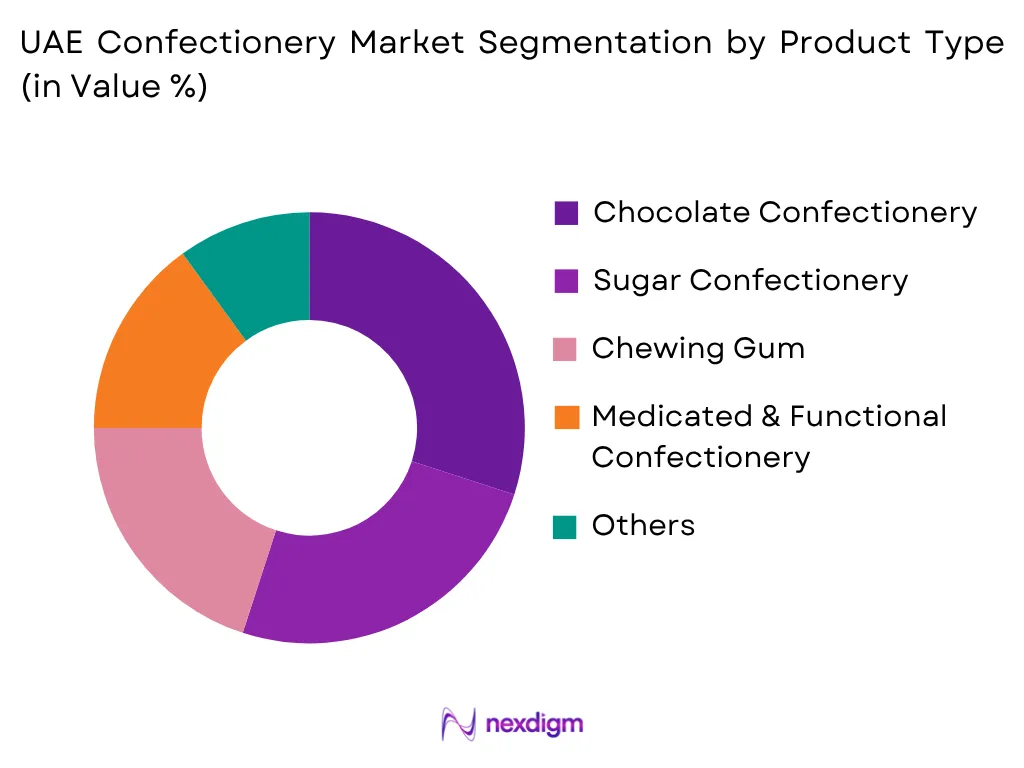
Chocolate confectionery dominates the UAE confectionery market owing to the country’s strong gifting culture, high concentration of premium retail formats, and expanding luxury confectionery offerings. Consumer demand remains particularly strong during occasions such as Ramadan and Eid, National Day, and Valentine’s Day, when chocolate gifting significantly increases retail sales. Large multinational manufacturers alongside homegrown premium chocolatiers continue introducing innovative flavors, premium cocoa formulations, and limited-edition products that attract both local Emirati and the country’s large expatriate consumer base. The UAE’s position as a major re-export and free zone processing hub also supports a wide variety of imported chocolate brands reaching shelves quickly. Continuous investments in premium chocolates, filled products, artisanal offerings, and sustainable cocoa sourcing have further strengthened the segment’s leadership while expanding its presence across supermarkets, specialty stores, convenience outlets, and online retail platforms.
By Distribution Channel
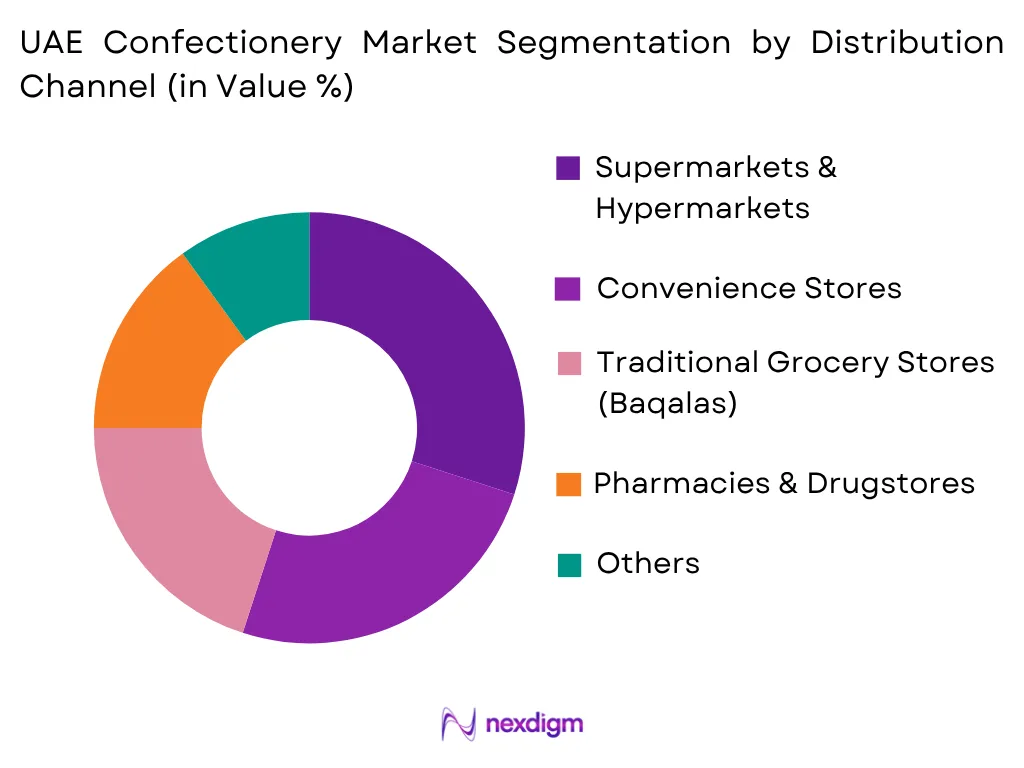
Supermarkets and hypermarkets account for the largest share of confectionery sales in the UAE because they provide consumers with extensive product assortments across multiple price segments and brands under one roof. Large retail chains maintain strong procurement relationships with domestic distributors and international confectionery manufacturers, ensuring continuous product availability throughout the year. These stores also capitalize on impulse purchasing by positioning confectionery products near checkout counters and promotional displays. Seasonal merchandising during Ramadan, Eid, and the year-end holiday season further boosts sales volumes. Additionally, supermarkets frequently introduce exclusive promotional campaigns, private-label offerings, multipack discounts, and premium confectionery sections, attracting both value-conscious and premium consumers. Their widespread geographic presence across Dubai, Abu Dhabi, and the Northern Emirates, combined with well-developed cold-chain and logistics infrastructure, further reinforces their dominance within the UAE confectionery retail landscape.
Competitive Landscape
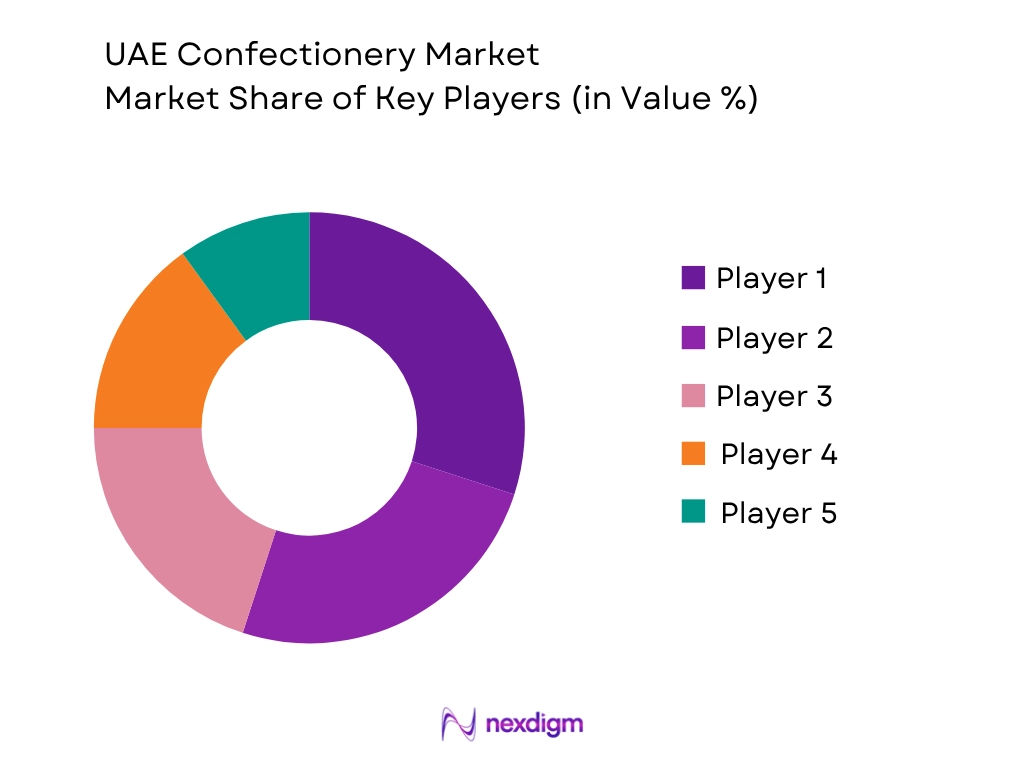
The UAE confectionery market is moderately consolidated, with multinational manufacturers competing alongside well-established regional and homegrown companies. Global companies such as Mondelez, Nestle, Mars, Ferrero, and Hershey leverage extensive distribution networks and free zone re-export capabilities, while regional and domestic brands including Patchi, Al Nassma Chocolate, Bateel International, and Mirzam Chocolate Makers maintain strong consumer loyalty through localized product offerings, premium gifting formats, and seasonal innovations. Continuous investments in premium chocolates, sustainable cocoa sourcing, distribution automation, and omnichannel retail strategies remain key competitive differentiators.
| Company | Establishment Year | Headquarters | Primary Protein Focus | Processing Facilities
|
Export Presence | Production Integration | Sustainability Programs | Value-Added Product Portfolio |
| Mondelez UAE | 2013 | ~ | ~ | ~ | ~ | ~ | ~ | ~ |
| Nestle Middle East | 1995 | ~ | ~ | ~ | ~ | ~ | ~ | ~ |
| Ferrero Middle East | 2006 | ~ | ~ | ~ | ~ | ~ | ~ | ~ |
| Patchi | 1974 | ~ | ~ | ~ | ~ | ~ | ~ | ~ |
| Al Nassma Chocolate | 2008 | ~ | ~ | ~ | ~ | ~ | ~ | ~ |
UAE Confectionary Market Analysis
Growth Drivers
Rising Premium Chocolate Consumption
The UAE’s strong consumer demand for chocolate continues to be one of the primary growth drivers for the confectionery market. The country imports the substantial majority of its chocolate and cocoa-based products, demonstrating the strength of its position as a regional distribution and re-export hub rather than a producer market. The UAE also remains among the highest per-capita confectionery consuming nations in the Middle East, supported by a population exceeding 10 million people, of which the vast majority are expatriates, creating a diverse and substantial consumer base for confectionery products. Urbanization further strengthens demand, as nearly the entire population resides in urban centers such as Dubai, Abu Dhabi, and Sharjah, encouraging frequent purchases through supermarkets, convenience stores, and specialty retailers. Household consumption also benefits from one of the region’s highest GDP per capita levels, with the International Monetary Fund (IMF) estimating UAE GDP per capita above USD 49,000, reflecting an economy capable of supporting premium food consumption. The World Bank estimated the UAE’s nominal GDP at more than USD 540 billion, underpinned by tourism, trade, and a rapidly growing non-oil economy. Seasonal occasions including Ramadan and Eid Al-Fitr, Eid Al-Adha, and National Day continue to stimulate premium chocolate sales as manufacturers introduce limited-edition products, artisanal collections, and higher cocoa-content offerings. Homegrown premium chocolatiers have expanded luxury gifting portfolios, while multinational manufacturers continue investing in localized product innovation, reinforcing chocolate as the largest revenue-generating category within the UAE’s confectionery industry.
Expansion of Modern Retail and Omnichannel Distribution
The continuous expansion of organized retail infrastructure has significantly strengthened confectionery accessibility across the UAE. The country’s population exceeds 10 million, of which nearly the entire population is classified as urban, providing a large consumer base served by supermarkets, hypermarkets, convenience stores, wholesalers, and specialty retailers. Dubai and Abu Dhabi alone account for the majority of organized retail floor space in the country, allowing national and regional retail chains to continuously expand their physical presence while strengthening last-mile logistics. The Federal Competitiveness and Statistics Centre estimates the national population above 10 million, supporting year-round demand for impulse confectionery purchases, further amplified by more than 20 million annual international visitors driving tourist-related gifting purchases. Digital commerce is also transforming product accessibility as the UAE maintains one of the highest internet and smartphone penetration rates globally. The International Monetary Fund projects the UAE to remain one of the Middle East’s largest and most diversified economies, with GDP exceeding USD 540 billion, supporting investments in modern retail infrastructure, warehouse automation, and digital payment systems. Large retailers increasingly dedicate shelf space to premium chocolates, sugar confectionery, and seasonal products, while convenience stores capitalize on impulse purchases through checkout merchandising. Omnichannel retailing enables manufacturers to combine physical distribution with direct-to-consumer platforms, subscription gifting, and rapid quick-commerce delivery services. These developments allow confectionery companies to broaden geographic reach, improve product availability, launch exclusive online collections, and strengthen consumer engagement, thereby supporting sustained demand across multiple product categories throughout the country.
Market Challenges
Cocoa Supply Volatility and Raw Material Availability
UAE confectionery manufacturers and distributors continue facing significant challenges arising from cocoa supply volatility and complete dependency on imported raw materials. As the UAE has no domestic cocoa cultivation, all chocolate-related raw materials must be sourced through imports, leaving local processors and re-packagers fully exposed to global price fluctuations. Globally, the International Cocoa Organization (ICCO) reported cocoa production falling to approximately 4.37 million tonnes, with end-of-season stocks declining to nearly 1.27 million tonnes, the lowest stock-to-grinding ratio recorded in decades. These global shortages directly affect UAE-based manufacturers and free zone processors because cocoa remains the principal raw material for chocolate production and the country has no buffer of domestic supply. Reliance on cocoa-producing regions in West Africa and Latin America makes the supply chain vulnerable to adverse weather conditions, crop diseases, shipping disruptions, and geopolitical developments affecting trade routes. Although free zone re-export and value-added processing capacity continues expanding, industrial demand currently exceeds what regional supply chains can reliably guarantee at stable prices. Manufacturers must therefore manage procurement risks, diversify sourcing strategies, improve supply-chain resilience, and invest in long-term partnerships with international cocoa suppliers to maintain stable production and ensure uninterrupted availability of chocolate products across retail channels.
Increasing Health Regulations and Consumer Shift Toward Reduced Sugar Products
Growing public health initiatives and evolving nutritional regulations are creating structural challenges for confectionery manufacturers operating in the UAE. The country has a population exceeding 10 million, with increasing awareness regarding obesity, diabetes, and excessive sugar intake influencing purchasing decisions, particularly given regionally high diabetes prevalence rates highlighted by the World Health Organization. The implementation of an excise tax on sugar-sweetened products by the UAE Federal Tax Authority, alongside enhanced front-of-pack nutrition labeling requirements from the Emirates Authority for Standardization and Metrology (ESMA), has increased transparency around products containing high levels of added sugars, encouraging consumers to compare nutritional profiles before purchasing. At the same time, the UAE’s affluent and increasingly health-conscious population is driving stronger demand for sugar-free, reduced-sugar, functional, and clean-label confectionery. Manufacturers are therefore required to reformulate recipes while maintaining taste, texture, and shelf stability in a hot climate—an increasingly complex technical challenge. The World Bank estimates life expectancy in the UAE at approximately 78 years, accompanied by a population that increasingly prioritizes healthier dietary choices. In addition, high education levels and near-universal internet access have accelerated consumer awareness regarding food ingredients and nutritional information. These trends require confectionery companies to invest continuously in research and development, alternative sweeteners, innovative ingredient technologies, and transparent labeling practices. While these investments create opportunities for innovation, they also increase formulation complexity and operational requirements across distribution and product development activities.
Market Opportunities
Premium, Functional and Better-for-You Confectionery
The UAE’s evolving consumer preferences are creating substantial opportunities for premium, functional, and health-oriented confectionery products. With a population of more than 10 million and a near-entirely urban population, the country provides a concentrated and affluent addressable market for manufacturers introducing premium chocolates, sugar-free confectionery, protein-enriched products, and clean-label innovations. High disposable income and a large base of affluent residents and tourists have encouraged greater spending on indulgent products with perceived quality and health benefits. The International Monetary Fund estimates the UAE’s nominal GDP per capita at more than USD 49,000, supporting stronger household and visitor expenditure on premium packaged foods. Simultaneously, increasing awareness of nutrition has accelerated demand for confectionery containing natural ingredients, higher cocoa content, reduced sugar formulations, plant-based ingredients, and functional additives such as vitamins, minerals, and probiotics. Premium gifting has also become increasingly important during Ramadan, Eid, and corporate occasions, creating opportunities for manufacturers to introduce artisanal collections, personalized gift boxes, and limited-edition products. Expansion of specialty chocolate boutiques and direct-to-consumer digital platforms further enables companies to target affluent urban consumers and tourists with differentiated offerings. Manufacturers investing in product innovation, premium packaging, halal-certified sourcing, and healthier ingredient profiles are therefore well positioned to capture future demand while strengthening brand loyalty across both domestic and regional export markets.
Re-Export Hub Expansion and Regional Distribution Growth
The strengthening of the UAE’s logistics and free zone ecosystem presents a significant long-term opportunity for the confectionery industry. The UAE remains among the leading re-export and trade hubs in the Middle East, with Jebel Ali Free Zone and Dubai South accounting for a large share of regional confectionery distribution. Continued investments in cold-chain logistics, bonded warehousing, and value-added repackaging facilities are increasing the country’s capacity to serve as a distribution base for the broader Gulf Cooperation Council (GCC) and wider Middle East and Africa region. At the same time, the UAE benefits from world-class port and airport infrastructure, with Jebel Ali Port and Al Maktoum International Airport supporting diversified trade flows and well-established logistics corridors connecting global cocoa and confectionery suppliers with regional end markets. Growing international demand for sustainably sourced cocoa and certified halal chocolate products provides UAE-based distributors and manufacturers with opportunities to expand regional exports while enhancing product value. Government initiatives supporting trade facilitation, digital customs processing, and food security strategies are expected to strengthen supply chain resilience over time. Furthermore, increasing investments in traceability, halal compliance, and responsible sourcing enable UAE-based confectionery companies to meet evolving international procurement standards. These developments not only improve competitiveness in premium regional export markets but also support manufacturers and distributors seeking to differentiate their products through sustainability, ethical sourcing, and higher-quality cocoa ingredients, thereby creating new avenues for long-term industry growth.
Future Outlook
The UAE confectionery market is expected to witness sustained growth throughout the forecast period, supported by rising disposable incomes, product premiumization, and evolving consumer preferences toward indulgent and functional confectionery. Manufacturers and distributors are increasingly investing in sugar-reduced formulations, premium cocoa products, halal-certified sourcing practices, and digital commerce platforms. Growing penetration of organized retail, expansion of specialty chocolate stores, and innovation in seasonal and festive gifting products are expected to create additional growth opportunities. Continued investments in distribution efficiency, free zone processing capacity, and environmentally responsible packaging will further strengthen long-term market competitiveness.
Major Players
- Mondelez UAE
- Nestle Middle East
- Ferrero Middle East
- Mars Wrigley UAE
- Patchi
- Al Nassma Chocolate
- Galaxy Chocolate (Mars)
- Hershey Middle East
- Bateel International
- Choithrams Confectionery
- Mirzam Chocolate Makers
- Al Foah
- Rasin Foods
- Lindt & Sprungli Gulf
- Purechoc Switzerland
Key Target Audience
- Confectionery Manufacturers
- Chocolate Manufacturers
- Cocoa Importers and Processors
- Sugar and Ingredient Suppliers
- Modern Retail Chains and Food Distributors
- Packaging Material Manufacturers
- Investments and Venture Capitalist Firms
- Government and Regulatory Bodies (Emirates Authority for Standardization and Metrology (ESMA), Ministry of Climate Change and Environment (MOCCAE))
Research Methodology
Step 1: Identification of Key Variables
The research begins by identifying the major stakeholders across the UAE confectionery value chain, including cocoa importers, ingredient suppliers, confectionery producers, distributors, retailers, and consumers. Extensive secondary research is conducted using government publications, industry associations, trade databases, company reports, and proprietary databases to establish the key variables influencing market performance.
Step 2: Market Analysis and Construction
Historical market information is compiled and evaluated to estimate the overall market size, product penetration, import volumes, consumption trends, pricing dynamics, and revenue generation across major confectionery categories. Both demand-side and supply-side indicators are analyzed using bottom-up and top-down market sizing approaches to ensure comprehensive market coverage.
Step 3: Hypothesis Validation and Expert Consultation
Preliminary market estimates and analytical assumptions are validated through Computer Assisted Telephone Interviews (CATIs) and structured discussions with confectionery manufacturers, cocoa importers, distributors, retail executives, procurement specialists, and industry experts. These interviews provide valuable commercial insights that strengthen the reliability of market estimates.
Step 4: Research Synthesis and Final Output
The final stage integrates primary research findings with secondary information to develop a comprehensive assessment of market size, segmentation, competitive landscape, consumer behavior, and future opportunities. Multiple validation techniques, including data triangulation and cross-verification, are employed to ensure the consistency, accuracy, and credibility of the final market report.

- Executive Summary
- Research Methodology (Market Definitions and Assumptions, Abbreviations, Market Taxonomy, Market Sizing Approach, Top-Down Analysis, Bottom-Up Analysis, Demand-Side Assessment, Supply-Side Assessment, Primary Industry Interviews, Secondary Research Validation, Data Triangulation, Forecasting Framework, Limitations and Future Conclusions)

- Definition and Scope
- Market Evolution and Industry Genesis
- Timeline of Major Industry Developments
- Industry Value Chain Analysis
- Supply Chain Analysis

- Growth Drivers (Strong Tourism and Retail Tourism Spending, Rising Disposable Income, Expansion of Modern Retail, Strong Festive and Gifting Culture, Increasing Expatriate-Driven Snacking Culture, Product Innovation, Rising Convenience Consumption, Expanding E-Commerce and Quick Commerce Sales)
- Market Challenges (Volatility in Cocoa Prices, Sugar Price Fluctuations, High Import Dependency, Inflationary Pressure on Consumer Spending, Health Concerns Regarding Sugar Intake, Extreme Climate Impact on Shelf-Life, Counterfeit and Grey-Market Products, Intense Retail Price Competition)
- Market Opportunities (Sugar-Free Confectionery Expansion, Functional Gummies, Premium Chocolate Gifting, Halal-Certified Cocoa Sourcing, Plant-Based Chocolate, Personalized and Corporate Gifting, Premium Packaging Innovation, Quick Commerce Expansion)
- Market Trends (Bean-to-Bar and Artisanal Chocolates, Clean Label Ingredients, Premiumization, Limited Edition Seasonal and Ramadan Products, Protein-Enriched Confectionery, Sustainable Packaging Adoption, Reduced Sugar Formulations, Premium Filled Chocolates)
- Government Regulations (Emirates Authority for Standardization and Metrology (ESMA) Food Safety Standards, Halal Certification Requirements, Nutritional Labeling Requirements, Sugar Tax and Excise Duty, Allergen Declaration Requirements, Food Additive Regulations, Packaging Compliance Standards, Import Regulations)
- Cocoa Supply and Pricing Analysis (Import Dependency for Cocoa Beans, Cocoa Bean and Derivative Imports, Cocoa Butter Prices, Cocoa Liquor Supply, Re-Export and Free Zone Processing Capacity, Price Transmission Analysis)
- Sugar Supply Analysis (Import-Based Sugar Availability, Sugar Cost Trends, Alternative Sweetener Adoption)
- Seasonal Demand Analysis (Ramadan and Eid Al-Fitr, Eid Al-Adha, National Day, Valentine’s Day, Christmas and New Year, Diwali, Corporate and Festive Gifting)
- Retail Shelf Space Analysis (Modern Trade Penetration, Category Allocation, Promotional Displays, Checkout Placement)
- Innovation Landscape (Flavor Innovation, Texture Innovation, Functional Ingredients, Packaging Innovation, Premium Launches)
- Sustainability Analysis (Sustainable Cocoa Sourcing Certifications, Cocoa Traceability, Sustainable Packaging, Carbon Reduction Initiatives)
- SWOT Analysis
- Porter’s Five Forces Analysis
- PESTLE Analysis
- Stakeholder Ecosystem
- Competition Ecosystem

- By Market Value (2020-2025)
- By Volume Consumption (2020-2025)
- By Average Selling Price (2020-2025)

- By Product Type (In Value %)
Chocolate Confectionery
Sugar Confectionery
Chewing Gum
Medicated & Functional Confectionery
Seasonal Confectionery
Premium & Gourmet Confectionery
Filled and Molded Chocolates
Countlines and Chocolate Bars - By Ingredient Type (In Value %)
Cocoa-Based Confectionery
Sugar-Based Confectionery
Sugar-Free Confectionery
Functional & Fortified Confectionery
Organic & Natural Confectionery
Plant-Based & Vegan Confectionery - By Distribution Channel (In Value %)
Supermarkets & Hypermarkets
Convenience Stores
Traditional Grocery Stores (Baqalas)
Pharmacies & Drugstores
Specialty Chocolate Stores
Cash & Carry Wholesale
E-Commerce
Direct-to-Consumer - By Packaging Type (In Value %)
Flexible Packs
Flow Wraps
Boxes
Pouches
Gift Packs
Multipacks
Sustainable Packaging - By Region (In Value %)
Dubai
Abu Dhabi
Sharjah
Northern Emirates (Ajman, Umm Al Quwain, Ras Al Khaimah, Fujairah)

- Market Share Analysis (By Value, Volume, Product Category, Distribution Channel, Price Segment)
- Cross Comparison Parameters (Chocolate Portfolio Breadth, Sugar Confectionery Portfolio, Annual New Product Launches, Import and Distribution Capability, Distribution Reach Across the UAE, Seasonal Product Portfolio Strength, Premium Product Mix, Retail Footprint)
- SWOT Analysis of Major Players
- Pricing Analysis (By SKU, Product Type, Cocoa Content, Premium Positioning, Pack Size)
- Detailed Profiles of Major Companies
Mondelez UAE
Nestle Middle East
Ferrero Middle East
Mars Wrigley UAE
Patchi
Al Nassma Chocolate
Galaxy Chocolate (Mars)
Hershey Middle East
Bateel International
Choithrams Confectionery
Mirzam Chocolate Makers
Al Foah
Rasin Foods
Lindt & Sprungli Gulf
Purechoc Switzerland

- Consumption Pattern Analysis (Consumption Frequency, Chocolate Preference, Sugar Confectionery Preference, Seasonal Buying Behavior, Household Penetration)
- Demographic Consumption Analysis (Age, Gender, Income Level, Nationality Mix, Household Size, Emirate-Wise Distribution)
- Household Expenditure Analysis
- Premium vs Mass Market Consumption Analysis
- Brand Loyalty Analysis
- Health & Wellness Purchase Behaviour
- Product Attribute Preference Analysis (Taste, Cocoa Content, Texture, Sugar Content, Brand Reputation, Packaging, Price, Ingredients)
- Impulse Purchase Behaviour
- Online vs Offline Purchase Behaviour
- Consumer Pain Point Analysis
- Purchase Decision-Making Process

- By Market Value (2026-2035)
- By Volume Consumption (2026-2035)
- By Average Selling Price (2026-2035)


 Request a Sample
 Ask for Customization
 Get a Quote
 Enquire Now