
 Download PDF
Market Overview
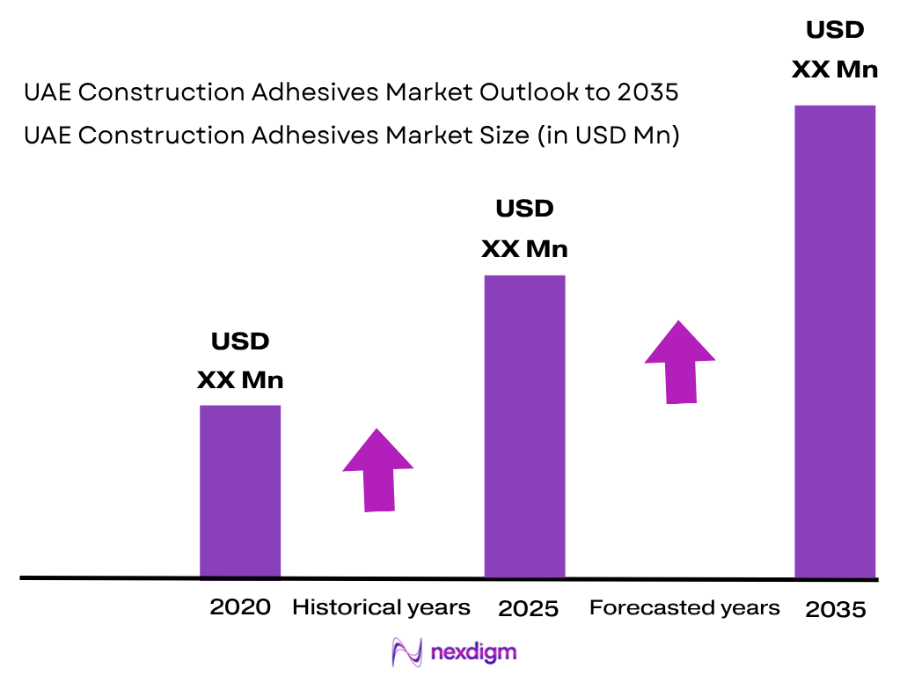
The UAE Construction Adhesives Market is valued at approximately ~USD XX million, supported by high-rise construction, villas, hospitality, infrastructure and interior fit-out activity. UAE GDP increased from USD 522.62 billion to USD 552.32 billion across the latest two annual observations, while construction was among the strongest non-oil activities. Abu Dhabi separately launched 144 infrastructure and development projects valued at AED66 billion, reinforcing demand for tile, flooring, anchoring, façade and general construction adhesives.
Dubai and Abu Dhabi dominate the UAE Construction Adhesives Market because they concentrate high-rise buildings, premium residences, hotels, airports, commercial fit-outs and infrastructure. Abu Dhabi moved from 49 development contracts worth AED22 billion to 144 approved projects with an AED66 billion budget, while Dubai International handled 87 million passengers in the earlier observation and 92.3 million subsequently, supporting continuous airport, hospitality, retail and urban-development requirements for technically specified construction materials.
Market Segmentation
By Product Type
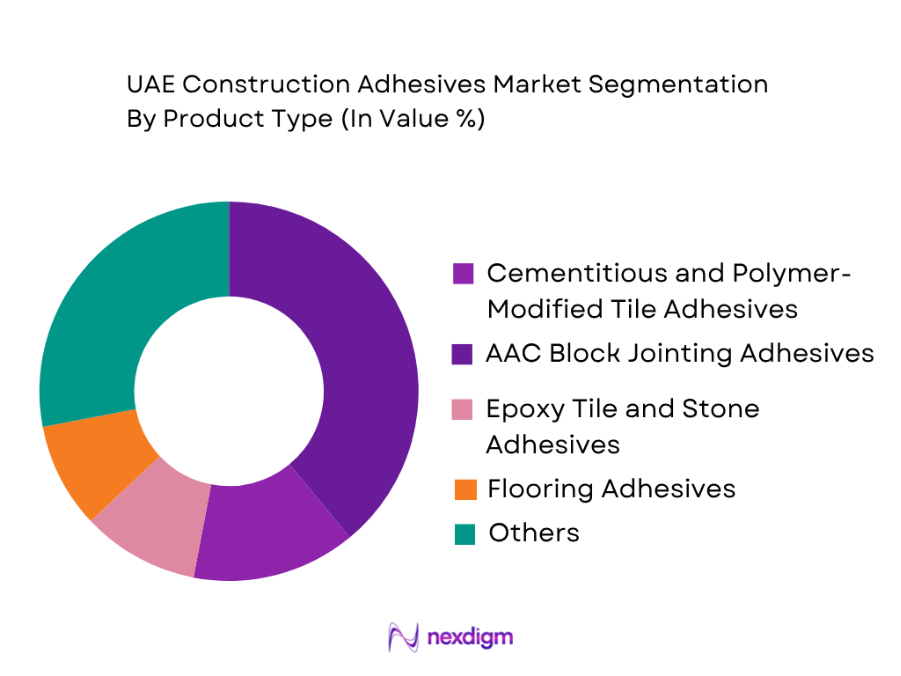
The UAE Construction Adhesives Market is segmented into cementitious tile adhesives, polymer-modified tile adhesives, flexible tile adhesives, epoxy systems, flooring adhesives, AAC-block jointing products, structural anchoring adhesives, polyurethane adhesives and hybrid polymer systems. Cementitious and polymer-modified tile adhesives hold the dominant modeled share because ceramic, porcelain, marble and large-format finishes are extensively used across villas, residential towers, hotels, retail projects and public buildings. High ambient temperatures, low-absorption porcelain and large-format slabs increasingly require factory-produced adhesives with controlled open time, slip resistance and deformability rather than conventional cement mortar. Dubai Municipality’s certification regime specifically covers low-emitting adhesives and adhesive primers under Al Sa’fat, demonstrating the increasing role of tested, formulated products in the construction ecosystem. The municipality’s certified-product register also includes dedicated tile adhesive products, supporting an organized specification-driven market. Premium project requirements therefore favor C2, flexible and specialized stone adhesives alongside mainstream cementitious products.
By Application
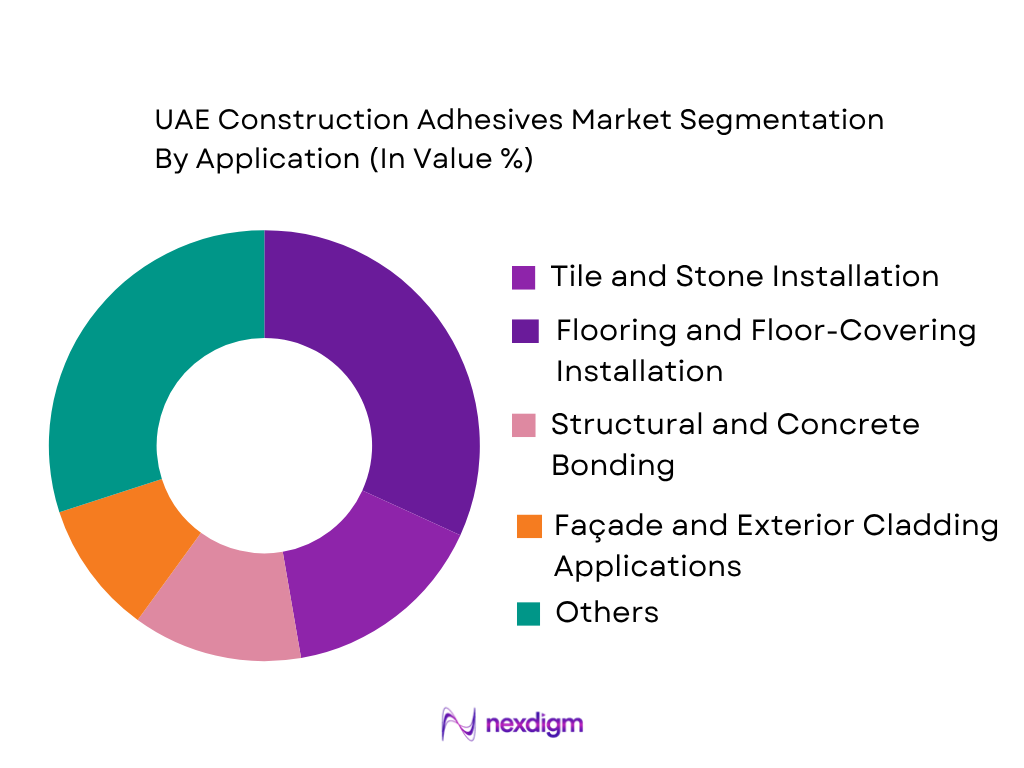
The UAE Construction Adhesives Market is segmented into tile and stone fixing, flooring, structural anchoring, interior fit-out, façade bonding, AAC masonry, roofing and prefabricated construction. Tile and stone installation represents the dominant modeled application, reflecting the widespread use of porcelain, marble, granite and ceramic finishes in residential, hospitality and commercial projects. Large-format installations are particularly adhesive-intensive because full-bed contact, deformability and vertical-slip resistance become critical as tile dimensions and weights increase. Abu Dhabi’s project pipeline reinforces this application base: the emirate approved 144 projects with a combined budget of AED66 billion, including more than AED59 billion directed toward housing and public facilities. The Yas Canal development alone includes 1,146 villas across 1.8 square kilometres, creating substantial tile, stone, wet-area and interior installation requirements. Dubai’s continuing hospitality and aviation activity adds further finishing demand through terminals, hotels, malls and mixed-use developments.
Competitive Landscape
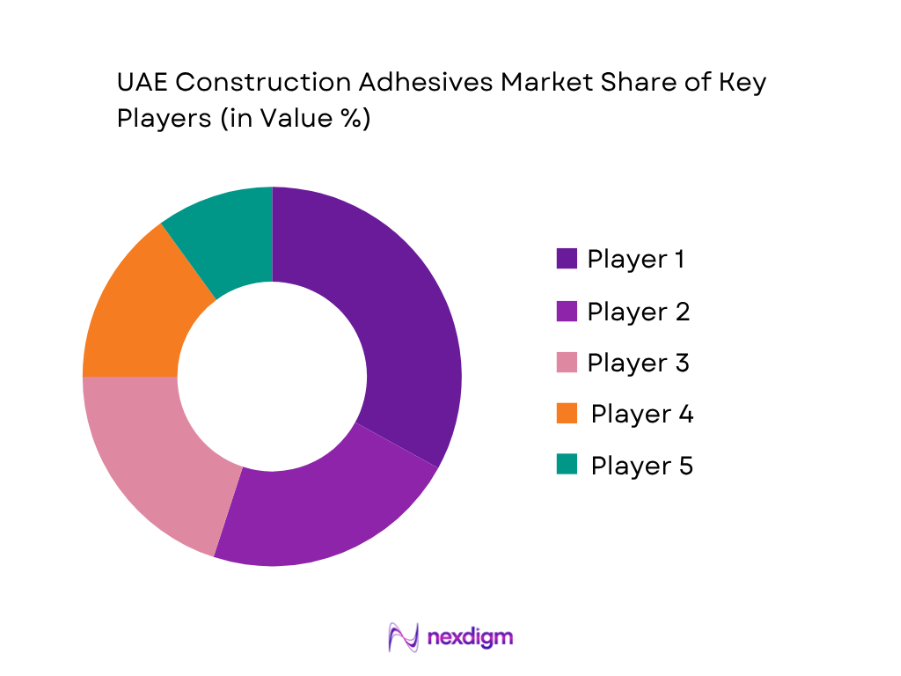
The UAE Construction Adhesives Market combines multinational construction-chemical companies, regional dry-mix specialists and locally manufactured adhesive brands. Sika, MAPEI, Fosroc, Saint-Gobain Weber and LATICRETE compete through premium tile systems, structural anchoring, flooring products, technical specification and contractor support. Local manufacturing and product certification are particularly important because Dubai and Abu Dhabi projects require rapid supply, documented conformity and adhesive systems capable of performing under high temperatures and demanding substrates.
| Major Player | Establishment Year | Headquarters | Tile & Stone Portfolio | Large-Format / Flexible Capability | UAE Manufacturing / Presence | Structural Bonding | Low-VOC / Green Building Capability | Technical Support |
| Sika | 1910 | Baar, Switzerland | ||||||
| MAPEI | 1937 | Milan, Italy | ||||||
| Fosroc | 1972 | Dubai, UAE | ||||||
| Saint-Gobain Weber | 1900 | Courbevoie, France | ||||||
| LATICRETE | 1956 | Bethany, Connecticut, USA |
UAE Construction Adhesives Market Analysis
Growth Drivers
High-Rise, Residential and Infrastructure Construction Sustaining Adhesive Demand
The UAE’s active residential, high-rise and infrastructure pipeline is supporting demand for polymer-modified tile adhesives, flooring products, façade bonding systems and structural anchors. Abu Dhabi approved 144 infrastructure and development projects with a combined budget of AED66 billion in 2024, including more than AED59 billion allocated to housing and public facilities. This construction intensity increases consumption of tile and stone adhesives across apartments, villas, schools, public buildings and community infrastructure, while reinforced-concrete structures create demand for epoxy anchoring and repair bonding. Dubai adds a substantial hospitality and transport-linked construction base: Dubai International handled 92.3 million passengers in 2024, generating continued requirements for airport refurbishment, retail fit-outs, flooring replacement and interior finishes. Construction demand is supported by strong national economic activity; World Bank data place UAE GDP at USD552.32 billion and GDP per capita at USD50,273.5 in 2024. The IMF also identified construction, tourism, manufacturing and financial services among the sectors driving non-hydrocarbon activity. With large-scale development concentrated in Dubai and Abu Dhabi, adhesive manufacturers benefit from recurring requirements for high-strength, flexible and specification-compliant installation materials across technically diverse building applications.
Hospitality, Aviation and Premium Interior Development Expanding Specialized Adhesive Applications
The UAE’s tourism, aviation and premium real-estate ecosystem is driving construction adhesive consumption beyond conventional tile fixing into natural-stone installation, flooring, wall panels, rapid-setting systems and interior-fit-out bonding. Dubai International processed 92.3 million passengers in 2024 and recorded 8.2 million passengers in December alone, illustrating the operating scale of terminals, retail areas, lounges and hospitality infrastructure that require regular refurbishment and replacement of finishes. Abu Dhabi simultaneously launched 144 projects valued at AED66 billion, while the emirate’s development program includes housing, tourism, education and community facilities. Premium hotels, villas, malls and mixed-use developments frequently specify porcelain, marble, granite and large-format slabs, increasing the need for deformable adhesives, epoxy stone systems and extended-open-time formulations rather than basic mortar. The macroeconomic environment provides substantial spending capacity: World Bank data record UAE GDP of USD552.32 billion and GDP per capita of USD50,273.5 in 2024, while official national data put real GDP at AED1,776 billion and non-oil GDP at AED1,342 billion. This diversified non-oil base supports continued construction finishing, renovation and fit-out activity, strengthening demand for high-performance construction adhesive systems.
Market Challenges
Extreme Heat and Rapid Moisture Loss Complicate Adhesive Installation Performance
Extreme UAE summer conditions create a market-specific technical challenge because cementitious and polymer-modified adhesives are sensitive to substrate temperature, water evaporation, open time and curing conditions. The Ministry of Human Resources and Emiratisation prohibits outdoor work under direct sunlight between 12:30 pm and 3:00 pm from 15 June to 15 September, demonstrating the severity of seasonal heat exposure faced by construction sites. High surface temperatures can accelerate moisture loss from tile adhesives, shorten workable open time and reduce wet transfer if installers spread excessive material before fixing tiles. Exterior façades, balconies and podium areas are especially demanding because large-format porcelain and stone installations must also tolerate thermal expansion and repeated heating cycles. Product selection therefore requires appropriate deformability, water retention and substrate preparation rather than simply increasing adhesive quantity. Compliance adds another technical layer because certified products must also meet project and green-building requirements. The broader construction economy remains substantial despite these execution challenges: World Bank data record USD552.32 billion of UAE GDP and USD50,273.5 GDP per capita in 2024, while official UAE statistics place non-oil GDP at AED1,342 billion. This large construction-oriented economy makes heat-resistant application performance a central competitive requirement for adhesive suppliers.
Product Certification and Imported Material Dependence Increase Supply and Qualification Complexity
Construction adhesive suppliers in the UAE must manage both international raw-material exposure and increasingly formal product-certification requirements. UAE non-oil foreign trade reached AED2.997 trillion in 2024, while Abu Dhabi alone imported AED140.2 billion of non-oil goods, up from AED136.4 billion in the preceding annual observation. These figures demonstrate the importance of international supply networks to the country’s manufacturing and construction-material ecosystem, which includes imported specialty polymers, epoxy ingredients, polyurethane components and chemical additives. Simultaneously, Dubai Municipality’s Al Sa’fat framework specifically regulates low-emitting adhesives, adhesive primers, bonding primers, sealants and sealant primers. Its certification register includes tile adhesives such as MilanoFix and ACE FIX Plus, showing that manufacturers must demonstrate formal product conformity rather than rely only on contractor acceptance. One Dubai Municipality certification document sets a 65 g/L VOC limit for water-based ceramic tile adhesives, illustrating the formulation constraints applied to selected systems. The economic base supporting construction remains strong, with World Bank data recording USD552.32 billion of GDP in 2024 and official UAE data recording AED1,776 billion of real GDP. Suppliers therefore face a technically attractive but compliance-intensive market requiring robust sourcing, laboratory testing and documentation capability.
Market Opportunities
Low-VOC and High-Performance Large-Format Tile Adhesives Offer Future Expansion Potential
Low-emission, flexible and large-format tile adhesive technologies offer a strong future opportunity because UAE projects increasingly combine premium interior finishes with formal green-building requirements. Dubai Municipality’s Al Sa’fat certification framework explicitly includes adhesives, adhesive primers and bonding primers under low-emitting material requirements, while its certified-product list includes specific tile adhesive systems. A Dubai Municipality conformity document applies a 65 g/L VOC limit to water-based ceramic tile adhesives, demonstrating that low-emission performance is already integrated into product qualification. At the same time, Abu Dhabi approved 144 projects worth AED66 billion in 2024, including more than AED59 billion for housing and public facilities. These current projects create a large installation base for porcelain slabs, natural stone and high-value interior finishes where C2, S1 and S2 adhesive classes can deliver improved adhesion, slip resistance and deformability. The macroeconomic backdrop reinforces future premium-product adoption: World Bank data record UAE GDP at USD552.32 billion and GDP per capita at USD50,273.5 in 2024, while official national statistics place non-oil GDP at AED1,342 billion. Suppliers combining low-VOC certification with high-temperature and large-format performance can therefore address both regulatory and technical requirements in one product platform.
Structural Anchoring, Data Centres and Prefabricated Construction Create Higher-Value Applications
Structural anchoring, modular construction and data-centre infrastructure provide future growth avenues for epoxy, hybrid and polyurethane construction adhesives beyond mainstream tile applications. Abu Dhabi launched a unified government data-centre platform in 2025 with 19 MW of combined secure AI-ready capacity across its primary Khalifa City facility and disaster-recovery location in Al Ain, demonstrating ongoing development of technically demanding digital infrastructure. These facilities require flooring adhesives, panel bonding, insulation attachment and chemical anchoring around equipment and building services. Infrastructure construction provides a broader base: Abu Dhabi approved 144 projects carrying AED66 billion of budget in 2024, and transport initiatives included more than AED3 billion for traffic-improvement programs. Adhesive anchoring systems can be used for rebar dowelling, threaded rods, façade supports and equipment installation, while prefabricated building components benefit from controlled factory-applied bonding that reduces reliance on mechanical fasteners and improves assembly consistency. The economic platform remains substantial, with World Bank data showing UAE GDP of USD552.32 billion and GDP per capita of USD50,273.5 in 2024. The IMF also identifies construction and manufacturing as important contributors to non-hydrocarbon activity, supporting future adoption of higher-value specification-driven adhesive technologies across digital, industrial and infrastructure projects.
Future Outlook
The UAE Construction Adhesives Market is forecast to expand at approximately ~X.X% CAGR during 2026–2035, supported by residential development, high-rise projects, hospitality, airports, data-intensive facilities and infrastructure. Future product demand should shift toward C2-class flexible systems, high-temperature adhesives, structural chemical anchors and low-emission products rather than relying primarily on basic cementitious bonding. Abu Dhabi provides a substantial project platform. The Abu Dhabi Projects and Infrastructure Centre approved 144 projects worth approximately AED66 billion, of which more than AED59 billion was allocated to housing and public facilities. The pipeline spans integrated communities, education, tourism and infrastructure, creating adhesive applications across tiles, stone, flooring, insulation, façade systems and structural anchoring.
Major Players
- Sika UAE LLC
- Mapei Construction Chemicals LLC
- Al Gurg Fosroc LLC
- Saint-Gobain Weber UAE
- LATICRETE Middle East LLC
- ARDEX Middle East
- Bostik Middle East / Arkema
- Henkel / LOCTITE Middle East
- MC-Bauchemie Middle East LLC
- CONMIX Ltd.
- DCP International
- Terraco UAE
- Saveto / Saudi Vetonit UAE
- ACE Impacts Adhesives Industry LLC
- Danube Building Materials / MilanoFix
Key Target Audience
- Construction Adhesive and Construction Chemical Manufacturers
- Tile, Porcelain and Natural Stone Manufacturers
- Real Estate Developers and Main Contractors
- Flooring, Tile and Interior Fit-Out Contractors
- Façade and Structural Engineering Contractors
- Building Material Distributors and Tile Dealers
- Investments and Venture Capitalist Firms
- Government and Regulatory Bodies (Dubai Municipality, Abu Dhabi Department of Municipalities and Transport, Ministry of Industry and Advanced Technology, Emirates Authority for Standardization and Metrology functions under MoIAT, Abu Dhabi Projects and Infrastructure Centre)
Research Methodology
Step 1: Identification of Key Variables
The initial phase involves constructing an ecosystem map covering adhesive manufacturers, polymer suppliers, dry-mix producers, tile companies, distributors, developers, contractors and applicators. Desk research identifies variables including project type, tile format, adhesive classification, local manufacturing, ambient temperature, substrate type, product certification and distribution structure.
Step 2: Market Analysis and Construction
Historical demand for the UAE Construction Adhesives Market is assessed through top-down and bottom-up methods. Top-down analysis considers residential projects, infrastructure spending, hospitality and commercial development, while bottom-up modelling estimates adhesive consumption using tile areas, flooring installations, façade applications, AAC masonry, structural anchoring and application-specific coverage.
Step 3: Hypothesis Validation and Expert Consultation
Market hypotheses are validated through computer-assisted telephone interviews with adhesive producers, distributors, tile contractors, flooring specialists, façade contractors and project procurement teams. These discussions validate C2/S1/S2 adoption, large-format tile requirements, low-VOC specifications, project approval processes, regional distribution and technical service requirements.
Step 4: Research Synthesis and Final Output
The final phase triangulates government project disclosures, Dubai Municipality product requirements, macroeconomic indicators, supplier portfolios and primary research. Bottom-up adhesive demand estimates are reconciled against construction activity and project pipelines to develop the final segmentation, competitive analysis, regional assessment and strategic outlook.

- Executive Summary
- Research Methodology (Market Definitions and Assumptions, UAE Construction Adhesives Market Boundary, Cementitious versus Polymer Adhesive Classification, Tile Adhesive Assessment, Stone Adhesive Assessment, Flooring Adhesive Assessment, AAC Block Jointing Adhesive Assessment, Epoxy Adhesive Assessment, Polyurethane Adhesive Assessment, Acrylic Adhesive Assessment, Hybrid Polymer Adhesive Assessment, Structural Anchoring Adhesive Assessment, Façade Bonding Assessment, Interior Fit-Out Adhesive Assessment, Roofing and Insulation Adhesive Assessment, Prefabricated Construction Adhesive Assessment, Ceramic and Porcelain Tile Assessment, Large-Format Tile Assessment, Natural Stone Assessment, BS EN 12004 Classification Mapping, Al Sa’fat Low-Emitting Adhesive Assessment, Dubai Municipality Product Certification Assessment, Abu Dhabi Construction Specification Mapping, Low-VOC Compliance Assessment, Applicator Mapping, Distributor Mapping, Supply-Side Assessment, Demand-Side Assessment, Top-Down Market Sizing, Bottom-Up Market Sizing, Primary Industry Interviews, Construction Pipeline Assessment, Data Triangulation, Forecasting Framework)

- Definition and Scope
- Evolution of Construction Adhesive Technology in the UAE, Transition from Traditional Cement-Sand Tile Mortar to Factory-Produced Cementitious Adhesives, Polymer-Modified Tile Adhesives, Porcelain Tile Adhesives, Large-Format Tile Adhesives, Natural Stone Adhesives, Flexible Exterior Tile Adhesives, Epoxy Adhesives, Polyurethane Construction Adhesives, Structural Anchoring Systems, AAC Block Jointing Adhesives, Flooring Adhesives, Façade Bonding Systems, Hybrid Polymer Adhesives, Low-VOC Adhesives, Prefabrication and Modular Construction Bonding
- Construction Adhesives Industry Value Chain Analysis
- Construction Adhesives Supply Chain Analysis
- Cement Suppliers, Redispersible Polymer Powder Suppliers, Cellulose Ether Suppliers, Acrylic Polymer Suppliers, Epoxy Resin Suppliers, Polyurethane Raw Material Suppliers, Silane and Hybrid Polymer Suppliers, Mineral Filler Suppliers, Specialty Additive Suppliers, Construction Adhesive Manufacturers, Dry-Mix Mortar Plants, Local Blenders, Importers, Construction Chemical Distributors, Tile and Sanitaryware Dealers, Building Material Retailers, Contractors, Tile Applicators, Flooring Contractors, Façade Contractors, Developers, Architects and Specifiers

- Growth Drivers (Dubai High-Rise Development, Abu Dhabi Residential Expansion, Hotel and Resort Construction, Luxury Villa Construction, Large-Format Porcelain Tile Adoption, Natural Stone Installation, Data Centre Construction, Airport and Transport Infrastructure, Interior Fit-Out Demand, Prefabricated Construction, Specification-Based Building Materials, Skilled-Labor Productivity Requirements)
- Market Challenges (Traditional Cement Mortar Competition, Low-Cost Product Substitution, Extreme Ambient Temperatures, Rapid Moisture Loss During Application, Incorrect Adhesive Selection, Poor Substrate Preparation, Inadequate Adhesive Coverage, Applicator Skill Variation, Imported Polymer Dependence, Product Certification Requirements, Large-Format Tile Detachment Risk, Multi-Substrate Bonding Complexity)
- Market Opportunities (C2 S1 and C2 S2 Large-Format Tile Adhesives, Flexible Exterior Façade Adhesives, Epoxy Tile and Stone Systems, Tile-on-Tile Renovation Adhesives, Low-VOC Al Sa’fat-Compliant Adhesives, Structural Anchoring Systems, Data Centre Flooring Adhesives, Prefabricated Construction Bonding, High-Temperature Adhesive Systems, Natural Stone Adhesives, Rapid-Setting Adhesives, Luxury Interior Fit-Out Adhesives, Contractor Training and Certification)
- Market Trends (C2-Class Tile Adhesive Adoption, S1 and S2 Flexible Adhesives, Large-Format Porcelain Installation, Thin-Bed Tile Systems, Ready-to-Use Adhesives, Epoxy Stone Adhesives, Hybrid Polymer Systems, Tile-on-Tile Renovation, Low-VOC Formulations, Factory-Mixed Dry Mortars, High-Temperature Application Systems, Structural Chemical Anchors, Digital Product Selection Tools)
- Government Regulations and Standards (Dubai Municipality Product Certification, Al Sa’fat Green Building System, Low-Emitting Adhesives and Sealants Requirements, BS EN 12004 Tile Adhesive Classification, ISO 13007 Tile Adhesive Requirements, Dubai Building Code Requirements, Abu Dhabi International Building Code Requirements, Estidama Pearl Rating Requirements, Product Conformity Certification, Chemical Labelling and Occupational Safety Requirements)
- SWOT Analysis
- Porter’s Five Forces Analysis
- PESTLE Analysis
- Stakeholder Ecosystem

- By Market Value (2020-2025)
- By Construction Adhesive Consumption Volume (2020-2025)
- By Cementitious Tile Adhesive Consumption (2020-2025)
- By Polymer-Modified Tile Adhesive Consumption (2020-2025)
- By Epoxy Adhesive Consumption (2020-2025)
- By Polyurethane Adhesive Consumption (2020-2025)

- By Product Type (In Value %)
Cementitious Tile Adhesives
Polymer-Modified Tile Adhesives
Flexible Tile Adhesives
Large-Format Tile Adhesives
Epoxy Tile and Stone Adhesives
Ready-to-Use Tile Adhesives
AAC Block Jointing Adhesives
Construction Bonding Agents
Structural Anchoring Adhesives
Flooring Adhesives
Polyurethane Construction Adhesives
Hybrid Polymer Adhesives
Façade and Panel Adhesives
Roofing and Insulation Adhesives
Specialty Repair Adhesives - By Resin and Chemistry Type (In Value %)
Cementitious Polymer-Modified Systems
Redispersible Polymer Powder-Based Systems
Acrylic Polymer-Based Adhesives
Epoxy Resin-Based Adhesives
Silyl-Modified Polymer Adhesives
Hybrid Polymer Adhesives
Vinyl Acetate and PVA Systems
Reactive Methacrylate Systems
Synthetic Resin Bonding Agents
Specialty Mineral-Polymer Systems - By Application (In Value %)
Ceramic Tile Fixing
Porcelain Tile Fixing
Large-Format Tile Installation
Marble and Granite Installation
Wall Tile Installation
Floor Tile Installation
Tile-on-Tile Applications
Exterior Façade Tile Fixing
Swimming Pool Tile Fixing
AAC Block Jointing
Flooring Installation - By Construction Activity (In Value %)
New Residential Construction
New Commercial Construction
Hospitality Construction
Infrastructure Construction
Industrial Construction
Residential Renovation
Commercial Refurbishment
Interior Fit-Out
Building Repair and Rehabilitation
Luxury Villa Construction
Prefab and Modular Construction - By Building Type (In Value %)
High-Rise Residential Towers
Villas and Low-Rise Residential Buildings
Shopping Malls and Retail Buildings
Hotels and Resorts
Hospitals and Healthcare Facilities
Educational Buildings
Data Centres
Industrial and Manufacturing Facilities
Warehouses and Logistics Facilities
Government Buildings
Metro and Transport Infrastructure
Airports
Mixed-Use Developments - By Tile and Surface Type (In Value %)
Ceramic Tiles
Porcelain Tiles
Large-Format Tiles
Natural Stone
Marble
Mosaic Tiles
Glass Tiles
Engineered Stone
Existing Tile Surfaces
Concrete Substrates

- Market Share of Major Players (By UAE Revenue, Construction Adhesive Volume, Tile Adhesive Portfolio, Large-Format Tile Adhesive Portfolio, Flooring Adhesive Exposure, Structural Anchoring Portfolio, Residential Construction Exposure, High-Rise Project Exposure, Hospitality Exposure, Infrastructure Exposure, Local Manufacturing Footprint, Distributor Network, Applicator Network, Project Specification Presence, Technical Support Coverage)
- Cross Comparison Parameters (Tile Stone and Construction Adhesive Portfolio Breadth, BS EN 12004 and ISO 13007 High-Performance Capability, Large-Format Porcelain S1 S2 and Exterior Application Capability, Flooring AAC Block Façade and Structural Bonding Capability, UAE Manufacturing Blending and Supply Footprint, Distributor Applicator and Project-Specification Network Reach, Al Sa’fat Low-VOC and Green-Building Compliance Capability, Technical Specification Applicator Training and Jobsite Support Capability)
- SWOT Analysis of Major Players (Technology Portfolio, Local Manufacturing, Distribution, Specification Strength, Contractor Reach)
- Major Companies
Sika UAE LLC
Mapei Construction Chemicals LLC
Al Gurg Fosroc LLC
Saint-Gobain Weber UAE
LATICRETE Middle East LLC
ARDEX Middle East
Bostik Middle East / Arkema
Henkel / LOCTITE Middle East
MC-Bauchemie Middle East LLC
CONMIX Ltd.
DCP International
Terraco UAE
Saveto / Saudi Vetonit UAE
ACE Impacts Adhesives Industry LLC
Danube Building Materials / MilanoFix

- Real Estate Developer Requirement Assessment
- Main Contractor Requirement Assessment
- Tile Applicator Requirement Assessment
- Flooring Contractor Requirement Assessment
- Interior Fit-Out Contractor Requirement Assessment
- Façade Contractor Requirement Assessment
- Infrastructure Contractor Requirement Assessment
- Architect and Specification Requirement Assessment
- Tile Manufacturer Partnership Assessment

- By Market Value (2026-2035)
- By Construction Adhesive Consumption Volume (2026-2035)
- By Cementitious Tile Adhesive Consumption (2026-2035)
- By Polymer-Modified Tile Adhesive Consumption (2026-2035)
- By Epoxy Adhesive Consumption (2026-2035)
- By Polyurethane Adhesive Consumption (2026-2035)


 Request a Sample
 Ask for Customization
 Get a Quote
 Enquire Now