

 Download PDF
Market Overview
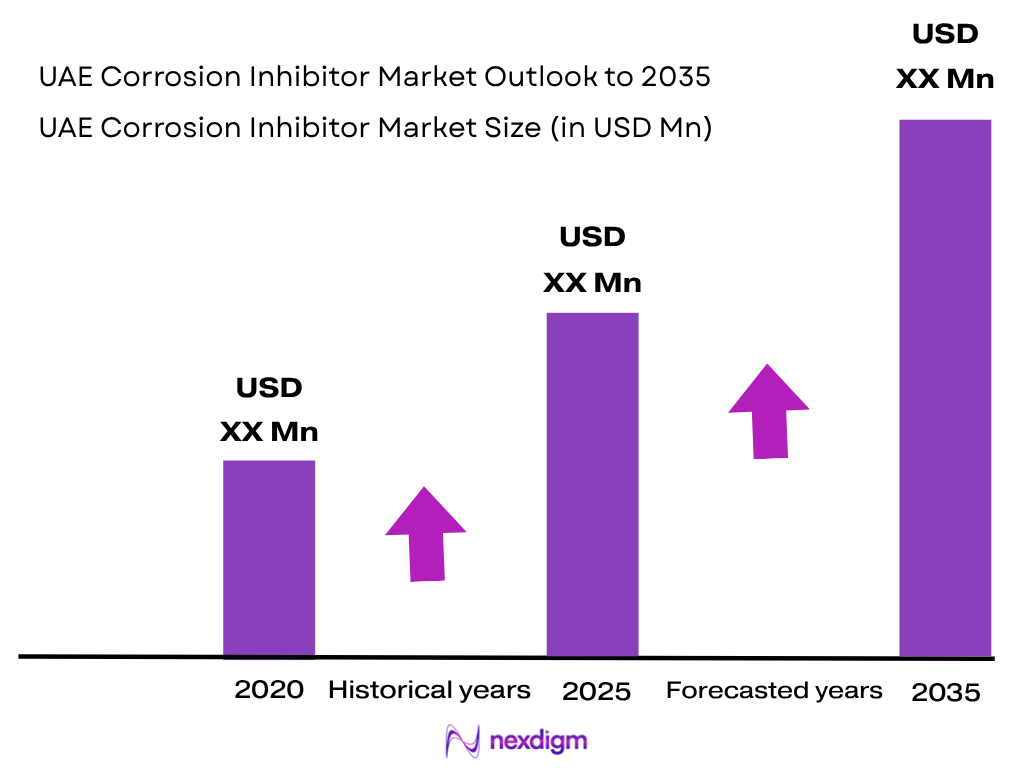
The UAE Corrosion Inhibitor Market is valued at approximately USD ~ billion, based on historical market analysis, with demand anchored by upstream hydrocarbons, gas processing, refining, petrochemicals, desalination and industrial cooling. ADNOC’s oil-production capacity increased from approximately 4.65 million barrels per day to 4.85 million barrels per day, while gas-production capacity remained around 11.5 billion standard cubic feet per day, expanding the asset base requiring corrosion-control chemicals for wells, pipelines and process equipment.
Abu Dhabi and Dubai dominate the UAE Corrosion Inhibitor Market because they concentrate the country’s largest hydrocarbon, desalination, district-cooling and industrial assets. Dubai’s desalinated-water output increased from 143,309 million imperial gallons to 150,478 million imperial gallons, while installed capacity remained 495 million imperial gallons per day. Dubai’s major district-cooling operator also reached 1.76 million refrigeration tons of contracted capacity, reinforcing demand for cooling-water corrosion inhibitors, azoles, phosphonate programs and closed-loop treatment chemicals.
Market Segmentation
By Product Chemistry
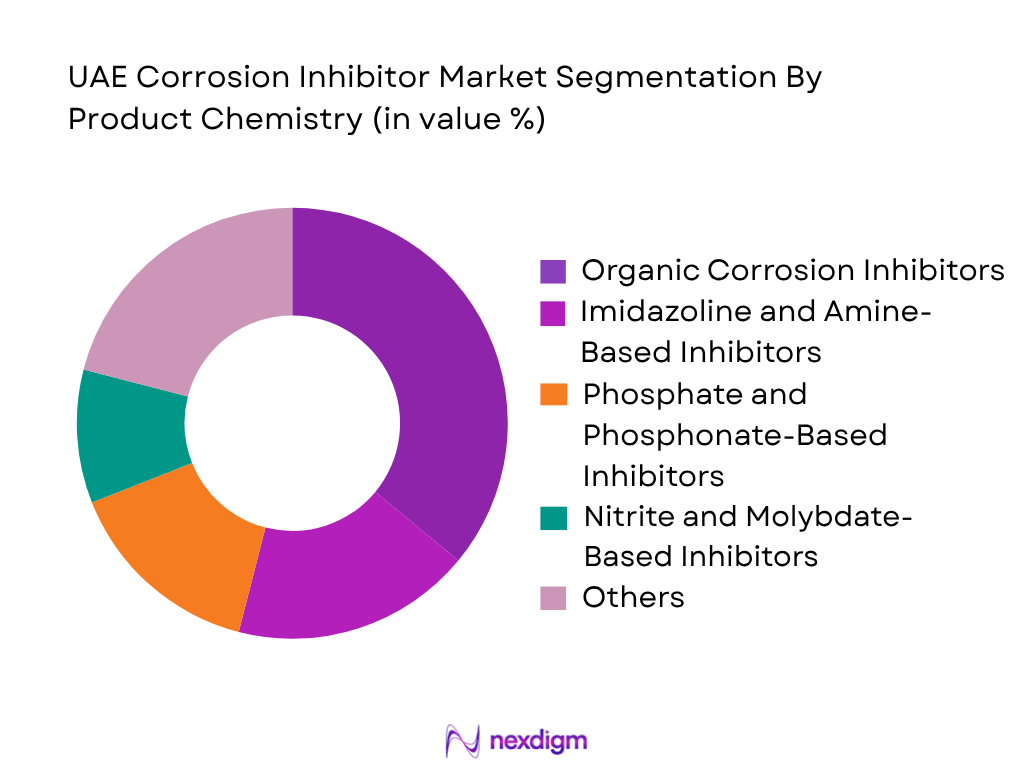
The UAE Corrosion Inhibitor Market is segmented into organic corrosion inhibitors, inorganic corrosion inhibitors, imidazoline-based inhibitors, amine-based inhibitors, phosphate and phosphonate inhibitors, nitrite and molybdate inhibitors, azole-based inhibitors and other specialty formulations. Organic corrosion inhibitors hold the dominant position in the report model because the UAE’s largest corrosion-control applications are concentrated in oil production, gas processing, pipelines and refinery systems where film-forming amines, imidazolines, quaternary compounds and multifunctional organic formulations are widely suited to hydrocarbon-service conditions. These chemicals can adsorb onto metallic surfaces and create protective films that reduce electrochemical attack caused by carbon dioxide, hydrogen sulfide, produced water and chloride-rich process environments. Organic chemistry also offers formulation flexibility for continuous injection, batch treatment and combination corrosion-scale control. Their strong fit with upstream production systems, sour-gas facilities and refinery corrosion programs supports their leading position over more application-specific inorganic chemistries used principally in water-treatment systems.
By End-Use Industry
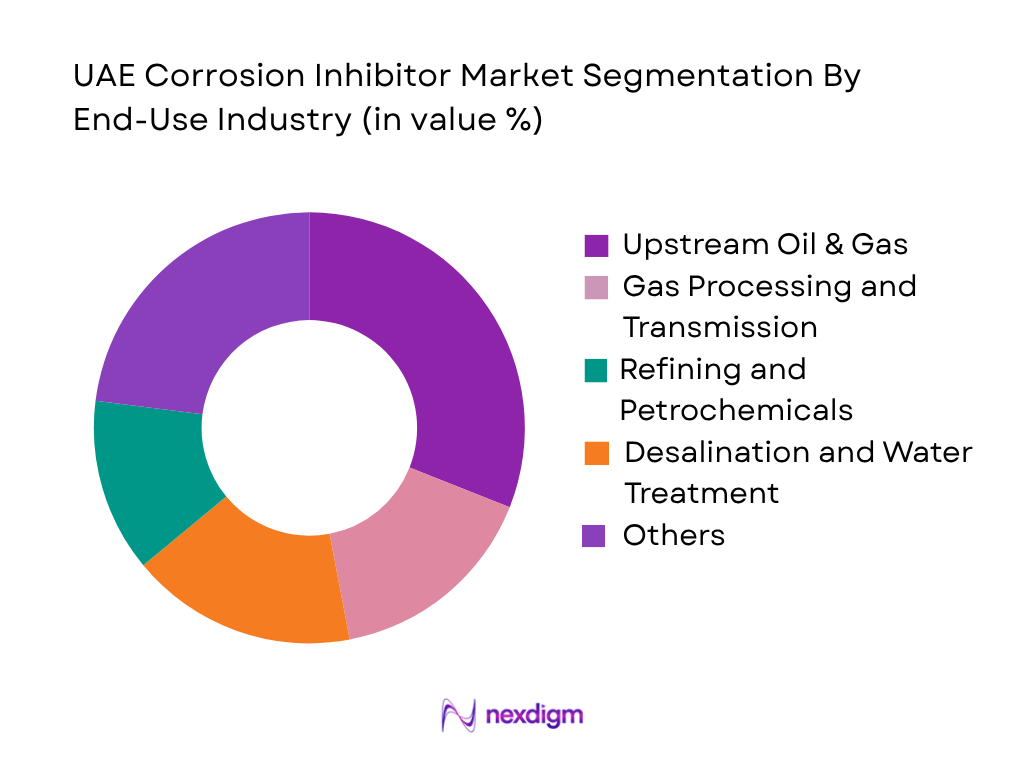
The UAE Corrosion Inhibitor Market is segmented into upstream oil and gas, gas processing and transmission, petroleum refining, petrochemicals and chemicals, desalination and water treatment, power generation, district cooling, construction and other industrial applications. Upstream oil and gas represents the dominant end-use segment because corrosion management is required throughout production tubing, gathering lines, produced-water systems, water-injection systems, flowlines and hydrocarbon pipelines. UAE production environments can involve carbon dioxide, hydrogen sulfide, high salinity, elevated temperature and multiphase fluid flow, creating strong requirements for continuous corrosion-inhibitor injection and field monitoring. Abu Dhabi’s concentration of producing fields and gas-processing infrastructure reinforces recurring chemical consumption rather than one-time product installation. Refining and petrochemicals form another substantial application base through crude-unit overhead protection, heat exchangers, process-water systems and utility networks, while desalination and district cooling create a separate recurring demand pool for closed-loop, cooling-water and copper-alloy corrosion-control formulations.
Competitive Landscape
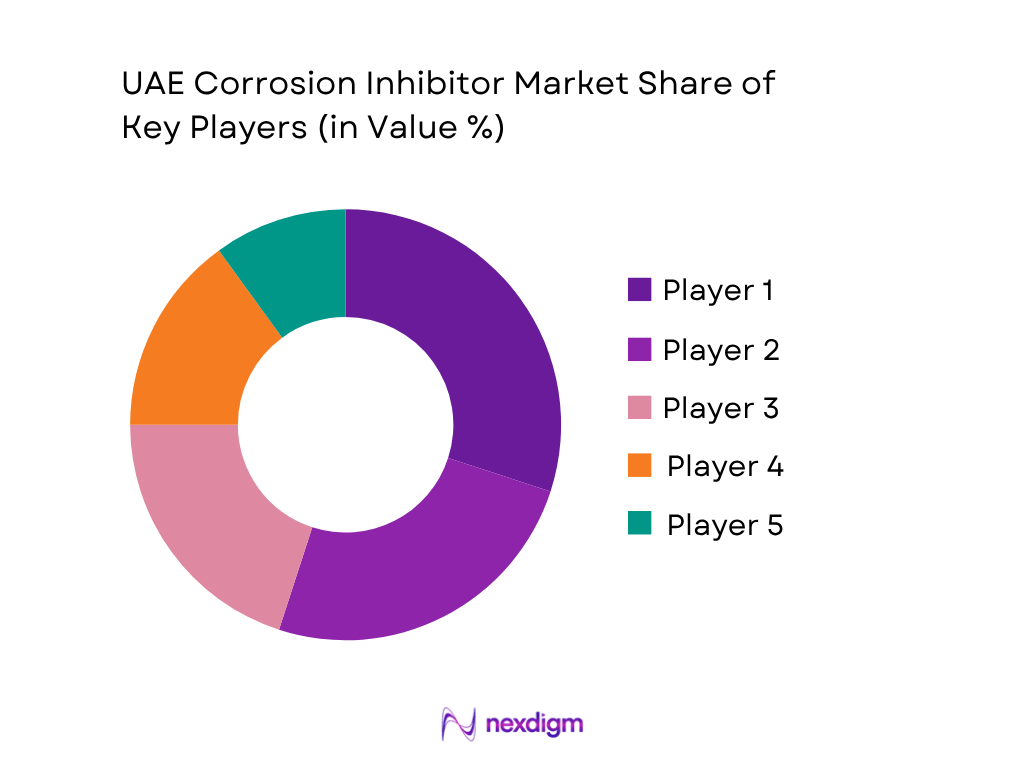
The UAE Corrosion Inhibitor Market features a mix of global oilfield-chemical specialists, industrial water-treatment companies, refinery chemical suppliers and locally established blending operations. Competition is driven less by commodity chemical availability and more by operator qualification, corrosion-performance testing, chemical compatibility, field technical support, dosage optimization and local manufacturing capability. International suppliers maintain strong positions in technically demanding hydrocarbon applications, while UAE-based manufacturing and blending are increasingly important as ADNOC and national industrial programs promote localization of production chemicals and corrosion inhibitors. ADNOC awarded AED 543 million of contracts to nine suppliers for locally manufactured industrial products including corrosion inhibitors, production chemicals and valves, highlighting this procurement direction.
| Company | Establishment Year | Headquarters | Core Corrosion Portfolio | Major UAE Demand Exposure | Oilfield Capability | Water-Treatment Capability | UAE Technical Presence | Digital / Monitoring Capability |
| Nalco Water / Ecolab | 1923 | St. Paul, USA | ~ | ~ | ~ | ~ | ~ | ~ |
| Baker Hughes | 1907 | Houston, USA | ~ | ~ | ~ | ~ | ~ | ~ |
| Clariant Oil Services | 1995 | Muttenz, Switzerland | ~ | ~ | ~ | ~ | ~ | ~ |
| Veolia Water Technologies | 1853 | Paris, France | ~ | ~ | ~ | ~ | ~ | ~ |
| Kurita AquaChemie | 1949 | Tokyo, Japan | ~ | ~ | ~ | ~ | ~ | ~ |
UAE Corrosion Inhibitor Market Analysis
Growth Drivers
Expansion of Oil, Gas and Sour-Gas Processing Infrastructure
The UAE’s hydrocarbon infrastructure is a fundamental growth driver for corrosion inhibitors because wells, production tubing, gathering lines, gas-processing systems, pipelines and process vessels require continuous protection against CO₂, H₂S, produced-water and chloride-induced corrosion. ADNOC reported 35 producing fields in 2024, with oil-production capacity of approximately 4.85 million barrels per day and gas-production capacity of approximately 11.5 billion standard cubic feet per day. The technical severity is particularly evident at the Shah Gas Plant, which handles ultra-sour gas containing more than 23 parts of H₂S per 100 parts of gas and has production capacity of 1.28 billion standard cubic feet per day, alongside 4.2 million tonnes of sulfur per year. These conditions require specialized film-forming amines, imidazoline chemistry, continuous injection programs and corrosion-monitoring systems rather than basic commodity treatment. The World Bank reported UAE GDP at USD 552.32 billion in 2024 and GDP per capita at USD 50,273.5, illustrating the economic scale supporting continued maintenance of energy assets. The combination of large hydrocarbon throughput and technically severe service environments sustains recurring corrosion-inhibitor consumption across upstream and gas-processing operations.
Growing Desalination and District-Cooling Treatment Requirements
Expansion in desalinated-water production and district-cooling infrastructure directly supports UAE corrosion-inhibitor consumption because high-volume water systems contain carbon-steel pipelines, heat exchangers, condensers, cooling towers and mixed-metal networks requiring continuous chemical protection. DEWA reported 150,478 million imperial gallons of desalinated-water production in 2024 compared with 143,309 million imperial gallons in 2023, while installed desalination capacity stood at 495 million imperial gallons per day. Production increased further to 158,359 million imperial gallons in 2025, while average daily demand reached 442.478 million imperial gallons per day. Dubai’s district-cooling infrastructure adds another substantial recurring treatment base: Empower operated 88 district-cooling plants, served 1,637 buildings, maintained more than 418 kilometres of piping, and had connected capacity exceeding 1.57 million refrigeration tons in 2024. Such networks require phosphonate, azole, nitrite, molybdate and other corrosion-control formulations for steel and copper-containing systems. The World Bank recorded UAE GDP of USD 552.32 billion in 2024, supporting continued utility and infrastructure activity. These operating assets create recurring chemical-dosing requirements rather than one-time corrosion-protection demand.
Market Challenges
High Technical Qualification Requirements for Sour and Critical Hydrocarbon Service
The UAE Corrosion Inhibitor Market faces substantial technical barriers because chemicals deployed in sour gas, offshore production and high-pressure hydrocarbon systems must demonstrate film persistence, thermal stability, materials compatibility and dependable performance under aggressive operating conditions. ADNOC’s 2024 upstream network covered 35 producing fields, with approximately 4.85 million barrels per day of oil capacity and 11.5 billion standard cubic feet per day of gas capacity, creating numerous application conditions rather than one standardized treatment environment. Shah Gas Plant further illustrates the challenge: the facility processes more than 1 billion cubic feet per day of ultra-sour gas, with H₂S content exceeding 23 parts per 100, while total stated production capacity reaches 1.28 billion standard cubic feet per day. Chemical suppliers therefore require sophisticated laboratory testing, field validation, corrosion coupons, electrical-resistance monitoring and compatibility assessment with scale inhibitors, demulsifiers and other production chemicals before widespread deployment. The World Bank reported UAE GDP of USD 552.32 billion and GDP per capita of USD 50,273.5 in 2024. This economically significant energy system raises reliability expectations, making qualification cycles and technical-service capability major market-entry hurdles for smaller corrosion-inhibitor formulators.
Dependence on Specialized Inputs and Pressure to Localize Chemical Supply
Dependence on externally sourced specialty chemical inputs remains a structural challenge because high-performance corrosion inhibitors frequently rely on specialized amines, imidazolines, surfactants, phosphonates, solvents and multifunctional active ingredients that require controlled formulation and stringent quality assurance. The scale of localization efforts indicates the importance of strengthening domestic supply. In 2025, ADNOC awarded AED 543 million, equivalent to USD 147.8 million, in contracts to 9 suppliers for UAE-manufactured industrial products including corrosion inhibitors, drilling and production chemicals and valves. ADNOC stated that these contracts were intended to strengthen supply-chain resilience and reduce reliance on imports. Its In-Country Value program had already redirected AED 242 billion into the UAE economy since 2018 when the contracts were announced, demonstrating how strongly local sourcing is being embedded into procurement. For corrosion-inhibitor manufacturers, meeting local-content expectations while maintaining specialty-chemical performance can require investment in blending, laboratory testing, storage, quality control and field-support infrastructure. The World Bank reported UAE GDP at USD 552.32 billion in 2024, while GDP per capita reached USD 50,273.5. The challenge is therefore not lack of industrial demand but establishing technically qualified local supply chains capable of replacing imported specialist formulations without compromising operational performance.
Market Opportunities
Localization of Corrosion Inhibitor Formulation and Production Chemicals
Localization offers a substantial future growth opportunity for the UAE Corrosion Inhibitor Market because current procurement demonstrates measurable demand for domestically manufactured production chemicals and asset-integrity products. ADNOC awarded AED 543 million in contracts to 9 suppliers in 2025 for locally manufactured products that explicitly included corrosion inhibitors and drilling and production chemicals. The same announcement reported that ADNOC’s In-Country Value program had redirected AED 242 billion into the UAE economy since its launch, establishing an operating procurement framework that rewards domestic industrial capability. This creates room for UAE-based formulators to expand local blending of oil-soluble and water-soluble corrosion inhibitors, imidazoline systems, neutralizing amines and multifunctional corrosion-scale formulations while developing laboratory and field-service capabilities close to major customers. The opportunity is reinforced by the underlying hydrocarbon asset base: ADNOC operated 35 producing fields with approximately 4.85 million barrels per day of oil-production capacity and 11.5 billion standard cubic feet per day of gas-production capacity in 2024. World Bank data place UAE GDP at USD 552.32 billion in 2024. Existing procurement localization and extensive operating assets therefore provide a tangible current foundation from which locally formulated corrosion-control products can expand.
Expansion of Advanced Water-System Corrosion Treatment
The UAE’s existing desalination and district-cooling infrastructure provides a strong platform for future expansion of advanced water-system corrosion inhibitors, particularly phosphate-reduced formulations, azoles, molybdates, closed-loop inhibitors and digitally controlled treatment programs. DEWA produced 150,478 million imperial gallons of desalinated water in 2024 and 158,359 million imperial gallons in 2025 while operating 495 million imperial gallons per day of installed desalination capacity. Average daily water demand reached 442.478 million imperial gallons per day in 2025 compared with 413.865 million imperial gallons per day in 2024, increasing operating intensity across water-production and distribution systems. District cooling provides another current demand foundation: Empower operated 88 plants, served more than 143,000 customers across 1,637 buildings, maintained over 418 kilometres of network piping, and had more than 1.57 million refrigeration tons of connected capacity in 2024. These assets expose carbon steel, copper alloys and mixed-metal components to continuous circulating-water conditions, creating opportunities for sophisticated corrosion monitoring and dosing optimization. World Bank data place UAE GDP at USD 552.32 billion in 2024, supporting continued utility-sector capability and investment in reliable water infrastructure.
Future Outlook
The UAE Corrosion Inhibitor Market is forecast to grow at approximately ~X.X% CAGR during 2026-2035, supported by continued hydrocarbon production, sour-gas development, refinery and petrochemical asset integrity requirements, desalination, district-cooling expansion and industrial localization. Demand is expected to move increasingly toward higher-performance film-forming chemistry, multifunctional corrosion-scale inhibitors, lower-toxicity formulations and automated dosing systems.
Future competition will increasingly depend on a supplier’s ability to provide not only chemicals but also corrosion monitoring, field testing, dosage optimization, digital treatment management and local technical support. UAE industrial procurement is also shifting toward domestic manufacturing. ADNOC’s local procurement awards covering corrosion inhibitors and production chemicals demonstrate that companies with UAE formulation, blending and testing capability may gain a stronger position in major energy-sector contracts.
Major Players
- Nalco Water / Ecolab
- Baker Hughes
- Clariant Oil Services
- SLB / ChampionX Production Chemicals
- Veolia Water Technologies
- Kurita AquaChemie
- Italmatch Chemicals
- Dorf Ketal Energy Services
- Innospec Oilfield Services
- Thermax Chemicals
- Metito
- Cortec Middle East
- Sika UAE
- Solenis
- BASF
Key Target Audience
- Oilfield Production Chemical Manufacturers and Formulators
- Oil & Gas Operators, Refinery and Petrochemical Companies
- Industrial Water-Treatment and Desalination Chemical Suppliers
- District Cooling, Power Generation and Utility Operators
- Chemical Distributors, Blenders and Industrial Specialty Chemical Manufacturers
- Investments and Venture Capitalist Firms
- Private Equity Firms, Strategic Investors and Industrial Conglomerates
- Government and Regulatory Bodies (Ministry of Industry and Advanced Technology, Ministry of Energy and Infrastructure, Abu Dhabi Department of Energy, Environment Agency – Abu Dhabi, Dubai Municipality)
Research Methodology
Step 1: Identification of Key Variables
The initial phase involves constructing an ecosystem map of the UAE Corrosion Inhibitor Market covering specialty chemical producers, local blenders, distributors, oilfield service companies, industrial water-treatment suppliers and major end users. Secondary research identifies critical variables including hydrocarbon production capacity, pipeline infrastructure, refinery operations, desalinated-water output, district-cooling capacity, chemical dosage requirements, local manufacturing and import dependence.
Step 2: Market Analysis and Construction
Historical market demand is evaluated using both top-down and bottom-up methods. The top-down model assesses corrosion-inhibitor consumption across oil and gas, refining, petrochemicals, desalination, cooling-water systems and industrial utilities. The bottom-up model examines supplier revenues, customer procurement, estimated application volumes, chemical injection frequency, dosage requirements, local manufacturing output and import flows to construct product- and end-user-level market estimates.
Step 3: Hypothesis Validation and Expert Consultation
Market hypotheses are validated through structured interviews with corrosion specialists, oilfield chemical suppliers, water-treatment companies, refinery personnel, procurement teams, distributors and industrial operators. These discussions validate inhibitor chemistry preferences, field dosage practices, operator qualification requirements, local-versus-imported supply, corrosion-monitoring practices, chemical compatibility and competitive positioning across hydrocarbon and industrial water applications.
Step 4: Research Synthesis and Final Output
The final stage triangulates primary findings with company information, government industrial data, energy infrastructure, utility statistics and application-level corrosion requirements. Top-down consumption estimates are reconciled against bottom-up supplier and end-user calculations. The resulting framework establishes market size, product segmentation, end-use demand, competitive structure, key growth drivers, challenges, emerging opportunities and the long-term outlook for the UAE Corrosion Inhibitor Market.

- Executive Summary
- Research Methodology (Market Definition and Scope, UAE Corrosion Inhibitor Market Classification, Oilfield Corrosion Inhibitor Demand Assessment, Refinery and Petrochemical Corrosion Control Mapping, Cooling Water and Boiler Treatment Demand Assessment, Desalination Corrosion Inhibitor Consumption Mapping, Construction Corrosion Protection Assessment, Domestic Corrosion Inhibitor Blending Capacity Assessment, Import Dependency Analysis, Amine Imidazoline Phosphonate Azole Nitrite and Molybdate Raw Material Assessment)

- Definition and Scope
- UAE Corrosion Inhibitor Industry Evolution and Development of Oilfield Production Chemicals, Refinery Corrosion Control, Industrial Water Treatment, Desalination Chemicals and Reinforced Concrete Corrosion Protection Ecosystem
- Organic Corrosion Inhibitor, Inorganic Corrosion Inhibitor, Film-Forming Amine, Imidazoline, Phosphonate, Azole, Nitrite, Molybdate and Vapor-Phase Corrosion Inhibitor Industry Structure
- UAE Corrosion Inhibitor Value Chain Analysis
- UAE Corrosion Inhibitor Supply Chain Analysis
- Specialty Chemical Feedstock Supplier, Active Ingredient Producer, Chemical Formulator, Local Blender, Oilfield Chemical Service Company, Distributor, EPC Contractor, Chemical Injection System Provider, Corrosion Monitoring Company and Industrial End-User Ecosystem Analysis
- Corrosion Inhibitor Integration Across Upstream Oil and Gas, Gas Processing, Pipelines, Refineries, Petrochemicals, Power Generation, Desalination, District Cooling, Industrial Water Treatment, Construction, Marine and Manufacturing Applications

- Growth Drivers (Large Upstream Oil and Gas Production Asset Base, Expansion of Sour Gas Processing Infrastructure, Extensive Hydrocarbon Pipeline Network, Refinery and Petrochemical Asset Integrity Requirements, High Desalinated Water Production, Expansion of District Cooling Infrastructure, Industrial Cooling Water Treatment Demand, High Chloride and Salinity Exposure, Increasing Focus on Equipment Reliability and Corrosion Monitoring)
- Market Challenges (Dependence on Imported Specialty Active Ingredients, Stringent Oilfield Chemical Qualification Requirements, High Temperature Pressure and Sour-Service Operating Conditions, Chemical Compatibility Requirements with Scale Inhibitors and Biocides, Variable Produced Water Chemistry, Long Operator Approval Cycles, Environmental Discharge Compliance, Competition from Cathodic Protection and Corrosion-Resistant Alloys, Continuous Field Performance Validation Requirements)
- Market Opportunities (Localization of Oilfield Corrosion Inhibitor Formulation, ADNOC Production Chemical Localization, High-Pressure Sour Gas Corrosion Control, Produced Water and Water Injection Treatment, Refinery Overhead Corrosion Programs, Desalination Asset Protection, District Cooling Corrosion Control, Phosphorus-Free Cooling Water Inhibitors)
- Market Trends (Imidazoline and Amine Film-Forming Inhibitors, Multifunctional Corrosion and Scale Inhibitors, Non-Phosphate Cooling Water Programs, Smart Chemical Dosing, Online Corrosion Monitoring, High-Temperature Sour-Service Chemistry, Low-Toxicity Formulations, Locally Blended Oilfield Chemicals, Digital Chemical Management)
- Regulatory and Standards Landscape (ADNOC Production Chemical Qualification Requirements, ADNOC In-Country Value Requirements, Ministry of Industry and Advanced Technology Industrial Product Requirements, UAE Chemical Management Requirements, Occupational Health and Chemical Handling Requirements)
- SWOT Analysis
- Porter’s Five Forces Analysis
- PESTLE Analysis
- Stakeholder Ecosystem
- Competition Ecosystem

- By Market Value (2020-2025)
- By Corrosion Inhibitor Consumption Volume (2020-2025)
- By Oil and Gas Corrosion Inhibitor Consumption Volume (2020-2025)
- By Refinery and Petrochemical Corrosion Inhibitor Consumption Volume (2020-2025)
- By Industrial Water Treatment Corrosion Inhibitor Consumption Volume (2020-2025)
- By Desalination Corrosion Inhibitor Consumption Volume (2020-2025)
- By Domestic Corrosion Inhibitor Production and Blending Volume (2020-2025)
- By Corrosion Inhibitor Import Value (2020-2025)
- By Average Selling Price (2020-2025)

- By Product Chemistry (In Value %)
Organic Corrosion Inhibitors
Inorganic Corrosion Inhibitors
Imidazoline-Based Corrosion Inhibitors
Amine-Based Corrosion Inhibitors
Quaternary Ammonium Compound-Based Inhibitors
Phosphate and Phosphonate-Based Inhibitors
Nitrite-Based Corrosion Inhibitors
Molybdate-Based Corrosion Inhibitors
Silicate-Based Corrosion Inhibitors
Zinc-Based Corrosion Inhibitors
Azole-Based Corrosion Inhibitors
Volatile and Vapor-Phase Corrosion Inhibitors
Organic Acid and Carboxylate-Based Inhibitors
Multifunctional Corrosion and Scale Inhibitor Formulations - By Corrosion Inhibition Mechanism (In Value %)
Anodic Corrosion Inhibitors
Cathodic Corrosion Inhibitors
Mixed Corrosion Inhibitors
Film-Forming Corrosion Inhibitors
Passivating Corrosion Inhibitors
Neutralizing Corrosion Inhibitors
Oxygen-Scavenging Corrosion Control Systems
Vapor-Phase Corrosion Inhibitors
Adsorption-Based Corrosion Inhibitors
Combination Corrosion and Scale Inhibitors - By Application System (In Value %)
Production Tubing and Well Systems
Oil and Gas Gathering Lines
Crude Oil and Gas Pipelines
Produced Water Systems
Water Injection Systems
Refinery Crude Unit Overhead Systems
Heat Exchangers
Cooling Towers
Closed Cooling Loops
Boilers and Steam Condensate Systems
Desalination Systems
Storage Tanks
Reinforced Concrete Structures
Metal Components and Equipment Preservation - By End-Use Industry (In Value %)
Upstream Oil and Gas
Gas Processing and Transmission
Petroleum Refining
Petrochemicals and Chemicals
Power Generation
Desalination
District Cooling
Industrial Cooling Water Systems
Boiler and Steam Systems
Marine and Offshore
Construction and Infrastructure
Metalworking and Manufacturing
Fertilizers and Industrial Processing
Food and Beverage Processing - By Emirate (In Value %)
Abu Dhabi
Dubai
Sharjah
Ras Al Khaimah
Fujairah
Ajman
Umm Al Quwain

- Market Share of Major Players (By UAE Revenue, Corrosion Inhibitor Sales Volume, Oilfield Corrosion Inhibitor Sales Volume, Industrial Water Treatment Corrosion Inhibitor Sales Volume, Product Chemistry, End-Use Industry, UAE Manufacturing and Blending Footprint, Technical Service and Corrosion Monitoring Coverage)
- Cross Comparison Parameters (UAE Corrosion Inhibitor Revenue, Oilfield-Water-Refinery Corrosion Inhibitor Portfolio Breadth, CO₂-H₂S-High-Salinity Chemistry Capability, UAE Manufacturing and Chemical Blending Capability, ADNOC and Major Hydrocarbon Customer Qualification Coverage, Desalination-Cooling-Boiler Treatment Capability, Laboratory Field Testing and Digital Corrosion Monitoring Capability, Local Chemical Injection Technical Service and Field Support Footprint)
- SWOT Analysis of Major Players
- Competitive Positioning Matrix
- Corrosion Inhibitor Product and Chemistry Portfolio Benchmarking
- Pricing and Corrosion Inhibitor Category Benchmarking
- Chemical Formulation, Blending and Corrosion Testing Technology Assessment
- End-Use Industry and Critical Corrosion Application Exposure Assessment
- Domestic Manufacturing Versus Imported Corrosion Inhibitor Supply Positioning
- Detailed Profiles of Major Companies
Nalco Water / Ecolab
Baker Hughes
Clariant Oil Services
SLB / ChampionX Production Chemicals
Veolia Water Technologies
Kurita AquaChemie
Italmatch Chemicals
Dorf Ketal Energy Services
Innospec Oilfield Services
Thermax Chemicals
Metito
Cortec Middle East
Sika UAE
Solenis
BASF

- ADNOC and Upstream Operator Corrosion Inhibitor Procurement Assessment
- Gas Processing and Sour Gas Facility Corrosion Control Requirement Analysis
- Crude Oil and Gas Pipeline Chemical Injection Requirement Assessment
- Refinery Corrosion Inhibitor and Neutralizing Amine Procurement Analysis
- Petrochemical Plant Process Corrosion Control Assessment
- Desalination Utility Corrosion Inhibitor Requirement Analysis
- Power Generation Cooling Water and Boiler Treatment Assessment
- District Cooling Operator Corrosion Control Requirement Analysis
- EPC Contractor Corrosion Inhibitor Specification Assessment
- Construction Contractor Reinforcement Corrosion Protection Requirement Assessment

- By Market Value (2026-2035)
- By Corrosion Inhibitor Consumption Volume (2026-2035)
- By Oil and Gas Corrosion Inhibitor Consumption Volume (2026-2035)
- By Refinery and Petrochemical Corrosion Inhibitor Consumption Volume (2026-2035)
- By Industrial Water Treatment Corrosion Inhibitor Consumption Volume (2026-2035)
- By Desalination Corrosion Inhibitor Consumption Volume (2026-2035)
- By Domestic Corrosion Inhibitor Production and Blending Volume (2026-2035)
- By Corrosion Inhibitor Import Value (2026-2035)
- By Average Selling Price (2026-2035)


 Request a Sample
 Ask for Customization
 Get a Quote
 Enquire Now