
 Download PDF
Market Overview
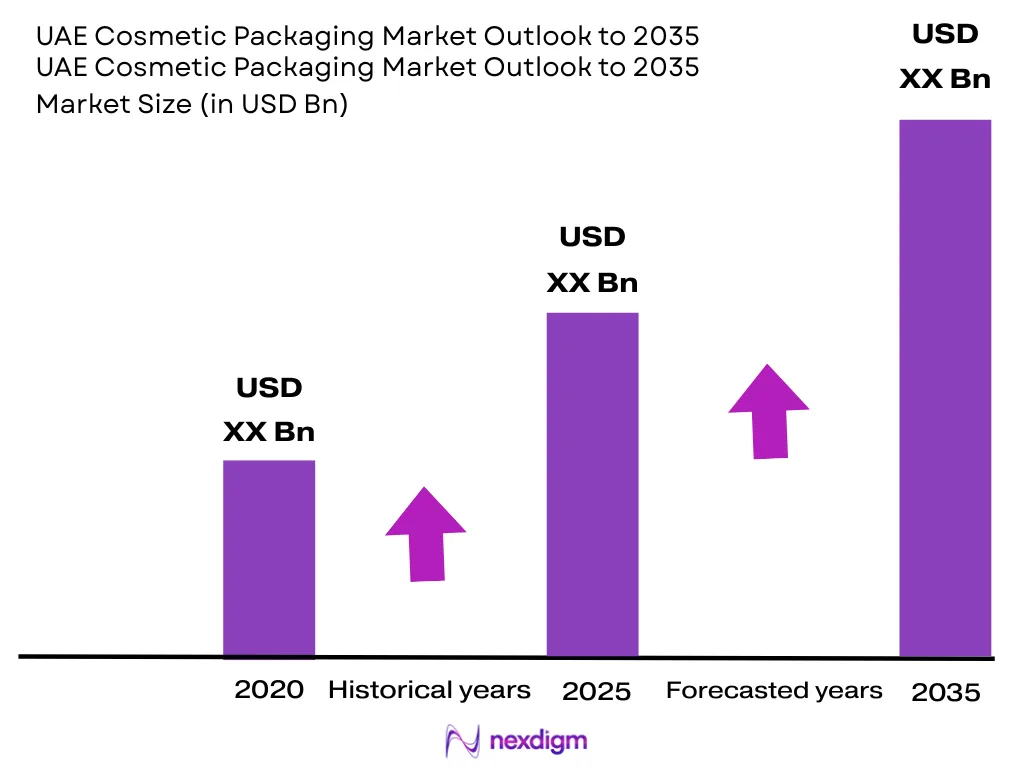
The UAE Cosmetic Packaging Market was valued at USD ~ Billion in 2024 and is anticipated to expand at a CAGR of ~% during 2026–2035. The market is primarily driven by Dubai’s position as a regional beauty, duty-free retail, and re-export hub, rising demand for luxury and premium packaging formats, and continued growth of the UAE’s private label and contract cosmetics manufacturing base. The UAE’s broader beauty and personal care market was valued at approximately USD ~ billion in 2025 and is projected to reach USD ~ billion by 2031, reflecting sustained consumer appetite for premium skincare, fragrance, and color cosmetics products. All cosmetics sold in the UAE, whether imported or locally manufactured, must obtain a Certificate of Conformity under the Ministry of Industry and Advanced Technology’s (MoIAT) Emirates Conformity Assessment Scheme (ECAS) and register with the relevant emirate-level authority, such as Dubai Municipality’s Montaji electronic portal, creating a packaging and labeling compliance environment that shapes product development across the country’s fast-growing beauty manufacturing and import sector.
Market Segmentation
By Packaging Tier
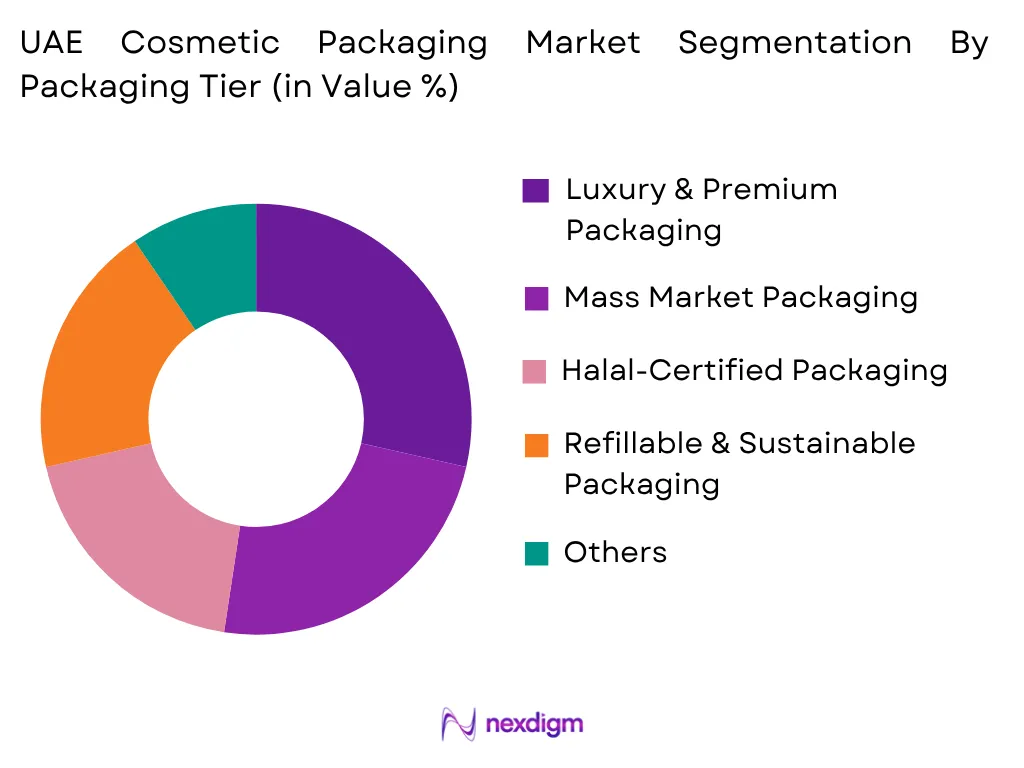
Luxury & Premium Packaging commands a distinctly large share of the UAE Cosmetic Packaging Market relative to other regional markets, reflecting the UAE’s reputation as a luxury retail destination where consumers place strong value on high-quality materials, sleek design, and prestige brand positioning; this dynamic leads UAE-focused cosmetics brands to prioritize premium packaging that exudes sophistication and elegance well beyond what price-sensitive mass markets typically demand. Halal-Certified Packaging represents a distinctive and growing category shaped by the UAE’s cultural and religious context, with several UAE-based contract manufacturers, including Sharjah-based makeup producer Elegance, explicitly offering halal-certified formulations and packaging to serve both domestic and wider GCC and African export markets. Refillable & Sustainable Packaging remains a smaller but fast-growing category, propelled by rising consumer awareness of eco-friendly and vegan-aligned beauty products and by contract manufacturers such as Rūt Essentials that have built their positioning specifically around biodegradable materials and sustainable packaging design.
By Product Category
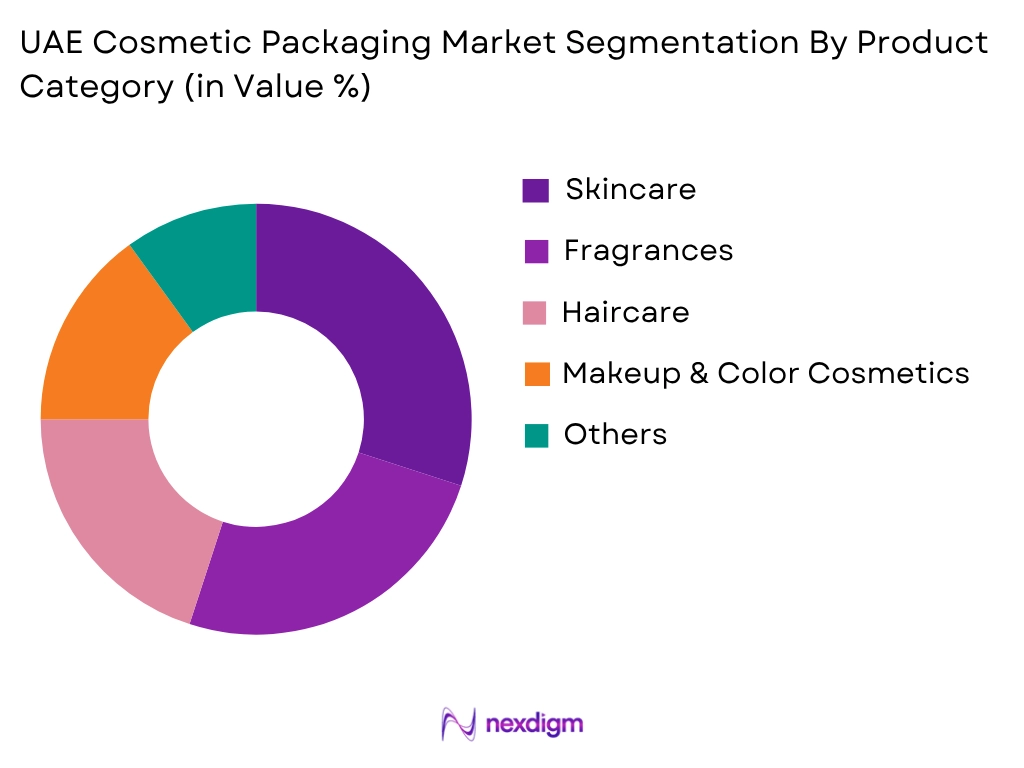
Skincare and Fragrances together represent the largest product categories in the UAE Cosmetic Packaging Market, consistent with the country’s strong culture of perfume and skincare consumption and its historical role as a global fragrance trading hub. Sharjah-based Swiss Perfume Industries, a contract manufacturer specializing in perfumes, body sprays, and deodorants, illustrates the depth of fragrance-focused manufacturing capability concentrated in the UAE, which serves both domestic demand and broader regional export markets. Makeup & Color Cosmetics and Haircare categories are also well represented among the UAE’s private label and contract manufacturing base, with companies such as Unicare, a Dubai-based global private label manufacturer with a workforce of more than 500 professionals serving brands across more than 120 countries, illustrating the scale at which UAE-based cosmetics manufacturers now operate as manufacturing and packaging partners for international beauty brands.
Competitive Landscape
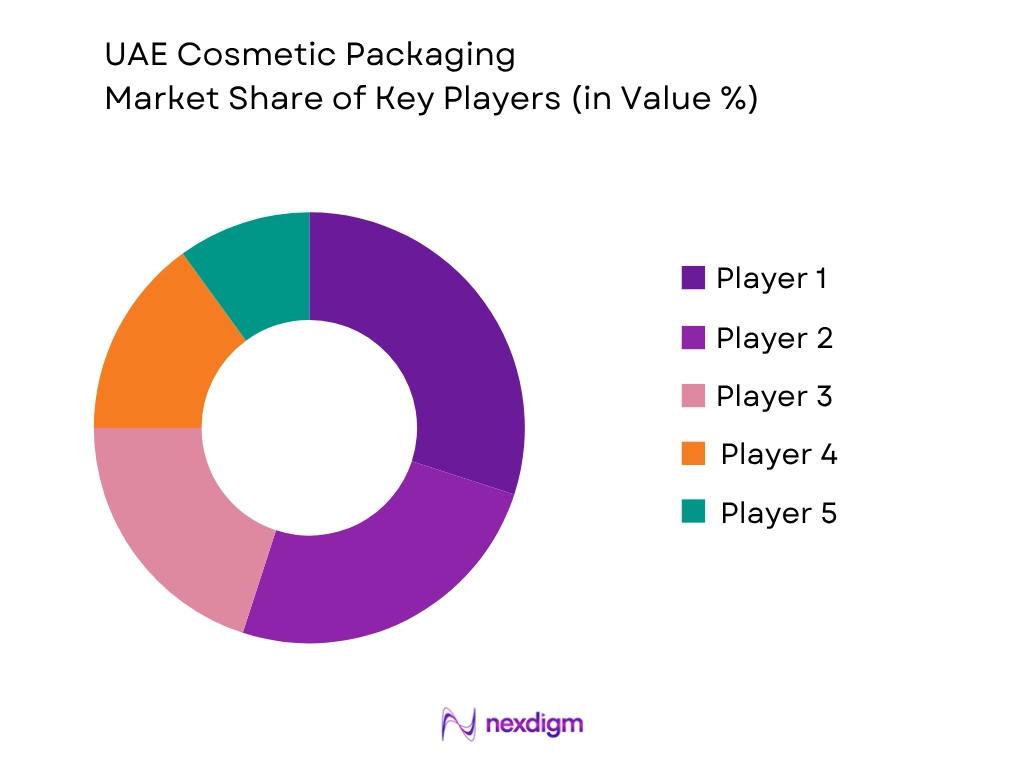
The UAE Cosmetic Packaging Market is shaped by a distinctive concentration of private label and contract manufacturers based in Dubai and Sharjah, alongside global luxury packaging specialists and dispensing technology majors serving the country’s premium retail and re-export trade. Elegance, founded in 2012 and based in Sharjah, has built a focused position in liquid and stick foundation manufacturing, including halal-certified formulations targeting UAE, wider GCC, and African markets, while Unicare, based in Dubai with more than 500 employees, has scaled into a global private label cosmetics manufacturer serving brands across more than 120 countries with integrated formulation, production, and packaging capability. Sharjah’s SAIF Zone and broader free zone ecosystem have attracted a cluster of specialized manufacturers, including fragrance-focused Swiss Perfume Industries and dedicated packaging suppliers such as Trendz Packaging Solutions FZE. Global luxury packaging specialists including HCP Packaging and Quadpack, alongside dispensing technology leader AptarGroup, maintain regional sales and distribution relationships to serve prestige beauty brands sold through Dubai’s luxury retail and duty-free channels, competing on premium finish quality, technical dispensing performance, and the ability to navigate MoIAT’s ECAS certification and Dubai Municipality’s Montaji registration requirements.
| Company | Establishment Year | Headquarters | Primary Product Portfolio | Cosmetic Packaging Portfolio
|
Manufacturing Presence | Major End-Use Industries | Key Strategic Focus | Certifications & Compliance |
| Elegance | 2012 | ~ | ~ | ~ | ~ | ~ | ~ | ~ |
| Unicare | 2015 | ~ | ~ | ~ | ~ | ~ | ~ | ~ |
| Swiss Perfume Industries | 2008 | ~ | ~ | ~ | ~ | ~ | ~ | ~ |
| Trendz Packaging Solutions FZE | 2010 | ~ | ~ | ~ | ~ | ~ | ~ | ~ |
| AptarGroup | 1992 | ~ | ~ | ~ | ~ | ~ | ~ | ~ |
UAE Cosmetic Packaging Market Analysis
Growth Drivers
Growth of Dubai as a Regional Beauty, Luxury Retail and Re-Export Hub
The UAE cosmetic packaging market is benefiting substantially from Dubai’s established position as a regional luxury retail, duty-free, and re-export hub for the wider Gulf Cooperation Council and broader Middle East and Africa region. The UAE’s beauty and personal care market, valued at approximately USD 3.29 billion in 2025 and projected to reach USD 4.68 billion by 2031, is underpinned by a cosmopolitan consumer base that places outsized value on premium packaging quality, sleek design, and prestige brand positioning, encouraging both multinational and regional beauty brands to prioritize higher-specification packaging materials and finishes than in many comparable markets. Dubai and Sharjah’s free zone ecosystem, including Sharjah’s SAIF Zone, has attracted a growing cluster of private label and contract cosmetics manufacturers such as Unicare, which now serves brands across more than 120 countries from its Dubai facility, reinforcing the UAE’s role not only as a consumption market but as a regional manufacturing and packaging hub serving export markets across Africa and the wider Middle East.
Rising Demand for Halal-Certified and Culturally Aligned Packaging
The UAE’s cultural and religious context continues to shape distinctive demand for halal-certified cosmetics and packaging, with UAE-based contract manufacturers including Sharjah’s Elegance explicitly producing halal-certified makeup formulations to serve both domestic consumers and export markets across the wider GCC and African regions where similar religious and cultural preferences apply. This dynamic is reinforced by growing consumer awareness of eco-friendly and vegan-aligned beauty products across the UAE market, with several private label manufacturers, including Rūt Essentials, building differentiated positioning around biodegradable materials and sustainable packaging design. As regional demand for culturally aligned, halal-certified beauty products continues to grow across the Middle East and Africa, UAE-based manufacturers with established halal certification capability are well positioned to capture increasing packaging and contract manufacturing volume from brands seeking to serve these markets.
Market Challenges
Complex Multi-Emirate Registration and Compliance Requirements
Cosmetic brands and packaging suppliers operating in the UAE must navigate a layered regulatory structure spanning federal-level MoIAT ECAS certification and emirate-specific registration requirements, such as Dubai Municipality’s Montaji portal, which mandates that products be registered through a locally based distributor before they can be legally sold within Dubai’s market. This dual federal-and-emirate compliance structure, further complicated by the involvement of the Ministry of Health and Prevention (MOHAP) for products bordering on medical or therapeutic claims, creates meaningful administrative complexity for brands and packaging suppliers, particularly smaller or newly established companies seeking to enter the UAE market without dedicated regulatory affairs expertise. Given the extreme complexity of these procedures and their continual legislative updates, many brands find that entering the UAE market independently poses significant risk without professional regulatory support.
Import Dependency for Packaging Materials and Premium Components
The UAE’s arid climate and limited domestic petrochemical and glass manufacturing base for cosmetic-grade applications mean that the substantial majority of plastic resin, glass, and premium packaging components used in UAE cosmetic packaging are imported, exposing brands and manufacturers to global commodity price volatility and shipping cost fluctuations. This import dependency is particularly pronounced for the luxury and premium packaging segment, where UAE consumers’ strong preference for high-quality materials and prestige finishes requires sourcing specialized components and decoration technology from established international suppliers. Currency fluctuations and regional logistics disruptions can materially affect landed costs for these imported materials, creating margin pressure for UAE-based private label and contract manufacturers competing on both quality and price within the region’s fast-growing but increasingly competitive private label manufacturing sector.
Market Opportunities
Localization of Premium Packaging Manufacturing
The UAE’s growing base of private label and contract cosmetics manufacturers, concentrated in Dubai and Sharjah’s free zones, creates a clear opportunity for packaging suppliers to establish local manufacturing and finishing capability rather than relying solely on imported premium components. As UAE-based manufacturers such as Unicare and Elegance continue to scale their contract manufacturing operations to serve brands across the GCC, Africa, and beyond, packaging suppliers that can offer locally produced or regionally sourced premium bottles, closures, and decoration services stand to capture growing demand while reducing the lead times and currency exposure associated with importing finished packaging components from Europe and Asia.
Expansion of Halal-Certified and Sustainable Packaging for Regional Export
The UAE’s established halal certification infrastructure and growing base of contract manufacturers already producing halal-certified cosmetics position the country to become a regional hub for halal-certified and sustainably packaged beauty products serving the broader Middle East and Africa region. As global and regional beauty brands increasingly seek differentiated, culturally aligned, and sustainability-forward packaging to serve GCC and African export markets, UAE-based manufacturers and packaging suppliers that combine halal certification capability with refillable or recyclable packaging design are well positioned to capture premium positioning with brands seeking a single regional manufacturing partner capable of serving multiple market requirements simultaneously.
Future Outlook
The UAE Cosmetic Packaging Market is expected to witness sustained expansion over the forecast period, supported by continued growth of Dubai and Sharjah’s private label and contract manufacturing base, sustained consumer demand for luxury and premium packaging formats, and the UAE’s deepening role as a regional beauty and re-export hub serving the GCC and broader Middle East and Africa region. Growing investment in halal-certified and sustainable packaging capability, alongside continued regulatory harmonization under GSO standards and MoIAT’s ECAS framework, will further accelerate demand for compliant, premium packaging solutions. The market is also likely to benefit from the UAE’s growing appeal as a regional manufacturing base, as global and regional beauty brands increasingly look to Dubai and Sharjah-based contract manufacturers to serve both the domestic luxury retail market and broader regional export opportunities.
Major Players
- Elegance
- Unicare
- Swiss Perfume Industries
- Trendz Packaging Solutions FZE
- AptarGroup
- Softcare Cosmetics
- L’Origine
- Costenaro Cosmetics
- NG Beauty World
- Mahloran
- HCP Packaging
- Quadpack
- Albea Group
- Berry Global
- Amcor plc
Key Target Audience
- Cosmetic Packaging Manufacturers and Converters
- Luxury and Prestige Beauty Brands
- Private Label and Contract Manufacturers
- Fragrance Houses and Halal Cosmetics Manufacturers
- Duty-Free and Luxury Retail Operators
- Investment and Venture Capitalist Firms
- Government and Regulatory Bodies (Ministry of Industry and Advanced Technology – MoIAT, Dubai Municipality, Ministry of Health and Prevention – MOHAP)
- Raw Material Suppliers and Packaging Material Distributors
Research Methodology
Step 1: Identification of Key Variables
The research process begins with identifying the complete ecosystem of the UAE Cosmetic Packaging Market, including raw material suppliers, packaging converters, private label and contract manufacturers, brand owners, retailers, and regulatory authorities. Extensive secondary research is conducted using company reports, government publications, trade associations, customs statistics, industry journals, and proprietary databases to determine the variables influencing market demand, pricing, production, consumption, and technological developments.
Step 2: Market Analysis and Construction
Historical market information is collected and analyzed to estimate market size, import volumes, product-wise demand, and pricing trends. A combination of top-down and bottom-up approaches is used to estimate market revenues and validate segment-level performance. Consumption patterns across skincare, fragrances, makeup, haircare, and personal care categories are evaluated to establish an accurate representation of the industry.
Step 3: Hypothesis Validation and Expert Consultation
The preliminary findings are validated through Computer-Assisted Telephone Interviews (CATIs) and structured discussions with packaging converters, procurement managers, regulatory affairs specialists, brand executives, and senior professionals operating within the UAE beauty and packaging industry. These interviews help verify market assumptions, competitive developments, technology adoption trends, pricing dynamics, and future investment opportunities while refining the overall market estimates.
Step 4: Research Synthesis and Final Output
The final stage integrates insights obtained from primary interviews with quantitative information collected through secondary sources. Data triangulation techniques are applied to reconcile differences between supply-side and demand-side estimates, ensuring robust market forecasting. The report is then reviewed through multiple quality assurance checkpoints to deliver a comprehensive analysis covering market size, segmentation, competitive landscape, future outlook, and strategic recommendations for industry stakeholders.

- Executive Summary
- Research Methodology (Market Definitions and Assumptions, Abbreviations, Market Sizing Approach, Top-Down Analysis, Bottom-Up Analysis, Demand-Side Assessment, Supply-Side Assessment, Primary Industry Interviews, Secondary Research Validation, Data Triangulation, Forecasting Framework, Limitations and Future Conclusions)

- Definition and Scope
- Market Evolution and Industry Genesis
- Timeline of Major Industry Developments
- Cosmetic Packaging Industry Value Chain Analysis
- Supply Chain Analysis

- Growth Drivers (Growth of Dubai as a Regional Beauty and Re-Export Hub, Rising Demand for Luxury and Premium Packaging, Growth of Halal-Certified Cosmetics, Expansion of Private Label and Contract Manufacturing, Rising Tourism and Duty-Free Retail Demand, Regulatory Harmonization Under GSO Standards)
- Market Challenges (Complex Multi-Emirate Registration Requirements, Import Dependency for Packaging Materials and Components, High Cost of Premium and Sustainable Packaging Materials, Counterfeit and Grey Market Product Risk, Currency and Logistics Cost Volatility, Limited Domestic Glass and Resin Manufacturing Capacity)
- Market Opportunities (Localization of Premium Packaging Manufacturing, Growth in Halal-Certified and Sustainable Packaging, Expansion of Private Label Manufacturing for Regional Export, Smart and Refillable Packaging Innovation, Public-Private Sustainability Partnerships, Regional GCC Export Hub Development)
- Market Trends (Rise of Premium and Minimalist Luxury Design, Growth of Halal-Certified Packaging Formats, Increasing Adoption of Refillable and Sustainable Packaging, Growth of Private Label and Indie Brand Packaging, Smart Packaging and Digital Authentication Features, Growing Demand for Eco-Friendly and Vegan-Aligned Packaging)
- Government Regulations (MoIAT Emirates Conformity Assessment Scheme (ECAS), Dubai Municipality Montaji Registration System, GSO 1943 Cosmetic Product Standards, Ministry of Health and Prevention (MOHAP) Requirements, Halal Certification Requirements, UAE National Bioeconomy Strategy Sustainability Alignment)
- Import and Export Analysis (Trade Volume, Major Import Sources, Re-Export Trade Flows, HS Code Analysis, Trade Balance)
- Raw Material Availability Analysis (Imported Plastic Resin Feedstocks, Imported Glass and Premium Component Feedstocks, Imported Aluminum and Metal Feedstocks, Regional GCC Petrochemical Supply Chain Access, Sustainable and Recycled Material Feedstocks)
- Technology Landscape (Injection Molding and Blow Molding Technology, Airless and Refillable Dispensing Systems, Premium Finishing and Decoration Technology, Smart Packaging and Digital Authentication, Sustainable Material Innovation)
- Sustainability Assessment (Recyclable and Refillable Packaging Adoption, Carbon Footprint Reduction in Import Logistics, Sustainable Material Sourcing Initiatives, Waste Reduction in Luxury Packaging, Circular Economy Alignment)
- PESTLE Analysis
- SWOT Analysis
- Porter’s Five Forces Analysis
- Stakeholder Ecosystem
- Competition Ecosystem

- By Market Value (2020-2025)
- By Volume Consumption (2020-2025)
- By Average Selling Price (2020-2025)

- By Material (In Value %)
Plastic (PP, PE, PET)
Glass
Aluminum & Metal
Paperboard & Paper
Bioplastics & Sustainable Alternatives - By Packaging Type (In Value %)
Bottles & Jars
Tubes
Compacts & Palettes
Sachets & Pouches
Caps, Closures & Dispensers - By Product Category (In Value %)
Skincare
Fragrances
Makeup & Color Cosmetics
Haircare
Personal Care & Toiletries - By Packaging Tier (In Value %)
Luxury & Premium Packaging
Mass Market Packaging
Halal-Certified Packaging
Refillable & Sustainable Packaging - By Region (In Value %)
Dubai
Abu Dhabi
Sharjah
Northern Emirates

- Market Share of Major Players (By Value, Volume, Material Type, Product Category, End User)
- Cross Comparison Parameters (Luxury/Premium Portfolio Breadth, Halal Certification Capability, Sustainable Packaging Portfolio, Application Technical Support, Manufacturing Capacity, Regulatory Compliance & Certifications, Customer Base, Innovation & New Product Launch Frequency)
- SWOT Analysis of Major Players
- Pricing Analysis by Product Category and SKU
- Production Capacity Analysis
- Manufacturing Footprint Analysis
- Distribution Network Analysis
- Innovation Benchmarking
- Detailed Profiles of Major Companies
Elegance
Unicare
Swiss Perfume Industries
Trendz Packaging Solutions FZE
AptarGroup
Softcare Cosmetics
L’Origine
Costenaro Cosmetics
NG Beauty World
Mahloran
HCP Packaging
Quadpack
Albea Group
Berry Global
Amcor plc

- Consumption Pattern Analysis (Industrial Usage, Batch Size, Product Category Penetration, Seasonal and Tourism-Linked Demand, Reformulation Activity)
- Purchasing Criteria (Aesthetic and Luxury Appeal, Regulatory Compliance, Cost Efficiency, Halal Certification, Barrier Performance, Refillability)
- Procurement and Supplier Selection Analysis
- Sustainable and Halal-Certified Packaging Adoption Assessment
- Premium vs Mass-Market Packaging Demand
- Product Attribute Preference Analysis (Aesthetic Finish, Dispensing Performance, Material Quality, Tamper Evidence, Recyclability, Brand Differentiation)
- Sustainability & ESG Influence on Procurement Decisions
- Pain Point Analysis
- Decision-Making Process

- By Market Value (2026-2035)
- By Volume Consumption (2026-2035)
- By Average Selling Price (2026-2035)


 Request a Sample
 Ask for Customization
 Get a Quote
 Enquire Now