
 Download PDF
Market Overview
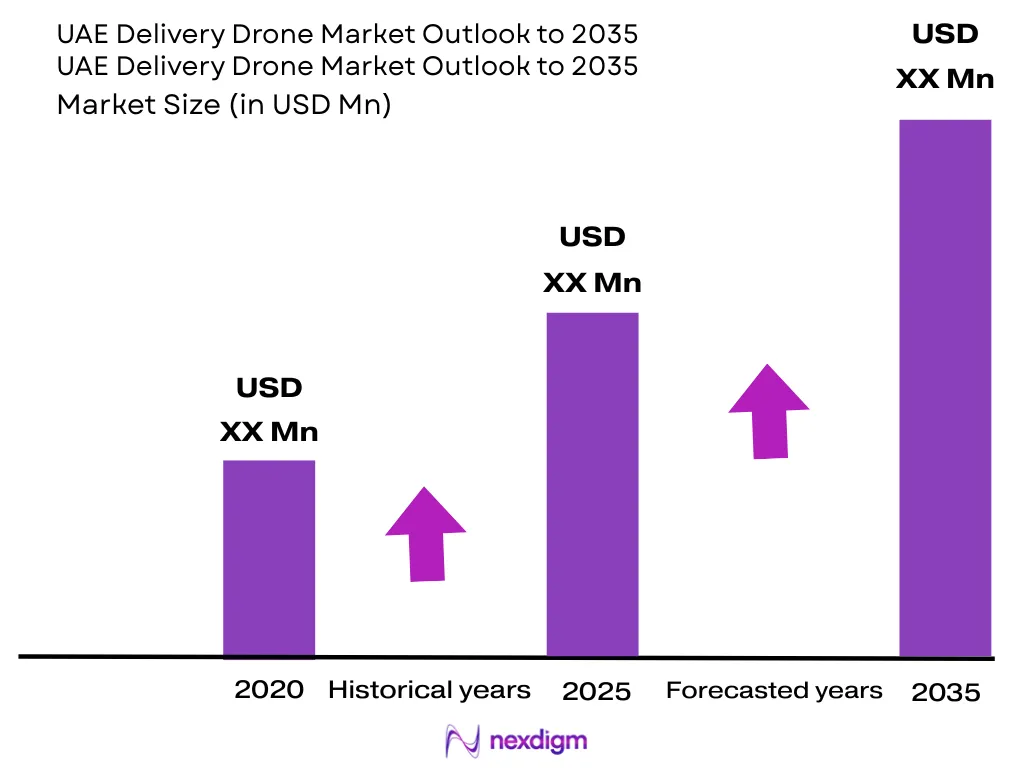
The UAE Delivery Drone Market was valued at USD ~ Million in 2024 and is anticipated to expand at a CAGR of ~% during 2026-2035. The market is primarily driven by the rapid expansion of e-commerce activities, a progressive regulatory framework established by the General Civil Aviation Authority (GCAA), and increasing government investment in autonomous delivery infrastructure under Dubai’s smart city initiatives. The market’s growth trajectory was significantly reinforced when the GCAA authorized the country’s first Beyond Visual Line of Sight (BVLOS) commercial drone delivery license to Keeta Drone, a subsidiary of Meituan, in December 2024, establishing a clear regulatory pathway for commercial aerial logistics. The Dubai Civil Aviation Authority’s ‘Dubai Sky Dome’ initiative and the broader Advanced Air Mobility (AAM) regulatory framework being developed in partnership with the Technology Innovation Institute (TII) and ASPIRE further underscore the UAE’s ambition to position itself as a global hub for drone delivery and urban air mobility, with drone delivery expansion targets set at 30% of Dubai by 2026 and 70% within five years.
Market Segmentation
By Platform Type
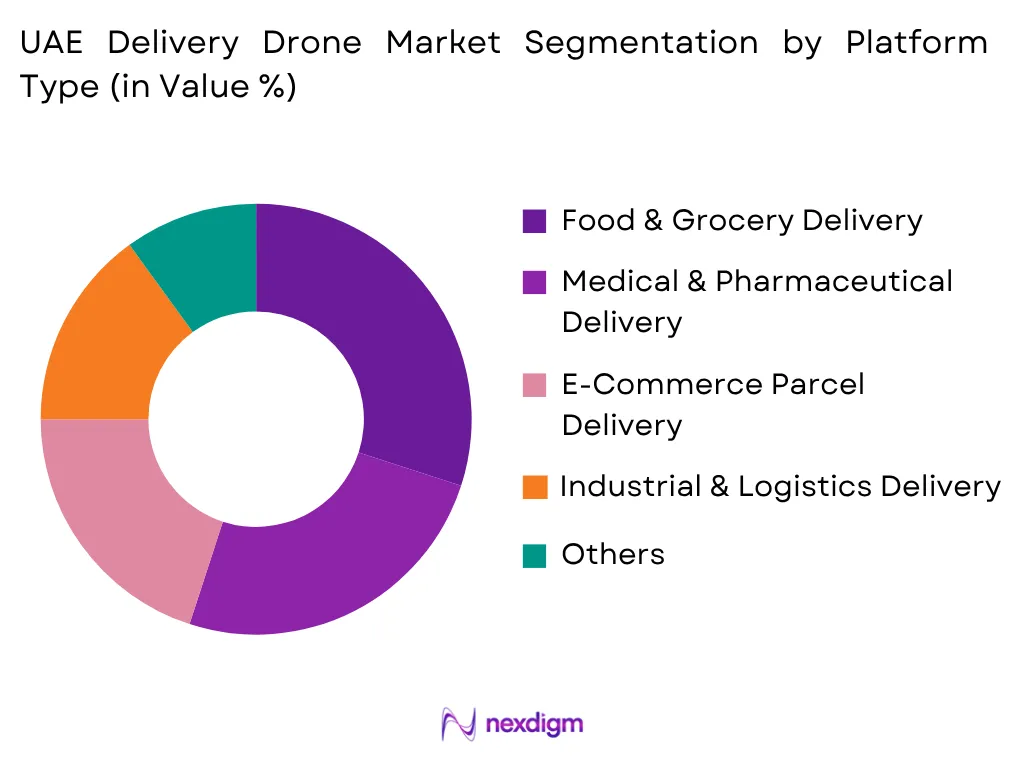
Among these, Rotary-Wing and Multi-Rotor Drones hold a leading share in the UAE Delivery Drone Market owing to their operational flexibility, vertical take-off and landing capability, and suitability for last-mile deliveries in dense urban environments such as Dubai and Abu Dhabi. Fixed-Wing Drones are gaining relevance for longer-range logistics and inter-city cargo movement, while Hybrid VTOL Drones, such as those being developed by LODD Autonomous capable of lifting 250 kilograms over 300-kilometer ranges, are emerging as a critical platform category for heavier payload and extended-range delivery operations. Nano and Micro Drones remain a smaller category, primarily used for lightweight parcel and food delivery. The GCAA’s structured airspace framework, including the proposed layered vertical configuration separating drone operations, safety buffer zones, and air taxi cruise zones, continues to support the safe scaling of multiple drone platform types across the country’s rapidly expanding delivery ecosystem.
By Application
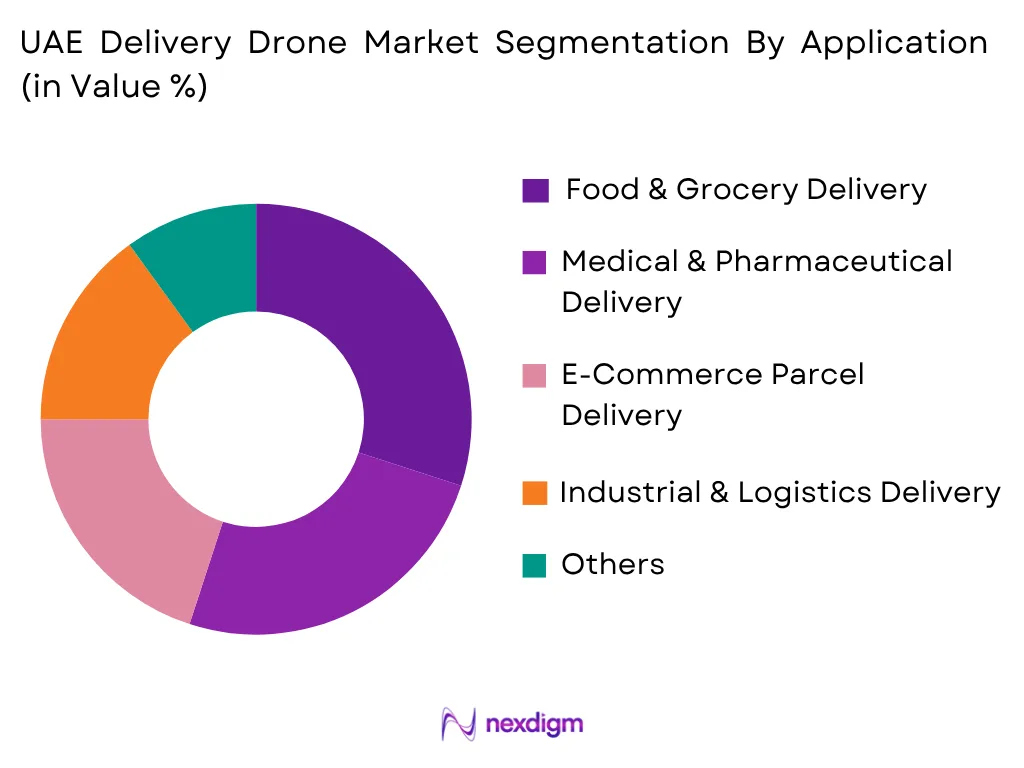
The Food & Grocery Delivery segment holds a significant share owing to the UAE’s dense urban population, high smartphone penetration, and strong consumer demand for rapid delivery services, with the sub-2kg payload category accounting for approximately 55% of market share in 2025. Meanwhile, the Medical & Pharmaceutical Delivery segment is expected to see accelerated growth, supported by the UAE’s healthcare sector expansion, projected to reach approximately AED 80 billion, with drones playing a vital role in transporting medicines and equipment to remote areas and improving healthcare accessibility. E-Commerce Parcel Delivery continues to expand rapidly as companies such as Emirates Post invest in drone technology to streamline last-mile logistics, reduce delivery costs, and improve delivery speed. Industrial & Logistics Delivery applications, including inter-facility cargo transport, are also gaining traction as heavy-lift cargo drone programs such as LODD Autonomous’s VTOL fleet prepare to commence commercial operations.
Competitive Landscape
The UAE Delivery Drone Market is in an early but rapidly consolidating growth phase, with a mix of international technology companies, regional drone manufacturers, and logistics operators competing for market share. Competition is primarily based on regulatory approvals and licensing status, payload and range capabilities, autonomous flight technology, fleet scalability, and partnerships with e-commerce, food delivery, and postal logistics companies. Early movers such as Keeta Drone, which secured the UAE’s first BVLOS commercial delivery license, and LODD Autonomous, an Abu Dhabi-based manufacturer developing heavy-lift VTOL cargo drones, have established strong first-mover advantages in the domestic market. Global drone hardware providers such as DJI continue to supply advanced platforms, including the DJI FlyCart 30 already deployed by UAE law enforcement, while companies such as Zipline bring proven international delivery track records to the region. The GCAA’s close collaboration with operators on regulatory frameworks and ground infrastructure, combined with substantial government investment through the UAE Drone Strategy, continues to lower barriers for new entrants while rewarding companies with strong compliance capabilities and technology maturity.
| Company | Establishment Year | Headquarters | Primary Product Portfolio | Drone Platform Portfolio
|
Manufacturing Presence | Major End-Use Industries | Key Strategic Focus | Certifications & Compliance |
| Keeta Drone | 2023 | ~ | ~ | ~ | ~ | ~ | ~ | ~ |
| LODD Autonomous | 2021 | ~ | ~ | ~ | ~ | ~ | ~ | ~ |
| Zipline International Inc. | 2014 | ~ | ~ | ~ | ~ | ~ | ~ | ~ |
| DJI (SZ DJI Technology Co., Ltd.) | 2016 | ~ | ~ | ~ | ~ | ~ | ~ | ~ |
| Falcon Eye Drones | 2016 | ~ | ~ | ~ | ~ | ~ | ~ | ~ |
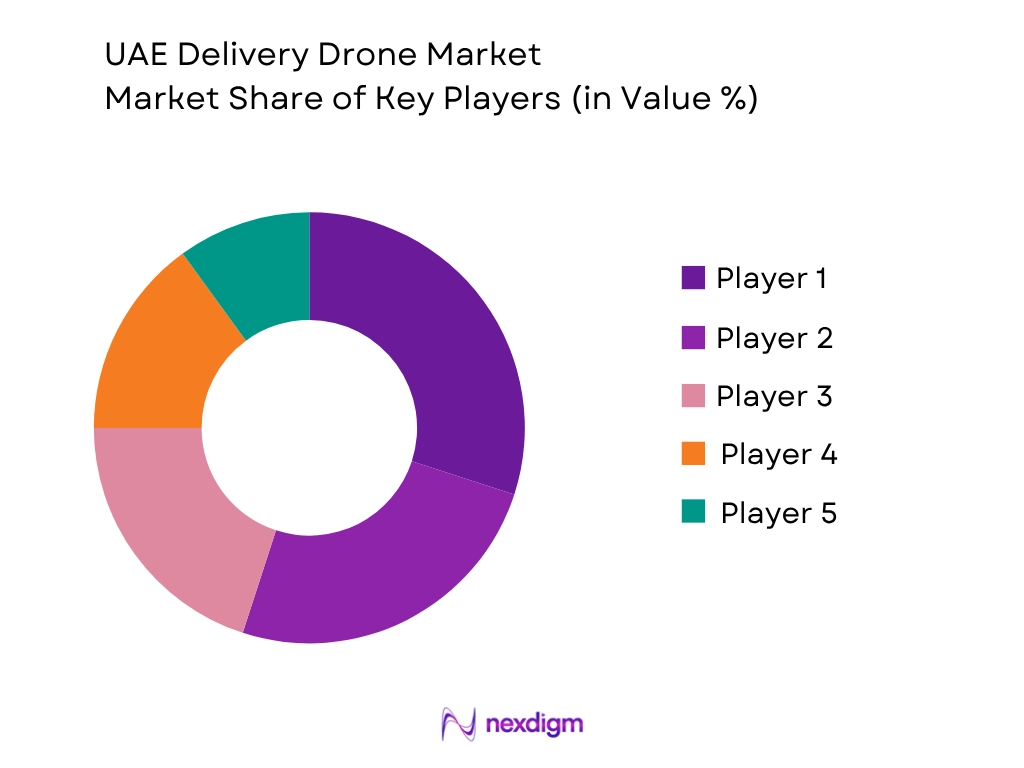
UAE Delivery Drone Market Analysis
Growth Drivers
Rapid Expansion of E-Commerce and Last-Mile Delivery Demand
The UAE Delivery Drone Market is experiencing rapid growth, estimated at USD 35.8 million in 2025 and projected to grow at a CAGR of 46.4% during 2026-2032 to reach USD 515.3 million by 2032, according to industry estimates. This growth is primarily fueled by the rapid expansion of e-commerce activities and surging consumer demand for fast, reliable last-mile delivery solutions. Companies such as Emirates Post are investing in drone technology to streamline last-mile delivery, reducing costs and delivery times while leveraging the UAE’s strategic location as a regional logistics hub to facilitate faster service across the Middle East. The hardware category currently holds the largest market share, at approximately 60% in 2025, driven by substantial initial investments in drone fleets, ground control stations, and supporting infrastructure as companies establish operations, while the services category is expected to register the highest CAGR of 46.7% as expanding delivery networks drive demand for maintenance, training, and logistics optimization services.
Progressive Regulatory Framework and Government-Backed Advanced Air Mobility Initiatives
The UAE’s decisive regulatory leadership continues to be a critical driver of market growth. Unlike many countries facing regulatory uncertainty, the General Civil Aviation Authority (GCAA) authorized the country’s first Beyond Visual Line of Sight (BVLOS) drone delivery license to Keeta Drone, a subsidiary of Meituan, in December 2024, establishing a clear regulatory pathway for commercial aerial logistics. The Dubai Civil Aviation Authority is simultaneously implementing the ‘Dubai Sky Dome’ initiative, creating virtual airspace infrastructure to support commercial drone use, while Dubai announced in February 2025 an initiative to map air corridors for air taxis and cargo drones within 20 months. The GCAA’s collaboration with the Technology Innovation Institute (TII) and ASPIRE under the Advanced Technology Research Council is further establishing a national Advanced Air Mobility (AAM) regulatory framework, with structured air corridors and a layered vertical airspace configuration separating drone operations from air taxi and commercial aircraft zones. The UAE government has also committed approximately AED 1 billion through initiatives like the UAE Drone Strategy to support drone technology development across transportation and public safety sectors.
Market Challenges
High Initial Investment and Infrastructure Costs
The high initial investment required for delivery drone systems presents a significant challenge for market participants, particularly smaller companies and startups. The average cost of commercial drones suitable for delivery applications ranges from approximately AED 50,000 to AED 500,000, while comprehensive delivery drone systems, including software and supporting infrastructure, can exceed AED 1 million. This substantial capital requirement, combined with ongoing maintenance and operational costs, strains budgets and limits the potential for widespread adoption among small and medium-sized enterprises seeking to enter the market. Companies must also invest in ground control stations, unmanned traffic management (UTM) systems, and specialized training for operators, further increasing the total cost of establishing drone delivery operations. As the industry matures, these high capital requirements remain a persistent barrier for new entrants despite the market’s otherwise favorable growth outlook.
Regulatory Compliance Complexity and Airspace Integration Challenges
Despite the UAE’s progressive regulatory stance, navigating the evolving compliance landscape remains a significant challenge for delivery drone operators. The GCAA’s CAR-UAS Part VIII Subpart 10 regulations require operators to obtain approvals, register drones, follow designated airspace and altitude limitations, and secure specific permissions for Beyond Visual Line of Sight (BVLOS) operations or flights in controlled airspace. Operators must adhere to updated licensing requirements which can delay market entry for new companies, and the complexity of navigating these regulations poses a substantial barrier, particularly for startups lacking dedicated compliance resources. Additionally, integrating drone operations safely within increasingly congested urban airspace, alongside future air taxi and Advanced Air Mobility operations, requires sophisticated Unmanned Traffic Management (UTM) systems and coordination between multiple regulatory bodies, including the GCAA and Dubai Civil Aviation Authority. These regulatory and technical integration requirements continue to extend development timelines and increase operational complexity for companies seeking to scale delivery drone operations across multiple emirates.
Market Opportunities
Expansion into Healthcare and Medical Supply Delivery
The UAE’s expanding healthcare sector, projected to reach approximately AED 80 billion, presents a substantial opportunity for delivery drone operators specializing in medical and pharmaceutical logistics. Drones are increasingly positioned to play a vital role in transporting essential medicines, vaccines, and medical equipment to remote areas, improving healthcare accessibility and emergency response times. International operators such as Zipline, which has delivered over 22 million vaccine doses globally and achieved 100 million commercial miles flown in 2025, demonstrate the proven reliability and scalability of drone logistics in healthcare applications, creating a strong template for expansion within the UAE market. As the country continues to invest in advanced healthcare infrastructure and emergency response capabilities, companies with regulatory approval and demonstrated medical logistics expertise are well positioned to capture this emerging high-value application segment.
Integration with Smart City and Advanced Air Mobility Ecosystems
The UAE’s investment in smart city projects, estimated at approximately AED 100 billion, presents a significant opportunity for deeper drone integration across urban planning, traffic management, and logistics optimization. The GCAA’s development of a comprehensive Advanced Air Mobility (AAM) regulatory framework, in partnership with the Technology Innovation Institute and ASPIRE, is establishing structured air corridors and certification pathways that will enable delivery drones to operate alongside future air taxi services within a unified airspace management system. Dubai’s mapping of air corridors for cargo drones and air taxis, expected to be completed within 20 months of its February 2025 announcement, alongside the ‘Dubai Sky Dome’ virtual airspace initiative, creates a foundation for scaled commercial drone operations integrated with broader urban mobility infrastructure. Companies capable of aligning their fleet operations with these emerging smart city and AAM ecosystems stand to benefit from expanded operational corridors, streamlined regulatory approvals, and integration with automated scheduling and routing platforms.
Future Outlook
The UAE Delivery Drone Market is expected to witness substantial expansion over the forecast period, transitioning from pilot testing and early commercial deployment toward large-scale operational integration. Continued regulatory advancement by the GCAA, including the completion of Advanced Air Mobility certification frameworks and expanded BVLOS approvals, is expected to unlock new operational corridors and delivery use cases across food, e-commerce, healthcare, and industrial logistics applications. Growing investment in autonomous flight technology, heavy-lift cargo drones, and Unmanned Traffic Management systems will further support the market’s transition toward fully autonomous, scalable delivery networks integrated with the UAE’s broader smart city and urban air mobility ambitions.
Major Players
- Keeta Drone
- LODD Autonomous
- Zipline International Inc.
- DJI (SZ DJI Technology Co., Ltd.)
- Falcon Eye Drones
- Wing (Alphabet Inc.)
- Matternet, Inc.
- Skyports Drone Services
- Manna Aero
- Amazon Prime Air
- Meituan
- Wingcopter GmbH
- Flytrex Aviation Ltd.
- EHang Holdings Limited
- Swoop Aero
Key Target Audience
- Delivery Drone Manufacturers and Technology Providers
- E-Commerce and Retail Companies
- Food Delivery Platforms
- Healthcare Providers and Pharmaceutical Companies
- Postal and Logistics Companies
- Investment and Venture Capitalist Firms
- Government and Regulatory Bodies (General Civil Aviation Authority (GCAA), Dubai Civil Aviation Authority (DCAA), Technology Innovation Institute (TII), Advanced Technology Research Council (ATRC))
- Ground Infrastructure and Airspace Management Solution Providers
Research Methodology
Step 1: Identification of Key Variables
The research process begins with identifying the complete ecosystem of the UAE Delivery Drone Market, including drone manufacturers, fleet operators, component suppliers, e-commerce and logistics companies, and regulatory authorities. Extensive secondary research is conducted using company annual reports, government publications, aviation authority disclosures, industry journals, and proprietary databases to determine the variables influencing market demand, pricing, fleet deployment, and technological developments.
Step 2: Market Analysis and Construction
Historical market information is collected and analyzed to estimate market size, delivery volume, application-wise demand, and pricing trends. A combination of top-down and bottom-up approaches is used to estimate market revenues and validate segment-level performance. Consumption patterns across food delivery, e-commerce, healthcare, and industrial logistics applications are evaluated to establish an accurate representation of the industry.
Step 3: Hypothesis Validation and Expert Consultation
The preliminary findings are validated through Computer-Assisted Telephone Interviews (CATIs) and structured discussions with drone manufacturers, fleet operators, logistics executives, regulatory experts, and senior executives operating within the UAE’s aerial logistics industry. These interviews help verify market assumptions, competitive developments, technology adoption trends, pricing dynamics, and future investment opportunities while refining the overall market estimates.
Step 4: Research Synthesis and Final Output
The final stage integrates insights obtained from primary interviews with quantitative information collected through secondary sources. Data triangulation techniques are applied to reconcile differences between supply-side and demand-side estimates, ensuring robust market forecasting. The report is then reviewed through multiple quality assurance checkpoints to deliver a comprehensive analysis covering market size, segmentation, competitive landscape, future outlook, and strategic recommendations for industry stakeholders.

- Executive Summary
- Research Methodology (Market Definitions and Assumptions, Abbreviations, Market Sizing Approach, Top-Down Analysis, Bottom-Up Analysis, Demand-Side Assessment, Supply-Side Assessment, Primary Industry Interviews, Secondary Research Validation, Data Triangulation, Forecasting Framework, Limitations and Future Conclusions)

- Definition and Scope
- Market Evolution and Industry Genesis
- Timeline of Major Industry Developments
- Delivery Drone Industry Value Chain Analysis
- Supply Chain Analysis

- Growth Drivers (Rapid E-Commerce Expansion, Progressive Regulatory Framework, Government-Backed Smart City Initiatives, Rising Demand for Last-Mile Delivery, Expansion into Healthcare Logistics, Advances in Autonomous Flight Technology)
- Market Challenges (High Initial Investment Costs, Regulatory Compliance Complexity, Airspace Integration Challenges, Limited BVLOS Approvals, Battery and Payload Limitations, Weather-Related Operational Constraints)
- Market Opportunities (Expansion into Medical and Pharmaceutical Delivery, Integration with Advanced Air Mobility Ecosystems, Smart City Infrastructure Investment, Autonomous Fleet Expansion, Cross-Border Logistics Corridors, Drone-as-a-Service Business Models)
- Market Trends (Shift Toward Fully Autonomous Operations, Rise of Drone-as-a-Service Models, Dubai Sky Dome Airspace Initiative, Growth in Heavy-Lift Cargo Drones, Integration of AI-Based Traffic Management, Expansion of Designated Drone Corridors)
- Government Regulations (GCAA CAR-UAS Part VIII Subpart 10 Regulations, Federal Decree-Law No. 26 of 2022, Dubai Civil Aviation Authority UAS Regulation, BVLOS Licensing Requirements, Unmanned Aircraft Operator Authorization, Airspace and Altitude Restrictions)
- Import and Export Analysis (Trade Volume, Major Import Sources, Export Destinations, HS Code Analysis, Trade Balance)
- Component Availability Analysis (Airframes, Batteries and Power Systems, Navigation and Sensor Systems, Communication Modules, Ground Control Stations)
- Technology Landscape (Autonomous Navigation Systems, Unmanned Traffic Management (UTM) Systems, Battery and Propulsion Technologies, Collision Avoidance Systems, AI-Based Route Optimization)
- Sustainability Assessment (Zero-Emission Electric Propulsion, Carbon Footprint Reduction, Reduced Road Congestion, Noise Impact Management, Energy-Efficient Fleet Operations)
- PESTLE Analysis
- SWOT Analysis
- Porter’s Five Forces Analysis
- Stakeholder Ecosystem
- Competition Ecosystem

- By Market Value (2020-2025)
- By Volume of Deliveries (2020-2025)
- By Average Selling Price (2020-2025)

- By Platform Type (In Value %)
Fixed-Wing Drones
Rotary-Wing / Multi-Rotor Drones
Hybrid VTOL Drones
Nano / Micro Drones - By Range (In Value %)
Short Range
Medium Range
Long Range - By Application (In Value %)
Food & Grocery Delivery
E-Commerce Parcel Delivery
Medical & Pharmaceutical Delivery
Industrial & Logistics Delivery - By End User (In Value %)
E-Commerce Companies
Food Delivery Platforms
Healthcare Providers
Postal & Logistics Companies
Retail Chains - By Region (In Value %)
Dubai
Abu Dhabi
Sharjah
Northern Emirates (Ajman, Ras Al Khaimah, Fujairah, Umm Al Quwain)

- Market Share of Major Players (By Value, Volume, Platform Type, Application Industry, Payload Category)
- Cross Comparison Parameters (Fleet Size, Payload Capacity Range, Autonomous Flight Capability, Regulatory Approvals & Licenses, Manufacturing Capacity, Delivery Network Coverage, Customer Base, Innovation & New Product Launch Frequency)
- SWOT Analysis of Major Players
- Pricing Analysis by Delivery Category and Service Type
- Fleet Capacity Analysis
- Operational Footprint Analysis
- Distribution Network Analysis
- Innovation Benchmarking
- Detailed Profiles of Major Companies
Keeta Drone
ODD Autonomous
Zipline International Inc.
DJI (SZ DJI Technology Co., Ltd.)
Falcon Eye Drones
Wing (Alphabet Inc.)
Matternet, Inc.
Skyports Drone Services
Manna Aero
Amazon Prime Air
Meituan
Wingcopter GmbH
Flytrex Aviation Ltd.
EHang Holdings Limited
Swoop Aero

- Consumption Pattern Analysis (Delivery Volume, Fleet Size, Application Penetration, Peak Demand Periods, Route Optimization Activity)
- Purchasing Criteria (Payload Capacity, Regulatory Compliance, Cost Efficiency, Battery Range, Reliability, After-Sales Support)
- Procurement and Supplier Selection Analysis
- Autonomous Technology Adoption Assessment
- Premium vs Conventional Delivery Model Demand
- Product Attribute Preference Analysis (Flight Range, Payload Capacity, Navigation Accuracy, Weather Resistance, Battery Life, Safety Features)
- Consumer Convenience and Speed Expectations
- Pain Point Analysis
- Decision-Making Process

- By Market Value (2026-2035)
- By Volume of Deliveries (2026-2035)
- By Average Selling Price (2026-2035)


 Request a Sample
 Ask for Customization
 Get a Quote
 Enquire Now