

 Download PDF
Market Overview
The UAE digital identity solutions opportunity is underpinned by one of the region’s most digitized public-service and access environments. The market is valued at USD ~ billion, while adjacent identity infrastructure such as the UAE biometrics market reached USD ~ million in 2025. On the demand side, UAE PASS had ~ million users in 2023, the UAE’s population reached 10,986,400 in 2024, internet usage stood at 100 per 100 people in 2024, and GDP reached USD 552.32 billion in 2024, creating a strong base for digital onboarding, authentication, and trust services.
Within the UAE, Dubai and Abu Dhabi dominate digital identity demand because they combine the country’s strongest public digital infrastructure, financial-services density, smart-city programs, and enterprise cybersecurity budgets. Dubai benefits from Digital Dubai programs, the paperless government architecture, and the concentration of private-sector digital services; 97% of Dubai government transactions were digital in 2023. Abu Dhabi is equally important because TAMM and wider government digitization are tied to AI-native public-service transformation, while the emirate also anchors federal institutions and regulated financial activity. At the national level, the UAE’s digital readiness is reinforced by its 11th global rank in the 2024 UN EGDI and 11th in the 2024 IMD World Digital Competitiveness Ranking.
By Solution Type
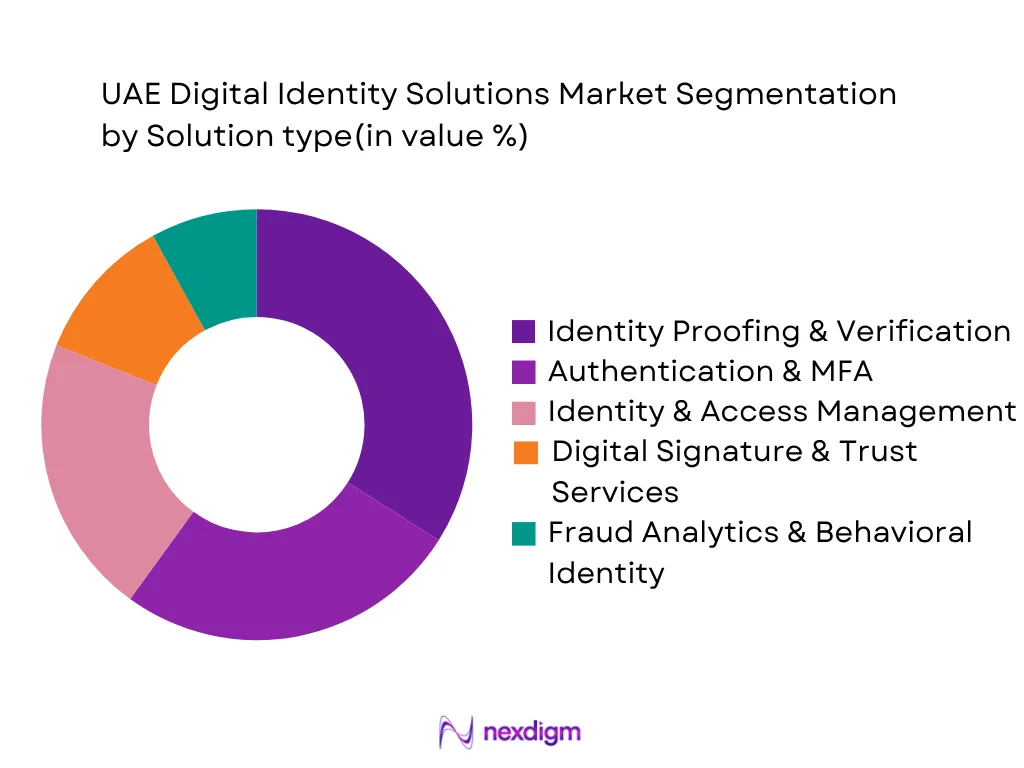
The UAE Digital Identity Solutions Market is segmented by solution type into identity proofing and verification, authentication and MFA, identity and access management, digital signature and trust services, and fraud analytics. Recently, identity proofing and verification has held the dominant share under this segmentation because the UAE’s demand is heavily shaped by onboarding-intensive use cases rather than only employee access control. UAE PASS, digital banking expansion, travel processing, and the newly announced nationwide eKYC platform from the Central Bank of the UAE all increase the need for document validation, facial matching, liveness checks, and trusted identity assertion at the first point of interaction. This makes IDV the commercial anchor for banks, fintechs, regulated platforms, and government-linked services. Authentication and IAM remain critical, but the market’s strongest monetization logic currently sits at the verification layer where fraud reduction, compliance, and customer conversion meet.
By End-Use Industry
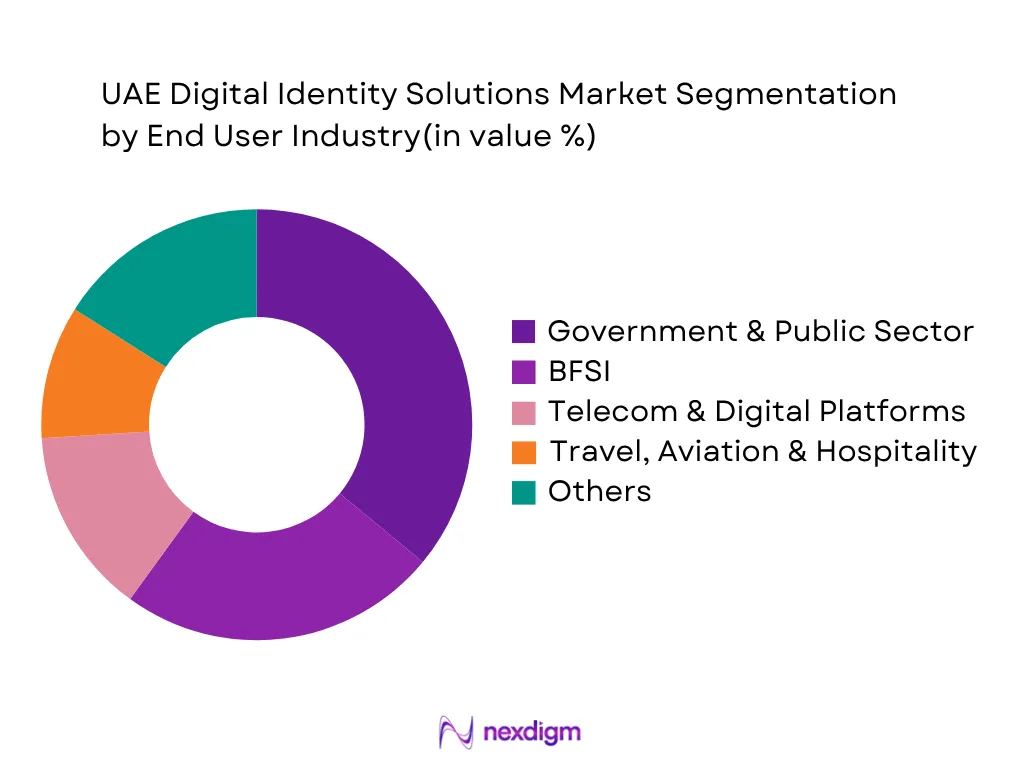
The UAE Digital Identity Solutions Market is segmented by end-use industry into government and public sector, BFSI, telecom and digital platforms, travel and hospitality, healthcare and insurance, and retail and e-commerce. Recently, the government and public sector segment has accounted for the dominant share because the country’s identity architecture is fundamentally state-led. UAE PASS is a national identity rail, Digital Dubai and Abu Dhabi’s digital government programs continue to normalize digital access to services, and the UAE ranks among the world’s leading e-government systems. That public backbone then influences the private market by setting authentication expectations, trust standards, and integration opportunities. BFSI is the second major spender because of eKYC and AML obligations, but public agencies still shape the largest share of infrastructure, onboarding, federation, and identity lifecycle demand across the federation.
Competitive Landscape
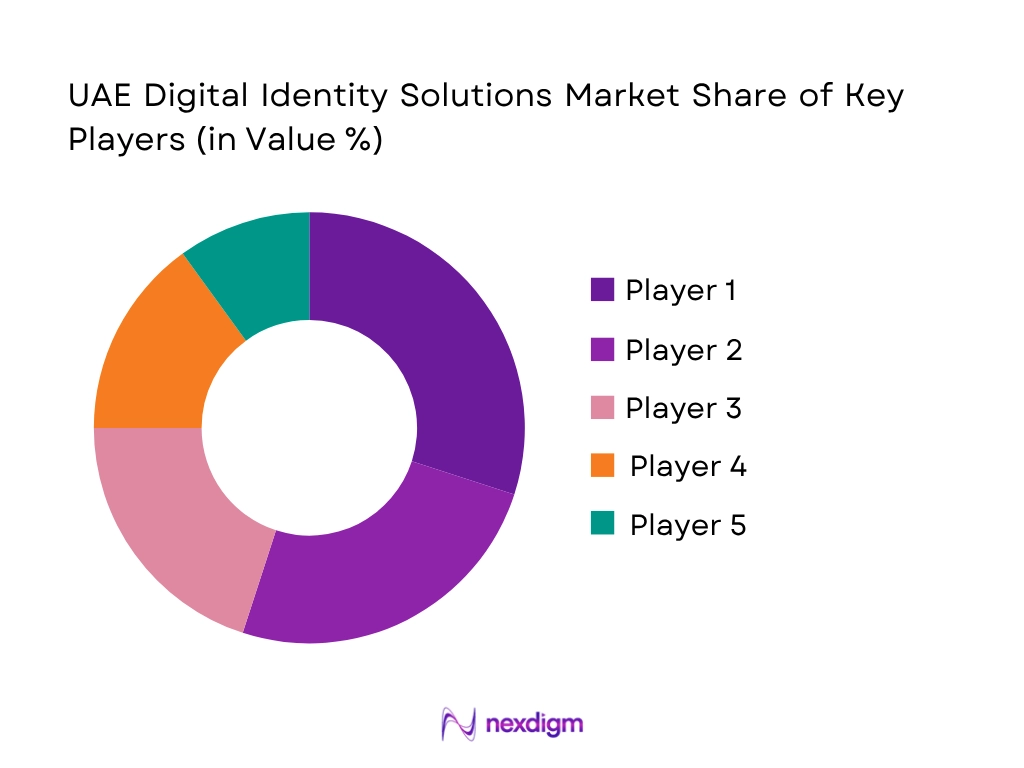
The UAE Digital Identity Solutions Market is led by a mix of global identity infrastructure vendors, biometric specialists, cloud IAM platforms, and digital onboarding firms. The competitive structure is not fragmented in the same way as a consumer app market; instead, it is shaped by a relatively small set of vendors that can meet enterprise-grade security, government integration, regulated-sector compliance, and large-scale authentication requirements. Global players such as Thales, IDEMIA, Entrust, Okta, and Jumio are especially relevant because they map well to the UAE’s strongest demand pockets: digital government, banking and fintech onboarding, secure access management, digital signatures, and fraud prevention.
| Company | Establishment Year | Headquarters | Core UAE-Relevant Offering | Primary Delivery Model | Strongest UAE Use Cases | Biometric / Liveness Strength | Digital Trust / Signing Relevance |
| Thales | 1893 | France | – | – | – | – | – |
| IDEMIA | 2017 | France | – | – | – | – | – |
| Entrust | 1969 | United States | – | – | – | – | – |
| Okta | 2009 | United States | – | – | – | – | – |
| Jumio | 2010 | United States | – | – | – | – | – |
Market Entry Strategy
Entering the UAE Digital Identity Solutions Market requires a government-aligned, partnership-led approach rather than a purely direct commercial strategy. The market is structurally anchored around national identity infrastructure such as UAE PASS, which already serves 11 million+ users across 15,000+ services and 350+ entities, making integration with government platforms and compliance with ICP and TDRA frameworks a prerequisite rather than an option. Vendors must prioritize local data residency compliance under UAE PDPL, API compatibility with public digital infrastructure, and partnerships with system integrators and sovereign cloud providers to access government and BFSI contracts. The opportunity is reinforced by 173.7 million digital government transactions and 57 million users across federal services, indicating that scalable deployment and interoperability are critical success factors. A phased entry model—starting with BFSI-led eKYC solutions or API-based identity services, followed by government integration—offers the most viable route to scale in this market.
Competitive Intelligence
The UAE Digital Identity Solutions Market is characterized by a concentrated competitive landscape where a limited number of global identity, biometric, and IAM vendors dominate high-value deployments, particularly in government and BFSI sectors. Players such as Thales Group, IDEMIA, and Entrust Corporation hold strong positioning in government-backed identity and digital trust infrastructure, while cloud-native IAM providers like Okta and verification specialists like Jumio lead in enterprise and fintech onboarding use cases. Competition is driven less by price and more by biometric accuracy, UAE PASS integration capability, regulatory compliance readiness, and ability to handle high transaction volumes, especially in an ecosystem processing 173.7 million digital government transactions. Vendors with strong local partnerships, proven deployments in regulated sectors, and AI-driven fraud detection capabilities are gaining competitive advantage, while newer entrants must differentiate through API-first architecture, faster integration, and niche capabilities such as behavioral biometrics or decentralized identity solutions.
UAE Digital Identity Solutions Market Analysis
Growth Drivers
Expansion of UAE PASS and National Digital Identity Adoption
The expansion of UAE PASS is a direct growth engine for the UAE Digital Identity Solutions Market because it converts identity from a one-time government credential into a recurring authentication layer across public and private digital journeys. The UAE PASS ecosystem has already moved beyond pilot-scale relevance: TDRA stated that the platform had more than 11 million users and supports over 15,000 digital services delivered through more than 350 entities, including 140+ private-sector entities. In the same operating environment, the UAE completed 173.7 million digital government transactions and served more than 57 million users through 1,419 digital services. This depth of usage matters because broader identity adoption raises demand for onboarding, authentication, consent management, digital signatures, document verification, and reusable credentials. The macroeconomic backdrop also reinforces this adoption cycle: the World Bank shows the UAE had a population of 10.99 million, GDP of USD 552.32 billion, and GDP per capita of USD 50,273.5 in 2024, indicating strong purchasing power and state capacity to support secure digital infrastructure at scale.
Growth in Digital Banking & eKYC Compliance Requirements
Digital banking growth is pushing identity demand from a convenience layer into a regulated control layer. The Central Bank of the UAE reported that banking sector total assets reached AED 4.56 trillion in 2024, underlining the scale of the regulated institutions that must continuously manage customer due diligence, onboarding, authentication, fraud controls, and account access. In parallel, the Central Bank has placed identity infrastructure at the center of its fintech agenda through the e-KYC Sharing Platform, Open Finance, and broader financial digital transformation initiatives. This is important because a larger banking system with more digital products creates more identity events per customer, not fewer. The market need is amplified by the UAE’s wider payment digitization: the Financial Stability Report notes that the UAE Payment Gateway System processed 2.1 million transactions in 2024, while official payments-and-settlements infrastructure is being expanded to support domestic and cross-border digital flows. Against a 2024 economy of USD 552.32 billion and per-capita income above USD 50,000, regulated digital finance in the UAE requires stronger identity proofing, screening, and continuous re-verification tools.
Market Challenges
Data Privacy Regulations & Cross-Border Data Restrictions
Data privacy regulation is a real market challenge because digital identity systems are built on sensitive personal, behavioral, and document data that often need to move across platforms, cloud environments, and jurisdictions. The UAE government states that the Personal Data Protection framework sets requirements for the cross-border transfer and sharing of personal data for processing purposes, which means vendors cannot treat the UAE as a frictionless data-routing environment. This matters more in a country with 11 million users on UAE PASS, 173.7 million digital government transactions, and 1,419 digital services accessed by 57 million users. The scale of activity increases the amount of identity, document, and consent data circulating through public and private systems, while compliance expectations rise in parallel. With the World Bank showing the UAE at USD 552.32 billion GDP and USD 50,273.5 GDP per capita in 2024, the market is large enough to attract global vendors, but local data handling, transfer rules, and trust requirements create integration and architecture complexity that can slow deployment and raise compliance burdens.
Legacy System Integration Challenges in Government & BFSI
Legacy integration remains a major challenge because the UAE digital identity stack must work across a very large service estate rather than a clean-sheet digital environment. Federal and local digital government together processed 173.7 million digital government transactions in 2024 across 1,419 digital services, while the broader identity ecosystem spans 350+ entities and 15,000+ services through UAE PASS. In banking, the Central Bank reported sector assets of AED 4.56 trillion in 2024, showing that identity vendors must integrate not only with government systems but also with large, risk-sensitive financial architectures. The challenge is not a lack of digital ambition; it is the need to harmonize older core systems, new APIs, regulatory workflows, authentication layers, and document verification rails without disrupting service continuity. A highly digitized environment actually makes the integration issue more urgent because identity failures can cascade across multiple channels. In a nearly 11 million population economy with high digital intensity, interoperability, data quality, and orchestration become implementation bottlenecks even when demand is strong.
Opportunities
Expansion of Digital Identity Wallets Across Services
The strongest medium-term opportunity in this market is the expansion of digital identity wallets from government login into a reusable credential layer across everyday service journeys. UAE PASS already demonstrates that this model has operating scale: TDRA reported 11 million+ users, 15,000+ services, and 350+ participating entities, while 2024 system activity included more than 16 million verified documents exchanged. The UAE government also recorded 173.7 million digital transactions and 57 million users across federal digital services, showing that there is enough volume to justify wallet-led identity orchestration far beyond a narrow citizen portal model. This creates room for wider use in banking onboarding, document sharing, employment services, property workflows, health records access, telecom activation, and travel-linked identity verification. Because wallet models reduce repeated verification and enable consent-based reuse of trusted credentials, they fit well with a country that already operates at high digital-service density. In a USD 552.32 billion economy with nearly 11 million residents, service-linked identity wallets represent a scalable commercialization path for the next layer of UAE digital identity growth.
Integration of AI-Based Identity Verification & Liveness Detection
AI-based identity verification and liveness detection represent a major opportunity because the UAE now has both the digital transaction scale and the policy direction needed to justify more intelligent verification layers. The UAE completed 173.7 million digital government transactions in 2024, while Digital Dubai’s GITEX 2024 government platform brought together 45+ entities showcasing AI-powered services and Digital Dubai launched a new data-and-AI platform to enable government and private entities to host and exchange data securely. At the same time, the cybersecurity environment remains demanding, with 223,800 potentially exposed UAE-hosted assets identified in the national threat landscape and official warnings around deepfake misuse. This combination creates a clear commercial case for AI-driven face matching, spoof detection, document forgery detection, behavioral scoring, and adaptive authentication. The opportunity is strong because AI in identity is not being driven by speculative future demand; it is being pulled by today’s service volume, data infrastructure, and security pressure. In the UAE, AI-enhanced identity tools can improve trust, reduce fraud, and lower friction across onboarding and authentication flows already operating at national scale.
Future Outlook
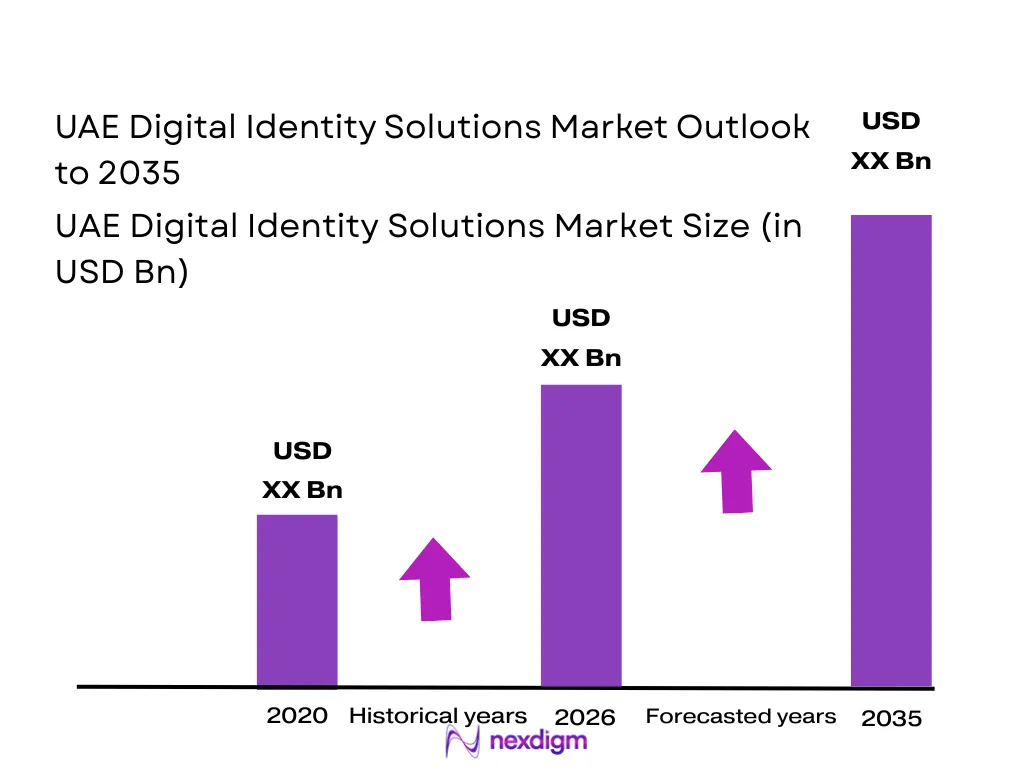
The UAE Digital Identity Solutions Market is expected to remain on a structurally strong growth path over the long term, supported by digital government expansion, financial-sector onboarding modernization, AI-linked fraud mitigation, and deeper integration between public identity rails and private digital services. The medium-term demand pipeline is especially strong in eKYC, biometric verification, passwordless access, digital signatures, and reusable identity workflows. Another major catalyst is the Central Bank’s move toward a nationwide eKYC platform, which could reduce onboarding friction and deepen standardization across banks and fintechs. At the same time, growth will increasingly depend on interoperability, sovereign-cloud readiness, and the ability of vendors to align with local data, trust, and regulatory requirements.
Major Players
- Thales
- IDEMIA
- Entrust
- Okta
- Jumio
- Microsoft
- Oracle
- Ping Identity
- ForgeRock
- NEC Corporation
- Veriff
- Yoti
- Daon
- GBG
- Onfido
Key Target Audience
- Government and regulatory bodies
- Banks, Islamic banks, and digital banking platforms
- Fintech, payments, remittance, and embedded finance providers
- Telecom operators and digital service providers
- Systems integrators, MSSPs, and digital transformation service providers
- Sovereign cloud, hyperscale cloud, and cybersecurity infrastructure providers
- Airports, airlines, travel, border-tech, and hospitality operators
- Investments and venture capitalist firms
Research Methodology
Step 1: Identification of Key Variables
The initial phase involves mapping the UAE digital identity ecosystem across government identity rails, regulated-sector onboarding, enterprise IAM, biometric verification, and digital trust services. Extensive desk research is used to identify the variables most relevant to this market, including UAE PASS penetration, e-government maturity, eKYC activity, digital-service density, and the role of sovereign cloud and local compliance requirements.
Step 2: Market Analysis and Construction
In this stage, the market is constructed using the closest open UAE benchmarks within the digital identity stack, especially Cloud IAM and biometric identity infrastructure. These are then interpreted alongside national digital usage signals, city-level government digitization, and demand intensity across BFSI, public services, telecom, travel, and healthcare to build a practical view of current market structure.
Step 3: Hypothesis Validation and Expert Consultation
Market hypotheses are validated through triangulation against open industry reports, official UAE digital-government publications, company product positioning, and sector-specific demand indicators. Special attention is given to areas where UAE-specific market values are partly paywalled, so qualitative validation focuses on onboarding intensity, authentication scale, and regulatory triggers shaping vendor demand.
Step 4: Research Synthesis and Final Output
The final phase combines top-down digital-economy signals with bottom-up reading of vendor relevance, use-case maturity, and sector concentration to synthesize the market narrative. This approach ensures the output remains commercially useful for business professionals while staying transparent about where the open market data is exact, where it is adjacent, and where the share mix is research allocation rather than officially published percentage disclosure.

- Executive Summary
- Research Methodology (Market Definition of Digital Identity Ecosystem, eID & Digital ID Framework Scope, UAE Regulatory Definitions (ICP, TDRA), Assumptions on Identity Lifecycle, Market Sizing via Identity Transactions & Active Digital IDs, Bottom-Up Vendor Revenue Mapping, Top-Down Government Digital Spend Allocation, Primary Interviews with Identity Providers & Government Stakeholders, Demand-Side Surveys (BFSI, Telecom, GovTech), Data Triangulation Across Digital Transactions, Limitations in Proprietary Identity Data Access)

- Definition and Scope
- Evolution of UAE Digital Identity Ecosystem (UAE PASS, Smart Government Initiatives)
- Digital Identity Value Chain (Identity Proofing → Authentication → Authorization → Identity Governance)
- Stakeholder Ecosystem (Government Authorities, ID Providers, System Integrators, Cloud Providers, End-Use Industries)
- Identity Lifecycle Framework (Enrollment, Verification, Authentication, Lifecycle Management)
- Integration with National Digital Infrastructure (Smart Dubai, UAE PASS, Federal Authority for Identity)

- Growth Drivers
Expansion of UAE PASS and National Digital Identity Adoption
Growth in Digital Banking & eKYC Compliance Requirements
Smart City Initiatives (Dubai Smart City, Abu Dhabi Digital Authority)
Rising Cybersecurity & Fraud Prevention Needs
Increase in Cross-Border Digital Transactions & Digital Economy - Market Challenges
Data Privacy Regulations & Cross-Border Data Restrictions
Legacy System Integration Challenges in Government & BFSI
Identity Fraud & Deepfake Risks
High Cost of Biometric Infrastructure Deployment - Opportunities
Expansion of Digital Identity Wallets Across Services
Integration of AI-Based Identity Verification & Liveness Detection
Growth of Embedded Identity APIs for FinTech & Platforms
Cross-Border Digital Identity Interoperability - Trends
Rise of Passwordless Authentication Systems
Adoption of Decentralized Identity (DID) & Blockchain Identity
Increasing Use of Behavioral Biometrics
Identity-as-a-Service (IDaaS) Expansion - Government Regulations
UAE Digital Government Strategy & Identity Mandates
Federal Data Protection Law (PDPL)
KYC/AML Compliance Regulations for BFSI - SWOT Analysis (Identity Infrastructure Strength, Regulatory Support, Integration Gaps)
- Stakeholder Ecosystem (Government Authorities, Identity Vendors, SIs, Cloud Providers, End Users)
- Porter’s Five Forces (Entry Barriers via Regulation, Supplier Power of Tech Providers, Buyer Power of Government Contracts)
- Competition Ecosystem (Global Identity Providers vs Local Government Platforms)

- By Value (Government Spending on Digital Identity Infrastructure), 2020-2025
- By Volume (Active Digital IDs, Authentication Transactions), 2020-2025
- By Deployment Scale (Enterprise vs National Platforms), 2020-2025
- By Authentication Transactions Volume (Annual API Calls, Identity Verifications), 2020-2025

- By Solution Type (In Value %)
Identity Proofing & Verification (KYC, eKYC, Document Verification)
Authentication Solutions (Biometric, OTP, Multi-Factor Authentication)
Identity Lifecycle Management (IAM, CIAM Platforms)
Digital Identity Wallets (UAE PASS, Mobile ID)
Fraud & Risk-Based Identity Analytics - By Authentication Type (In Value %)
Biometric Authentication (Facial Recognition, Fingerprint, Iris)
Knowledge-Based Authentication (KBA)
Token-Based Authentication (OTP, Smart Cards)
Behavioral Biometrics - By Deployment Model (In Value %)
Cloud-Based Identity Solutions
On-Premise Identity Systems
Hybrid Deployment Models - By End-Use Industry (In Value %)
Government & Public Sector
BFSI (Banking, FinTech, Payments)
Telecom & ICT
Healthcare & Insurance
Travel, Aviation & Hospitality
Retail & E-commerce - By Use Case (In Value %)
Customer Onboarding & eKYC
Access Management & Workforce Identity
Digital Payments Authentication
Cross-Border Identity Verification
Smart City & Government Services Access - By Region (In Value %)
Dubai
Abu Dhabi
Sharjah
Northern Emirates

- Technology Benchmarking
Biometric Accuracy & Liveness Detection
AI-Based Fraud & Risk Analytics
Behavioral Biometrics Capabilities - Platform & Architecture Benchmarking
API-First vs Legacy IAM Platforms
Cloud-Native vs On-Prem Solutions
Identity-as-a-Service (IDaaS) Adoption - UAE Ecosystem Integration Benchmarking
UAE PASS & Emirates ID Integration Capability
Smart Government Platform Compatibility - Commercial & GTM Benchmarking
Industry Penetration (BFSI, Government, Telecom)
Pricing Models (Per Verification, Subscription)
Partner Ecosystem (SIs, Government Contracts) - Competitive Positioning Matrix
Leaders
Challengers
Niche Players - UAE Digital Identity Solutions Market Entry Strategy
- Entry Models
Government Partnership / Public Sector Integration
SI-Led Joint Ventures
Direct Enterprise Sales (BFSI, Telecom)
API-Based SaaS Entry - Regulatory & Technology Requirements
PDPL, KYC/AML Compliance
UAE PASS Integration & Certification
Data Residency & Sovereign Cloud - Go-To-Market Strategy
BFSI-Led Entry (eKYC, Onboarding)
Government & Smart City Programs
API Economy & FinTech Integration - Risk & Opportunity Assessment
Regulatory & Integration Risks
Competitive Landscape Risks
White Space (DID, Cross-Border Identity, AI Fraud Detection) - Entry Roadmap
Compliance & Partnerships
Pilot Deployment
Scale via API Ecosystem

- Market Share Analysis (Identity Transaction Volume, Revenue by Solution Type)
- Cross Comparison Parameters (Biometric Accuracy Rate, Authentication Latency, API Integration Capability, Regulatory Compliance Coverage (KYC/AML), Deployment Flexibility (Cloud/Hybrid), Identity Verification Speed, Fraud Detection Capability, Partnerships with Government/Enterprises)
- SWOT Analysis of Key Players
- Pricing Benchmarking (Per Verification Cost, API Pricing Models, Subscription vs Usage-Based Pricing)
- Detailed Company Profiles
Thales Group
IDEMIA
NEC Corporation
Entrust Corporation
Okta
Microsoft
Oracle
Ping Identity
ForgeRock
Jumio
Onfido
GBG Plc
Veriff
Yoti
Daon

- Demand Analysis by Industry
- Digital Identity Adoption Maturity
- Key Pain Points (Fraud Risk, Onboarding Friction)
- Decision-Making Criteria (Accuracy, Speed, Compliance)
Vendor Selection Parameters

- By Value (Government Spending on Digital Identity Infrastructure), 2026-2035
- By Volume (Active Digital IDs, Authentication Transactions), 2026-2035
- By Deployment Scale (Enterprise vs National Platforms), 2026-2035
- By Authentication Transactions Volume (Annual API Calls, Identity Verifications), 2026-2035


 Request a Sample
 Ask for Customization
 Get a Quote
 Enquire Now