

 Download PDF
Market Overview
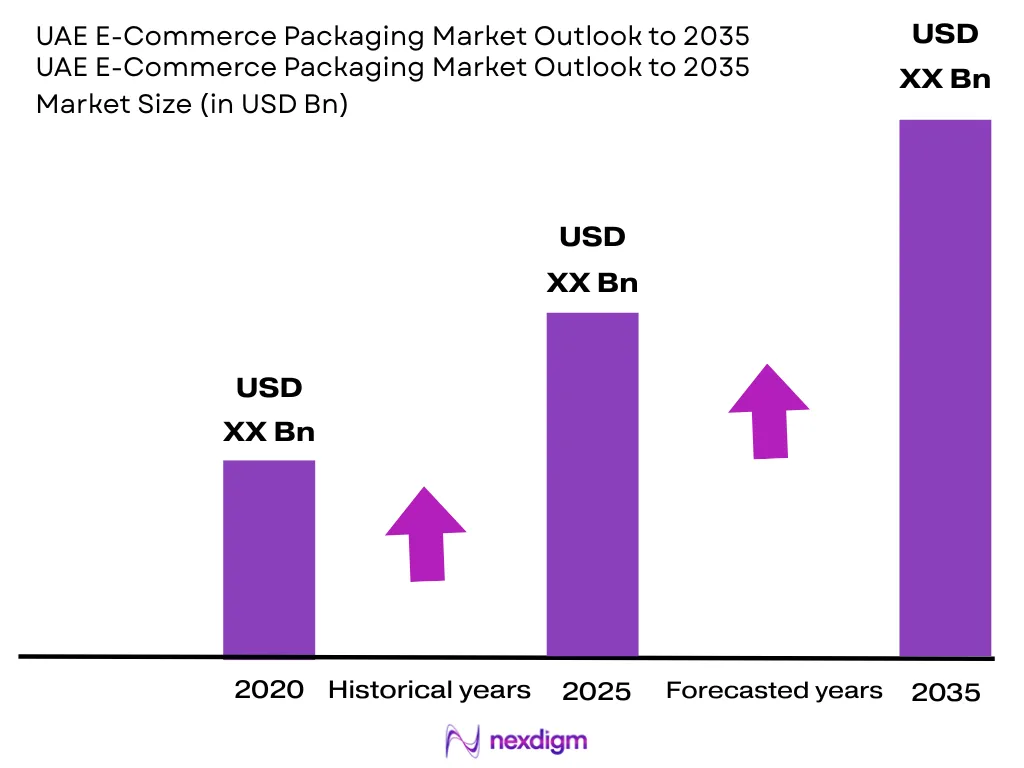
The UAE E-Commerce Packaging Market was valued at USD ~ Billion in 2024 and is anticipated to expand at a CAGR of ~% during 2026-2035, tracking growth in the UAE’s broader packaging industry, valued at approximately USD ~ billion in 2025 and projected to reach approximately USD ~ billion by 2031. E-commerce fulfillment specifically is projected to top USD 9.2 billion in 2026, pulling substantial corrugated and flexible packaging volumes into micro-flute boxes and stand-up pouches engineered to travel efficiently through last-mile delivery networks. Heightened dependency on e-commerce lifted last-mile corrugated packaging to approximately 40% of national box output in 2025, up sharply from approximately 25% in 2020, as Amazon UAE and Noon each expanded their fulfillment center networks, with Noon’s Dubai South site alone processing more than 1 million parcels during peak months. The market is further reshaped by the UAE’s aggressive single-use plastics regulatory agenda, including the Dubai and Abu Dhabi plastic bag bans that took effect in 2024, accelerating e-commerce sellers’ transition toward paper-based and mono-material packaging alternatives.
Market Segmentation
By Material Type
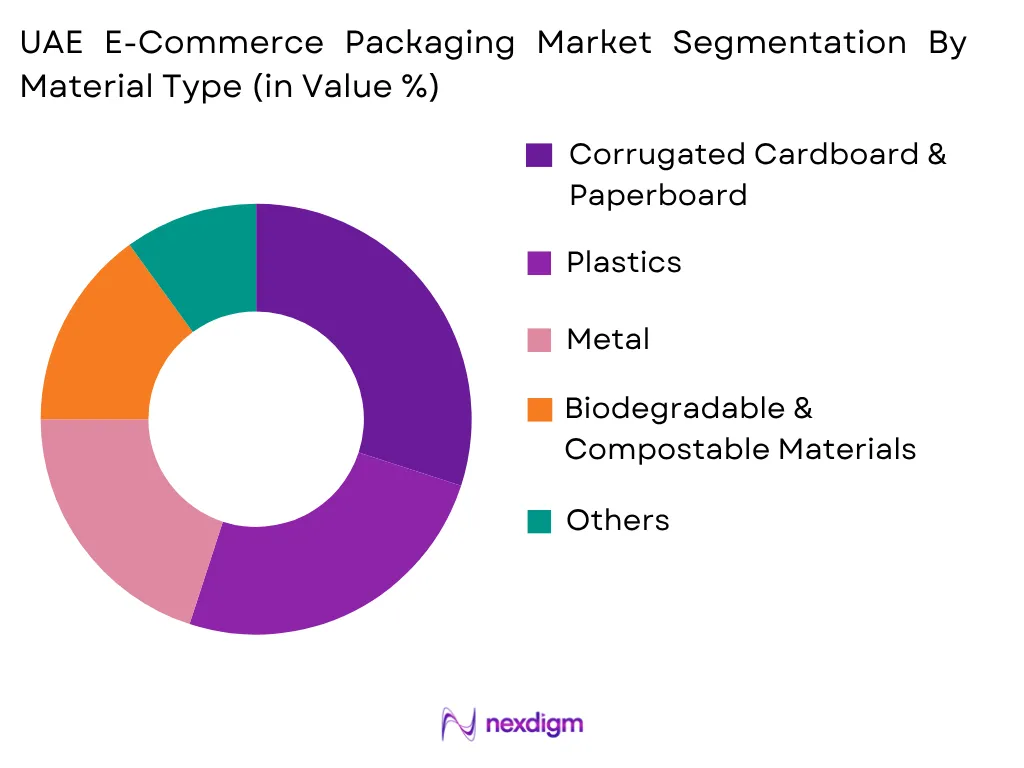
Corrugated Cardboard & Paperboard leads the UAE E-Commerce Packaging Market by volume, with last-mile corrugated packaging climbing to approximately 40% of national box output in 2025, up from approximately 25% in 2020, directly reflecting the scale of Amazon UAE and Noon’s fulfillment center expansion since 2024. Plastic materials, increasingly shifting toward mono-material formats to comply with tightening single-use plastic regulations, retain an important role in lightweight mailers and protective films, with flexible formats expanding at approximately 7.37% CAGR through 2031 as e-commerce and food delivery services specify lighter, space-efficient packs. Paper and kraft paper packaging continues to gain share following the 2024 single-use plastic bag bans implemented by the Environment Agency Abu Dhabi and Dubai’s Executive Council, with major retailers including Lulu, Carrefour, and Spinneys now offering reusable kraft paper bags at checkout. Aluminum foil, paired with paperboard lids, has emerged as a distinctive material solution for the cloud-kitchen segment, now accounting for approximately 45% of that category given its ability to withstand extended motorcycle delivery transit in temperatures reaching 40 degrees Celsius without warping, directly supplanting banned expanded polystyrene foam containers.
By Product Type
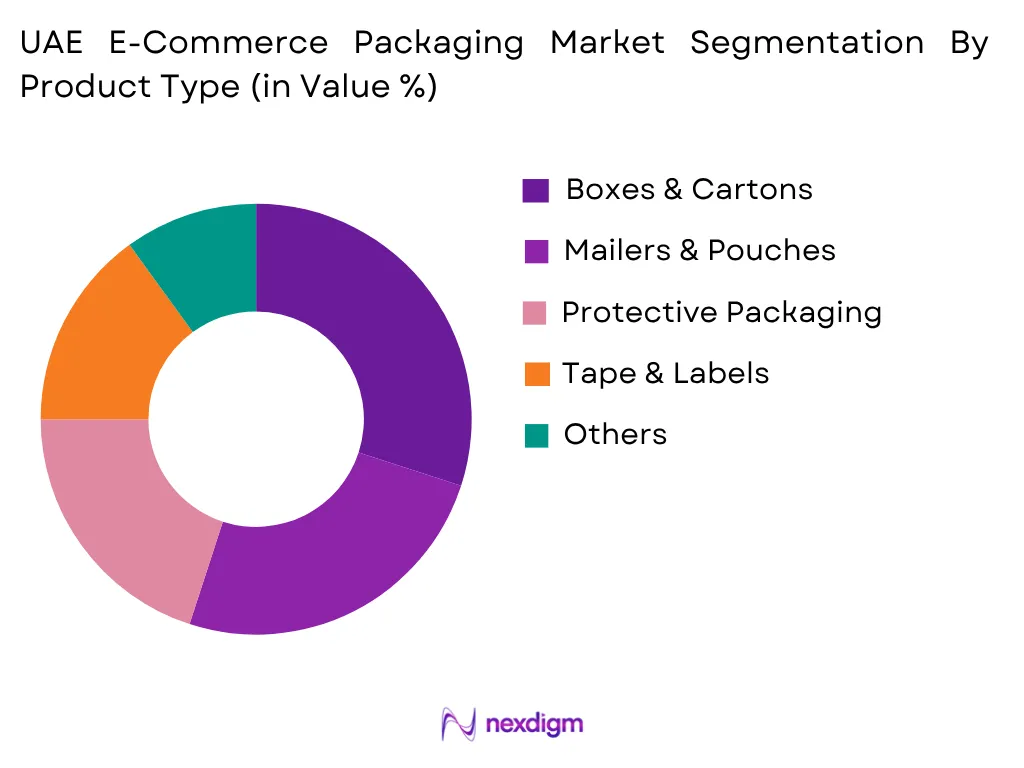
Boxes & Cartons, particularly micro-flute formats optimized for last-mile efficiency, represent the largest product-type segment in the UAE E-Commerce Packaging Market, directly tied to Amazon UAE and Noon’s expanding fulfillment operations. The Make It in the Emirates incentive program, offering ten-year tax holidays and subsidized land to local converters, has encouraged investment in digital-print folder-gluer technology capable of profitably handling sub-5,000-unit production runs demanded by flash-sale retailers, supporting rapid growth in customized, short-run packaging formats. Mailers & Pouches continue to expand alongside the UAE’s growing fashion and apparel e-commerce category, favored for their reduced weight and material efficiency relative to rigid boxes. Insulated & Cold-Chain Packaging represents a distinctive and fast-growing segment, driven by the UAE’s expanding food and grocery delivery sector, where aluminum foil trays with paperboard lids have become the preferred format for cloud-kitchen deliveries given their proven heat resilience across the region’s extreme summer temperatures.
Competitive Landscape
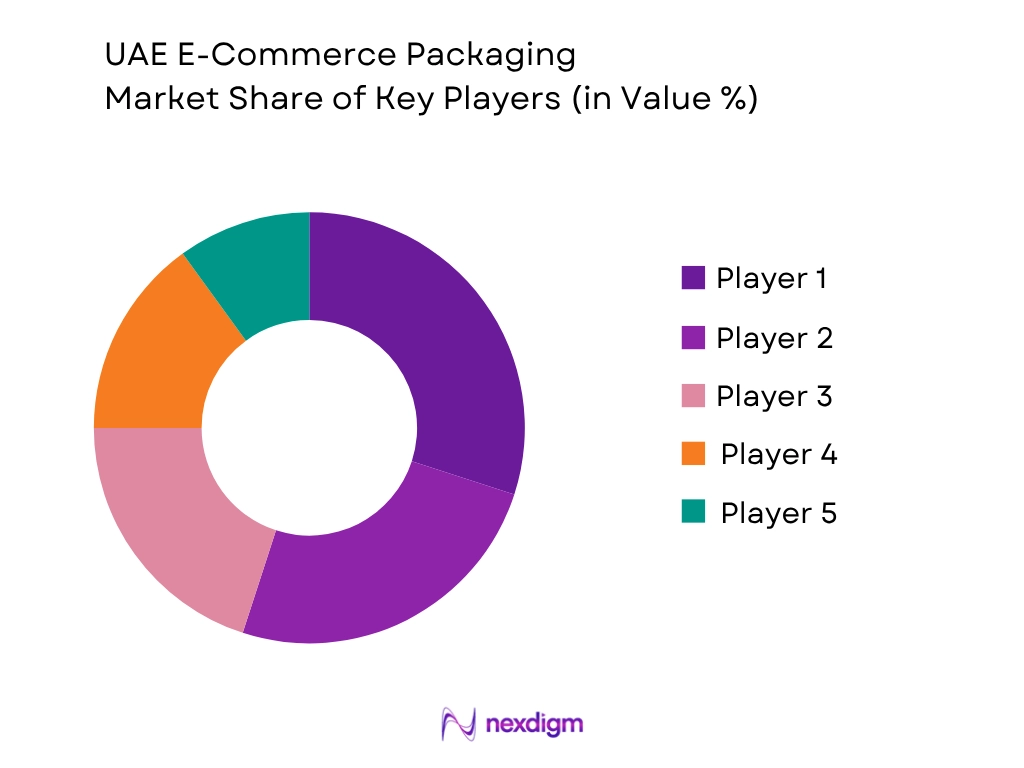
The UAE E-Commerce Packaging Market exhibits moderate fragmentation, led by Hotpack Packaging Industries, which commands approximately 15.2% market share leveraging ten domestic manufacturing plants and a growing export pipeline extending to 100 countries, underscored by the company’s USD 100 million New Jersey factory inaugurated in May 2025 as part of a strategic pivot toward dollar-denominated revenues that hedge foreign-exchange exposure. Falcon Pack follows with approximately 11.8% share, having built a competitive position focused on disposables that comply with Dubai’s single-use plastic ban through early adoption of mono-material polypropylene formats. Huhtamaki consolidated its UAE production sites into a single Jebel Ali facility in 2024 to improve operational efficiency and better align with regional sustainability standards, while global majors including Amcor and Mondi continue expanding regional distribution capability to serve both multinational e-commerce platforms and the UAE’s growing base of direct-to-consumer brands. Industrial zones including Dubai Industrial City and Jebel Ali Free Zone (JAFZA) continue to attract sustained investment in advanced printing and packaging technologies from both domestic and international converters.
| Company | Established | Headquarters | Primary Product Portfolio | Natural Color Portfolio | Manufacturing Presence | Major End-Use Industries | Key Strategic Focus | Certifications & Compliance |
| Hotpack Packaging Industries | 1995 | ~ | ~ | ~ | ~ | ~ | ~ | ~ |
| Falcon Pack | 2005 | ~ | ~ | ~ | ~ | ~ | ~ | ~ |
| Huhtamaki | 1920 | ~ | ~ | ~ | ~ | ~ | ~ | ~ |
| Amcor plc | 1860 | ~ | ~ | ~ | ~ | ~ | ~ | ~ |
| Mondi Group | 1967 | ~ | ~ | ~ | ~ | ~ | ~ | ~ |
UAE E-Commerce Packaging Market Analysis
Growth Drivers
E-Commerce Fulfillment Growth and Marketplace Expansion
The UAE e-commerce packaging market is experiencing sustained growth due to rapid expansion of the country’s e-commerce fulfillment infrastructure, with e-commerce fulfillment specifically projected to top USD 9.2 billion in 2026. Amazon UAE and Noon have each substantially expanded their fulfillment center networks since 2024, with Noon’s Dubai South site alone processing more than 1 million parcels during peak shopping months, directly amplifying demand for right-sized shipping boxes and cushioned mailers. This fulfillment expansion has structurally reshaped the UAE’s packaging supply base, lifting last-mile corrugated packaging to approximately 40% of national box output in 2025, up sharply from approximately 25% in 2020. As UAE e-commerce platforms continue to scale operations and compete on delivery speed and packaging quality, sustained investment in fulfillment center capacity is expected to continue driving proportional growth in demand for protective, branded, and increasingly sustainable packaging formats across the market.
Single-Use Plastic Ban Driving Sustainable Packaging Transition
The UAE’s aggressive regulatory timeline targeting single-use plastics continues to reshape material selection across the e-commerce packaging value chain. The Single-Use Plastic Bags Ban, implemented by the Environment Agency Abu Dhabi and Dubai’s Executive Council in 2024, prohibits thin single-use plastic bags across retail, e-commerce, and food delivery channels, with penalties beginning at AED 200 and doubling to AED 2,000 for repeat non-compliance. Dubai extended this regulatory trajectory by banning polystyrene and straws in 2025, with a nationwide single-use plastics ban targeting plastic plates and food containers scheduled for 2026, directly affecting the packaging formats e-commerce and food delivery platforms can specify. Major retailers including Lulu, Carrefour, and Spinneys have already transitioned to offering reusable kraft paper bags at checkout in response to these regulations, while Amazon UAE and Noon have each incorporated more paper-based packaging for deliveries to reduce environmental footprint and enhance customer satisfaction. This regulatory momentum continues to accelerate e-commerce sellers’ shift toward paper-based, mono-material, and other compliant packaging alternatives across the UAE market.
Market Challenges
Decentralized Emirate-Level Enforcement Fragmentation
The UAE E-Commerce Packaging Market continues to navigate a decentralized approach to single-use plastic enforcement, with Dubai leading implementation while other emirates, including Fujairah, have yet to formalize equivalent bans, requiring packaging suppliers and e-commerce sellers to maintain agile, emirate-specific compliance strategies rather than a single uniform national standard. This regulatory fragmentation complicates packaging specification decisions for e-commerce platforms and third-party sellers operating across multiple emirates, as materials and formats compliant in Dubai may not yet be mandatory, though they may still be commercially preferable, in emirates with less advanced regulatory timelines. Packaging suppliers serving national e-commerce platforms must therefore design compliance strategies capable of satisfying the most stringent emirate-level requirements while remaining cost-competitive in markets with comparatively relaxed enforcement, adding operational complexity relative to markets with unified federal packaging regulations.
Recycling Infrastructure Gaps for Thin Films and Flexible Formats
The UAE E-Commerce Packaging Market faces meaningful recycling infrastructure limitations that constrain full circularity for flexible and thin-film packaging formats increasingly favored by e-commerce and food delivery sellers. AI-enabled optical sorting systems currently achieve approximately 91% accuracy when processing rigid bottles but struggle significantly with films thinner than 50 microns, forcing brand owners and packaging suppliers to pay higher gate fees for energy-from-waste disposal of these harder-to-recycle formats. Planned 100-megawatt waste-to-energy plants in Abu Dhabi and Dubai will help treat hard-to-recycle residues but cannot fully close the loop for genuine value-chain circularity, leaving a persistent infrastructure deficit that restrains momentum toward fully circular flexible packaging systems. This infrastructure gap creates a structural tension for e-commerce sellers seeking to specify lightweight, cost-efficient mono-material mailers and films, as these formats often fall outside the effective range of the UAE’s current mechanical recycling and sorting capability, even as regulatory pressure continues pushing the market toward lighter, more flexible packaging solutions.
Market Opportunities
Growth in Digital Printing for Short-Run and Flash-Sale Packaging
The Make It in the Emirates incentive program, offering local converters ten-year tax holidays and subsidized land, is encouraging substantial investment in digital-print folder-gluer technology capable of profitably handling sub-5,000-unit production runs demanded by flash-sale retailers and direct-to-consumer brands. This shift toward digital printing capability creates significant opportunity for converters seeking to serve the UAE’s growing base of smaller e-commerce sellers and brand owners who require customized, branded packaging without the volume commitments traditionally associated with conventional flexographic or offset printing. As UAE e-commerce platforms increasingly compete on unboxing experience and brand differentiation, packaging suppliers capable of offering rapid-turnaround, customized digital printing are well positioned to capture growing demand from flash-sale campaigns, limited product drops, and personalized packaging initiatives increasingly common across the region’s fast-growing direct-to-consumer brand ecosystem.
Cold-Chain and Heat-Resilient Packaging for Food Delivery Growth
The UAE’s rapidly expanding food and grocery delivery sector creates substantial opportunity for packaging suppliers specializing in insulated and heat-resilient formats suited to the region’s extreme climate conditions. Aluminum foil trays paired with paperboard lids now account for approximately 45% of the cloud-kitchen packaging segment, having proven their ability to withstand 30-minute motorcycle delivery rides in temperatures reaching 40 degrees Celsius without warping, directly displacing banned expanded polystyrene foam containers. As quick-commerce and food delivery platforms including Talabat and Careem continue expanding across the UAE, demand for validated, heat-tolerant packaging formats capable of maintaining food quality and safety across extended delivery transit times is expected to grow correspondingly. Packaging suppliers that can combine proven heat resilience with the UAE’s tightening sustainability requirements, offering recyclable or compostable alternatives to conventional foam and plastic formats, are well positioned to capture premium contract positioning from the region’s expanding cloud-kitchen and food delivery ecosystem.
Future Outlook
The UAE E-Commerce Packaging Market is expected to witness robust expansion over the forecast period, supported by continued fulfillment center investment from Amazon UAE and Noon, the UAE’s aggressive single-use plastics regulatory timeline extending through the 2026 nationwide ban, and sustained government incentives under the Make It in the Emirates program encouraging local packaging manufacturing capacity. Continued investment in mono-material recyclable formats, digital printing capability, and heat-resilient cold-chain packaging will further shape competitive positioning across the industry. The market is also likely to benefit from planned waste-to-energy infrastructure investment in Abu Dhabi and Dubai, even as the industry continues navigating the recycling infrastructure gaps that currently constrain full circularity for thin-film and flexible packaging formats.
Major Players
- Hotpack Packaging Industries
- Falcon Pack
- Huhtamaki
- Amcor plc
- Mondi Group
- International Paper Company
- Sonoco Products Company
- DS Smith plc
- Gulf Packaging Systems
- Union Paper Mills Co. LLC
- ALPLA Werke Alwin Lehner GmbH
- Berry Global, Inc.
- Sealed Air Corporation
- Smurfit Westrock plc
- TriMas Corporation
Key Target Audience
- E-Commerce Packaging Manufacturers
- E-Commerce Marketplaces & Online Retailers
- Direct-to-Consumer Retail Brands
- Third-Party Logistics Providers
- Food & Grocery Delivery Platforms
- Investment and Venture Capitalist Firms
- Government and Regulatory Bodies (Environment Agency Abu Dhabi (EAD), Dubai Municipality, Ministry of Climate Change and Environment)
- Raw Material Suppliers and Paper Producers
Research Methodology
Step 1: Identification of Key Variables
The research process begins with identifying the complete ecosystem of the UAE E-Commerce Packaging Market, including raw material suppliers, packaging converters, printing technology providers, e-commerce marketplaces, logistics providers, and regulatory authorities. Extensive secondary research is conducted using company annual reports, government publications, trade associations, customs statistics, industry journals, and proprietary databases to determine the variables influencing market demand, pricing, production, consumption, and technological developments.
Step 2: Market Analysis and Construction
Historical market information is collected and analyzed to estimate market size, production volumes, import-export activity, application-wise demand, and pricing trends. A combination of top-down and bottom-up approaches is used to estimate market revenues and validate segment-level performance. Consumption patterns across fashion, electronics, food delivery, and beauty e-commerce packaging are evaluated to establish an accurate representation of the industry.
Step 3: Hypothesis Validation and Expert Consultation
The preliminary findings are validated through Computer-Assisted Telephone Interviews (CATIs) and structured discussions with e-commerce packaging converters, procurement managers, distributors, packaging engineers, logistics executives, and senior executives operating within the UAE e-commerce and packaging industries. These interviews help verify market assumptions, competitive developments, technology adoption trends, pricing dynamics, and future investment opportunities while refining the overall market estimates.
Step 4: Research Synthesis and Final Output
The final stage integrates insights obtained from primary interviews with quantitative information collected through secondary sources. Data triangulation techniques are applied to reconcile differences between supply-side and demand-side estimates, ensuring robust market forecasting. The report is then reviewed through multiple quality assurance checkpoints to deliver a comprehensive analysis covering market size, segmentation, competitive landscape, future outlook, and strategic recommendations for industry stakeholders.

- Executive Summary
- Research Methodology (Market Definitions and Assumptions, Abbreviations, Market Sizing Approach, Top-Down Analysis, Bottom-Up Analysis, Demand-Side Assessment, Supply-Side Assessment, Primary Industry Interviews, Secondary Research Validation, Data Triangulation, Forecasting Framework, Limitations and Future Conclusions)

- Definition and Scope
- Market Evolution and Industry Genesis
- Timeline of Major Industry Developments
- E-Commerce Packaging Industry Value Chain Analysis
- Supply Chain Analysis

- Growth Drivers (E-Commerce Fulfillment Growth & Marketplace Expansion, Single-Use Plastic Ban Driving Sustainable Packaging Shift, Make It in the Emirates Localization Incentives, Growth in Quick-Commerce & Food Delivery, Rising Cross-Border E-Commerce Volumes, Free Zone-Enabled Manufacturing Investment)
- Market Challenges (Decentralized Emirate-Level Enforcement Fragmentation, Recycling Infrastructure Gaps for Thin Films, Raw Material Price Volatility, Import Dependency for Specialty Substrates, Extreme Heat Packaging Performance Requirements, Compliance Cost Burden for Smaller Converters)
- Market Opportunities (Growth in Digital Printing for Short-Run & Flash-Sale Packaging, Cold-Chain & Heat-Resilient Packaging for Food Delivery, Mono-Material Recyclable Format Innovation, Export-Oriented Manufacturing under Make It in the Emirates, Waste-to-Energy & Circular Infrastructure Investment, Right-Sizing & Lightweight Packaging Adoption)
- Market Trends (Growth in Right-Sized & Lightweight Boxes, Rising Aluminum & Paperboard Cloud-Kitchen Formats, AI-Enabled Sorting & Recycling Technology, Mono-Material Film Substitution, Digital Print Adoption for Mass Customization, Reusable Crate & Container Pilots)
- Government Regulations (Single-Use Plastic Bags Ban (2024), Dubai Polystyrene & Straws Ban (2025), Nationwide Single-Use Plastics Ban (2026), Make It in the Emirates Fiscal Incentives, Dubai Waste Management Strategy 2041, Extended Producer Responsibility Framework Development)
- Import and Export Analysis (Trade Volume, Major Import Sources, Export Destinations, HS Code Analysis, Trade Balance)
- Raw Material Availability Analysis (Imported Kraft Linerboard & Pulp, Recycled Fiber Feedstock, Mono-Material Polypropylene Films, Aluminum Foil Stock, Bio-Based & Compostable Materials)
- Technology Landscape (Digital Print Folder-Gluer Technologies, AI-Enabled Optical Sorting Systems, Automated Box-Making & Corrugation Technologies, Insulated Packaging Technologies, Waste-to-Energy Processing Infrastructure)
- Sustainability Assessment (Mono-Material Recyclability, Post-Consumer Recycled Content Adoption, Waste-to-Energy Integration, Reusable Packaging Pilots, Circular Economy Partnerships)
- PESTLE Analysis
- SWOT Analysis
- Porter’s Five Forces Analysis
- Stakeholder Ecosystem
- Competition Ecosystem

- By Market Value (2020-2025)
- By Volume Consumption (2020-2025)
- By Average Selling Price (2020-2025)

- By Material Type (In Value %)
Corrugated Cardboard & Paperboard
Plastic (Mono-Material Mailers & Films)
Paper & Kraft Paper
Protective & Void-Fill Materials
Biodegradable & Compostable Materials - By Product Type (In Value %)
Boxes & Cartons (Micro-Flute)
Mailers & Pouches
Protective Packaging
Tape & Labels
Insulated & Cold-Chain Packaging - By Application (In Value %)
Fashion & Apparel
Electronics & Electricals
Food & Grocery Delivery
Beauty & Personal Care
Home & Furniture
Others - By End User (In Value %)
E-Commerce Marketplaces
Direct-to-Consumer Retail Brands
Third-Party Logistics Providers
Food & Grocery Delivery Platforms
Cloud Kitchens & Dark Stores - By Region (In Value %)
Dubai
Abu Dhabi
Sharjah
Ras Al Khaimah
Other Emirates

- Market Share of Major Players (By Value, Volume, Material Type, Application, Product Category)
- Cross Comparison Parameters (Product Portfolio Breadth, Mono-Material & Recycled-Content Capability, Digital Printing Capacity, Application Technical Support, Manufacturing Capacity, Regulatory Compliance & Certifications, Marketplace Customer Base, Innovation & New Product Launch Frequency)
- SWOT Analysis of Major Players
- Pricing Analysis by Product Category and Format
- Production Capacity Analysis
- Manufacturing Footprint Analysis
- Distribution Network Analysis
- Innovation Benchmarking
- Detailed Profiles of Major Companies
Hotpack Packaging Industries
Falcon Pack
Huhtamaki
Amcor plc
Mondi Group
International Paper Company
Sonoco Products Company
DS Smith plc
Gulf Packaging Systems
Union Paper Mills Co. LLC
ALPLA Werke Alwin Lehner GmbH
Berry Global, Inc.
Sealed Air Corporation
Smurfit Westrock plc
TriMas Corporation

- Consumption Pattern Analysis (Order Volume, Batch Size, Product Category Penetration, Peak Season Demand, Fulfillment Model Activity)
- Purchasing Criteria (Regulatory Compliance, Cost per Shipment, Protective Performance, Recyclability, Heat Resilience, Lead Time)
- Procurement and Supplier Selection Analysis
- Recycled-Content Adoption Assessment
- Marketplace-Fulfilled vs Seller-Fulfilled Packaging Demand
- Product Attribute Preference Analysis (Damage Protection, Tamper-Evidence, Print & Branding Quality, Recyclability, Weight Efficiency, Heat Tolerance)
- Regulatory Compliance Influence on Packaging Investment
- Pain Point Analysis
- Decision-Making Process

- By Market Value (2026-2035)
- By Volume Consumption (2026-2035)
- By Average Selling Price (2026-2035)


 Request a Sample
 Ask for Customization
 Get a Quote
 Enquire Now