
 Download PDF
Market Overview
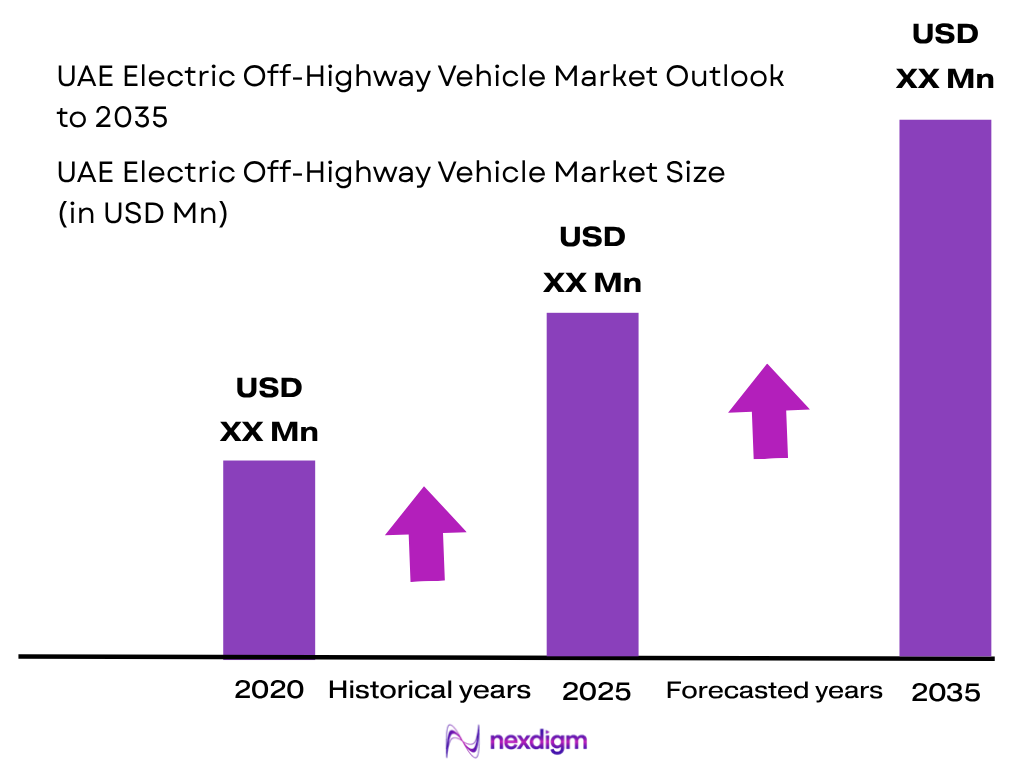
The UAE Electric Off-Highway Vehicle Market is valued at ~USD XX million in 2024, with demand supported by construction, logistics, ports, industrial operations and the country’s transition toward lower-emission equipment. The UAE’s construction sector expanded by 8.4% in 2024, while transport and storage grew by 9.6%, creating favorable operating environments for electric material-handling, construction and utility equipment. (Federal Customs Authority) The market is additionally supported by the UAE Net Zero 2050 Strategy, which explicitly covers construction, industry and transport and includes more than 25 programs across six sectors.
Dubai and Abu Dhabi represent the principal demand centers because they combine large construction programs, ports, logistics zones, industrial facilities and government-led sustainability initiatives. Dubai’s energy strategy targets 30% savings in electricity, water and transport-fuel consumption by 2030 and 50% by 2050 compared with business as usual, supporting efficiency-oriented equipment adoption. Dubai also has an established EV-charging regulatory framework, while the federal government introduced technical regulations for EV supply equipment that became effective in 2026. (Dubai Electricity and Water Authority) Abu Dhabi provides an additional growth cluster through construction, industrial and logistics activity.
Market Segmentation
By Propulsion Type
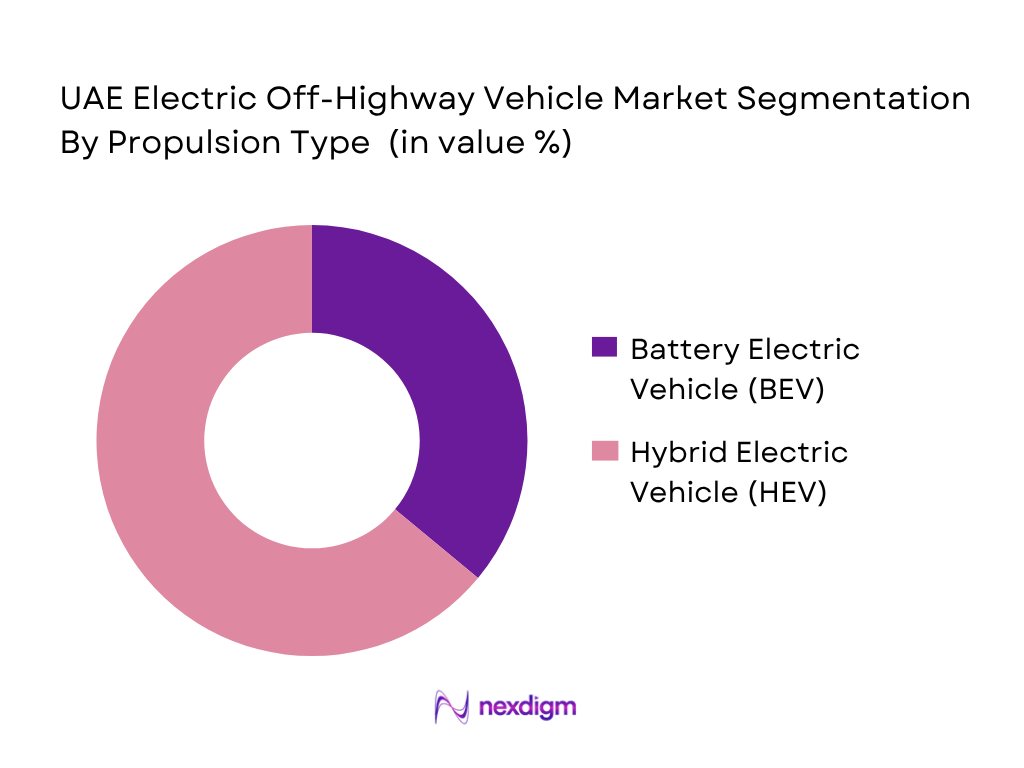
The UAE Electric Off-Highway Vehicle Market is segmented by propulsion type into Battery Electric Vehicles (BEV) and Hybrid Electric Vehicles (HEV). HEVs currently represent the dominant sub-segment, supported by applications where operators require extended operating duration, high load capability and reduced dependence on charging infrastructure. This is particularly relevant for construction and heavy industrial operations where equipment can operate for long shifts and where charging availability at temporary worksites can be limited. HEVs provide a transitional technology by retaining an internal-combustion power source while incorporating electric drive or energy-recovery systems. At the same time, BEVs are gaining strategic importance in controlled applications such as warehouses, ports, indoor construction environments and fixed industrial sites where charging can be scheduled around operating cycles. The UAE’s broader decarbonization agenda and development of charging infrastructure strengthen the long-term case for BEVs. The government’s Net Zero 2050 Strategy specifically covers industry, transport and buildings, creating a policy environment favorable to progressively lower-emission equipment.
By Vehicle Type
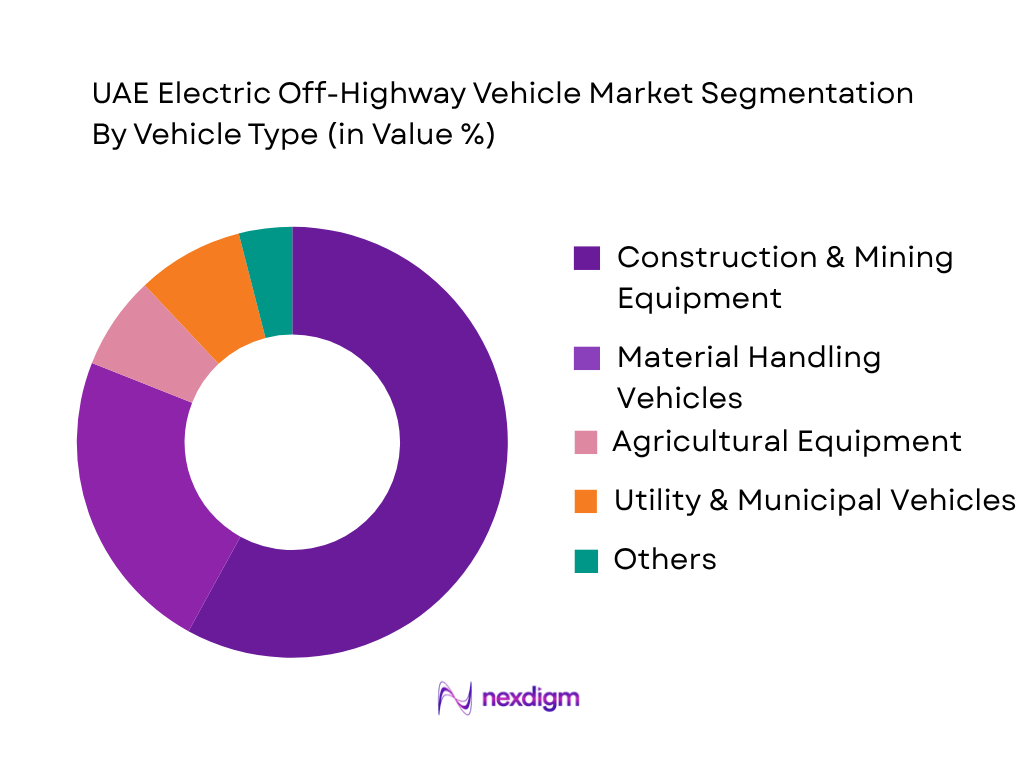
The UAE Electric Off-Highway Vehicle Market is segmented by vehicle type into construction and mining equipment, material-handling vehicles, agricultural equipment, utility and municipal vehicles, and other specialized off-highway vehicles. Construction and mining equipment is expected to represent the leading sub-segment, reflecting the UAE’s substantial infrastructure and real-estate development activity. Electric compact excavators, loaders, skid-steer machines, telehandlers and other equipment can be particularly suitable for urban projects, enclosed worksites and noise-sensitive environments. The construction sector expanded by 8.4% in 2024, making it an important current demand base for equipment modernization. (Federal Customs Authority) Material-handling vehicles form another important application because logistics facilities and ports offer predictable routes and centralized operating locations. Electric equipment is therefore increasingly practical where charging can be integrated into depots. Dubai’s charging framework and the UAE’s wider EVSE regulations provide an emerging infrastructure foundation for electrified equipment, although off-highway machinery will continue to require application-specific charging, battery and power-management solutions.
Competitive Landscape
The UAE market is characterized by established global construction-equipment manufacturers, agricultural-equipment companies, material-handling specialists and emerging electric-equipment providers. Competition is increasingly shifting from conventional machine specifications toward battery capacity, operating hours, charging compatibility, thermal management, connected equipment, service support and total cost of ownership. Global manufacturers including Caterpillar, Volvo Construction Equipment, Komatsu, JCB, Hitachi Construction Machinery and CNH Industrial have significant relevance across construction, earthmoving and industrial equipment. Published UAE market research also identifies Caterpillar, Volvo, Komatsu, Deere, Sandvik, Hitachi Construction Machinery, Epiroc, CNH Industrial and JCB among relevant global players.
| Company | Establishment | Headquarters | Key Product Focus | Electric Technology | UAE Relevance | Application Focus | Service Capability | Connected Equipment |
| Caterpillar | 1925 | Irving, USA | ~ | ~ | ~ | ~ | ~ | ~ |
| Volvo Construction Equipment | 1832 | Gothenburg, Sweden | ~ | ~ | ~ | ~ | ~ | ~ |
| Komatsu | 1921 | Tokyo, Japan | ~ | ~ | ~ | ~ | ~ | ~ |
| JCB | 1945 | Rocester, UK | ~ | ~ | ~ | ~ | ~ | ~ |
| Hitachi Construction Machinery | 1949 | Tokyo, Japan | ~ | ~ | ~ | ~ | ~ | ~ |
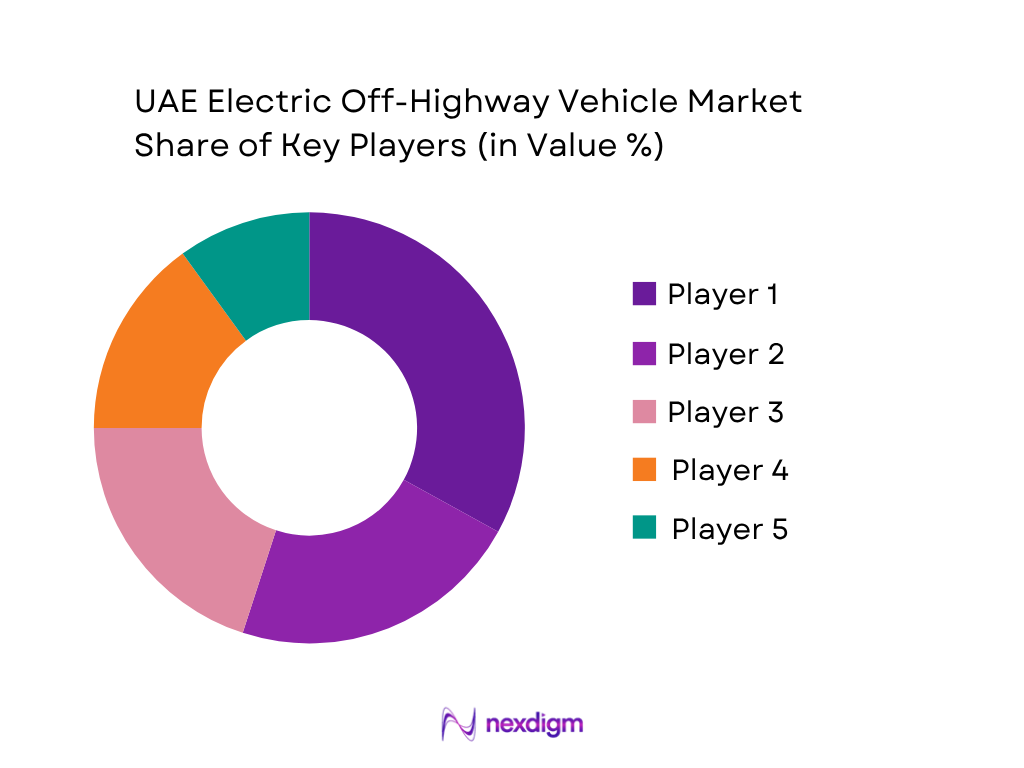
UAE Electric Off-Highway Vehicle Market Analysis
Growth Drivers
Port Electrification and Logistics Activity
The UAE’s concentrated port and logistics infrastructure is creating a practical operating base for electric off-highway equipment, particularly electric terminal tractors, internal terminal vehicles and container-handling equipment. Jebel Ali Port handled 15.5 million TEUs in 2024, while DP World’s UAE terminals handled 1.3 million vehicles, including nearly 960,000 vehicles at Jebel Ali, demonstrating the scale of repetitive material and cargo movements that can be electrified. (DP World) DP World had already deployed more than 30 electric terminal tractors globally by the end of 2024, while Jebel Ali and JAFZA were reported as operating with 100% renewable electricity, strengthening the case for electric equipment within controlled logistics environments. (DP World) The company subsequently expanded Jebel Ali’s electric internal-terminal-vehicle fleet from 14 units to 146 units, supported by rapid-charging infrastructure, demonstrating that electrification is moving beyond pilot-scale deployment. (DP World) The broader economic environment also supports equipment modernization. World Bank data records UAE GDP at US$552.32 billion and GDP per capita at US$50,273.5 in 2024, while real GDP growth reached 4.0. (World Bank Open Data) The World Bank also identified transportation, construction, manufacturing and tourism as important contributors to non-hydrocarbon activity, reinforcing the operating base for electric construction, warehouse and logistics equipment.
Construction, Mega-Projects and Equipment Modernisation
Construction and real-estate activity provide another major demand channel because UAE projects require continuous movement of aggregates, concrete, materials, components and equipment across sites, creating applications for electric excavators, compact loaders, forklifts, utility vehicles and other off-highway machinery. Dubai recorded 226,000 real-estate transactions with a combined value of AED761 billion in 2024, while total real-estate procedures reached 2.78 million, indicating substantial development and project activity across the emirate. (Government of Dubai Media Office) The UAE’s broader economic expansion also provides a supportive environment for capital-intensive equipment renewal: the World Bank recorded 4.0 real GDP growth and US$552.32 billion of GDP in 2024. (World Bank Open Data) Electrification is particularly relevant where equipment operates repeatedly within defined construction, warehouse or industrial environments because charging can be coordinated around shift patterns. Port electrification provides an established reference point: the electric fleet at Jebel Ali expanded to 146 internal terminal vehicles by October 2025, while 11 electric empty-container handlers had also been deployed. (DP World) Such deployments demonstrate the applicability of battery-powered equipment for high-utilization duty cycles and create operational knowledge around charging, maintenance, battery management and fleet scheduling. Continued project activity therefore supports replacement of older diesel equipment while increasing the addressable base for electric machinery and digitally managed fleets.
Market Challenges
Battery Runtime, Heat Exposure and Heavy-Duty Duty Cycles
UAE operating conditions create specific technical barriers for electric off-highway equipment because machinery can face high ambient temperatures, intensive utilization, heavy payloads and long operating shifts. These conditions directly affect battery thermal management, usable energy, charging requirements and equipment availability. The challenge is particularly relevant for construction and material-handling equipment that cannot always return to a depot between operating cycles. Unlike controlled warehouse applications, excavators, loaders and utility equipment may operate across dispersed worksites where charging access is limited. The UAE’s strong economic activity increases the importance of maintaining equipment productivity: World Bank data records US$552.32 billion of GDP and US$50,273.5 GDP per capita in 2024, while real GDP expanded by 4.0. (World Bank Open Data) This economic scale supports high equipment utilization but also raises the operational cost of downtime. Port operations illustrate the infrastructure requirements. DP World’s Jebel Ali electric fleet expansion was supported by a network of rapid-charging stations, demonstrating that substantial electrification requires dedicated charging infrastructure rather than relying solely on existing facilities. (DP World) For equipment with higher energy demand, operators must additionally evaluate battery capacity, charging duration, thermal controls, duty-cycle compatibility and shift scheduling. Consequently, electric mini excavators and compact loaders may achieve adoption more readily in predictable applications, whereas larger construction and specialized equipment require more careful route, load and charging planning.
Imported Components and Limited Electric-Equipment Service Capability
The UAE’s electric off-highway vehicle ecosystem remains dependent on internationally sourced equipment, batteries, power electronics, motors, charging systems and specialized components, making supply continuity and technical support important considerations for fleet operators. This dependency is reinforced by the UAE’s role as a major international trade hub. Jebel Ali handled 15.5 million TEUs in 2024, providing extensive access to imported machinery and components but simultaneously exposing operators to international shipping and supply-chain conditions. (DP World) The transition from diesel machinery to electric equipment also changes maintenance requirements: technicians must understand high-voltage systems, battery-management systems, electric drivetrains, thermal-management systems and charging hardware in addition to conventional hydraulics and mechanical systems. The challenge becomes more significant for construction fleets operating away from centralized workshops. Operators need rapid diagnostics and replacement-component availability because equipment downtime can disrupt project schedules. UAE economic activity creates strong utilization requirements; World Bank data records 4.0 real GDP growth in 2024 and GDP of US$552.32 billion, while the World Bank identifies construction, transportation and manufacturing among the country’s important non-hydrocarbon activities. (World Bank Open Data) The existing electric-port deployments show that specialized support infrastructure can be developed, but extending comparable capabilities across construction sites, warehouses and municipal fleets requires investment in technicians, mobile service, spare parts, battery diagnostics and charging maintenance. This increases the complexity of transitioning from conventional machinery to electric alternatives.
Market Opportunities
Electric Port and Material-Handling Equipment
The UAE’s port ecosystem provides one of the clearest near-term pathways for electric off-highway equipment because container terminals offer predictable routes, centralized charging locations and repetitive operating cycles. Jebel Ali handled 15.5 million TEUs in 2024, creating a substantial operating environment for electric terminal tractors, internal terminal vehicles, empty-container handlers and related equipment. (DP World) The scale of actual deployment provides evidence of current market readiness: DP World expanded its Jebel Ali electric internal-terminal-vehicle fleet from 14 units to 146 units by October 2025 and added 11 electric empty-container handlers. (DP World) An earlier electric freight programme at Jebel Ali was designed to move more than 204,000 twenty-foot containers annually, demonstrating the potential utilization of electrified equipment in continuous port operations. (DP World) These deployments create opportunities not only for vehicle manufacturers but also for charging providers, battery-management companies, fleet-optimization platforms, maintenance providers and equipment-financing businesses. Warehouse and distribution applications provide a complementary opportunity because forklifts and compact electric utility equipment can operate within defined facilities where charging infrastructure can be centralized. The UAE’s GDP reached US$552.32 billion in 2024 and real GDP growth was 4.0, supporting continued investment across logistics, transportation and industrial activities. (World Bank Open Data) The existing port electrification base therefore provides an operational template that can be extended to other high-utilization industrial applications.
Electric Construction Equipment and Integrated Fleet Solutions
Construction and infrastructure activity creates an opportunity to expand electrification beyond ports into mini excavators, compact loaders, electric utility equipment, mobile charging and digitally managed machinery. Dubai recorded AED761 billion in real-estate transactions across 226,000 transactions in 2024, while total real-estate procedures reached 2.78 million, indicating a large volume of development-related activity. (Government of Dubai Media Office) Electric compact equipment is particularly suited to urban construction, indoor projects and applications where lower local emissions and reduced noise can provide operational benefits. The UAE’s economic base also supports continued equipment investment: World Bank data records GDP of US$552.32 billion, GDP per capita of US$50,273.5 and real GDP growth of 4.0 in 2024. (World Bank Open Data) For larger equipment, the opportunity extends beyond vehicle electrification toward integrated energy and fleet-management solutions. Mobile charging can address temporary construction sites, while battery leasing can reduce the upfront equipment commitment for operators testing electric machinery. Equipment-as-a-Service can further shift procurement toward utilization-based models that combine machinery, charging, maintenance and software. Existing port deployments demonstrate the value of combining equipment with infrastructure: Jebel Ali’s expanded electric fleet operates with rapid-charging stations, while DP World has also worked on renewable-energy and battery-storage solutions for port operations. (DP World) This creates a pathway toward broader electric construction and industrial fleets managed through connected platforms.
Future Outlook
The UAE Electric Off-Highway Vehicle Market is expected to transition from pilot deployments and selected low-duty applications toward broader commercial adoption. Construction, ports, warehouses and industrial facilities are likely to remain the primary early-adoption environments because operating cycles can be controlled and charging can be centralized.
Over the longer term, improvements in battery energy density, charging infrastructure, thermal management and connected fleet systems should expand the range of commercially viable applications. The UAE’s Net Zero 2050 framework provides an additional structural incentive for equipment operators to evaluate lower-emission machinery.
Major Players
- Caterpillar Inc.
- Volvo Construction Equipment
- Komatsu Ltd.
- JCB
- Hitachi Construction Machinery Co., Ltd.
- CNH Industrial N.V.
- Deere & Company
- Sandvik AB
- Epiroc AB
- Liebherr Group
- SANY Group
- XCMG
- Hyundai Construction Equipment
- Doosan Bobcat
- Manitou Group
Key Target Audience
- Construction and Infrastructure Contractors
- Mining and Quarrying Equipment Operators
- Port and Terminal Operators
- Logistics and Warehouse Operators
- Industrial Manufacturing Companies
- Equipment Rental and Leasing Companies
- Investments and Venture Capitalist Firms
- Government and Regulatory Bodies (Ministry of Energy and Infrastructure, Ministry of Climate Change and Environment, Dubai Municipality, Roads and Transport Authority, Dubai Electricity and Water Authority)
Research Methodology
Step 1: Identification of Key Variables
The initial phase involves mapping the UAE electric off-highway vehicle ecosystem across OEMs, dealers, fleet operators, construction contractors, ports, logistics companies and charging-infrastructure providers. Secondary research is used to identify equipment categories, propulsion technologies, operating applications and regulatory variables relevant to the UAE market.
Step 2: Market Analysis and Construction
Historical equipment adoption, fleet requirements, construction activity, logistics development and electrification indicators are compiled to construct the market baseline. The analysis evaluates vehicle deployment by application, propulsion technology, operating environment, equipment capacity and fleet-use characteristics.
Step 3: Hypothesis Validation and Expert Consultation
Market hypotheses are validated through discussions with equipment manufacturers, distributors, fleet operators, construction companies and technical specialists. Interviews focus on equipment utilization, charging requirements, battery performance, purchasing criteria, replacement cycles and barriers to electric-equipment adoption.
Step 4: Research Synthesis and Final Output
Bottom-up estimates are reconciled with top-down economic and industry indicators to establish the final market assessment. Company-level information, application-level demand signals and regulatory developments are triangulated to produce market segmentation, competitive analysis and the long-term outlook.

- Executive Summary
- Research Methodology (Market Definition and Scope, Electric Off-Highway Vehicle Classification, ICE-to-Electric Conversion Boundary, Market Sizing Framework, Top-Down Assessment, Bottom-Up Assessment, Unit Sales Validation, OEM and Distributor Mapping, Fleet-Level Demand Assessment, Primary Interviews, Secondary Research, Data Triangulation, Adoption Modelling, Forecasting Framework, Scenario Analysis, Assumptions and Limitations)

- Definition and Scope
- Evolution of Electric Off-Highway Mobility in the UAE
- UAE Off-Highway Vehicle Ecosystem
- UAE Electric Off-Highway Vehicle Value Chain
- UAE Construction and Infrastructure Equipment Landscape
- UAE Port and Terminal Electrification Landscape

- Growth Drivers (Port Electrification, Construction and Mega-Project Activity, Industrial Decarbonisation, Warehouse Electrification, Equipment Modernisation, Government Sustainability Targets, Fleet Operating Efficiency)
- Market Challenges (High Initial Acquisition Requirements, Extreme Heat Exposure, Battery Runtime, Charging Infrastructure, Heavy-Duty Duty Cycles, Imported Component Dependence, Limited Electric Equipment Service Expertise, Residual-Value Uncertainty)
- Market Opportunities (Electric Port Equipment, Electric Mini Excavators, Electric Forklifts, Electric Compact Loaders, Electric Utility Equipment, Mobile Charging, Battery Leasing, Equipment-as-a-Service, Smart Fleet Management)
- Emerging Technology Trends(LFP Battery Adoption, High-Voltage Architecture, Fast Charging, Electric Hydraulics, Regenerative Braking, Integrated Electric Powertrains, Thermal Management, Battery Swapping)
- Government and Regulatory Framework (National Electric Vehicles Policy, UAE Net Zero 2050 Strategy, UAE Energy Strategy 2050, Emirate-Level EV Policies, Green Building Regulations, Battery Recycling Framework, Environmental Standards)
- Porter’s Five Forces Analysis
- PESTLE Analysis
- SWOT Analysis

- By Market Value (2020-2025)
- By Unit Sales (2020-2025)
- By Average Selling Value (2020-2025)
- By Equipment Type (2020-2025)
- By Application (2020-2025)
- By Propulsion Technology (2020-2025)
- By Battery Capacity (2020-2025)

- By Equipment Type (in value %)
Electric Excavators
Electric Mini Excavators
Electric Wheel Loaders
Electric Skid-Steer Loaders
Electric Backhoe Loaders
Electric Cranes
Electric Dumpers
Electric Forklifts
Electric Reach Trucks
Electric Utility Vehicles
Electric Mining and Quarrying Equipment
Electric Road Construction Equipment
Electric Port and Terminal Equipment - By Application (in value %)
Construction and Infrastructure
Ports and Container Terminals
Manufacturing and Industrial Facilities
Agriculture and Landscaping
Mining and Quarrying
Road Construction
Municipal Operations
Oil and Gas Support Operations
Airports and Aviation Ground Operations - By Propulsion Technology (in value %)
Battery Electric
Hybrid Electric
Plug-in Hybrid Electric
Hydrogen Fuel Cell
Hydrogen Internal Combustion
Other Alternative Powertrains - By Battery Capacity ( in value %)
Below 50 kWh
50–150 kWh
151–300 kWh
301–500 kWh
Above 500 kWh - By Power Output ( in value %)
Below 50 kW
50–100 kW
101–200 kW
201–400 kW
Above 400 kW - By Operating Weight ( in value %)
Below 5 Tons
5–10 Tons
10–20 Tons
20–40 Tons
Above 40 Tons

- Market Share of Major Players (By Revenue, Unit Sales, Equipment Type, Application, Propulsion Technology, Battery Capacity, Equipment Weight and Emirate)
- Cross Comparison Parameters (Electric Equipment Portfolio Breadth, Electric Model Count, Battery Capacity Range, Maximum Operating Power, Battery Runtime, Charging Technology Capability, UAE Dealer and Service Network Coverage, Telematics and Autonomous Technology Capability)
- SWOT Analysis of Major Players
- Detailed Profiles of Major Companies
Caterpillar
Komatsu
Volvo Construction Equipment
JCB
Hitachi Construction Machinery
Liebherr
SANY
XCMG
Hyundai Construction Equipment
Doosan Bobcat
Toyota Material Handling
Mitsubishi LogisnextJungheinrich
Manitou
BYD

- Equipment Purchase Behavior
- Application-Based Demand
- Fleet Electrification Readiness
- Buyer Decision-Making Criteria
- Electric Equipment Adoption Barriers
- Ownership and Procurement Preferences

- By Market Value (2026-2035)
- By Unit Sales (2026-2035)
- By Average Selling Value (2026-2035)
- By Equipment Type (2026-2035)
- By Application (2026-2035)
- By Propulsion Technology (2026-2035)
- By Battery Capacity (2026-2035)


 Request a Sample
 Ask for Customization
 Get a Quote
 Enquire Now