
 Download PDF
Market Overview
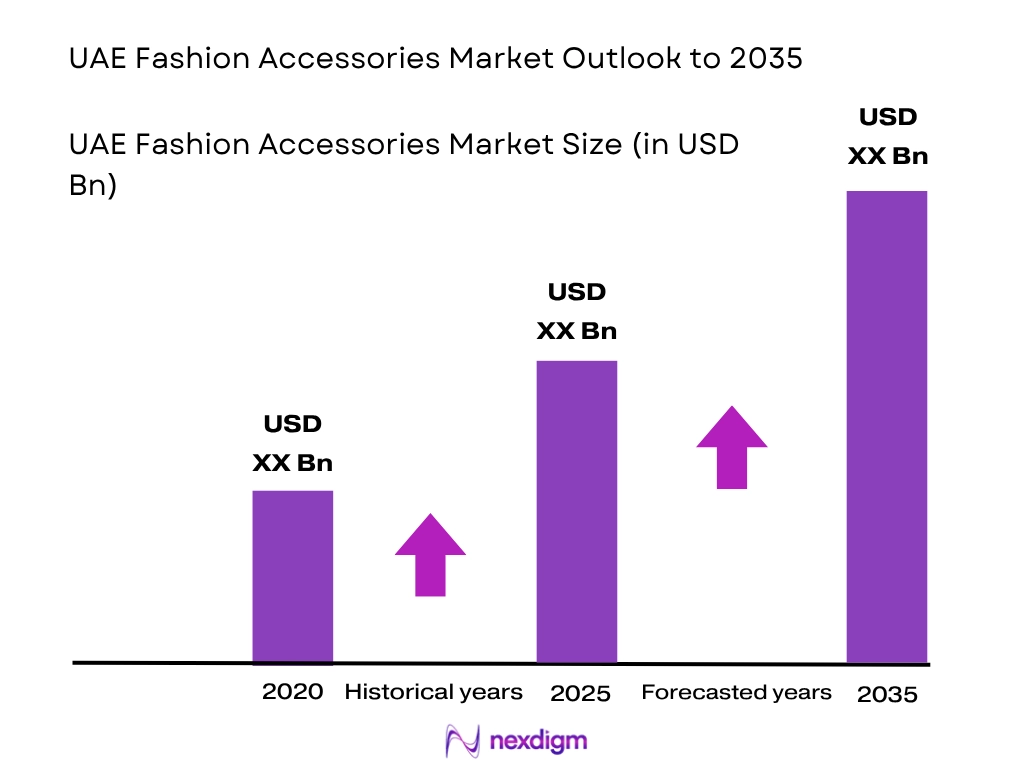
The UAE Fashion Accessories Market is valued at USD ~ billion, based on Nexdigm’s country-level market assessment, with handbags identified as the largest product segment. The market is forecast to expand at a 7.96% CAGR over the available forecast window; this CAGR is used as the forward benchmark for the extended business-planning horizon. Demand is supported by luxury retail, jewellery culture, tourism shopping, e-commerce access and high mall productivity.
Dubai and Abu Dhabi dominate the UAE Fashion Accessories Market due to their luxury malls, affluent resident base, high tourist flow, airport retail, online luxury fulfilment and concentration of global fashion houses. Dubai welcomed 18.72 million international overnight visitors, above the previous benchmark of 17.15 million, while Dubai Mall recorded 57 million visitors in H1, compared with 52 million in the comparable period. UAE hotels also hosted 15.3 million guests in H1, reinforcing tourism-led accessories demand.
Market Segmentation
By Product Category
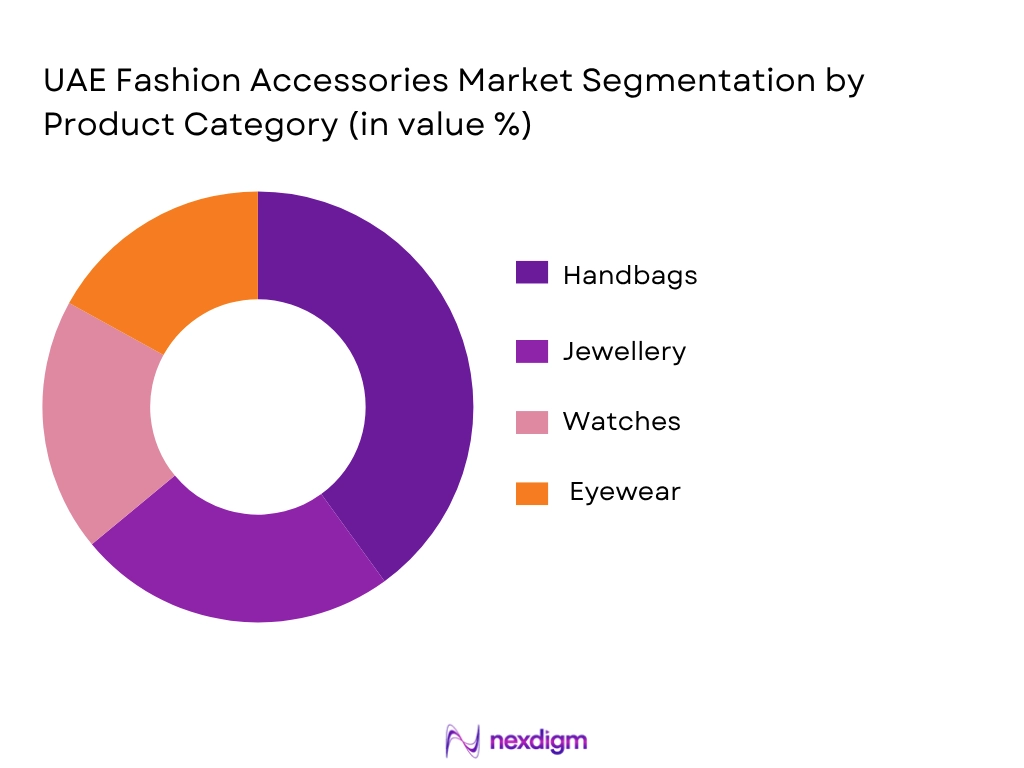
UAE Fashion Accessories Market is segmented by product category into handbags, jewellery, watches and eyewear. Handbags hold the dominant market share because they combine luxury signalling, practical usage, gifting relevance and strong visibility across malls, online luxury platforms and mono-brand boutiques. Designer handbags and premium work bags are especially important in Dubai and Abu Dhabi, where affluent residents, GCC tourists and international shoppers purchase accessories as lifestyle and status products. Jewellery follows closely because of the UAE’s gold-buying culture, wedding demand, South Asian expatriate base and gifting cycles. Watches remain concentrated in specialist luxury retailers, while eyewear benefits from tourist demand, climate-driven sunglass usage and fashion-led prescription frames. Nexdigm research discloses handbags at USD ~ billion within a total market of USD ~ billion, making handbags the largest product segment.
By Distribution Channel
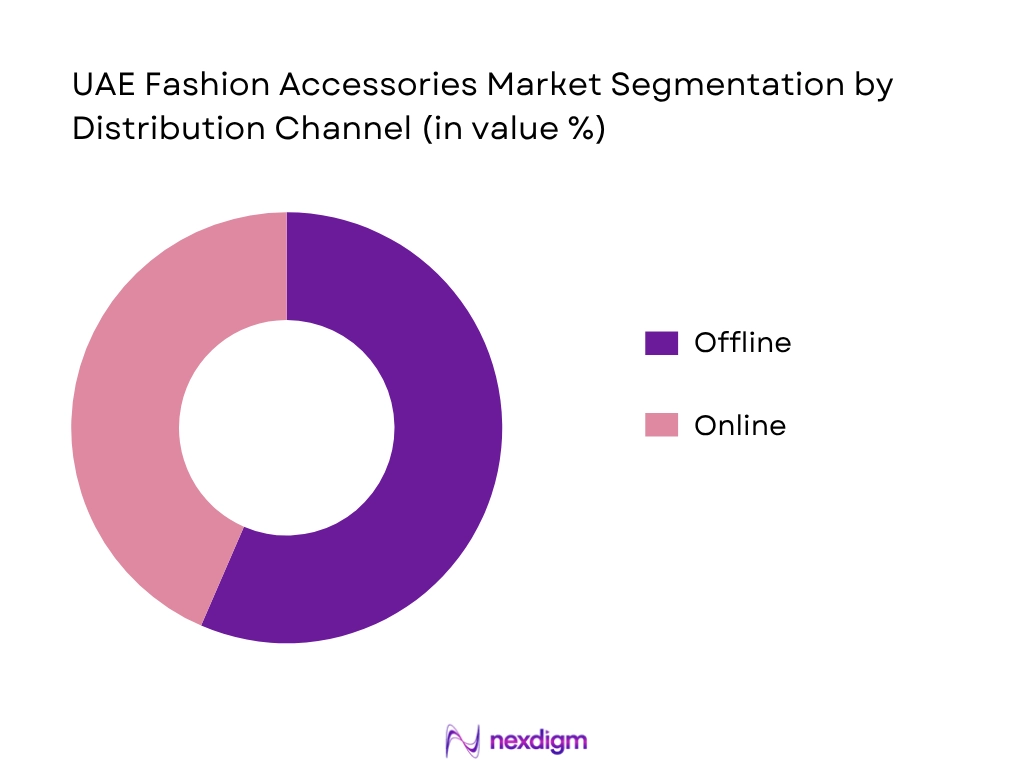
UAE Fashion Accessories Market is segmented by distribution channel into offline and online channels. Offline retail dominates the market because fashion accessories in the UAE are highly experiential, particularly for designer handbags, jewellery, watches and eyewear, where consumers prefer product trial, authentication, aftersales consultation, resizing, warranty handling and luxury packaging. Dubai Mall, Mall of the Emirates, The Galleria Al Maryah Island, Yas Mall and traditional gold retail corridors create strong in-person conversion. Offline retail also benefits from tourist impulse buying and luxury clienteling. Online channels are expanding rapidly through Ounass, Namshi, Noon, Amazon.ae, Farfetch and brand-owned websites, supported by mobile commerce, same-day delivery, curated luxury edits and marketplace breadth. However, authentication, product feel, fit and high-ticket service needs keep offline retail ahead. Nexdigm research discloses offline distribution at USD ~ billion, indicating channel leadership.
Competitive Landscape
The UAE Fashion Accessories Market is moderately consolidated at the premium and luxury end, with franchise groups, luxury distributors, watch specialists, jewellery chains and online fashion platforms shaping brand access and consumer reach. Chalhoub Group, Al Tayer Insignia/Ounass, Apparel Group, Seddiqi Holding and Damas Jewellery influence the market through exclusive brand partnerships, mall footprint, digital capability, clienteling, aftersales infrastructure and category depth. Online competition is intensified by Ounass, Namshi, Noon, Amazon.ae and Farfetch, while jewellery and watches remain specialist-led.
| Company | Establishment Year | Headquarters | Core Accessory Strength | UAE Channel Strength | Luxury/Price Positioning | Omnichannel Capability | Key Customer Base | Market-Specific Advantage |
| Chalhoub Group | 1955 | Dubai, UAE | ~ | ~ | ~ | ~ | ~ | ~ |
| Al Tayer Insignia / Ounass | 1979 / 2016 | Dubai, UAE | ~ | ~ | ~ | ~ | ~ | ~ |
| Apparel Group | 1996 | Dubai, UAE | ~ | ~ | ~ | ~ | ~ | ~ |
| Ahmed Seddiqi / Seddiqi Holding | 1950 | Dubai, UAE | ~ | ~ | ~ | ~ | ~ | ~ |
| Damas Jewellery | 1907 | Dubai, UAE | ~ | ~ | ~ | ~ | ~ | ~ |
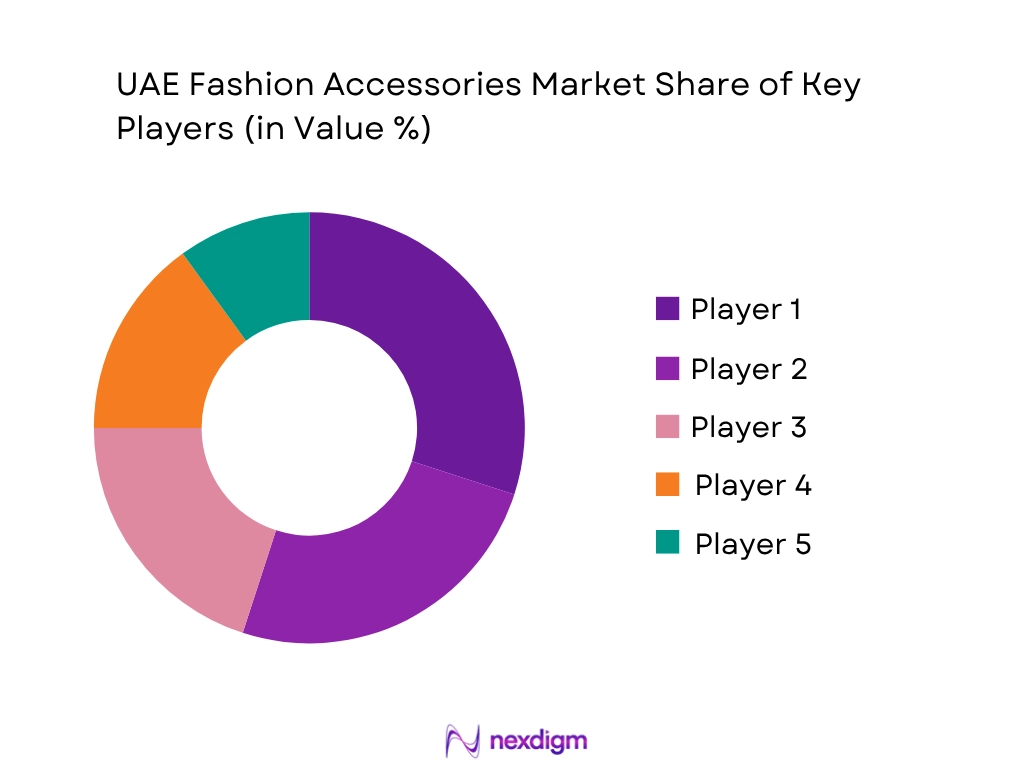
UAE Fashion Accessories Market Analysis
Growth Drivers
Affluent Resident Base
The UAE Fashion Accessories Market is strongly supported by an affluent resident base, because handbags, watches, jewellery, sunglasses and small leather goods are discretionary categories that scale with income, financial confidence and premium lifestyle consumption. The World Bank reports UAE GDP at USD 552.32 billion and GDP per capita at USD 50,273.5 in 2024, while IMF country data places UAE GDP at USD 621.55 billion in current prices, indicating a high-income consumption environment for premium and luxury accessories. The country’s resident and expatriate base is also supported by strong employment-linked migration, wealth inflows and business activity across Dubai and Abu Dhabi, which increases demand for daily premium accessories, gifting products, branded work bags, luxury watches and jewellery. In the same consumption ecosystem, Dubai welcomed 18.72 million international overnight visitors in 2024, above 17.15 million in 2023, creating an additional luxury-spend layer on top of resident demand. UAE hotel establishments also recorded about 15.3 million guests in the first half of 2024, supporting retail conversion in malls, airports and luxury districts. These macroeconomic and tourism indicators justify why affluent residents and visitors together drive higher basket values for branded accessories, especially in Dubai and Abu Dhabi, where premium retail, private clienteling and jewellery-led gifting are deeply embedded.
Luxury Mall Expansion
Luxury mall expansion is a core growth driver for the UAE Fashion Accessories Market because accessories are highly trial-led, gift-led and service-led categories where store environment directly affects conversion. Emaar reported that Dubai Mall recorded 111 million visitors in 2024, compared with 105 million visitors in 2023, while Emaar’s mall assets achieved 98.5% average occupancy as of 31 December 2024. This indicates sustained demand for prime retail space and high consumer traffic in malls that house luxury handbags, watches, eyewear, jewellery and designer accessory boutiques. Majid Al Futtaim also announced a major Mall of the Emirates transformation, adding 20,000 square metres of retail space and 100 new stores across luxury, fashion and lifestyle categories, with AED 1.1 billion already allocated to enhancements underway. The UAE’s broader macro backdrop also supports mall expansion: World Bank data places UAE GDP at USD 552.32 billion in 2024, and the Ministry of Economy reported about 15.3 million hotel guests across the seven emirates in the first half of 2024. This combination of high-income residents, tourist traffic, flagship mall expansion and dense luxury-store clustering reinforces physical retail as a demand engine for handbags, watches, jewellery and eyewear.
Market Challenges
High Rents
High rents remain a major challenge for the UAE Fashion Accessories Market because prime accessory categories need high-visibility mall locations, luxury storefronts, display-led merchandising and trained retail staff. While the requested data excludes pricing or costing figures, official operating indicators show the pressure point clearly: Emaar reported 98.5% average occupancy across its mall assets as of 31 December 2024, while Dubai Mall alone attracted 111 million visitors in 2024. Such high occupancy and footfall intensify competition for premium units suitable for handbags, watches, jewellery and eyewear brands. The Central Bank of the UAE also reported strong real estate activity, with residential sales transactions in Abu Dhabi and Dubai rising by 37.7 year-on-year in 2024 and rents increasing by 1.0 year-on-year, reflecting tightness in the broader property ecosystem. For accessories retailers, this creates a structural challenge because sales productivity must be high enough to justify prime-store presence, especially for slow-moving luxury watches, seasonal handbags, sunglasses and jewellery lines that require premium display space. The World Bank’s UAE GDP figure of USD 552.32 billion and GDP per capita of USD 50,273.5 support strong demand, but the same affluence also keeps prime commercial locations highly contested.
Inventory Obsolescence
Inventory obsolescence is a significant challenge in the UAE Fashion Accessories Market because handbags, sunglasses, fashion jewellery, scarves, caps and small leather goods are trend-sensitive categories with seasonal colours, limited collections, gifting peaks and tourist-driven buying patterns. The UAE’s trade structure amplifies this challenge. Official UAE reporting states that non-oil imports reached AED 1.701 trillion in 2024, with key imported goods including gold, jewellery and diamonds; this import-heavy environment means retailers must manage long replenishment cycles, customs lead times and assortment risk across high-SKU categories. Dubai tourism also creates demand volatility: the city recorded 18.72 million international overnight visitors in 2024, compared with 17.15 million in 2023, while Dubai welcomed 9.31 million international overnight visitors in the first half of 2024 alone. Retailers therefore need to buy ahead for Ramadan, Eid, Dubai Shopping Festival, wedding cycles, tourist peaks and new fashion drops, but unsold accessories can quickly lose appeal once trends or tourist cohorts change. The Central Bank of the UAE reported national inflation averaging 1.7 in 2024, indicating stable macro conditions, yet category-level obsolescence remains operationally high because fashion accessories depend on style freshness, authenticity, colour relevance and season-specific display cycles.
Market Opportunities
Resale Luxury
Resale luxury is an emerging opportunity in the UAE Fashion Accessories Market because the country has the income base, tourism flow, digital infrastructure and luxury-store density required for authenticated secondary sales of handbags, watches and jewellery. The World Bank reports UAE GDP per capita at USD 50,273.5 and GDP at USD 552.32 billion in 2024, supporting a large pool of consumers able to buy, trade, consign or upgrade luxury accessories. Digital readiness is also strong: World Bank data reports individuals using the internet in the UAE at 100 in 2024, which supports online listing, authentication booking, digital payments and cross-emirate resale discovery. Dubai’s tourism base adds further liquidity to luxury resale, with 18.72 million international overnight visitors in 2024 and 9.31 million visitors in the first half of 2024, creating demand from short-stay buyers who seek certified luxury products in accessible retail locations. The opportunity is market-specific because UAE consumers already purchase luxury handbags, watches and jewellery through flagship malls and premium online platforms; resale can extend that behaviour through buyback, exchange, consignment, refurbishment and authentication-led models. For retailers, resale also reduces dependence on fresh-season sell-through and allows monetisation of pre-owned designer bags, watches and jewellery without diluting luxury positioning.
Authenticated Pre-Owned Watches
Authenticated pre-owned watches represent a strong future-facing opportunity in the UAE Fashion Accessories Market because the country has an established luxury watch culture, affluent residents, tourist traffic and a specialist retail ecosystem in Dubai and Abu Dhabi. The Federation of the Swiss Watch Industry reported Swiss watch exports of 26.0 billion Swiss francs in 2024 and annual export volume of 15.3 million watches, showing that global luxury watch supply remains large but increasingly selective. The UAE is relevant to this opportunity because Dubai is a regional luxury-shopping hub, supported by 18.72 million international overnight visitors in 2024 and Dubai Mall footfall of 111 million visitors in 2024. The World Bank’s UAE GDP per capita of USD 50,273.5 further supports high-value watch purchases, trade-ins and collector behaviour. Authenticated pre-owned models can address three market-specific needs: buyers want verified provenance before purchasing expensive watches; owners want liquidity for older pieces; and retailers want recurring revenue from authentication, servicing, warranty, polishing and resale commissions. Since luxury watches require trust, condition grading and aftersales capability, UAE watch specialists and jewellery retailers are well positioned to formalise certified pre-owned programmes through boutiques, online platforms and private-client networks.
Future Outlook
The UAE Fashion Accessories Market is expected to expand steadily, supported by luxury tourism, digital retail maturity, affluent migration, premium gifting and the sustained importance of Dubai and Abu Dhabi as shopping hubs. Growth will be strongest in handbags, jewellery, eyewear, online luxury, authenticated resale and personalised accessories. Retailers are expected to invest in Arabic localisation, same-day fulfilment, loyalty-linked clienteling, private appointments and aftersales services. The market’s forward benchmark CAGR is 7.96%, based on the available UAE fashion accessories forecast published by Deep Market Insights. Key future demand themes include the rise of quiet luxury, daily-wear jewellery, men’s premium accessories, certified pre-owned watches, authenticated handbags, and digitally curated luxury platforms. Airport retail, destination malls, Dubai Shopping Festival, Ramadan gifting and wedding-related purchases will continue to support accessories sales. The strongest competitive advantage will sit with players that can combine physical retail credibility with online convenience, authenticity assurance, quick fulfilment and premium aftersales.
Major Players
- Chalhoub Group
- Al Tayer Insignia
- Ounass
- Apparel Group
- Azadea Group
- Landmark Group
- Seddiqi Holding / Ahmed Seddiqi
- Rivoli Group
- Damas Jewellery
- Malabar Gold & Diamonds UAE
- Joyalukkas UAE
- Pure Gold Jewellers
- Namshi
- Noon Fashion
- Brands For Less Group
Key Target Audience
- Luxury fashion accessory brands
- Jewellery retailers and manufacturers
- Watch retailers and authorised distributors
- E-commerce platforms and online marketplaces
- Mall developers and retail real estate operators
- Investments and venture capitalist firms
- Government and regulatory bodies: Ministry of Economy, Dubai Department of Economy and Tourism, Abu Dhabi Department of Economic Development, UAE Ministry of Industry and Advanced Technology, Federal Tax Authority
- Logistics, fulfilment and payment solution providers
Research Methodology
Step 1: Identification of Key Variables
The initial phase involves constructing an ecosystem map of the UAE Fashion Accessories Market, including luxury distributors, jewellery retailers, watch specialists, mall operators, online platforms, marketplace sellers and tourism-linked retail channels. Key variables include product category mix, channel sales, mall footfall, tourist conversion, online GMV, average unit retail price, gross margin and customer cohort behaviour.
Step 2: Market Analysis and Construction
Historical market data is compiled using secondary sources, company publications, retail channel mapping, store footprint analysis and category-level published datasets. The market size is structured through top-down allocation from fashion accessories and luxury retail data, then cross-checked through bottom-up revenue modelling across handbags, jewellery, watches, eyewear, offline stores and online platforms.
Step 3: Hypothesis Validation and Expert Consultation
Market assumptions are validated through interviews with accessory retailers, jewellery chains, watch distributors, e-commerce category managers, mall leasing teams and logistics providers. These discussions help validate category dominance, channel margins, price-band performance, tourist-led sales, online return rates, customer acquisition costs and aftersales requirements.
Step 4: Research Synthesis and Final Output
The final phase consolidates secondary data, expert inputs and bottom-up calculations into a structured market model. The output includes market size, segmentation, competitive landscape, growth drivers, challenges, future outlook and target audience. The findings are triangulated across published sources, retailer footprints, tourism indicators and UAE-specific fashion accessories demand patterns.

- Executive Summary
- Research Methodology (Market definitions and assumptions, accessories category inclusions and exclusions, UAE retail channel mapping, luxury and mass-premium classification, imported-brand revenue estimation, online GMV triangulation, SKU-level price benchmarking, store-count mapping, mall-footfall validation, tourist-spend allocation, primary interviews with retailers/distributors/brand principals/e-commerce platforms, bottom-up sell-out modeling, top-down apparel and luxury retail allocation, limitations and forecast sensitivity)

- Definition and Scope
- Market Genesis and Evolution
- UAE Fashion Accessories Business Cycle
- Supply Chain and Value Chain Analysis
- Import Dependency and Local Assembly Ecosystem
- Retail Geography and Commercial Clusters
- Consumer Archetype Mapping

- Growth Drivers (Tourism arrivals, affluent resident base, luxury mall expansion, Gen Z fashion discovery, social-commerce influence, gifting culture, gold and jewellery affinity, e-commerce convenience, buy-now-pay-later adoption)
- Market Challenges (High rents, inventory obsolescence, counterfeit risk, grey-market pricing, luxury markdown pressure, high return rates online, tourist-demand volatility, fragmented value retail)
- Market Opportunities (Resale luxury, authenticated pre-owned watches, local designer accessories, modest-luxury accessories, personalised jewellery, men’s accessories, travel retail, AI styling, private clienteling)
- Market Trends (Quiet luxury, logo fatigue, mini bags, smart wearables, pearl revival, lab-grown diamond discussion, gold lightweighting, phygital retail, BNPL, luxury resale)
- Regulatory and Compliance Framework (VAT, customs duty, hallmarking, Kimberley Process, consumer protection, e-commerce rules, anti-counterfeit enforcement, product labelling, eyewear standards)
- SWOT Analysis (Luxury retail hub strength, import dependence weakness, resale and local-brand opportunity, counterfeit and demand-cyclicality threats)
- Stakeholder Ecosystem (Brand principals, franchise groups, jewellery houses, watch distributors, eyewear distributors, online platforms, mall operators, tourists, residents, influencers, payment providers, logistics partners)
- Porter’s Five Forces (Supplier power of luxury houses, buyer power by price tier, threat of online entrants, substitution by apparel/beauty gifting, rivalry across malls/platforms)
- Competition Ecosystem (Luxury houses, franchise groups, jewellery chains, watch specialists, eyewear retailers, department stores, value retailers, online marketplaces, resale platforms)
- Pricing and Promotion Analysis (Full-price sell-through, markdown cycles, festival discounts, loyalty rewards, BNPL, bundle offers, gift-with-purchase, exchange offers for jewellery)
- Channel Margin Pool Analysis (Gross margin by category, rental drag, platform commission, logistics cost, returns cost, inventory holding cost)

- By Value (2020-2025)
- By Volume (2020-2025)
- By Average Realisation (2020-2025)
- By Channel Economics (2020-2025)

- By Product Category (In Value%)
Handbags
Small Leather Goods
Fashion Jewellery
Fine Jewellery as Fashion Accessory
Watches
Sunglasses and Eyewear Frames
Belts, Scarves and Hats
Hair Accessories and Other Styling Accessories - By Consumer Gender (In Value%)
Women
Men
Unisex
Kids and Teens - By Price Positioning (In Value%)
Luxury
Affordable Luxury
Premium
Mass and Value - By Distribution Channel (In Value%)
- Mono-Brand Boutiques
Multi-Brand Stores and Department Stores
Hypermarkets and Value Retail
Online Luxury Platforms
Online Marketplaces and Fashion Platforms
Traditional Retail and Souks
Travel Retail - By Emirate (In Value%)
Dubai
Abu Dhabi
Sharjah
Ajman
Ras Al Khaimah
Fujairah
Umm Al Quwain - By End-Use Occasion (In Value%)
Daily Wear
Occasion and Wedding Wear
Gifting
Travel and Tourism Shopping
Modest and Cultural Styling
Fitness and Lifestyle - By Consumer Nationality Cluster (In Value%)
Emirati Consumers
GCC Tourists
South Asian Residents and Tourists
Western Expatriates
Arab Expatriates
Chinese and International Tourists - By Sales Model (In Value%)
Franchise Retail
Distributor-Led Wholesale
Marketplace Seller Model
Direct-to-Consumer Brand.com
Consignment and Concession Model
Resale and Pre-Owned

- Market Share of Major Players (Value share, online GMV share, store footprint, category strength, emirate presence, Product Category, Channel, Price Tier)
- Cross Comparison Parameters (Company overview, ownership/franchise model, accessories category portfolio, brand exclusivity rights, UAE store footprint, online GMV capability, luxury versus value positioning, price architecture, average basket size, private-label share, omnichannel services, delivery promise, return/exchange policy, loyalty ecosystem, mall presence, emirate coverage, tourism exposure, supplier relationships, customer cohort strength, merchandising strategy, promotional intensity, gross margin profile, inventory turnover, digital traffic, social media influence, recent developments, strengths, weaknesses)
- SWOT Analysis of Major Players (Brand portfolio strength, digital maturity, pricing power, inventory risk, customer loyalty, service differentiation)
- Pricing Analysis Basis SKUs for Major Players (Designer handbag SKU, branded wallet SKU, sunglasses SKU, fashion jewellery SKU, 18K gold jewellery SKU, luxury watch SKU, belt SKU, scarf SKU)
- Detailed Profiles of Major Companies
Chalhoub Group
Al Tayer Insignia / Ounass
Apparel Group
Azadea Group
Landmark Group / Centrepoint / Splash / Max
Seddiqi Holding / Ahmed Seddiqi
Rivoli Group
Damas Jewellery
Malabar Gold & Diamonds UAE
Joyalukkas UAE
Pure Gold Jewellers
Namshi
Noon Fashion
Amazon.ae Fashion
Brands For Less Group

- Demand and Utilisation (Accessory ownership, purchase frequency, occasion intensity, product lifecycle, gifting frequency)
- Purchasing Power and Budget Allocation (Disposable income, luxury wallet share, tourist spend, gold budget, payday cycles, BNPL usage)
- Needs, Desires and Pain Points (Authenticity, prestige, convenience, Arabic content, fast delivery, premium packaging, aftersales, resizing, repair, warranty)
- Decision-Making Process (Brand awareness, influencer discovery, mall trial, online comparison, authenticity check, payment choice, aftersales expectation)
- Customer Journey Mapping (Social discovery, product shortlist, in-store trial, omnichannel checkout, delivery, return/exchange, loyalty retention)/
- Loyalty and Retention Behaviour (Tiered rewards, private sales, VIP clienteling, birthday gifting, early access, app push conversion)

- By Value (2026-2035)
- By Volume (2026-2035)
- By Average Realisation (2026-2035)
- By Channel Economics (2026-2035)


 Request a Sample
 Ask for Customization
 Get a Quote
 Enquire Now