

 Download PDF
Market Overview
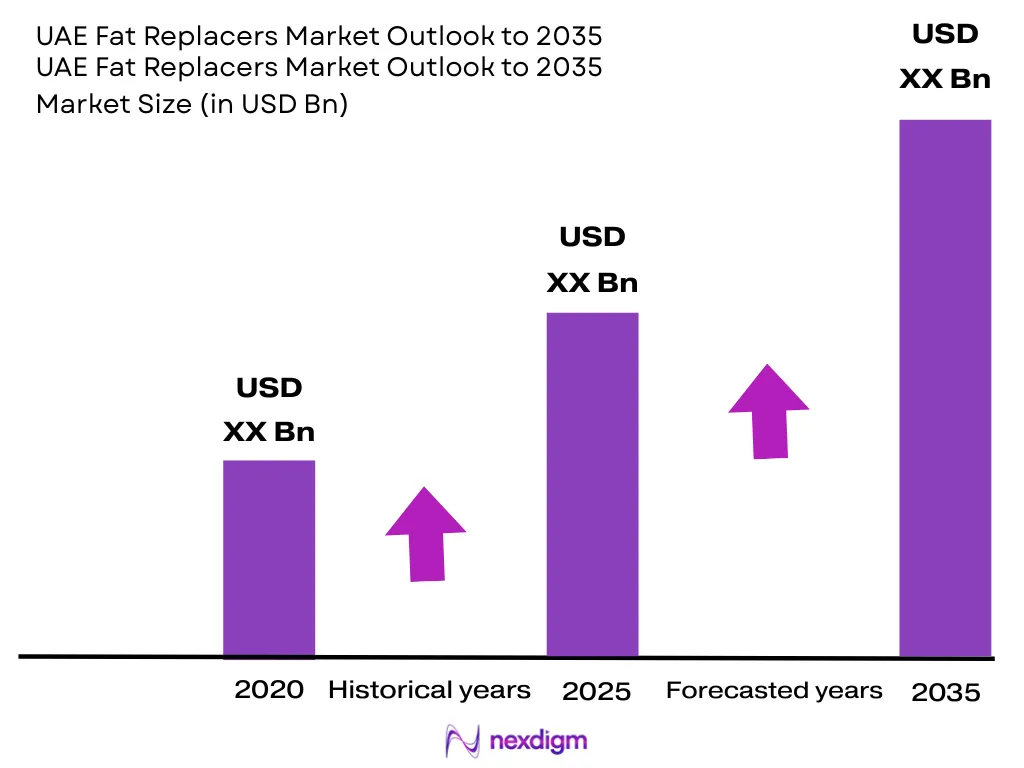
The UAE fat replacers market was valued at USD ~ million in 2024 and is projected to expand at a CAGR of ~% during the 2026–2035 forecast period. According to data published by the Emirates Authority for Standardization and Metrology (ESMA) and the Ministry of Climate Change and Environment, the UAE’s food and beverage processing sector continues to expand as one of the most sophisticated and internationally integrated food manufacturing ecosystems in the Middle East, while the country’s role as a regional re-export and ingredient distribution hub amplifies demand for specialty food ingredients including fat replacers across both domestic manufacturing consumption and GCC-wide distribution. Fat replacers, encompassing carbohydrate-based, protein-based, and lipid-based functional ingredients that replicate the textural, mouthfeel, and structural properties of fat at lower caloric density, are gaining increasing adoption across the UAE’s dairy, bakery, processed halal meat, sauce, and functional food manufacturing segments. Demand is driven by the UAE’s exceptionally high prevalence of diet-related non-communicable diseases, with the World Health Organization reporting that the UAE has one of the highest diabetes prevalence rates globally at approximately 16 percent of the adult population, alongside rising rates of overweight and obesity that are motivating government-led public health campaigns and consumer-level dietary change. Growth is further supported by the UAE’s expanding halal food processing industry, the country’s large and diverse expatriate population creating demand across multiple dietary traditions, rising health and wellness product premiumisation, and the government’s UAE National Nutrition Strategy targeting measurable improvements in population dietary quality.
Market Segmentation
By Source
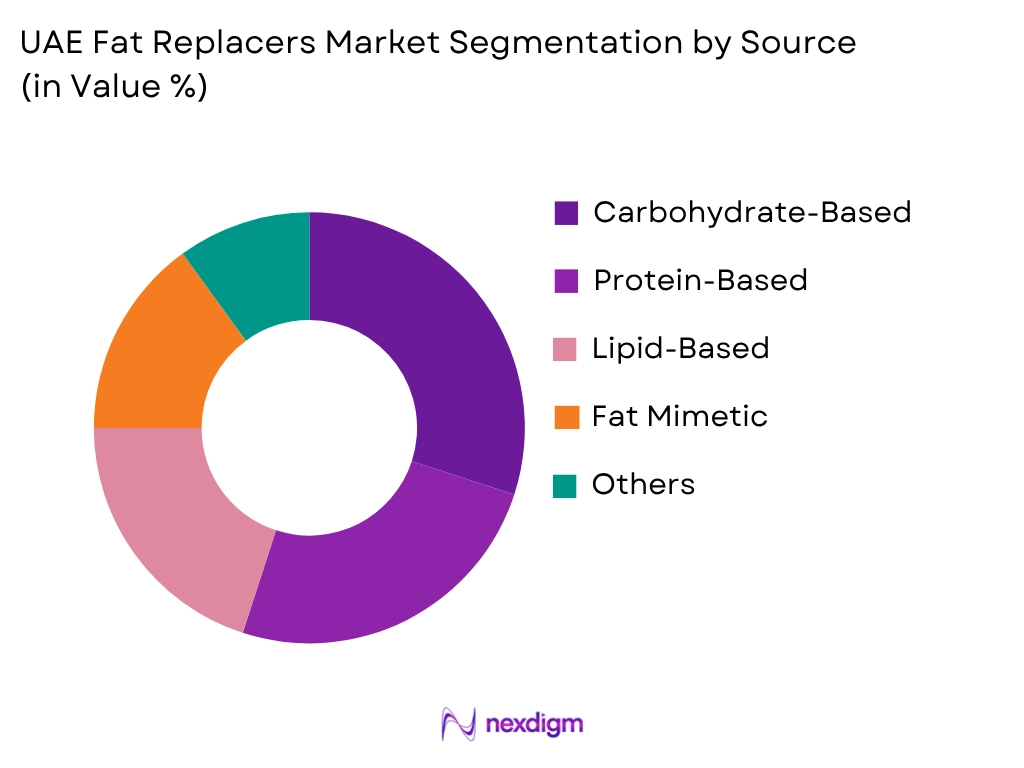
Carbohydrate-based fat replacers dominate the UAE fat replacers market by volume, reflecting their cost competitiveness, wide functional versatility across bakery, dairy, sauce, and processed food applications, and established regulatory acceptance under ESMA and Gulf Standard Organisation food additive frameworks. Modified starches, sourced predominantly from wheat, corn, and potato via imports from Europe and Asia, represent the most widely used fat replacer ingredient category among UAE food manufacturers, offering effective water-binding, gel-forming, and fat-mimicking properties compatible with the high-temperature processing and extended ambient shelf-life requirements characteristic of food manufacturing in the UAE’s hot climate environment. Maltodextrins and polydextrose are extensively used in low-fat dairy drinks, dietetic bakery products, and reduced-calorie snack formulations, while inulin and chicory fibre are gaining adoption as dual-function fat replacers and prebiotic fibre ingredients in functional dairy and health food products targeting the UAE’s health-conscious urban consumer segment. Protein-based fat replacers, including whey protein concentrates, pea protein isolates, and soy protein systems, represent the fastest-growing fat replacer category by value, driven by the convergence of fat reduction and protein enrichment objectives in premium dairy, sports nutrition, and functional food product development. Lipid-based fat replacers, including structured lipids, interesterified fat systems, and emulsifier-based fat mimetic blends, are adopted by larger food manufacturers with advanced formulation capabilities and are particularly relevant in bakery and spread applications where fat crystal structure and melt behaviour are critical to product sensory quality. Clean label hydrocolloid-based fat replacers including pectin, guar gum, xanthan gum, and locust bean gum are gaining traction among manufacturers responding to consumer demand for recognisable, naturally derived ingredient declarations on UAE retail product labels.
By Application
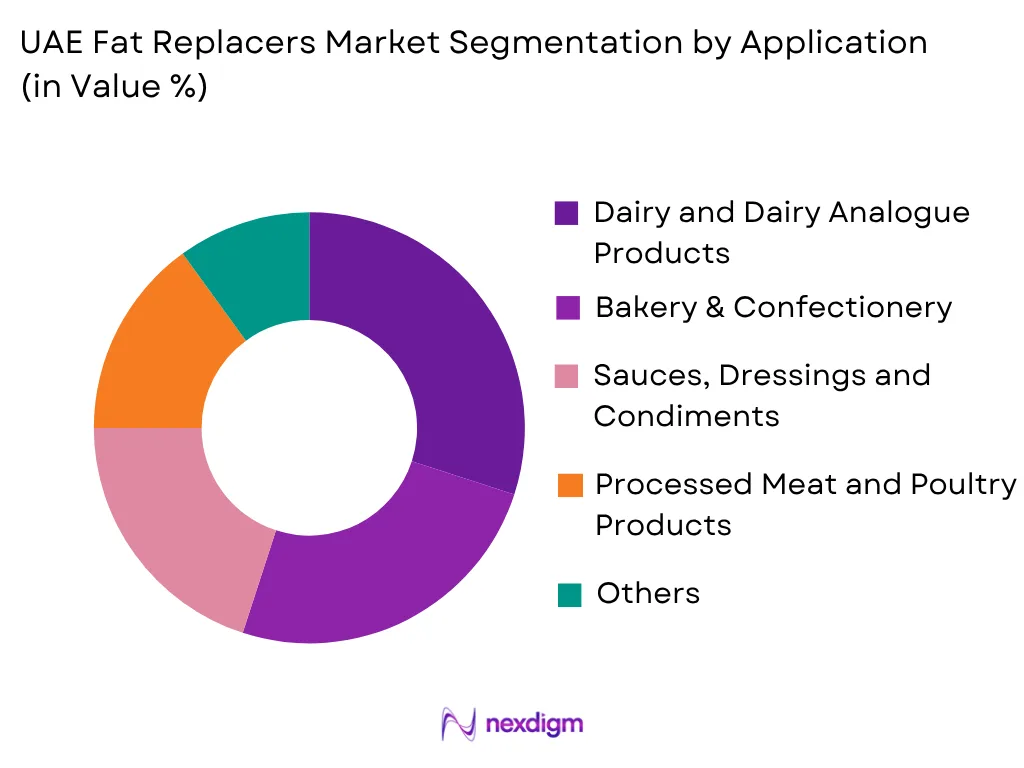
Dairy and dairy analogue products represent the largest and most strategically important application segment for fat replacers in the UAE market by value, reflecting the country’s high per-capita dairy consumption, the rapid growth of reduced-fat and functional dairy product lines by both domestic manufacturers and imported brands, and the technical necessity of fat replacers in maintaining acceptable texture, body, and mouthfeel in low-fat yoghurt, labneh, cheese, flavoured milk, and ice cream formulations. The UAE dairy processing industry, led by companies including Al Ain Dairy, Almarai UAE operations, Lacnor, and Nadec, produces a significant and growing volume of chilled and ambient dairy products for both domestic retail and GCC export, with reduced-fat variants increasingly featuring in manufacturer portfolios as consumer health awareness grows. Bakery and confectionery represents the second-largest application segment, encompassing a diverse range of products from industrial bread and biscuit manufacturing to traditional Arabic sweets including baklava, basbousa, and luqaimat, as well as the growing premium international bakery and patisserie sector servicing the UAE’s hotel and foodservice industry. Processed halal meat and poultry products constitute a significant fat replacer application in the UAE given the country’s large halal-certified processed meat manufacturing base, with fat replacers used in chicken sausages, mortadella, halal deli meat, and processed poultry products to reduce fat content while maintaining juiciness, binding, and yield. The HoReCa sector, encompassing the UAE’s extensive hotel, restaurant, and catering industry which serves more than 20 million annual international visitors alongside the domestic population, creates a distinct and premium-oriented demand channel for fat replacer-enabled reduced-fat foodservice formulations aligned with international guest dietary preferences and health trends.
Competitive Landscape
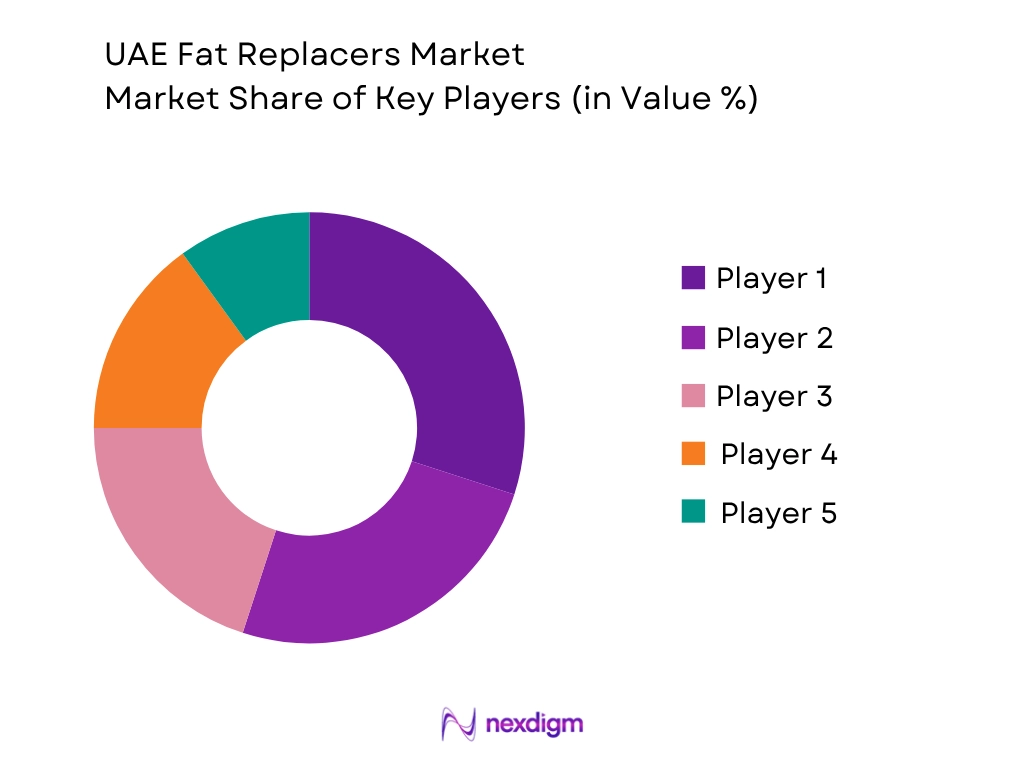
The UAE fat replacers market is moderately consolidated at the supplier level, with a small number of large multinational ingredient companies dominating the premium and technical ingredient categories while a broader base of regional distributors and trading companies serve price-sensitive smaller food manufacturers with commodity-grade and mid-tier fat replacer products. Global ingredient multinationals including Ingredion, Cargill, Kerry, Tate and Lyle, and Roquette operate through UAE-based offices, Jebel Ali Free Zone distribution infrastructure, and dedicated Gulf technical sales teams serving food manufacturers across the UAE and wider GCC region. Regional ingredient distributors including Brenntag Middle East and BM International Middle East supplement multinational direct sales with broader small and medium manufacturer coverage. Domestic UAE food companies including Al Ghurair and Gulf Food Industries maintain ingredient procurement and some value-added processing capabilities. Halal certification status, heat stability performance in the UAE’s extreme climate, and the ability to provide GCC-wide regulatory compliance documentation are key competitive differentiators across all supplier tiers.
| Company | Establishment Year | Headquarters | Primary Fat Replacer Portfolio | Key Application Industries
|
Manufacturing Presence | R&D Capability | Distribution Network | Clean Label Solutions |
| Ingredion Middle East | 2010 | ~ | ~ | ~ | ~ | ~ | ~ | ~ |
| Cargill Middle East | 1997 | ~ | ~ | ~ | ~ | ~ | ~ | ~ |
| Tate & Lyle | 2005 | ~ | ~ | ~ | ~ | ~ | ~ | ~ |
| Roquette Middle East | 2012 | ~ | ~ | ~ | ~ | ~ | ~ | ~ |
| Kerry Group Middle East | 2008 | ~ | ~ | ~ | ~ | ~ | ~ | ~ |
UAE Confectionary Market Analysis
Growth Drivers
High Prevalence of Diabetes, Obesity and Diet-Related Non-Communicable Diseases
The UAE’s exceptionally high and well-documented prevalence of diet-related non-communicable diseases constitutes the most powerful structural demand driver for reduced-fat food products and consequently for fat replacer ingredients across the country’s food manufacturing ecosystem. The World Health Organization and the UAE Ministry of Health and Prevention have consistently reported that the UAE has one of the highest adult diabetes prevalence rates globally, estimated at approximately 16 percent of the adult population, with the International Diabetes Federation ranking the UAE among the top ten countries worldwide for diabetes burden relative to population size. Obesity and overweight rates are similarly elevated, with the UAE National Nutrition Survey and academic studies published by UAE universities estimating that more than 60 percent of UAE adult males and more than 40 percent of UAE adult females are classified as overweight or obese, reflecting the combined impact of a high-calorie dietary tradition rich in saturated fats, a sedentary urban lifestyle, extreme summer temperatures limiting outdoor physical activity, and a food environment historically dominated by full-fat traditional Middle Eastern and South Asian dietary patterns. These health statistics have generated substantial government policy response through the UAE National Nutrition Strategy, the Ministry of Health and Prevention’s Weqaya diabetes prevention program, the Dubai Health Authority’s chronic disease management initiatives, and the Abu Dhabi Public Health Centre’s population nutrition improvement programs, all of which include food reformulation and reduced-fat product development as explicit priorities. Rising health consciousness among UAE consumers, particularly the country’s large and well-educated expatriate population drawn from health-aware markets including the United Kingdom, India, and the United States, is translating into growing retail demand for food products carrying reduced-fat, low-calorie, light, and better-for-you positioning claims. Food manufacturers operating in the UAE are responding by expanding reduced-fat product lines across dairy, bakery, processed meat, and snack categories, creating a progressively growing industrial demand base for fat replacer ingredients that enable calorie and fat reduction without unacceptable compromise of product sensory quality.
UAE as Regional Ingredient Re-Export and Distribution Hub for GCC and Middle East
The UAE’s established position as the leading food ingredient re-export and regional distribution hub for the Gulf Cooperation Council and broader Middle East market significantly amplifies the total addressable market for fat replacer ingredient suppliers operating in the country beyond the scale implied by domestic food manufacturing consumption alone. Jebel Ali Free Zone, operated by DP World and recognised as one of the world’s leading free trade zones, provides bonded warehousing, temperature-controlled storage, rapid customs clearance, and efficient trans-shipment logistics that enable multinational ingredient companies to consolidate GCC-wide ingredient distribution through a single UAE-based hub, serving food manufacturers in Saudi Arabia, Kuwait, Qatar, Bahrain, Oman, Jordan, Egypt, and the wider Levant and North Africa region from UAE inventory. The Federal Competitiveness and Statistics Centre estimates that the UAE re-exports food and beverage ingredients and processed food products worth billions of dirhams annually to regional markets, underscoring the commercial significance of the hub distribution role. Fat replacer ingredient suppliers that establish UAE distribution operations gain access not only to the country’s domestic food manufacturing demand but also to the GCC’s aggregate food processing market, which is substantially larger than the UAE market alone, with Saudi Arabia representing particularly significant incremental demand given its food manufacturing scale and large population. The UAE’s world-class air freight connectivity through Dubai International Airport and Al Maktoum International Airport also enables rapid delivery of temperature-sensitive or time-critical ingredient consignments to regional customers, a logistics advantage that reinforces the UAE’s hub status. The progressive tightening of ESMA and Gulf Standard Organisation food additive regulations, while creating compliance requirements for ingredient suppliers, simultaneously incentivises consolidation of regulatory documentation and product registration activities at the UAE distribution level, further reinforcing the logic of UAE-centric regional supply chain structures for fat replacer and specialty food ingredient distribution.
Market Challenges
Near-Total Import Dependency and High Ingredient Procurement Costs
The UAE fat replacers market faces a fundamental structural challenge in the form of near-complete dependency on imported ingredients across all major fat replacer categories, as the country has no meaningful domestic agricultural production base from which carbohydrate-based, protein-based, or lipid-based fat replacer raw materials could be economically derived. Unlike Vietnam, which can draw on abundant domestic cassava and rice production for starch-based fat replacer development, or European markets that benefit from nearby whey protein and wheat fibre ingredient manufacturing clusters, UAE food manufacturers must import essentially all fat replacer ingredients from production sources in Europe, North America, Asia, and increasingly the broader Middle East and North Africa agricultural region. This total import dependency exposes UAE-based food manufacturers and ingredient distributors to a compounding set of cost pressures including international commodity price volatility, ocean freight and air freight cost fluctuations, currency exchange movements between the UAE Dirham and major trading currencies, port handling and customs clearance costs, temperature-controlled warehousing expenses in the UAE’s extreme climate, and distributor margin requirements that collectively result in landed ingredient costs significantly above factory gate prices in producing countries. These elevated ingredient costs are particularly challenging for smaller UAE and GCC food manufacturers operating on tight production margins in competitive retail price environments, often leading to formulation decisions that prioritise lower-cost commodity alternatives over higher-performance premium fat replacer systems that would deliver superior sensory results. The UAE’s excise tax framework, which imposes duties on certain sweetened and calorie-dense food products, adds further complexity to fat replacer adoption calculations, as manufacturers must weigh the cost of ingredient reformulation against the tax liability implications of product categorisation changes. Ingredient suppliers operating in the UAE market must therefore develop clear and quantifiable total cost of ownership and formulation benefit justifications that demonstrate the economic case for fat replacer adoption beyond simple ingredient price comparison.
Halal Certification Complexity and Evolving Regulatory Requirements
The requirement for halal certification compliance across all food ingredient categories used in UAE and GCC food manufacturing represents a distinctive and operationally significant challenge for fat replacer ingredient suppliers seeking to serve the UAE market, adding layers of documentation, certification cost, and supply chain audit requirements that are not encountered to the same degree in non-Muslim majority food markets. The UAE Halal Mark scheme, administered by ESMA in coordination with approved halal certification bodies, requires that food ingredients used in products bearing halal claims or sold into halal-certified manufacturing environments meet specific halal production standards encompassing raw material sourcing, processing aids, enzyme systems, cross-contamination prevention, and supply chain traceability. For fat replacer ingredients, halal compliance requirements are particularly relevant in several categories including protein-based fat replacers derived from animal sources such as gelatin or certain casein derivatives, lipid-based fat replacers where the source of fatty acid raw materials must be demonstrably free of porcine origin, and enzyme-processed carbohydrate ingredients where the microbial or animal origin of processing enzymes must be verified and certified. The Gulf Standard Organisation harmonised food additive regulations, which govern permitted fat replacer ingredient categories, maximum usage levels, and labelling requirements across GCC member states, continue to evolve in alignment with Codex Alimentarius international standards while maintaining GCC-specific requirements, creating ongoing compliance monitoring requirements for ingredient suppliers as regulations are updated. Novel fat replacer ingredients including certain specialty fibres, oleogels, and microparticulated protein systems may require pre-market notification or product registration with ESMA or Dubai Municipality’s Food Safety Department before commercial use in UAE food manufacturing, adding regulatory lead time and administrative cost that can slow the pace of ingredient innovation adoption by UAE food manufacturers relative to less regulated markets.
Market Opportunities
Diabetic-Friendly, Functional and Clinical Nutrition Product Development
The UAE’s extremely high diabetes prevalence, estimated by the International Diabetes Federation at approximately 16 percent of the adult population, combined with a large and growing awareness of diabetic dietary management among affected individuals and their families, creates a distinctive and commercially significant opportunity for fat replacer ingredient suppliers to develop and position ingredients specifically targeting the formulation of diabetic-friendly, glycaemic-controlled, and clinical nutrition food products. Unlike most global markets where diabetic-specific foods represent a niche segment, the UAE’s diabetes burden is of sufficient scale to support a meaningful and growing commercial category of specialised reduced-fat, reduced-sugar, and glycaemic-index-optimised food products that are purchased as part of daily dietary management by a large consumer cohort. Fat replacers play a dual functional role in diabetic-friendly food formulations by simultaneously reducing caloric density and fat content while, in the case of fibre-based fat replacers, contributing soluble dietary fibre that further supports glycaemic control through viscosity-mediated slowing of glucose absorption. Inulin, beta-glucan, pectin, and polydextrose, all of which function as fat replacers in reduced-fat food matrices while delivering documented prebiotic and glycaemic benefit effects, are particularly well-positioned for dual-functionality marketing in the UAE’s health and wellness food segment. The UAE’s high-quality private healthcare ecosystem, with world-class hospital groups including Cleveland Clinic Abu Dhabi, Mediclinic Middle East, and NMC Healthcare operating extensive clinical nutrition programs, creates a premium clinical nutrition product demand channel where fat replacer-enabled medical food formulations commanding high price points can be commercialised with clinical evidence support. Ingredient suppliers that invest in clinical nutrition formulation partnerships, glycaemic response testing, and evidence-based health claim development aligned with ESMA nutritional labelling requirements are well positioned to capture the premium value segment of this health-driven market opportunity.
Halal-Certified Clean Label and Plant-Based Food Sector Growth
The convergence of halal certification requirements with clean label ingredient preferences and the emerging plant-based food trend in the UAE market creates a distinctive and high-growth opportunity for fat replacer ingredient suppliers that can offer products simultaneously satisfying all three positioning requirements. The UAE’s consumer base, which includes a large South Asian expatriate community from India, Pakistan, Bangladesh, and Sri Lanka alongside significant Arab national and Western expatriate segments, creates demand for halal-certified food products across a remarkably diverse range of food categories, and the clean label and plant-based trends that have transformed European and North American food ingredient markets are progressively influencing the dietary preferences of the UAE’s health-conscious urban consumer cohort. Plant-based fat replacers derived from pea protein, oat fibre, chicory inulin, potato starch, and rice protein are inherently compatible with halal certification requirements, avoiding the animal-origin sourcing concerns associated with whey, gelatin, and certain enzyme systems, and are gaining favour among UAE food manufacturers seeking to simultaneously meet halal compliance, clean label positioning, and plant-based product development objectives. The UAE plant-based food sector, while still relatively small compared to European markets, is growing rapidly across modern retail formats including Carrefour UAE, Lulu Hypermarket, Spinneys, and Waitrose UAE, where dedicated plant-based and health food sections are expanding their shelf space allocations. International plant-based food brands entering the UAE market through retail and foodservice channels provide additional demand for plant-protein-based fat replacer systems used in plant-based meat, dairy alternative, and egg alternative formulations. Ingredient suppliers that proactively develop halal-certified, plant-sourced fat replacer portfolios with verified clean label declarations, and that invest in UAE-specific application development demonstrating performance in traditional Middle Eastern food formats including labneh, hummus, and Arabic bakery products, are well positioned to capture the growing intersection of these converging demand trends.
Future Outlook
The UAE fat replacers market is expected to witness sustained growth throughout the forecast period, supported by the country’s high and rising prevalence of diet-related non-communicable diseases generating consumer and policy demand for reduced-fat food products, expanding domestic halal food manufacturing capacity, growing health and wellness product premiumisation among the UAE’s affluent and health-conscious consumer base, and the country’s strengthening role as a regional ingredient re-export and distribution hub serving the GCC and broader Middle East food processing market. Ingredient suppliers are increasingly investing in halal certification documentation, heat-stable fat replacer formulations suited to UAE climate conditions, GCC-wide regulatory compliance support, and application development resources targeting Arabic dairy, bakery, and processed food formats. Growing demand for diabetic-friendly functional foods, plant-based and vegan food products, premium clean label reduced-fat formulations, and clinical nutrition products is expected to create additional ingredient demand opportunities across multiple food manufacturing segments throughout the forecast period. Continued investments in Jebel Ali Free Zone distribution infrastructure, regional regulatory harmonisation under the Gulf Standard Organisation framework, and digital B2B ingredient procurement platform development will further strengthen the UAE’s position as the preferred regional market entry and distribution hub for international fat replacer ingredient suppliers targeting the GCC and Middle East.
Major Players
- Ingredion Middle East (UAE)
- Cargill Middle East (UAE)
- Kerry Group Middle East (UAE)
- Tate and Lyle Middle East (UAE)
- Roquette Middle East (UAE)
- CP Kelco Middle East (UAE)
- IFF (International Flavors and Fragrances) Nutrition Middle East
- BASF Middle East (Nutrition and Health Division)
- Beneo GmbH (UAE Distribution)
- Nexira Middle East
- Gulf Food Industries (Al Islami Foods Group)
- Al Ghurair Food Ingredients
- Emirates Refining Company
- BM International Middle East
- Brenntag Middle East (Food Ingredients Division)
Key Target Audience
- Food and Beverage Manufacturers (Dairy, Bakery, Processed Halal Meat, Sauce, Snack and Functional Food)
- Food Ingredient Importers, Distributors and Free Zone Trading Companies
- Halal-Certified Food Processors and Exporters
- Nutraceutical, Functional Food and Clinical Nutrition Manufacturers
- Food Technologists and Product Development Teams
- Hotel, Restaurant and Catering (HoReCa) Sector Operators
- Investments and Venture Capitalist Firms
- Government and Regulatory Bodies (Emirates Authority for Standardization and Metrology (ESMA), Ministry of Climate Change and Environment (MOCCAE), Dubai Municipality Food Safety Department, Abu Dhabi Agriculture and Food Safety Authority (ADAFSA))
Research Methodology
Step 1: Identification of Key Variables
The research begins by identifying the major stakeholders across the UAE fat replacers value chain, including multinational ingredient suppliers, regional and domestic ingredient distributors, food and beverage manufacturers across all relevant application segments, halal certification bodies, food safety regulatory authorities, free zone operators, and industry associations. Extensive secondary research is conducted using ESMA and MOCCAE publications, Dubai Municipality Food Safety Department data, Abu Dhabi Agriculture and Food Safety Authority reports, Gulf Standard Organisation regulatory frameworks, UAE National Nutrition Survey data, and proprietary ingredient market databases to establish the key variables influencing market performance.
Step 2: Market Analysis and Construction
Historical market information is compiled and evaluated to estimate the overall market size, ingredient volume consumption by type and application, import volumes and re-export flows, average selling prices, distributor margins, and revenue generation across major fat replacer categories and food manufacturing end-use segments. Both demand-side and supply-side indicators are analyzed using bottom-up and top-down market sizing approaches to ensure comprehensive market coverage across the UAE’s diverse food manufacturing, foodservice, and regional distribution segments.
Step 3: Hypothesis Validation and Expert Consultation
Preliminary market estimates and analytical assumptions are validated through Computer Assisted Telephone Interviews (CATIs) and structured discussions with food technologists and product development managers at UAE food manufacturers, ingredient sales managers at multinational and regional suppliers, free zone logistics and warehousing operators, halal certification consultants, food safety regulatory advisors, and academic nutrition researchers at UAE universities. These interviews provide critical on-ground formulation and commercial insights that strengthen the reliability of market estimates.
Step 4: Research Synthesis and Final Output
The final stage integrates primary research findings with secondary information to develop a comprehensive assessment of market size, segmentation, competitive landscape, customer procurement behaviour, and future opportunities. Multiple validation techniques, including data triangulation across UAE Federal Customs Authority import trade data, food manufacturing industry production statistics from the Federal Competitiveness and Statistics Centre, and ingredient supplier commercial disclosures, are employed to ensure the consistency, accuracy, and credibility of the final market report.

- Executive Summary
- Research Methodology (Market Definitions and Assumptions, Abbreviations, Market Taxonomy, Market Sizing Approach, Top-Down Analysis, Bottom-Up Analysis, Demand-Side Assessment, Supply-Side Assessment, Primary Industry Interviews, Secondary Research Validation, Data Triangulation, Forecasting Framework, Limitations and Future Conclusions)

- Definition and Scope
- Market Evolution and Industry Genesis
- Timeline of Major Industry Developments
- Fat Replacer Industry Value Chain Analysis
- Supply Chain Analysis

- Growth Drivers (Rising Health and Wellness Awareness Among UAE Consumers, High Prevalence of Diabetes and Obesity Driving Reduced-Fat Product Demand, Expanding Low-Fat and Reduced-Calorie Food Product Development by Local Manufacturers, Growth of Domestic Halal Food Processing Industry, Government Nutrition and Public Health Initiatives, UAE as Regional Re-Export and Distribution Hub for Fat Replacer Ingredients, Growing Foodservice and HoReCa Sector Demand, Expanding Modern Retail and E-Commerce Food Trade)
- Market Challenges (Near-Total Import Dependency for Fat Replacer Ingredients, High Ingredient Procurement and Logistics Costs, Price Sensitivity Among Smaller Food Manufacturers, Regulatory Complexity and Halal Certification Requirements for Novel Ingredients, Heat and Humidity Climate Impact on Ingredient Storage and Functionality, Competition from Full-Fat Traditional Middle Eastern Food Formats, Limited Domestic Food Technology Research and Development Capability, Fragmented Small and Medium Food Manufacturer Customer Base)
- Market Opportunities (Low-Fat Dairy and Plant-Based Dairy Analogue Expansion, Reduced-Calorie Snack Food and Bakery Development, Halal-Certified Clean Label Fat Replacer Demand, Functional and Fortified Food Manufacturing Growth, Plant-Based and Vegan Food Sector Emergence, Clinical and Medical Nutrition Product Development, UAE as Regional Ingredient Distribution Hub for GCC and Middle East, Date and Regional Ingredient-Based Functional Fat Mimetic Innovation)
- Market Trends (Clean Label and Natural Ingredient Demand, Halal-Certified and Ethically Sourced Ingredient Preference, Plant-Based and Vegan Food Product Growth, Reduced Sugar and Reduced Fat Dual Positioning, Functional Fibre Integration in Fat Replacer Systems, Protein-Enriched Reduced-Fat Formulations, Premium Ingredient Positioning in High-End Food Products, Digital B2B Ingredient Procurement and Supply Chain Transparency)
- Government Regulations (Emirates Authority for Standardization and Metrology (ESMA) Food Safety Standards, UAE Federal Law No. 10 of 2015 on Food Safety, GSO Gulf Standard Organisation Harmonised Food Additive Regulations, Halal Certification Requirements Under UAE Halal Mark Scheme, Ministry of Climate Change and Environment (MOCCAE) Food Import Regulations, Dubai Municipality Food Safety Department Standards, Abu Dhabi Agriculture and Food Safety Authority (ADAFSA) Regulations, Excise Tax on Sweetened and Calorie-Dense Products, Nutritional Labelling Requirements Under ESMA Standards)
- Raw Material and Ingredient Supply Analysis (Import Dependency for All Major Fat Replacer Ingredient Categories, Free Zone Warehousing and Re-Export Capability, Regional Distribution Hub Role for GCC Fat Replacer Supply, Whey Protein Import Sources from Europe and USA, Modified Starch Import Sources from Asia and Europe, Inulin and Chicory Fibre Supply Chains, Pectin and Hydrocolloid Gum Import Availability, Ingredient Cost Comparison Across Import Sources)
- Food Manufacturing Industry Demand Analysis (Dairy Industry Fat Replacer Consumption, Bakery and Arabic Sweets Industry Demand, Processed Halal Meat Industry Usage, Snack Food Industry Adoption, Sauce and Condiment Manufacturer Demand, HoReCa and Institutional Catering Sector Usage)
- Seasonal Demand Analysis (Ramadan and Eid Al-Fitr Low-Fat Dairy and Bakery Production Surge, Eid Al-Adha Processed Meat Demand Peak, National Day Corporate Food Gift Production, Summer Heat Impact on Ice Cream and Dairy Fat Replacer Demand, Back-to-School Season Snack and Bakery Production, Year-End Corporate Catering Demand)
- Re-Export and Regional Distribution Analysis (UAE as GCC and Middle East Fat Replacer Ingredient Hub, Jebel Ali Free Zone Warehousing Role, Trans-Shipment to Saudi Arabia, Kuwait, Qatar, Bahrain and Oman, Re-Export to Egypt, Jordan and Levant Markets, Bonded Warehouse Ingredient Availability)
- Innovation Landscape (Date Fibre-Based Functional Fat Mimetic Development, Arabic Dairy and Labneh Low-Fat Formulation Innovation, Dual-Function Fat and Sugar Replacer Systems for Diabetic-Friendly Products, Heat-Stable Fat Replacer Systems for Hot Climate Storage, Plant Protein Microparticulation for Halal Markets, Clean Label Stabiliser Blends for Middle Eastern Food Applications)
- Sustainability Analysis (Sustainable and Responsibly Sourced Ingredient Certification, Halal Supply Chain Traceability, Reduced Saturated Fat in UAE Food Supply, Sustainable Packaging for Ingredient Delivery, Food Waste Reduction Through Extended Shelf Life Applications, Carbon Footprint Reduction in Ingredient Procurement)
- SWOT Analysis
- Porter’s Five Forces Analysis
- PESTLE Analysis
- Stakeholder Ecosystem
- Competition Ecosystem

- By Market Value (2020-2025)
- By Volume Consumption (2020-2025)
- By Average Selling Price (2020-2025)

- By Source (In Value %)
Carbohydrate-Based Fat Replacers
Protein-Based Fat Replacers
Lipid-Based Fat Replacers
Fat Mimetics
Oleogels and Novel Lipid Structuring Agents - By Application (In Value %)
Dairy and Dairy Analogue Products
Bakery and Confectionery
Sauces, Dressings and Condiments
Processed Meat and Poultry Products
Snack Foods and Extruded Products
Frozen and Ready-to-Eat Meals
Spreads and Margarines
Infant, Maternal and Clinical Nutrition Products - By End-Use Industry (In Value %)
Food and Beverage Manufacturers
Foodservice and Quick Service Restaurants
Institutional Catering, Hospital and Clinical Nutrition
Nutraceutical and Functional Food Producers
Infant and Clinical Nutrition Manufacturers
Hotel, Restaurant and Catering (HoReCa) Sector - By Distribution Channel (In Value %)
Direct Sales to Food Manufacturers (B2B)
Ingredient Distributors and Trading Companies
Specialty Food Ingredient Importers and Free Zone Traders
E-Commerce and Digital B2B Ingredient Platforms - By Emirate (In Value %)
Dubai
Abu Dhabi
Sharjah
Northern Emirates (Ajman, Umm Al Quwain, Ras Al Khaimah, Fujairah)

- Market Share Analysis (By Value, Volume, Ingredient Type, Application Segment, Distribution Channel)
- Cross Comparison Parameters (Fat Replacer Portfolio Breadth, Halal Certification Status, Application Technical Support Capability, Local Regulatory Compliance Documentation, Distribution Network Coverage Across UAE and GCC, Annual New Ingredient Launches, Clean Label Portfolio Strength, Free Zone Warehousing and Re-Export Capability, Pricing Competitiveness)
- SWOT Analysis of Major Players
- Pricing Analysis (By Fat Replacer Type, Functionality, Source, Application, Pack Size, Contract Volume)
- Detailed Profiles of Major Companies
Ingredion Middle East (UAE)
Cargill Middle East (UAE)
Kerry Group Middle East (UAE)
Tate and Lyle Middle East (UAE)
Roquette Middle East (UAE)
CP Kelco Middle East (UAE)
IFF (International Flavors and Fragrances) Nutrition Middle East
BASF Middle East (Nutrition and Health Division)
Beneo GmbH (UAE Distribution)
Nexira Middle East
Gulf Food Industries (Al Islami Foods Group)
Al Ghurair Food Ingredients
Emirates Refining Company
BM International Middle East
Brenntag Middle East (Food Ingredients Division)

- Procurement Pattern Analysis (Ingredient Sourcing Frequency, Fat Replacer Type Preference, Application-Specific Usage Behaviour, Seasonal Procurement Cycles, Annual Ingredient Budget Allocation)
- Demographic and Industry Buyer Analysis (Large Food Manufacturers, SME Food Processors, Foodservice Operators, Nutraceutical Producers, HoReCa Operators, Clinical Nutrition Producers)
- Formulation Cost and Functionality Trade-Off Analysis
- Premium Imported vs Cost-Competitive Regional Ingredient Preference
- Supplier and Brand Loyalty Analysis
- Halal Certification and Regulatory Compliance-Driven Ingredient Selection Behaviour
- Ingredient Attribute Preference Analysis (Halal Certification, Functionality, Organoleptic Performance, Clean Label Status, Heat Stability, Price, Availability, Technical Support, Minimum Order Quantity)
- Domestic UAE Manufacturer vs Re-Export and Regional Customer Procurement Differences
- Digital vs Traditional B2B Ingredient Procurement Behaviour
- Customer Pain Point Analysis
- Procurement Decision-Making Process

- By Market Value (2026-2035)
- By Volume Consumption (2026-2035)
- By Average Selling Price (2026-2035)


 Request a Sample
 Ask for Customization
 Get a Quote
 Enquire Now