
 Download PDF
Market Overview
The UAE fertilizer market is one of the most strategically significant agricultural input markets in the Gulf Cooperation Council region, supported by the country’s ambitious food security agenda and its drive to enhance domestic agricultural production in an arid environment. The UAE cultivated approximately 250,000 hectares of agricultural land producing a range of crops including date palms, vegetables, fruits, forage crops, and greenhouse-grown produce, creating consistent demand for advanced nutrient management solutions. Fertilizer consumption is driven by the expansion of protected agriculture, rising adoption of controlled-environment farming, increasing use of fertigation and hydroponics, and government programs aimed at strengthening domestic food production and reducing import dependence on essential food commodities.
Market Segmentation
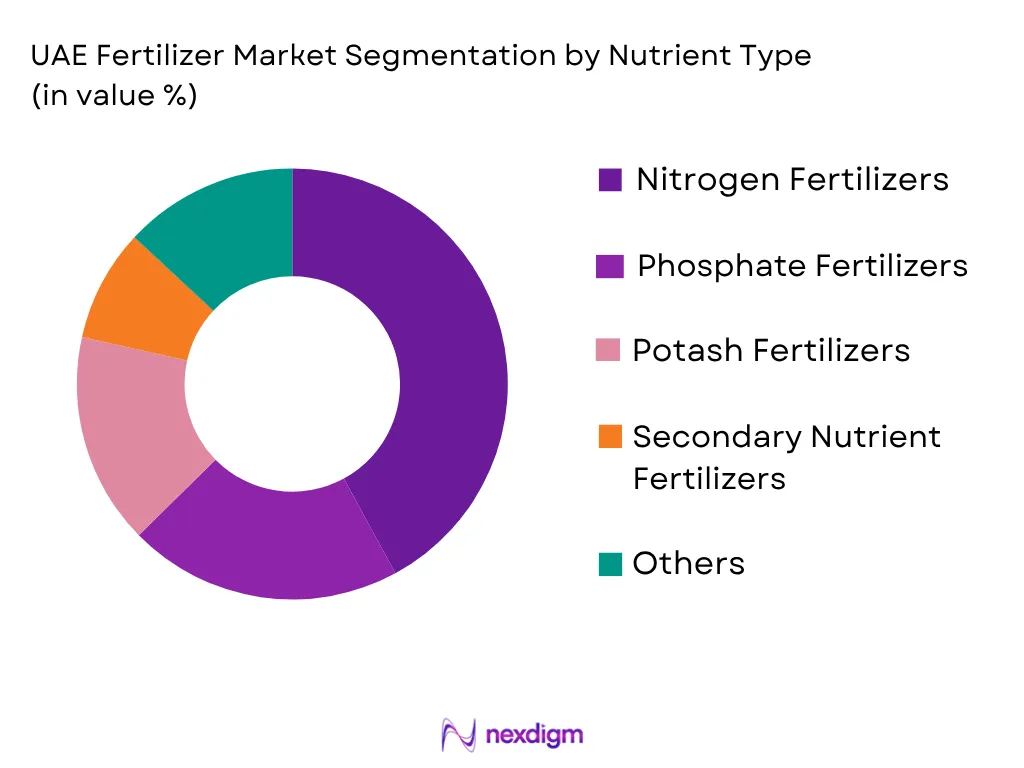
By Nutrient Type
Nitrogen fertilizers dominate the UAE fertilizer market due to the country’s widespread cultivation of vegetables, date palms, and greenhouse crops, all of which require frequent nitrogen applications to sustain growth in arid and semi-arid conditions. UAE soils are inherently low in organic matter and nitrogen content, making regular fertilization essential for achieving acceptable yields. The extensive use of hydroponic and fertigation systems across the country further amplifies nitrogen demand, as water-soluble nitrogen-based formulations are widely preferred for controlled-environment agriculture. Growing adoption of precision agriculture technologies and customized nutrient programs by commercial farming enterprises continues to reinforce the dominance of nitrogen fertilizers across the UAE market.
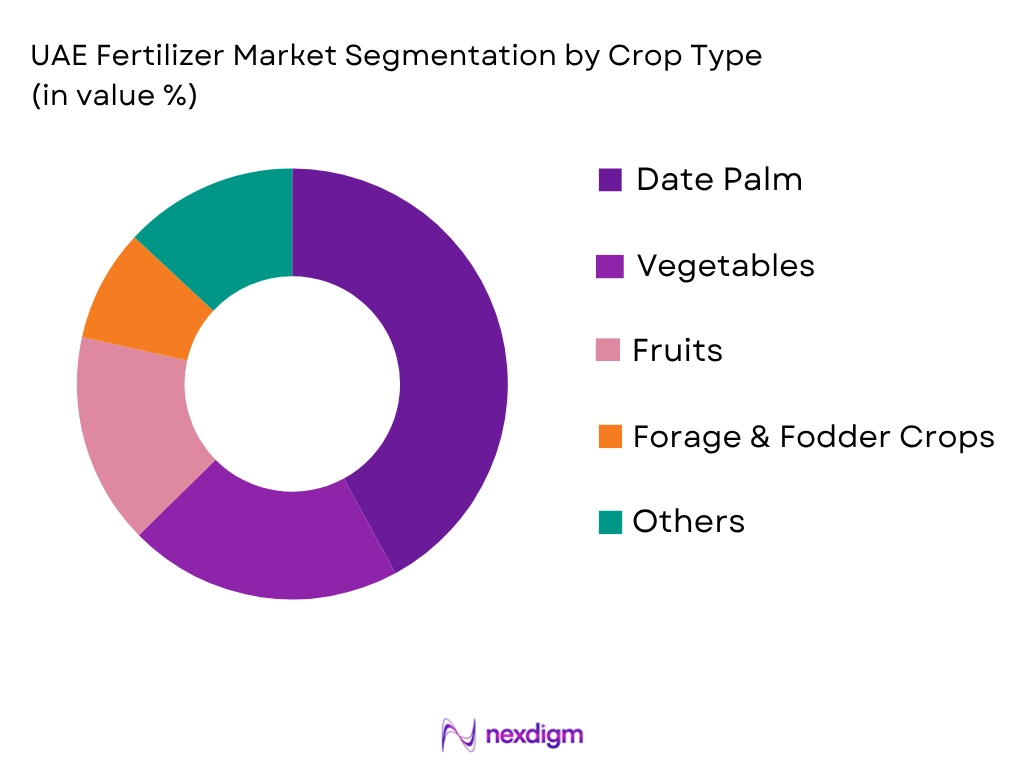
By Crop Type
Date palm represents the dominant crop segment within the UAE fertilizer market as the country is one of the world’s largest producers and exporters of dates, with an estimated 40 million date palm trees cultivated across the Emirates. Date palms require consistent applications of nitrogen, potassium, and micronutrients to sustain productivity under intense heat and limited water conditions. Large-scale commercial date palm farms across Abu Dhabi, Al Ain, and Ras Al Khaimah depend on structured fertilization programs to maintain yield quality and fruit size. Rising global demand for UAE dates has encouraged producers to expand cultivation and intensify nutrient management practices. Consequently, date palm farming remains the largest contributor to fertilizer consumption throughout the country.
Competitive Landscape
The UAE fertilizer market is moderately concentrated, with major petrochemical-linked fertilizer producers, international specialty fertilizer companies, and regional distributors controlling a substantial portion of production, imports, distribution, and agricultural service activities. Companies compete through extensive distribution networks, agronomic consulting services, specialty product portfolios, and solutions tailored to arid-climate agriculture. Strategic investments in water-soluble fertilizers, precision nutrition solutions, and sustainable agricultural inputs continue to shape competitive dynamics across the market.
| Company | Establishment Year | Headquarters | Product Portfolio | Production & Blending Facilities
|
Import Infrastructure | Distribution Reach | Specialty Fertilizer Portfolio | Agronomic Support Network |
| FERTIGLOBE | 2019 | ~ | ~ | ~ | ~ | ~ | ~ | ~ |
| Abu Dhabi Fertilizer Industries | 1994 | ~ | ~ | ~ | ~ | ~ | ~ | ~ |
| Yara Middle East | 1905 | ~ | ~ | ~ | ~ | ~ | ~ | ~ |
| Haifa Group Middle East | 1966 | ~ | ~ | ~ | ~ | ~ | ~ | ~ |
| ICL Specialty Fertilizers | 1968 | ~ | ~ | ~ | ~ | ~ | ~ | ~ |
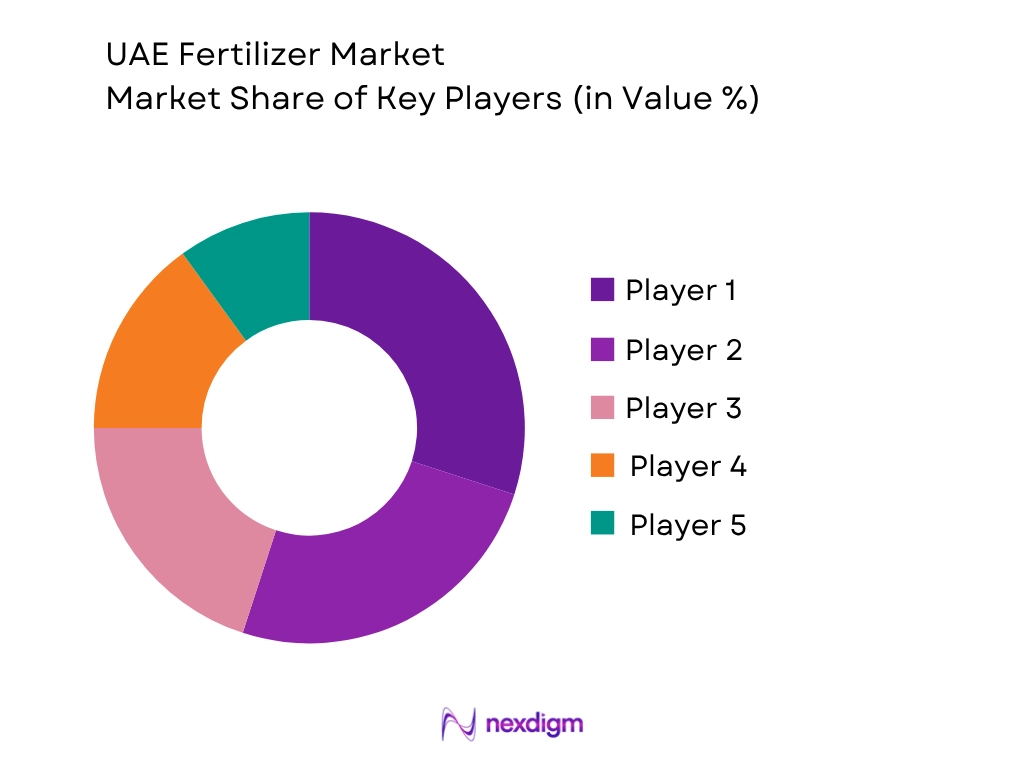
UAE Fertilizer Market Analysis
Growth Drivers
Food Security Strategy and Government-Backed Agricultural Programs
The UAE fertilizer market is fundamentally driven by the country’s national food security agenda and government-led agricultural development initiatives. According to the UAE Ministry of Climate Change and Environment, the UAE Food Security Strategy 2051 aims to position the country among the top ten in the Global Food Security Index. The government has committed substantial investment toward expanding domestic food production, reducing dependence on food imports, and developing advanced agricultural infrastructure across the Emirates. The UAE’s total food imports exceed USD 10 billion annually, creating urgency to develop domestic production capacity and modernize agricultural practices. Abu Dhabi’s Department of Agriculture and Food Safety has channeled funding toward controlled-environment farms, vertical farming facilities, and hydroponic systems. Dubai’s Agriculture Sector Strategy similarly targets expansion of commercial greenhouse production and urban farming initiatives. According to the World Bank, the UAE’s GDP exceeded USD 500 billion in 2024, providing the fiscal capacity to invest in agricultural infrastructure. These strategic programs are creating consistent demand for high-quality fertilizers, particularly water-soluble formulations, micronutrient blends, and specialty products designed for arid-climate and controlled-environment agriculture throughout the country.
Expansion of Protected Agriculture and Controlled-Environment Farming
The rapid expansion of protected agriculture, greenhouse farming, and controlled-environment production systems is a major structural driver of fertilizer consumption in the UAE. According to the UAE Ministry of Climate Change and Environment, the area under protected agriculture has grown substantially over recent years, with greenhouse and shaded net house cultivation covering tens of thousands of hectares across the Emirates. Extreme heat, water scarcity, and saline soils make open-field farming economically challenging, pushing producers toward closed or semi-controlled production environments where fertigation and precision nutrient management are essential. Water-soluble fertilizers, controlled-release formulations, and liquid nutrient solutions are widely adopted within these systems, supporting consistent fertilizer demand regardless of seasonal variation. The UAE’s population exceeded 10 million in 2024, increasing domestic consumption requirements for fresh vegetables, fruits, and dairy products. The International Monetary Fund recorded stable economic growth in the UAE, enabling continued investments in advanced agricultural infrastructure. As commercial greenhouse clusters expand across Abu Dhabi, Dubai, Sharjah, and Ras Al Khaimah, demand for specialized fertilizer products adapted to hydroponic, aeroponic, and substrate-based growing systems continues to strengthen across the UAE fertilizer market.
Market Challenges
Extreme Climatic Conditions and Soil Salinity Constraints
A fundamental challenge facing the UAE fertilizer market is the country’s harsh desert climate and widespread occurrence of saline and sandy soils that significantly limit agricultural productivity. Average summer temperatures regularly exceed 45 degrees Celsius, while annual rainfall averages below 100 millimeters across most of the country. According to the UAE Ministry of Climate Change and Environment, more than 80% of the land area consists of desert terrain with minimal organic matter and poor water retention capacity. Soil salinity is a persistent constraint, particularly in coastal areas where irrigation with slightly saline groundwater has led to salt accumulation in the root zone. These conditions reduce nutrient availability and fertilizer use efficiency, requiring specialized formulations, soil conditioners, and carefully managed application schedules. High evaporation rates increase the risk of nutrient leaching and salt stress, complicating conventional fertilization approaches. Farmers must frequently apply soil amendments, organic matter, and specially formulated fertilizers to maintain productive growing conditions. As agricultural production expands across marginal lands, managing soil quality, salinity, and nutrient availability remains a persistent agronomic and economic challenge throughout the UAE fertilizer market.
High Import Dependence and Global Supply Chain Vulnerabilities
The UAE fertilizer market is heavily dependent on imported fertilizer products due to limited domestic production capacity relative to national demand. While the UAE hosts FERTIGLOBE and Abu Dhabi Fertilizer Industries as significant producers, the range and volume of specialty fertilizers, micronutrients, and phosphate-based products required by modern farming operations substantially exceed local output. According to trade data from the UAE Ministry of Economy, fertilizer imports represent a critical input for the country’s agricultural sector, with products sourced from Russia, China, Morocco, Canada, and various European countries. Global supply disruptions, geopolitical tensions, currency fluctuations, and international commodity price volatility directly impact fertilizer availability and costs within the UAE market. The Russia-Ukraine conflict highlighted the vulnerability of import-dependent fertilizer markets to sudden supply shocks, with prices for urea, ammonia, and potash experiencing significant volatility. Additionally, shipping logistics and port congestion can delay product availability during critical growing seasons. As the UAE’s protected agriculture sector expands and demand for specialty fertilizers grows, ensuring stable and competitively priced import supply chains remains a persistent operational challenge for distributors, agricultural input retailers, and commercial farmers across the country.
Market Opportunities
Expansion of Specialty and Water-Soluble Fertilizer Production
The UAE’s growing protected agriculture sector and precision farming adoption present a significant opportunity for specialty and water-soluble fertilizer products. According to the UAE Ministry of Climate Change and Environment, the area under controlled-environment agriculture continues to expand across all seven Emirates, driven by food security investments and private sector interest in commercial greenhouse production. Hydroponic farms, vertical farming facilities, and substrate-based growing systems require high-purity, water-soluble fertilizer formulations that are precisely dosed through automated fertigation systems. Conventional granular fertilizers are poorly suited to these production models, creating strong demand for specialized liquid and soluble nutrient concentrates. Multinational specialty fertilizer companies including Yara, Haifa Group, ICL, and Compo Expert have expanded their presence in the UAE to serve this growing segment. Domestic blending facilities are increasingly capable of producing customized nutrient blends tailored to specific crops and growing media. The UAE’s advanced logistics infrastructure, high purchasing power, and commitment to food security investment provide an exceptionally favorable environment for specialty fertilizer market development, positioning this segment as one of the strongest growth opportunities within the broader UAE fertilizer industry.
Growth of Sustainable and Biological Fertilizers Aligned with National Sustainability Goals
The UAE’s national sustainability agenda, including its commitment to the UAE Net Zero by 2050 Strategic Initiative and the outcomes of COP28 hosted in Dubai in 2023, is creating meaningful opportunities for sustainable and biological fertilizer products. Commercial farms, government agricultural entities, and research institutions are increasingly seeking nutrient solutions that minimize environmental impact, improve soil biology, and reduce dependence on synthetic chemical inputs. Biostimulants, biofertilizers, organic-mineral blends, and slow-release nitrogen formulations are gaining acceptance across the country’s protected agriculture and open-field cultivation sectors. Abu Dhabi’s Environment Agency and the Ministry of Climate Change and Environment have introduced initiatives to promote sustainable agricultural practices and reduce agricultural greenhouse gas emissions. Additionally, the UAE generates significant quantities of agricultural organic waste, animal manure, and food processing residues that present opportunities for compost-based and organomineral fertilizer development. Ongoing investments in agricultural research and innovation, including projects through the International Centre for Biosaline Agriculture and Khalifa University, are accelerating the adoption of sustainable crop nutrition solutions. These trends position biological and sustainable fertilizers as a growing and strategically important segment within the UAE fertilizer market over the forecast period.
Future Outlook
The UAE fertilizer market is expected to witness sustained growth over the forecast period due to expanding protected agriculture, increasing adoption of precision farming technologies, and government commitment to strengthening domestic food production. National initiatives under the UAE Food Security Strategy 2051 are expected to encourage investment in controlled-environment farming, hydroponic systems, and advanced nutrient management practices. Rising demand for specialty fertilizers, micronutrients, biological solutions, and water-soluble formulations will further support market expansion. Additionally, technological advancements in digital agriculture, automated fertigation systems, and sustainable nutrient management are likely to strengthen long-term market prospects across the country.
Major Players
- FERTIGLOBE (OCI / ADNOC Joint Venture)
- Abu Dhabi Fertilizer Industries (ADFERT)
- Yara Middle East
- Haifa Group Middle East
- ICL Specialty Fertilizers UAE
- SQM Middle East
- Compo Expert Middle East
- Agrium UAE (Nutrien)
- Agri Advanced Industries
- Green Star Agriculture
- Al Ain Farms
- Emirates Hydroponics Farms
- Al Rawabi Agriculture
- United Hydroponics
- Falcon Farms
Key Target Audience
- Fertilizer Manufacturers
- Agricultural Input Distributors and Retailers
- Commercial Farming Enterprises
- Government Agricultural Development Entities
- Investments and Venture Capitalist Firms
- Government and Regulatory Bodies (Ministry of Climate Change and Environment, Abu Dhabi Department of Agriculture and Food Safety, Dubai Agriculture and Food Safety Authority)
- Fertilizer Importers and Exporters
- Precision Agriculture Technology Providers
Research Methodology
Step 1: Identification of Key Variables
The initial phase involves constructing an ecosystem map encompassing all major stakeholders within the UAE Fertilizer Market. Extensive secondary research is conducted through industry publications, government databases, company annual reports, trade associations, and agricultural statistics. The objective is to identify critical variables influencing fertilizer demand, supply, pricing, imports, and crop production.
Step 2: Market Analysis and Construction
This phase focuses on gathering and analyzing historical information regarding fertilizer production, imports, nutrient consumption, crop acreage, and agricultural output. Market revenues are estimated through analysis of fertilizer volumes, average selling prices, and nutrient demand trends. Both supply-side and demand-side assessments are incorporated to develop comprehensive market estimates.
Step 3: Hypothesis Validation and Expert Consultation
Preliminary findings and market assumptions are validated through structured interviews with fertilizer manufacturers, distributors, agricultural cooperatives, agronomists, and industry specialists. These consultations provide valuable insights into purchasing patterns, nutrient application trends, production economics, and future market developments.
Step 4: Research Synthesis and Final Output
The final stage integrates findings obtained from primary and secondary research. Data triangulation techniques are applied to ensure consistency and reliability across all market estimates. The resulting report provides a comprehensive assessment of market structure, competitive dynamics, growth opportunities, and long-term industry outlook for the UAE Fertilizer Market.

- Executive Summary
- Research Methodology (Market Definitions and Assumptions, Abbreviations, Market Sizing Approach, Top-Down Analysis, Bottom-Up Analysis, Fertilizer Demand Assessment by Crop Area, Nutrient Consumption Analysis, Import-Export Assessment, Primary Industry Interviews, Data Triangulation, Forecasting Framework, Limitations and Future Conclusions)

- Definition and Scope
- Market Evolution and Industry Genesis
- Timeline of Major Industry Developments
- UAE Agricultural Production Ecosystem
- Fertilizer Industry Value Chain Analysis

- Growth Drivers (Expansion of Protected Agriculture, Rising Food Security Initiatives, Increasing Adoption of Controlled-Environment Agriculture, Government-Backed Agricultural Programs, Growth in Hydroponic and Vertical Farming, Rise of Smart Irrigation and Fertigation Systems)
- Market Challenges (Harsh Climatic Conditions, Dependence on Imported Fertilizers, Water Scarcity and Soil Salinity, High Cost of Agricultural Production, Limited Arable Land Availability)
- Market Opportunities (Specialty Fertilizer Expansion, Biofertilizer Adoption, Precision Agriculture Solutions, Sustainable Fertilizer Development, Growth in Greenhouse and Vertical Farming)
- Market Trends (Increased Use of Water-Soluble Fertilizers, Digital Agriculture Integration, Customized Nutrient Blends for Arid Conditions, Carbon-Efficient Crop Nutrition, Expansion of Biological Inputs)
- Government Regulations (UAE Food Security Strategy, Ministry of Climate Change and Environment Standards, Environmental Licensing Requirements, Nutrient Quality Regulations, Import and Trade Policies)
- Import Dependency Assessment (Nitrogen Import Ratio, Phosphate Import Ratio, Potash Import Ratio, Supplier Country Concentration)
- Raw Material Analysis (Natural Gas Availability, Phosphate Rock Supply, Ammonia Production Capacity, Sulfur Availability)
- Fertilizer Consumption Intensity Analysis (Kg per Hectare, Nutrient Use Efficiency, Crop-Wise Consumption, Regional Application Rates)
- Price Trend Analysis (Urea Prices, MAP Prices, DAP Prices, Potash Prices, NPK Prices)
- Supply-Demand Gap Analysis (Domestic Production Capacity, Installed Capacity Utilization, Import Requirements, Inventory Levels)
- SWOT Analysis
- Porter’s Five Forces Analysis
- PESTLE Analysis
- Stakeholder Ecosystem
- Competition Ecosystem

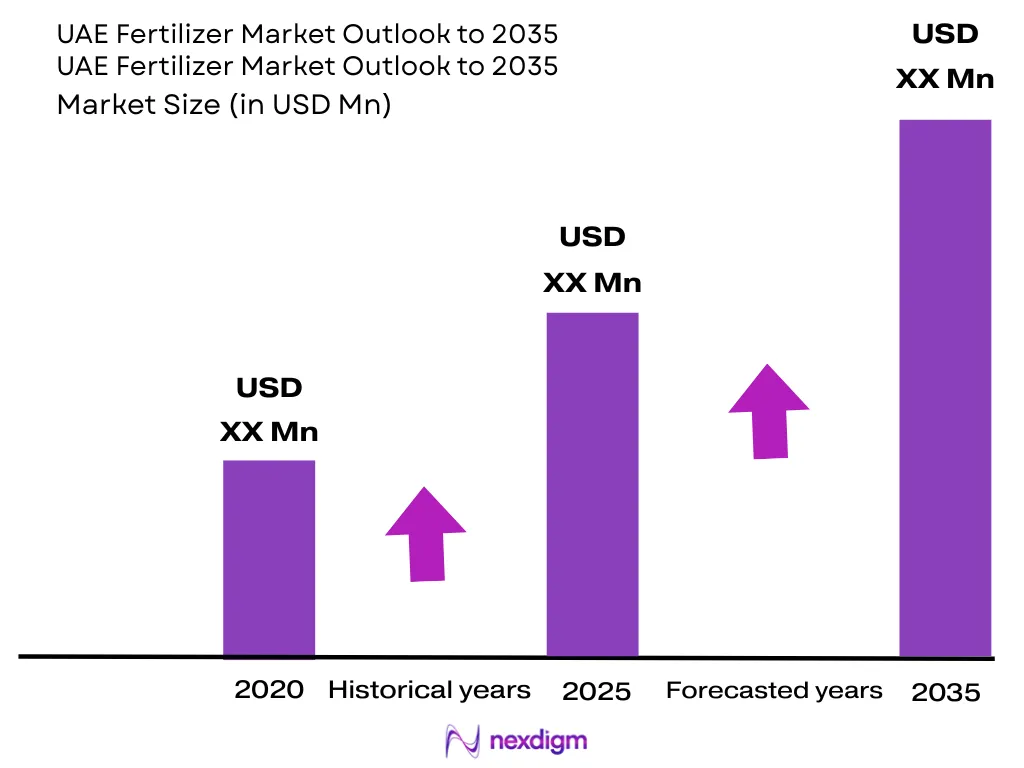
- By Market Value (2020-2025)
- By Production Volume (2020-2025)
- By Average Selling Price (2020-2025)

- By Nutrient Type (In Value %)
Nitrogen Fertilizers
Phosphate Fertilizers
Potash Fertilizers
Secondary Nutrient Fertilizers
Micronutrient Fertilizers
Specialty and Customized Fertilizers - By Application Method (In Value %)
Soil Application
Fertigation
Foliar Application
Seed Treatment
Precision Agriculture Application - By Crop Type (In Value %)
Date Palm
Vegetables
Fruits
Forage and Fodder Crops
Cereals
Flowers and Ornamentals
Greenhouse Crops
Hydroponic and Vertical Farm Crops
Others - By Region (In Value %)
Abu Dhabi
Dubai
Sharjah
Ras Al Khaimah
Other Emirates (Ajman, Fujairah, Umm Al Quwain) - By Distribution Channel (In Value %)
Agricultural Cooperatives and Government Entities
Agricultural Retailers
Direct Sales by Manufacturers
Distributors and Wholesalers
Digital Agricultural Platforms

- Market Share Analysis of Major Players (By Value, By Volume, Nutrient Segment, Crop Segment, By Region)
- Market Concentration Analysis
- Cross Comparison Parameters (Product Portfolio Diversity, Annual Fertilizer Production Capacity, Blending Capacity, Import Terminal Infrastructure, Distribution Network Reach, Agronomic Technical Service Coverage, Specialty Fertilizer Portfolio Strength, Crop-Specific Nutrient Solution Capability)
- SWOT Analysis of Major Players
- Pricing Analysis by Product Type and Nutrient Grade
- Detailed Profiles of Major Companies
FERTIGLOBE (OCI / ADNOC Joint Venture)
Abu Dhabi Fertilizer Industries (ADFERT)
Yara Middle East
Haifa Group Middle East
ICL Specialty Fertilizers UAE
SQM Middle East
Compo Expert Middle East
Agrium UAE (Nutrien)
Agri Advanced Industries
Green Star Agriculture
Al Ain Farms
Emirates Hydroponics Farms
Al Rawabi Agriculture
United Hydroponics
Falcon Farms

- Crop Nutrient Consumption Assessment (Crop Area, Yield Targets, Nutrient Removal Rates, Fertilizer Intensity)
- Farm Size Analysis (Small Farms, Medium Farms, Large Commercial Farms)
- Purchasing Power Analysis (Farm Income Levels, Credit Availability, Fertilizer Budget Allocation)
- Seasonal Demand Assessment (Planting Cycles, Crop Calendar, Procurement Patterns)
- Farmer Purchasing Behavior (Brand Preference, Nutrient Preference, Price Sensitivity)
- Precision Agriculture Adoption Analysis (GPS-Based Application, Variable Rate Technology, Digital Farm Management)
- Sustainability Adoption Analysis (Carbon Reduction Practices, Soil Health Management, Sustainable Agriculture)
- Pain Point Analysis (Input Costs, Nutrient Availability, Logistics Challenges, Agronomic Support)
- Purchase Decision-Making Process

- By Market Value (2026-2035)
- By Production Volume (2026-2035)
- By Average Selling Price (2026-2035)


 Request a Sample
 Ask for Customization
 Get a Quote
 Enquire Now