

 Download PDF
Market Overview
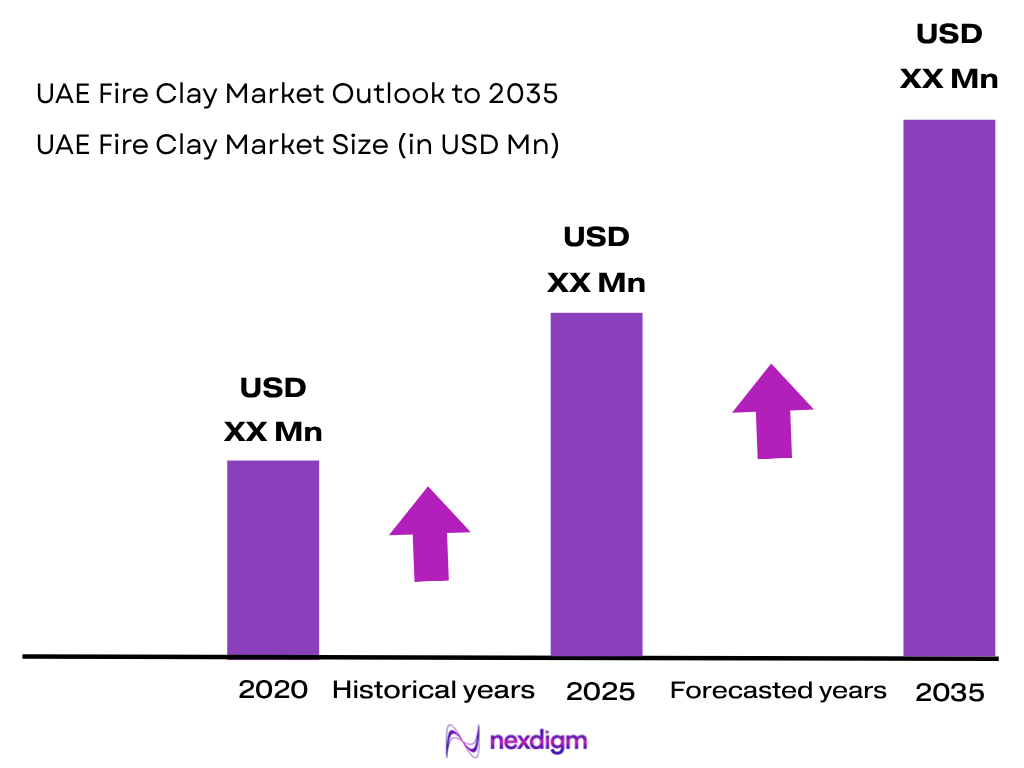
The UAE Fire Clay Market is estimated at USD ~XX million in 2024, with the 2026–2035 CAGR at ~XX% as a placeholder for the final market model. Demand is primarily derived from refractory applications supporting steel, aluminium, cement, glass, ceramics, petrochemicals and other high-temperature industries. The UAE produced 2.69 million tonnes of primary aluminium, 3.72 million tonnes of raw steel, 13.4 million tonnes of hydraulic cement and 3.49 million tonnes of direct-reduced iron in 2024, according to the U.S. Geological Survey. The country’s mineral and industrial ecosystem therefore provides multiple downstream channels for fire-clay-based refractory products.
Abu Dhabi, Dubai, Ras Al Khaimah, Sharjah and Fujairah constitute the principal industrial locations relevant to the UAE Fire Clay Market because they combine manufacturing, construction, minerals processing, ceramics, steel, aluminium and refractory activities. Abu Dhabi recorded AED 111.6 billion in manufacturing value added and AED 107.4 billion in construction value added in 2024, while its population reached 4.14 million. Ras Al Khaimah has a particularly established ceramics and minerals ecosystem, including large-scale ceramic manufacturing, while Sharjah hosts refractory suppliers and industrial distributors.
Market Segmentation
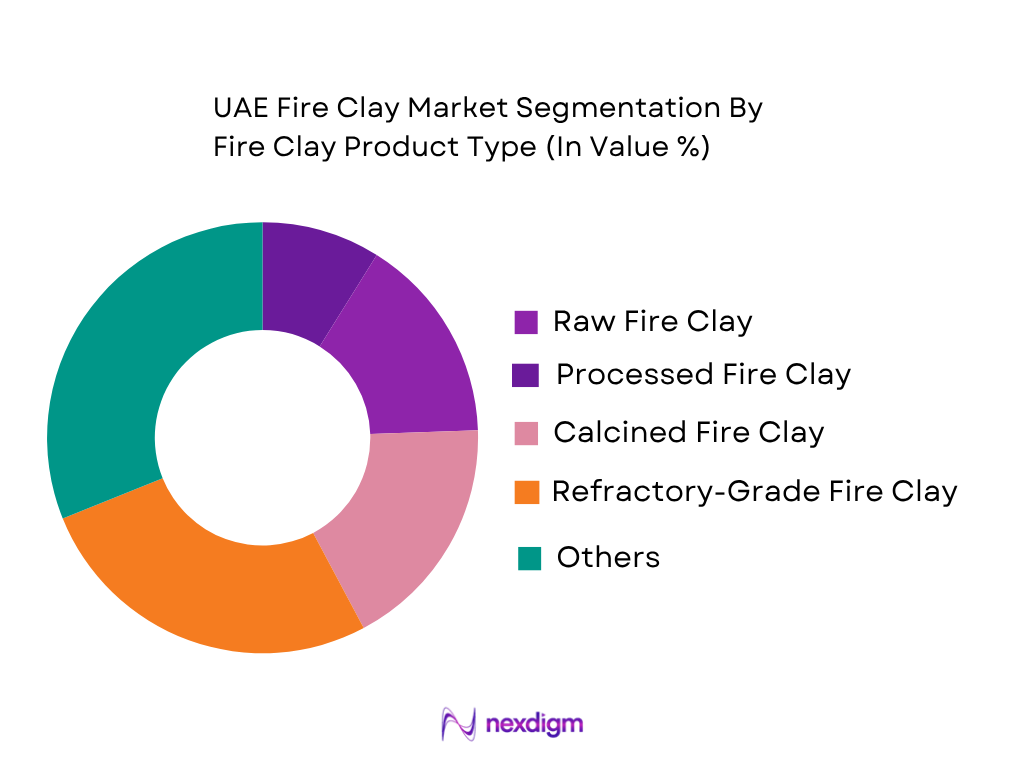
By Fire Clay Product Type
The UAE Fire Clay Market is segmented by fire clay product type into raw fire clay, processed fire clay, calcined fire clay, refractory-grade fire clay, high-alumina fire clay, low-iron fire clay, plastic fire clay, flint clay and specialty fire clay grades. Refractory-grade fire clay is expected to represent the leading sub-segment because the largest demand opportunity comes from converting suitable aluminosilicate raw materials into products capable of serving furnaces, kilns and other high-temperature equipment. UAE industrial production provides a diversified downstream base, with 2.69 million tonnes of primary aluminium, 3.72 million tonnes of raw steel and 13.4 million tonnes of hydraulic cement produced in 2024. Local suppliers already offer fire-clay mortars, fireclay bricks and high-alumina refractory products, supporting a structured demand chain between raw-material suppliers, refractory manufacturers and industrial users.
By End-Use Industry
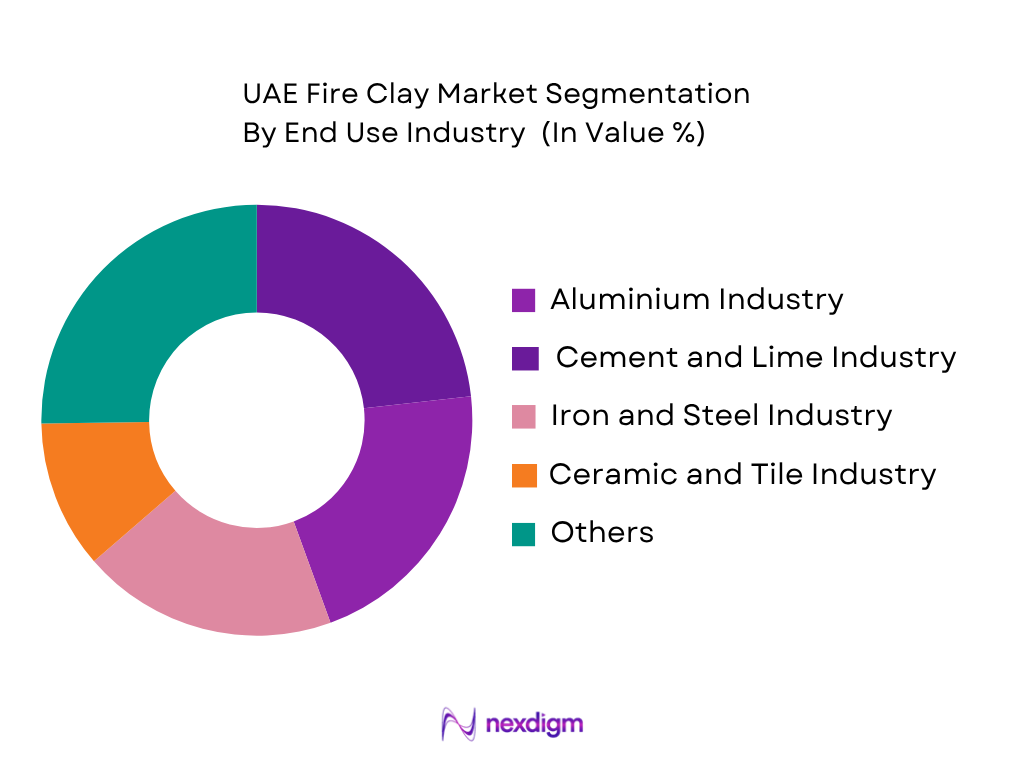
The UAE Fire Clay Market is segmented by end-use industry into steel and direct-reduced iron, aluminium, cement and lime, glass, ceramics and tiles, petrochemical and refining, foundry and non-ferrous metals, industrial furnaces, construction materials and other high-temperature processing industries. Aluminium industry is positioned as a major end-user segment because the UAE operates a large integrated aluminium ecosystem requiring refractory materials across high-temperature processing. The country produced 2.69 million tonnes of primary aluminium and 2.54 million tonnes of alumina in 2024. Steel and cement provide additional industrial demand, with 3.72 million tonnes of raw steel and 13.4 million tonnes of hydraulic cement produced during the same year.
Competitive Landscape
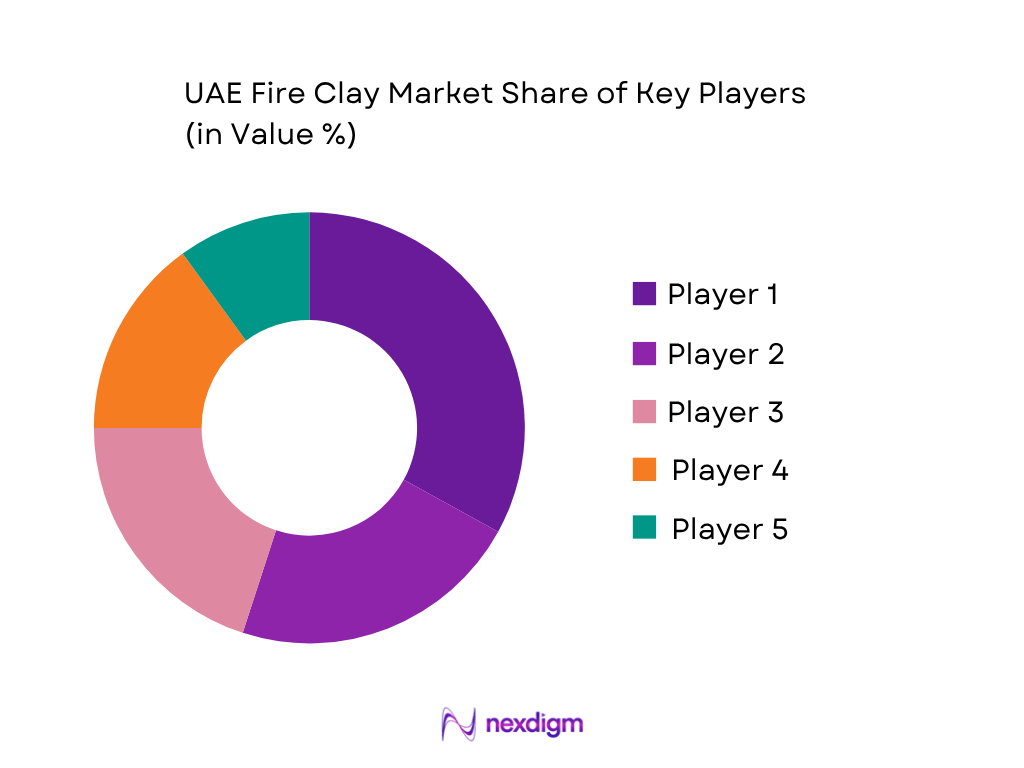
The UAE Fire Clay Market includes refractory manufacturers, refractory service providers, fire-clay suppliers, mineral distributors and international refractory groups. Competition is shaped by access to industrial customers, refractory product breadth, technical support and supply-chain capabilities. Local companies such as Al Karawan Refractories and Capstone Ceramics supply fire-clay and refractory products, while international groups such as Vesuvius maintain UAE manufacturing or service operations.
| Company | Establishment Year | Headquarters | Fire Clay / Refractory Portfolio | Key End Users | UAE Presence | Manufacturing / Service Capability | Application Coverage |
| Vesuvius | 1916 | London, UK | ~ | ~ | ~ | ~ | ~ |
| Calderys | 1907 | Paris, France | ~ | ~ | ~ | ~ | ~ |
| Al Karawan Refractories | — | Sharjah, UAE | ~ | ~ | ~ | ~ | ~ |
| Capstone Ceramics | — | UAE | ~ | ~ | ~ | ~ | ~ |
| High Tech Refractories | — | Ras Al Khaimah, UAE | ~ | ~ | ~ | ~ | ~ |
UAE Fire Clay Market Analysis
Growth Drivers
Expansion of Aluminium Smelting Capacity
The UAE Fire Clay Market is supported by the country’s large aluminium-processing base, where refractory materials are required in high-temperature production equipment, furnaces, furnaces linings and associated thermal-processing units. The U.S. Geological Survey reported 2.69 million tonnes of primary aluminium and 2.54 million tonnes of alumina production in the UAE in 2024, compared with 2.66 million tonnes of primary aluminium and 2.48 million tonnes of alumina in 2023. Emirates Global Aluminium also reported 2.74 million tonnes of cast-metal sales to 440 customers across more than 55 countries in 2024. The company’s aluminium segment therefore provides a substantial industrial base for refractory consumption and creates recurring requirements for materials capable of withstanding thermal shock, chemical attack and prolonged furnace exposure. The expansion of higher-value aluminium products further increases the technical requirements placed on refractory systems. Emirates Global Aluminium reported that value-added products represented 82% of sales in 2024, compared with 76% in 2023. These production and processing indicators support opportunities for fire-clay materials used in aluminium-related refractory applications, particularly where thermal stability, dimensional integrity and resistance to molten-metal environments are important procurement criteria.
Cement and Clinker Manufacturing
Cement and clinker production provide another significant downstream demand base for the UAE Fire Clay Market because rotary kilns, preheaters, coolers and other high-temperature equipment require refractory linings and shaped or monolithic refractory products. The U.S. Geological Survey recorded 13.4 million tonnes of hydraulic cement production in the UAE in 2024, with the same reported production level in 2023. EMSTEEL reported 4.6 million tonnes per annum of cement-production capacity, alongside 1.386 million tonnes of clinker sales and 1.673 million tonnes of cement-product sales in 2024. Its cement manufacturing process includes burning raw material at approximately 1,500°C, creating demanding thermal conditions for kiln refractories. The broader UAE economy also provides supporting construction activity: Federal Competitiveness and Statistics Centre data show that real GDP reached AED 1.776 trillion in 2024, while construction was among the fastest-growing activities, expanding by 8.4%. Cement plants therefore represent an important recurring application environment for fire-clay-containing refractory systems, particularly for kiln maintenance, thermal-zone protection and replacement of worn lining materials.
Market Challenges
Limited Domestic Fire Clay Resources and Dependence on Imported Refractory Inputs
The UAE Fire Clay Market faces a structural supply challenge because domestic mineral-resource development is concentrated in commodities for which reliable production statistics are available, while detailed national production information for specific clay categories remains limited. The U.S. Geological Survey explicitly notes that clays may be produced in the UAE but that available information was inadequate to make reliable estimates of output. This creates uncertainty around the scale and consistency of locally available fire-clay feedstock. At the same time, the UAE’s mineral-processing industries rely heavily on internationally sourced raw materials. USGS recorded 10.8 million tonnes of bauxite imports from Guinea in 2024, compared with 14.1 million tonnes in 2023, illustrating the importance of overseas mineral supply chains to the country’s aluminium ecosystem. The country’s total non-oil GDP reached AED 1.342 trillion in 2024, reinforcing the scale of industrial activity that requires dependable material inputs. For fire-clay suppliers, limited visibility over domestic deposits, dependence on imported refractory-grade materials and the need to maintain consistent chemical and physical specifications can increase supply-chain complexity.
Quality Consistency, Processing and Regulatory Requirements
Quality consistency is a significant challenge for the UAE Fire Clay Market because refractory manufacturers and industrial furnace operators require raw materials with controlled alumina, silica, iron-oxide, moisture and particle-size characteristics. Variations in these parameters can affect refractoriness, thermal-shock resistance, dimensional stability and service life. The challenge is particularly relevant in a market where large industrial consumers operate sophisticated thermal-processing assets. USGS reported 3.72 million tonnes of raw steel, 3.49 million tonnes of direct-reduced iron, 2.69 million tonnes of primary aluminium and 13.4 million tonnes of hydraulic cement production in the UAE in 2024. EMSTEEL additionally operates 4.2 million tonnes per annum of direct-reduction capacity, 3.5 million tonnes per annum of steelmaking capacity and 4.6 million tonnes per annum of cement-production capacity. These operations require refractory inputs that meet application-specific technical specifications rather than simply generic clay requirements. UAE mineral-resource governance also involves emirate-level jurisdiction, as Article 23 of the Federal Constitution grants each emirate ownership and management responsibility over its mineral resources. Consequently, suppliers must navigate technical qualification, environmental considerations, mineral-resource regulation and application-specific quality requirements when developing domestic fire-clay supply.
Market Opportunities
Domestic Fire Clay Processing and Calcined Fire Clay Development
Domestic processing of suitable clay resources represents an opportunity for the UAE Fire Clay Market to move toward higher-value refractory inputs rather than relying exclusively on imported processed materials. The opportunity is supported by the UAE’s sizeable downstream industrial base. In 2024, the country produced 2.69 million tonnes of primary aluminium, 3.72 million tonnes of raw steel, 3.49 million tonnes of direct-reduced iron and 13.4 million tonnes of hydraulic cement, according to the U.S. Geological Survey. EMSTEEL operates 4.6 million tonnes per annum of cement-production capacity, with clinker manufacturing involving temperatures of approximately 1,500°C, demonstrating the demanding thermal environment served by refractory materials. Emirates Global Aluminium produced a record 2.54 million tonnes of alumina and 2.69 million tonnes of hot metal in 2024. Developing local beneficiation, drying, sizing and calcination capabilities could enable suitable mineral feedstock to be converted into more consistent refractory-grade inputs. Calcined fire clay can provide improved dimensional stability and controlled moisture characteristics for refractory formulations. The UAE’s industrial infrastructure, concentrated manufacturing base and established import-export logistics provide conditions for integrating mineral processing with refractory manufacturing and distribution.
Import Substitution and Integrated Refractory Manufacturing
Import substitution provides an opportunity for the UAE Fire Clay Market because the country has substantial downstream demand but remains connected to international mineral and refractory supply chains. The UAE recorded AED 1.776 trillion in real GDP and AED 1.342 trillion in non-oil GDP in 2024, while manufacturing contributed AED 181 billion based on the Federal Competitiveness and Statistics Centre’s reported economic structure. The country also produced 2.69 million tonnes of primary aluminium, 3.72 million tonnes of raw steel, 13.4 million tonnes of hydraulic cement and 2.54 million tonnes of alumina during the same period. These industries provide multiple potential customers for locally processed fire-clay refractory products. EMSTEEL’s operations include 3.5 million tonnes per annum of steelmaking capacity, 4.2 million tonnes per annum of direct-reduction capacity and 4.6 million tonnes per annum of cement-production capacity, while its cement division sold 1.386 million tonnes of clinker in 2024. Developing integrated mine-to-processing-to-refractory supply chains could shorten procurement routes, improve material traceability and support application-specific refractory formulations. Such integration could also strengthen the UAE’s position as a regional distribution and re-export base for refractory products serving nearby industrial markets.
Future Outlook
Over the forecast period, the UAE Fire Clay Market is expected to benefit from continued industrial diversification, construction activity and utilization of high-temperature processing equipment. The country’s real GDP reached AED 1.776 trillion in 2024, while construction expanded by 8.4% and transportation and storage grew by 9.6%. Manufacturing remained a major economic activity, while Abu Dhabi’s manufacturing value added reached AED 111.6 billion. These conditions support continued demand for refractory materials across metals, cement, ceramics and industrial furnace applications. The UAE also has significant mineral resources in the northern Emirates. The Ministry of Energy and Infrastructure identifies extensive limestone and hard-rock resources used for construction aggregate and cement, while noting that demand for higher-value mineral products is currently met through imports and could potentially be served by local resources. This creates a broader opportunity for mineral processing and value-added refractory-material development. Ministry of Education
Major Players
- Vesuvius
- Calderys
- Al Karawan Refractories
- Capstone Ceramics
- High Tech Refractories
- RefraeX International FZ-LLC
- RAK Ceramics
- Saint-Gobain
- RHI Magnesita
- Morgan Advanced Materials
- Krosaki Harima Corporation
- Shinagawa Refractories
- HWI International
- IFGL Refractories
- Al Saada General Trading LLC
Key Target Audience
- Aluminium Smelters and Alumina Producers
- Steel and Direct-Reduced Iron Producers
- Cement and Clinker Manufacturers
- Ceramic and Glass Manufacturers
- Petrochemical and Refinery Operators
- Refractory Manufacturers and Industrial Material Suppliers
- Investments and Venture Capitalist Firms
- Government and Regulatory Bodies (Ministry of Energy and Infrastructure, Ministry of Industry and Advanced Technology, Federal Competitiveness and Statistics Centre)
Research Methodology
Step 1: Identification of Key Variables
The initial phase involves constructing a UAE Fire Clay Market ecosystem covering mineral suppliers, refractory manufacturers, distributors and industrial end users. Key variables include fire-clay grade, alumina content, refractory application, industrial furnace demand and end-user consumption. Government industrial statistics and mineral-production datasets are mapped to establish the underlying demand environment.
Step 2: Market Analysis and Construction
Historical market information is compiled using production, consumption, trade, industrial output and downstream refractory indicators. The analysis evaluates fire-clay demand across aluminium, steel, cement, ceramics, glass, petrochemicals and industrial furnace applications. Bottom-up demand calculations are reconciled with broader industrial indicators to establish the market framework.
Step 3: Hypothesis Validation and Expert Consultation
Market hypotheses are assessed against information from refractory manufacturers, suppliers, industrial users and mineral-processing participants. Technical factors such as grade specifications, refractory formulation, furnace conditions, replacement cycles and procurement practices are incorporated into the validation process. This approach helps distinguish direct fire-clay consumption from indirect demand generated through refractory products.
Step 4: Research Synthesis and Final Output
The final stage integrates supply-side, demand-side, trade and industrial information into a unified UAE Fire Clay Market assessment. Segment-level assumptions are cross-checked against downstream production indicators and company capabilities. The resulting framework supports historical analysis, competitive benchmarking and the 2026–2035 market outlook.

- Executive Summary
- Research Methodology (Market Definition and Scope, Fire Clay Market Boundary, Refractory Raw-Material Mapping, Data Collection Framework, Top-Down Market Sizing, Bottom-Up Market Sizing, Demand-Side Assessment, Supply-Side Assessment, Primary Industry Interviews, Production and Consumption Reconciliation, Import-Export Validation, Data Triangulation, Forecasting Framework, Market Share Assessment, Assumptions and Limitations)

- Definition and Scope
- UAE Fire Clay Market Evolution
- Fire Clay Resource and Refractory Ecosystem Analysis
- Fire Clay Value Chain Analysis
- Fire Clay Supply Chain Analysis
- UAE Fire Clay Market Industrial Demand Mapping
- UAE Fire Clay Market Geographic Industry Concentration Analysis

- Growth Drivers (Expansion of Aluminium Smelting Capacity, Steel and Direct-Reduced Iron Production, Cement and Clinker Manufacturing, Industrial Furnace Utilization, Glass and Ceramic Manufacturing, Petrochemical Processing, Construction-Material Production, Demand for High-Temperature Refractory Materials)
- Market Challenges (Limited Domestic Fire Clay Resources, Dependence on Imported Refractory Raw Materials, Quality Consistency Requirements, Limited Local Fire Clay Processing, Transportation and Logistics Constraints, Environmental Compliance, Mining and Mineral Resource Regulations, High Specification Requirements, Competition from High-Alumina and Alternative Refractory Minerals)
- Market Opportunities (Domestic Fire Clay Processing, Calcined Fire Clay Development, High-Alumina Refractory Raw Materials, Import Substitution, Integrated Refractory Manufacturing, Advanced Fireclay Products, Industrial Furnace Applications, Aluminium and Steel Refractory Demand, Value-Added Mineral Processing, Regional Re-Export Opportunities)
- Market Trends (Growth of High-Performance Refractories, Low-Cement Refractory Adoption, Precast Refractory Solutions, Furnace Efficiency Optimization, Digital Refractory Monitoring, Refractory Life Extension, Sustainable Mineral Processing, Industrial Waste Recycling, Advanced Kiln Technologies)
- Government Regulations and Standards (UAE Mining and Quarrying Regulations, Ministry of Energy and Infrastructure Mineral Resource Policies, Ministry of Industry and Advanced Technology Industrial Regulations, Environmental Compliance Requirements, Waste Management Requirements, Industrial Safety Standards, Product Conformity Requirements, Customs and Import Regulations, GCC Standards and Technical Regulations)
- SWOT Analysis
- Porter’s Five Forces Analysis
- PESTLE Analysis
- Stakeholder Ecosystem
- Competition Ecosystem

- By Market Value (2020-2025)
- By Volume Consumption (2020-2025)
- By Fire Clay Consumption Volume (2020-2025)
- By Refractory Material Production Volume Supported by Fire Clay (2020-2025)
- By Import Volume (2020-2025)
- By Export Volume (2020-2025)

- By Fire Clay Product Type (In Value %)
Raw Fire Clay
Processed Fire Clay
Calcined Fire Clay
Refractory-Grade Fire Clay
High-Alumina Fire Clay
Low-Iron Fire Clay
Plastic Fire Clay
Flint Clay
Semi-Flint Clay
Specialty Fire Clay Grades - By Refractory Application (In Value %)
Fireclay Bricks
Fireclay Mortars
Refractory Castables
Monolithic Refractories
Kiln Linings
Furnace Linings
Precast Refractory Shapes
Insulating Firebricks
Refractory Components
Other Fire Clay-Based Refractory Products - By End-Use Industry (In Value %)
Iron and Steel Industry
Aluminium Industry
Cement and Lime Industry
Glass Industry
Ceramic and Tile Industry
Petrochemical and Refining Industry
Foundry and Non-Ferrous Metals Industry
Industrial Furnace Industry
Construction-Material Industry
Other High-Temperature Processing Industries - By Grade and Chemical Composition (In Value %)
Standard Fire Clay
High-Alumina Fire Clay
Low-Iron Fire Clay
Low-Alkali Fire Clay
High-Refractoriness Fire Clay
Plasticity-Optimized Fire Clay
Calcined Fire Clay
Blended Fire Clay - By Application Temperature Range (In Value %)
Moderate-Temperature Applications
High-Temperature Applications
Very-High-Temperature Applications
Thermal-Shock-Resistant Applications
Continuous-Firing Applications
Intermittent-Firing Applications - By Sales and Distribution Channel (In Value %)
Direct Sales to Refractory Manufacturers
Direct Sales to Industrial End Users
Refractory Material Distributors
Mineral and Raw-Material Traders
Industrial Equipment Suppliers
Specialized Refractory Suppliers
Project-Based Procurement

- Market Share of Major Players (By UAE Revenue, Product Portfolio, Fire Clay Product Coverage, Refractory Product Coverage, End-Use Industry Coverage)
- Cross Comparison Parameters (Fire Clay Product Portfolio Breadth, Refractory Grade Coverage, High-Alumina Material Capability, Calcined Fire Clay Capability, Refractory Manufacturing Capacity, Industrial End-User Coverage, Technical Refractory Engineering Capability, UAE Distribution and Supply Network)
- SWOT Analysis of Major Players
- Detailed Profiles of Major Companies
RAK Ceramics P.J.S.C.
High Tech Refractories LLC
Al Karawan Refractories
Capstone Ceramics
RefraeX International FZ-LLC
Peneq Industrial Equipment
Saint-Gobain Middle East
RHI Magnesita
Vesuvius
Calderys
Krosaki Harima Corporation
Morgan Advanced Materials
Shinagawa Refractories
HWI International
IFGL Refractories

- Steel and Direct-Reduced Iron Consumer Assessment
- Aluminium Industry Consumer Assessment
- Cement and Lime Industry Consumer Assessment
- Glass Industry Consumer Assessment
- Ceramic and Tile Industry Consumer Assessment
- Petrochemical and Refining Consumer Assessment
- Foundry and Non-Ferrous Metals Consumer Assessment

- By Market Value (2026-2035)
- By Volume Consumption (2026-2035)
- By Fire Clay Consumption Volume (2026-2035)
- By Refractory Material Production Supported by Fire Clay (2026-2035)
- By Import Volume (2026-2035)
- By Export Volume (2026-2035)


 Request a Sample
 Ask for Customization
 Get a Quote
 Enquire Now