
 Download PDF
 Download PDF
Market Overview
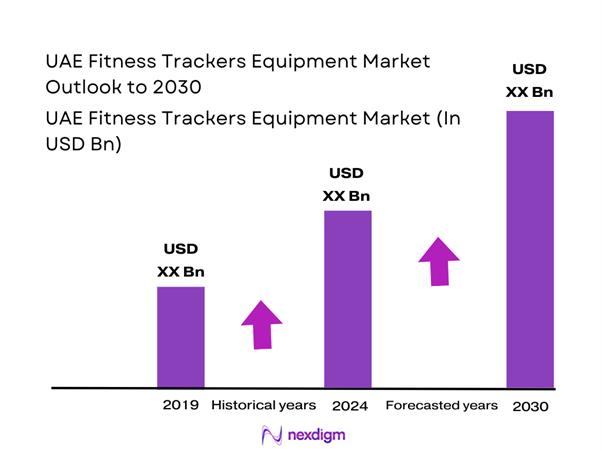
The UAE fitness trackers equipment market is valued at USD ~ million, supported by a broader wearable computing spend of USD ~ million that signals strong consumer readiness for wrist-worn tech and app-led health tracking. Demand is being driven by premium smartphone ecosystems, higher device replacement cycles in urban centers, and channel maturity across electronics retail and e-commerce. The market’s medium-term trajectory is anchored by the forecast expansion to USD ~ million, reflecting deeper penetration of always-on biometrics, sleep/recovery analytics, and subscription-led coaching layers.
Market demand is concentrated in Dubai and Abu Dhabi due to higher density of premium retail, fitness chains, corporate wellness programs, and digitally enabled consumers who upgrade more frequently. Cross-border brand dominance is led by U.S., South Korean, and Chinese OEM ecosystems because of stronger platform lock-in (phones + wearables + services), faster product refresh cycles, and deeper channel partnerships in the UAE. These ecosystems also win in “sticky” usage—health dashboards, coaching apps, and accessories—creating a repeat purchase loop through add-on bands, chargers, and warranty/service ecosystems.
Market Segmentation
By Product Type
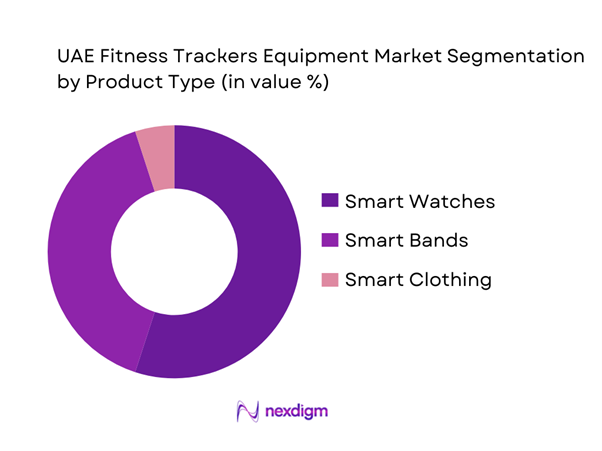
The UAE fitness trackers equipment market is segmented by product type into smart watches, smart bands, and smart clothing. Recently, smart watches have a dominant market share because they operate as a “daily utility” device rather than a single-purpose fitness tracker—combining notifications, payments-ready features (model dependent), workout tracking, and medical-adjacent sensors such as heart-rate and SpO₂. UAE buyers also skew toward premium, brand-led purchases where flagship watches are marketed alongside smartphones and sold through high-visibility electronics retail and carrier-adjacent promotions. This creates stronger upsell economics (LTE variants, accessories) and higher replacement cycles than bands.
By Distribution Channel
The UAE fitness trackers equipment market is segmented into online and offline channels. Recently, offline has remained the leading channel because buyers often prefer hands-on evaluation for high-ticket wearables—fit/comfort, strap quality, display readability, and instant warranty confidence. Offline also benefits from bundling mechanics (phone + watch, accessory add-ons, extended warranty), in-store promotions, and immediate fulfillment, which matters for gifting and fast replacement use-cases. At the same time, online is gaining because UAE consumers are highly digital and price-comparative; however, the premium segment still converts strongly in physical retail where trust and service reassurance are highest.

Competitive Landscape
The UAE fitness trackers equipment market is dominated by a small set of global ecosystems where device + app + phone integration drives higher retention, higher upgrade frequency, and stronger premium pricing power. The competitive structure is therefore shaped less by “hardware only” and more by platform depth, sensor roadmap, and distribution strength across UAE electronics retail and e-commerce. Premium brands win on trust, cross-device sync, and after-sales confidence, while fast-moving challengers compete on value features, battery life, and aggressive online merchandising.
| Company | Established | Headquarters | Core Product Strength (UAE Fit) | Health / Sensor Depth | App & Ecosystem Strength | UAE Channel Strength | Price Positioning | Warranty / Service Model |
| Apple | 1976 | USA | ~ | ~ | ~ | ~ | ~ | ~ |
| Samsung | 1938 | South Korea | ~ | ~ | ~ | ~ | ~ | ~ |
| Huawei | 1987 | China | ~ | ~ | ~ | ~ | ~ | ~ |
| Garmin | 1989 | USA | ~ | ~ | ~ | ~ | ~ | ~ |
| Xiaomi | 2010 | China | ~ | ~ | ~ | ~ | ~ | ~ |

UAE Fitness Trackers Equipment Market Analysis
Growth Drivers
Chronic Disease Monitoring Demand
The UAE’s healthcare system is actively scaling screening and early-detection pathways, which directly increases the addressable base for home-based monitoring devices (including fitness trackers with heart-rate, activity, sleep and SpO₂ features that are increasingly used as “first-line” self-tracking). A clear signal is the UAE Ministry of Health and Prevention’s national prediabetes/diabetes program exceeding ~ early-detection screenings (HbA1c-based testing for high-risk individuals, linked to care pathways and follow-ups), delivered across government facilities and public/private workplaces—exactly the environments where wearables adoption typically accelerates via “screen → coach → track” loops. This demand is structurally supported by the UAE’s ability to fund and scale preventive care, with GDP at USD ~ billion and GDP per capita at USD ~, which underpins higher per-capita health spending capacity and faster rollout of tech-enabled monitoring models (remote counseling, app-enabled follow-ups, and device-assisted adherence). Together, high screening throughput and strong macro capacity make fitness trackers more “utility-led” (monitoring) rather than only “lifestyle-led.”
Corporate Wellness Adoption
Corporate-led wellness programs are a powerful accelerator in the UAE because a very large share of the population is workforce-linked, and employers can institutionalize device usage through challenges, rewards, and preventive checkups (for example, steps-based campaigns, weight management, sleep improvement, stress reduction). The UAE’s labor market scale and economic productivity context supports this, with the economy at USD ~ billion and GDP per capita at USD ~, creating budget headroom for large employers in energy, aviation, logistics, retail, banking, and government-linked entities to treat health and wellness as a productivity and retention lever rather than a discretionary perk. In parallel, government-backed fitness mega-programming provides ready-made calendars that corporate HR teams plug into, with Dubai Fitness Challenge recording ~ participants and Abu Dhabi hosting ~ sports and community events attracting ~ participants. This combination of macro capacity, concentrated large-employer base, and mass fitness programming keeps corporate wellness a durable driver for sustained tracker purchases and refresh cycles.
Challenges
Data Privacy and Consent Readiness
Wearables generate sensitive behavioral and physiological signals, including sleep timing, location-adjacent activity patterns, and heart-rate variability proxies, making privacy, consent, and data residency operational requirements rather than only legal checkboxes. The UAE has the digital scale to benefit from wearables, but the same scale raises governance complexity, with federal entities processing ~ digital transactions and serving ~ users across ~ services. This means the ecosystem is already high-volume and multi-platform, where consent management, third-party data sharing, and auditability become hard at the edge, especially when devices, apps, insurers, employers, and healthcare providers intersect. Telecom-scale connectivity further increases the surface area, with total subscriptions at ~ and active mobile subscriptions around ~, enabling continuous syncing and cloud storage that are useful for users but demanding for compliance teams. For the fitness tracker market, this translates to longer enterprise procurement cycles, stricter vendor due diligence, and higher requirements for privacy-by-design.
Clinical Accuracy Perception
A core market friction is the gap between consumer-grade wellness sensing and clinical-grade expectations, especially when users buy trackers specifically for chronic condition monitoring rather than for steps. The UAE’s health system is actively increasing screening throughput, with ~ diabetes screenings conducted under a national campaign, which increases the number of people who become health-aware and more demanding about measurement reliability, follow-up guidance, and linkage to validated pathways. When a newly screened, high-risk user adopts a wearable, they often compare wearable readings against clinic readings, and perceived inconsistencies can reduce trust and repeat usage. Macro context amplifies this, with GDP per capita at USD ~ enabling consumers and employers to afford premium ecosystems and raising expectations for accuracy, app insights, multilingual UX, and clinical partnerships. For vendors, this challenge is not only technical but also about messaging discipline and localized validation narratives without implying regulated medical claims.
Opportunities
Insurer-Backed Programs
The UAE has the digital and macro capacity for payer-driven wearables programs that reward measurable behaviors such as activity consistency, sleep regularity, and weight management adherence without relying on speculative future claims. The opportunity is grounded in current-scale digital operating reality, with federal entities processing ~ digital transactions, recording ~ website visits, and serving ~ users across ~ digital services. This means the country already runs high-volume identity-aware service journeys that can be adapted to insurer engagement flows, including member authentication, consent capture, rewards disbursement, and audit trails. On the demand side, national screening intensity with ~ diabetes screenings under a government program creates a large cohort of newly aware high-risk individuals likely to engage with behavior change tools. With GDP per capita at USD ~, insurers and employers can co-fund programs that prioritize long-term engagement rather than one-time giveaways, shifting trackers from retail-led to programmatic adoption.
Employer-Led Wearables
Employer-led wearables programs are a high-leverage opportunity in the UAE because corporate participation is already normalized through city-scale fitness initiatives and because workplaces are a proven distribution node. Government screening campaigns explicitly reached public and private workplaces, reinforcing this channel. Fitness mega-events provide ready-made seasons for employer activation, with Dubai Fitness Challenge recording ~ participants and Abu Dhabi hosting ~ events attracting ~ participants. These create repeatable calendars where HR can run step challenges, team competitions, and coaching-based interventions across sleep, nutrition, and stress. The digital operating base, with ~ federal digital transactions, reduces friction for verifying participation, pushing nudges, and integrating benefits enrollment journeys. With GDP at USD ~ billion and GDP per capita at USD ~, many employers can justify wearables as part of productivity, safety, and retention programs, supporting growth through bulk procurement, structured engagement, and predictable replacement cycles.
Future Outlook
Over the next five years, the UAE fitness trackers equipment market is expected to expand strongly as wearables shift from activity tracking to continuous health sensing and insight delivery. Growth will be powered by deeper sensor stacks such as sleep and recovery, improved battery performance, tighter smartphone integration, and a rising role of employer and insurer wellness initiatives. Based on published market projections, revenue is expected to scale from USD ~ million to USD ~ million, implying a CAGR of ~ across the period.
Major Players
- Apple
- Samsung
- Huawei
- Garmin
- Xiaomi
- Fitbit
- Amazfit
- Withings
- Polar
- Oura
- Whoop
- Suunto
- Honor
- Realme
Key Target Audience
- Head of Corporate Procurement
- Head of Product / Category Management
- Head of Distribution & Channel Partnerships
- Head of Digital Health Platforms & Consumer Apps
- Head of Corporate HR & Rewards
- Head of Health & Life Insurance Product
- Investments and venture capitalist firms
- Government and regulatory bodies
Research Methodology
Step 1: Identification of Key Variables
We build the UAE wearable ecosystem map covering OEMs, distributors, retailers, e-commerce marketplaces, carriers (where relevant), gyms, and insurers. Desk research consolidates device categories, sensor stacks, pricing ladders, and channel structures. The goal is to define the variables that shape adoption, including platform ecosystems, premiumization, and after-sales confidence.
Step 2: Market Analysis and Construction
We compile historical revenue and shipment indicators and map them to UAE channel behavior and product mix such as watches, bands, and clothing. A bottom-up build is created from SKU presence, channel checks, and brand-level triangulation. We cross-validate the market construction using published country-level benchmarks.
Step 3: Hypothesis Validation and Expert Consultation
Market hypotheses are validated via expert interviews with UAE distributors, retail category managers, e-commerce sellers, and fitness ecosystem stakeholders. These discussions validate price bands, sell-through patterns, warranty dynamics, and promotional intensity. Insights are used to refine adoption assumptions and competitive positioning.
Step 4: Research Synthesis and Final Output
Findings are synthesized into a decision-ready report covering segmentation, competition, and strategic opportunity spaces. We run consistency checks across value chain feedback loops and align outputs to buyer use-cases such as GTM planning, partnership strategy, and investment screening. Final outputs are packaged with clear assumptions and replicable logic.

- Executive Summary
- Research Methodology (Market Definitions and Assumptions, Scope Delimitations, Abbreviations, Device Classification Framework, Installed Base Estimation Logic, Shipment vs Active Usage Modeling, Bottom-Up Brand Mapping, Primary Interviews with UAE Distributors Pharmacies Insurers and Gyms, Validation via Channel Checks, Limitations and Forward-Looking Assumptions)

- Definition and Scope
- Market Genesis and Evolution
- Technology Adoption Curve in UAE
- Consumer and Enterprise Usage Lifecycle
- UAE Wearable Ecosystem and Value Chain

- Growth Drivers
Chronic Disease Monitoring Demand
Corporate Wellness Adoption
Digital Health Penetration
Fitness Culture Expansion
Insurance Incentivization - Challenges
Data Privacy and Consent Readiness
Clinical Accuracy Perception
Price Sensitivity Outside Premium Segments
Device Abandonment Rates
Platform Fragmentation - Opportunities
Insurer-Backed Programs
Employer-Led Wearables
Medical-Grade Consumer Devices
Arabic-Localized Health Platforms
Subscription-Based Analytics - Trends
ECG Enablement
Sleep Analytics
AI-Based Coaching
Battery Optimization
Form-Factor Innovation - Regulatory & Policy Landscape
- SWOT Analysis
- Stakeholder & Ecosystem Analysis
- Porter’s Five Forces Analysis
- Competitive Intensity & Ecosystem Mapping

- By Value, 2019–2024
- By Volume, 2019–2024
- By Average Selling Price, 2019–2024
- Installed Base vs Replacement Demand, 2019–2024

- By Fleet Type (in Value %)
Smartwatches
Fitness Bands
Smart Rings
Chest Straps
Clip-on Trackers - By Application (in Value %)
Heart Rate Monitoring
SpO₂ Tracking
ECG Enabled
Sleep and Recovery Metrics
Multi-Sport Tracking - By Technology Architecture (in Value %)
Bluetooth-Only
Smartphone-Dependent
Cloud-Connected
Health App Integrated
API-Ready Devices - By Connectivity Type (in Value %)
Individual Consumers
Corporate Wellness Programs
Fitness Centers and Gyms
Insurance-Linked Users
Clinical and Preventive Healthcare Users - By End-Use Industry (in Value %)
Electronics Retail
Pharmacies
E-Commerce Platforms
OEM Direct-to-Consumer
Corporate and Institutional Sales - By Region (in Value %)
Dubai
Abu Dhabi
Sharjah
Northern Emirates

- Market Share of Major Players on the Basis of Value and Volume
- Cross Comparison Parameters (Device Portfolio Breadth, Sensor and Health Metric Depth, App and Ecosystem Strength, UAE Channel Penetration, Regulatory Readiness, Pricing Ladder, After-Sales and Warranty Model, Brand Trust and Retention)
- Competitive SWOT Analysis
- Pricing Analysis Basis Key SKUs Across UAE Channels
- Detailed Profiles of Major Companies
Apple
Samsung
Huawei
Garmin
Xiaomi
Fitbit
Amazfit
Withings
Polar
Oura
Whoop
Suunto
Honor
Realme
Fossil Group

- Market Demand Patterns
- Usage Frequency
- Budget Allocation Logic
- Decision-Making Hierarchy
- Brand vs Feature Trade-offs

- By Value, 2025–2030
- By Volume, 2025–2030
- By Average Selling Price, 2025–2030
- Installed Base vs Replacement Demand, 2025–2030


 Request a Sample
 Ask for Customization
 Get a Quote
 Enquire Now