
 Download PDF
Market Overview
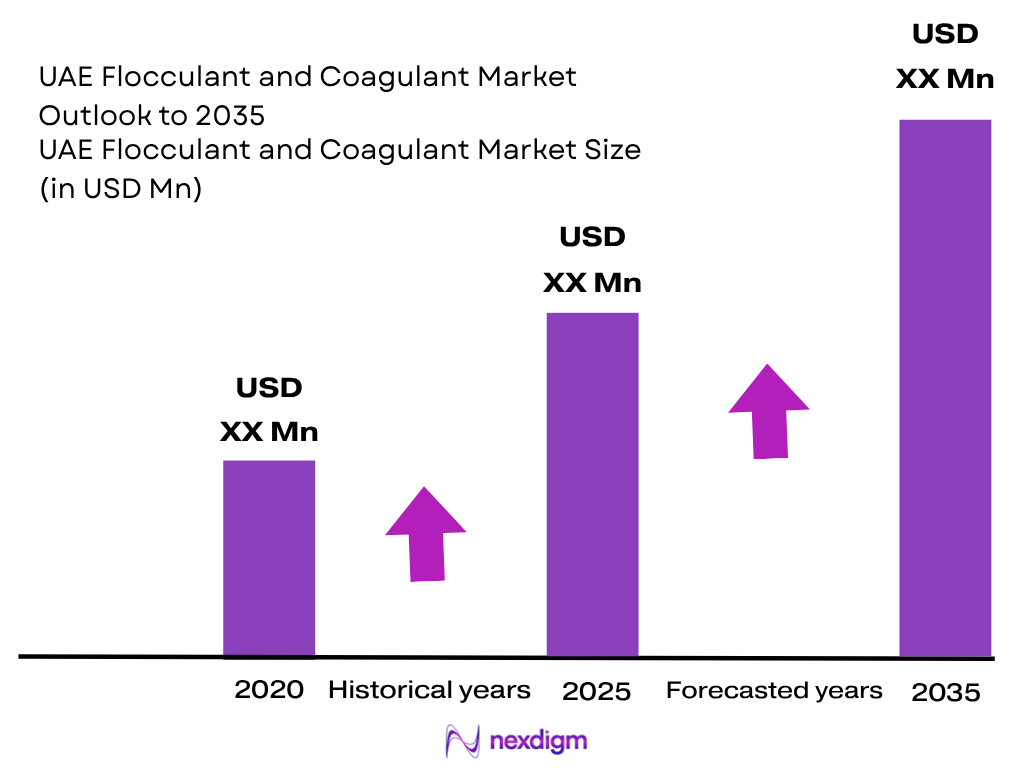
The UAE Flocculant and Coagulant Market was valued at approximately USD ~ billion in 2024, compared with USD ~ billion in 2023, with demand supported by desalination, municipal wastewater treatment, industrial water reuse, oil and gas processing, and sludge management. The UAE’s economic base provides substantial industrial and infrastructure activity: the World Bank reports USD 552.32 billion GDP, USD 50,273.5 GDP per capita, and 4.0 GDP growth for 2024. Population reached 10.99 million, supporting continued municipal water and wastewater infrastructure requirements.
The UAE Flocculant and Coagulant Market is concentrated around Abu Dhabi and Dubai because these emirates combine large municipal populations, desalination assets, wastewater-treatment infrastructure, industrial facilities, and extensive construction activity. Abu Dhabi’s concentration of oil and gas, petrochemicals, power and water infrastructure creates recurring industrial treatment requirements, while Dubai’s dense urban development, tourism, commercial facilities and wastewater infrastructure support municipal and industrial consumption. The UAE recorded 10.99 million people and 100 internet users per 100 people in 2024, reflecting a highly urbanized, infrastructure-intensive economy.
Market Segmentation
By Product Type
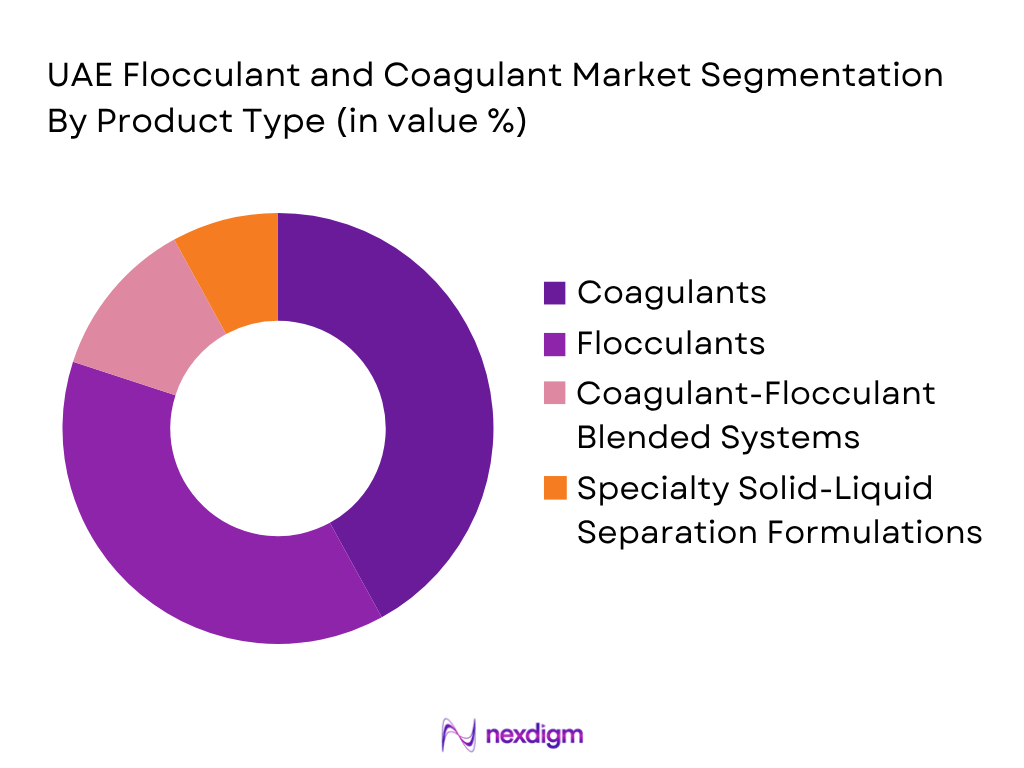
The UAE Flocculant and Coagulant Market is segmented by product type into flocculants, coagulants, coagulant-flocculant blended systems and specialty solid-liquid separation formulations. Flocculants are expected to represent the dominant sub-segment because they are extensively used after coagulation to promote particle aggregation and improve clarification, sedimentation and sludge separation. Their applicability across municipal wastewater, industrial effluent, desalination pretreatment and sludge dewatering creates a broad demand base. Polyacrylamide-based formulations are particularly relevant where operators require controlled molecular weight, charge density and settling performance. The UAE’s highly water-constrained environment increases the importance of treatment efficiency and water reuse, while its industrial structure creates demand for formulations capable of treating variable wastewater streams. The World Bank records 98 people per 100 with safely managed sanitation services in 2024, reinforcing the importance of established sanitation and wastewater-management infrastructure.
By Water Treatment Application
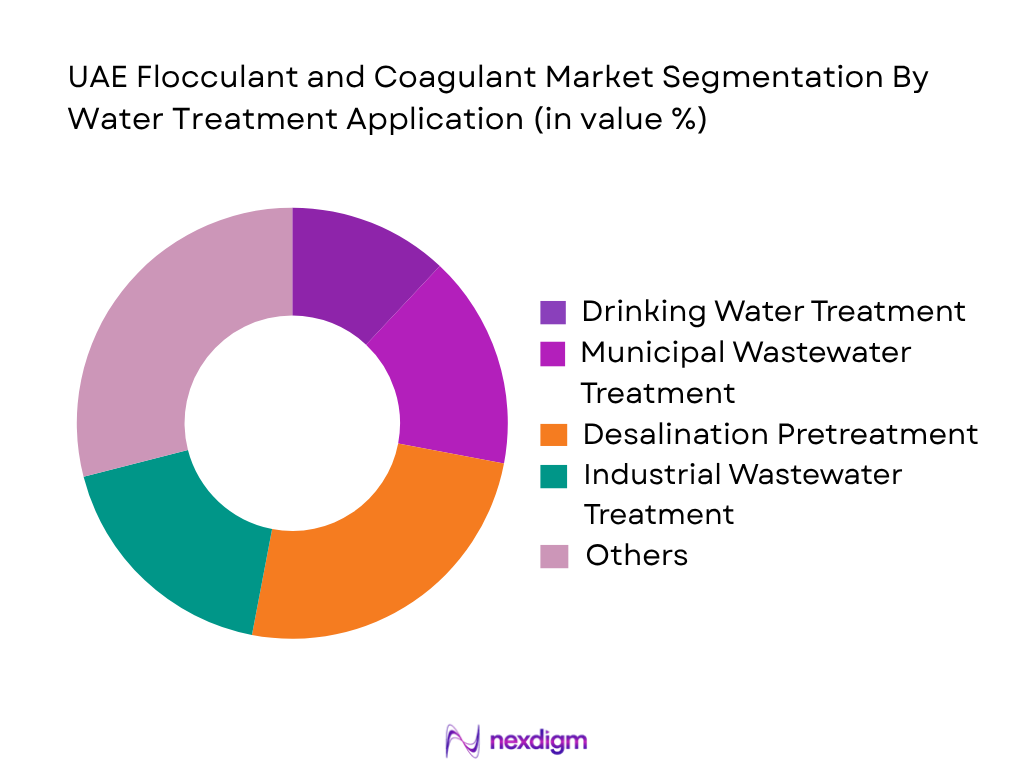
The UAE Flocculant and Coagulant Market is segmented by water treatment application into drinking water treatment, municipal wastewater treatment, desalination pretreatment, industrial wastewater treatment, produced water treatment, cooling water treatment, boiler water treatment, water reuse and recycling, and sludge treatment. Desalination pretreatment represents a structurally significant application because the UAE depends heavily on desalinated water and requires effective removal of suspended solids and other contaminants before membrane-based processes. Chemical coagulation and flocculation can support downstream filtration and reduce particulate loading. Municipal wastewater treatment and industrial wastewater treatment further expand consumption because different wastewater streams require application-specific chemistry. The country’s 2024 GDP of USD 552.32 billion and population of 10.99 million provide a broad economic and infrastructure base for water treatment demand, while 100% electricity access also supports energy-intensive water infrastructure.
Competitive Landscape
The UAE Flocculant and Coagulant Market comprises international water-treatment chemical manufacturers, specialty polymer suppliers, integrated water-treatment companies and regional treatment-service providers. Competition is shaped by product chemistry, technical formulation capability, treatment performance, application engineering, distribution reach and relationships with municipal utilities, desalination operators and industrial customers. Companies with broad portfolios covering coagulants, polyacrylamide flocculants, sludge-treatment chemicals and industrial wastewater applications are positioned across multiple demand segments.
| Company | Establishment Year | Headquarters | Flocculant Portfolio | Coagulant Portfolio | Desalination Capability | Industrial Wastewater Capability | Distribution / Technical Service | UAE Market Focus |
| SNF | 1978 | Andrézieux, France | ~ | ~ | ~ | ~ | ~ | ~ |
| Ecolab | 1923 | St. Paul, USA | ~ | ~ | ~ | ~ | ~ | ~ |
| Kemira | 1920 | Helsinki, Finland | ~ | ~ | ~ | ~ | ~ | ~ |
| Solenis | 1907 | Wilmington, USA | ~ | ~ | ~ | ~ | ~ | ~ |
| BASF | 1865 | Ludwigshafen, Germany | ~ | ~ | ~ | ~ | ~ | ~ |
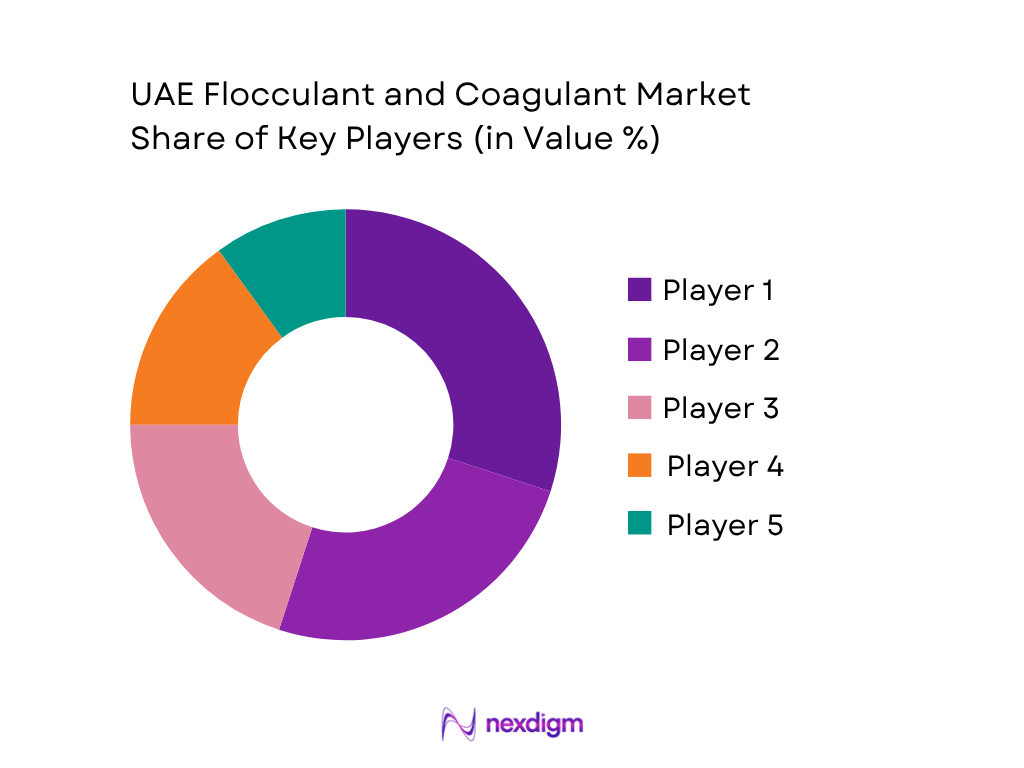
UAE Flocculant and Coagulant Market Analysis
Growth Drivers
Expansion of Desalination and Water Infrastructure
The UAE Flocculant and Coagulant Market is supported by the country’s extensive water-treatment infrastructure and continued requirement for reliable water supply. The World Bank records UAE population at 10,986,400 in 2024, while GDP reached USD 552.32 billion, indicating the scale of the population and economic base requiring continuous water and wastewater services. The same source reports 98 people per 100 with access to safely managed sanitation services in 2024, demonstrating the established role of wastewater infrastructure. Desalination plants require chemical pretreatment to remove suspended particles and colloidal matter before membrane-based separation, creating recurring demand for coagulants and flocculants. The UAE’s industrial and urban concentration further increases chemical-treatment requirements across drinking-water facilities, municipal wastewater plants and industrial water systems. IMF reporting identifies construction, tourism, manufacturing and financial services as important contributors to economic activity, supporting continued infrastructure development. The combination of 10.99 million residents, USD 50,273.5 GDP per capita, and USD 552.32 billion GDP creates a substantial infrastructure base for water-treatment chemical consumption. This environment supports demand for conventional coagulants, polyacrylamide flocculants, specialty formulations and sludge-treatment chemicals across UAE water infrastructure.
Industrial Diversification and Wastewater Treatment Demand
Industrial diversification represents another important growth driver for the UAE Flocculant and Coagulant Market because chemical treatment is required across multiple industrial wastewater streams. The World Bank records UAE GDP at USD 552.32 billion in 2024, while GDP per capita reached USD 50,273.5, reflecting the scale of economic activity supporting industrial facilities and associated water-management systems. IMF data identifies manufacturing, construction, tourism and financial services as major contributors to economic expansion, while hydrocarbon activity remains an important component of the economy. Industrial operations in oil and gas, petrochemicals, power generation, food processing and manufacturing produce wastewater with varying concentrations of suspended solids, hydrocarbons, organic compounds and process residues. These characteristics require customized coagulation and flocculation programs rather than a single standardized treatment formulation. The UAE also recorded 10,986,400 residents in 2024, creating additional municipal wastewater requirements alongside industrial demand. Continued development of industrial zones and production facilities can therefore increase requirements for clarification, sludge thickening and dewatering. The market opportunity extends beyond basic chemical supply toward application-specific polymers, automated dosing systems and technical treatment services capable of optimizing chemical consumption across diverse industrial wastewater conditions.
Market Challenges
Dependence on Imported Specialty Chemicals and Complex Supply Chains
The UAE Flocculant and Coagulant Market faces supply-chain challenges because a significant portion of specialty water-treatment chemicals, polymer technologies and formulated products are sourced through international manufacturers and distributors. This dependence exposes purchasers to international logistics conditions, shipping disruptions, currency movements and availability constraints affecting specialized formulations. The World Bank reports that the UAE generated USD 552.32 billion GDP in 2024, while GDP per capita reached USD 50,273.5, indicating a large and diversified economy with substantial demand for industrial inputs. However, the market’s specialized requirements mean that technically equivalent substitutes are not always immediately available when a particular polymer grade or coagulant formulation faces supply constraints. Flocculant performance depends on molecular weight, charge density, formulation concentration and wastewater chemistry, limiting the practicality of rapid product substitution. IMF reporting also identifies the UAE’s strong international trade and capital linkages as important components of its economic structure. For water-treatment operators, this creates a requirement for inventory planning, supplier diversification and technical qualification of alternative products. The challenge is particularly relevant for industrial customers requiring consistent treatment performance and validated chemical specifications for continuous operations.
Stringent Treatment Requirements and Application Complexity
The UAE Flocculant and Coagulant Market faces application complexity because treatment chemicals must operate effectively under highly variable water chemistry and demanding treatment conditions. The UAE’s 10,986,400 population in 2024 and USD 552.32 billion GDP support a large municipal and industrial infrastructure base, while the World Bank records 98 people per 100 with safely managed sanitation services. Such infrastructure requires consistent treatment outcomes rather than simple chemical consumption. Desalination pretreatment, municipal wastewater treatment and industrial effluent treatment each involve different suspended-solids characteristics, salinity conditions, pH levels and organic loading. Consequently, a formulation that performs effectively in one treatment process may require modification or different dosing in another. The UAE’s climate and water-scarcity conditions further increase the operational importance of reliable treatment because water resources must be managed efficiently. IMF data shows that economic activity continues to be supported by non-hydrocarbon sectors including construction, manufacturing and tourism, expanding the range of wastewater streams requiring treatment. Operators therefore require jar testing, dosage optimization, monitoring and technical support. These requirements can increase qualification periods and make market entry more demanding for suppliers without established application-engineering capabilities.
Market Opportunities
Expansion of Water Reuse and Advanced Wastewater Treatment
Water reuse and advanced wastewater treatment provide a significant opportunity for the UAE Flocculant and Coagulant Market because the country operates within a water-constrained environment and maintains a large urban and industrial infrastructure base. The World Bank records 10,986,400 people in 2024, USD 552.32 billion GDP, and USD 50,273.5 GDP per capita, demonstrating the scale of economic activity requiring reliable water systems. The same source records 98 people per 100 with safely managed sanitation services, indicating extensive sanitation infrastructure that can support advanced wastewater-management systems. As treated wastewater becomes increasingly important for applications such as landscaping, district cooling, industrial processes and other non-potable uses, treatment plants require reliable coagulation, flocculation, clarification and sludge-management stages. This creates opportunities for higher-performance polymers, specialty coagulants and formulations designed to improve solids removal and downstream filtration performance. The opportunity also extends to automated dosing and online water-quality monitoring, allowing operators to adjust chemical application according to changing influent conditions. IMF reporting identifies continued investment in infrastructure and non-hydrocarbon economic activity, providing a supportive environment for infrastructure-intensive water-management projects. Suppliers capable of combining chemistry, application engineering and dosing optimization can address increasingly sophisticated wastewater-treatment requirements.
Specialty Formulations for Desalination and Industrial Applications
Specialty formulations for desalination, oil and gas, petrochemicals, power generation and industrial wastewater represent another opportunity for the UAE Flocculant and Coagulant Market. The UAE recorded USD 552.32 billion GDP in 2024, while GDP per capita reached USD 50,273.5, reflecting a high-value economic environment capable of supporting technically advanced water-treatment systems. IMF reporting identifies manufacturing, construction and hydrocarbon activity among important contributors to economic performance, creating multiple industrial applications for coagulation and flocculation chemistry. Desalination pretreatment can require carefully selected coagulants and flocculants to reduce suspended solids and colloidal loading before downstream membrane processes. Industrial wastewater streams similarly require formulations adapted to hydrocarbons, metals, organic compounds, suspended solids and variable pH conditions. This creates room for specialty polyacrylamide grades, organic coagulants, hybrid formulations and application-specific treatment programs. The UAE’s 10,986,400 population in 2024 also sustains municipal water demand alongside industrial requirements. Suppliers can therefore pursue differentiated products based on treatment performance, dosage efficiency, sludge characteristics and compatibility with downstream filtration or membrane systems rather than competing solely through conventional chemical supply.
Future Outlook
Over the forecast period, the UAE Flocculant and Coagulant Market is expected to benefit from continued investment in water security, desalination, wastewater treatment and industrial water management. Increasing emphasis on water reuse and resource efficiency should support demand for higher-performance treatment chemistry. Industrial applications in oil and gas, petrochemicals, power generation, food processing and manufacturing should remain important demand contributors. The market is also expected to move toward optimized dosing, specialty polymers, lower-residual formulations and integrated treatment systems.
The UAE’s macroeconomic foundation supports this outlook. The World Bank reports USD 552.32 billion GDP and 4.0 economic growth in 2024, while population reached 10.99 million. These indicators provide a substantial base for infrastructure, industrial and municipal water-treatment requirements.
Major Players
- SNF
- Ecolab / Nalco Water
- Kemira
- Solenis
- BASF
- SUEZ
- Veolia Water Technologies
- Kurita Water Industries
- Metito
- Feralco
- LANXESS
- Buckman
- Chemtrade Logistics
- Dow
- USALCO
Key Target Audience
- Water and Wastewater Treatment Companies
- Desalination Plant Operators
- Oil and Gas Companies
- Industrial Manufacturing Companies
- Investments and Venture Capitalist Firms
- Government and Regulatory Bodies (UAE Ministry of Energy and Infrastructure, Ministry of Climate Change and Environment)
- Engineering, Procurement and Construction Companies
- Chemical Distributors and Specialty Water-Treatment Suppliers
Research Methodology
Step 1: Identification of Key Variables
The initial phase involves defining the UAE Flocculant and Coagulant Market ecosystem, covering chemical manufacturers, distributors, municipal utilities, desalination operators, wastewater-treatment plants and industrial users. Key variables include product chemistry, dosage requirements, treatment applications, end-use industries, import dependence and distribution structures. The analysis establishes the variables required for market sizing and segmentation.
Step 2: Market Analysis and Construction
Historical market information is compiled using secondary industry information, trade data, company disclosures, government publications and water-infrastructure indicators. The assessment covers flocculant and coagulant consumption, application demand, product chemistry, import and export activity, and end-use requirements. Top-down and bottom-up approaches are reconciled to establish the market framework.
Step 3: Hypothesis Validation and Expert Consultation
Market hypotheses are developed around demand from desalination, municipal wastewater, industrial wastewater, oil and gas, power generation and sludge treatment. These hypotheses are validated through discussions with industry participants, chemical suppliers, treatment operators and application specialists. Technical feedback is used to refine product segmentation, demand drivers and competitive positioning.
Step 4: Research Synthesis and Final Output
The final stage integrates market estimates, industry structure, application analysis, company assessments and demand-side findings. Information obtained from manufacturers, distributors and treatment operators is compared with secondary data to identify inconsistencies and improve reliability. The final output provides a structured assessment of market size, segmentation, competition, opportunities and future development.

- Executive Summary
- Research Methodology (Market Definition and Scope, UAE Flocculant and Coagulant Market Classification, Flocculant and Coagulant Product Mapping, Chemistry-Level Assessment, Polymer-Level Assessment, Charge-Type Assessment, Form-Level Assessment, Application-Level Demand Analysis, End-Use Industry Assessment, Water Treatment Process Mapping, Desalination Capacity Assessment, Municipal Water Infrastructure Assessment, Wastewater Treatment Infrastructure Assessment, Industrial Effluent Assessment, Domestic Supply Assessment, Import and Export Trade Analysis, Raw Material Supply Assessment, Municipal Demand Assessment, Industrial Demand Assessment, Demand-Side Assessment, Supply-Side Assessment, Top-Down Market Sizing, Bottom-Up Market Sizing, Primary Industry Interviews, Data Triangulation, Forecasting Framework, Market Share Validation, Limitations and Future Conclusions)

- Definition and Scope
- UAE Flocculant and Coagulant Industry Evolution and Development of Desalination Infrastructure, Municipal Water Treatment, Wastewater Treatment, Industrial Water Recycling and Advanced Solid-Liquid Separation Technologies
- Flocculant and Coagulant Value Chain Analysis
- Flocculant and Coagulant Supply Chain Analysis
- Chemical Feedstock Suppliers, Polymer Manufacturers, Coagulant Manufacturers, Flocculant Formulators, Water Treatment Chemical Suppliers, Distributors, Municipal Water Utilities, Wastewater Treatment Operators, Desalination Companies, Engineering and EPC Companies, Industrial End Users, Oil and Gas Operators, Power Generation Companies
- Flocculant Integration Across Drinking Water Treatment, Desalination Pretreatment, Municipal Wastewater Treatment, Industrial Effluent Treatment, Oil and Gas Produced Water, Power Generation, Food and Beverage, Chemical Processing and Sludge Dewatering

- Growth Drivers (Expansion of Desalination Capacity, Municipal Wastewater Treatment Development, Increasing Water Reuse, Industrial Wastewater Treatment Requirements, Oil and Gas Produced Water Treatment, Power Generation Water Demand, Urban Infrastructure Development, Increasing Sludge Dewatering Requirements, Demand for High-Efficiency Solid-Liquid Separation)
- Market Challenges (Dependence on Imported Specialty Chemicals, Raw Material Price Volatility, High Water Treatment Intensity, Stringent Water Quality Requirements, Complex Wastewater Chemistry, Chemical Dosing Optimization Requirements, Competition from Advanced Membrane Technologies, Supply Chain Disruptions, Skilled Water Treatment Operator Requirements)
- Market Opportunities (Advanced Desalination Pretreatment, Industrial Water Recycling, Municipal Wastewater Reuse, Oil and Gas Produced Water Treatment, Specialty Polymer Flocculants, High-Performance Organic Coagulants, Sustainable Water Treatment Chemistry, Automated Chemical Dosing, Digital Water Treatment Monitoring)
- Market Trends (High-Performance Polymer Flocculants, Desalination Pretreatment Optimization, Water Reuse Technologies, Advanced Sludge Dewatering, Automated Chemical Dosing, Digital Water Treatment Monitoring, Specialty Industrial Wastewater Formulations, Sustainable Flocculant Development, Online Process Monitoring)
- Government Regulations and Standards (UAE Water Security Strategy, Federal Environmental Regulations, Abu Dhabi Water Quality Requirements, Dubai Municipality Water and Wastewater Requirements, Industrial Effluent Discharge Requirements, Wastewater Reuse Standards, Environmental Protection Requirements, Chemical Handling Regulations, Product Safety and Labeling Requirements)
- SWOT Analysis
- Porter’s Five Forces Analysis
- PESTLE Analysis
- Stakeholder Ecosystem
- Competition Ecosystem

- By Market Value (2020-2025)
- By Market Volume (2020-2025)
- By Flocculant Consumption Volume (2020-2025)
- By Coagulant Consumption Volume (2020-2025)
- By Organic Flocculant Consumption Volume (2020-2025)
- By Inorganic Coagulant Consumption Volume (2020-2025)
- By Domestic Production Volume (2020-2025)
- By Import Volume (2020-2025)
- By Export Volume (2020-2025)
- By Average Selling Price (2020-2025)

- By Product Type (In Value %)
Flocculants
Coagulants
Coagulant-Flocculant Blended Systems
Specialty Solid-Liquid Separation Formulations - By Flocculant Type (In Value %)
Polyacrylamide Flocculants
Cationic Flocculants
Anionic Flocculants
Nonionic Flocculants
Amphoteric Flocculants
Natural Flocculants
Biopolymer-Based Flocculants
Other Specialty Flocculants - By Application Type (In Value %)
Coagulation
Flocculation
Clarification
Sedimentation
Sludge Thickening
Sludge Dewatering
Dissolved Air Flotation
Desalination Pretreatment
Solid-Liquid Separation
Water Recycling and Reuse - By End-Use Industry (In Value %)
Municipal Water and Wastewater Treatment
Desalination Industry
Oil and Gas
Power Generation
Chemical and Petrochemical Manufacturing
Food and Beverage
Construction
Pharmaceutical Manufacturing
Industrial Manufacturing
Other Industrial Applications - By Water Treatment Application (In Value %)
Drinking Water Treatment
Municipal Wastewater Treatment
Desalination Pretreatment
Industrial Wastewater Treatment
Produced Water Treatment
Cooling Water Treatment
Boiler Water Treatment
Water Reuse and Recycling
Sludge Treatment - By Emirate (In Value %)
Abu Dhabi
Dubai
Sharjah
Ras Al Khaimah
Fujairah
Ajman
Umm Al Quwain

- Market Share of Major Players (By UAE Revenue, Flocculant Sales Volume, Coagulant Sales Volume, Product Chemistry Portfolio, Polymer Production Capacity, Desalination Application Exposure, Municipal Customer Coverage, Industrial Customer Coverage, Distribution Network Coverage, Emirate-Level Presence, Water Treatment Application Coverage, Technical Service Capability, R&D and Application-Laboratory Capability)
- Cross Comparison Parameters (Flocculant and Coagulant Revenue, Organic and Inorganic Product Portfolio Breadth, Polyacrylamide Technology Coverage, Desalination Pretreatment Capability, Municipal Water Treatment Capability, Industrial Wastewater Treatment Coverage, Sludge Dewatering Technology Capability, UAE Distribution Network Reach)
- SWOT Analysis of Major Players
- Competitive Positioning Matrix
- Flocculant Product Portfolio and Application Benchmarking
- Industrial Wastewater Treatment Technology Assessment
- Desalination Pretreatment and Solid-Liquid Separation Technology Assessment
- Sludge Dewatering and Wastewater Reuse Technology Assessment
- Major Companies
SNF
Ecolab / Nalco Water
Kemira
Solenis
Veolia Water Technologies
SUEZ Water Technologies & Solutions
BASF
Dow
Kurita Water Industries
Metito
Feralco
LANXESS
Buckman
Chemtrade Logistics
USALCO

- Municipal Drinking Water Utility Procurement Assessment
- Municipal Wastewater Treatment Plant Chemical Requirement Analysis
- Desalination Plant Coagulant and Flocculant Requirement Analysis
- Industrial Wastewater Treatment Operator Assessment
- Oil and Gas Produced Water Treatment Requirement Analysis
- Power Generation Water Treatment Chemical Procurement Analysis
- Food and Beverage Wastewater Treatment Assessment
- Chemical and Petrochemical Effluent Treatment Analysis
- Sludge Dewatering Chemical Procurement Assessment
- Water Treatment Engineering and EPC Procurement Analysis

- By Market Value (2026-2035)
- By Market Volume (2026-2035)
- By Flocculant Consumption Volume (2026-2035)
- By Coagulant Consumption Volume (2026-2035)
- By Organic Flocculant Consumption Volume (2026-2035)
- By Inorganic Coagulant Consumption Volume (2026-2035)
- By Domestic Production Volume (2026-2035)
- By Import Volume (2026-2035)
- By Export Volume (2026-2035)
- By Average Selling Price (2026-2035)


 Request a Sample
 Ask for Customization
 Get a Quote
 Enquire Now