

 Download PDF
Market Overview
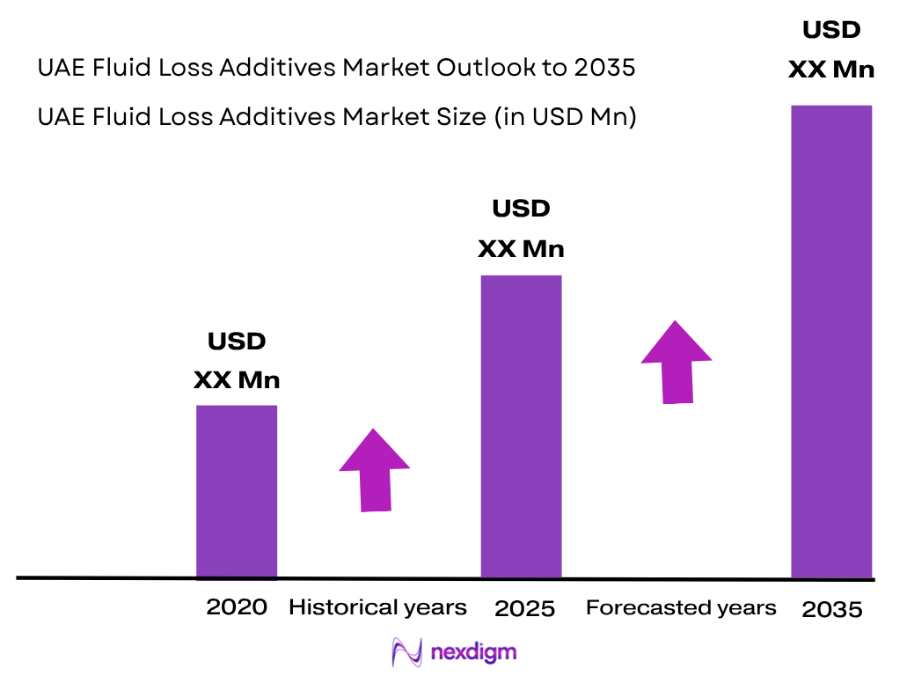
The UAE Fluid Loss Additives Market is valued at ~USD XX million in 2024, supported by sustained drilling activity, increasing well complexity, and demand for filtration-control chemicals across onshore, offshore, unconventional and completion operations. ADNOC Drilling drilled 676 wells in 2024, compared with 613 wells in 2023, while its fleet expanded from 129 to 142 rigs. The UAE economy also remained supportive of energy investment, with IMF projecting real GDP growth of 3.7% for 2024 and non-hydrocarbon GDP growth of 4.9%. ADNOC Drilling
Abu Dhabi dominates the UAE Fluid Loss Additives Market because it contains the country’s principal upstream oil and gas assets, drilling infrastructure, operator ecosystem and offshore production base. ADNOC Drilling’s 2024 fleet included 95 land rigs, 37 jackups and 10 island rigs, reflecting the breadth of drilling environments requiring fluid-loss control. Abu Dhabi also remains central to UAE hydrocarbon capacity expansion, with IMF reporting crude production capacity of approximately 4.85 million barrels per day and a medium-term target of 5 million barrels per day.
Market Segmentation
By Product Type
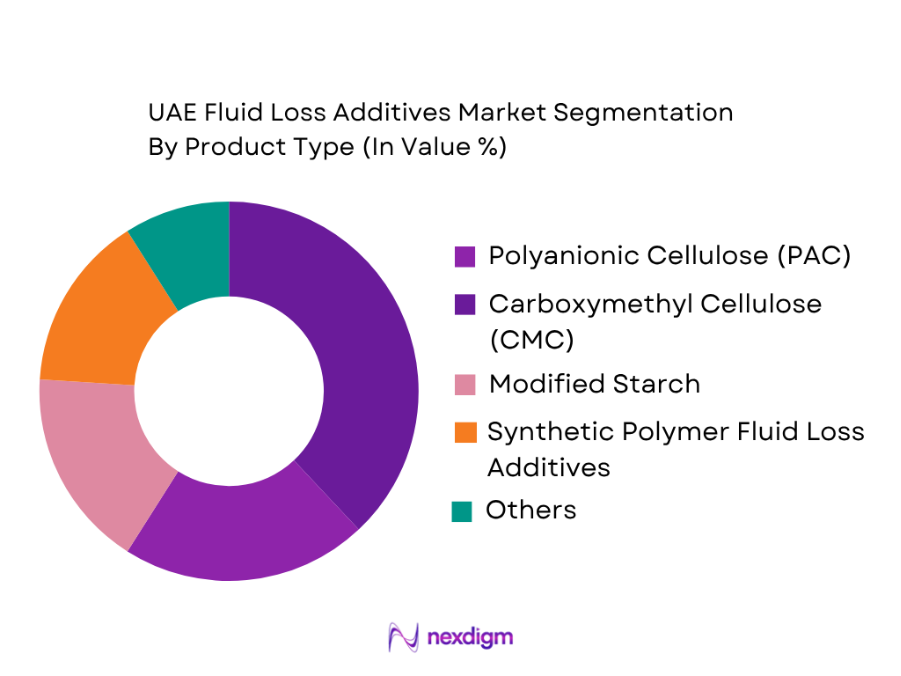
The UAE Fluid Loss Additives Market is segmented by product type into Polyanionic Cellulose (PAC), Carboxymethyl Cellulose (CMC), modified starch, synthetic polymer fluid-loss additives and natural polymer-based additives. PAC is expected to represent the dominant segment, reflecting its broad application in water-based drilling fluids and its ability to control API and HTHP filtration while contributing to filter-cake quality and wellbore stability. The importance of filtration control increases as UAE drilling programs move toward deeper, more complex and unconventional wells. ADNOC Drilling delivered 676 wells in 2024, while its unconventional strategy includes a 144-well drilling contract, creating requirements for fluid systems capable of maintaining filtration performance under demanding downhole conditions. PAC-based formulations can also be tailored for salinity, temperature and formation-specific requirements, making them particularly relevant to the UAE’s mixed onshore, offshore and unconventional drilling environment.
By Drilling Fluid System
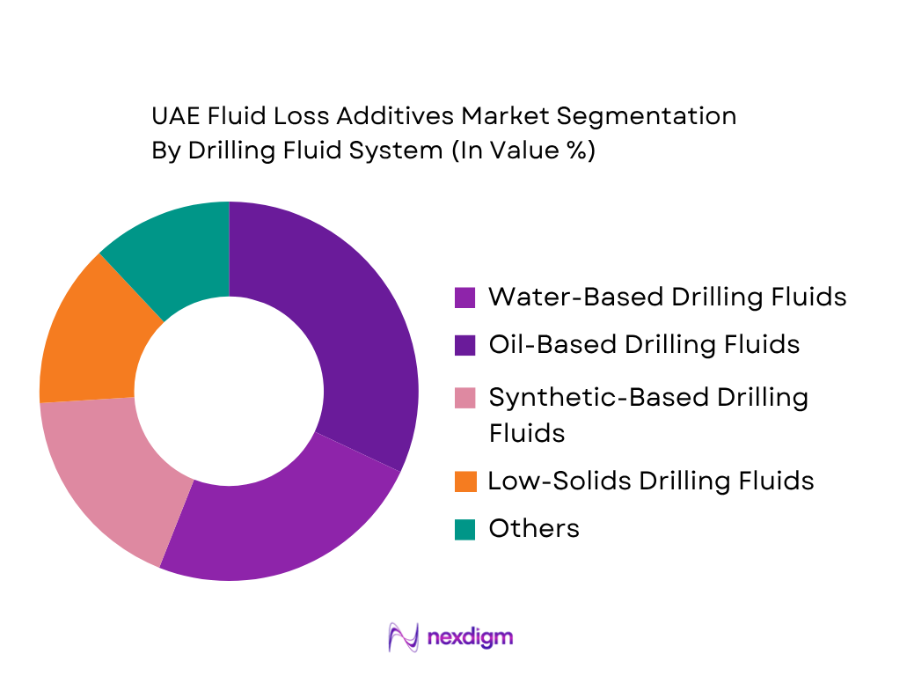
The UAE Fluid Loss Additives Market is segmented by drilling-fluid system into water-based drilling fluids, oil-based drilling fluids, synthetic-based drilling fluids, low-solids drilling fluids, reservoir drill-in fluids and completion fluids. Water-based drilling fluids are expected to hold the leading position, supported by their broad application across conventional drilling, development wells and selected unconventional operations. Fluid-loss additives are essential in water-based systems because filtration control directly influences filter-cake formation, wellbore stability and formation-damage management. The scale of UAE drilling activity reinforces this requirement, with ADNOC Drilling reporting 676 wells delivered during 2024 and a fleet of 142 rigs. The company’s unconventional expansion also creates additional demand for engineered water-based systems capable of managing complex formations and drilling conditions.
Competitive Landscape
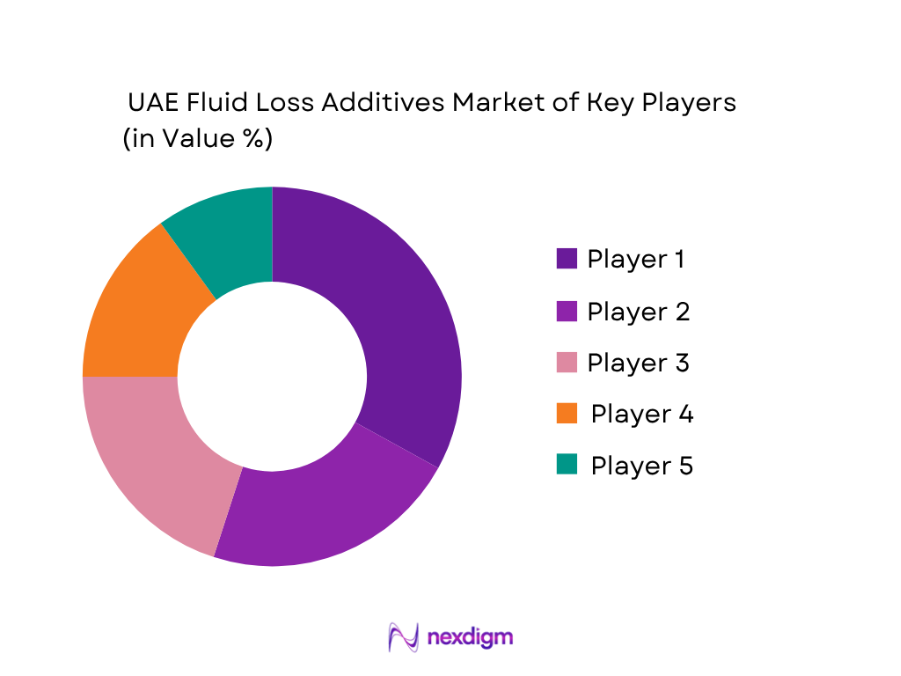
The UAE Fluid Loss Additives Market is characterized by competition between global oilfield-service companies, specialty drilling-chemical suppliers and integrated drilling-fluid providers. Competitive strength depends less on standalone additive availability and more on fluid formulation capability, ADNOC qualification, HPHT performance, offshore support, local technical services, drilling-fluid engineering and integration with broader well-construction services. ADNOC Drilling’s expansion to 142 rigs and its integrated drilling-services model increase the importance of suppliers capable of supporting large-scale, technically demanding drilling programs.
| Company | Established | Headquarters | PAC/CMC Portfolio | HPHT Fluid-Loss Capability | Offshore Capability | Local Technical Support | Drilling-Fluid Engineering | UAE Operator Exposure |
| SLB | 1926 | Houston, USA | ||||||
| Halliburton | 1919 | Houston, USA | ||||||
| Baker Hughes | 1907 | Houston, USA | ||||||
| Weatherford | 1941 | Houston, USA | ||||||
| Newpark Fluids Systems | 1932 | Houston, USA |
UAE Fluid Loss Additives Market Analysis
Growth Drivers
ADNOC Drilling Expansion
The expansion of ADNOC Drilling is a direct demand driver for the UAE Fluid Loss Additives Market because increasing rig deployment and well construction require continuous drilling-fluid consumption and filtration-control treatment. ADNOC Drilling operated 142 rigs in 2024, after adding 13 rigs, and drilled 676 wells, including a record 53,000-foot well from an artificial offshore island rig. The company also reported 96% rig availability, indicating sustained utilization of its drilling fleet. Integrated Drilling Services were implemented on 57 rigs, up from 48 in 2023, increasing the requirement for technically integrated drilling-fluid solutions. The UAE’s broader hydrocarbon investment environment reinforces this activity: the IMF recorded 4.0% real GDP growth in 2024, while real hydrocarbon GDP grew 1.0%, and crude production increased to approximately 2.9 million barrels per day. ADNOC’s production strategy remains linked to a 5 million barrels-per-day capacity target. This operating environment supports recurring consumption of PAC, CMC, modified starch and synthetic fluid-loss polymers as drilling programs expand and fluid systems become more application-specific.
Onshore, Offshore and Unconventional Well Development
The UAE Fluid Loss Additives Market is supported by simultaneous development of onshore, offshore and unconventional wells, creating demand for additives capable of maintaining filtration control across substantially different pressure, temperature, salinity and formation conditions. ADNOC Drilling’s 2024 fleet comprised 142 rigs, with operations spanning conventional and unconventional drilling. The company was awarded a USD 1.7 billion contract covering 144 unconventional wells, and it drilled the first wells under that program during the year. Offshore activity is also important: ADNOC’s Belbazem offshore development is designed to progressively reach 45,000 barrels per day of light crude and 27 million standard cubic feet per day of associated gas. At the macroeconomic level, the IMF reported UAE real GDP growth of 4.0% in 2024, while non-hydrocarbon GDP expanded 5.0%, supporting investment capacity across the wider industrial economy. The combination of conventional development, offshore production and unconventional drilling increases the range of drilling-fluid formulations required, strengthening demand for high-performance fluid-loss additives that provide thin filter cakes, control filtrate invasion and maintain wellbore stability under complex drilling conditions.
Market Challenges
Raw-Material Dependence
Raw-material dependence remains a structural challenge for the UAE Fluid Loss Additives Market because many specialized drilling-fluid chemicals require internationally sourced cellulose derivatives, polymers and performance-enhancing chemical inputs. The challenge becomes more significant when drilling programs require tightly controlled specifications for filtration, rheology, salinity tolerance and temperature stability. ADNOC’s 2024 procurement data nevertheless shows that localization is progressing: AED 72.3 billion of products had been locally manufactured within its procurement pipeline, exceeding the earlier AED 70 billion target, while the company returned AED 55.0 billion to the UAE economy through its ICV program during the year. ADNOC also reported an ICV score above 50% for 2024. These figures demonstrate both the scale of localization efforts and the continuing need to strengthen domestic supply chains. At the national level, the World Bank recorded UAE GDP of USD 552.32 billion in 2024 and GDP growth of 4.0%, providing a strong industrial base but not eliminating exposure to globally sourced specialty chemicals. For fluid-loss-additive suppliers, maintaining reliable access to consistent polymer grades while meeting operator specifications remains a key operational requirement.
Polymer Performance and Complex Fluid Conditions
Polymer performance variability presents a significant challenge because fluid-loss additives must remain effective under high temperature, high pressure, elevated salinity and contamination conditions encountered in technically demanding UAE wells. The scale of drilling complexity is illustrated by ADNOC Drilling’s 53,000-foot well drilled from an artificial offshore island rig in 2024. The company also maintained 96% rig availability, meaning fluid-system failures or prolonged formulation adjustments can have significant operational consequences in a highly utilized drilling environment. UAE hydrocarbon development increasingly combines conventional, offshore and unconventional applications, requiring additives to maintain filtration performance without creating adverse rheological effects or increasing formation-damage risk. The macroeconomic environment adds further pressure for operational efficiency: the World Bank recorded USD 552.32 billion of UAE GDP in 2024, while the IMF reported 5.0% non-hydrocarbon GDP growth, reflecting an economy capable of sustaining substantial industrial activity. Consequently, fluid-loss additives must deliver predictable performance rather than merely basic filtration control. Suppliers face additional technical requirements around compatibility with brines, drilling-fluid formulations, formation characteristics and completion objectives, increasing formulation complexity and application-engineering requirements.
Market Opportunities
High-Performance PAC and CMC
High-performance PAC and CMC formulations represent a strong opportunity because UAE drilling programs increasingly require fluid systems capable of controlling filtration while maintaining stable rheology under demanding well conditions. ADNOC Drilling drilled 676 wells in 2024 and operated 142 rigs, providing a large application base for filtration-control additives. Its unconventional program includes 144 wells, further increasing the need for polymers engineered for complex formations and demanding drilling-fluid environments. The opportunity also aligns with the UAE’s industrial-localization strategy. ADNOC reported AED 72.3 billion of locally manufactured products in its procurement pipeline in 2024 and established a new target of AED 90 billion by 2030. In 2025, ADNOC additionally awarded AED 543 million of contracts for locally manufactured products, explicitly including chemicals for drilling and production. These developments create a pathway for domestic production, blending and customization of fluid-loss additives rather than relying entirely on imported finished formulations. Suppliers that combine PAC and CMC performance with salinity tolerance, low dosage requirements, HPHT stability and local technical support can therefore address both drilling-performance requirements and the UAE’s increasing emphasis on localized industrial supply chains.
Local Additive Manufacturing and Customized Drilling-Fluid Packages
Local additive manufacturing and customized drilling-fluid packages offer an opportunity to align chemical supply with the UAE’s expanding localization agenda and increasingly differentiated well requirements. ADNOC’s ICV program returned AED 55.0 billion to the UAE economy in 2024, while its procurement pipeline contained AED 72.3 billion of locally manufactured products. ADNOC has set a further target of AED 90 billion of locally manufactured products in its procurement pipeline by 2030. The program also created 7,000 private-sector jobs for UAE Nationals in 2024, bringing the cumulative total to 18,500 jobs since 2018. These indicators provide a strong industrial framework for establishing local blending, formulation, testing and technical-support capabilities for fluid-loss additives. The opportunity is particularly relevant because UAE drilling spans onshore, offshore and unconventional environments. ADNOC Drilling’s 144-well unconventional contract and its 53,000-foot record well demonstrate the need for formulations tailored to specific operating conditions rather than standardized additive packages. Local suppliers can potentially shorten lead times, adapt PAC, CMC and synthetic-polymer blends to formation conditions, support real-time mud optimization and improve supply resilience while simultaneously satisfying local-content requirements.
Future Outlook
The UAE Fluid Loss Additives Market is expected to expand from ~USD XX million in 2024 to ~USD XX million by 2035, representing a forecast CAGR of ~XX% during 2026–2035. Growth is expected to be supported by continued drilling activity, unconventional resource development, offshore operations and increasing well complexity. ADNOC Drilling’s 144-well unconventional contract creates a direct requirement for specialized drilling-fluid technologies, while the company’s 2024 fleet of 142 rigs provides a substantial operating base for fluid-loss-control demand. ADNOC
The market is expected to move toward higher-performance PAC and CMC systems, low-dosage synthetic polymers, HPHT filtration-control technologies and customized drilling-fluid packages. Digital mud monitoring and integrated drilling-fluid optimization are also expected to gain importance as operators seek improved wellbore stability and drilling efficiency.
Major Players
- SLB
- Halliburton
- Baker Hughes
- Weatherford
- Newpark Fluids Systems
- BASF
- Clariant
- Nouryon
- Elementis
- Dow
- Ingevity
- Kemira
- CES Energy Solutions
- Flotek Industries
- Solvay
Key Target Audience
- Oil & Gas Operators and Producers – ADNOC Group companies and international operators
- Drilling Contractors – Onshore, offshore, jackup and island-rig operators
- Oilfield-Service Companies – Drilling-fluid, cementing, completion and well-intervention providers
- Drilling-Chemical Manufacturers – PAC, CMC, modified-starch and synthetic-polymer producers
- Investments and Venture Capitalist Firms – Energy-focused private-equity, infrastructure and industrial-technology investors
- Government and Regulatory Bodies – Abu Dhabi National Oil Company (ADNOC), UAE Ministry of Energy and Infrastructure, Environment Agency – Abu Dhabi
- Industrial Chemical Distributors – Oilfield chemical distributors and specialty chemical suppliers
- Energy Technology and Digitalization Companies – Drilling optimization, mud monitoring and well-construction technology providers
Research Methodology
Step 1: Identification of Key Variables
The initial phase involves mapping the UAE Fluid Loss Additives Market ecosystem across operators, drilling contractors, drilling-fluid companies, chemical manufacturers and distributors. Key variables include drilling activity, well count, rig deployment, drilled footage, drilling-fluid consumption, additive dosage, product type, fluid system and application.
Step 2: Market Analysis and Construction
Historical drilling activity is analyzed alongside well complexity, onshore and offshore operations, unconventional development and drilling-fluid requirements. Demand is constructed using a bottom-up framework combining well activity, additive consumption intensity, product mix and application-specific requirements, supplemented by operator and supplier-side assessments.
Step 3: Hypothesis Validation and Expert Consultation
Market hypotheses are validated through interviews with drilling-fluid engineers, procurement specialists, oilfield-service executives, chemical suppliers and drilling contractors. Particular emphasis is placed on PAC, CMC, modified starch and synthetic polymer usage, HPHT requirements, salinity tolerance and ADNOC-related qualification requirements.
Step 4: Research Synthesis and Final Output
The final market model integrates operator activity, drilling-rig deployment, product demand, fluid-system requirements and competitive positioning. Secondary data from official UAE and corporate sources are triangulated with industry interviews to validate market sizing, segmentation shares and future demand assumptions.

- Executive Summary
- Research Methodology (Market Definition and Scope, Fluid-Loss Additive Classification, Market Sizing Framework, Top-Down Analysis, Bottom-Up Analysis, Drilling Activity Assessment, Well-Meterage Analysis, Additive Consumption Intensity, Operator-Side Assessment, Supplier-Side Assessment, Primary Industry Interviews, Mud-Engineering Expert Consultation, Data Triangulation, Forecasting Framework, Assumptions and Limitations)

- Fluid Loss Additives in Drilling and Completion Fluids
- UAE Oil & Gas Industry Structure
- UAE Onshore and Offshore Drilling Landscape
- Conventional and Unconventional Well Development
- Drilling Fluid Technology Evolution
- Fluid-Loss Control Mechanisms Across Well Construction
- Fluid-Loss Additives Value Chain
- Drilling-Fluid Supply Chain

- Growth Drivers (ADNOC Drilling Expansion, Onshore and Offshore Well Development, Unconventional Resource Development, Extended-Reach Drilling, High-Performance Water-Based Fluids, Wellbore Stability Requirements, Formation-Damage Prevention, Integrated Drilling Services, Local Manufacturing, Digital Drilling Optimization)
- Market Challenges (Raw-Material Dependence, Polymer Performance Variability, HPHT Compatibility, High-Salinity Conditions, Calcium Contamination, Formation-Damage Risk, Complex Fluid Formulation, Offshore Logistics, Chemical Qualification, Environmental Compliance, Local Content Requirements, Supply-Chain Reliability)
- Market Opportunities (High-Performance PAC and CMC, HPHT Fluid-Loss Polymers, Unconventional Drilling Fluids, Extended-Reach Well Applications, Local Additive Manufacturing, In-Country Value Development, Environmentally Preferred Formulations, Reservoir Drill-In Fluids, Digital Mud Monitoring, Low-Dosage Synthetic Polymers, Offshore Fluid-Loss Optimization, Customized Drilling-Fluid Packages)
- Market Trends (Advanced PAC Formulations, High-Temperature Filtration Control, Low-Dosage Polymer Systems, Customized Fluid-Loss Packages, Digital Mud Monitoring, AI-Enabled Drilling Optimization, Environmentally Preferred Fluids, Local Chemical Manufacturing, Integrated Drilling Services, Unconventional Well Fluid Optimization)
- Government Regulations and Standards (ADNOC Drilling Fluid Specifications, ADNOC HSE Requirements, UAE Environmental Regulations, Offshore Drilling Waste Management, Oil-Based Mud Management, Water-Based Mud Requirements, Chemical Registration and Handling, Hazardous Chemical Controls, Marine Environmental Protection, Local Content and In-Country Value Requirements)
- SWOT Analysis
- Porter’s Five Forces Analysis
- PESTLE Analysis
- Stakeholder Ecosystem
- Competition Ecosystem

- By Volume Consumption (2020-2025)
- By Average Selling Price (2020-2025)
- By Additive Consumption per Well (2020-2025)
- By Consumption per Drilled Meter (2020-2025)
- By Drilling-Fluid System (2020-2025)
- By Application (2020-2025)
- By Operator Demand (2020-2025)

- By Product Type (In Value %)
Polyanionic Cellulose (PAC)
Carboxymethyl Cellulose (CMC)
Modified Starch
Synthetic Polymer Fluid-Loss Additives
Natural Polymer-Based Fluid-Loss Additives - By Drilling Fluid System (In Value %)
Water-Based Drilling Fluids
Oil-Based Drilling Fluids
Synthetic-Based Drilling Fluids
Low-Solids Drilling Fluids
Reservoir Drill-In Fluids
Completion Fluids - By Application (In Value %)
Exploration Drilling
Development Drilling
Extended-Reach Drilling
Unconventional Drilling
Workover and Completion
Reservoir Drill-In - By Well Type (In Value %)
Vertical Wells
Directional Wells
Horizontal Wells
Extended-Reach Wells
High-Angle Wells
Deep and High-Pressure Wells - By Operating Environment (In Value %)
Onshore
Offshore
Artificial-Island Drilling
Shallow-Water Operations
Deepwater Operations - By Fluid-Loss Control Requirement (In Value %)
API Filtration Control
HTHP Filtration Control
Filter-Cake Formation
Wellbore Stabilization
Formation-Damage Prevention
Lost-Circulation Management - By End User (In Value %)
ADNOC Group Companies
International Oil & Gas Operators
Integrated Drilling-Service Providers
Drilling Contractors
Drilling-Fluid Service Companies
Completion and Well-Intervention Contractors - By Procurement Model (In Value %)
Integrated Drilling-Fluid Service Contracts
Direct Operator Procurement
Long-Term Framework Agreements
Oilfield Chemical Distributors
Local Manufacturing and Blending

- Market Share of Major Players (By Value, Volume, Product Type, Drilling Fluid System, Application, End User, Operating Environment)
- Cross Comparison Parameters (PAC and CMC Grade Portfolio, HPHT Fluid-Loss Performance, High-Salinity Compatibility, Unconventional Drilling Capability, Offshore Technical Support, Local Manufacturing Capability, Mud-Engineering Integration, ADNOC Qualification and Project Experience)
- SWOT Analysis
- Detailed Profiles of Major Companies
SLB
Halliburton
Baker Hughes
ADNOC Drilling
Weatherford
Newpark Fluids Systems
Nouryon
Clariant
BASF
Elementis
Ingevity
CES Energy Solutions
Flotek Industries
Kemira
Dow

- Oil & Gas Operators
- Drilling Fluid Service Providers
- Well Completion & Intervention Companies
- Oilfield Service Companies
- Unconventional Drilling Operators
- Offshore Drilling Operators

- By Volume Consumption (2026-2035)
- By Average Selling Price (2026-2035)
- By Additive Consumption per Well (2026-2035)
- By Consumption per Drilled Meter (2026-2035)
- By Drilling-Fluid System (2026-2035)
- By Application (2026-2035)
- By Operator Demand (2026-2035)


 Request a Sample
 Ask for Customization
 Get a Quote
 Enquire Now