
 Download PDF
Market Overview
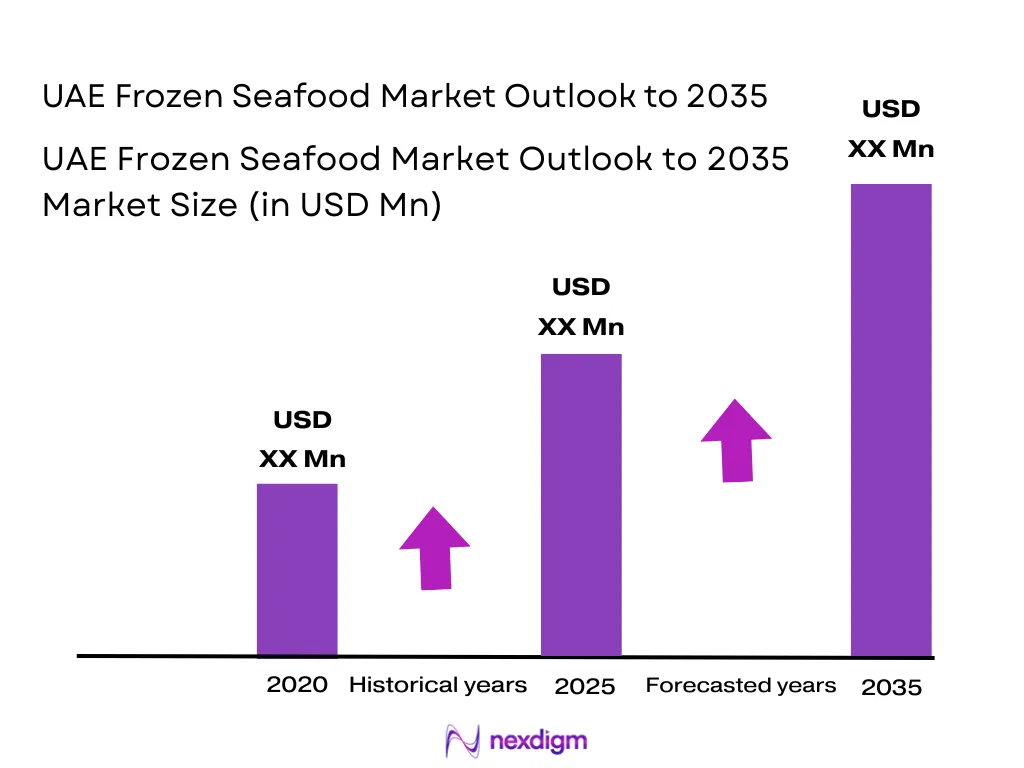
The UAE Frozen Seafood Market is valued at USD ~ million, derived from the UAE seafood market value of USD ~ million and frozen seafood’s 49.51% form share. The market is driven by import dependence, high-income urban consumers, tourism-linked foodservice demand, and freezer-led retail merchandising. The UAE’s fish and seafood imports increased from Can ~ million in the preceding trade base to Can ~ million in the latest trade base. Dubai and Abu Dhabi dominate the UAE Frozen Seafood Market due to hotel density, premium retail formats, foodservice demand, cold-chain infrastructure, and access to import logistics through Jebel Ali and Khalifa Port. India, Thailand, Norway, Türkiye and Vietnam dominate supply because they collectively shipped Can ~ million of fish and seafood to the UAE, with India at Can ~ million, Thailand at Can ~ million, Norway at Can ~ million, Türkiye at Can ~ million, and Vietnam at Can ~ million.
Market Segmentation
By Product Type
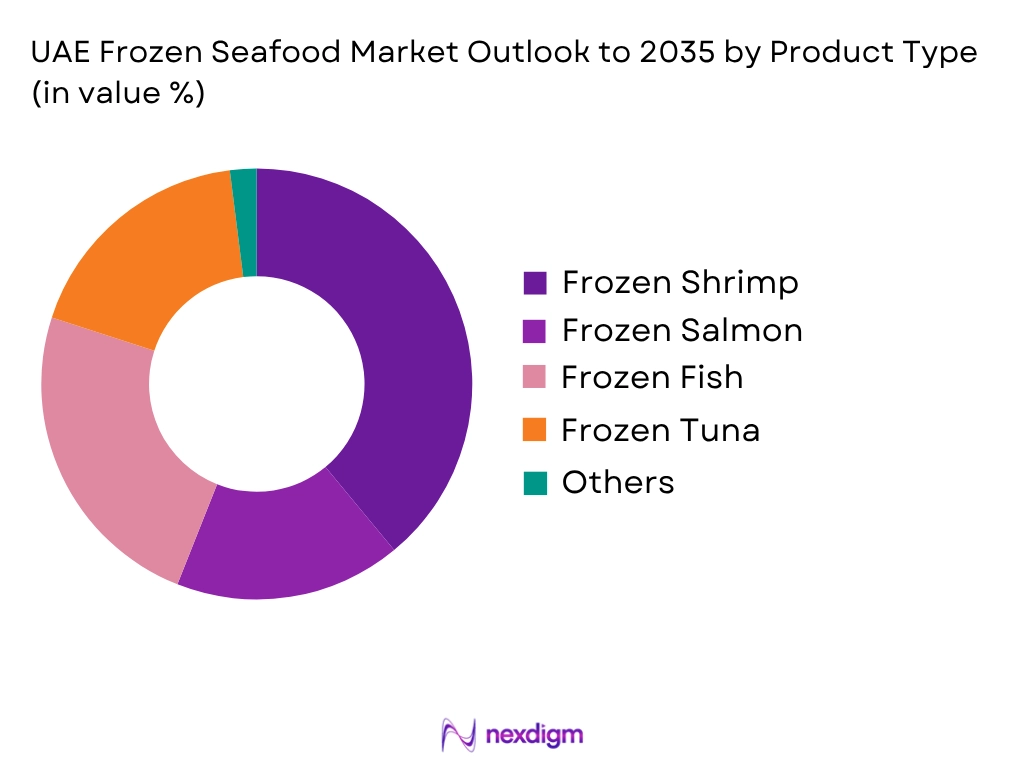
UAE Frozen Seafood Market is segmented by product type into frozen shrimps and prawns, frozen fish, frozen yellowfin tuna, frozen Atlantic and Danube salmon, and other frozen seafood. Recently, frozen shrimps and prawns have a dominant market share in the UAE under product type segmentation, due to their strong acceptance across hotels, restaurants, catering, retail freezers and private-label seafood packs. The category is supported by regular imports from India, Ecuador, Iran, Pakistan and Vietnam, enabling distributors to supply multiple count sizes and formats such as peeled, deveined, cooked, breaded and IQF shrimp. Frozen shrimp also fits UAE foodservice demand because it is easy to portion, store, thaw and use across Arabic, Indian, Asian and continental cuisines. The UAE imported Can ~ million of frozen shrimps and prawns in the latest trade base, making it the leading imported seafood commodity.
By Source Country
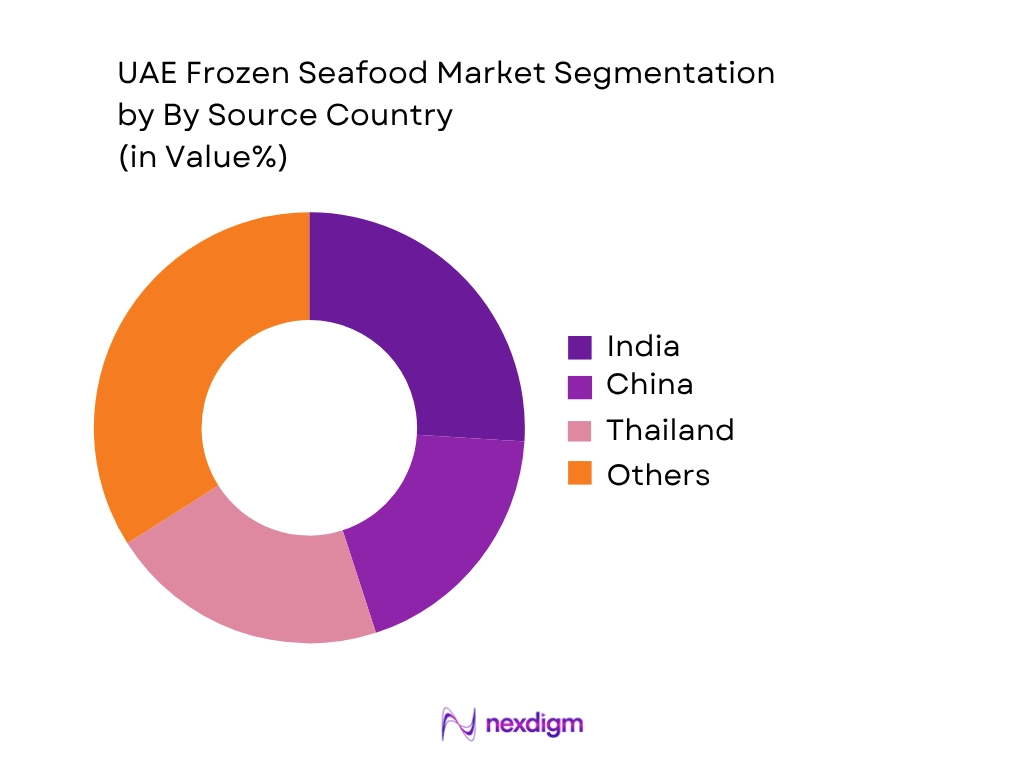
UAE Frozen Seafood Market is segmented by source country into India, Thailand, Norway, Türkiye, Vietnam, Ecuador, China, Iran and others. Recently, India has a dominant market share under source-country segmentation because it is a large supplier of frozen shrimps and prawns, frozen fish and other marine products to the UAE. Indian products are competitively positioned for UAE importers due to shorter sea transit than many long-haul suppliers, established trade routes, wide product availability, and strong demand from South Asian expatriate consumers and HoReCa buyers. Thailand is relevant for processed tuna and value-added seafood, while Norway is dominant in premium salmon supply. India shipped Can ~ million of fish and seafood to the UAE in the latest trade base, ahead of Thailand at Can ~ million and Norway at Can ~ million, showing the depth of UAE’s import-led seafood sourcing network.
Competitive Landscape
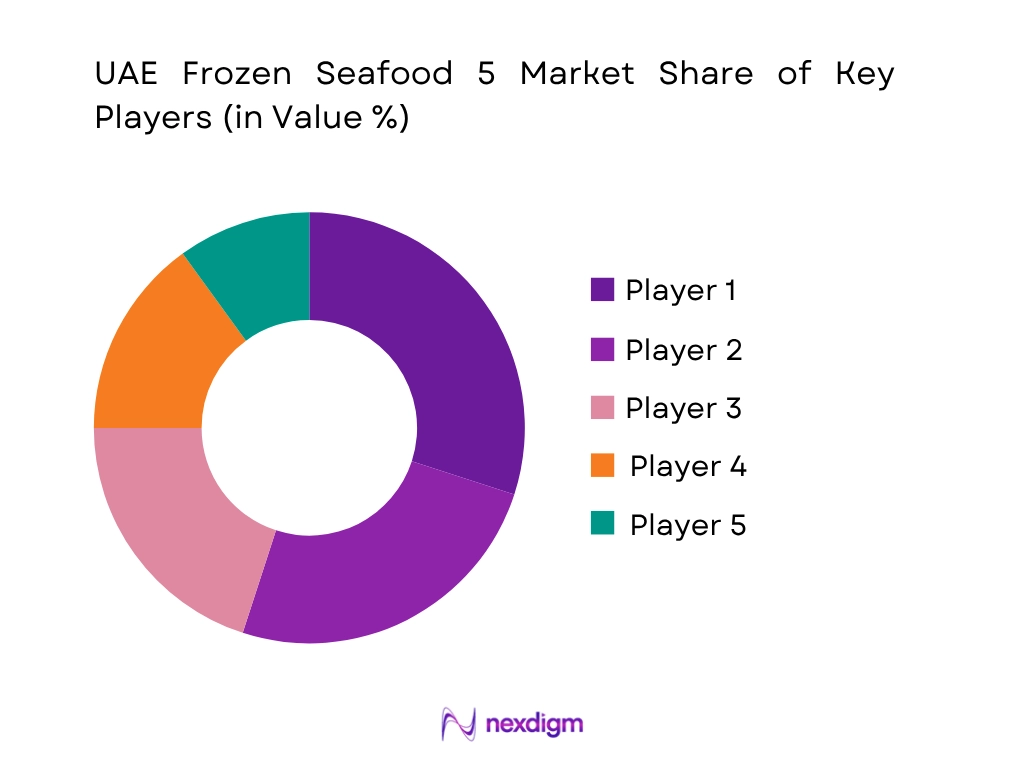
The UAE Frozen Seafood Market is led by importers, foodservice distributors, retail chains, specialty seafood suppliers and online grocery operators. The market is moderately consolidated across organized players that control cold storage access, import documentation, supplier relationships and HoReCa contracts. Competition is shaped by product origin, frozen SKU range, private-label readiness, premium species access, regulatory compliance, and the ability to deliver frozen seafood across Dubai, Abu Dhabi, Sharjah and the Northern Emirates.
| Company | Establishment Year | Headquarters | Core Seafood Focus | Channel Reach | Import / Sourcing Model | Cold-Chain Role | Product Positioning | Strategic Strength |
| East Fish Processing | 1989 | Dubai, UAE | ~ | ~ | ~ | ~ | ~ | ~ |
| Al Islami Foods | 1981 | Dubai, UAE | ~ | ~ | ~ | ~ | ~ | ~ |
| Fresh Express | 1993 | Dubai, UAE | ~ | ~ | ~ | ~ | ~ | ~ |
| Truebell | 1984 | Sharjah / UAE | ~ | ~ | ~ | ~ | ~ | ~ |
| Kibsons | 1980 | Dubai, UAE | ~ | ~ | ~ | ~ | ~ | ~ |
UAE Frozen Seafood Market Outlook to 2035
Growth Drivers
Import-Led Species Availability Across Shrimp, Salmon, Tuna and Frozen Fish
The UAE Frozen Seafood Market is driven by wide import-led species availability, which allows distributors and retailers to supply frozen shrimp, tuna, salmon, pangasius, squid, crab, lobster and seafood mixes despite limited domestic production depth. Agriculture and Agri-Food Canada reported that UAE fish and seafood imports reached Can ~ million in 2024, compared with exports of Can ~ million, confirming a structurally import-led seafood system. Frozen shrimps and prawns alone reached Can ~ million, while frozen fish not elsewhere specified reached Can ~ million, frozen yellowfin tuna reached Can ~ million, and frozen Atlantic and Danube salmon reached Can ~ million. Supplier depth is also material: India shipped Can ~ million, Thailand Can ~ million, Norway Can ~ million, Türkiye Can ~ million, and Vietnam Can ~ million to the UAE. This supports freezer cabinets, HoReCa procurement and re-export trading. World Bank data records UAE population at 10,986,400, GDP at USD ~ billion, and GDP per capita at USD 50,273.5 in 2024, supporting high-value imported protein consumption.
Tourism, Hotels and Foodservice Demand Supporting Frozen Seafood Procurement
The UAE Frozen Seafood Market is supported by hotel, restaurant, catering and travel-linked consumption, especially in Dubai and Abu Dhabi, where frozen seafood is used for buffet menus, airline catering, seafood restaurants, cloud kitchens, institutional food service and resort dining. Dubai Department of Economy and Tourism reported 18.72 million international overnight visitors in 2024, compared with 17.15 million visitors in 2023. Dubai’s hotel inventory reached 154,016 rooms across 832 establishments, compared with 150,291 rooms in 2023, while occupied room nights reached 43.03 million, compared with 41.70 million in 2023. Dubai International Airport also handled 92.3 million passengers and connected travelers to 272 destinations, strengthening seafood demand from hospitality, catering and premium restaurants. Dubai Municipality separately reported 25,000 food establishments during the first half of 2024, with 1,373 new establishments opened in that period. World Bank data records UAE net migration at 158,634 in 2025, reinforcing expatriate-led demand for diverse frozen seafood formats.
Market Opportunities
Ready-to-Cook Frozen Seafood for Retail, Foodservice and Online Grocery
The UAE Frozen Seafood Market has a clear opportunity in ready-to-cook seafood, including breaded shrimp, fish fingers, marinated fillets, seafood burgers, squid rings, salmon portions and mixed seafood packs. The opportunity is supported by existing import depth and a large base of urban foodservice and retail buyers. Agriculture and Agri-Food Canada reported that prepared or preserved tunas, skipjack and Atlantic bonito imports reached Can$201.6 million in 2024, while frozen shrimps and prawns reached Can$275.5 million, demonstrating that UAE buyers already accept both processed and frozen seafood formats. Dubai Municipality’s inspection activity shows the scale of the addressable food channel: it carried out 18,374 inspections at food establishments across restaurants, hotels, cafés, commercial centres, hypermarkets, supermarkets and temporary events during the first half of 2024. The Emirate had 25,000 food establishments and 31 temporary events inspected under the food-safety scope. World Bank data shows UAE GDP per capita at USD 50,273.5 and population at 10,986,400 in 2024, supporting premium convenience foods and freezer-led retail demand across expatriate and Emirati households.
Re-Export and Cold-Chain Hub Opportunity Through Dubai Logistics
The UAE Frozen Seafood Market has an opportunity to strengthen its role as a regional frozen seafood redistribution hub for GCC, Africa and South Asia through Dubai’s port, airport and free-zone logistics ecosystem. Agriculture and Agri-Food Canada reported UAE fish and seafood imports of Can$1,248.1 million and exports of Can$511.0 million in 2024, showing that the country is not only a consumption market but also a trade and redistribution platform. Product diversity supports re-export consolidation, with frozen shrimps and prawns at Can$275.5 million, prepared or preserved tunas at Can$201.6 million, fresh or chilled Atlantic and Danube salmon at Can$121.2 million, frozen yellowfin tunas at Can$24.7 million, and frozen salmon at Can$23.9 million. Dubai’s logistics capacity supports this role: DET reported Dubai International Airport handled 92.3 million passengers and connected to 272 destinations in 2024, while Dubai’s hotel and tourism ecosystem remained supported by 154,016 rooms. IMF lists UAE country population at 11.465 million for 2026, indicating a growing domestic base alongside re-export demand.
Market Challenges
Heavy Import Dependence and Supplier-Origin Concentration
The UAE Frozen Seafood Market faces a structural challenge from dependence on external suppliers, making availability sensitive to origin-country harvest cycles, freight disruption, border documentation, food-safety holds and supplier concentration. Agriculture and Agri-Food Canada reported UAE fish and seafood imports of Can$1,248.1 million in 2024, against exports of Can$511.0 million, indicating a large import gap. The top five suppliers shipped Can$681.6 million to the UAE: India supplied Can$204.3 million, Thailand Can$196.5 million, Norway Can$152.7 million, Türkiye Can$67.1 million, and Vietnam Can$61.1 million. For frozen seafood, concentration is visible in key categories, with frozen shrimps and prawns at Can$275.5 million, frozen fish at Can$33.4 million, frozen yellowfin tuna at Can$24.7 million, and frozen Atlantic and Danube salmon at Can$23.9 million. Any disruption in India, Thailand, Norway, Vietnam or Ecuador can affect UAE stock availability and product variety. World Bank data shows the UAE’s GDP at USD 552.32 billion and population at 10,986,400 in 2024, meaning demand resilience must be supported by reliable external sourcing.
Food Safety, Cold-Chain Integrity and Compliance Burden
The UAE Frozen Seafood Market faces a compliance challenge because frozen seafood requires temperature integrity, correct labelling, health documentation, shelf-life control and border inspection discipline across import, warehousing, retail display and foodservice use. Dubai Municipality carried out 52,233 inspection visits in environment, health and food fields during the first half of 2024. Its food-safety inspection teams carried out 18,374 inspections at food establishments, covering restaurants, hotels, cafés, commercial centres, hypermarkets, supermarkets and temporary events, and received 2,733 food-safety reports. The municipality also evaluated more than 17,000 shipments of consumer products at ports, equivalent to 145,000 tons, reflecting the inspection intensity faced by food importers. For seafood importers, these checks raise the need for accurate storage temperature records, compliant labels, valid health certificates and traceable product batches. The scale of the operating environment is large: Dubai had 25,000 food establishments during the first half of 2024, while World Bank data records UAE GDP per capita at USD 50,273.5 in 2024, supporting premium demand but also higher quality expectations.
Future Outlook
Over the next decade, the UAE Frozen Seafood Market is expected to grow through import diversification, premium seafood retail, HoReCa recovery, freezer-led merchandising and ready-to-cook innovation. Dubai and Abu Dhabi will remain the primary demand centers because of tourism, hotels, restaurants, modern grocery and high-income expatriate households. Frozen shrimp, salmon, pangasius, tuna, squid, lobster and seafood mixes are expected to remain core categories. The market will also benefit from digital grocery platforms, dark-store fulfillment, private labels, value-added seafood and portion-controlled foodservice packs. Importers and distributors will need to strengthen cold-chain monitoring, Arabic-English labelling, shelf-life compliance, and origin traceability. Companies with premium sourcing, reliable frozen logistics, diversified supplier bases and strong retailer/HoReCa relationships are expected to gain stronger competitive positions.
Major Players
- East Fish Processing
- Al Islami Foods
- Fresh Express
- Gulf Seafood LLC
- Truebell
- Kibsons
- JM Foods
- Barakat
- Chef Middle East
- Bidfood UAE
- Transmed Foodservice
- Al Maya Distribution
- Lulu Group International
- Carrefour UAE
- Choithrams
Key Target Audience
- Frozen seafood importers and distributors
- HoReCa chains, hotels and catering companies
- Hypermarkets, supermarkets and specialty seafood retailers
- Online grocery and quick commerce platforms
- Cold-chain logistics and reefer transport companies
- Seafood processors and private-label frozen food companies
- Investments and venture capitalist firms
- Government and regulatory bodies
Research Methodology
Step 1: Identification of Key Variables
The initial phase involves constructing an ecosystem map covering seafood importers, distributors, cold stores, foodservice buyers, retailers, online grocery platforms, re-export traders and regulatory bodies. This step defines key variables such as product type, source country, import value, frozen form share, retail channel, HoReCa procurement and cold-chain capability.
Step 2: Market Analysis and Construction
In this phase, historical UAE seafood trade data, frozen product shares, supplier-country imports and retail/foodservice demand indicators are compiled. The market is constructed using a top-down seafood market base and a frozen-form share approach. Import data is cross-checked with company portfolios and distribution-channel presence.
Step 3: Hypothesis Validation and Expert Consultation
Market hypotheses are validated through interviews with importers, frozen food distributors, retail category managers, foodservice procurement teams and cold-chain operators. These consultations help confirm product mix, frozen seafood turnover, destination-channel demand, supplier reliability, storage requirements and shelf-life compliance issues.
Step 4: Research Synthesis and Final Output
The final phase combines secondary research, trade intelligence, company profiling and channel validation into a structured market model. Segment shares, competitive positioning and future outlook are refined using triangulation. This ensures the final UAE Frozen Seafood Market report reflects practical business dynamics and decision-ready market intelligence.

- Executive Summary
- Research Methodology (Market Definitions and Assumptions, Abbreviations, Market Sizing Approach, UAE Customs and Re-Export Mapping, HS Code Mapping, Importer and Distributor Interviews, Retail SKU Audits, HoReCa Procurement Checks, Cold-Chain Capacity Review, Port-Level Reefer Movement Assessment, Top-Down Import Reconciliation, Bottom-Up Distributor Revenue Mapping, Limitations and Future Conclusions)

- Definition and Scope
- Overview Genesis
- Timeline of Major Players
- Business Cycle
- Supply Chain and Value Chain Analysis

- Growth Drivers (Protein Diversification, Shelf-Life Advantage, Health Positioning, Retail Freezer Expansion, Ready-to-Cook Demand)
- Rising Demand for Convenient High-Protein Meals (Frozen Fillets, Shrimp Packs, Seafood Mixes, Air-Fryer Products, Ready-to-Cook Marinades, Working Households)
- Market Challenges(Import Exposure, Species Price Volatility, Labor Costs, Cold-Chain Disruption, Quality Perception)
- Market Opportunities (White Space Products, Channel Expansion, Technology Adoption, Premiumization, Re-Export Growth)
- Market Trends (Retail Merchandising, Product Innovation, Sustainability, Digital Grocery, Packaging Shift)
- Government Regulation (Food Import Registration, Label Approval, Health Certificates, Halal Requirements, Cold-Chain Standards, Fisheries Conservation)
- Supply Chain Risk Analysis
- SWOT Analysis
- Porter’s Five Forces
- Upstream Stakeholders
- Competition Ecosystem

- By Value (2020-2025)
- By Volume (2020-2025)
- By Average Realization (2020-2025)

- By Product Type (In Value %)
Frozen Fish
Frozen Shrimp
Frozen Premium Seafood
Frozen Cephalopods - By End User (In Value %)
HoReCa
Retail Consumers
Catering and Institutional Buyers
Food Processors and Cloud Kitchens
Re-Export Traders - By Distribution Channel (In Value %)
Importer and Distributor Channel
Hypermarkets and Supermarkets
Online Grocery and Quick Commerce
Specialty Seafood Retail - By Emirate (In Value %)
Dubai
Abu Dhabi
Sharjah
Ajman
Ras Al Khaimah

- Market Share of Major Players on the Basis of Value and Volume
- Cross Comparison Parameters (Product Portfolio, Import Origin Network, Cold-Chain Infrastructure, HoReCa Distribution Reach, Retail Listing Strength, Re-Export Capability, Certification and Compliance Systems, Value-Added Seafood SKU Depth)
- SWOT Analysis of Major Players
- Pricing Analysis Basis SKUs for Major Players
- Detailed Profiles of Major Companies
East Fish Processing
Al Islami Foods
Fresh Express
Gulf Seafood LLC
Truebell
Kibsons
JM Foods
Barakat
Chef Middle East
Bidfood UAE
Transmed Foodservice
Al Maya Distribution
Lulu Group International
Carrefour UAE
Choithrams

- HoReCa Buyer Analysis
- Retail Consumer Analysis
- Catering and Institutional Buyer Analysis
- Online Grocery Buyer Analysis

- By Value (2026-2035)
- By Volume (2026-2035)
- By Average Realization (2026-2035)


 Request a Sample
 Ask for Customization
 Get a Quote
 Enquire Now