
 Download PDF
Market Overview
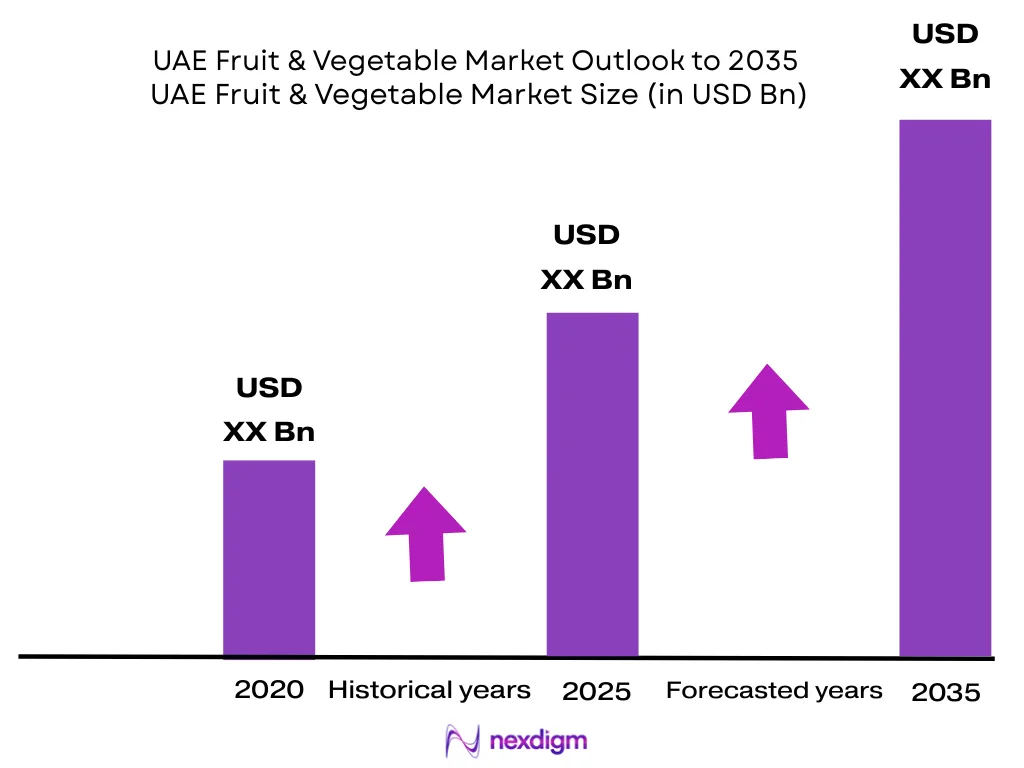
The UAE Fruits and Vegetables Market is valued at USD ~ billion in 2025, and is forecast to grow at 7.51% CAGR during the 2026-2035 outlook period, aligned with the latest available 2026-2031 growth benchmark. The market is supported by import-led availability, controlled-environment agriculture, supermarket penetration, tourism demand and foodservice consumption. UAE GDP reached USD 552.32 billion in 2024, while GDP per capita reached USD 50,273.5, supporting premium fresh produce consumption. Dubai and Abu Dhabi dominate the UAE Fruits and Vegetables Market because Dubai anchors Jebel Ali logistics, Al Aweer wholesale trade, re-export flows and tourism-driven foodservice demand, while Abu Dhabi supports food security, agritech and controlled-environment farming. Dubai welcomed 17.15 million international overnight visitors in 2023 and 18.72 million in 2024, strengthening hotel, restaurant and catering demand. India, Egypt, South Africa, Philippines and Turkey dominate sourcing due to supply scale, seasonality and port connectivity.
Market Segmentation
By Product Type
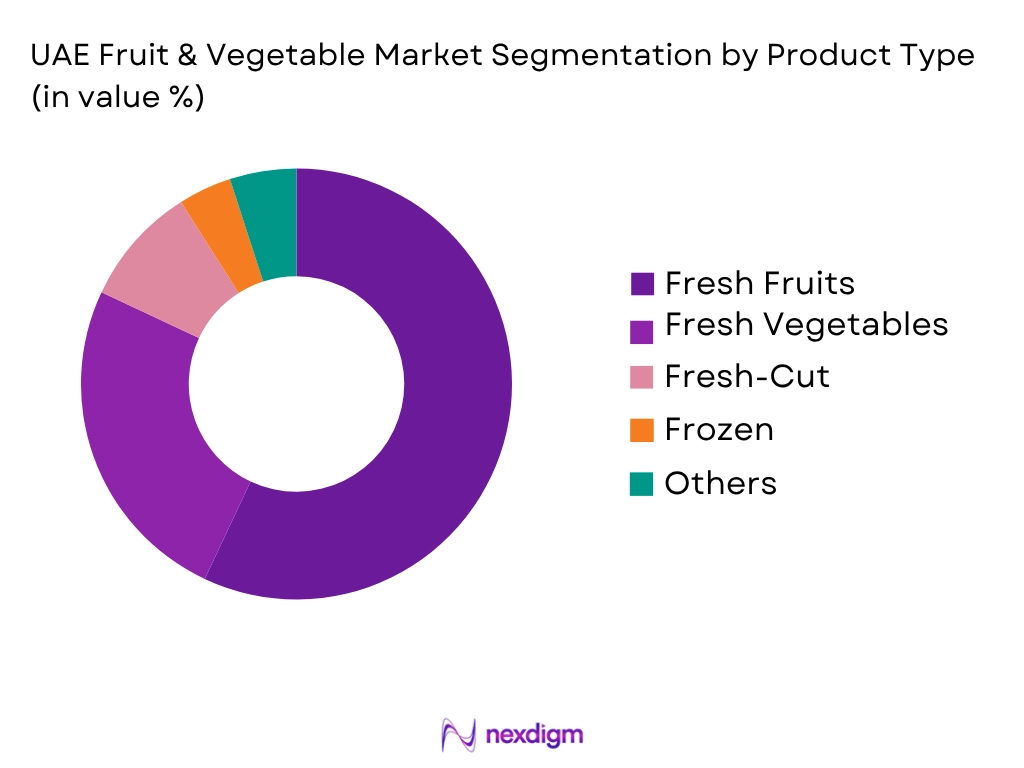
UAE Fruits and Vegetables Market is segmented by product type into fresh fruits, fresh vegetables, fresh-cut and ready-to-eat produce, frozen fruits and vegetables, and canned, dried and ambient produce. Recently, fresh fruits have a dominant market share in the UAE under the segmentation product type, it is due to the country’s high import dependence, premium consumer base, expatriate diversity and strong demand from hotels, supermarkets and airline catering. Apples, bananas, citrus, grapes, berries, mangoes, avocados, melons, dates and tropical fruits are high-rotation categories across modern retail and foodservice. Fresh fruit also benefits from strong gifting culture, Ramadan consumption, tourist hotel buffets, online grocery baskets and re-export trade. Dubai’s wholesale and port infrastructure allows the market to maintain wide country-of-origin diversity and year-round fruit availability.
By Distribution Channel
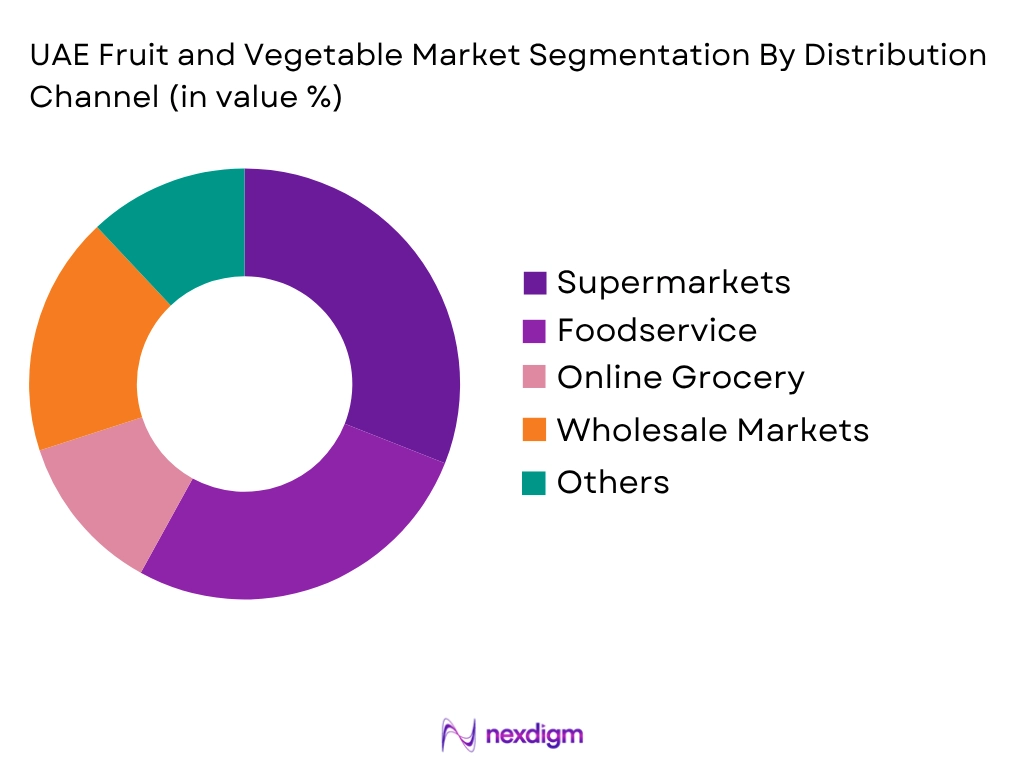
UAE Fruits and Vegetables Market is segmented by distribution channel into supermarkets and hypermarkets, wholesale markets and import distributors, foodservice and catering distributors, online grocery and fresh delivery platforms, and convenience stores/specialty retail/direct farm supply. Recently, supermarkets and hypermarkets have a dominant market share in the UAE under the segmentation distribution channel, it is due to their wide fresh produce assortment, chilled display systems, private-label ranges, premium imported SKUs and high-frequency grocery footfall. Carrefour, LuLu, Spinneys, Choithrams, Union Coop and other grocery chains dominate fresh produce merchandising through imported fruits, local hydroponic vegetables, organic produce, premium berries, cut fruit bowls and salad packs. Their dominance is reinforced by e-commerce integration, loyalty promotions, centralized procurement, in-store quality control and direct relationships with importers and local farms.
Competitive Landscape
The UAE Fruits and Vegetables Market is dominated by importers, distributors, modern retailers, online fresh platforms and controlled-environment agriculture companies. Players such as Barakat Group, Kibsons, NRTC Fresh, Silal and Pure Harvest Smart Farms have significant influence due to cold-chain assets, sourcing networks, domestic production capability, HoReCa relationships and modern retail penetration. Competition is shaped by import reliability, freshness, premium sourcing, food safety compliance, delivery speed, hydroponic production and ability to serve retail, foodservice and re-export buyers.
| Company | Establishment Year | Headquarters | Key Categories | Business Model | Key Channel | Sourcing / Production Footprint | Market-Specific Capability | Competitive Advantage |
| Barakat Group | 1976 | Dubai | ~ | ~ | ~ | ~ | ~ | ~ |
| Kibsons International | 1980 | Dubai | ~ | ~ | ~ | ~ | ~ | ~ |
| NRTC Fresh | 1973 | Dubai | ~ | ~ | ~ | ~ | ~ | ~ |
| Silal | 2020 | Abu Dhabi | ~ | ~ | ~ | ~ | ~ | ~ |
| Pure Harvest Smart Farms | 2016 | Abu Dhabi | ~ | ~ | ~ | ~ | ~ | ~ |
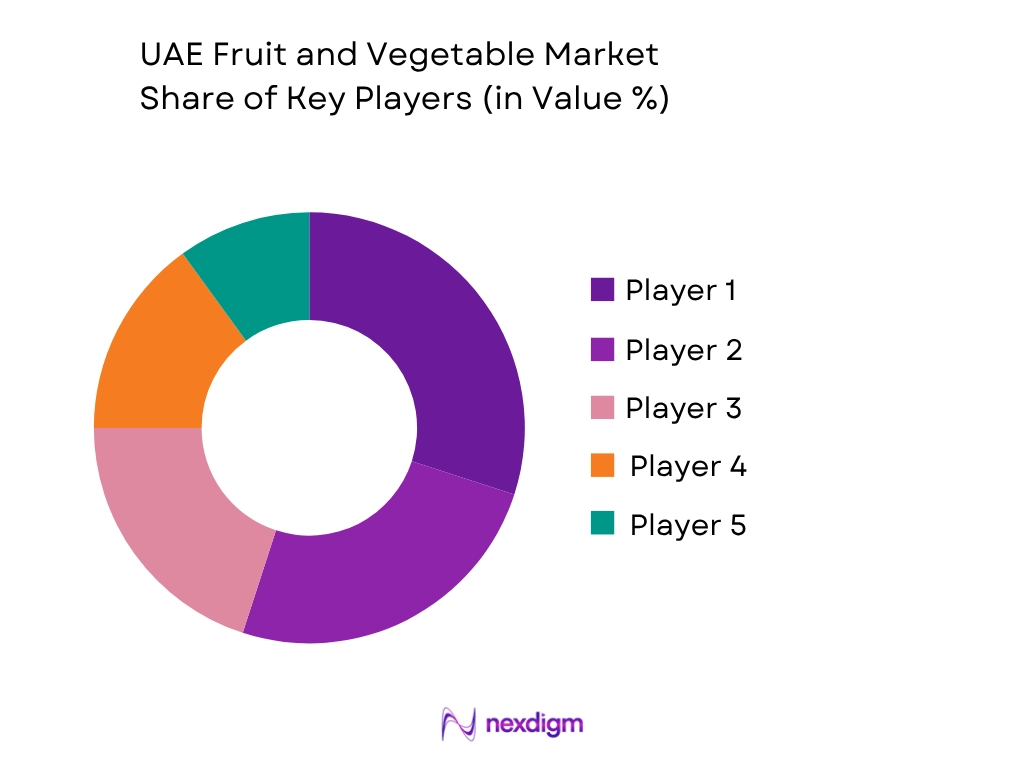
UAE Fruit And Vegetable Market Analysis
Growth Drivers
Rising Population, High Purchasing Power and Food Consumption Support Fresh Produce Demand
The UAE fruit and vegetable market is supported by strong demographic and macroeconomic fundamentals. According to the World Bank, the UAE’s GDP reached USD 552.32 billion in 2024, while GDP per capita stood at USD 50,273.5, indicating one of the highest consumer purchasing capacities globally. The World Bank also reported population growth of 4.7 in 2024, expanding the consumer base for fresh fruits and vegetables through household, retail and foodservice channels. Additionally, the World Bank projects real GDP growth of 4.0 in 2024, reflecting continued expansion in domestic consumption and non-oil economic activities that directly stimulate demand for premium imported and locally produced fresh produce.
Tourism, Hospitality and Non-Oil Economic Expansion Drive Fresh Fruit and Vegetable Consumption
The UAE’s tourism and hospitality sectors remain major demand generators for fruits and vegetables through hotels, restaurants, airline catering and institutional foodservice. The Ministry of Economy reports 30.7 million hotel guests, 77.9 hotel occupancy, and 13 contribution of tourism to GDP under the latest tourism performance indicators. Simultaneously, the World Bank projects non-oil GDP growth of 3.2 in 2024, supported by tourism, transportation, manufacturing and retail activities. These sectors consume large quantities of premium fruits, leafy vegetables, berries and fresh-cut produce, reinforcing continuous procurement by wholesalers, distributors and supermarket chains throughout the country.
Market Challenges
Limited Arable Land and Severe Water Scarcity Restrict Domestic Fruit and Vegetable Production
One of the biggest constraints for the UAE fruit and vegetable market is its harsh desert environment. The World Bank reports annual freshwater withdrawals equal to 1,510 of internal renewable water resources, highlighting the country’s extreme dependence on desalination and groundwater resources. Furthermore, forest area accounts for only 4.5 of total land area, reflecting limited natural agricultural land. The Food and Agriculture Organization (FAO) also identifies scarce water resources, arid climatic conditions and restricted arable land as structural barriers to expanding open-field cultivation, making the UAE highly dependent on imported fruits and vegetables despite investments in hydroponics and controlled-environment agriculture.
Dependence on Imported Produce Increases Supply Chain Exposure
The UAE relies heavily on imported fruits and vegetables because domestic agricultural capacity remains limited. The World Bank notes that imports of goods and services are projected to grow by 4.8 in 2024, reflecting continued reliance on international trade. At the same time, exports of goods and services are projected at 4.8 in 2024, confirming the country’s position as a regional trading hub. While this logistics strength supports market availability, it also exposes importers and distributors to shipping disruptions, geopolitical risks, container availability and climate-related production issues in supplier countries, affecting the continuity of fresh produce supply.
Market Opportunities
Government Food Security Initiatives Create Opportunities for Controlled-Environment Agriculture
The UAE government’s focus on food security is creating long-term opportunities for hydroponics, vertical farming and greenhouse cultivation. According to the World Bank, the UAE recorded GDP of USD 552.32 billion in 2024 and GDP growth of 4.0, providing fiscal capacity for continued investment in agricultural innovation. FAO identifies controlled-environment agriculture as the most suitable production model for overcoming water scarcity and climatic limitations. Expanding hydroponic farms, greenhouse vegetable production and precision agriculture enables retailers and distributors to reduce dependence on imports while supplying locally grown tomatoes, cucumbers, lettuce, herbs and leafy vegetables throughout the year.
Expansion of Logistics and International Trade Strengthens Fresh Produce Distribution
The UAE continues to strengthen its position as the Middle East’s leading food logistics and re-export hub. According to the World Bank, GDP per capita reached USD 50,273.5 in 2024, supporting premium food consumption, while GDP reached USD 552.32 billion. The World Bank also projects current account surplus of 8.4 of GDP in 2024, indicating strong external trade performance. Modern logistics infrastructure, integrated ports, cold-chain facilities, airport cargo terminals and free zones create significant opportunities for expanding fruit and vegetable imports, regional redistribution, premium produce handling and value-added fresh-cut processing for GCC and international markets.
Future Outlook
Over the next five years, the UAE Fruits and Vegetables Market is expected to grow steadily through higher import diversification, controlled-environment agriculture, modern retail expansion, tourism-driven foodservice demand and online grocery adoption. The 2026-2035 forecast CAGR is placed at 7.51%, aligned with the latest 2026-2031 UAE growth benchmark for fruits and vegetables. Fresh fruits will remain the leading product category because the UAE relies on global sourcing for apples, bananas, citrus, grapes, berries, mangoes, avocados and stone fruits. Premium fruits will gain from high-income consumers, hospitality demand, health-conscious eating and gifting occasions. Dates will remain culturally important, but imported fruits will dominate assortment depth across supermarkets and HoReCa channels.
Fresh vegetables will benefit from local hydroponic and greenhouse expansion, particularly in lettuce, herbs, cucumbers, tomatoes, microgreens and leafy greens. Abu Dhabi and Dubai will remain key hubs for controlled-environment agriculture because farms can supply retailers with shorter lead times, local-origin claims and reduced import risk. However, local farms will continue to face high energy, cooling and water-use constraints. The market will remain highly import dependent, but Dubai’s logistics position will continue to support regional re-export opportunities. Jebel Ali, Al Aweer, Dubai Airport Cargo and free-zone warehousing strengthen the UAE’s role as a produce distribution hub for the GCC, East Africa and South Asia. Growth opportunities will be strongest in fresh-cut fruit, salad bowls, premium berries, organic greens, hydroponic vegetables, online fresh delivery, HoReCa supply contracts and cold-chain distribution.
Major Players
- Barakat Group
- Kibsons International
- NRTC Fresh
- Fresh Fruits Company
- Silal
- Elite Agro
- Pure Harvest Smart Farms
- Bustanica
- Madar Farms
- Emirates Hydroponics Farms
- Badia Farms
- UNS Farms
- LuLu Group International
- Carrefour UAE
- Spinneys UAE
Key Target Audience
- Fresh fruit and vegetable importers
- Wholesale produce distributors and re-export traders
- Supermarkets, hypermarkets and premium grocery retailers
- Online grocery and fresh delivery platforms
- HoReCa, airline catering and institutional foodservice suppliers
- Hydroponic, greenhouse and vertical farming companies
- Investments and venture capitalist firms
- Government and regulatory bodies (Ministry of Climate Change and Environment, Dubai Municipality, Abu Dhabi Agriculture and Food Safety Authority, UAE Food Security Office, Federal Competitiveness and Statistics Centre, Dubai Customs, Abu Dhabi Customs)
Research Methodology
Step 1: Identification of Key Variables
The initial phase involves constructing an ecosystem map encompassing all major stakeholders within the UAE Fruits and Vegetables Market. This includes importers, wholesalers, local farms, hydroponic producers, retailers, online grocery platforms, HoReCa distributors, re-export traders and regulators. The key variables include import dependence, domestic CEA output, cold-chain capacity, sourcing origins, channel mix and foodservice demand.
Step 2: Market Analysis and Construction
In this phase, historical data is compiled and analyzed for UAE fruits and vegetables revenue, import flow, domestic farming, retail demand, wholesale movement and re-export channels. The analysis combines top-down market sizing with bottom-up product and channel mapping. Specific attention is given to fresh fruits, salad vegetables, premium produce, hydroponic crops and foodservice-linked demand.
Step 3: Hypothesis Validation and Expert Consultation
Market hypotheses are validated through computer-assisted telephonic interviews with importers, grocery category managers, local farm operators, cold-chain companies, hotel procurement heads and online fresh platforms. These consultations help verify sourcing behaviour, quality requirements, delivery frequency, local produce acceptance, retail pricing structures and HoReCa procurement expectations.
Step 4: Research Synthesis and Final Output
The final phase integrates secondary research, trade analysis, company profiling and expert validation into a structured market report. The output provides market size, segmentation, competitive landscape, growth outlook, target audience mapping and strategic recommendations. This ensures that the UAE Fruits and Vegetables Market analysis reflects both import-led trade realities and local food security priorities.

- Executive Summary
- Research Methodology (Market Definitions and Assumptions, Fresh and Processed Produce Classification, Farm-Gate and Import Valuation, Retail and Wholesale Valuation, Dubai Customs Trade Mapping, USDA GAIN Data Review, UAE Food Security Policy Review, Top-Down Consumption Model, Bottom-Up Import and Domestic Supply Model, Primary Interviews with Importers, Distributors, Retailers, Hydroponic Farms, Foodservice Buyers and Cold-Chain Operators, Limitations and Forecast Assumptions)

- Definition and Scope
- Market Genesis and Evolution
- UAE Fresh Produce Demand Landscape
- Role of Imports in Year-Round Availability

- Growth Drivers (High Import-Led Food Availability, Tourism and HoReCa Demand, Expatriate Consumption Diversity, Modern Grocery Expansion, Online Grocery Growth, Food Security Strategy, Hydroponic Farming, Cold-Chain Logistics)
- Market Challenges (High Import Dependence, Cold-Chain Cost, Water Scarcity, Limited Arable Land, Shelf-Life Loss, Port Disruption, Food Safety Compliance, Price Volatility)
- Market Opportunities (Vertical Farming, Hydroponic Leafy Greens, Local Strawberry Production, Import Substitution, Premium Retail Produce, Foodservice Supply Contracts, Fresh-Cut Processing, GCC Re-Exports)
- Trends (Local-Origin Branding, Water-Efficient Farming, Controlled Environment Agriculture, Fresh Produce Apps, Premium Fruit Gifting, Sustainable Packaging, Food Waste Reduction, Re-Export Formalization)
- SWOT Analysis
- Porter’s Five Forces

- By Value (2020-2025)
- By Volume (2020-2025)
- By Average Realization (2020-2025)

- By Product Category (In Value %)
Fresh Fruits
Fresh Vegetables
Frozen Fruits and Vegetables
Canned and Ambient Produce
Value-Added Produce - By Fruit Type (In Value %)
Bananas and Tropical Fruits
Citrus Fruits
Apples, Pears and Stone Fruits
Berries and Grapes
Dates, Melons and Premium Fruits - By Distribution Channel (In Value %)
Supermarkets and Hypermarkets
Traditional Wholesale Markets
Online Grocery
Convenience Stores
Foodservice Distributors
- By Geography (In Value %)
Dubai
Abu Dhabi
Sharjah
Ajman
Ras Al Khaimah

- Market Share of Major Players (Value Share, Volume Share, Import Share, Domestic Production Share, Retail Channel Share, HoReCa Channel Share)
- Cross Comparison Parameters (Import Sourcing Footprint, Domestic Farm and CEA Production Capacity, Cold-Chain and Ripening Infrastructure, Retail and E-Grocery Channel Penetration, HoReCa and Catering Account Reach, Re-Export and Free Zone Distribution Capability, Food Safety and Traceability Compliance, Premium/Organic/Hydroponic Product Portfolio)
- SWOT Analysis of Major Players
- Pricing and SKU Benchmarking of Major Players
- Detailed Profiles of Major Companies
Barakat Group
Kibsons International
NRTC Fresh
Fresh Fruits Company
Silal
Elite Agro
Pure Harvest Smart Farms
Bustanica
Madar Farms
Emirates Hydroponics Farms
Badia Farms
UNS Farms
LuLu Group International
Carrefour UAE
Spinneys UAE

- Household Consumers
- Supermarkets and Hypermarkets
- Hotels and Restaurants
- Airline and Institutional Catering
- Online Grocery and Fresh Delivery Platforms

- By Value (2026-2035)
- By Volume (2026-2035)
- By Average Realization (2026-2035)


 Request a Sample
 Ask for Customization
 Get a Quote
 Enquire Now