
 Download PDF
Market Overview
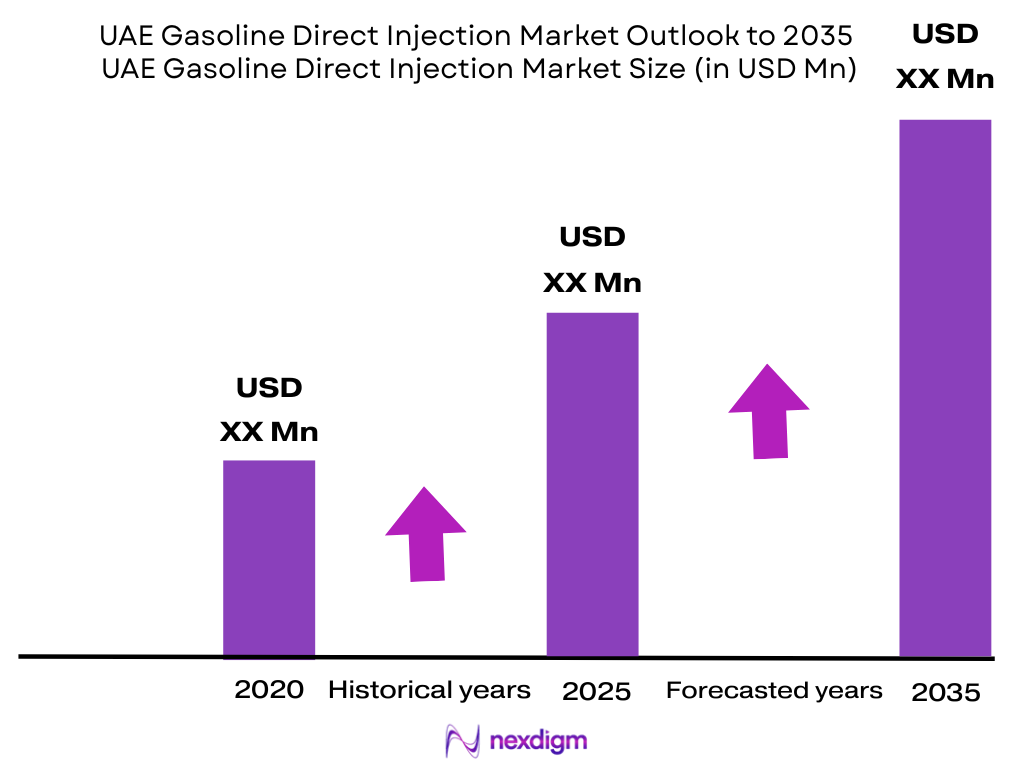
The UAE Gasoline Direct Injection Market is valued at approximately USD ~ million, retained as a placeholder pending proprietary bottom-up validation. The underlying passenger-car demand base expanded from 225,386 vehicles to 268,876 vehicles across the two latest historical periods reported through OICA data. The UAE economy also reached USD 552.32 billion, with GDP per capita at USD 50,273.5, supporting demand for technologically advanced gasoline SUVs, premium cars, turbocharged vehicles and their high-pressure fuel systems. Dubai and Abu Dhabi dominate UAE GDI demand because they concentrate premium vehicles, corporate fleets, authorised distributors, specialist workshops and high-value imported cars, while Sharjah supports a substantial independent aftermarket. Dubai’s rental fleet expanded from 49,725 vehicles to 71,040 vehicles, while its luxury e-hail fleet increased from 12,602 vehicles to 16,396 vehicles across the latest two historical periods. These expanding fleets reinforce replacement demand for injectors, high-pressure pumps, sensors and fuel-system diagnostics.
Market Segmentation
By Component Type
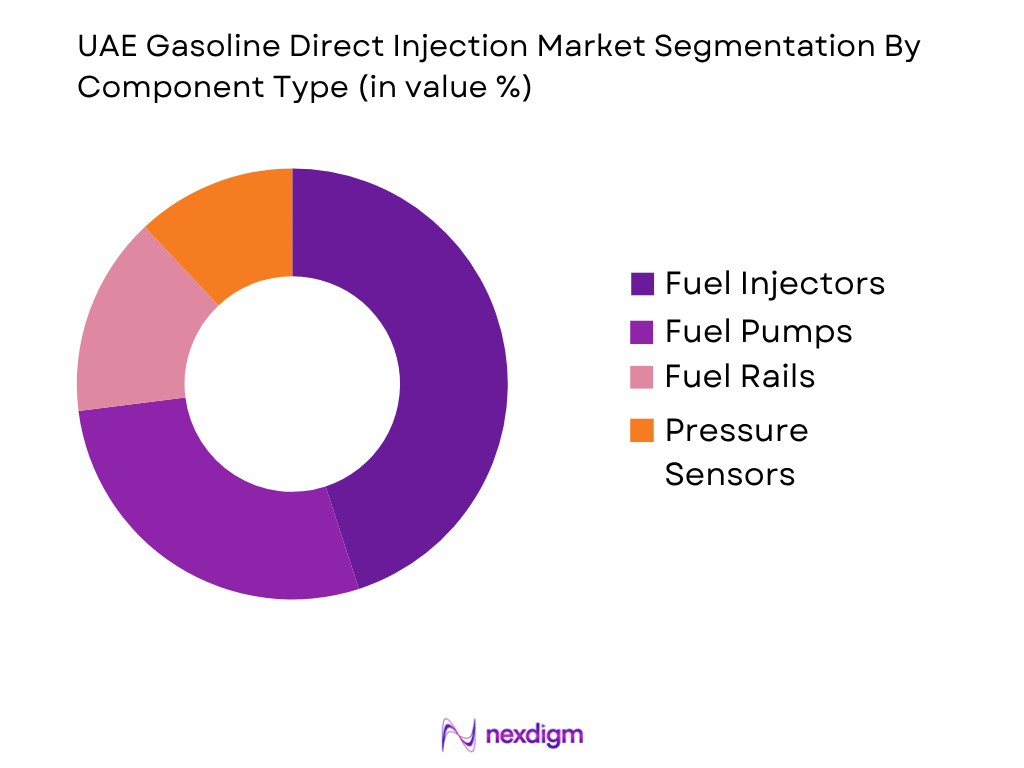
The UAE Gasoline Direct Injection Market is segmented into high-pressure fuel injectors, high-pressure fuel pumps, fuel rails, pressure sensors and control valves, and ECU/high-pressure supporting components. High-pressure fuel injectors account for the dominant modelled share because GDI engines require one precisely controlled injector for every cylinder, making injector content directly proportional to engine cylinder count. This is particularly relevant in the UAE, where turbocharged four-cylinder engines coexist with six- and eight-cylinder premium and performance platforms. Injectors determine fuel quantity, atomisation, spray targeting and multiple-injection capability. Technology intensity is also increasing: Bosch offers GDI architecture operating at up to 350 bar, PHINIA offers injector systems reaching 400 bar and above 500 bar, and Astemo supports high-pressure gasoline fuel systems reaching 50 MPa. Higher pressures increase machining accuracy, sealing, flow calibration and contamination-control requirements, strengthening injector value relative to simpler supporting components.
By Powertrain Type
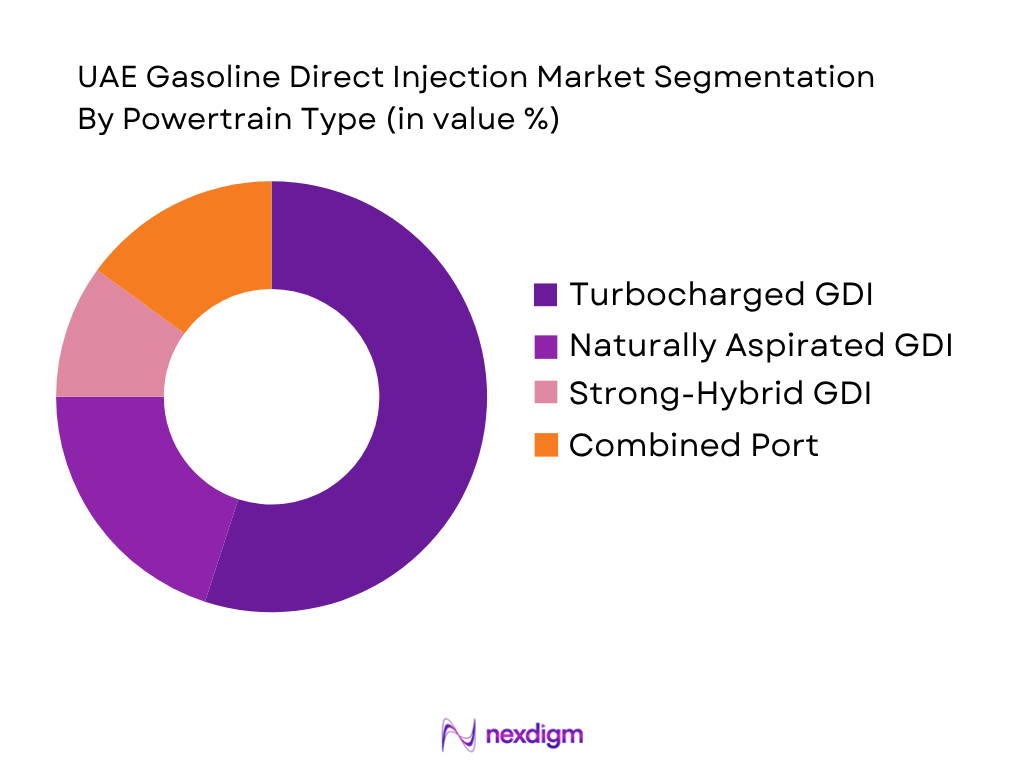
The UAE Gasoline Direct Injection Market is segmented into turbocharged GDI, naturally aspirated GDI, mild-hybrid GDI, strong-hybrid GDI, plug-in hybrid GDI and combined port/direct injection. Turbocharged GDI represents the dominant modelled segment because the UAE passenger-vehicle mix contains extensive premium sedan, crossover, SUV and performance applications that use boosted gasoline engines. Direct injection permits precise in-cylinder fuel delivery and supports higher torque from smaller displacement engines. It also complements larger high-output turbo and twin-turbo engines used in luxury vehicles. Hybrid-GDI is becoming strategically more important because gasoline-electric vehicles preserve the combustion engine while placing greater requirements on transient injection control, restart performance and fuel-pressure stability. PHINIA has secured GDI business specifically for hybrid and low-emission light-vehicle applications, demonstrating that direct injection remains relevant within electrified powertrains rather than being limited to conventional ICE architectures.
Competitive Landscape
The UAE Gasoline Direct Injection Market is concentrated around global Tier-1 fuel-system suppliers because the country primarily consumes imported vehicle platforms rather than manufacturing complete GDI systems domestically. Bosch, DENSO, PHINIA/Delphi, Astemo and Marelli possess established gasoline fuel-injection engineering capabilities, while authorised distributors and specialist aftermarket channels determine their effective access to UAE vehicle owners. Competitive differentiation increasingly depends on maximum operating pressure, injector flow control, pump efficiency, hybrid-powertrain compatibility and replacement availability. Bosch currently supports systems up to 350 bar, PHINIA has commercial technology exceeding 500 bar, and Astemo supplies gasoline pumps reaching 50 MPa.
| Company | Established | Headquarters | GDI Injector Capability | High-Pressure Pump Capability | Pressure Positioning | Fuel-System Integration | Hybrid/Advanced ICE Position | Key UAE Relevance |
| Robert Bosch GmbH | 1886 | Stuttgart, Germany | ~ | ~ | ~ | ~ | ~ | ~ |
| DENSO Corporation | 1949 | Kariya, Japan | ~ | ~ | ~ | ~ | ~ | ~ |
| PHINIA / Delphi | 2023 as PHINIA | Auburn Hills, USA | ~ | ~ | ~ | ~ | ~ | ~ |
| Astemo Ltd. | 2021 | Tokyo, Japan | ~ | ~ | ~ | ~ | ~ | ~ |
| Marelli | 1938 heritage | Saitama, Japan / Corbetta, Italy | ~ | ~ | ~ | ~ | ~ | ~ |
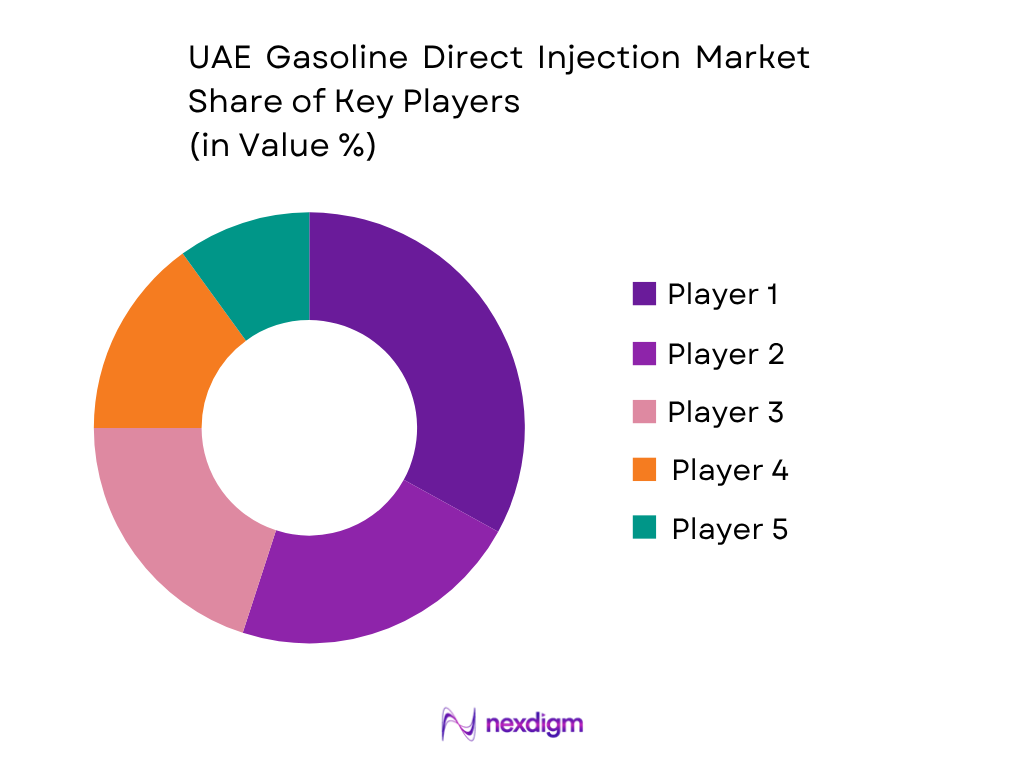
UAE Gasoline Direct Injection Market Analysis
Growth Drivers
Expanding Gasoline Vehicle Base, Urban Mobility and Premium Turbocharged Vehicle Demand
The UAE Gasoline Direct Injection Market is supported by the country’s dense urban mobility environment, high household purchasing capacity and large concentration of imported gasoline SUVs, crossovers, luxury sedans and performance vehicles. World Bank data place the UAE’s GDP at USD 552.32 billion in 2024 and GDP per capita at USD 50,273.5, giving the country an economic base capable of sustaining continued demand for technology-intensive passenger vehicles. The IMF places the UAE population at approximately 11.465 million people in 2026, expanding the addressable mobility base across Dubai, Abu Dhabi, Sharjah and the Northern Emirates. Dubai’s Roads and Transport Authority reported that the number of vehicles moving within Dubai during daytime hours reached approximately 3.5 million in 2024, demonstrating the exceptionally large amount of vehicle activity concentrated within the country’s main automotive market. This environment is particularly relevant to gasoline direct injection because the UAE passenger-vehicle mix contains substantial numbers of turbocharged SUVs, premium vehicles and performance-oriented gasoline models that increasingly rely on high-pressure direct injection to achieve stronger torque output, precise combustion control and improved engine response. The rental industry further increases utilisation of modern gasoline vehicles: Dubai’s active vehicle-rental fleet reached 71,040 vehicles at the end of 2024, compared with 49,725 vehicles in 2023, while the number of active rental companies reached 3,494. Higher vehicle utilisation increases accumulated mileage, fuel-system operating cycles and eventual demand for injectors, pumps, rail-pressure sensors and related replacement components. The UAE’s combination of high income, extensive highway travel, luxury-car ownership and sustained demand for high-output SUVs therefore gives GDI suppliers a comparatively technology-rich vehicle base rather than a market dominated solely by low-cost naturally aspirated engines. Direct injection is particularly relevant where manufacturers combine smaller-displacement gasoline engines with turbocharging, hybrid assistance or high specific power, because accurate in-cylinder fuel delivery becomes critical to combustion stability. For suppliers, this creates demand not only at initial vehicle import but across authorised dealer servicing, independent premium workshops, injector specialists and performance-vehicle service channels. The UAE’s urbanised vehicle ecosystem consequently supports sustained consumption of high-pressure injectors, pumps, fuel rails, sensors and control hardware even as the broader powertrain market begins diversifying toward electrified mobility.
Large Automotive Import, Distribution and Aftermarket Ecosystem
The UAE’s position as one of the Middle East’s principal automotive import, distribution and re-export centres is another important growth driver for the Gasoline Direct Injection Market because GDI-equipped vehicles and replacement components enter the country through an exceptionally developed logistics and dealership ecosystem. DP World reported that its Dubai terminals handled a record 1.3 million vehicles during 2024, with Jebel Ali Port alone accounting for nearly 960,000 units. The volume includes vehicles moving into the UAE as well as vehicles moving through Dubai’s wider regional automotive trading network, reinforcing the country’s role as a gateway for Japanese, Korean, German, American, British and Chinese vehicle brands. This matters to GDI suppliers because imported vehicles bring a broad range of direct-injection engine families, injector specifications, pump designs, pressure sensors and calibration requirements into a relatively compact servicing market. Dubai’s wider commercial transport ecosystem also illustrates the scale of supporting automotive infrastructure. The Dubai Media Office reported more than 400,000 vehicles registered in the commercial and logistics transport sector during 2024, while that fleet surpassed 500,000 vehicles during 2025. Although much of that segment extends beyond gasoline passenger vehicles, its scale supports a dense network of automotive distributors, parts warehouses, workshops, diagnostic suppliers and logistics operators that also serve passenger cars and GDI components. The country’s macroeconomic foundation strengthens the commercial case for stocking technically specialised components. World Bank data show GDP of USD 552.32 billion in 2024, while the IMF’s April 2026 database places nominal GDP at approximately USD 621.55 billion in 2026. Such economic scale supports large distributor inventories and specialised aftermarket operations, important because GDI injectors and high-pressure pumps are engine-specific components that cannot always be substituted across platforms. Dubai’s Jebel Ali, Ras Al Khor, Al Quoz and Sharjah’s industrial areas provide a regional concentration of authorised parts channels, independent automotive importers, used-parts traders, engine specialists and high-end vehicle workshops. These channels allow GDI suppliers to address both domestic replacement demand and GCC re-export requirements from a single inventory base. The market also benefits from Dubai’s rental and fleet ecosystem, where the vehicle-rental fleet reached 71,040 vehicles in 2024, increasing exposure of modern gasoline vehicles to intensive duty cycles. High mileage can accelerate the need for injector cleaning, pressure diagnosis, seal replacement and high-pressure pump servicing. As a result, the UAE does not depend solely on new-vehicle installations to sustain GDI activity; it possesses an established aftermarket and cross-border trading structure capable of generating recurrent demand for replacement injectors, pumps, rails, sensors and diagnostic services.
Market Challenges
Accelerating Battery-Electric Vehicle Adoption and Gasoline Powertrain Substitution
The most important structural challenge facing the UAE Gasoline Direct Injection Market is the rapid expansion of battery-electric mobility because a fully electric vehicle removes the gasoline injection system completely. Unlike hybridisation, which can preserve a gasoline engine and therefore retain injectors, pumps and fuel rails, battery-electric vehicles require none of these components. Government data demonstrate that the substitution threat has already progressed beyond a conceptual stage. Dubai Electricity and Water Authority reported more than 34,970 electric vehicles registered in Dubai by October 2024, supported by more than 740 EV Green Charger points across the emirate. Abu Dhabi Mobility subsequently reported that, as of 1 August 2025, the UAE had approximately 66,288 electric vehicles, while Abu Dhabi itself had 16,373 electric vehicles. The same official dataset recorded 74,832 hybrid vehicles across the UAE, confirming that vehicle electrification is developing through both battery-electric and hybrid channels. This creates a two-sided effect for GDI suppliers. Hybrid adoption can retain demand for direct injection where the combustion engine uses GDI, but every vehicle migrating entirely to battery propulsion eliminates lifetime demand for high-pressure gasoline injectors, pumps, rails, sensors and related aftermarket services. The UAE’s economic capacity allows this transition to occur relatively quickly. World Bank data place GDP per capita at USD 50,273.5 in 2024, while the IMF reports a population of approximately 11.465 million people in 2026, providing a large, affluent customer base capable of purchasing new electrified vehicles as model availability expands. The charging network also continues to deepen, reducing one of the historical barriers to electric-vehicle use. For incumbent GDI companies, this creates uncertainty when deciding how much local inventory, specialised diagnostic equipment and technician capability to commit to conventional gasoline fuel systems. The risk is especially relevant to premium sedans and luxury urban vehicles, where battery-electric alternatives are proliferating rapidly and where the UAE traditionally represents an important market. GDI suppliers therefore cannot rely simply on continued growth in overall vehicle activity. They must identify segments where gasoline engines remain technically resilient—large SUVs, performance models, long-distance vehicles and gasoline hybrids—and align product portfolios accordingly. The presence of 74,832 hybrid vehicles in 2025 provides a potential bridge, but it also means component suppliers increasingly need to understand hybrid operating cycles, intermittent engine operation, restart behaviour and more complex electronic control. The market challenge is therefore a gradual narrowing and technological reshaping of the addressable gasoline-engine population rather than an immediate disappearance of GDI demand.
High Technical Complexity, Hot-Climate Operation and Fragmented Component Compatibility
The UAE Gasoline Direct Injection Market faces an operational challenge created by the combination of technically complex high-pressure fuel systems, extreme vehicle utilisation conditions and a highly diverse imported vehicle population. GDI systems depend on precisely matched injectors, pressure pumps, rails, sensors and engine-control software, meaning a component that physically fits an engine may still be unsuitable because of flow calibration, electronic characteristics or pressure requirements. This compatibility challenge becomes particularly important in the UAE because its automotive ecosystem encompasses vehicles imported from numerous technology regions and includes GCC-specification models, parallel imports and premium performance vehicles. DP World’s Dubai terminals handled 1.3 million vehicles during 2024, including nearly 960,000 units through Jebel Ali, illustrating the scale and diversity of vehicles passing through the country’s automotive supply chain. Dubai itself experiences approximately 3.5 million vehicles during daytime hours, according to RTA data, creating heavy stop-start traffic, prolonged idling and substantial cumulative engine operating time. The rental sector adds another high-utilisation population, with 71,040 rental vehicles operating in Dubai at the end of 2024. These conditions increase the importance of fuel pressure stability, injector cleanliness, high-pressure pump durability and accurate electronic diagnostics. Unlike conventional port fuel injection, GDI places the injector directly within the combustion chamber, exposing it to greater thermal loading and combustion deposits. High-pressure pumps also operate under demanding mechanical loads and depend on precise pressure control. Service workshops therefore require specialised scan tools, fuel-pressure testing equipment, injector-flow testing capability and technicians who understand fuel trims, misfire data and pressure-control faults. This creates a barrier for smaller workshops and increases the risk that vehicle owners use incorrect aftermarket components or replace functioning injectors before accurately diagnosing the underlying fault. The UAE’s USD 552.32 billion economy in 2024, reported by the World Bank, supports sophisticated dealership and premium workshop infrastructure, but a fragmented independent aftermarket still has to manage hundreds of engine families and part numbers. Component authenticity is another concern because high-value GDI injectors and pumps create incentives for non-genuine or poorly remanufactured products to enter independent channels. Parallel-import vehicles may also arrive with engine calibrations and component specifications originally intended for different markets, complicating diagnosis and sourcing. Consequently, GDI suppliers operating in the UAE need more than component inventory: they require VIN-level catalogue accuracy, technical support, warranty control, installer training and diagnostic partnerships. These capabilities increase operating complexity and can slow aftermarket penetration for suppliers lacking a strong local distributor or authorised technical network. Sources: DP World/Dubai Media Office, Dubai Roads and Transport Authority, Dubai Media Office and World Bank.
Market Opportunities
Hybrid-GDI Systems and Advanced Gasoline Powertrains as a Bridge to Electrification
The UAE’s rapid move toward electrification creates a significant opportunity for GDI suppliers in hybrid powertrains because hybrid vehicles can reduce dependence on conventional gasoline-only propulsion without eliminating the combustion engine. Abu Dhabi Mobility reported 74,832 hybrid vehicles across the UAE as of 1 August 2025, including 22,847 hybrid vehicles in Abu Dhabi. These numbers demonstrate that hybrid technology already represents a material part of the UAE’s evolving vehicle ecosystem rather than a future concept. For the Gasoline Direct Injection Market, the opportunity lies specifically in hybrid models whose gasoline engines use direct injection or combined port-and-direct-injection systems. Such powertrains demand accurate fuel metering during repeated engine starts, transitions between electric and combustion propulsion, low-load operation and rapid changes in engine torque. This shifts supplier value away from simple component volume toward more sophisticated injector dynamics, pump-control stability and ECU integration. The opportunity is reinforced by the scale of the broader vehicle economy. Dubai experiences approximately 3.5 million vehicles during daytime hours, while its rental fleet reached 71,040 vehicles in 2024, indicating a substantial operating base where hybrid SUVs and passenger vehicles can progressively enter corporate, rental and private use. The UAE’s macroeconomic capacity also supports accelerated adoption of advanced powertrain technology: World Bank data show USD 552.32 billion GDP and USD 50,273.5 GDP per capita in 2024, while the IMF reports a national population of 11.465 million in 2026. For GDI manufacturers, this combination creates room to reposition product portfolios from conventional naturally aspirated gasoline systems toward turbo-hybrid and efficiency-focused gasoline engines. The opportunity extends to the aftermarket. Hybrid vehicles that retain gasoline engines still require injectors, high-pressure pumps, rail-pressure sensors, seals and diagnostics throughout their operating lives, but servicing requires technicians familiar with both high-voltage hybrid systems and gasoline fuel delivery. Suppliers able to provide hybrid-compatible technical documentation, precise injector coding, pump testing and training can establish stronger positions with premium workshops and authorised distributors. Hybridisation can therefore lengthen the commercial life of advanced GDI technology even while battery-electric vehicles reduce demand in other segments. Rather than competing directly against electrification, GDI suppliers can target those electrified architectures in which the combustion engine remains part of the propulsion system. The 74,832-unit hybrid stock recorded in 2025 provides current evidence that this transition pathway is already relevant in the UAE and can support future demand for technologically advanced direct-injection components without relying on projections of conventional gasoline-engine growth.
UAE as a GCC GDI Component Distribution, Diagnostics and Remanufacturing Hub
The UAE has a strong opportunity to develop into a regional centre for advanced GDI component distribution, diagnostics and specialised remanufacturing because its automotive logistics infrastructure serves a market far larger than domestic vehicle demand alone. DP World handled 1.3 million vehicles through its Dubai terminals in 2024, with Jebel Ali Port accounting for nearly 960,000 units. Such throughput supports established shipping, customs, warehousing, distributor and re-export capabilities that can be leveraged for high-pressure gasoline injectors, pumps, rails and electronic sensors destined for the wider GCC, Middle East, Africa and South Asia. The opportunity is reinforced by Dubai’s growing vehicle-service ecosystem. The vehicle-rental fleet reached 71,040 vehicles at the end of 2024, while the city’s commercial and logistics transport sector contained more than 400,000 registered vehicles in 2024 and exceeded 500,000 vehicles in 2025. Although not all of these vehicles use gasoline direct injection, these fleet volumes sustain a dense automotive repair and parts-distribution environment containing warehouses, specialist workshops, vehicle inspection facilities and electronic diagnostic businesses. The same infrastructure can support GDI-specific services such as injector flow testing, spray-pattern evaluation, ultrasonic cleaning, leak testing, high-pressure pump bench testing, rail-pressure diagnosis and validated remanufacturing. World Bank data place the UAE economy at USD 552.32 billion in 2024, while the IMF records approximately USD 621.55 billion in nominal GDP for 2026, giving distributors the financial and logistical environment needed to carry high-value specialised inventory. The opportunity is particularly attractive because GDI components are highly fragmented by engine family and vehicle brand; regional distributors that aggregate demand from several GCC markets can carry broader inventories than country-specific suppliers. Dubai’s combination of Jebel Ali logistics and established automotive clusters in Ras Al Khor and Al Quoz, alongside Sharjah’s independent automotive trading base, provides the physical ecosystem for this strategy. Suppliers can further differentiate themselves by combining genuine and OE-equivalent component distribution with technical services rather than competing only on parts availability. A central UAE facility could receive used injectors or pumps from regional workshops, conduct controlled testing and remanufacturing, and return calibrated units with documented performance results. This model becomes increasingly relevant as imported premium and turbocharged vehicles age and move outside manufacturer warranties. The presence of large numbers of parallel-import and performance vehicles also creates demand for advanced diagnostics where authorised dealer channels may not provide economical solutions. Accordingly, the UAE can capture value not merely as an end-market for imported GDI systems but as a regional aftermarket competence centre linking component suppliers, vehicle distributors, diagnostic specialists and GCC re-export networks.
Future Outlook
The UAE Gasoline Direct Injection Market is forecast to expand at approximately ~ CAGR during 2026–2035, retained as a placeholder for the final market model. Growth will increasingly originate from sophisticated rather than basic gasoline applications, particularly turbocharged SUVs, premium vehicles, performance cars, hybrids and high-pressure replacement components. Technology migration should push the market from conventional GDI toward 350-bar, 500-bar and higher-pressure systems. PHINIA already commercialises pumps and injectors above 500 bar, while Astemo supports pumps at 50 MPa, indicating the direction of global platform development entering the UAE through imported vehicles. Hybridisation will extend the economic life of gasoline injection even while battery-electric adoption increases. The UAE’s National Electric Vehicles Policy seeks to raise electric vehicles to 50% of vehicles on the road by 2050, making electrification simultaneously the largest substitution risk and an incentive for GDI suppliers to concentrate on efficient hybrid-compatible combustion systems. The aftermarket will therefore become increasingly important as the installed GDI vehicle parc ages. Dubai, Abu Dhabi and Sharjah should remain the principal centres for injector replacement, pump servicing, fuel-pressure diagnostics, premium-vehicle repair and remanufacturing.
Major Players
- Robert Bosch GmbH / Bosch Middle East
- DENSO Corporation
- PHINIA / Delphi
- Astemo Ltd.
- Marelli
- Stanadyne
- Aisan Industry Co., Ltd.
- Mikuni Corporation
- AUMOVIO
- TI Fluid Systems
- AISIN Corporation
- Schaeffler Group
- Standard Motor Products
- GB Remanufacturing
- Motorcar Parts of America
Key Target Audience
- Gasoline Direct Injection System and Component Manufacturers
- Passenger Vehicle, SUV and Premium Automobile OEMs
- Automotive Importers and Authorised Vehicle Distributors
- Automotive Spare Parts Importers and Aftermarket Distributors
- Premium, Luxury and Performance Vehicle Service Networks
- Fleet Operators, Rental Companies and Mobility Service Providers
- Investments and Venture Capitalist Firms
- Government and Regulatory Bodies (Ministry of Energy and Infrastructure, Ministry of Industry and Advanced Technology, Roads and Transport Authority Dubai, Abu Dhabi Mobility)
Research Methodology
Step 1: Identification of Key Variables
The initial phase develops an ecosystem map covering vehicle OEMs, exclusive distributors, parts importers, integrated GDI suppliers, injector manufacturers, high-pressure pump suppliers, authorised dealerships and independent workshops. Core variables include passenger-car sales, gasoline powertrain mix, turbocharger fitment, cylinder count, GDI penetration, hybridisation, vehicle age, premium vehicle concentration and replacement cycles.
Secondary research incorporates OICA vehicle sales, World Bank macroeconomic indicators, UAE government mobility policy and primary corporate technical documentation. This establishes the structural demand base before any proprietary market-value assumptions are applied.
Step 2: Market Analysis and Construction
The top-down model begins with the UAE passenger-vehicle base and identifies gasoline vehicle platforms equipped with direct injection. Vehicle volumes are allocated by sedan, SUV, premium, luxury, performance and hybrid powertrain categories before estimating GDI fitment.
The bottom-up calculation converts GDI-equipped engines into injector, pump, rail and sensor demand using cylinder count and component content per engine. Technology bands are benchmarked against commercial systems including Bosch’s 350-bar, PHINIA’s 500+ bar and Astemo’s 50-MPa architectures.
Step 3: Hypothesis Validation and Expert Consultation
Market hypotheses are validated through CATIs with automotive distributors, fuel-system suppliers, premium-vehicle workshops, independent parts importers, fleet operators and GDI technicians. Interviews assess GDI fitment, component replacement frequency, genuine versus aftermarket sourcing, injector cleaning, pump failures, pressure-sensor issues and parts availability.
Particular attention is given to UAE-specific operating conditions including extended idling, high ambient temperatures, premium vehicle usage, fleet utilisation and parallel-import vehicle specifications. Findings are used to reconcile the theoretical component model with actual aftermarket and distributor behaviour.
Step 4: Research Synthesis and Final Output
The final stage triangulates vehicle-sales statistics, powertrain platform mapping, supplier technical specifications, distributor information and primary interviews. Separate demand pools are constructed for OEM-linked replacement, authorised dealer replacement, independent aftermarket and performance applications. Forecast models incorporate passenger-car demand, turbo-GDI penetration, hybrid adoption, injection-pressure migration, premium-vehicle parc expansion, fleet ageing and battery-electric substitution. Scenario analysis is used to test the sensitivity of the UAE Gasoline Direct Injection Market to accelerated electrification and higher-pressure GDI adoption.

- Executive Summary
- Research Methodology (Market Definitions and Assumptions, GDI System Boundary, Abbreviations, Vehicle Platform Mapping, Engine Family Mapping, Top-Down Market Sizing, Bottom-Up Component Consumption Analysis, GDI Fitment Assessment, Injectors per Engine Assessment, Pump and Rail Fitment, Import-Based Supply Assessment, Vehicle Parc Modelling, Demand-Side Assessment, Supply-Side Assessment, OEM and Distributor Interviews, Workshop Interviews, Data Triangulation, Forecasting Framework, Limitations and Future Conclusions)

- Definition and Scope
- Evolution from Multi-Point Fuel Injection to Gasoline Direct Injection
- Evolution of Naturally Aspirated Gasoline Engines to Turbo-GDI Engines
- UAE Gasoline Passenger Vehicle Ecosystem
- Premium and Performance Gasoline Vehicle Ecosystem

- Growth Drivers (Premium Vehicle Parc, SUV Demand, Turbocharged Gasoline Engines, Engine Downsizing, Performance Vehicles, Hybrid-GDI Adoption, High-Octane Fuel Availability, Advanced Engine Technology)
- Market Challenges (Battery-Electric Substitution, Import Dependency, Extreme Heat, Injector Deposits, Pump Failures, Parallel Imports, Diagnostic Complexity, Parts Authenticity)
- Market Opportunities (Very-High-Pressure GDI, Hybrid Systems, Premium Aftermarket, Remanufacturing, Diagnostics, Regional Distribution, Performance Upgrades, Re-Export)
- Market Trends (Higher Injection Pressure, Dual Injection, Turbo-Hybrid Engines, Integrated Fuel Rails, Electronic Diagnostics, Performance Calibration, Remanufacturing, EV Transition)
- SWOT Analysis
- Porter’s Five Forces Analysis
- PESTLE Analysis

- By Market Value (2020-2025)
- By GDI System Volume (2020-2025)
- By GDI-Equipped Vehicle Volume (2020-2025)

- By Component Type (In Value %)
High-Pressure Fuel Injectors
High-Pressure Fuel Pumps
Fuel Rails
Fuel Rail Pressure Sensors
Pressure Control and Volume Control Valves - By Vehicle Type (In Value %)
Sedans
Compact SUVs
Mid-Size SUVs
Large SUVs
Crossovers - By Powertrain Type (In Value %)
Naturally Aspirated GDI
Turbocharged GDI
Twin-Turbo GDI
Mild-Hybrid GDI
Strong-Hybrid GDI - By Emirate (In Value %)
Dubai
Abu Dhabi
Sharjah
Ajman
Ras Al Khaimah

- Market Share of Major Players by Value
- Cross Comparison Parameters (Maximum GDI Injection Pressure Capability, High-Pressure Injector Portfolio Breadth, High-Pressure Pump Pressure and Flow Capability, Integrated Fuel Rail and Pressure-Sensor Capability, Turbo/Performance Engine Coverage, Hybrid-GDI and Dual-Injection Capability, UAE/GCC Distributor and Service Footprint, Hot-Climate and Alternative-Fuel Compatibility)
- SWOT Analysis of Major Players
- Detailed Profiles of Major Companies
Robert Bosch GmbH / Bosch Middle East
DENSO Corporation
PHINIA / Delphi
Astemo Ltd.
Marelli
Stanadyne
Aisan Industry Co., Ltd.
Mikuni Corporation
AUMOVIO
TI Fluid Systems
AISIN Corporation
Schaeffler Group
Standard Motor Products
GB Remanufacturing
Motorcar Parts of America

- Mass-Market Passenger Vehicle Owners
- SUV Owners
- Premium Vehicle Owners
- Luxury Vehicle Owners
- Performance Vehicle Owners
- Hybrid Vehicle Owners

- By Market Value (2026-2035)
- By GDI System Volume (2026-2035)
- By GDI-Equipped Vehicle Volume (2026-2035)


 Request a Sample
 Ask for Customization
 Get a Quote
 Enquire Now