

 Download PDF
 Download PDF
Market Overview
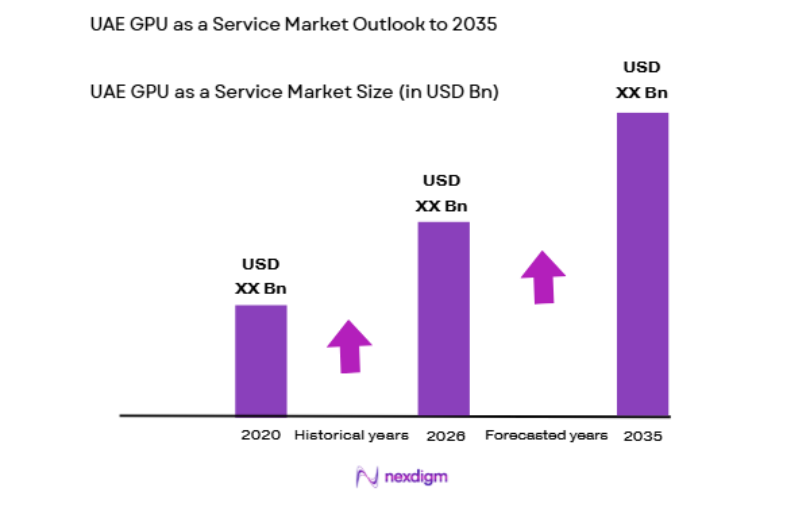
The UAE GPU as a Service market is projected to be valued at approximately USD ~ million, driven by the increasing demand for high-performance computing in various industries, such as artificial intelligence (AI), machine learning (ML), and cloud gaming. As businesses increasingly adopt data-intensive applications that require GPU acceleration, the demand for GPU as a Service solutions has surged. The market is supported by the growing shift toward cloud computing and the rise in GPU-based workloads that benefit from the parallel processing capabilities of GPUs.
Dubai, Abu Dhabi, and Sharjah are the dominant cities in the UAE for GPU as a Service offerings. Dubai’s status as a global business hub and the presence of major technology companies drive the demand for GPU-based services, particularly in industries like AI and data science. Abu Dhabi is also a key player due to its significant investment in technology and smart city initiatives. Sharjah, with its growing tech infrastructure, is emerging as an important location for cloud services. These cities are central to the market’s growth due to their developed infrastructure and tech ecosystem.
Market Segmentation
By Product Type
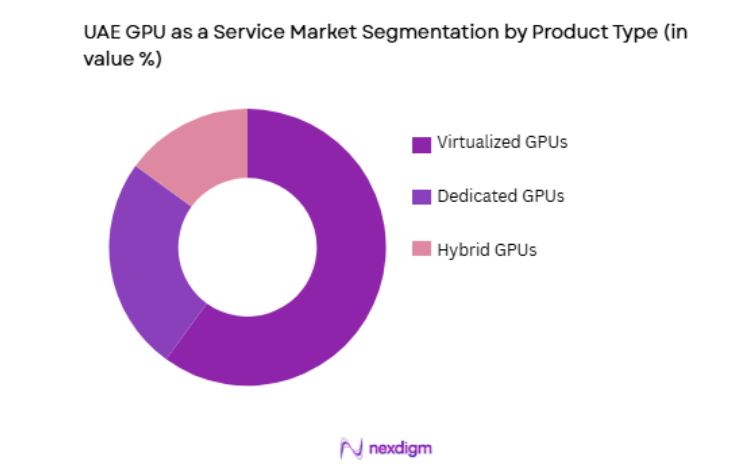
The UAE GPU as a Service market is segmented by product type into virtualized GPUs, dedicated GPUs, and hybrid GPUs. Recently, virtualized GPUs have gained dominance due to their ability to provide flexible and scalable computing power at a lower cost. Virtualized GPUs allow multiple clients to share the computational power of a single physical GPU, making them an attractive option for businesses looking to scale their computing needs without large upfront investments. This flexibility, combined with the cost-effectiveness of cloud GPU services, has contributed to the growing adoption of virtualized GPUs, particularly in industries such as AI, machine learning, and cloud gaming, where large-scale computational tasks are common.
By End-User Industry
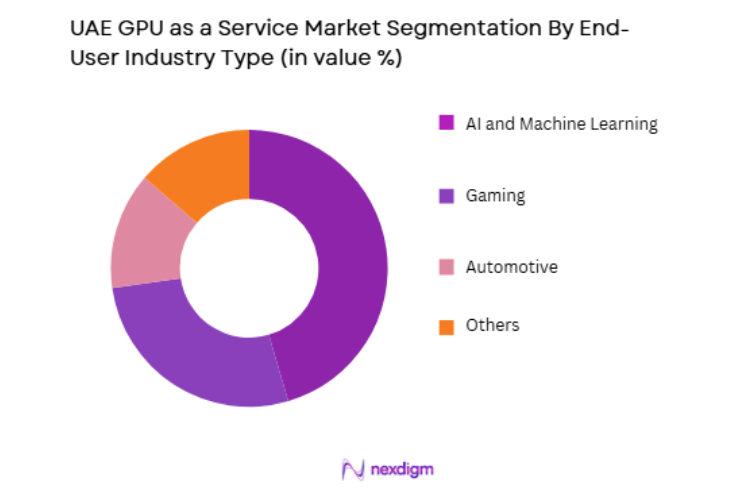
The UAE GPU as a Service market is segmented by end-user industry into AI and machine learning, gaming, automotive, and others. Recently, AI and machine learning have dominated the market, driven by the increasing reliance on GPUs for training and running complex machine learning models. GPUs are particularly well-suited for parallel processing, making them ideal for tasks such as deep learning and neural networks, which are essential in AI-driven industries. The demand for GPU-powered computing is growing in industries such as finance, healthcare, and retail, where AI models are increasingly used to derive insights from large datasets. The rise in AI adoption across various sectors is expected to continue driving demand for GPU as a Service in the UAE.
Competitive Landscape
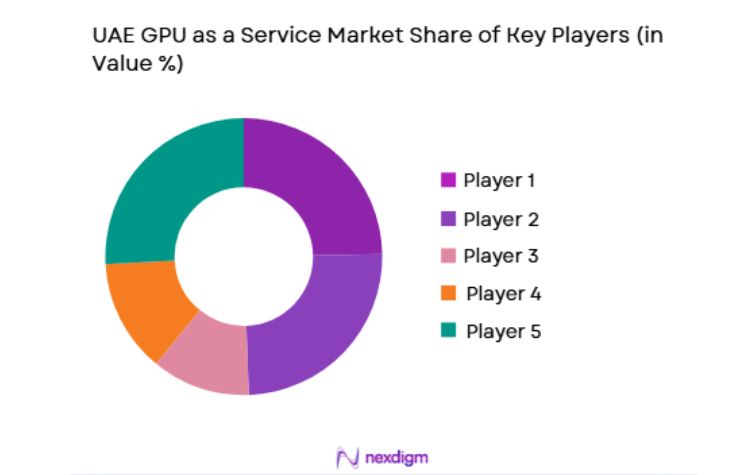
The competitive landscape of the UAE GPU as a Service market is characterized by a mix of global cloud providers such as Amazon Web Services (AWS), Microsoft Azure, and Google Cloud, as well as local players that cater specifically to the UAE market. These established global players dominate the market by offering highly scalable and flexible GPU-powered cloud services to meet the demands of industries such as AI, gaming, and data science. Local players are increasingly investing in providing GPU as a Service to meet the specific needs of the regional market, especially with the UAE’s growing focus on smart cities and technology-driven initiatives.
| Company Name | Establishment Year | Headquarters | Technology Focus | Market Reach | Key Products | Revenue (USD) | Additional Parameter |
| Amazon Web Services | 2006 | Seattle | ~ | ~ | ~ | ~ | ~ |
| Microsoft Azure | 2010 | Redmond | ~ | ~ | ~ | ~ | ~ |
| Google Cloud | 2008 | Mountain View | ~ | ~ | ~ | ~ | ~ |
| IBM Cloud | 2007 | Armonk | ~ | ~ | ~ | ~ | ~ |
| Oracle Cloud | 2012 | Redwood City | ~ | ~ | ~ | ~ | ~ |
UAE GPU as a Service Market Analysis
Growth Drivers
AI and Machine Learning Applications
The increasing demand for artificial intelligence and machine learning applications is a significant driver of the GPU as a Service market in the UAE. As AI technologies become more prevalent across various industries, from healthcare to automotive, the need for computational power to run machine learning algorithms is growing rapidly. GPUs are particularly well-suited for this purpose due to their ability to handle parallel processing, which is essential for training AI models on large datasets. The UAE’s push to become a leader in AI and its Vision 2030 initiatives are encouraging businesses to adopt advanced technologies, which, in turn, is boosting demand for GPU resources. Additionally, the ability to scale GPU resources on-demand, without the need for significant upfront investment, has made GPU as a Service an attractive solution for organizations looking to integrate AI into their operations without high capital costs.
Expansion of Cloud Computing Infrastructure
The continued growth of cloud computing in the UAE is another major driver of the GPU as a Service market. As businesses across the region increasingly move to the cloud, the demand for GPU-powered cloud services has grown substantially. Cloud service providers, such as AWS, Microsoft Azure, and Google Cloud, are offering specialized GPU instances that allow businesses to offload computationally intensive tasks, such as machine learning model training, data analytics, and rendering, without the need to invest in dedicated hardware. This scalability and cost-effectiveness are key reasons why GPU as a Service is gaining traction in industries like gaming, entertainment, and research. The UAE’s focus on expanding its digital infrastructure to support smart city initiatives and technological innovation further accelerates the growth of GPU-powered cloud services in the region.
Market Challenges
High Cost of GPU Resources
One of the key challenges facing the UAE GPU as a Service market is the high cost associated with utilizing GPUs in the cloud. While GPU as a Service offers flexibility and scalability, the cost of renting GPU instances can be significantly higher than using CPU-based services, especially for businesses that require extensive computing power over long periods. These high operational costs are particularly challenging for smaller businesses and startups, who may not have the budget to fully leverage GPU services. As the demand for GPU resources increases, the pricing models for these services must become more transparent and affordable to accommodate a broader range of businesses. For companies heavily relying on GPU-intensive tasks, the escalating costs can limit their ability to scale operations efficiently.
Limited Availability of Specialized GPUs
Another challenge is the limited availability of specialized GPUs that are optimized for certain workloads. While general-purpose GPUs are widely available on cloud platforms, businesses in sectors such as deep learning, scientific computing, and 3D rendering often require specialized GPUs to handle specific tasks. The demand for such specialized GPUs is increasing, but many cloud service providers still offer a limited selection of GPUs that cater to these niche needs. As industries such as autonomous vehicles, gaming, and healthcare increasingly rely on specialized GPU capabilities, the need for more customized offerings is expected to grow. Providers will need to expand their GPU offerings to include a broader range of specialized GPUs to meet the specific needs of these industries.
Opportunities
Growth in Cloud Gaming
The rise of cloud gaming presents a significant opportunity for the GPU as a Service market in the UAE. With the growing popularity of gaming and the shift toward cloud-based gaming platforms, the demand for powerful GPUs to handle intensive graphics rendering and real-time gameplay has surged. Cloud gaming services, such as NVIDIA GeForce Now and Google Stadia, rely on high-performance GPUs to deliver seamless gaming experiences without the need for users to invest in expensive gaming hardware. As the UAE’s gaming industry continues to expand, driven by an increasing number of gamers and e-sports enthusiasts, the demand for GPU as a Service will rise. Cloud gaming services enable game developers and players to access GPU power on-demand, removing the barriers of hardware limitations and enabling a wider audience to engage in high-quality gaming experiences.
Expansion of Smart City Initiatives
The UAE’s focus on becoming a global leader in smart city development offers significant opportunities for the GPU as a Service market. Smart city applications, such as traffic management, energy optimization, and urban planning, require vast amounts of data processing and analysis, which is well-suited for GPU acceleration. As the UAE invests in smart city technologies, businesses involved in urban development, infrastructure management, and public services will need access to high-performance computing resources to process real-time data and make data-driven decisions. GPU as a Service provides these businesses with the necessary computing power to process large volumes of data without the need for significant investment in physical hardware. The expansion of smart cities will continue to drive the adoption of GPU-powered cloud services, creating new opportunities for service providers in the UAE.
Future Outlook
The future outlook for the UAE GPU as a Service market is highly positive, with expected growth driven by the continued expansion of AI and machine learning applications, as well as the rise of cloud gaming and smart city initiatives. Over the next five years, the demand for GPU services is expected to increase as businesses and governments continue to invest in cutting-edge technologies. Cloud service providers will likely expand their GPU offerings to accommodate the growing needs of industries such as AI, gaming, and smart cities, making GPU as a Service an integral part of the region’s technological landscape. The market will continue to evolve with advancements in GPU hardware and cloud computing infrastructure, enabling businesses to access high-performance computing resources on-demand.
Major Players
- Amazon Web Services
- Microsoft Azure
- Google Cloud
- IBM Cloud
- Oracle Cloud
- NVIDIA
- DigitalOcean
- Rackspace Technology
- Vultr
- Paperspace
- Linode
- G-Core Labs
- OVHcloud
- Tencent Cloud
- Alibaba Cloud
Key Target Audience
- Investments and venture capitalist firms
- Government and regulatory bodies
- AI and machine learning developers
- Gaming companies
- Automotive manufacturers
- Healthcare providers
- Data analytics firms
- VR and AR developers
Research Methodology
Step 1: Identification of Key Variables
This step involves identifying critical market drivers such as AI growth, cloud computing, and the rising demand for GPUs in various industries.
Step 2: Market Analysis and Construction
Market trends are analyzed, segments are identified, and data is gathered to build a comprehensive market model that highlights key growth areas.
Step 3: Hypothesis Validation and Expert Consultation
Consultations with industry experts validate market assumptions, providing insights into the validity of the current trends and expected future developments.
Step 4: Research Synthesis and Final Output
All collected data is synthesized into a final report, offering actionable insights and detailed market forecasts based on rigorous analysis.

- Executive Summary
- Research Methodology (Definitions, Scope, Industry Assumptions, Market Sizing Approach, Primary & Secondary Research Framework, Data Collection & Verification Protocol, Analytic Models & Forecast Methodology, Limitations & Research Validity Checks)

- Market Definition and Scope
- Value Chain & Stakeholder Ecosystem
- Regulatory / Certification Landscape
- Sector Dynamics Affecting Demand

- Growth Drivers
Increase in Cloud Adoption
Growth in Artificial Intelligence and Machine Learning
Rising Demand for Gaming and E-sports Cloud Services - Market Challenges
High Cost of GPU Infrastructure
Limited GPU Availability
Integration Complexity with Existing Systems - Market Opportunities
Demand for GPU Services in Emerging Markets
Expansion of Edge Computing
Growth in Cloud Gaming Services - Trends
Rise in AI and Deep Learning Applications
Cloud Gaming and Streaming Services Growth
Adoption of GPU Virtualization Technology - Government regulations
Cloud Data Security Regulations
Environmental Regulations for Data Centers
Regulations on Data Protection and Privacy - SWOT analysis
- Porters 5 forces

- By Market Value, 2020-2025
- By Installed Units, 2020-2025
- By Average System Price,2020-2025
- By System Complexity Tier, 2020-2025

- By System Type (In Value%)
Cloud-based GPU Services
AI/ML Optimized GPU Services
Gaming GPU as a Service
High-performance GPU Computing Services
Virtualized GPU Services - By Platform Type (In Value%)
Public Cloud Platforms
Private Cloud Platforms
Hybrid Cloud Platforms
On-premise Platforms
Edge Computing Platforms - By Fitment Type (In Value%)
Standalone GPU Solutions
Integrated GPU Solutions
Cloud-integrated GPU Solutions
AI/ML Computing Solutions
Custom GPU Solutions - By EndUser Segment (In Value%)
Gaming Industry
Artificial Intelligence / Machine Learning
Cloud Service Providers
Data Centers & High-Performance Computing
Media & Entertainment Industry - By Procurement Channel (In Value%)
Direct Procurement
Cloud Service Providers
Third-party Resellers

- Market Share Analysis
- Cross Comparison Parameters (System Type, Platform Type, Procurement Channel, End User Segment, Fitment Type, Service Level, GPU Utilization, Scalability, Cost Structure, Geographic Reach)
- SWOT Analysis of Key Competitors
- Pricing & Procurement Analysis
- Key Players
Amazon Web Services
NVIDIA
Microsoft Azure
Google Cloud
IBM Cloud
Oracle Cloud
Alibaba Cloud
AMD
Vultr
Intel
LiquidWeb
Rackspace
Packet
DigitalOcean
Huawei Cloud

- Gaming Companies Utilizing Cloud GPUs
- AI/ML Companies Seeking Scalable GPU Solutions
- Cloud Service Providers Offering GPU as a Service
- Media & Entertainment Companies Adopting Cloud-based Rendering Solutions

- Forecast Market Value, 2026-2035
- Forecast Installed Units,2026-2035
- Price Forecast by System Tier, 2026-2035
- Future Demand by Platform, 2026-2035


 Request a Sample
 Ask for Customization
 Get a Quote
 Enquire Now