

 Download PDF
Market Overview
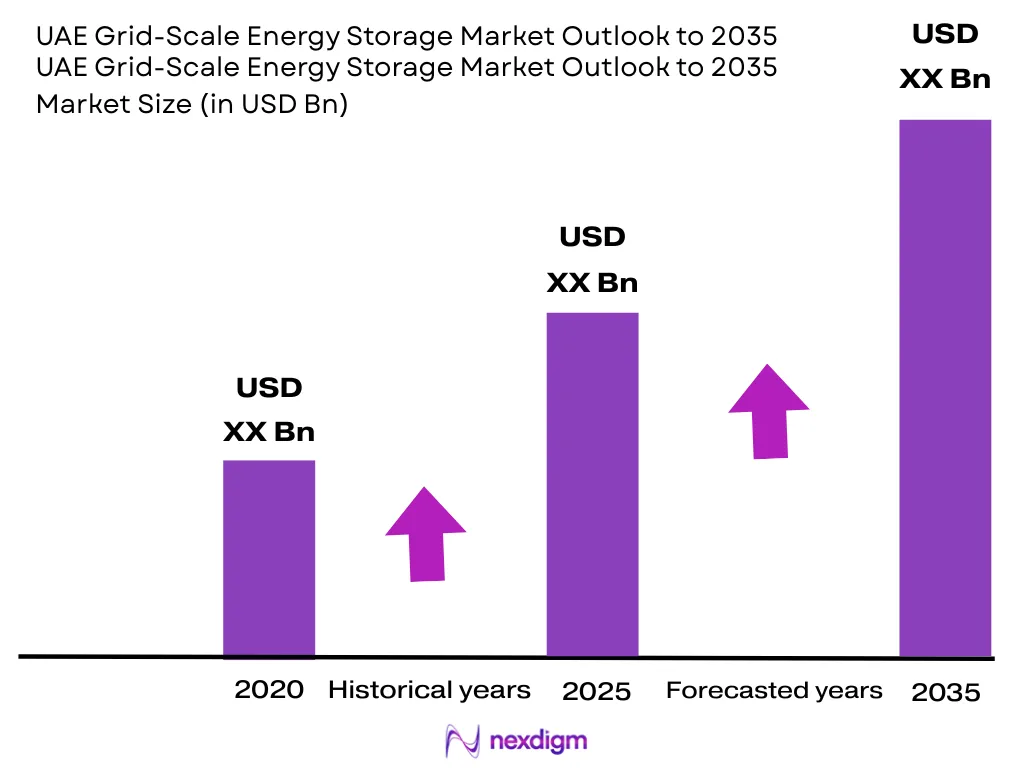
The UAE Grid-Scale Energy Storage Market was valued at USD ~ Billion in 2025 and is anticipated to expand at a CAGR of ~% during 2025–2031, reaching approximately USD ~ Billion by 2031, according to Mobility Foresights. The market is primarily driven by decarbonization targets under the UAE Energy Strategy 2050, surging renewable power installations, and rising electricity demand across the country’s rapidly growing grid infrastructure. The UAE held the largest revenue share of 34.85% in the Middle East battery energy storage systems market in 2024, driven by its leadership in renewable deployment and grid modernization, according to Grand View Research, while the broader Middle East and Africa grid-scale battery storage market is expected to grow at a CAGR of 26.6% from 2025 to 2030, with the UAE registering the highest country-level CAGR in the region. Masdar selected BYD Energy Storage to supply a battery energy storage facility with a capacity of 1,644 megawatts and 11,275 megawatt-hours for a round-the-clock renewable energy project in Abu Dhabi, representing one of the largest single storage procurements globally. Meanwhile, DEWA’s Q1 2025 revenue reached AED 5.96 billion, supporting the utility’s tender for a 2 GW solar plant paired with a 1,000 MW/6,000 MWh Battery Energy Storage System alongside an AED 7.6 billion investment in transmission infrastructure, reflecting sustained capital deployment across industrial, utility, and commercial grid-scale energy storage applications.
Market Segmentation
By Technology
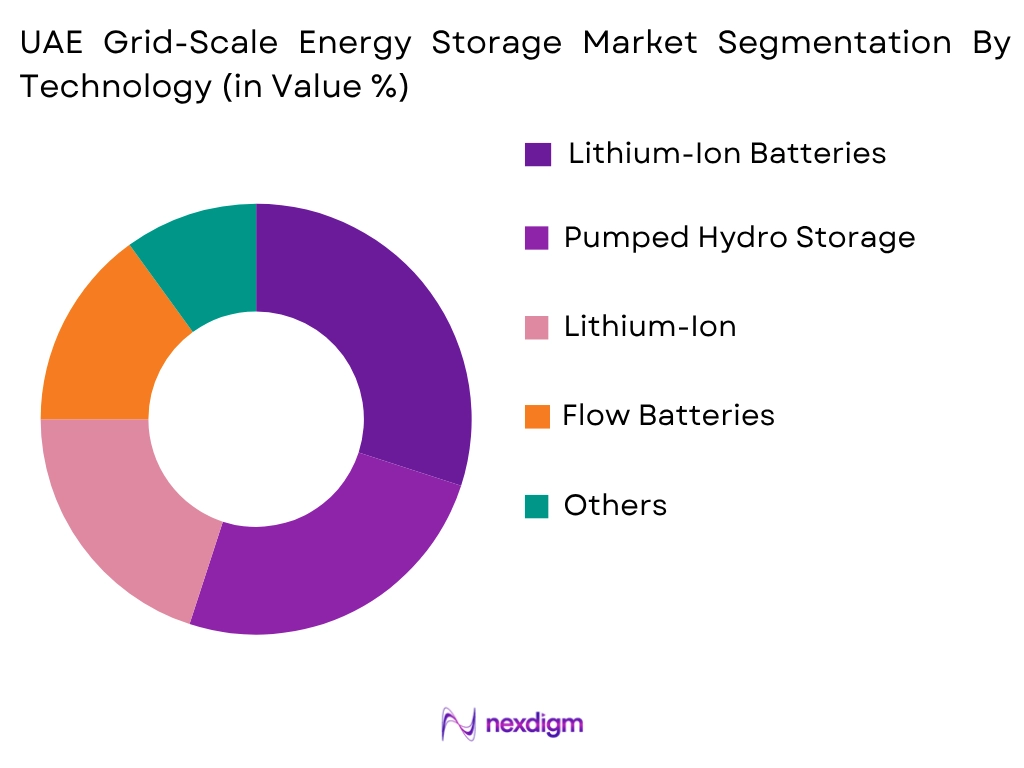
Among these, Lithium-Ion Batteries held the highest revenue share of the UAE Grid-Scale Energy Storage Market in 2024, anchored by mega-scale procurements such as Masdar’s 1,644 MW/11,275 GWh BYD Energy Storage facility and Tesla’s award of the 200 MWh Megapack project for the Dubai Electricity and Water Authority. Abu Dhabi’s sovereign wealth fund Mubadala jointly established the first lithium-ion battery super-factory in the Middle East with CATL, featuring a capacity of 20 GWh per year, locking in local supply chain capability and reducing the country’s historical dependency on imported battery cells. Flow Batteries, particularly zinc-bromine chemistry, represent a smaller but strategically important segment suited to the UAE’s extreme climate conditions, exemplified by AMEA Power’s collaboration with Redflow to deploy 50 MWh of zinc-bromine flow batteries specifically engineered for high-temperature desert applications where conventional lithium-ion systems face greater degradation challenges.
By Application
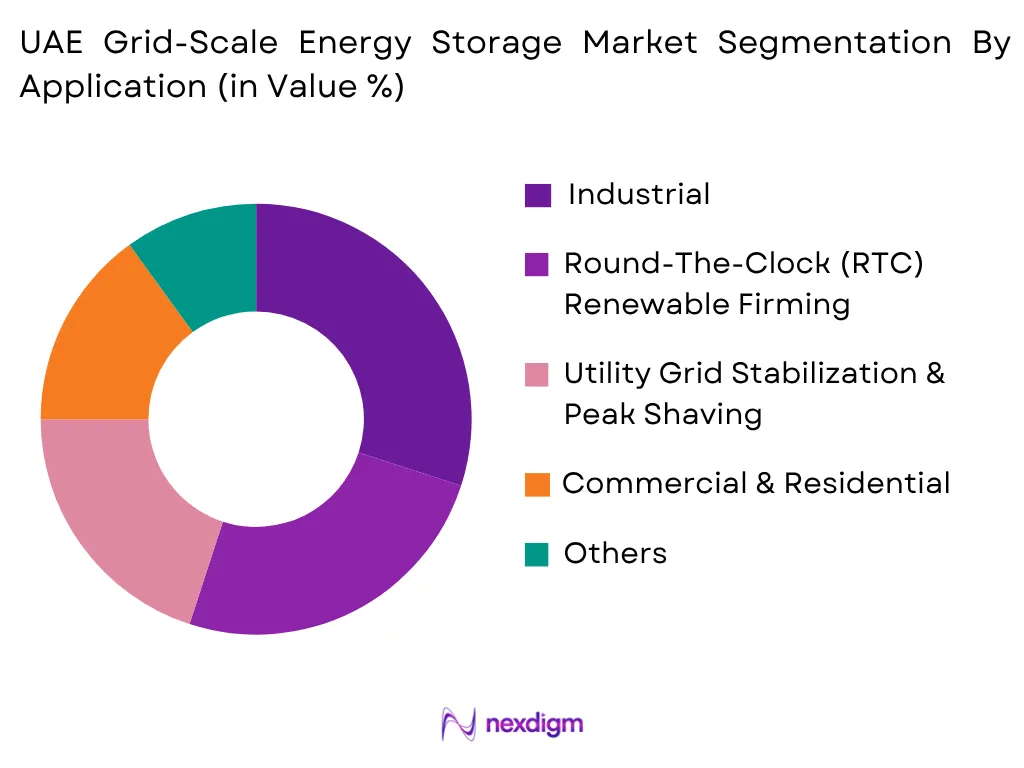
The Industrial segment held the highest revenue share of 71.85% in the broader Middle East battery energy storage systems market in 2024, reflecting the region’s substantial oil and gas sector adoption of storage for microgrid applications. Fluence provided energy storage solutions for the microgrids of oil and gas fields operated by the UAE’s Abu Dhabi National Oil Company, integrating AI prediction algorithms that reduced diesel consumption by 35%, illustrating the substantial efficiency gains available through storage-enabled microgrid optimization in the country’s energy sector. The Round-The-Clock (RTC) Renewable Firming segment represents the fastest-growing application, driven by Masdar’s integrated solar-storage-hydrogen project pipeline and DEWA’s development of the Mohammed bin Rashid Al Maktoum Solar Park’s Phase 7, which will add a 1 GW six-hour battery, making it the first dispatchable solar hub in the region and directly addressing the intermittency challenges inherent to the UAE’s rapidly expanding solar generation capacity.
Competitive Landscape
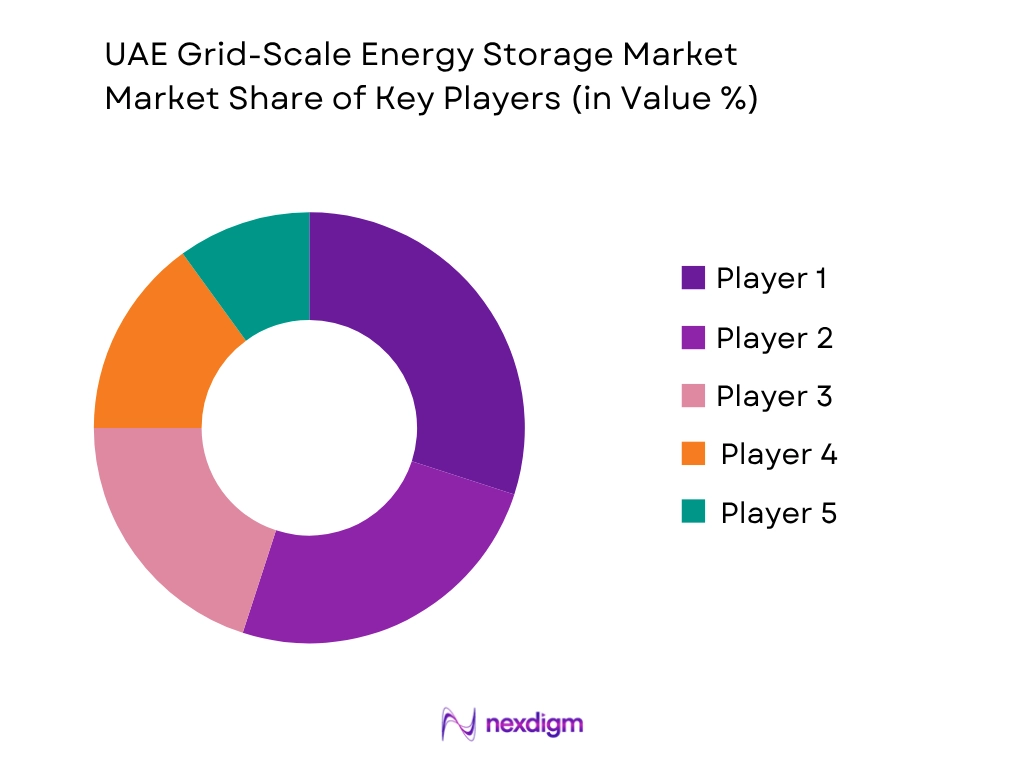
The UAE Grid-Scale Energy Storage Market is moderately concentrated, with government-linked utilities and renewable energy developers driving the majority of large-scale project deployment while sourcing battery technology from international manufacturers. Competition is primarily based on project development capacity, integration with renewable generation assets, regulatory alignment with the UAE Energy Strategy 2050, and the ability to secure competitive financing for multi-gigawatt-hour procurements. TAQA, DEWA, and EWEC collectively control approximately three-quarters of the UAE’s installed generation capacity, positioning these entities as the dominant force in grid-scale storage procurement decisions. EWEC’s 2024 tender for the country’s first utility-scale standalone battery storage project drew 27 bidders, reflecting intense international competition for UAE storage contracts, while Masdar, the Abu Dhabi Future Energy Company, dominates the national energy storage strategy, launching a 1.2 GWh tender in 2024 focused on integrated solar-storage-hydrogen projects. AMEA Power continues to develop specialized flow battery projects suited to desert climate conditions, while ADNOC’s adoption of Fluence-supplied microgrid storage for its oil and gas fields illustrates the diversification of storage demand beyond traditional utility-scale grid applications.
| Company | Establishment Year | Headquarters | Primary Product Portfolio | Energy Storage Portfolio
|
Manufacturing Presence | Major End-Use Industries | Key Strategic Focus | Certifications & Compliance |
| Masdar (Abu Dhabi Future Energy Company) | 2006 | ~ | ~ | ~ | ~ | ~ | ~ | ~ |
| TAQA (Abu Dhabi National Energy Company) | 2005 | ~ | ~ | ~ | ~ | ~ | ~ | ~ |
| AMEA Power | 2016 | ~ | ~ | ~ | ~ | ~ | ~ | ~ |
| DEWA (Dubai Electricity and Water Authority) | 1992 | ~ | ~ | ~ | ~ | ~ | ~ | ~ |
| EWEC (Emirates Water and Electricity Company) | 2018 | ~ | ~ | ~ | ~ | ~ | ~ | ~ |
UAE Grid-Scale Energy Storage Market Analysis
Growth Drivers
UAE Energy Strategy 2050 Renewable Integration Mandate
The UAE Grid-Scale Energy Storage Market is experiencing sustained growth due to the UAE Energy Strategy 2050, which increasingly incorporates large-scale battery storage as a critical enabler of the country’s renewable energy transition, ensuring stability, reliability, and efficient integration of intermittent solar and wind resources into the national grid. This national strategy, alongside the Dubai Clean Energy Strategy, prioritizes clean generation and makes new gas approvals unlikely unless paired with carbon capture, reinforcing sustained policy support for battery storage deployment. Masdar’s selection of BYD Energy Storage to supply a 1,644 MW/11,275 GWh battery energy storage facility for a round-the-clock renewable energy project in Abu Dhabi exemplifies the scale of investment flowing into grid-scale storage as the UAE pursues its decarbonization targets, with the country registering the highest CAGR of any Middle East and Africa market for grid-scale battery storage between 2025 and 2030.
Masdar’s Round-The-Clock Renewable Energy Mega-Project
Masdar’s development of round-the-clock renewable energy infrastructure continues to serve as a major driver of the UAE Grid-Scale Energy Storage Market. The company’s 1,644 MW/11,275 GWh battery energy storage facility, supplied by BYD Energy Storage, represents one of the largest single storage procurements globally and directly supports Masdar’s broader 1.2 GWh tender launched in 2024 focused on integrated solar-storage-hydrogen projects. This mega-scale approach to combining renewable generation, storage, and hydrogen production reflects the UAE’s ambition to establish dispatchable, round-the-clock renewable power as a viable alternative to conventional baseload generation, creating substantial and sustained demand for battery storage technology capable of supporting multi-day renewable energy firming at a scale rarely seen elsewhere in the world.
Market Challenges
High Local Ownership and Labor Cost Requirements
The UAE Grid-Scale Energy Storage Market faces challenges related to local ownership requirements that increase project costs for international developers and technology suppliers. Certain positions within energy storage projects must be held by local citizens, increasing labor costs by an estimated 20%, creating a structural cost consideration for international companies seeking to establish or expand operations within the UAE market. While these requirements support the country’s broader Emiratization employment objectives, they add complexity to project cost modeling for international battery manufacturers and system integrators competing for large-scale UAE storage contracts, requiring companies to carefully balance compliance with local employment mandates against overall project cost competitiveness.
Grid Interconnection Capacity Constraints in Northern Emirates
The UAE Grid-Scale Energy Storage Market faces significant grid interconnection constraints in the Northern Emirates, which remain capacity-constrained, importing up to 90% of peak load over transmission lines operating near design limits. TRANSCO’s new 400 kV substations in Sharjah and Ras Al Khaimah are not scheduled to enter service until 2028, meaning rooftop solar and behind-the-meter storage must serve as interim solutions for these grid-constrained regions in the near term. This structural grid limitation creates both a challenge and a near-term opportunity for distributed storage deployment, as the Northern Emirates’ transmission constraints will likely persist for several years before major infrastructure upgrades are completed, requiring continued reliance on smaller-scale, distributed storage solutions rather than centralized grid-scale procurement in these specific regions.
Market Opportunities
Energy Storage Asset Securitization and REIT Structures
The anticipated introduction of an Energy Storage Asset Securitization Act in 2025, which would allow foreign investors to hold energy storage assets through Real Estate Investment Trust structures, presents substantial opportunities for capital market development within the UAE Grid-Scale Energy Storage Market. This regulatory development is expected to increase liquidity by approximately 30%, complementing the Energy Storage Capacity Market launched in late 2024, which guarantees annual fixed income for storage projects at rates around USD 80 per kilowatt-year. Together, these financial market innovations create a more mature investment ecosystem for grid-scale storage assets, potentially accelerating capital inflows from international investors seeking exposure to the UAE’s rapidly growing energy storage infrastructure without requiring direct operational involvement in project development.
Domestic Battery Super-Factory Development
The establishment of the first lithium-ion battery super-factory in the Middle East, a joint venture between CATL and Abu Dhabi’s sovereign fund Mubadala featuring a capacity of 20 GWh per year, presents significant opportunities to develop a more resilient domestic battery supply chain for the UAE Grid-Scale Energy Storage Market. This domestic manufacturing capacity reduces the country’s historical dependency on imported battery cells while positioning the UAE as a potential regional battery manufacturing hub serving neighboring Gulf Cooperation Council markets. Companies capable of establishing complementary supply chain operations, including battery management systems, thermal management technology, and recycling infrastructure, are well positioned to capture growing opportunities as the UAE’s domestic battery manufacturing ecosystem continues to develop alongside this flagship super-factory investment.
Future Outlook
The UAE Grid-Scale Energy Storage Market is expected to witness sustained expansion over the forecast period, supported by continued implementation of the UAE Energy Strategy 2050, ongoing mega-scale renewable-storage-hydrogen project development led by Masdar, and growing domestic battery manufacturing capacity through the CATL-Mubadala super-factory partnership. Continued development of financial market infrastructure, including the anticipated Energy Storage Asset Securitization Act and Energy Storage Capacity Market, is expected to accelerate capital inflows into the sector. The market is also likely to benefit from continued grid modernization investment addressing Northern Emirates transmission constraints, supporting long-term growth across industrial, utility-scale, and round-the-clock renewable firming energy storage applications throughout the UAE.
Major Players
- Masdar (Abu Dhabi Future Energy Company)
- TAQA (Abu Dhabi National Energy Company)
- AMEA Power
- DEWA (Dubai Electricity and Water Authority)
- EWEC (Emirates Water and Electricity Company)
- ADNOC (Abu Dhabi National Oil Company)
- BYD Energy Storage
- CATL (Contemporary Amperex Technology Co.)
- Fluence Energy, Inc.
- Tesla Energy (Tesla, Inc.)
- Sungrow Power Supply Co., Ltd.
- Redflow Limited
- SirajPower
- Mubadala Investment Company
- Jinko Solar Co., Ltd.
Key Target Audience
- Grid-Scale Energy Storage Developers and System Integrators
- Electric Utilities and Government-Linked Energy Companies
- Renewable Energy Project Developers
- Oil and Gas Companies (Microgrid Applications)
- Battery Cell Manufacturers
- Sovereign Wealth Funds and Investment Entities
- Investment and Venture Capitalist Firms
- Government and Regulatory Bodies (Ministry of Energy and Infrastructure, Dubai Electricity and Water Authority (DEWA), Emirates Water and Electricity Company (EWEC))
- Component Suppliers and Raw Material Providers
Research Methodology
Step 1: Identification of Key Variables
The research process begins with identifying the complete ecosystem of the UAE Grid-Scale Energy Storage Market, including battery cell manufacturers, system integrators, utilities, renewable energy developers, and regulatory authorities. Extensive secondary research is conducted using company annual reports, government publications, trade associations, customs statistics, industry journals, and proprietary databases to determine the variables influencing market demand, pricing, installed capacity, and technological developments.
Step 2: Market Analysis and Construction
Historical market information is collected and analyzed to estimate market size, installed capacity, technology adoption trends, application-wise demand, and pricing trends. A combination of top-down and bottom-up approaches is used to estimate market revenues and validate segment-level performance. Deployment patterns across industrial, utility, and renewable firming applications are evaluated to establish an accurate representation of the industry.
Step 3: Hypothesis Validation and Expert Consultation
The preliminary findings are validated through Computer-Assisted Telephone Interviews (CATIs) and structured discussions with energy storage developers, procurement managers, utility executives, regulatory experts, and senior executives operating within the UAE energy industry. These interviews help verify market assumptions, competitive developments, technology adoption trends, pricing dynamics, and future investment opportunities while refining the overall market estimates.
Step 4: Research Synthesis and Final Output
The final stage integrates insights obtained from primary interviews with quantitative information collected through secondary sources. Data triangulation techniques are applied to reconcile differences between supply-side and demand-side estimates, ensuring robust market forecasting. The report is then reviewed through multiple quality assurance checkpoints to deliver a comprehensive analysis covering market size, segmentation, competitive landscape, future outlook, and strategic recommendations for industry stakeholders.

- Executive Summary
- Research Methodology (Market Definitions and Assumptions, Abbreviations, Market Sizing Approach, Top-Down Analysis, Bottom-Up Analysis, Demand-Side Assessment, Supply-Side Assessment, Primary Industry Interviews, Secondary Research Validation, Data Triangulation, Forecasting Framework, Limitations and Future Conclusions)

- Definition and Scope
- Market Evolution and Industry Genesis
- Timeline of Major Industry Developments
- Energy Storage Industry Value Chain Analysis
- Supply Chain Analysis

- Growth Drivers (UAE Energy Strategy 2050 Renewable Integration Mandate, Masdar’s Round-The-Clock Renewable Energy Mega-Project, DEWA Solar Park Dispatchable Hub Development, Domestic Battery Cell Manufacturing Investment, Oil and Gas Microgrid Storage Adoption, Grid Congestion in Northern Emirates)
- Market Challenges (High Local Ownership and Labor Cost Requirements, Grid Interconnection Capacity Constraints in Northern Emirates, Import Dependency for Battery Cell Technology, High Upfront Capital Costs, Regulatory Compliance Complexity)
- Market Opportunities (Energy Storage Asset Securitization and REIT Structures, Domestic Battery Super-Factory Development, Virtual Power Plant Aggregation Services, Flow Battery Technology for High-Temperature Applications, Energy Storage Capacity Market Participation)
- Market Trends (Growth of Integrated Solar-Storage-Hydrogen Projects, Virtual Power Plant Development, AI-Enabled Microgrid Optimization, Six-Hour Dispatchable Solar Hub Development, Consolidation Through Strategic Partnerships)
- Government Regulations (UAE Energy Strategy 2050, Dubai Clean Energy Strategy, Energy Storage Capacity Market Framework, Energy Storage Asset Securitization Act, Local Ownership and Emiratization Requirements)
- Import and Export Analysis (Trade Volume, Major Import Sources, Export Destinations, HS Code Analysis, Trade Balance)
- Raw Material Availability Analysis (Lithium-Ion Cells, Zinc-Bromine Flow Battery Materials, Domestic Battery Manufacturing Capacity, Solar PV Components, Grid Infrastructure Equipment)
- Technology Landscape (Lithium-Ion Battery Technology, Zinc-Bromine Flow Battery Technology, AI-Powered Microgrid Management, Virtual Power Plant Aggregation Platforms, Grid-Forming Inverter Technology)
- Sustainability Assessment (Renewable Energy Integration, Diesel Consumption Reduction in Oil & Gas Microgrids, Carbon Footprint Reduction, Integrated Hydrogen Project Development, Grid Resilience Enhancement)
- PESTLE Analysis
- SWOT Analysis
- Porter’s Five Forces Analysis
- Stakeholder Ecosystem
- Competition Ecosystem

- By Market Value (2020-2025)
- By Installed Capacity (2020-2025)
- By Average Selling Price (2020-2025)

- By Technology (In Value %)
Lithium-Ion Batteries
Flow Batteries (Zinc-Bromine)
Other Emerging Chemistries - By Application (In Value %)
Industrial
Utility Grid Stabilization & Peak Shaving
Round-The-Clock (RTC) Renewable Firming
Commercial & Residential - By Ownership Model (In Value %)
Utility-Owned
Independent Power Producer (IPP)
Behind-the-Meter (Oil & Gas Microgrids) - By Emirate (In Value %)
Abu Dhabi
Dubai
Sharjah & Northern Emirates

- Market Share of Major Players (By Value, Installed Capacity, Technology, Application, Emirate)
- Cross Comparison Parameters (Project Portfolio Breadth, Battery Chemistry Capability, Application Technical Support Capability, Development Capacity, Regulatory Compliance & Certifications, Utility Customer Base, Innovation & New Project Launch Frequency)
- SWOT Analysis of Major Players
- Pricing Analysis by Project Category and Capacity Class
- Development Capacity Analysis
- Project Footprint Analysis
- Distribution Network Analysis
- Innovation Benchmarking
- Detailed Profiles of Major Companies
Masdar (Abu Dhabi Future Energy Company)
TAQA (Abu Dhabi National Energy Company)
AMEA Power
DEWA (Dubai Electricity and Water Authority)
EWEC (Emirates Water and Electricity Company)
ADNOC (Abu Dhabi National Oil Company)
BYD Energy Storage
CATL (Contemporary Amperex Technology Co.)
Fluence Energy, Inc.
Tesla Energy (Tesla, Inc.)
Sungrow Power Supply Co., Ltd.
Redflow Limited
SirajPower
Mubadala Investment Company
Jinko Solar Co., Ltd.

- Consumption Pattern Analysis (Deployment Scale, Project Size, Product Category Penetration, Seasonal Demand, Repowering Activity)
- Purchasing Criteria (Regulatory Compliance, Cost Efficiency, Round-Trip Efficiency, Cycle Life, Real-Time Monitoring, Supplier Reliability)
- Procurement and Supplier Selection Analysis
- Sustainable Energy Adoption Assessment
- Premium vs Conventional Storage Demand
- Product Attribute Preference Analysis (Round-Trip Efficiency, Cycle Life, Real-Time Monitoring, Scalability, Safety Certification, Software Integration)
- Grid Resilience and Reliability Influence on Product Development
- Pain Point Analysis
- Decision-Making Process

- By Market Value (2026-2035)
- By Installed Capacity (2026-2035)
- By Average Selling Price (2026-2035)


 Request a Sample
 Ask for Customization
 Get a Quote
 Enquire Now