
 Download PDF
Market Overview
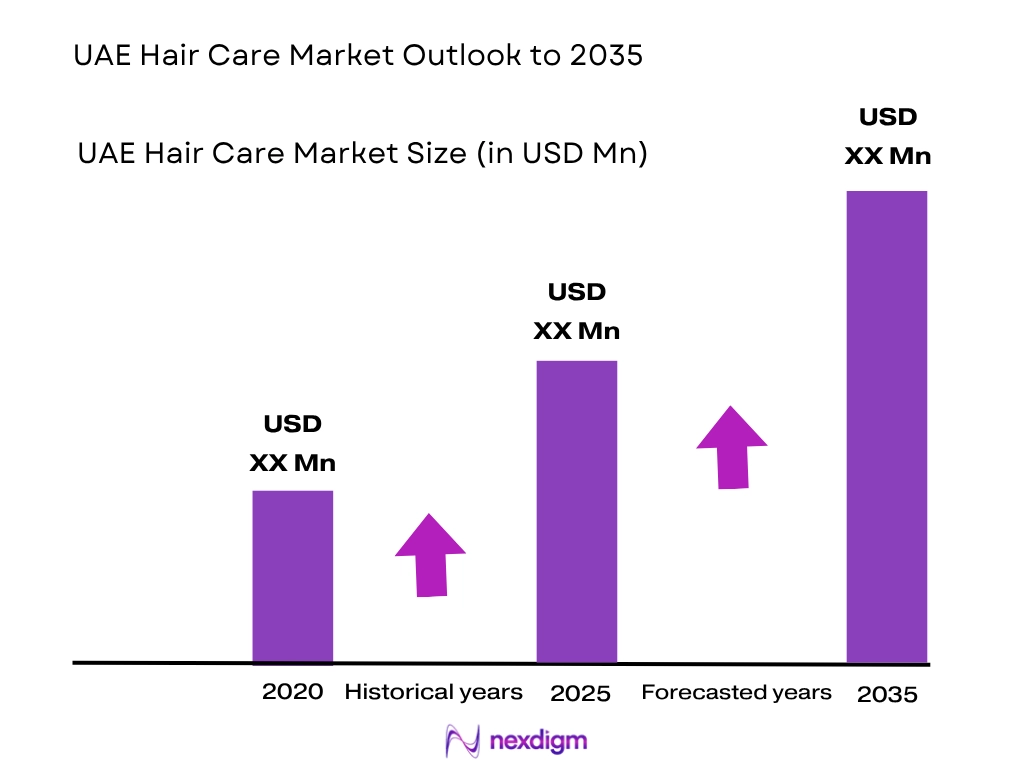
The UAE Hair Care Market is valued at USD ~ million, with Nexdigm Research identifying the same base value and projecting the market to reach USD ~ million at 3.92% CAGR through the medium-term forecast window. Demand is driven by premium and organic product adoption, frequent salon visits, professional styling and coloring treatments, and personal-care spending of about USD ~ per resident, alongside a national population base of ~ million.
Dubai dominates the UAE Hair Care Market because it combines the country’s strongest beauty-retail ecosystem, dense salon network, premium mall concentration, tourist-led beauty consumption, and digital discovery. Dubai’s resident population is estimated at 4,248,200, while the emirate welcomed 18.72 million international overnight visitors compared with 17.15 million in the prior annual benchmark, creating strong demand for shampoos, colorants, styling products, luxury hair care, salon treatments, and travel-retail beauty purchases.
Market Segmentation
By Product Type
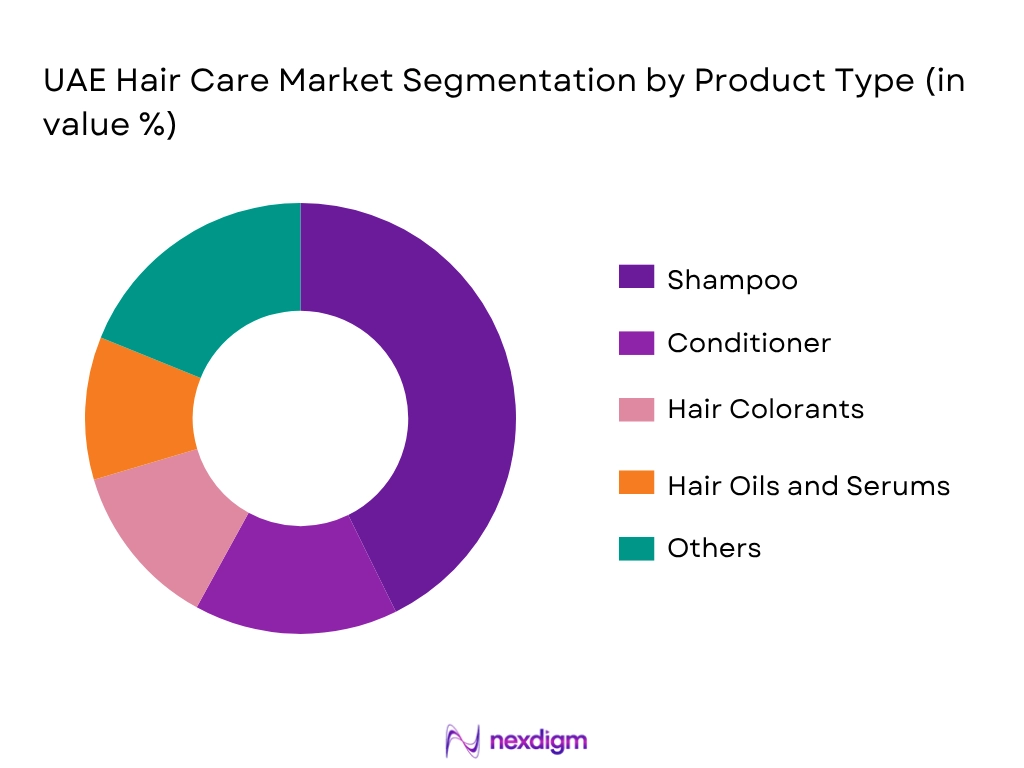
UAE Hair Care Market is segmented by product type into shampoo, conditioner, hair colorants, hair oils and serums, hair styling products, and hair treatments/scalp care. Recently, shampoo has a dominant market share under the product type segmentation, due to its daily-use nature in a hot, humid, dusty, and air-conditioned environment. Consumers in Dubai, Abu Dhabi, Sharjah, and the Northern Emirates frequently seek anti-dandruff, anti-hair fall, smoothing, sulfate-free, and moisturizing shampoos to address scalp hygiene, humidity-led frizz, dryness, and perceived hair fall linked to lifestyle and water-quality concerns. Large FMCG brands also give shampoo the deepest distribution across Carrefour, Lulu, Union Coop, pharmacies, beauty stores, Amazon.ae, Noon, and grocery quick-commerce platforms. Nexdigm also identifies shampoo as the leading UAE hair care product category, with styling products growing fastest, supporting shampoo’s role as the anchor category for household and professional purchases.
By Distribution Channel
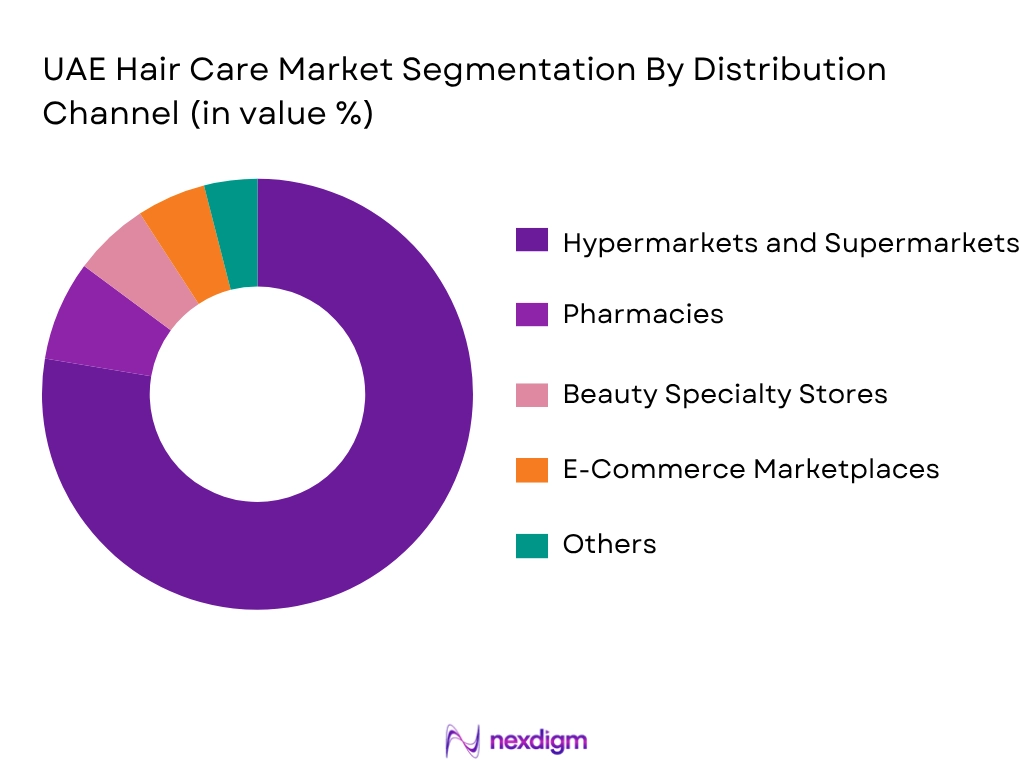
UAE Hair Care Market is segmented by distribution channel into supermarkets and hypermarkets, pharmacies, beauty specialty stores, e-commerce marketplaces, salons and professional supply, and duty-free/others. Recently, supermarkets and hypermarkets have a dominant market share under the distribution channel segmentation, due to their high footfall, trusted product authenticity, large brand assortments, family-pack availability, frequent price promotions, and ability to serve both mass and masstige hair care buyers. Carrefour, Lulu, Spinneys, Choithrams, and Union Coop benefit from routine grocery-linked purchases, where shampoo, conditioner, oils, and anti-dandruff products are replenished regularly. This channel also supports impulse purchases through end-cap promotions, bundled packs, and seasonal discounts. Nexdigm identifies supermarkets and hypermarkets as the leading UAE hair care distribution channel, while online retail is the fastest-growing channel because of marketplace assortment and discount-led discovery.
Competitive Landscape
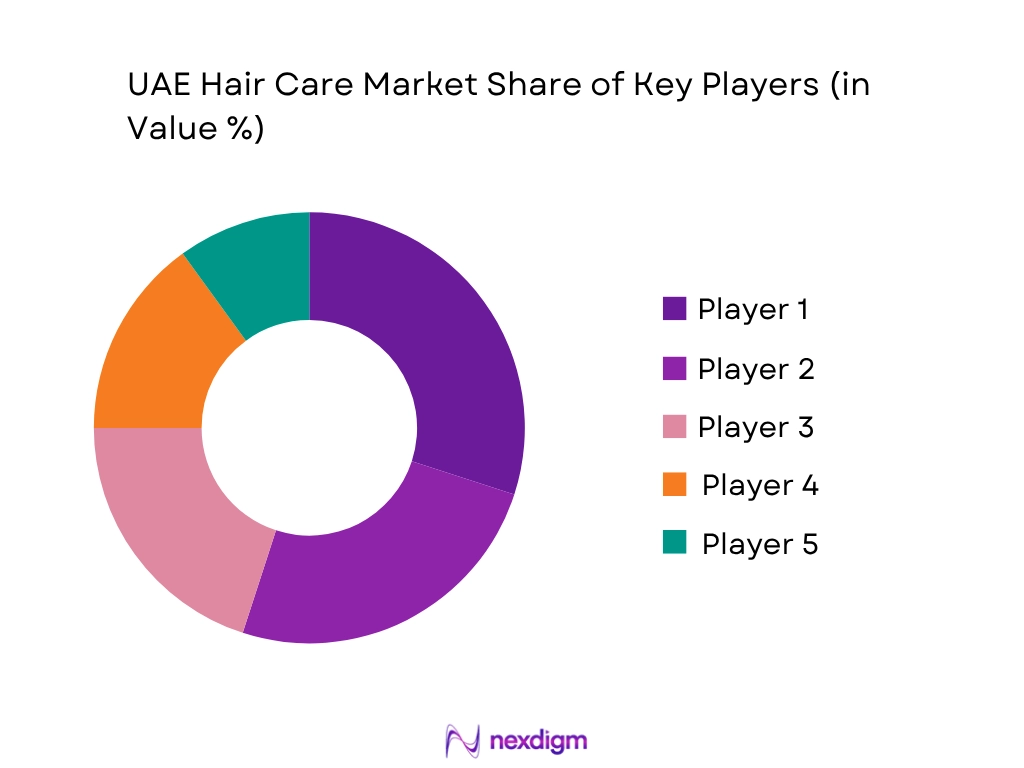
The UAE Hair Care Market is moderately concentrated, led by multinational FMCG and beauty companies with strong mass, premium, professional, and herbal portfolios. Procter & Gamble, Unilever, L’Oréal, Henkel, and Dabur are particularly influential because they cover high-frequency shampoo, anti-dandruff, conditioner, colorants, salon-professional, ayurvedic oil, and premium treatment needs across supermarkets, pharmacies, salons, and e-commerce. Competition is shaped by price promotions, salon endorsement, ingredient claims, anti-hair fall credibility, and digital visibility.
| Company | Establishment Year | Headquarters | UAE Hair Care Brands | Core Price Tier | Strongest Product Categories | Key Channels | Market Positioning | Strategic Advantage |
| Procter & Gamble | 1837 | Cincinnati, United States | ~ | ~ | ~ | ~ | ~ | ~ |
| Unilever | 1930 | London, United Kingdom | ~ | ~ | ~ | ~ | ~ | ~ |
| L’Oréal | 1909 | Clichy, France | ~ | ~ | ~ | ~ | ~ | ~ |
| Henkel | 1876 | Düsseldorf, Germany | ~ | ~ | ~ | ~ | ~ | ~ |
| Dabur | 1884 | Ghaziabad, India | ~ | ~ | ~ | ~ | ~ | ~ |
UAE Hair Care Market Analysis
Growth Drivers
High grooming expenditure
The UAE Hair Care Market benefits from a high-income consumer base that supports frequent purchase of shampoos, conditioners, anti-dandruff products, hair oils, styling gels, colorants, salon aftercare, and premium treatment ranges. The World Bank records the UAE’s GDP at USD 552.32 billion, GDP per capita at USD 50,273.5, total population at 10,986,400, and GDP growth at 4.0 for the latest reported macro year, indicating a strong personal-consumption environment for discretionary grooming. The same source records life expectancy at 83 years, which supports sustained wellness, appearance, and self-care routines across age groups. For hair care brands, this macro base is important because consumers in the UAE often trade up from basic cleansing products to problem-solution formats such as anti-hair fall, anti-frizz, scalp relief, sulfate-free, and salon-grade repair care. High disposable income also supports channel depth across hypermarkets, pharmacies, beauty specialty stores, salons, and e-commerce platforms, allowing brands to maintain both mass and premium portfolios.
Dubai beauty hub status
Dubai’s role as the UAE’s beauty and grooming hub is supported by its tourism, retail, trade, and resident-consumption base. Dubai welcomed 18.72 million international overnight visitors, compared with 17.15 million in the earlier benchmark, according to Dubai Department of Economy and Tourism data. This visitor flow strengthens demand for travel-size shampoos, luxury hair treatments, styling products, salon services, and duty-free beauty purchases. Dubai’s resident population is also estimated at 4,248,200, with 2,911,500 males and 1,336,700 females, creating a large local base for daily-use and salon-led hair care. The emirate’s tourism infrastructure, mall density, premium beauty retail, hotel salons, and professional grooming services make it the primary launchpad for premium and international hair care brands in the UAE. For suppliers, Dubai provides stronger brand visibility, faster product discovery, and better acceptance of professional-grade hair care than smaller emirates.
Market Challenges
Counterfeit risk
Counterfeit products remain a serious challenge for the UAE Hair Care Market because branded shampoos, conditioners, oils, serums, colorants, and salon treatments depend heavily on consumer trust, formulation safety, and visible authenticity. Dubai Customs reported 54 seizures involving 10.8 million counterfeit items, while its broader intellectual property enforcement recorded 285 intellectual property seizures valued at approximately AED 92.695 million. The authority also registered 439 trademarks, 205 commercial agencies, and 6 intellectual property assets, showing the scale of brand-protection activity required in a high-trade economy. For hair care companies, counterfeit risk affects premium salon products, imported professional brands, online marketplace listings, and grey-channel beauty products where consumers may not easily verify origin, expiry, storage conditions, or formula authenticity. This is especially relevant for scalp-care and hair-loss products, where perceived efficacy and product safety directly influence repeat purchase.
Parallel imports
Parallel imports are a structural challenge for the UAE Hair Care Market because the country is a regional trade and re-export hub with large volumes of branded consumer goods moving through formal and informal wholesale channels. UAE non-oil foreign trade reached AED 2.997 trillion, while non-oil exports reached AED 561.2 billion and exports to CEPA partner countries reached AED 135 billion. Dubai Customs also reported 3,273 seizures, handled higher cargo volumes, and recorded 49.2 growth in customs data processing, showing the scale and complexity of trade flows passing through the emirate. For hair care brands, this creates exposure to unauthorized sourcing, regional price arbitrage, non-localized labels, inconsistent batch freshness, and channel conflict between official distributors, salons, pharmacies, and online sellers. Parallel imports can weaken brand control in premium products such as Kérastase-style salon care, bond-repair treatments, colorants, and dermocosmetic scalp products.
Opportunities
Scalp care
Scalp care is a strong future growth opportunity in the UAE Hair Care Market because the country’s macro and climate conditions support frequent cleansing, scalp hygiene, anti-dandruff, anti-itch, and oil-control routines. The World Bank records a UAE population base of 10,986,400, GDP per capita of USD 50,273.5, and life expectancy of 83 years, supporting a broad wellness-oriented consumer base that can adopt more specialized hair routines beyond shampoo and conditioner. The UAE’s climate context also supports category relevance: the UAE’s official climate profile highlights rising temperatures, increased humidity, longer hot seasons, and heavier rainfall as national climate challenges. These conditions are directly relevant to scalp discomfort, sweat, oil buildup, dandruff perception, frizz, and frequent product use. For brands, the opportunity lies in scalp serums, exfoliating scalp scrubs, anti-dandruff maintenance lines, cooling scalp tonics, sensitive-scalp shampoos, and dermatologist-positioned hair care sold through pharmacies, salons, and e-commerce.
Men’s hair loss care
Men’s hair loss care is a strong opportunity in the UAE Hair Care Market because the country has a large male resident base, high workforce participation, and grooming-driven urban consumption. Dubai’s population bulletin records 2,911,500 males in the emirate, compared with 1,336,700 females, making male grooming a structurally important category in the UAE’s leading beauty hub. At the national level, the World Bank records the UAE population at 10,986,400 and GDP per capita at USD 50,273.5, giving brands a large and high-income base for anti-hair fall shampoos, caffeine-based scalp products, thickening sprays, anti-dandruff solutions, styling waxes, and salon/barbershop retail products. Men’s hair loss care can also benefit from Dubai’s professional grooming ecosystem, where barbershops, clinics, pharmacies, and e-commerce platforms can educate consumers and build repeat purchases around prevention, scalp strengthening, and appearance-led confidence.
Future Outlook
The UAE Hair Care Market is expected to expand steadily, supported by premiumization, natural and organic formulations, salon-grade at-home treatments, e-commerce expansion, and rising concern around hair fall, dandruff, frizz, scalp health, and heat-styling damage. Nexdigm projects the UAE hair care market at 3.70% CAGR during 2026-2034, reaching USD 635.0 million; this is the closest publicly available long-range CAGR and is used as the directional basis for the 2026-2035 outlook.
Future growth will be led by scalp-care routines, bond-repair treatments, sulfate-free and silicone-free ranges, hair-loss adjunct products, curly/textured-hair solutions, and professional salon take-home kits. Dubai will remain the premium discovery hub because of malls, salons, luxury beauty retail, and travel retail. Abu Dhabi will support premium pharmacy and affluent family consumption, while Sharjah and the Northern Emirates will continue supporting value packs, ayurvedic oils, herbal shampoos, and family-oriented mass products.
Major Players
- Procter & Gamble Gulf FZE
- Unilever Gulf FZE
- L’Oréal Middle East / L’Oréal UAE
- Henkel Jebel Ali FZCO
- Dabur International Ltd.
- Kao Corporation
- The Estée Lauder Companies Middle East
- Wella Company
- Johnson & Johnson / Kenvue
- Himalaya Wellness
- Beiersdorf Middle East
- Shiseido Group
- Amway
- Chanel Limited FZE
- Guerlain Middle East
Key Target Audience
- Hair care product manufacturers
- Beauty and personal care brand owners
- Salon chains and professional beauty distributors
- Supermarket, hypermarket and pharmacy retail chains
- E-commerce marketplaces and beauty e-tailers
- Importers, wholesalers and regional FMCG distributors
- Investments and venture capitalist firms
- Government and regulatory bodies (Ministry of Industry and Advanced Technology, Dubai Municipality, Abu Dhabi Quality and Conformity Council, Emirates Authority for Standardization and Metrology legacy framework)
Research Methodology
Step 1: Identification of Key Variables
The initial phase involves mapping the UAE Hair Care Market ecosystem, including brand principals, Gulf distributors, hypermarkets, pharmacies, salons, beauty specialty stores, online marketplaces, and duty-free retailers. Key variables include product type, pack size, price tier, channel penetration, hair concern, salon influence, ingredient claims, and emirate-level demand concentration.
Step 2: Market Analysis and Construction
Historical market value is compiled using published market-size sources, retail channel mapping, category-level brand presence, and price-band validation. The market model is built using top-down personal-care allocation and bottom-up SKU benchmarking across shampoo, conditioner, oils, serums, treatments, colorants, and styling products.
Step 3: Hypothesis Validation and Expert Consultation
Market hypotheses are validated through structured interviews with distributors, salon operators, beauty category managers, pharmacy buyers, and e-commerce sellers. These discussions validate channel margins, replenishment cycles, promotional intensity, high-velocity SKUs, consumer hair concerns, professional product usage, and online discounting behavior.
Step 4: Research Synthesis and Final Output
The final phase integrates secondary research, trade interviews, price checks, channel audits, and competitive benchmarking into a consolidated market view. Segment shares, growth drivers, competitive positioning, and opportunity areas are refined through triangulation, ensuring that the final report supports market entry, portfolio expansion, pricing, distribution, and investment decisions.

- Executive Summary
- Research Methodology (Market definitions and assumptions, hair care category inclusions/exclusions, abbreviations, top-down market sizing approach, bottom-up SKU and channel build-up, triangulated research approach, primary interviews with distributors/salon chains/modern trade/e-commerce sellers, price ladder validation, retail audit methodology, salon product sell-out mapping, regulatory validation, limitations and future conclusion framework)

- Definition and Scope
- Overview Genesis
- Evolution of UAE Hair Care Consumption
- Timeline of Major Players and Brand Entry
- Business Cycle
- Supply Chain and Value Chain Analysis
- Import Dependency and Local Re-Export Ecosystem
- Channel Structure: Retail, Pharmacy, Salon, Online and Duty Free
- UAE Hair Care Consumer Archetypes

- Growth Drivers (High grooming expenditure, Dubai beauty hub status, diverse expatriate base, salon culture, premium beauty adoption, online assortment expansion, natural/organic preference, scalp-health awareness)
- Market Challenges(Counterfeit risk, parallel imports, price discounting, claim substantiation, ingredient compliance, salon channel fragmentation, SKU proliferation, retailer margin pressure)
- Opportunities (Scalp care, textured hair, men’s hair loss care, clean beauty, halal-friendly hair care, salon retailing, dermocosmetic hair care, luxury travel retail)
- Market Trends (Clean-label hair care, bond-repair products, rosemary and scalp oils, sulfate-free routines, AI/personalized recommendations, influencer hair routines, luxury minis, refill and sustainable packaging)
- Government Regulation (ECAS, MoIAT conformity, municipality product registration, ingredient restrictions, bilingual labeling, product safety, claims control, import documentation)
- SWOT Analysis (Brand equity, premium pricing power, channel reach, formulation differentiation, regulatory readiness, salon influence, online visibility, counterfeit vulnerability)
- Stakeholder Ecosystem (Brand principals, regional distributors, importers, municipalities, MoIAT/ECAS bodies, modern trade, pharmacy chains, salons, beauty e-tailers, influencers, dermatologists, logistics providers)
- Porter’s Five Forces (Supplier power, retailer power, threat of substitutes, threat of new entrants, intra-category rivalry, private-label threat, online marketplace pressure)
- PESTLE Analysis (Regulation, expatriate demographics, premium consumption, e-commerce infrastructure, clean-beauty awareness, sustainability packaging, import dependence)
- Pricing Analysis (AED per ml/litre, pack-size ladder, promotion depth, salon litre-pack pricing, premium vs mass spread, e-commerce discount parity)
- Brand Positioning Map (Mass efficacy, natural/herbal, salon professional, luxury repair, dermatological scalp care, men’s grooming)

- By Value (2020-2025)
- By Volume (2020-2025)
- By Average Realized Price (2020-2025)
- By Retail vs Professional Hair Care Revenue (2020-2025)
- By Mass, Masstige, Premium and Luxury Hair Care Revenue (2020-2025)

- By Product Type (In Value%)
Shampoo
Conditioner
Hair Colorants
Hair Styling Products
Hair Treatment Products
Hair Oils and Serums
Scalp Care Products - By Hair Concern (In Value%)
Anti-Dandruff and Scalp Relief
Anti-Hair Fall and Hair Strengthening
Frizz Control and Humidity Protection
Dryness and Damage Repair
Color Protection and Grey Coverage - By Price Tier (In Value%)
Mass Hair Care
Masstige Hair Care
Premium Hair Care
Luxury Hair Care
Dermatological/Pharmacy Hair Care - By Distribution Channel (In Value%)
Supermarkets and Hypermarkets
Pharmacies
Beauty Specialty Stores
Salons and Professional Supply
E-Commerce Marketplaces
Brand-Owned Online Channels
Duty-Free and Travel Retail - By End User (In Value%)
Women
Men
Children and Family Users
Salon Professionals
Tourists and Travel Retail Buyers - By Gender Positioning (In Value%)
Female-Focused Hair Care
Male-Focused Hair Care
Unisex and Family Hair Care - By Ingredient and Claim Positioning (In Value%)
Natural and Organic-Positioned Hair Care
Ayurvedic and Herbal Hair Care
Free-From Hair Care
Dermatological and Clinical Claims - By Emirate (In Value%)
Dubai
Abu Dhabi
Sharjah
Northern Emirates

- Market Share of Major Players (Value share, volume share, product-category share, channel-wise share, mass vs premium share, salon professional share)
- Cross Comparison Parameters (Hair concern portfolio coverage, salon-professional penetration, UAE channel footprint, price-tier ladder, natural/clean/halal-friendly claim strength, SKU and pack-size depth, e-commerce discount intensity, regulatory and Arabic-label compliance readiness)
- SWOT Analysis of Major Players (Brand equity, distribution strength, professional credibility, price competitiveness, innovation pipeline, online visibility, claim substantiation, grey-market exposure)
- Pricing Analysis Basis SKUs for Major Players (Shampoo per litre, conditioner per litre, hair mask per 100 ml, serum per 100 ml, hair oil per 100 ml, colorant kit price, salon litre pack, online bundle price)
- Recent Developments and Strategic Moves (Product launches, salon partnerships, influencer campaigns, online exclusives, premium range expansion, sustainability packaging, scalp-care innovation)
- Detailed Profiles of Major Companies
Procter & Gamble Gulf FZE
Unilever Gulf FZE
L’Oréal Middle East / L’Oréal UAE
Henkel Jebel Ali FZCO
Dabur International Ltd.
Kao Corporation
The Estée Lauder Companies Middle East
Wella Company
Johnson & Johnson / Kenvue
Himalaya Wellness
Beiersdorf Middle East
Shiseido Group
Amway
Chanel Limited FZE
Guerlain Middle East

- Consumer Demand and Utilization (Wash frequency, conditioner attachment rate, treatment usage, hair-color cycle, styling frequency, scalp-care adoption)
- Purchasing Power and Budget Allocation (Mass family packs, premium masks, salon treatment aftercare, monthly beauty spend, promotion sensitivity)
- Needs, Desires and Pain Point Analysis (Hair fall, dandruff, frizz, dryness, hard-water damage, color fading, heat damage, scalp irritation)
- Decision-Making Process (Ingredient scan, brand trust, dermatologist recommendation, stylist recommendation, influencer review, price promotion, online rating)
- Customer Cohort Analysis (Arab nationals, South Asian expatriates, Filipino expatriates, African/textured-hair consumers, Western expatriates, tourists, male grooming users)
- Salon and Professional Buyer Analysis (Back-bar consumption, stylist retail conversion, treatment-led product pull, distributor credit terms, training and education support)
- Retailer and Distributor Buying Criteria (Shelf velocity, gross margin, promotion funding, exclusivity, minimum order quantity, trade marketing, logistics reliability)

- By Value (2026-2035)
- By Volume (2026-2035)
- By Average Realised Price (2026-2035)
- By Retail vs Professional Hair Care Revenue (2026-2035)
- By Mass, Masstige, Premium and Luxury Hair Care Revenue (2026-2035)


 Request a Sample
 Ask for Customization
 Get a Quote
 Enquire Now