

 Download PDF
Market Overview
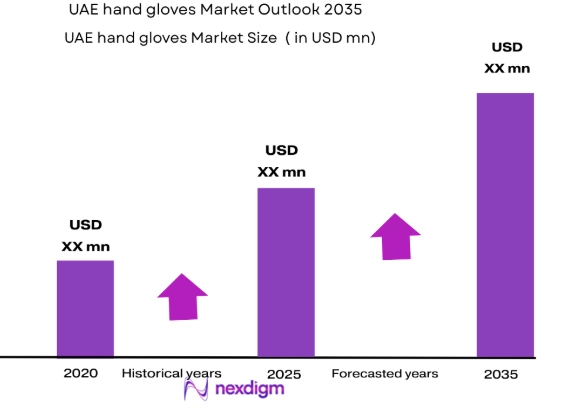
The UAE hand gloves market is valued at approximately USD ~ million in 2024, supported by strong demand from healthcare, hospitality, construction, and industrial sectors. The UAE healthcare sector recorded expenditure exceeding USD 19 billion, while the country operates more than 150 hospitals and over 5,000 healthcare facilities, ensuring continuous consumption of medical gloves. Additionally, the UAE’s non-oil GDP reached USD 435 billion, driven by construction, logistics, and manufacturing activities, all of which require protective gloves. The country’s population of over 10 million and high influx of expatriate workers further increase demand for hygiene and safety products across multiple industries.
The UAE hand gloves market is concentrated in Dubai, Abu Dhabi, and Sharjah due to strong infrastructure, healthcare facilities, and industrial clusters. Dubai dominates due to its role as a logistics hub, with Jebel Ali Port handling over 14 million TEUs annually, facilitating import and re-export of gloves. Abu Dhabi contributes through large healthcare investments and oil & gas operations requiring safety equipment. Sharjah supports manufacturing and industrial activities. These regions benefit from high population density, industrial development, and advanced healthcare systems, making them key consumption centers for hand gloves.
Market Segmentation
By Product Type
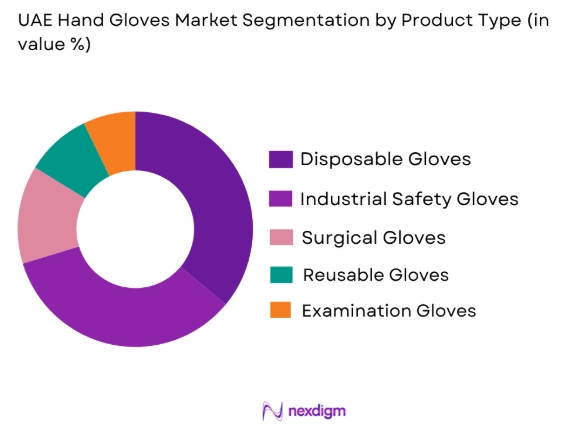
UAE hand gloves market is segmented by product type into disposable gloves, reusable gloves, surgical gloves, examination gloves, and industrial safety gloves. Disposable gloves dominate the market due to their extensive use across healthcare, food service, hospitality, and cleaning applications. Hospitals, clinics, and diagnostic centers require single-use gloves to maintain hygiene and prevent cross-contamination. Additionally, the UAE’s tourism and hospitality sector, which welcomed over 28 million visitors, drives demand for disposable gloves in food handling and service industries. The strict hygiene regulations enforced in restaurants and hotels further increase consumption. Disposable gloves are preferred due to their convenience, compliance with safety standards, and lower risk of contamination, making them the leading segment in the market.
By Material Type
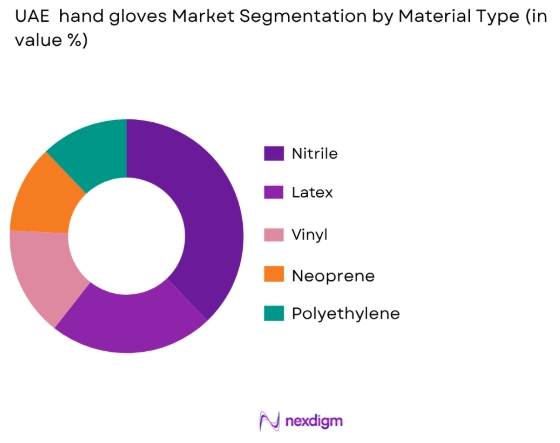
UAE hand gloves market is segmented by material type into nitrile gloves, latex gloves, vinyl gloves, neoprene gloves, and polyethylene gloves. Nitrile gloves dominate the market due to their superior resistance to chemicals, punctures, and allergens compared to latex gloves. Healthcare facilities prefer nitrile gloves to minimize allergic reactions, while industrial sectors such as oil & gas and construction require durable gloves for handling hazardous materials. The UAE’s oil production exceeding 3 million barrels per day and strong industrial activities increase demand for high-performance gloves. Additionally, nitrile gloves offer longer durability and better protection, making them suitable for both medical and industrial applications, thereby strengthening their dominance in the market.
Competitive Landscape
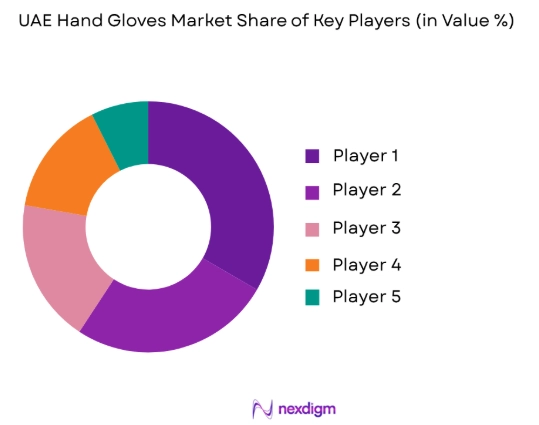
The UAE hand gloves market is moderately fragmented, with strong participation from international manufacturers and regional distributors. Global players dominate due to their advanced product offerings and established supply chains, while local distributors focus on efficient logistics and re-export capabilities. The UAE’s strategic position as a trade hub enhances competition, as companies leverage Dubai’s logistics infrastructure to supply gloves across the Middle East and Africa.
| Company | Establishment Year | Headquarters | Product Focus | Distribution Network | Key Industries Served | Import/Local Presence | Competitive Advantage |
| Ansell Limited | 1893 | Australia | ~ | ~ | ~ | ~ | ~ |
| Top Glove Corporation | 1991 | Malaysia | ~ | ~ | ~ | ~ | ~ |
| Hartalega Holdings | 1988 | Malaysia | ~ | ~ | ~ | ~ | ~ |
| 3M Gulf | 1902 | USA | ~ | ~ | ~ | ~ | ~ |
| Kimberly-Clark | 1872 | USA | ~ | ~ | ~ | ~ | ~ |
UAE Hand Gloves Market Analysis
Growth Drivers
Expansion of Healthcare Infrastructure and Medical Services
UAE hand gloves demand is supported by continuous use of examination, surgical, and hygiene gloves across hospitals, clinics, laboratories, emergency units, and outpatient facilities. The UAE Statistical Annual Health Sector Report recorded 173 hospitals, 18,497 hospital beds, 953,364 admitted cases, 2,932,823 inpatient days, and more than 25 million hospital visits. WHO also reports UAE population at 10,642,081, creating a sizable healthcare service base requiring recurring medical consumables. For glove suppliers, these healthcare volumes support repeat procurement from public and private providers.
Growth in Hospitality, Tourism, and Food Service Industry
UAE hand gloves demand is strengthened by hotels, restaurants, catering, airport food service, cleaning contractors, and tourism-linked hospitality operations where disposable gloves are used for food handling and hygiene. UAE hotel establishments received about 15.3 million guests in the first half of 2024, while hotel establishment revenues reached AED 24.6 billion. Dubai recorded 18.72 million international overnight visitors in 2024, supporting glove consumption across kitchens, housekeeping, airport catering, restaurants, and event venues. Food service hygiene requirements make gloves a recurring consumable for hospitality operators.
Market Challenges
High Dependence on Imports
UAE hand gloves market faces import dependence because domestic demand is largely served by foreign suppliers. World Bank WITS data shows exporters shipped surgical gloves to the UAE from China at 2,134,860 kg, Malaysia at 1,451,690 kg, India at 875,459 kg, Thailand at 720,595 kg, and the European Union at 80,092 kg. This dependence exposes healthcare, food service, and industrial buyers to external supply disruptions, customs delays, supplier concentration, and freight constraints. Import reliance is especially important for nitrile and surgical gloves used in regulated environments.
Regulatory Compliance and Quality Standards
UAE hand gloves suppliers face regulatory and quality compliance requirements because medical gloves are used in patient care, infection control, laboratories, and healthcare facilities. MoHAP’s licensed medical facilities dataset covers annual distribution of licensed facilities by emirate, sector, main category, and facility type, showing an active regulatory environment for healthcare service delivery. The UAE health sector recorded 173 hospitals and 18,497 beds, making product quality, documentation, traceability, and conformity essential for institutional procurement. Suppliers serving hospitals and clinics must align with healthcare procurement and product registration expectations.
Opportunities
Growth in Local Manufacturing and Re-Export Activities
UAE hand gloves suppliers have an opportunity in local assembly, warehousing, and re-export because the country already functions as a regional trade hub. World Bank WITS data shows importers bought surgical gloves from the UAE, including the European Union at 27,765 kg, Denmark at 27,765 kg, Zimbabwe at 43,792 kg, Zambia at 15,364 kg, and Kenya at 26,614 kg. The UAE’s non-oil GDP reached approximately AED 660 billion in the first half of 2024, supporting logistics, distribution, and re-export-oriented business models.
Increasing Demand for Nitrile and Powder-Free Gloves
UAE hand gloves suppliers have an opportunity in nitrile and powder-free gloves because healthcare, laboratories, food handling, oil & gas, and cleaning services need gloves with chemical resistance, lower allergy risk, and contamination control. World Bank WITS data shows China shipped 2,134,860 kg of surgical gloves to the UAE, Malaysia shipped 1,451,690 kg, India shipped 875,459 kg, and Thailand shipped 720,595 kg, reflecting substantial demand for medical-use gloves. UAE’s hospital base of 173 facilities and 25 million-plus hospital visits supports higher-specification disposable glove adoption.
Future Outlook
Over the next five years, the UAE hand gloves market is expected to experience steady growth driven by healthcare expansion, tourism recovery, and industrial development. Government investments in healthcare infrastructure and increasing medical tourism will boost demand for medical gloves.
The construction and oil & gas sectors will continue to drive demand for industrial safety gloves, while the hospitality and food service industries will support disposable glove consumption. The UAE’s position as a global trade hub will also facilitate re-export opportunities, further strengthening market growth.
Major Players
- Top Glove Corporation
- Hartalega Holdings Berhad
- Kossan Rubber Industries
- Ansell Limited
- Supermax Corporation
- Riverstone Holdings
- Kimberly-Clark Corporation
- Medicom Group
- Sempermed
- AMMEX Corporation
- Julphar
- Al Hayat Pharmaceuticals
- B. Braun Medical Gulf
- 3M Gulf
- Fine Hygienic Holding
Key Target Audience
- Healthcare providers and hospital procurement departments
- Industrial and construction companies
- Oil and gas companies
- Food processing and hospitality businesses
- Retail and wholesale distributors
- Investments and venture capitalist firms
- Government and regulatory bodies (Ministry of Health and Prevention UAE, Dubai Health Authority)
- Occupational safety and compliance organizations
Research Methodology
Step 1: Identification of Key Variables
The initial phase involves mapping stakeholders in the UAE hand gloves market, including manufacturers, distributors, healthcare institutions, and industrial users. Secondary sources such as government publications and trade data are used to identify key variables affecting demand and supply.
Step 2: Market Analysis and Construction
Historical data is analyzed to understand consumption patterns, industrial output, and healthcare utilization. The study evaluates glove usage across sectors and distribution channels to construct a reliable market model.
Step 3: Hypothesis Validation and Expert Consultation
Industry experts are consulted to validate assumptions and provide insights into market dynamics. These interactions help refine demand estimates and identify key growth factors.
Step 4: Research Synthesis and Final Output
The final phase integrates primary and secondary research findings to deliver a validated market assessment. Data triangulation ensures accuracy and consistency in the analysis.

- Executive Summary
- Research Methodology (Market Definitions and Assumptions Abbreviations, Market Sizing Approach, Consolidated Research Approach, Understanding Market Potential Through In-Depth Industry Interviews, Primary Research Approach, Limitations and Future Conclusions)

- Definition and Scope
- Market Dynamics Overview
- Market Genesis
- Major Players and Market Timeline
- Business Cycle and Trends
- Supply Chain and Value Chain Analysis

- Growth Drivers
Expansion of Healthcare Infrastructure and Medical Services
Growth in Hospitality, Tourism, and Food Service Industry
Increasing Focus on Workplace Safety and Hygiene
Rising Demand from Industrial and Construction Sectors - Market Challenges
High Dependence on Imports
Price Sensitivity and Competitive Market Structure
Fluctuations in Raw Material Supply
Regulatory Compliance and Quality Standards - Opportunities
Growth in Local Manufacturing and Re-Export Activities
Increasing Demand for Nitrile and Powder-Free Gloves
Expansion of E-commerce and Medical Supply Distribution
Rising Healthcare Investments and Medical Tourism
- Key Trends
Shift toward nitrile and synthetic gloves
Rising demand for disposable single use gloves
Growth in industrial safety glove applications
Increasing focus on eco friendly gloves
Expansion of healthcare and PPE demand - Government Regulations
- SWOT Analysis
- Porter’s Five Forces

- By Value, 2020–2025
- By Volume, 2020–2025
- By Average Price, 2020–2025

- By Product Type (In Value %)
Disposable Gloves
Reusable Gloves
Surgical Gloves
Examination Gloves
Industrial Safety Gloves - By Material Type (In Value %)
Latex
Nitrile
Vinyl
Neoprene
Polyethylene - By Application (In Value %)
Healthcare
Industrial Manufacturing
Food Processing
Hospitality and Tourism
Household and Cleaning - By Distribution Channel (In Value %)
Direct Sales
Distributors and Wholesalers
Retail Pharmacies
Online Channels - By Region (In Value %)
Dubai
Abu Dhabi
Sharjah
Rest of UAE

- Market Share of Major Players by Value/Volume
- Market Share of Major Players by Product Type
- Cross Comparison Parameters(Company Overview, Business Strategies, Recent Developments, Strength, Weakness, Organizational Structure, Revenues, Revenues by Product Type, Number of Touchpoints, Distribution Channels, Number of Dealers and Distributors, Margins, Production Plant, Capacity, Unique Value Offering and Others)
- SWOT Analysis of Major Players
- Detailed Profiles of Major Companies
Top Glove Corporation
Hartalega Holdings Berhad
Kossan Rubber Industries
Ansell Limited
Supermax Corporation
Riverstone Holdings
Kimberly-Clark Corporation
Medicom Group
Sempermed
AMMEX Corporation
Julphar (Gulf Pharmaceutical Industries)
Al Hayat Pharmaceuticals
B. Braun Medical Gulf
3M Gulf
Fine Hygienic Holding

- Market Demand and Utilization
- Purchasing Power and Budget Allocations
- Regulatory and Compliance Requirements
- Needs, Desires, and Pain Point Analysis
- Decision-Making Process

- By Value, 2026–2035
- By Volume, 2026–2035
- By Average Price, 2026–2035


 Request a Sample
 Ask for Customization
 Get a Quote
 Enquire Now