

 Download PDF
Market Overview
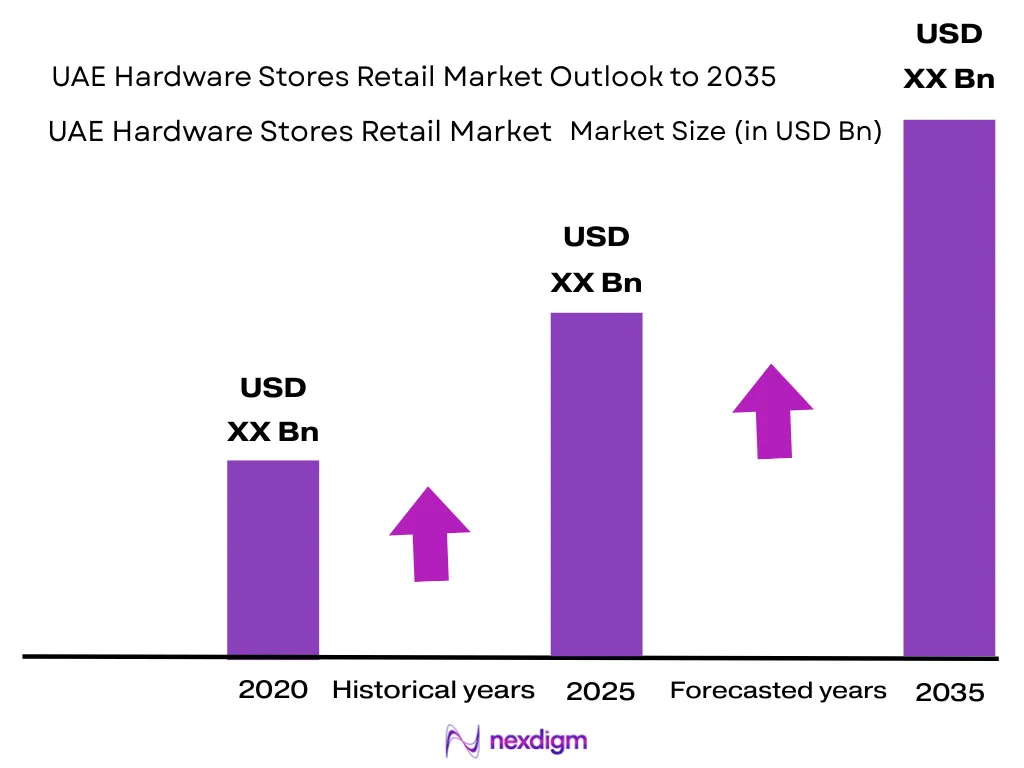
The UAE hardware stores retail market is assessed within the wider UAE retail, home improvement, DIY and construction-supply ecosystem. The country’s retail market is valued at USD ~ billion, while the UAE construction market is valued at USD ~ billion, creating a strong downstream demand base for hand tools, power tools, fasteners, electrical supplies, plumbing products, paints, sealants, PPE and maintenance consumables. The market is driven by residential fit-outs, contractor procurement, renovation activity, facility management and e-commerce-enabled specialty retail. Dubai and Abu Dhabi dominate the UAE hardware stores retail market because they concentrate construction activity, commercial maintenance demand, residential communities, hospitality assets and organized retail formats. Dubai’s real estate sector recorded 226,000 transactions valued at AED 761 billion, supporting fit-out, repair and renovation purchases. Abu Dhabi adds public-sector infrastructure, oil-and-gas-linked industrial demand and large facility management contracts. Sharjah remains relevant for value hardware retail, industrial-area trading and SME contractor procurement.
Market Segmentation
By Product Category
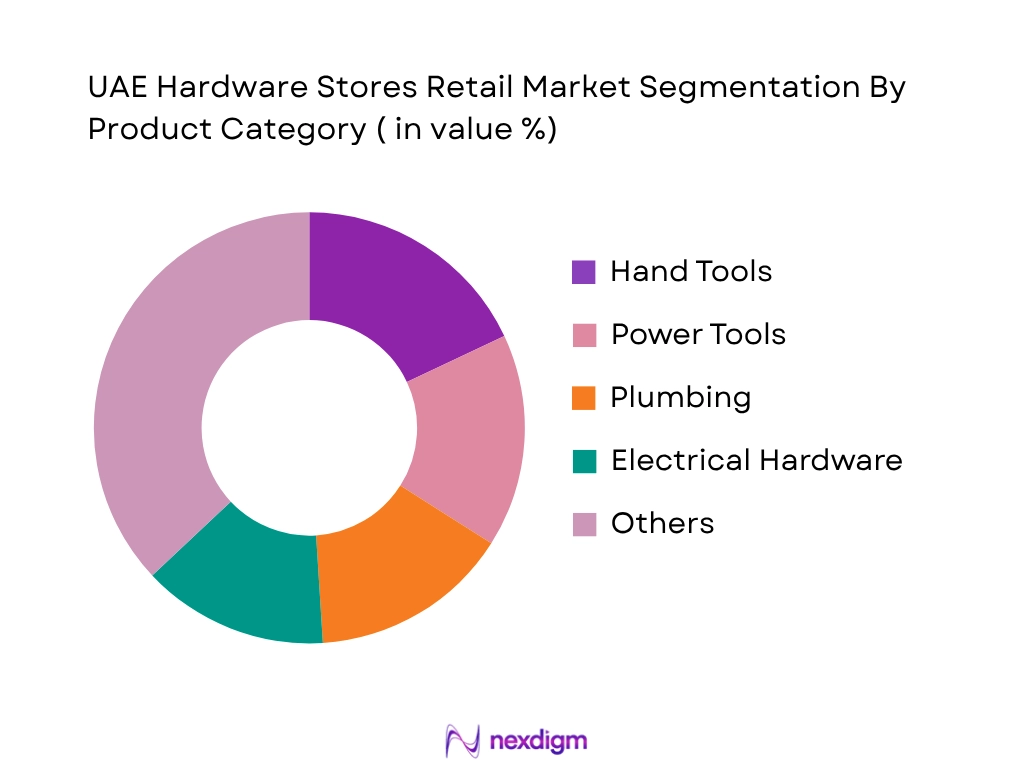
The UAE hardware stores retail market is segmented by product category into hand tools, power tools, plumbing supplies, electrical hardware, fasteners, paints, adhesives, PPE and outdoor hardware. Hand tools and tool kits hold a dominant position because they serve both professional and household use cases. Contractors, maintenance technicians, facility management teams and DIY consumers purchase screwdrivers, pliers, hammers, spanners, cutters and measuring tools frequently for small repairs and site work. Unlike power tools, hand tools have lower ticket sizes, faster replacement cycles and broader customer reach. Their dominance is further supported by neighbourhood hardware stores, trade counters and online platforms that maintain wide SKU availability for daily maintenance and repair needs.
By Customer Type
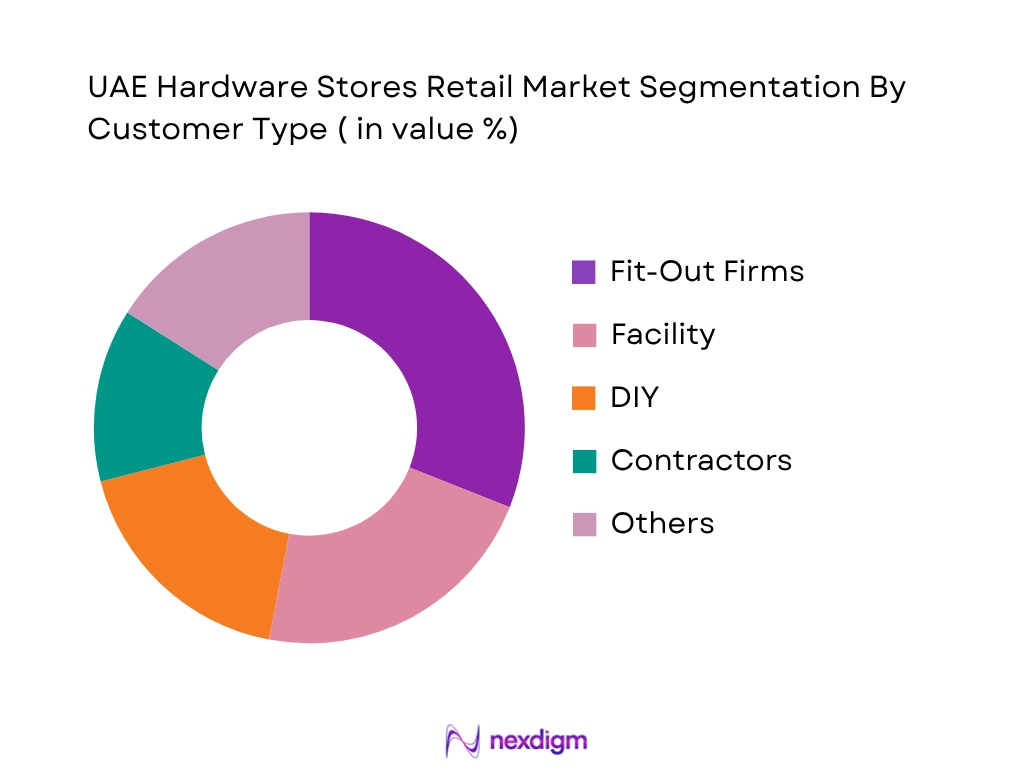
The UAE hardware stores retail market is segmented by customer type into professional contractors, facility management firms, DIY consumers, MEP contractors, hospitality maintenance teams, institutional buyers and small resellers. Professional contractors and fit-out firms dominate because hardware purchases are closely connected to residential handovers, commercial fit-outs, renovation cycles and real estate maintenance. These buyers purchase in repeat volumes and require access to tools, fasteners, adhesives, plumbing inputs, electrical items and site consumables. Their buying behaviour is also more predictable than household DIY demand, as it is tied to project timelines and replenishment cycles. Retailers serving this segment usually benefit from bulk pricing, credit accounts, delivery services and repeat procurement relationships.
Competitive Landscape
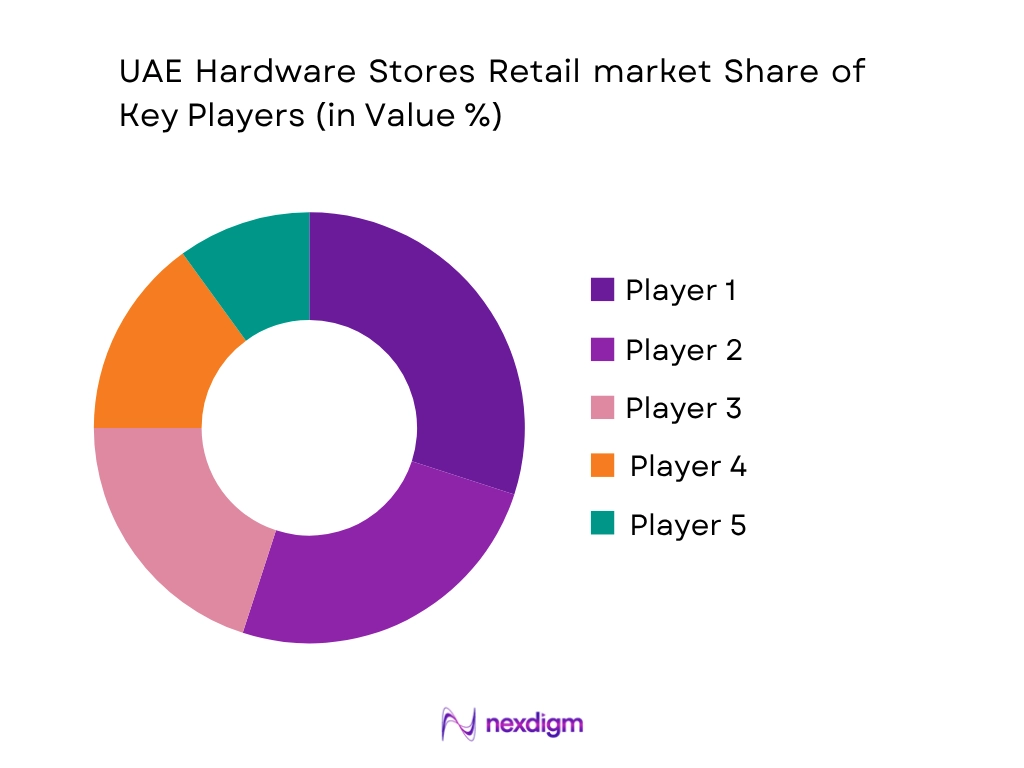
The UAE hardware stores retail market is fragmented but increasingly organized. Large-format home improvement retailers serve DIY and household buyers, while specialist hardware stores, industrial tool distributors and building-material retailers serve contractors and maintenance companies. Competition is shaped by SKU depth, emirate-wise store presence, supplier relationships, online catalogue strength, delivery speed, warranty support and contractor account penetration. Players such as ACE UAE, Speedex Tools, Homesmiths, Danube Home and Toolmart Middle East compete across overlapping product categories but differ in customer focus and channel strategy.
| Major Player | Establishment Year | Headquarters | Core Retail Positioning | Key Product Strength | Primary Customer Base | Channel Presence | Delivery / Fulfilment Capability | Market-Specific Differentiator |
| ACE UAE | 1991 UAE operations under Al-Futtaim | Dubai, UAE | ~ | ~ | ~ | ~ | ~ | ~ |
| Speedex Tools | 1991 | Dubai, UAE | ~ | ~ | ~ | ~ | ~ | ~ |
| Homesmiths | 2016 | Dubai, UAE | ~ | ~ | ~ | ~ | ~ | ~ |
| Danube Home | 2008 | Dubai, UAE | ~ | ~ | ~ | ~ | ~ | ~ |
| Toolmart Middle East | 2007 | Dubai, UAE | ~ | ~ | ~ | ~ | ~ | ~ |
UAE Hardware Stores Retail Market Analysis
Growth Drivers
Construction, Fit-Out and Real Estate Maintenance Demand
The UAE hardware stores retail market is strongly supported by construction-linked and property-maintenance demand, especially for hand tools, power tools, plumbing supplies, electrical fittings, fasteners, adhesives, sealants and PPE. Dubai’s real estate sector recorded 2.78 million procedures and 226,000 real estate transactions with a combined value of AED 761 billion, creating repeated demand for fit-out, repair, refurbishment and contractor procurement across residential and commercial properties. Abu Dhabi also provides a strong project-led demand base, with its construction sector reaching AED 107.4 billion and real estate activities exceeding AED 41.7 billion, according to Statistics Centre – Abu Dhabi. These indicators directly support hardware retail because building completions, villa upgrades, office fit-outs and hospitality refurbishments require recurring purchases of installation tools, consumables, safety products and MEP-related supplies. The dominance of Dubai and Abu Dhabi in property activity makes them the primary demand centres for organized hardware stores, trade counters and contractor-focused retail formats.
Strong Urban Consumption and Non-Oil Economic Base
The UAE hardware stores retail market benefits from a dense urban consumer base and strong non-oil economic activity, both of which support household repairs, DIY purchases, contractor services and facility maintenance. The World Bank reports the UAE population at 11 million and GDP per capita at USD 50,273.5, reflecting a high-income consumer base with capacity for home improvement and maintenance spending. The UAE’s GDP stood at USD 552.32 billion, according to the World Bank, showing the scale of the broader economy supporting retail and construction-linked sectors. In Q1 2025, UAE real GDP reached AED 455 billion, while non-oil GDP reached AED 352 billion, according to the Ministry of Economy and Tourism citing Federal Competitiveness and Statistics Centre data. This matters for hardware retail because non-oil activities include trade, construction, real estate, manufacturing and maintenance-intensive commercial sectors. A larger urban and non-oil base supports recurring purchases through stores, e-commerce platforms, contractor accounts and facility management procurement channels.
Market Challenges
Import Dependence and Inventory Exposure
The UAE hardware stores retail market remains exposed to import dependence because a large share of power tools, hand tools, electrical fittings, plumbing products, locks, fasteners and branded accessories are sourced through international manufacturers and distributors. UAE non-oil foreign trade reached AED 2.997 trillion, while non-oil imports reached AED 1.701 trillion, according to the Dubai Media Office. The same source states that re-exports reached AED 734.4 billion, showing the UAE’s role as both a domestic retail market and redistribution hub. In H1 2025, non-oil imports reached AED 969.3 billion, while total non-oil foreign trade reached AED 1.728 trillion, indicating continued import-heavy trade flows. For hardware retailers, this creates operational pressure around lead times, stock planning, supplier concentration and product availability. Slow-moving SKUs can lock working capital, while fast-moving construction consumables and tool accessories require continuous replenishment. Retailers serving contractors face greater risk because project buyers expect immediate availability of exact sizes, grades, brands and compatible parts.
Counterfeit Products and Compliance Risk
Counterfeit products remain a specific challenge for UAE hardware stores because tools, electrical accessories, safety equipment, locks, adhesives and branded spare parts depend heavily on product authenticity, warranty assurance and safety compliance. Dubai Customs reported 285 intellectual property seizures valued at approximately AED 92.695 million, along with 439 trademark registrations, 205 commercial agency registrations and 6 intellectual property asset registrations. In Q1 2025 alone, Dubai Customs recorded 68 seizures worth around AED 42.195 million, supported by 159 trademark registrations and 63 commercial agency registrations. Although the seizures covered multiple counterfeit categories, the risk is directly relevant to hardware retail because counterfeit power tools, electrical components and safety gear can create warranty disputes, product failure, injury risk and reputational damage. Organized retailers must therefore invest in authorized sourcing, invoice traceability, supplier verification and after-sales support. This raises compliance workload and creates margin pressure against informal sellers offering lower-priced, non-authenticated products.
Market Opportunities
Contractor-Focused Trade Counters and B2B Hardware Procurement
The UAE hardware stores retail market has a clear opportunity in contractor-focused trade counters, especially in Dubai, Abu Dhabi and Sharjah industrial clusters. Abu Dhabi’s construction sector reached AED 107.4 billion, while its wholesale and retail trade sector reached AED 62.7 billion, according to Statistics Centre – Abu Dhabi. Dubai’s real estate sector recorded 217,000 investments valued at AED 526 billion and attracted 110,000 new investors, according to Dubai Land Department. These current indicators show a large base of project owners, contractors, maintenance teams and fit-out firms that need frequent access to tools, fasteners, plumbing fittings, electrical goods, sealants, paints and PPE. Hardware retailers can use this demand to build account-based sales models, delivery scheduling, quotation desks, bulk ordering and trade credit controls. The opportunity is strongest for retailers that can maintain reliable SKU depth, technical staff, warranty-backed branded tools and rapid fulfilment to construction sites, villas, offices, hotels and facility management accounts.
Omnichannel Hardware Retail and Digital Catalogue Expansion
Digital ordering is a major opportunity for UAE hardware stores because professional buyers increasingly need searchable catalogues, stock visibility, WhatsApp ordering, click-and-collect and site delivery. The UAE achieved an ICT Development Index score of 97.5 out of 100, according to the Official UAE Government Portal, supporting digital adoption across retail and service channels. The World Bank reports UAE GDP per capita at USD 50,273.5 and population at 11 million, creating a digitally capable and high-income buyer base for online hardware discovery and repeat purchasing. Trade infrastructure also supports this shift, with UAE non-oil foreign trade reaching AED 2.997 trillion and re-exports reaching AED 734.4 billion, allowing retailers to connect imported SKUs with local and regional demand. Hardware retailers can use digital catalogues to reduce search friction across thousands of SKUs, especially for fasteners, fittings, tool accessories and electrical items. The strongest opportunity lies in hybrid models combining physical availability, online ordering, technical support and rapid delivery.
Future Outlook
The UAE hardware stores retail market is expected to grow steadily through the forecast period, supported by construction activity, housing handovers, commercial renovations, tourism-linked property maintenance and the growth of facility management services. The forecasted CAGR for the period is estimated at around 5.7%, aligned with the broader UAE retail outlook and supported by construction-linked hardware demand. The market will shift from traditional counter-based selling toward omnichannel retail, B2B account management, real-time stock visibility and faster last-mile delivery. Organized retailers are expected to gain from SKU rationalization, private label development and contractor loyalty programs. The strongest growth pockets will likely include power tools, electrical hardware, plumbing supplies, adhesives, sealants, safety products and smart home-linked hardware. Dubai will remain the leading retail and renovation hub, while Abu Dhabi will continue to generate demand from infrastructure, government assets, industrial zones and facility management contracts. Sharjah and the Northern Emirates will remain important for value retail, wholesale distribution and SME contractor demand. E-commerce will become more relevant, but physical stores will continue to matter because hardware retail depends on product inspection, immediate availability, technical advice and emergency purchasing. The winning retailers will combine physical stock depth with digital catalogues, same-day delivery, credit accounts, WhatsApp ordering, project quotations and after-sales warranty support. The market’s key risks include import cost volatility, counterfeit products, margin pressure, slow-moving inventory and intense price competition from unorganized stores and marketplace sellers.
Major Players
- ACE UAE
- Speedex Tools
- Danube Home
- Homesmiths
- Al Quoz Star Building Materials
- Damam Hardware
- SITCO UAE
- Creative Hardware
- Bin Dasmal General Trading
- Juma Al Majid Building Materials Division
- Al Naboodah Building Materials
- HardwareCity UAE
- Toolmart Middle East
- WeMENA
- Amazon UAE and Noon Hardware Sellers
Key Target Audience
- Hardware store chains and specialty retailers
- Building material retailers and distributors
- Power tool and hand tool manufacturers
- Construction contractors and fit-out companies
- Facility management and maintenance service providers
- E-commerce platforms and B2B procurement marketplaces
- Investments and venture capitalist firms
- Government and regulatory bodies, including Ministry of Economy UAE, Dubai Municipality, Abu Dhabi Department of Economic Development, Dubai Land Department and Emirates Authority for Standardization and Metrology-linked regulatory entities
Research Methodology
Step 1: Identification of Key Variables
The initial phase involves mapping the UAE hardware stores retail ecosystem, including retailers, distributors, importers, contractors, facility managers, e-commerce platforms and end users. Key variables include product category revenue, store density, SKU depth, import dependence, contractor demand, online sales contribution, average basket size and emirate-wise demand concentration.
Step 2: Market Analysis and Construction
The second phase involves compiling historical data from retail, construction, home improvement, import and real estate indicators. Market construction is carried out using a top-down approach from UAE retail and construction benchmarks, followed by a bottom-up assessment of store formats, product categories, customer segments and channel-level revenue contribution.
Step 3: Hypothesis Validation and Expert Consultation
Market assumptions are validated through structured discussions with hardware retailers, tool distributors, building-material suppliers, contractors, MEP professionals, facility management buyers and e-commerce sellers. These discussions help refine assumptions related to product margins, fast-moving SKUs, contractor credit behaviour, stock replenishment cycles and category-level demand.
Step 4: Research Synthesis and Final Output
The final phase integrates secondary research, trade data, retail benchmarks and primary inputs into a validated market model. The output includes market sizing, segmentation, competitive benchmarking, future growth outlook, customer analysis and strategic recommendations for retailers, investors, suppliers and channel partners operating in the UAE hardware stores retail market.

- Executive Summary
- Research Methodology (Market Definitions and Assumptions, Hardware Retail Scope, DIY vs Professional Trade Scope, Retail vs Wholesale Boundary, Top-Down Market Sizing, Bottom-Up Store Revenue Estimation, SKU-Level Price Benchmarking, Primary Interviews with Retailers/Contractors/Distributors, Supplier Channel Checks, Import and Re-Export Mapping, Limitations and Forecast Assumptions)

- Definition and Scope
- Market Genesis and Evolution
- UAE Hardware Retail Business Cycle
- Hardware Retail Value Chain Analysis
- Hardware Retail Supply Chain Analysis

- Growth Drivers (Real Estate Development, Villa Renovation, Hospitality Expansion, Facility Management Growth, DIY Adoption, E-Commerce Penetration, Population Growth, Infrastructure Maintenance)
- Market Challenges (Import Cost Volatility, Price Competition, Counterfeit Tools, Inventory Fragmentation, Low Brand Loyalty, Skilled Staff Shortage, Rental Cost Pressure, Slow-Moving SKUs)
- Market Opportunities (Private Label Development, Contractor Loyalty Programs, E-Commerce Expansion, Maintenance Kits, Green Building Products, Smart Home Hardware, Industrial Safety Retailing)
- Market Trends (Digital Ordering, Branded Tool Bundles, DIY Workshops, Premiumization, Cross-Border Sourcing, Safety Compliance, Fast Delivery, Category Bundling)
- SWOT Analysis
- Porter’s Five Forces Analysis
- Stakeholder Ecosystem
- Pricing and Margin Structure

- By Retail Revenue (2020-2025)
- By Number of Hardware Retail Outlets (2020-2025)
- By Average Revenue per Store (2020-2025)

- By Product Category (In Value %)
Hand Tools
Power Tools
Fasteners and Fixings
Plumbing and Sanitary Hardware
Electrical Hardware - By Store Format (In Value %)
Big-Box Home Improvement Retailers
Contractor-Focused Trade Counters
Neighbourhood Hardware Stores
Building Material and Hardware Yards
Online Hardware Retailers - By Sales Channel (In Value %)
Offline Walk-In Retail
B2B Account-Based Sales
E-Commerce and Retailer-Owned Websites
Marketplace-Led Hardware Sales
WhatsApp and Catalogue-Based Ordering - By Emirate (In Value %)
Dubai
Abu Dhabi
Sharjah
Northern Emirates

- Market Share of Major Players (Retail Revenue, Store Count, Category Sales, Online Visibility, Contractor Account Base)
- Cross Comparison Parameters (Store Footprint by Emirate, SKU Depth by Product Category, Contractor Account Penetration, E-Commerce and Delivery Capability, Private Label Presence, Brand Partnerships and Authorized Dealerships, Average Basket Size, After-Sales and Warranty Support)
- Price Benchmarking of Key SKUs (Cordless Drill, Angle Grinder, Screwdriver Set, PVC Pipe Fittings, Electrical Cable, Silicone Sealant, Door Lock, Safety Shoes, Wall Paint, Fastener Packs)
- SWOT Analysis of Major Players
- Detailed Profiles of Major Competitors
ACE UAE
Speedex Tools
Danube Home
Homesmiths
Al Quoz Star Building Materials
Damam Hardware
SITCO UAE
Creative Hardware
Bin Dasmal General Trading
Juma Al Majid Est. Building Materials Division
Al Naboodah Building Materials
HardwareCity UAE
Toolmart Middle East
WeMENA
Noon and Amazon UAE Hardware Sellers

- DIY Customer Analysis
- Contractor and SME Buyer Analysis
- Facility Management Buyer Analysis
- Hospitality and Commercial Property Buyer Analysis
- Purchase Decision-Making Process

- By Retail Revenue (2026-2035)
- By Store Count (2026-2035)
- By Average Revenue per Store (2026-2035)


 Request a Sample
 Ask for Customization
 Get a Quote
 Enquire Now