
 Download PDF
Market Overview
The UAE Health Drinks Market is valued at USD ~ billion, derived from Ken Research’s UAE functional beverage outlook that projects the market to reach USD 2.5 billion at an 8.0% CAGR. Demand is driven by functional hydration, fortified juices, protein RTDs, zero-sugar energy drinks, and plant-based beverages. Supporting consumption indicators include UAE population growth from 10.64 million to 11.03 million and retail market value of USD 44.38 billion. Dubai and Abu Dhabi dominate the UAE Health Drinks Market due to premium retail density, tourism, gyms, hotels, restaurants, and high-income expatriate demand. Dubai welcomed 17.15 million international overnight visitors before rising to 18.72 million, increasing on-the-go beverage consumption across malls, cafés, hotels, convenience stores, and quick-commerce platforms. Abu Dhabi’s population reached 4.14 million, supporting demand through modern trade, workplace consumption, fitness clubs, and premium hospitality channels.
Market Segmentation
Product Type
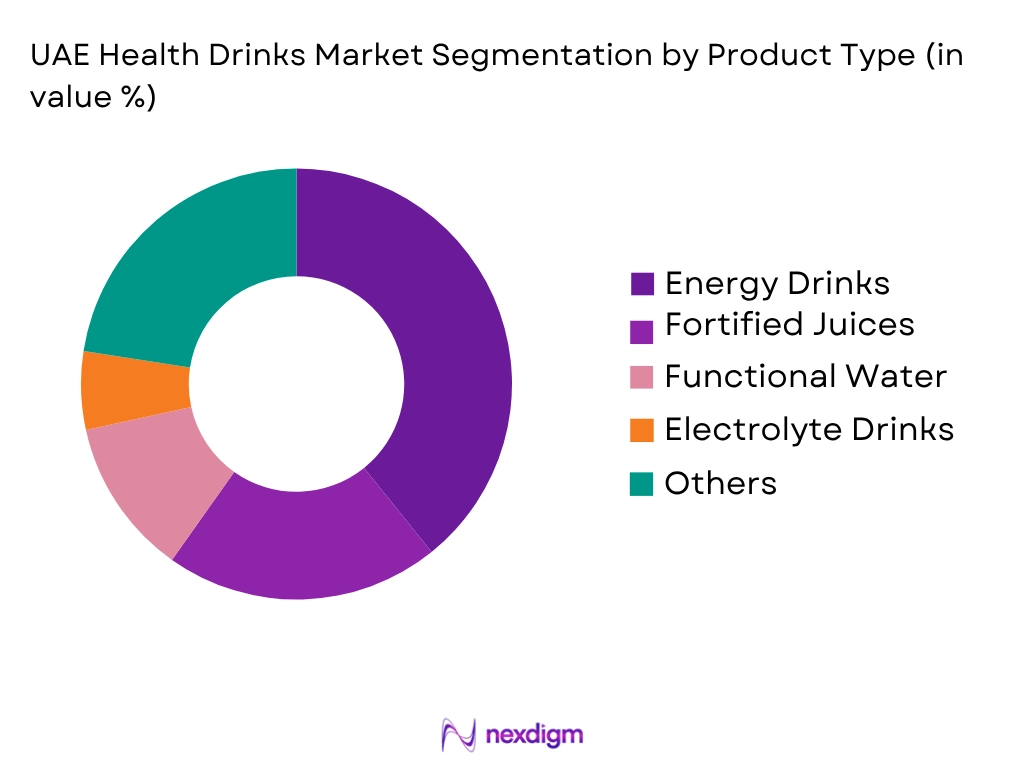
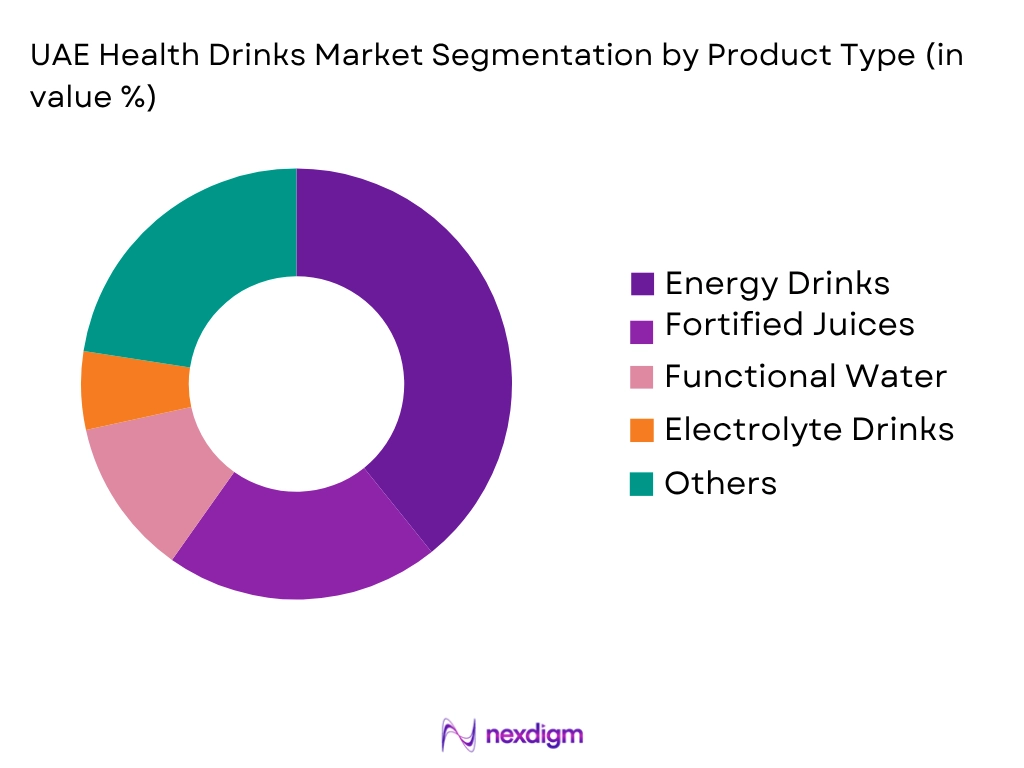
The UAE Health Drinks Market is segmented by product type into energy drinks, sports and electrolyte drinks, fortified juices, functional water, protein RTD drinks, kombucha and probiotic drinks, coconut water, and plant-based functional beverages. Energy drinks hold the dominant market share due to their deep penetration across convenience stores, petrol stations, supermarkets, gyms, and foodservice outlets. The segment benefits from strong brand recall, frequent impulse purchases, single-serve can formats, and extensive availability of sugar-free variants. Red Bull, Monster, Sting, C4, Celsius, and Alani Nu have also increased category visibility among office professionals, students, fitness users, and nightlife consumers. In the UAE, hot climate, long working hours, active commuting patterns, and high tourist footfall further support consumption of caffeinated, chilled, and ready-to-drink products.
By Distribution Channel
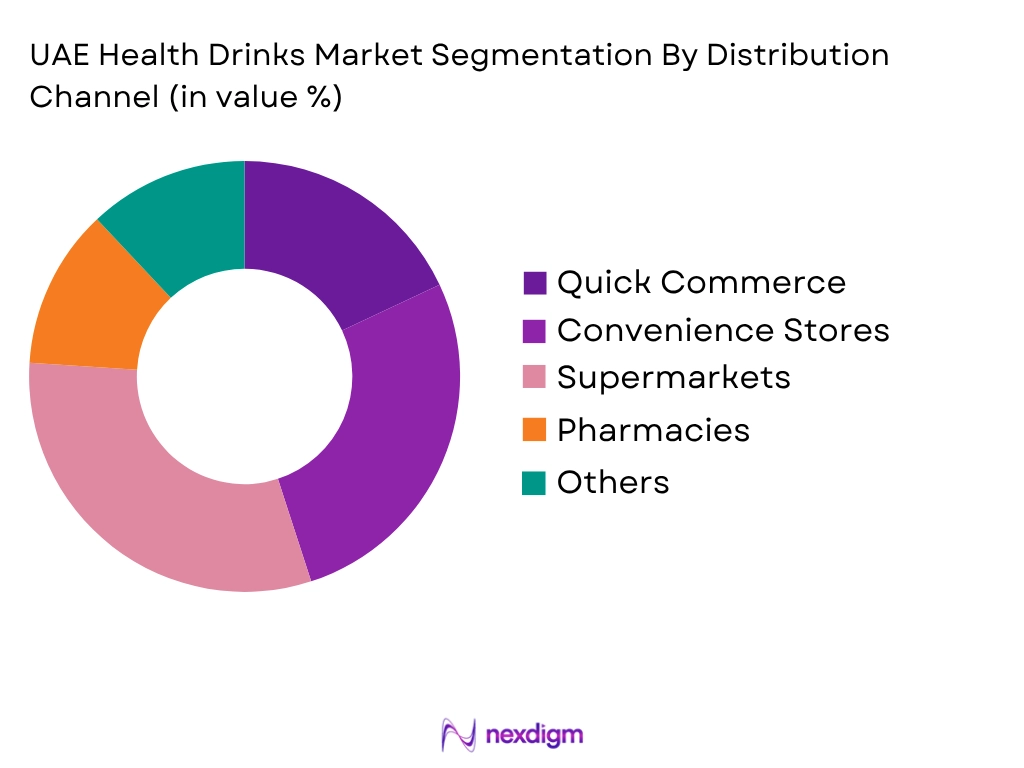
The UAE Health Drinks Market is segmented by distribution channel into supermarkets and hypermarkets, convenience stores and petrol stations, online retail and quick commerce, pharmacies and health stores, gyms and fitness centers, HoReCa, and vending. Supermarkets and hypermarkets dominate the market because consumers use large-format retail for weekly grocery baskets, multipack purchases, price comparison, promotional bundles, and access to imported premium brands. Carrefour, Lulu, Spinneys, Waitrose, Choithrams, and Union Coop provide broad shelf visibility for energy drinks, fortified juices, coconut water, functional water, and plant-based beverages. These stores also offer chilled aisles, end-cap promotions, private-label opportunities, and strong coverage across Dubai, Abu Dhabi, and Sharjah. Online and quick-commerce channels are expanding rapidly, but physical retail remains central for trial, visibility, and household replenishment.
Competitive Landscape
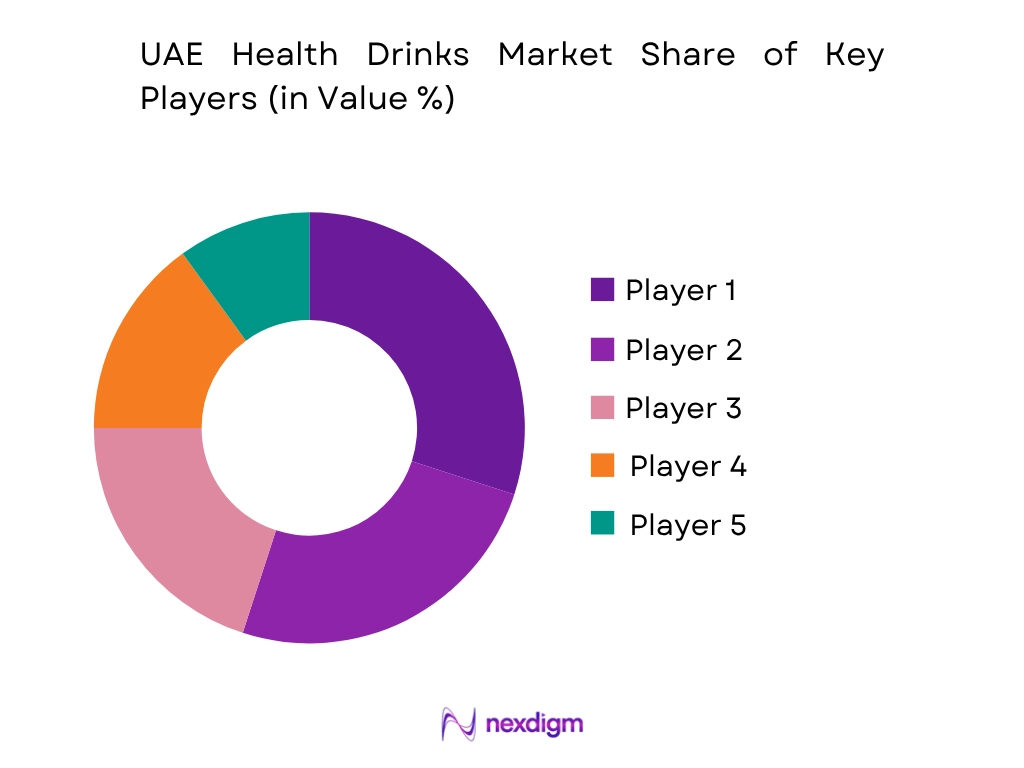
The UAE Health Drinks Market is led by a mix of global beverage companies, energy drink specialists, regional bottled-water players, and local dairy and juice companies. Competition is concentrated around chilled availability, sugar-free reformulation, functional claims, retail visibility, and imported premium positioning. Red Bull and Monster dominate branded energy visibility, Coca-Cola and PepsiCo leverage sports hydration and broad beverage distribution, while Agthia benefits from local bottling strength and UAE retail access.
| Company | Establishment Year | Headquarters | Key UAE Health Drinks Portfolio | Primary Functional Positioning | Core Channel Strength | Sugar-Free / Low-Sugar Strength | Packaging Strength | UAE Competitive Advantage |
| Red Bull GmbH | 1987 | Fuschl am See, Austria | ~ | ~ | ~ | ~ | ~ | ~ |
| Monster Beverage Corporation | 1935 / Monster brand 2002 | Corona, California, USA | ~ | ~ | ~ | ~ | ~ | ~ |
| The Coca-Cola Company | 1886 | Atlanta, Georgia, USA | ~ | ~ | ~ | ~ | ~ | ~ |
| PepsiCo | 1965 | Purchase, New York, USA | ~ | ~ | ~ | ~ | ~ | ~ |
| Agthia Group | 2004 | Abu Dhabi, UAE | ~ | ~ | ~ | ~ | ~ | ~ |
UAE Health Drinks Market Analysis
Growth Drivers
Urban, high-income, tourism-led consumption base is expanding on-the-go health drink demand
The UAE Health Drinks Market is supported by a large, urban, high-spending consumer base that creates repeat demand for functional water, electrolyte drinks, zero-sugar energy drinks, fortified juices, and protein RTDs across supermarkets, petrol stations, gyms, hotels, cafés, and quick-commerce platforms. The UAE population reached 11,294,243 people in official administrative estimates, giving beverage brands a sizable resident base for daily hydration, fitness, and wellness-led consumption. The World Bank reports UAE GDP at USD 552.32 billion and GDP per capita at USD 50,273.5, indicating strong household purchasing capacity for premium imported and functional beverages. Tourism adds an additional consumption layer: Dubai received 18.72 million international overnight visitors, compared with 17.15 million earlier, while Dubai’s hotel inventory reached 154,016 rooms across 832 establishments. UAE-wide tourism infrastructure also strengthens route-to-market depth, with 217,000 hotel rooms and 1,252 hotels reported by the Ministry of Economy and Tourism. These indicators justify stronger demand for chilled, single-serve, convenience-led, premium, and travel-consumption health drinks.
Fitness participation and public wellness activation are increasing demand for sports, protein, and hydration drinks
The UAE Health Drinks Market is increasingly supported by structured public wellness activity, especially in Dubai, where fitness participation directly supports electrolyte drinks, sports hydration, protein RTDs, low-sugar energy drinks, recovery beverages, and functional water. Dubai Fitness Challenge recorded 2,735,158 participants in its city-wide fitness calendar, with participants encouraged to complete 30 minutes of daily activity for 30 days. Dubai Run added another mass-participation consumption occasion, with 278,000 people taking part on Sheikh Zayed Road and Downtown Dubai routes. The momentum continued with Dubai Fitness Challenge participation exceeding 3 million participants, indicating that fitness is not limited to gyms but is becoming a city-level consumer habit. This matters for the health drinks market because active consumers require hydration, electrolytes, caffeine-free energy, protein recovery, and low-calorie beverages before, during, and after workouts. With UAE population at 11,294,243 people, mass fitness participation creates a broad addressable base beyond elite athletes. It supports brand activation through gyms, running events, community sports, corporate wellness programs, and convenience retail.
Market Challenges
Sugar-linked regulation creates reformulation and compliance pressure for energy and sweetened health drinks
The UAE Health Drinks Market faces a regulatory challenge because energy drinks, sweetened beverages, fortified juices, and functional drinks with added sugars are directly exposed to nutrition scrutiny and excise-tax policy. The Federal Tax Authority states that excise tax applies to products considered harmful to public health, including energy drinks and sweetened beverages, and the tiered-volumetric model is designed to regulate sugar-linked beverages. The revised model uses sugar concentration thresholds of 5 grams and 8 grams per 100 millilitres, making formulation, laboratory testing, label accuracy, and SKU-level documentation more important for beverage companies. Energy drinks remain separately treated under the FTA framework, which keeps compliance especially relevant for brands selling caffeinated functional drinks. The compliance burden is amplified by the UAE’s federal structure of 7 emirates, where beverage importers and manufacturers must manage product registration, Arabic labeling, customs documentation, and municipality-level food control processes. This creates operational difficulty for brands launching protein RTDs, vitamin drinks, kombucha, fortified juices, or low-sugar variants, because every claim, ingredient, and nutrition panel must withstand regulatory review.
Import dependence and cold-chain complexity increase supply risk for premium health drink categories
The UAE Health Drinks Market is highly exposed to import and logistics risk because many functional beverage inputs and finished products, including kombucha, coconut water, protein RTDs, plant-based drinks, fortified ingredients, sweeteners, vitamins, and specialty cans, rely on overseas sourcing. USDA’s official Food Processing Ingredients report states that approximately 8 out of 10 agricultural products consumed in the UAE are imported, while consumer-oriented agricultural imports reached USD 16.2 billion. The same source states that the United States exported USD 1.17 billion in agricultural and related products to the UAE, showing how important external supply corridors are for food and beverage inputs. This dependence creates challenges for health drinks because product availability can be affected by shipping lead times, port clearance, temperature control, expiry-date requirements, and importer-distributor coordination. Premium health drinks also require more complex handling than ambient soft drinks: probiotic beverages, kombucha, cold-pressed juices, dairy-based protein RTDs, and chilled fortified beverages need reliable refrigeration across warehouses, delivery fleets, retail chillers, gyms, and cafés. The UAE has 1,252 hotels and 217,000 hotel rooms, creating large hospitality demand but also increasing the number of temperature-sensitive delivery points. For new entrants, this raises execution complexity before scale is achieved.
Market Opportunities
Quick-commerce and digital grocery channels create stronger access for multipack and subscription-led health drinks
The UAE Health Drinks Market has a clear opportunity in online grocery, quick commerce, and subscription-led replenishment because the country has strong digital infrastructure and a highly connected consumer base. FCSC/TDRA ICT infrastructure data lists 22,178,236 active mobile broadband internet subscriptions, indicating that mobile-first ordering behavior can support health drink discovery, repeat purchases, and multipack replenishment. The UAE’s resident population of 11,294,243 people means mobile broadband subscriptions exceed the resident base in absolute terms, creating a strong environment for app-led grocery ordering, digital promotions, influencer-driven product discovery, and direct-to-consumer beverage bundles. This is market-specific because health drinks are often occasion-based: consumers order electrolyte drinks before outdoor activity, protein RTDs after gym sessions, zero-sugar energy drinks during office hours, and kombucha or coconut water as part of weekly wellness routines. Digital platforms can also solve shelf-space limitations in physical stores by allowing brands to list wider flavor ranges, sugar-free variants, multipacks, and trial bundles. With IMF listing the UAE country population at 11.465 million, the medium-term addressable digital consumer base remains large for brands building online-first health drink portfolioh.
Tourism, aviation, and hospitality infrastructure create premium placement opportunities for health drinks
The UAE Health Drinks Market has a strong opportunity in travel, hospitality, and high-footfall consumption points because visitor flows and hotel capacity create repeated purchase occasions for hydration, energy, wellness, and recovery beverages. Dubai International Airport handled 92.3 million guests and 440,000 flight movements, creating a large captive audience for functional water, electrolyte beverages, zero-sugar energy drinks, and premium grab-and-go health drinks. Dubai also welcomed 18.72 million international overnight visitors, while the wider UAE hotel sector recorded approximately 15.3 million hotel guests in the first 6 months of the year. Abu Dhabi further strengthens hospitality-led opportunities, with 4.8 million hotel guests reported between January and October. These numbers support future placement opportunities across hotel minibars, airport retail, cafés, resort gyms, beach clubs, wellness resorts, sports events, and tourism-heavy convenience stores. Health drinks with travel-relevant claims—hydration, low sugar, vitamin support, caffeine-free energy, digestive wellness, and protein recovery—can benefit from tourist demand and premium willingness to try imported or functional products. Dubai’s 154,016 hotel rooms across 832 establishments create a large channel base for beverage trial and visibility.
Future Outlook
The UAE Health Drinks Market is forecasted to grow at a CAGR of 8.0% during 2026-2035, supported by sugar-free energy drinks, functional hydration, protein RTDs, gut-health beverages, and plant-based formulations. Growth will be reinforced by Dubai and Abu Dhabi’s premium retail infrastructure, tourism recovery, rising gym participation, and health-conscious expatriate consumption. Excise-tax sensitivity will push brands toward low-sugar, zero-sugar, and naturally sweetened portfolios. The market will also see stronger quick-commerce penetration, subscription packs, cold-chain expansion, and localized functional flavors.
Major Players
- Red Bull GmbH
- Monster Beverage Corporation
- The Coca-Cola Company
- PepsiCo
- PRIME Hydration
- Celsius Holdings
- Alani Nu
- Nutrabolt
- Otsuka Pharmaceutical
- Agthia Group
- Mai Dubai
- Masafi
- National Food Products Company
- Al Rawabi Dairy Company
- Remedy Drinks
Key Target Audience
- Health drink manufacturers and brand owners
- Beverage importers and distributors
- Supermarket, hypermarket, and convenience retail chains
- Online grocery and quick-commerce platforms
- Gyms, fitness clubs, wellness centers, and sports facility operators
- Hotels, restaurants, cafés, and premium hospitality groups
- Investments and venture capitalist firms
- Government and regulatory bodies (UAE Ministry of Health and Prevention, UAE Federal Tax Authority, Dubai Municipality, Abu Dhabi Agriculture and Food Safety Authority, Ministry of Economy and Tourism)
Research Methodology
Step 1: Identification of Key Variables
The initial phase involves mapping the UAE Health Drinks Market ecosystem across brand owners, bottlers, importers, distributors, retailers, gyms, pharmacies, HoReCa outlets, and e-commerce channels. Key variables include product type, functional claim, sugar content, excise exposure, pack format, retail price, and channel presence.
Step 2: Market Analysis and Construction
Historical market construction is conducted through top-to-bottom analysis using published market reports, non-alcoholic beverage indicators, retail market data, demographic trends, and tourism demand. Bottom-to-top validation is conducted through SKU-level price checks, channel mapping, brand assortment analysis, and category-level allocation across energy drinks, fortified juices, sports drinks, functional water, and protein RTDs.
Step 3: Hypothesis Validation and Expert Consultation
Market hypotheses are validated through interviews with beverage distributors, supermarket category managers, gym procurement teams, HoReCa buyers, importers, and functional beverage brand representatives. These consultations are used to test assumptions on product velocity, channel margins, seasonality, consumer cohorts, and sugar-free migration.
Step 4: Research Synthesis and Final Output
The final phase integrates desk research, primary interviews, SKU benchmarking, regulatory review, and triangulated market sizing. Findings are synthesized into market size, segmentation, competitive benchmarking, growth outlook, and strategic recommendations for companies evaluating market entry, portfolio expansion, pricing, distribution, or investment in the UAE Health Drinks Market.

- Executive Summary
- Research Methodology (Market Definitions and Exclusions, Health Drinks Classification Framework, Top-to-Bottom Market Sizing, Bottom-to-Top SKU and Channel Build-Up, Retail Shelf Audit Approach, E-Commerce Price Scraping Approach, Distributor and Importer Mapping, Consumer Cohort Interviews, Gym and HoReCa Channel Checks, Modern Trade Validation, Excise Tax Impact Modelling, Ingredient Claim Validation, Limitations and Future Conclusions)

- Definition and Scope
- Market Genesis and Evolution
- Health Drinks Product Boundary
- Timeline of Major Market Entrants
- Business Cycle and Consumption Seasonality

- Growth Drivers (Preventive Wellness, Fitness Club Expansion, High Ambient Temperature, Sugar Reduction Awareness, Premium Retail Access, Tourism and Expat Consumption)
- Market Challenges (Excise Tax, Sugar Reformulation Cost, Cold Chain Gaps, Premium Pricing, Regulatory Claim Scrutiny, High Import Dependence)
- Market Opportunities (Zero Sugar, Electrolyte Hydration, Women’s Wellness, Halal-Certified Functional Drinks, Arabic Flavor Profiles, School-Safe Beverages, Corporate Wellness Packs)
- Market Trends (Clean Label, Sugar-Free Energy, Natural Caffeine, Collagen Drinks, Functional Waters, Multipack E-Commerce, Premium Chilled Beverages)
- SWOT Analysis
- Porter’s Five Forces Analysis
- PESTLE Analysis

- By Value (2020-2025)
- By Volume (2020-2025)
- By Average Selling Price (2020-2025)

- By Product Category (In Value %)
Energy Drinks
Sports and Isotonic Drinks
Electrolyte and Hydration Drinks
Functional and Enhanced Water
Fortified Juices and Juice-Based Health Drinks - By Packaging Type (In Value %)
Cans
PET Bottles
Glass Bottles
Tetra Packs
Sachets and Powder Sticks - By Distribution Channel (In Value %)
Supermarkets and Hypermarkets
Convenience Stores and Petrol Stations
E-Commerce and Quick Commerce
Pharmacies and Health Stores
Gyms, Sports Clubs and Fitness Studios - By Emirate (In Value %)
Dubai
Abu Dhabi
Sharjah and Northern Emirates

- Market Share of Major Players (Value Share, Volume Share, Category Share, Modern Trade Share, E-Commerce Visibility)
- Cross Comparison Parameters (Product Portfolio Breadth, Zero Sugar SKU Penetration, Functional Ingredient Strength, Average Price per Liter, Modern Trade Shelf Presence, E-Commerce Multipack Availability, Chilled Distribution Capability, Excise Tax Exposure)
- Pricing Analysis by SKU
SWOT Analysis of Major Players - Detailed Profiles of Major Companies
Red Bull GmbH
Monster Beverage Corporation
The Coca-Cola Company
PepsiCo
PRIME Hydration
Celsius Holdings
Alani Nu
Nutrabolt
Otsuka Pharmaceutical
Agthia Group
Mai Dubai
Masafi
National Food Products Company
Al Rawabi Dairy Company
Remedy Drinks

- Fitness Enthusiasts and Athletes
- Office Professionals and Urban Commuters
- Students and Young Adults
- Expat Families and Household Buyers
- Outdoor Workers and Heat-Exposed Consumers

- By Value (2026-2035)
- By Volume (2026-2035)
- By Average Selling Price (2026-2035)


 Request a Sample
 Ask for Customization
 Get a Quote
 Enquire Now