
 Download PDF
 Download PDF
Market Overview
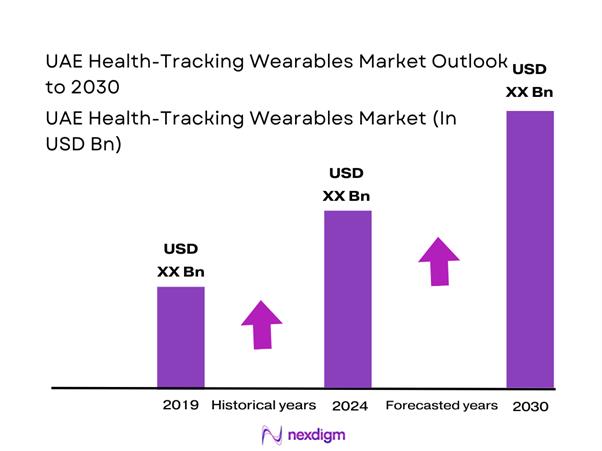
The UAE health-tracking wearables market is closely tied to the broader GCC wearable technology and medical wearables space, which together are valued in the low billions of US dollars today. GCC wearable technology alone is estimated at roughly USD ~ billion, while GCC wearable medical devices are around USD ~ billion, indicating a sizeable health-centric opportunity in the region. Based on UAE’s outsized share of GCC GDP and consumer tech spend, The UAE health-tracking wearables market has recently risen from just under USD ~ million to about USD ~ million, supported by high income levels and strong digital infrastructure.
Dubai and Abu Dhabi dominate the UAE health-tracking wearables market due to their concentration of affluent residents, large expatriate professional bases and dense smart-city infrastructure. Dubai alone handles more than ~ million international passengers annually and serves as a global lifestyle and tourism hub, reinforcing demand for premium consumer tech and wellness devices. Both cities benefit from near-universal internet access, widespread 5G coverage and a thriving ecosystem of electronics retail, healthcare providers and fitness facilities, while northern emirates contribute more to value-seeking and family-focused segments.
Market Segmentation
By Device Type
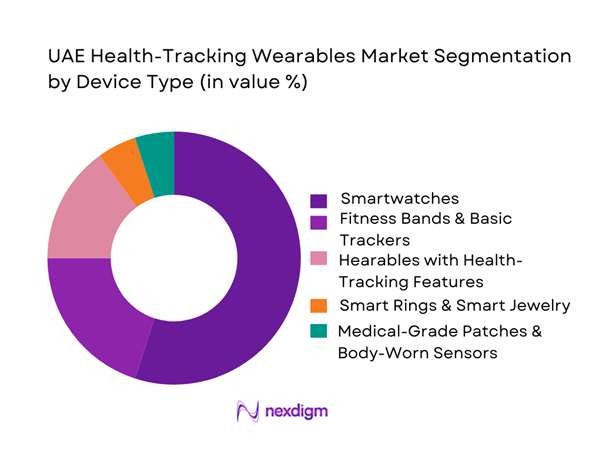
The UAE health-tracking wearables market is segmented into smartwatches, fitness bands & basic trackers, smart rings & smart jewelry, hearables with health-tracking features, and medical-grade patches & body-worn sensors. Smartwatches currently dominate this segmentation in the UAE because they combine multi-sensor health tracking (heart rate, SpO₂, sleep, stress proxies) with communications, contactless payments and app ecosystems, making them an everyday lifestyle hub. Global smart wearables data shows smartwatches as the largest form factor across MEA, and GCC consumers typically prioritize premium, feature-rich devices that fit professional and social contexts. Telecom operators and electronics chains in Dubai and Abu Dhabi strongly promote smartwatch bundles with smartphones and postpaid plans, further reinforcing their share relative to simple bands or niche form factors.
By Application / Use Case
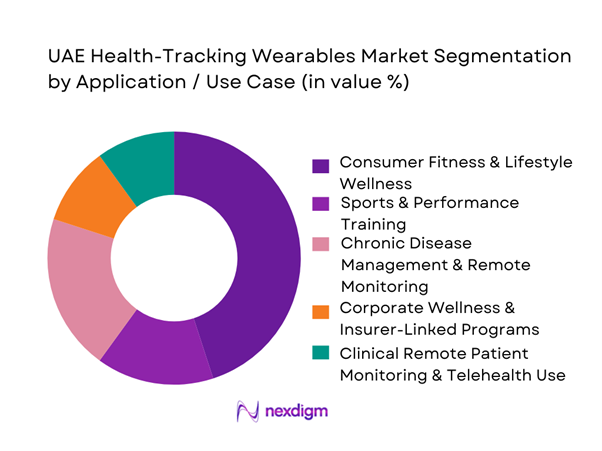
The UAE health-tracking wearables market is segmented into consumer fitness & lifestyle wellness, sports & performance training, chronic disease management & remote monitoring, corporate wellness & insurer-linked programs, and clinical remote patient monitoring & telehealth integration. Consumer fitness & lifestyle wellness is the dominant application segment because of the country’s high burden of obesity and diabetes and the strong social emphasis on appearance, performance and active living. Over two-thirds of UAE adults live with overweight or obesity, while more than ~ million adults have diabetes, creating strong motivation for self-tracking and preventive health behaviors. Combined with near-universal internet access and smartphone use, everyday fitness tracking—steps, calories, sleep and stress—is the default entry point into wearables, while more complex clinical and enterprise use cases are emerging from a smaller base.
Competitive Landscape
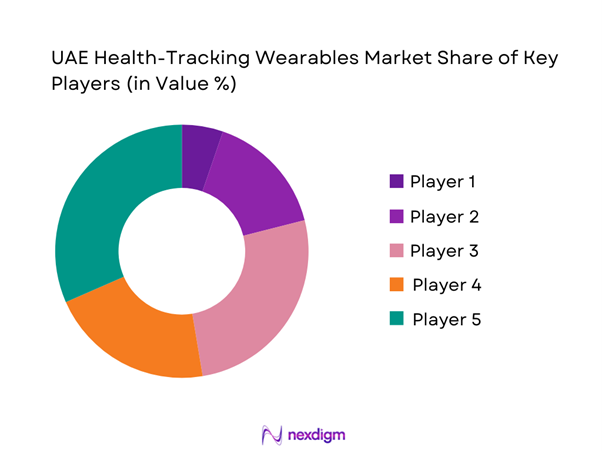
The UAE health-tracking wearables market is shaped by a mix of global platform leaders and performance-focused specialists. Apple, Samsung, Huawei, Fitbit (Google) and Garmin anchor the premium and upper mid-tier, while value brands and new form factors (rings, hearables) compete for younger and mass-market users. Global reports show that smart wearables and wearable medical devices are highly concentrated among a few multinational brands, which leverage strong R&D, AI-enabled health analytics and deep app ecosystems. In the UAE, these firms build additional advantage through telecom bundles, presence in large electronics chains, Arabic-localized interfaces and partnerships with gyms, insurers and healthcare providers.
| Company | Establishment Year | Headquarters | Flagship Health-Tracking Devices in UAE | Primary Price Band Focus (UAE) | Dominant Sales Channels in UAE | Key Health Metrics & Sensors Offered | UAE-Specific Partnerships / Initiatives | Primary Target Segment in UAE |
| Apple | 1976 | Cupertino, USA | ~ | ~ | ~ | ~ | ~ | ~ |
| Samsung | 1969 | Suwon, South Korea | ~ | ~ | ~ | ~ | ~ | ~ |
| Huawei | 1987 | Shenzhen, China | ~ | ~ | ~ | ~ | ~ | ~ |
| Fitbit (Google) | 2007 | California, USA | ~ | ~ | ~ | ~ | ~ | ~ |
| Garmin | 1989 | Olathe, Kansas, USA | ~ | ~ | ~ | ~ | ~ | ~ |
UAE Health-Tracking Wearables Market Analysis
Growth Drivers
Digital health strategies
The UAE is building a full-stack digital health ecosystem, which directly boosts adoption of health-tracking wearables. Dubai Health Authority (DHA) reported around 293,000 telemedicine consultations in one year, rising to nearly 375,000 consultations the following year, alongside more than 230,000 electronic prescriptions, showing rapid normalization of remote, data-driven care in Dubai alone. Federal initiatives such as the UAE’s national health and wellbeing agenda and official telemedicine platforms (e.g., 24/7 phone and video consultation services) embed remote monitoring into care pathways, increasing demand for devices that can feed continuous vitals, activity and sleep data into these platforms.
Preventive health
The UAE faces a heavy non-communicable disease burden, making continuous self-monitoring highly relevant. National nutrition data indicate that 44.2 out of 100 adult women and 30.9 out of 100 adult men live with obesity, while diabetes affects 17.4 out of 100 adult women and 17.3 out of 100 adult men. The International Diabetes Federation estimates ~ adults with diabetes out of ~ adults in the UAE, underscoring the scale of cardiometabolic risk that needs daily management. With WHO listing adult obesity and child/adolescent obesity as active indicators for the UAE, national policy increasingly emphasizes prevention and lifestyle modification, supporting uptake of wearables that help track glucose, heart rate, activity and weight-management behaviors over time.
Challenges
Device affordability
Despite high average income, affordability is uneven because of the UAE’s demographic structure. Recent demographic analysis indicates that expatriates make up about 88.5 out of every 100 residents, or roughly ~ million people out of a ~ million total population, with Emirati citizens representing only ~ million. Many expatriates work in relatively low-wage roles, while national economic data show nominal GDP per capita above USD 52,000, masking wide income dispersion behind a high average. For blue-collar workers sending remittances home, premium smartwatches and multi-sensor wearables can compete with essential expenditures, creating a pricing barrier unless devices are subsidized by employers, insurers or wellness programs.
Accuracy concerns
Clinical and policy stakeholders increasingly scrutinize the reliability of remote-monitoring data feeding into healthcare decisions. A large telehealth experience study in Dubai recruited 64,173 telehealth users from electronic medical records, ultimately analyzing responses from 1,535 participants using a validated Telehealth Usability Questionnaire. While overall usability scores were high, reliability metrics scored lower than domains such as usefulness and satisfaction, underlining concerns about stable performance and trust in remote readings. Clinical analyses of 241,822 telehealth visits in Dubai further highlighted that older adults and those using video visits showed different completion patterns, pointing to workflow and technology-fit issues that can also apply to wearable-driven remote monitoring. For wearables, this translates into heightened demand for clinically validated sensors, standardized outcome measures and integration with regulated telehealth workflows.
Opportunities
Clinical-grade wearables
The scale and cost of chronic disease in the UAE create a compelling case for clinical-grade wearables that go beyond step-counting. IDF data show 1,274,200 adults with diabetes out of 7,710,700 adults, with a prevalence above 20 out of 100 adults, indicating a large cohort needing daily glycaemic and cardiovascular monitoring. World Bank gender data report 69.7 out of 100 adults as overweight, while national nutrition profiles show obesity among 44.2 out of 100 adult women and 30.9 out of 100 adult men. These twin burdens of obesity and diabetes, combined with WHO-tracked obesity indicators and national wellbeing programs, open space for wearables that are validated for heart rhythm monitoring, sleep apnoea risk, arrhythmia detection and even continuous glucose trends—especially when integrated into endocrinology, cardiology and bariatric care pathways that already manage large patient volumes.
Kids and senior segments
Demographic structure in the UAE supports long-term growth in specialized wearables for children, adolescents and seniors. UN and WHO population data show that people aged 0–14 years represent about 16.1 out of every 100 residents, while those aged 65 years and above account for about 1.7 out of every 100 residents, with absolute numbers set to rise as the population ages. WHO indicators explicitly track child and adolescent obesity for the UAE, and global obesity briefs highlight high levels of overweight and obesity already being observed in youth cohorts, implying early cardiometabolic risk. In parallel, national digital-health and emergency-care studies stress the role of connected medical devices and sensors in tele-emergency frameworks and remote monitoring, which can be particularly beneficial for frail seniors and children with chronic conditions. Together, these trends create headroom for age-specific wearables—child-friendly fitness trackers, fall-detection bands and clinically integrated devices for older adults—within the UAE health-tracking wearables market.
Future Outlook
Over the next several years, the UAE health-tracking wearables market is poised for sustained, innovation-led expansion. Global wearable medical devices are already on a strong growth trajectory, rising from more than USD ~ billion in value with forecasts indicating a several-fold increase by the end of the decade. In parallel, MEA and GCC smart wearables and fitness trackers are projected to grow at mid- to high-teens compound rates, driven by rising incomes, digital connectivity and a shift toward preventive health and performance optimization. Within this context, UAE’s combination of high per-capita GDP, advanced healthcare and ambitious digital-health strategies positions it as a regional testbed for more advanced, AI-enabled and clinically integrated wearables.
Major Players
- Apple
- Samsung Electronics
- Huawei Technologies
- Fitbit
- Garmin
- Xiaomi
- Amazfit – Zepp Health
- Oura
- Whoop
- Withings
- Polar
- Oppo
- Honor
- e& (Etisalat by e&)
Key Target Audience
- Global and regional wearable device manufacturers
- Consumer electronics and telecom operators
- Hospitals, health systems and private clinic networks
- Health and life insurance companies
- Corporate HR and employee benefits teams
- Investments and venture capitalist firms
- Government and regulatory bodies
- Sports councils, fitness chains and elite performance academies
Research Methodology
Step 1: Identification of Key Variables
The initial phase involves mapping the complete UAE health-tracking wearables ecosystem, covering device OEMs, component suppliers, telecom operators, retailers, healthcare providers, insurers and corporate buyers. Extensive desk research is carried out using secondary sources and proprietary databases on global and regional wearable, digital-health and medical-device markets. The objective is to define the market boundary (health-focused wearables only) and identify the key variables that influence adoption, usage intensity, monetization models and regulatory requirements in the UAE.
Step 2: Market Analysis and Construction
In this phase, we compiles and analyzes historical data from GCC wearable technology, GCC medical wearables and MEA smart wearables and fitness trackers, alongside UAE macroeconomic and health indicators. This includes assessing installed base growth, device replacement cycles, channel mix, and the balance between hardware and subscription revenues. A bottom-up sizing model is built using shipment data, average selling prices and adoption multipliers by user cohort, and is then reconciled with top-down region-level benchmarks to derive UAE market size and segment splits.
Step 3: Hypothesis Validation and Expert Consultation
Market hypotheses on device mix, application-wise adoption, pricing corridors and growth drivers are validated through structured interviews and online consultations with industry experts. These include executives from global and regional OEMs, UAE telecom operators, leading electronics retailers, digital-health platforms, hospital CIOs and corporate HR heads running wellness programs. Insights from these stakeholders refine assumptions around user behavior, enterprise purchasing criteria, integration barriers, regulatory interpretation and the pace of migration from consumer-only to clinically connected use cases. This feedback loop is used to adjust the sizing model and stress test growth and profitability scenarios.
Step 4: Research Synthesis and Final Output
The final phase synthesizes quantitative estimates and qualitative insights into a coherent narrative and data book for the UAE health-tracking wearables market. Detailed segment-wise forecasts, competitive benchmarks and scenario analyses are generated, along with TAM/SAM/SOM views and entry-priority matrices for different player types. All numbers are cross-checked against multiple external benchmarks and internal consistency tests, and any residual gaps are explicitly noted as assumptions. The outcome is a validated, decision-useful view of the UAE health-tracking wearables ecosystem for strategy, investment and go-to-market planning.

- Executive Summary
- Research Methodology (Market Definitions, Device Taxonomy and Scope, Data Sources and Triangulation, Top-Down and Bottom-Up Sizing Approach, Sampling Frame for Primary Research, Validation, Assumptions and Sensitivity Checks, Study Limitations and Directions for Further Research)

- Definition and Scope of Health-Tracking Wearables
- Evolution of the UAE Health-Tracking Wearables Ecosystem
- Business Cycle: From Component Supply to End-User Engagement
- Supply Chain and Value Chain Structure
- Role of Health-Tracking Wearables in the UAE Digital Health Landscape

- Growth Drivers
Digital health strategies
Preventive health
Fitness culture
Tech affinity - Challenges
Device affordability
Accuracy concerns
Privacy fears
Clinical acceptance hurdles - Opportunities
Clinical-grade wearables
Kids and senior segments
B2B2C models - Trends
AI coaching
Non-invasive biomarkers
Form-factor innovation - Regulatory and Compliance Landscape
- Data Privacy, Cybersecurity and Ethical AI Considerations
- Stakeholder Ecosystem Mapping
- Supply Chain, Sourcing and Localization Dynamics
- Porter’s Five Forces Analysis
- SWOT Analysis of the UAE Health-Tracking Wearables Market

- By Value, 2019-2024
- By Volume, 2019-2024
- By Device Category, 2019-2024
- By Use Case Cluster, 2019-2024
- Contribution of Hardware vs Subscription and Data-Driven Revenue Streams, 2019-2024

- By Device Category (in Value %)
Smartwatches
Fitness Bands and Basic Trackers
Smart Rings and Smart Jewelry
Medical-Grade Patches and Body-Worn Sensors - By Health Metric and Sensor Suite Depth (in Value %)
Activity, Steps and Calorie Tracking Devices
Heart Rate and Heart Rate Variability Tracking Devices
ECG, Arrhythmia and Cardiac Event Detection Devices
SpO2, Respiratory Rate, Temperature and Stress Tracking Devices
Blood Pressure, Glucose and Advanced Biomarker Monitoring Devices - By Use Case / Application (in Value %)
Consumer Fitness and Lifestyle Wellness
Sports, Performance and Professional Training
Chronic Disease Management and Remote Monitoring
Women’s Health, Fertility and Pregnancy Monitoring
Corporate Wellness, Insurer-Linked and Employer Programs - By Connectivity and Platform Ecosystem (in Value %)
Bluetooth-Only and Smartphone-Tethered Devices
Cellular/LTE/eSIM-Enabled Standalone Devices
Wi-Fi and Home IoT-Integrated Devices
Apple Health, Google Fit and Samsung Health Integrated Devices
Devices Integrated with UAE Provider, Insurer and Telehealth Platforms - By Distribution Channel (in Value %)
Online Marketplaces and E-Retailers
Brand-Owned E-Stores and Direct-to-Consumer Platforms
Electronics and Telecom Retailers
Hypermarkets, Supermarkets and General Retail
Healthcare and Pharmacy Channels - By End-User Profile (in Value %)
UAE Nationals
Expatriates – Affluent and Upper-Middle Income Segments
Expatriates – Mass Market Segments
Sports Enthusiasts and Professional Athletes
High-Risk and Chronic Disease Patients - By Emirate and City Cluster (in Value %)
Dubai
Abu Dhabi
Sharjah and Northern Emirates
Other Emirates and Free Zones

- Market Share of Major Players by Value
Market Share of Major Players by Volume
Market Share by Device Category for Major Players - Cross Comparison Parameters (Sensor and Health-Metric Depth, Regulatory Status and Medical-Grade Capabilities, AI Analytics and Personalized Coaching Sophistication, Ecosystem and Platform Integration, Battery Life, Durability and Form Factor Fit for UAE Usage, Data Privacy, Security and Governance Posture, Distribution Reach and Bundling Strength in UAE, Monetization Model and Recurring Revenue Intensity)
- Detailed Profiles of Major Companies
Apple
Samsung Electronics
Huawei Technologies
Garmin
Fitbit – Google
Xiaomi
Amazfit – Zepp Health
Oura
Whoop
Withings
Polar
Oppo
Honor
e& (Etisalat by e&)

- Consumer Awareness, Usage Frequency and Feature Prioritization
- Purchase Triggers, Brand Consideration Sets and Decision-Making Unit
- Corporate and Insurer Buyer Behaviour
- Digital Engagement, App Usage and Service Adoption
- Pain-Point and Unmet Need Analysis

- By Value, 2025-2030
- By Volume, 2025-2030
- By Device Category, 2025-2030
- By Use Case Cluster, 2025-2030
- Contribution of Hardware vs Subscription and Data-Driven Revenue Streams, 2025-2030


 Request a Sample
 Ask for Customization
 Get a Quote
 Enquire Now