
 Download PDF
Market Overview
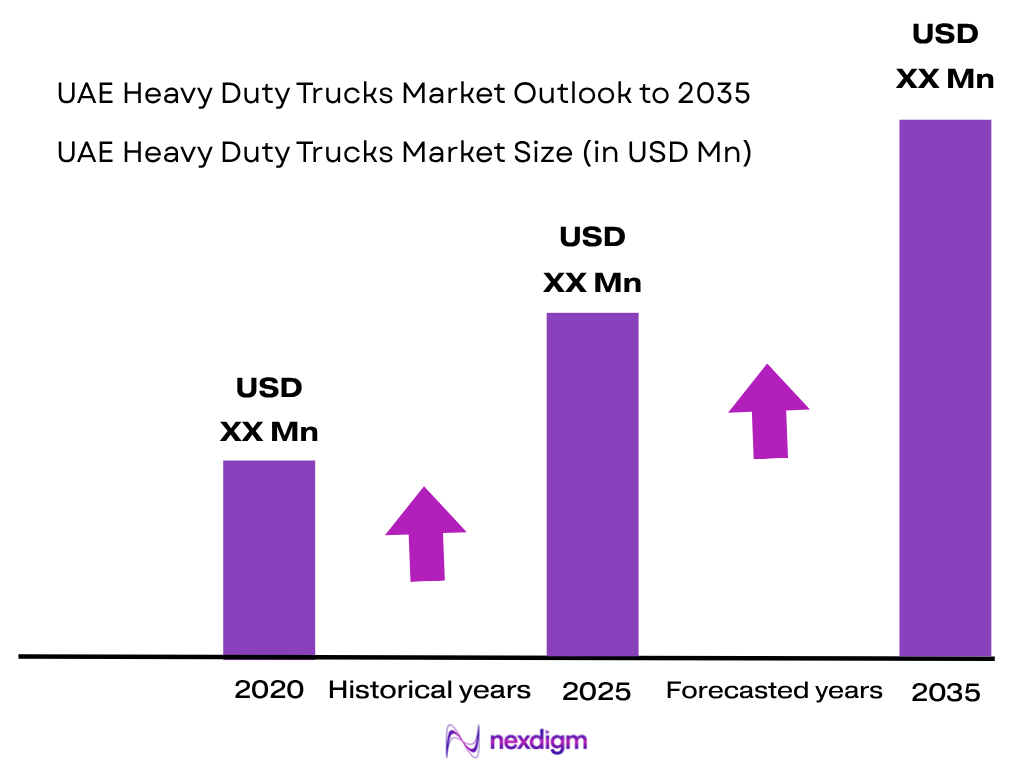
The UAE Heavy Duty Trucks Market is valued at ~USD XX billion, supported by the country’s expanding logistics, construction, industrial and energy ecosystems. The UAE recorded USD 552.32 billion GDP in 2024, compared with continued economic expansion in 2023, while real GDP growth reached 4.0 in 2024. Transport and storage was among the fastest-growing activities, expanding 9.6 in 2024, while construction grew 8.4, strengthening demand for tractor heads, tippers, tankers and heavy cargo vehicles.
The UAE Heavy Duty Trucks Market is concentrated around Dubai and Abu Dhabi, supported by their roles as logistics, industrial, port and infrastructure hubs. Jebel Ali Port handled 15.5 million TEUs in 2024, an increase of 1 million TEUs from the preceding year, strengthening demand for container tractor heads and port-linked freight vehicles. Abu Dhabi benefits from Khalifa Port, industrial zones and energy-related logistics, while Sharjah, Ras Al Khaimah and other emirates contribute through manufacturing, construction and regional freight activity.
Market Segmentation
By Truck Configuration
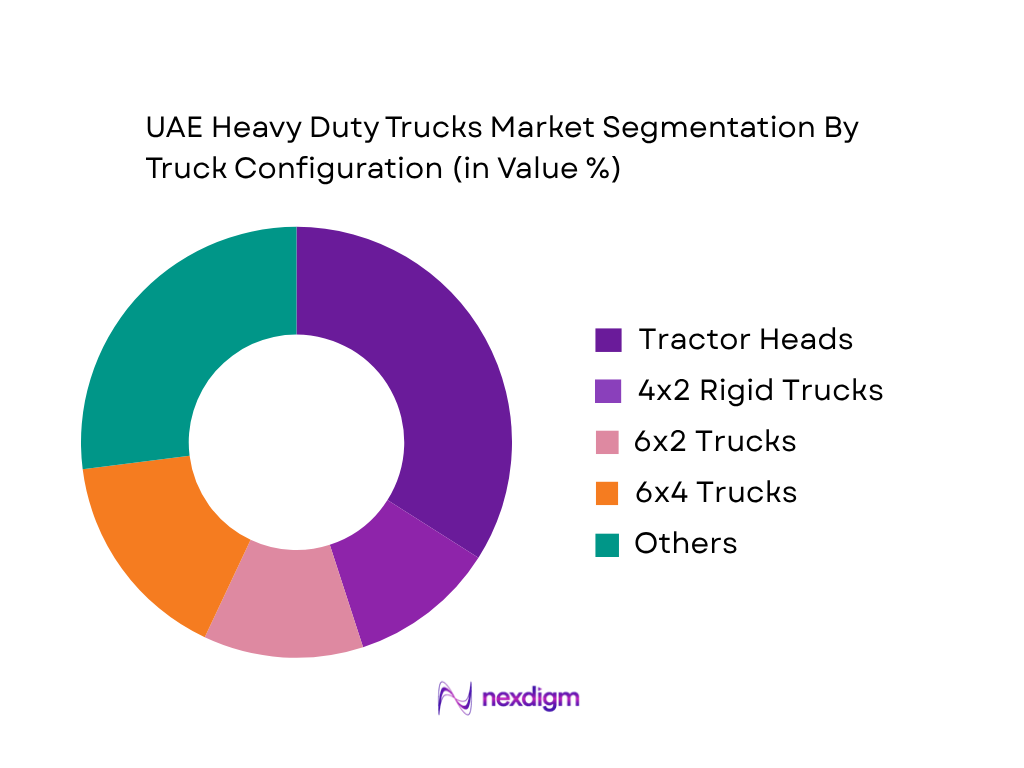
The UAE Heavy Duty Trucks Market is segmented by truck configuration into tractor heads, 4×2 rigid trucks, 6×2 trucks, 6×4 trucks, 8×4 trucks, 8×6 trucks, multi-axle trucks and specialized heavy-haul configurations. Tractor heads represent the leading configuration because the UAE’s position as a regional logistics and transshipment center creates sustained requirements for container and trailer transportation between ports, free zones, warehouses and industrial areas. Jebel Ali alone processed 15.5 million TEUs in 2024, creating a substantial operating base for container-haulage vehicles. Heavy rigid and multi-axle configurations remain important for construction materials, quarrying, infrastructure projects and industrial cargo. UAE federal-road regulations also specify maximum gross weights ranging from 21 tonnes for two-axle vehicles to 65 tonnes for six-axle vehicles, reinforcing the importance of axle configuration and payload capability in fleet purchasing decisions.
By End-Use Industry
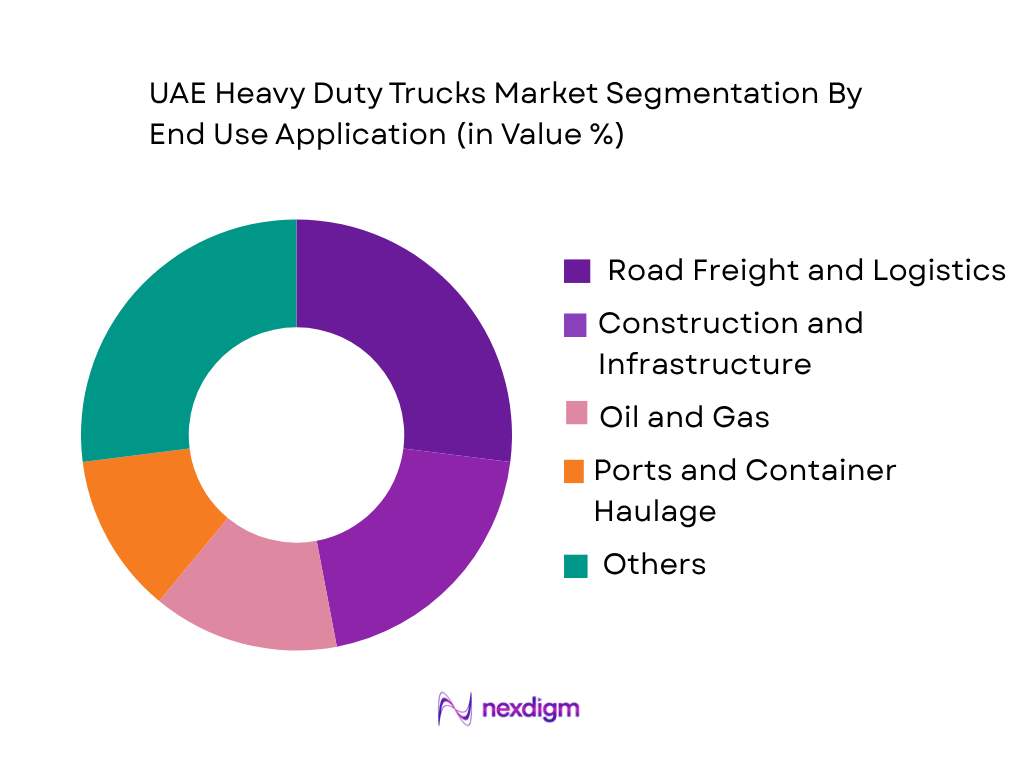
The UAE Heavy Duty Trucks Market is segmented by end-use industry into road freight and logistics, construction and infrastructure, oil and gas, ports and container haulage, manufacturing, cement and building materials, food and cold chain, retail and e-commerce logistics, waste management, and energy and utilities. Road freight and logistics represent the leading demand pool because the UAE functions as a regional distribution platform connecting seaports, airports, free zones, industrial clusters and GCC markets. The country’s transport and storage sector grew 9.6 in 2024, while trade represented 16.8 of non-oil GDP and manufacturing contributed 13.5, supporting continuous movement of industrial and consumer cargo. Construction also expanded 8.4, creating demand for dump trucks, concrete mixers, flatbeds and heavy-haul vehicles. The combination of port activity, industrial production and construction therefore produces diversified truck utilization rather than dependence on a single end-use segment.
Competitive Landscape
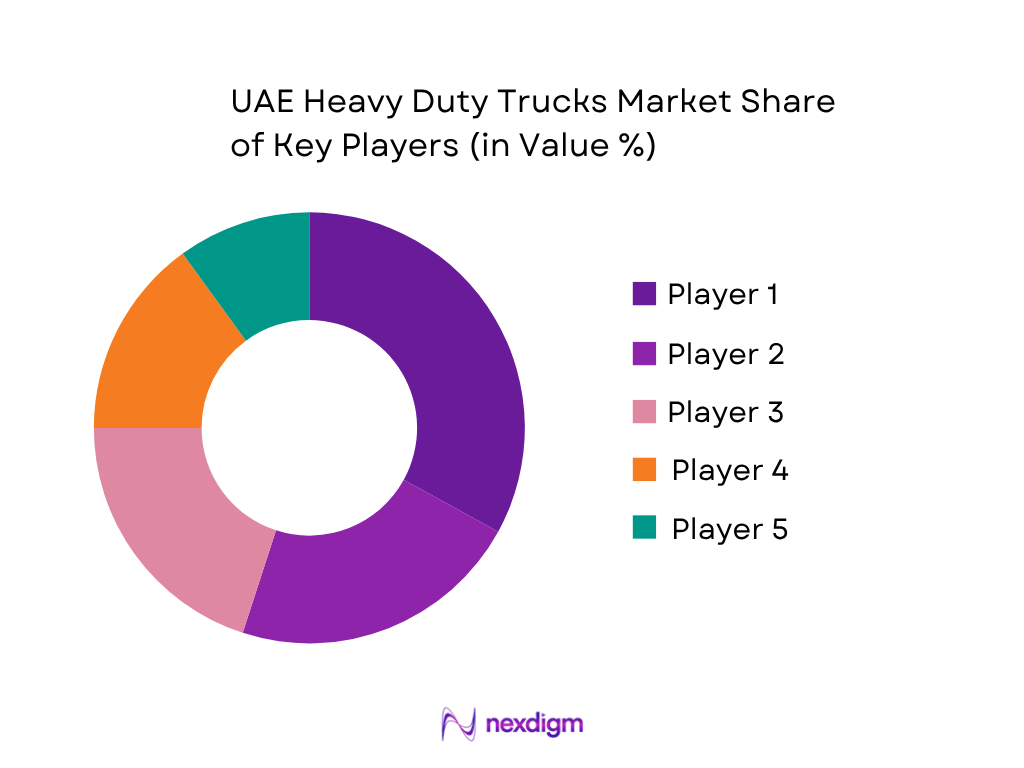
The UAE Heavy Duty Trucks Market is characterized by strong competition between European, Japanese and other international manufacturers, with purchasing decisions heavily influenced by payload capability, operating economics, dealer support and suitability for high-temperature conditions. Leading brands include Mercedes-Benz Trucks, Volvo Trucks, Scania, MAN, DAF, Isuzu, Hino, Mitsubishi Fuso, UD Trucks, Iveco, Tata Motors, Ashok Leyland, Renault Trucks, Sinotruk and Foton. The market is particularly attractive for manufacturers able to combine high-load capability with fuel efficiency, uptime, connected fleet technologies and strong UAE-wide aftermarket support.
| Major Player | Established | Headquarters | Product Portfolio | Maximum Power / Performance | Key Configurations | UAE Aftermarket Network | Fleet Technology | Primary UAE Applications |
| Mercedes-Benz Trucks | 1926 | Stuttgart, Germany | ~ | ~ | ~ | ~ | ~ | ~ |
| Volvo Trucks | 1927 | Gothenburg, Sweden | ~ | ~ | ~ | ~ | ~ | ~ |
| Scania | 1891 | Södertälje, Sweden | ~ | ~ | ~ | ~ | ~ | ~ |
| MAN Truck & Bus | 1758 | Munich, Germany | ~ | ~ | ~ | ~ | ~ | ~ |
| Isuzu | 1916 | Tokyo, Japan | ~ | ~ | ~ | ~ | ~ | ~ |
UAE Heavy Duty Trucks Market Analysis
Growth Drivers
Logistics & Freight Expansion
The UAE’s position as a regional logistics platform continues to support demand for heavy-duty trucks across long-haul freight, port drayage, construction-material movement and industrial distribution. The World Bank records UAE GDP at US$552.32 billion and GDP per capita at US$50,273.5, while real GDP expanded by 4.0% in 2024, demonstrating the scale of economic activity supporting commercial transport demand. Jebel Ali Port handled 15.5 million TEUs and 5.4 million metric tonnes of breakbulk cargo in 2024, with container throughput increasing by 1 million TEUs from 2023. DP World also handled 1.3 million vehicles across Dubai terminals, including nearly 960,000 vehicles at Jebel Ali, reinforcing the requirement for heavy tractor units, container haulers, vehicle carriers and logistics support vehicles. Construction is another important demand channel: DP World reported approximately US$112 billion of planned UAE construction projects in 2024, while Dubai recorded 226,000 real-estate transactions worth AED761 billion. The IMF additionally identifies construction, transportation, manufacturing and tourism as important contributors to UAE non-hydrocarbon activity. Together, port throughput, construction activity, industrial diversification and cross-border logistics create recurring requirements for high-payload tractors, rigid trucks and multi-axle vehicles.
GCC Cross-Border Freight and Fleet Replacement:
The UAE’s logistics model increasingly depends on high-frequency movements between ports, free zones, warehouses, industrial clusters and neighbouring GCC markets, creating a structural requirement for heavy trucks capable of sustained highway operation. Jebel Ali’s 15.5 million TEUs of 2024 throughput provides a direct indicator of the volume of containerized trade requiring inland transport, while its 25-kilometre quay and more than 100 berths support a large ecosystem of road-based cargo movements. The port also has an annual container capacity of 19.4 million TEUs, providing substantial infrastructure headroom for continued road-freight activity. Automotive logistics adds another layer: Dubai terminals processed 1.3 million vehicles in 2024, while Jafza was home to more than 930 automotive and spare-parts companies. The UAE’s e-commerce ecosystem is also becoming more logistics-intensive. EZDubai reported UAE e-commerce activity of AED32.3 billion in 2024, creating additional demand for distribution vehicles and regional fulfilment networks. The World Bank’s assessment of UAE growth and the IMF’s finding that non-hydrocarbon activity remained strong reinforce the underlying demand environment for commercial transportation. These conditions encourage fleet operators to replace ageing assets with trucks offering higher payload utilization, better fuel efficiency, advanced telematics and stronger uptime characteristics. For operators serving GCC corridors, fleet renewal is particularly relevant because tractor heads and multi-axle configurations must accommodate sustained mileage, high ambient temperatures, heavy loads and variable operating conditions.
Market Challenges
Capital & Operating Costs
Heavy-duty truck operators in the UAE face a demanding operating environment in which vehicle reliability and utilization directly affect fleet economics. The UAE recorded 4.0% real GDP growth in 2024, while inflation was contained at 1.7%, according to the World Bank, indicating a relatively stable macroeconomic environment but not eliminating the capital intensity associated with heavy commercial vehicles. The operational challenge is amplified by the UAE’s climate, where sustained high temperatures place additional thermal loads on engines, cooling systems, batteries, tires and lubricants. Heavy trucks working around ports and construction sites also experience repeated stop-start cycles, high payloads and dust exposure, increasing maintenance requirements. Tire wear and component degradation become particularly important for 6×4, 8×4 and specialized heavy-haul configurations operating at high gross vehicle weights. Driver availability can constrain fleet utilization because heavy-haul, tanker and long-distance operations require appropriately licensed and experienced personnel. Financing requirements represent another barrier because fleet operators must commit substantial capital before realizing revenue from freight contracts. Utilization can also fluctuate according to construction cycles, shipping schedules and commodity activity. The IMF notes that the UAE economy remains exposed to external shocks, global growth conditions and commodity-price volatility, factors that can affect freight volumes. Consequently, operators increasingly prioritize uptime, service-network coverage, preventive maintenance, residual value and total operating efficiency when selecting heavy-duty trucks.
Imported Component Dependency and Alternative-Powertrain Infrastructure Constraints
The UAE heavy-duty truck market remains exposed to international vehicle and component supply chains, particularly for engines, transmissions, electronic control systems, driveline components, specialized bodies and advanced safety technologies. This exposure becomes more significant when fleet operators require rapid replacement parts to maintain high vehicle availability. Jebel Ali’s role as a major transshipment hub demonstrates the scale of international supply-chain integration: the port handled 15.5 million TEUs in 2024, while breakbulk volumes reached 5.4 million tonnes. Although this connectivity improves access to imported vehicles and components, it also leaves distributors and fleets sensitive to shipping disruptions, geopolitical developments and logistics bottlenecks. Alternative-powertrain deployment introduces a separate constraint. In 2024, DP World and Einride announced a deployment of 100 connected electric trucks at Jebel Ali designed to support approximately 1,600 container movements per day, demonstrating that electric heavy-duty freight is technically viable for controlled port applications. However, the transition requires dedicated charging infrastructure, grid capacity, route planning and suitable vehicle duty cycles. The subsequent expansion of Jebel Ali’s electric internal-terminal fleet to 146 units by October 2025 illustrates both the pace of infrastructure development and the concentration of early adoption in controlled environments. Long-haul heavy trucking remains more complex because charging duration, payload impact, range requirements and cross-border infrastructure must be considered simultaneously. These factors can slow adoption of electric and other alternative-powertrain trucks outside predictable port and depot routes.
Market Opportunities
Fleet Electrification & Modernization
The UAE provides a strong test environment for next-generation heavy commercial vehicles because logistics activity is concentrated around sophisticated ports, free zones, industrial areas and major road corridors. Jebel Ali handled 15.5 million TEUs in 2024 and has 19.4 million TEUs of annual container capacity, creating a large operating environment for tractor heads, terminal tractors and container-haulage vehicles. The strongest near-term opportunity for alternative powertrains is therefore likely to emerge in controlled logistics applications where routes, loading cycles and depot locations are predictable. DP World and Einride’s UAE programme illustrates this direction: the companies planned 100 connected electric trucks and approximately 1,600 daily container movements, with projected annual savings of 14,600 tonnes of CO2e and 158 tonnes of NOx at full deployment. By October 2025, DP World had expanded its electric internal-terminal fleet at Jebel Ali from 14 to 146 units, alongside 11 electric empty-container handlers. These deployments provide an operating reference for wider fleet modernization and demonstrate the commercial relevance of electrification in high-utilization freight environments. Connected fleet management also has a natural application because large logistics fleets can use telematics, predictive maintenance, route optimization and driver-performance systems to improve asset utilization. The UAE’s AED32.3 billion e-commerce activity further strengthens demand for integrated freight networks.
Autonomous & Connected Freight
The UAE is creating practical opportunities for advanced heavy-truck technologies through controlled logistics corridors, ports and smart-mobility programmes. Abu Dhabi Mobility oversaw a pilot of autonomous logistics and freight trucks in February 2026, described by the Abu Dhabi Media Office as the first operation of its kind in the MENA region. This provides a direct pathway for heavy-duty truck manufacturers, autonomous-system providers, fleet operators and infrastructure companies to test driver-assistance and autonomous freight technologies in structured operating environments. Dubai provides a parallel opportunity through port electrification: DP World’s Jebel Ali programme progressed from a 2024 announcement involving 100 connected electric trucks toward actual electric freight operations in 2025, with the first deployment designed to move more than 204,000 twenty-foot containers annually. The UAE’s broader economic scale also supports localization opportunities. World Bank data places 2024 GDP at US$552.32 billion, while IMF data shows real non-hydrocarbon GDP growth of 5.0% in 2024, reflecting continued diversification across manufacturing, construction, transportation, real estate and other activities. This creates scope for local assembly, body-building, fleet conversion, charging infrastructure, maintenance and telematics services around imported truck platforms. Specialized heavy-haul vehicles can also benefit from infrastructure and industrial logistics: Jebel Ali handled 5.4 million tonnes of breakbulk cargo in 2024, including heavy machinery, construction materials, solar panels and wind-turbine equipment. These applications support demand for high-capacity configurations and purpose-built transport solutions.
Future Outlook
The UAE Heavy Duty Trucks Market is expected to maintain a strong development trajectory through expanding freight activity, construction investment, industrial diversification and fleet modernization. The country’s real GDP reached AED 1.776 trillion in 2024, while non-oil GDP increased to AED 1.342 trillion. Transport and storage expanded 9.6, and construction increased 8.4, creating a broad demand base for heavy commercial vehicles.
Future demand is expected to increasingly shift toward fuel-efficient powertrains, automated transmissions, connected fleet management and advanced safety systems. Port electrification, zero-emission freight initiatives and smart logistics infrastructure should gradually create opportunities for electric and alternative-powertrain heavy trucks, although diesel vehicles are expected to remain important across long-haul, construction and energy applications.
Major Players
- Mercedes-Benz Trucks
- Volvo Trucks
- Scania
- MAN Truck & Bus
- DAF Trucks
- Isuzu
- Hino Motors
- Mitsubishi Fuso Truck and Bus Corporation
- UD Trucks
- Iveco
- Tata Motors
- Ashok Leyland
- Renault Trucks
- Sinotruk / HOWO
- Foton Motor
Key Target Audience
- Heavy-duty truck OEMs and regional commercial-vehicle manufacturers
- Authorized truck distributors and dealer networks
- Logistics, freight forwarding and road-transport fleet operators
- Construction, infrastructure and heavy-equipment contractors
- Oil, gas, petrochemical and energy companies
- Port operators, container-haulage companies and free-zone logistics operators
- Investments and venture capitalist firms
- Government and regulatory bodies (UAE Ministry of Energy and Infrastructure, Roads and Transport Authority, Integrated Transport Centre, Federal Authority for Identity, Citizenship, Customs and Port Security)
Research Methodology
Step 1: Identification of Key Variables
The research begins with a UAE Heavy Duty Trucks ecosystem map covering OEMs, distributors, fleet operators, logistics companies, ports, construction companies, energy companies and regulatory authorities. Key variables include vehicle registrations, truck configurations, GVW, payload, powertrain, fleet age, utilization, replacement cycles and end-use applications.
Step 2: Market Analysis and Construction
Historical market information is reconstructed through a combination of vehicle-unit analysis, OEM and distributor intelligence, registration information, import data, fleet additions and end-use demand indicators. Particular attention is given to tractor heads, rigid heavy trucks, multi-axle configurations and specialized vehicles.
Step 3: Hypothesis Validation and Expert Consultation
Market hypotheses are validated through structured discussions with commercial-vehicle manufacturers, distributors, fleet managers, logistics operators, construction companies, port-linked transport providers and aftermarket specialists. Inputs focus on purchasing criteria, vehicle utilization, replacement behavior, operating economics and technology adoption.
Step 4: Bottom-Up Demand Reconstruction
The bottom-up assessment estimates demand across logistics, construction, oil and gas, ports, manufacturing, infrastructure, retail distribution and specialized applications. Fleet size, vehicle age, utilization, replacement requirements and new-project activity are evaluated to identify underlying vehicle demand.
Step 5: Competitive and Product Benchmarking
Major OEMs are benchmarked using product breadth, GVW capability, engine output, fuel efficiency, driveline technology, service coverage, warranty, telematics, ADAS and alternative-powertrain readiness. This establishes manufacturer positioning across major UAE fleet applications.
Step 6: Data Triangulation and Forecast Validation
Demand-side findings are reconciled against macroeconomic indicators, trade activity, port throughput, construction performance, industrial activity and transport-sector development. The final model uses cross-validation between top-down economic indicators and bottom-up fleet requirements to strengthen market consistency.

- Executive Summary
- Research Methodology (Market Definition and Scope, Heavy-Duty Truck Classification, GVW and Payload Thresholds, Tractor-Head Inclusion Criteria, New-Vehicle Market Boundary, Top-Down Market Sizing, Bottom-Up Unit Reconstruction, OEM and Dealer Validation, Fleet-Demand Assessment, Vehicle Registration Reconciliation, Import-Export Analysis, Primary Industry Interviews, Data Triangulation, Forecasting Framework, Scenario Analysis, Assumptions and Limitations)

- Definition and Scope
- UAE Heavy Duty Truck Industry Evolution
- Heavy Duty Truck Ecosystem Mapping
- Heavy Duty Truck Value Chain Analysis
- Heavy Duty Truck Supply Chain Analysis
- UAE Commercial Vehicle Registration Ecosystem
- Heavy Truck Import and Distribution Structure

- Growth Drivers (Expansion of Road Freight and Logistics, Port Throughput and Transshipment Activity, Construction and Mega-Project Development, Oil and Gas Logistics, Industrial Diversification, E-Commerce Fulfilment, GCC Cross-Border Freight and Fleet Replacement)
- Market Challenges (High Vehicle Acquisition Requirements, Driver Availability, Extreme Heat Exposure, Tire and Maintenance Stress, Financing Requirements, Fleet Utilization Variability, Heavy-Vehicle Operating Restrictions, Imported Component Dependency and Alternative-Powertrain Infrastructure Constraints)
- Market Opportunities (Fleet Modernization, Fuel-Efficient Heavy Trucks, Zero-Emission Freight Vehicles, Electric Port Trucks, LNG and Alternative-Fuel Trucks, Connected Fleet Management, Autonomous Freight Technologies, Specialized Heavy-Haul Vehicles and Local Commercial-Vehicle Ecosystem Development)
- Market Trends (Euro-Compliant Engines, Fuel-Efficiency Optimization, Automated Manual Transmissions, Fleet Telematics, Predictive Maintenance, ADAS, Connected Trucks, Driver Monitoring, Alternative Powertrains and Zero-Emission Heavy Transport)
- Government and Regulatory Framework (UAE Federal Transport Regulation, Emirates-Level Commercial Vehicle Regulation, Heavy Vehicle Registration, Vehicle Type Approval, Technical Inspection, Axle-Load Requirements, Driver Licensing, Road Safety, Emission Standards and Cross-Border Truck Requirements)
- SWOT Analysis
- Porter’s Five Forces Analysis
- PESTLE Analysis

- By Market Value (2020-2025)
- By Vehicle Units Sold (2020-2025)
- By Average Selling Price (2020-2025)
- By New Truck Registrations (2020-2025)
- By GVW and Payload Class (2020-2025)
- By Powertrain (2020-2025)
- By Truck Configuration (2020-2025)
- By Body Type (2020-2025)
- By End-Use Industry (2020-2025)

- By Gross Vehicle Weight / Payload Class (In Volume %)
Medium-Heavy Trucks
Heavy Trucks
Extra-Heavy Trucks
Tractor Heads
Multi-Axle Heavy Trucks
Heavy-Haul Trucks
Special-Purpose Heavy Trucks - By Powertrain (In Volume %)
Diesel
Compressed Natural Gas
Liquefied Natural Gas
Battery Electric
Hybrid Electric
Alternative-Fuel Heavy Trucks - By Truck Configuration (In Volume %)
4×2
6×2
6×4
8×4
8×6
10×4 - By Body Type / Vehicle Application (In Volume %)
Tractor Heads
Tipper and Dump Trucks
Cargo Trucks
Flatbed Trucks
Tanker Trucks
Concrete Mixer Trucks
Refrigerated Trucks
Container Carriers
Crane Trucks
Waste Management Trucks
Specialized Heavy Trucks - By End-Use Industry (In Volume %)
Road Freight and Logistics
Construction and Infrastructure
Oil and Gas
Ports and Container Haulage
Mining and Quarrying
Manufacturing and Industrial Distribution
Cement and Building Materials
Food and Cold Chain
Retail and E-Commerce Logistics
Waste Management and Municipal Services
Agriculture and Food Processing
Energy and Utilities - By Fleet Ownership (In Volume %)
Large Logistics Fleets
Dedicated Industrial Fleets
Construction Fleets
Oilfield and Energy Fleets
Port and Container Fleets
Government and Municipal Fleets
SME Fleet Operators
Owner-Operators
Rental and Contract-Hire Fleets

- Market Share of Major Players (By Vehicle Units, Market Value, GVW Class, Tractor Heads, Body Type, Powertrain, End-Use Industry and Emirate)
- Cross Comparison Parameters (Heavy-Duty Product Portfolio Breadth, Maximum GVW and Payload Capability, Engine Power, Torque and Driveline Performance, Fuel Efficiency and Total Cost of Ownership, Fleet Telematics and Connected-Truck Capability)
- SWOT Analysis of Major Players
- Detailed Profiles of Major Companies
Volvo Trucks
Mercedes-Benz Trucks
Scania
MAN Truck & Bus
DAF Trucks
UD Trucks
Isuzu
Hino Motors
Mitsubishi Fuso Truck and Bus Corporation
Tata Motors
Ashok Leyland
Iveco
Renault Trucks
Sinotruk
Foton Motor

- Logistics and Freight Fleet Analysis
- Port and Container Haulage Analysis
- Construction Fleet Analysis
- Oil and Gas Fleet Analysis
- Manufacturing and Industrial Fleet Analysis
- Retail and E-Commerce Logistics Analysis
- Cold-Chain Fleet Analysis

- By Market Value (2026-2035)
- By Vehicle Units Sold (2026-2035)
- By Average Selling Price (2026-2035)
- By New Truck Registrations (2026-2035)
- By GVW and Payload Class (2026-2035)
- By Powertrain (2026-2035)
- By Truck Configuration (2026-2035)
- By Body Type (2026-2035)
- By End-Use Industry (2026-2035)


 Request a Sample
 Ask for Customization
 Get a Quote
 Enquire Now