
 Download PDF
Market Overview
The UAE Herbicide Market is valued at USD ~ million, triangulated from the UAE pesticide market value of USD ~ million and herbicide’s product-share benchmark in crop-protection chemicals. Demand is driven by protected agriculture, date palm farms, public landscaping, golf courses, roadside vegetation control and industrial facility maintenance. UAE pesticide demand is supported by advanced farming techniques and agricultural infrastructure investment. Abu Dhabi, Dubai, Sharjah and Ras Al Khaimah dominate the UAE Herbicide Market because demand is concentrated in municipal landscaping, date palm farms, protected farms, golf courses, real estate communities and industrial corridors. Abu Dhabi is important for farms and public-sector landscaping, Dubai for golf/turf and urban landscapes, Sharjah for distribution and industrial zones, and Ras Al Khaimah for farms and nurseries. UAE has around 40 million date palms, including 8.5 million in Al Ain.
Market Segmentation
By Application Area
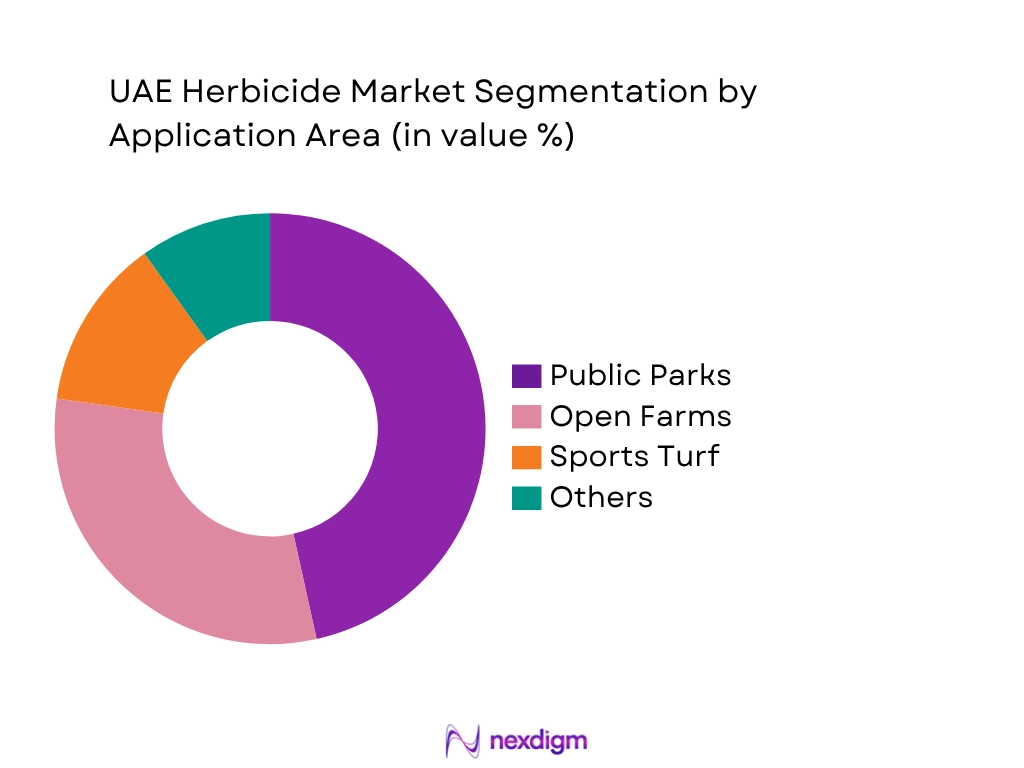
UAE Herbicide Market is segmented by application area into landscaping & public parks, date palm farms & open farms, golf courses & sports turf, roadside, infrastructure & industrial facilities, protected agriculture & nurseries, and retail garden use. Recently, landscaping & public parks have a dominant market share in UAE under this segmentation because the country’s herbicide demand is less dependent on broad-acre crop farming and more linked to urban green-space maintenance, municipal beautification, residential communities, hospitality landscapes and public infrastructure. Dubai and Abu Dhabi maintain high-value landscapes where weed-free surfaces, visual quality and maintenance efficiency are essential. Landscape contractors also buy herbicides repeatedly for hardscape edges, ornamental beds, medians, public parks and villa communities, making this segment more commercially consistent than seasonal farm-based herbicide consumption.
By Herbicide Type
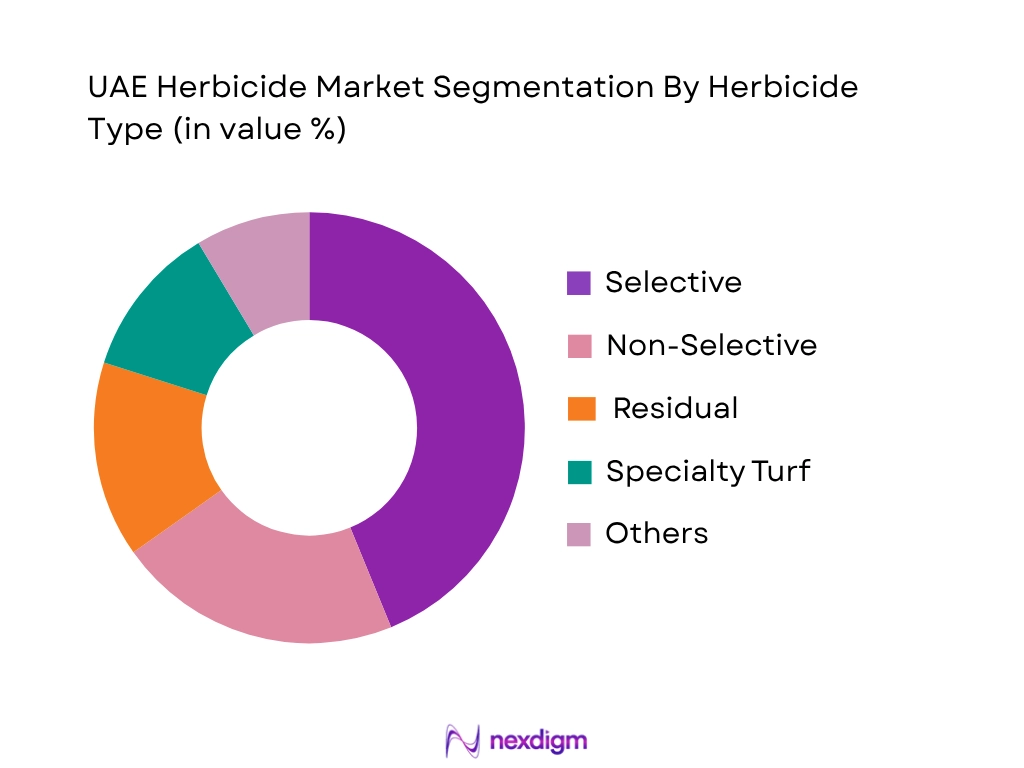
UAE Herbicide Market is segmented by herbicide type into non-selective herbicides, selective herbicides, residual herbicides, specialty turf herbicides, bio-based & low-toxicity herbicides, and others. Recently, non-selective herbicides have a dominant market share in UAE under this segmentation because a large part of the country’s weed-control demand comes from non-crop and semi-professional use cases such as roadsides, industrial sites, fence lines, utility corridors, date palm farm boundaries, landscape beds and hardscape maintenance. Glyphosate and glufosinate-type products remain important for fast vegetation clearance and directed spraying where crop selectivity is less critical. Public works contractors, facilities management firms and landscape maintenance companies prefer broad-spectrum products because they reduce labour requirements and support quick clearance across high-temperature outdoor environments.
Competitive Landscape
The UAE Herbicide Market is led by multinational crop-protection companies, regional agrochemical distributors, professional turf suppliers and local chemical importers. Companies compete through registered product portfolios, MOCCAE/EDE compliance, turf and landscape product availability, distributor coverage, professional applicator support and ability to serve municipality and contractor procurement. Since UAE herbicide demand is import-led and application-specific, companies with regulatory approvals, warehousing capability and contractor relationships remain better positioned than generic suppliers with limited technical support.
| Company | Establishment Year | Headquarters | Herbicide Portfolio Focus | UAE Demand Fit | Distribution Model | Regulatory Strength | Application Expertise | Strategic Positioning |
| Bayer CropScience | 1863 | Leverkusen, Germany | ~ | ~ | ~ | ~ | ~ | ~ |
| Syngenta | 2000 | Basel, Switzerland | ~ | ~ | ~ | ~ | ~ | ~ |
| BASF | 1865 | Ludwigshafen, Germany | ~ | ~ | ~ | ~ | ~ | ~ |
| FMC Corporation | 1883 | Philadelphia, USA | ~ | ~ | ~ | ~ | ~ | ~ |
| UPL Limited | 1969 | Mumbai, India | ~ | ~ | ~ | ~ | ~ | ~ |
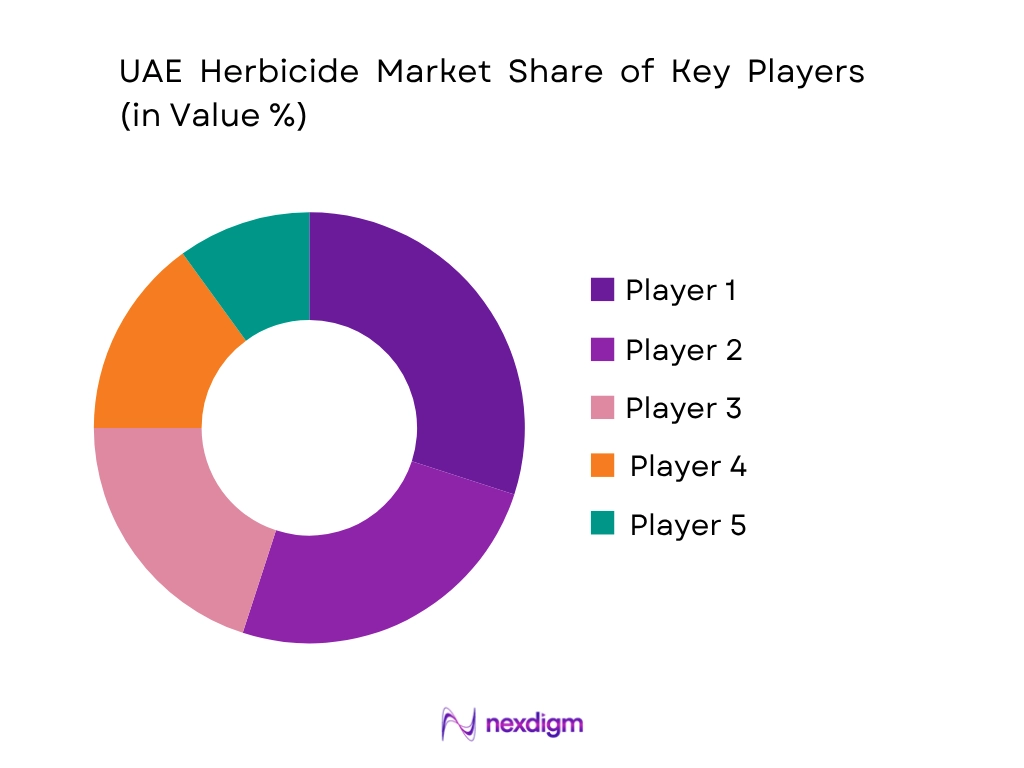
UAE Herbicide Market Analysis
Growth Drivers
Urban Landscaping and Public-Realm Maintenance Expanding Professional Herbicide Demand
UAE Herbicide Market is supported by intensive urban landscaping, where municipalities and contractors require recurring weed control across parks, medians, streetscapes, residential communities, hotels and hardscape edges. Dubai Municipality reported 31 million visitors across parks and facilities and currently oversees 220 public parks and recreational facilities, supported by 1,283 recreational, sporting, community and cultural events, creating repeated maintenance cycles for public green assets. Dubai Municipality also planted 216,500 new trees, equal to an average of 600 trees daily, increasing demand for landscape-bed maintenance, spot weed control and contractor-led herbicide application. The macroeconomic base is supportive, with World Bank data showing UAE GDP at USD 552.32 billion, GDP per capita at USD 50,273.5, and population at 10,986,400, reinforcing premium urban infrastructure spending and managed community maintenance. For herbicide suppliers, this makes landscaping more stable than seasonal open-field farming because demand is tied to city upkeep, public aesthetics, visitor experience and year-round contracted maintenance.
Protected Farming and Local Food Production Supporting Controlled Weed-Management Use
UAE Herbicide Market is driven by controlled agriculture, nurseries and farm perimeters where weed suppression is required for sanitation, pest reduction and labour-efficient farm management. MOCCAE reported 38,000 farms operating in the UAE, using multiple production systems, including organic farming across 46,000 dunum and soilless aquatic farms across 1,000 dunum. The same ministry data places UAE vegetable production at around 156,000 tons, field crops and feed at more than 500 tons, and fruit production at about 200,000 tons. This supports herbicide use in greenhouse perimeters, nursery beds, farm roads, date palm basins and open-field support areas rather than large broad-acre cropping alone. World Bank macro indicators show a large purchasing base, with UAE population at 10,986,400 and GDP per capita at USD 50,273.5, enabling adoption of higher-quality, registered and professional-use agricultural inputs. The driver is market-specific because UAE farms face high heat, water scarcity and labour efficiency pressure, making controlled, label-compliant weed management important for protected agriculture and high-value crops.
Market Challenges
Limited Arable Land and Water Scarcity Restrict Broad-Acre Herbicide Expansion
UAE Herbicide Market faces a structural ceiling because the country does not have the large cultivated-area base seen in major agricultural economies. World Bank data shows UAE agricultural land at 18.3 of land area in the latest reported indicator, while annual freshwater withdrawals reached 1,510 of internal resources, reflecting severe water-resource pressure relative to domestic availability. This creates a herbicide market concentrated in landscaping, date palm farms, nurseries, protected agriculture and non-crop vegetation control rather than broad-acre cereal, oilseed or plantation systems. MOCCAE data shows 38,000 farms, but crop production remains concentrated in vegetables, fruits, field crops and controlled systems, with vegetable output at 156,000 tons and fruit output at about 200,000 tons. The UAE’s macroeconomic scale is large, with GDP of USD 552.32 billion, but herbicide volume growth is constrained by the small farm base, water-intensive cultivation limits and reliance on precision agriculture rather than field-scale herbicide programmes. Companies must therefore focus on professional, high-value applications instead of assuming broad agricultural acreage expansion.
Registration, Import and Chemical-Control Compliance Raise Entry Barriers
UAE Herbicide Market faces strict compliance requirements because pesticides can only be imported, exported or circulated after registration with the responsible UAE authority, while banned pesticides cannot be registered or imported. MOCCAE’s pesticide decree requires establishments to obtain a licence before pesticide registration, and chemical pesticide registration requires documents such as a pesticide registration certificate from the origin country and a certificate from another country where applicable. Federal Law No. 10 of 2020 also covers procedures for registration, importation, clearance, re-exportation, circulation, cancellation, disposal, warehouse licensing and banned / restricted pesticide lists. The Emirates Drug Establishment pesticide-registration service requires UAE PASS login, application submission, document attachment, fee payment and certificate issuance, adding process discipline for market participation. The macro environment is attractive, with World Bank GDP at USD 552.32 billion and GDP per capita at USD 50,273.5, but access is not frictionless. For suppliers, weak documentation, incomplete labels, non-compliant active ingredients or poor distributor controls can delay product availability and restrict participation in municipality and professional contractor procurement.
Market Opportunities
Tourism, Parks and Premium Landscapes Create Scope for Low-Odour and Public-Safe Herbicides
UAE Herbicide Market has an opportunity in public-safe, low-odour and professional-use weed-control products because tourism and public-space utilisation create high expectations for clean landscapes. Dubai welcomed 18.72 million international overnight visitors, while the previous benchmark was 17.15 million, according to Dubai Department of Economy and Tourism data. Dubai International Airport handled 92.3 million guests, reinforcing high footfall across airport corridors, hotels, roadsides and visitor-facing landscapes. Dubai Municipality’s 31 million park and facility visitors and 220 public parks create a large professional maintenance base for spot treatment, selective turf herbicides and lower-exposure products in public areas. World Bank data shows UAE GDP at USD 552.32 billion and GDP per capita at USD 50,273.5, supporting premium urban services and maintenance outsourcing. This opportunity reflects future growth potential without relying on future projections: current visitor volume, public-space usage and managed parks already create commercial rationale for safer formulations, contractor training, digital SDS access, QR-labelled products and municipality-ready herbicide portfolios.
Food Security and Controlled-Agriculture Systems Create Scope for Stewardship-Led Herbicide Portfolios
UAE Herbicide Market has an opportunity in stewardship-led herbicides for protected agriculture, nurseries and local farm systems because domestic food-security initiatives are pushing farms toward controlled, efficient and traceable production. MOCCAE data shows 38,000 farms, organic farming spread across 46,000 dunum, soilless aquatic farms across 1,000 dunum, vegetable output of around 156,000 tons, fruit output of about 200,000 tons and field crops and feed production of more than 500 tons. This creates room for herbicides used around greenhouse perimeters, nursery floors, farm access roads, drainage edges, date palm basins and open-field support zones. The opportunity is not high-volume commodity herbicide use; it is registered, low-phytotoxicity, crop-safe and residue-conscious weed-control support for high-value farming systems. World Bank data shows UAE population at 10,986,400, GDP at USD 552.32 billion and GDP per capita at USD 50,273.5, supporting demand for food security, premium local produce and regulated input use. Suppliers that combine compliant labels, training material, pack traceability and applicator stewardship can serve farms more effectively than generic importers focused only on low-cost active ingredients.
Future Outlook
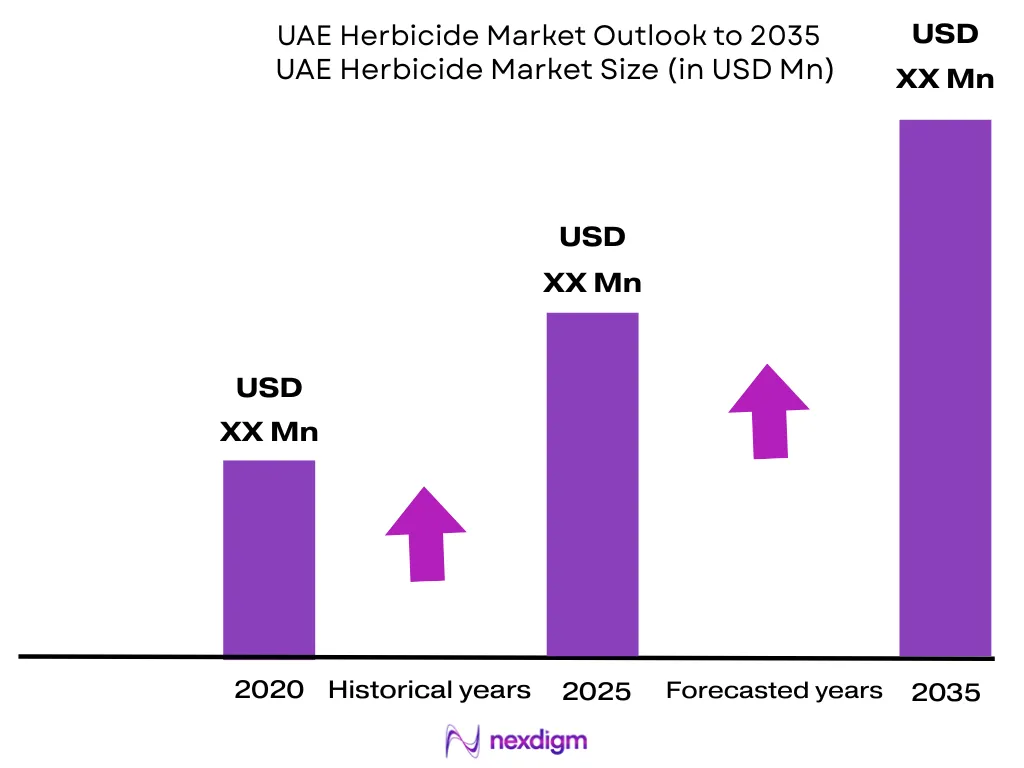
The UAE Herbicide Market is expected to grow steadily at a forecasted CAGR of 4.18% during the extended 2026-2035 outlook, benchmarked from the country’s pesticide-market growth trajectory and adjusted for herbicide-specific demand from landscaping, turf, farms and infrastructure maintenance. Over the next decade, the UAE Herbicide Market will be shaped by urban landscape maintenance, protected agriculture, food-security investments, golf tourism, public-realm beautification and industrial vegetation management. The market will remain import-dependent, but demand will become more professional, regulated and application-specific. Suppliers with registered products, low-odour formulations, contractor training programs and municipality procurement access are expected to gain stronger commercial traction. Non-crop herbicide demand will remain central because the UAE has limited broad-acre farming compared with large agricultural economies. Roadsides, industrial facilities, ports, airports, solar parks, free zones, logistics parks and public spaces require regular weed suppression for safety, aesthetics and operational access. This will keep broad-spectrum and residual weed-control products relevant for professional applicators. Agricultural demand will be concentrated in date palm farms, greenhouses, vegetable farms, nurseries and controlled-environment agriculture. As the UAE continues food-security initiatives, herbicides used around greenhouse perimeters, nursery beds and farm boundaries will gain relevance. However, residue-sensitive protected agriculture will push suppliers toward safer, labelled and lower-phytotoxicity products.
Major Players
- Bayer Crop Science
- Syngenta
- BASF
- FMC Corporation
- Corteva Agriscience
- UPL Limited
- ADAMA Agricultural Solutions
- Nufarm
- Sumitomo Chemical
- Arysta LifeScience / UPL Platform
- Al Rowad Chemicals
- Gulf Agro Industries
- Al Dahra Agriculture
- Emirates Bio Fertilizer Factory
- Rentokil Boecker
Key Target Audience
- Herbicide manufacturers
- Agrochemical importers and authorised distributors
- Landscape contractors
- Golf course and sports turf operators
- Protected agriculture and greenhouse operators
- Investments and venture capitalist firms
- Government and regulatory bodies — Ministry of Climate Change and Environment, Emirates Drug Establishment, Abu Dhabi Agriculture and Food Safety Authority, Dubai Municipality, Abu Dhabi City Municipality
- Facilities management and industrial vegetation-control companies
Research Methodology
Step 1: Identification of Key Variables
The initial phase involves constructing an ecosystem map of the UAE Herbicide Market, including multinational suppliers, authorised importers, distributors, municipalities, landscape contractors, farms, golf courses and industrial buyers. Key variables include registered product count, herbicide type, application area, buyer category, formulation type, import dependency and professional applicator demand.
Step 2: Market Analysis and Construction
In this phase, historical pesticide market data, crop-protection benchmarks, UAE agriculture indicators, registered pesticide lists and trade-linked information are compiled. The market is constructed using a top-down pesticide allocation and a bottom-up build-up across landscaping, farms, golf courses, nurseries, public infrastructure and industrial vegetation-control demand.
Step 3: Hypothesis Validation and Expert Consultation
Market hypotheses are validated through structured interviews with authorised distributors, landscape contractors, turf managers, greenhouse operators, farm input suppliers, facilities management companies and municipal procurement-linked stakeholders. These consultations help verify demand concentration, formulation preferences, procurement patterns, active ingredient usage and regulatory compliance barriers in the UAE.
Step 4: Research Synthesis and Final Output
The final phase integrates secondary research, regulatory screening and primary validation to develop a market-ready view of the UAE Herbicide Market. Segment shares are refined through triangulation of application area, buyer type, herbicide category, distributor feedback, product registration status and demand seasonality across the seven emirates.

- Executive Summary
- Research Methodology (Market Definitions and Assumptions, Abbreviations, Herbicide Scope, Active Ingredient Mapping, Crop and Non-Crop Demand Modelling, Import-Distributor Validation, Registered Product Screening, Municipality Procurement Checks, Dealer and Applicator Interviews, Bottom-Up SKU Analysis, Top-Down Crop Protection Allocation, Limitations and Future Conclusions)

- Definition and Scope
- Market Genesis
- Evolution of Weed-Control Practices
- Business Cycle
- Supply Chain and Value Chain Analysis

- Growth Drivers (Urban Landscaping Expansion, Protected Agriculture Growth, Golf and Turf Maintenance, Date Palm Farm Management, Labour Cost Pressure, Public Infrastructure Maintenance, Food Security Initiatives)
- Market Challenges (Limited Arable Land, High Import Dependence, Pesticide Registration Compliance, Heat Stress on Application, Drift Risk, Public Safety Scrutiny, Contractor Training Gaps, Water Scarcity)
- Opportunities (Sustainable Landscaping Products, Bio-Based Herbicides, Low-Residue Protected Agriculture, Golf Turf Specialist Programs, Smart Spraying, Municipality Framework Contracts, Industrial Vegetation Management)
- Market Trends (Shift Toward Professional Application, Low-Odour Formulations, Residual Weed-Control Programs, Sustainable Landscaping, QR-Enabled Packaging, Tender-Based Procurement, Integrated Weed Management)
- SWOT Analysis
- Porter’s Five Forces

- By Value (2020-2025)
- By Volume (2020-2025)
- By Average Realisation (2020-2025)

- By Herbicide Type (In Value %)
Selective Herbicides
Non-Selective Herbicides
Residual Herbicides
Contact Herbicides - By End User (In Value %)
Commercial Farms
Greenhouse Operators
Municipality Departments
Landscape Contractors
Golf Course Operators - By Sales Channel (In Value %)
Agrochemical Distributor
Authorised Importer
Garden Retail Channel
Municipality Tender
Landscape Contractor Procurement - By Emirate (In Value %)
Abu Dhabi
Dubai
Sharjah
Ajman
Ras Al Khaimah

- Market Share of Major Players on the Basis of Value and Volume (Multinational Brands, Regional Distributors, Local Importers, Specialty Turf Suppliers,
- Cross Comparison Parameters (Registered Herbicide Portfolio, MOCCAE/EDE Compliance Strength, Turf and Landscape Product Depth, Protected Agriculture Fit, Date Palm and Farm Portfolio, Municipality Tender Capability, Import and Warehousing Network, Applicator Training and Stewardship Support)
- SWOT Analysis of Major Players
- Detailed Profiles of Major Companies
Bayer Crop Science
Syngenta
BASF
FMC Corporation
Corteva Agriscience
UPL Limited
ADAMA Agricultural Solutions
Nufarm
Sumitomo Chemical
Arysta LifeScience / UPL Platform
Al Rowad Chemicals
Gulf Agro Industries
Al Dahra Agriculture
Emirates Bio Fertilizer Factory
Rentokil Boecker

- Market Demand and Utilisation
- Purchasing Power and Budget Allocation
- Regulatory and Compliance Requirements
- Needs, Desires and Pain Point Analysis
- Decision-Making Process

- By Value (2026-2035)
- By Volume (2026-2035)
- By Average Realisation (2026-2035)


 Request a Sample
 Ask for Customization
 Get a Quote
 Enquire Now