
 Download PDF
Market Overview
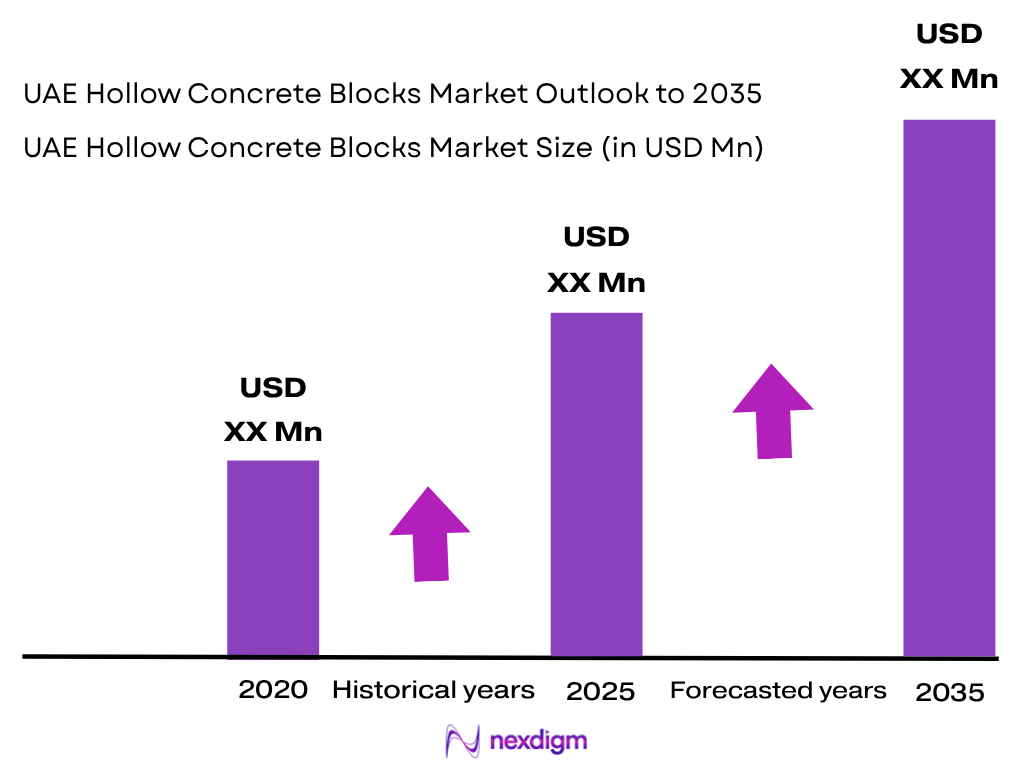
The UAE Hollow Concrete Blocks Market is valued at approximately USD ~ billion, based on a five-year historical analysis. Demand is supported by residential, commercial, hospitality, industrial and infrastructure construction. Dubai issued 13,133 building permits compared with 12,410, while the UAE construction sector generated approximately AED 141 billion compared with AED 132 billion in gross value added. Local certification requirements further support demand for standardized, factory-produced concrete masonry.
Dubai and Abu Dhabi dominate UAE hollow concrete block demand, supported by high-rise residential developments, villa communities, hospitality projects, industrial zones and infrastructure, while Sharjah and Ras Al Khaimah maintain important manufacturing and construction bases. Dubai’s population increased from approximately 3.65 million to 3.86 million, while Abu Dhabi’s population reached approximately 4.14 million. Jebel Ali, Dubai South, Mussafah and KEZAD additionally generate demand through logistics, industrial and warehouse development.
Market Segmentation
By Product Type
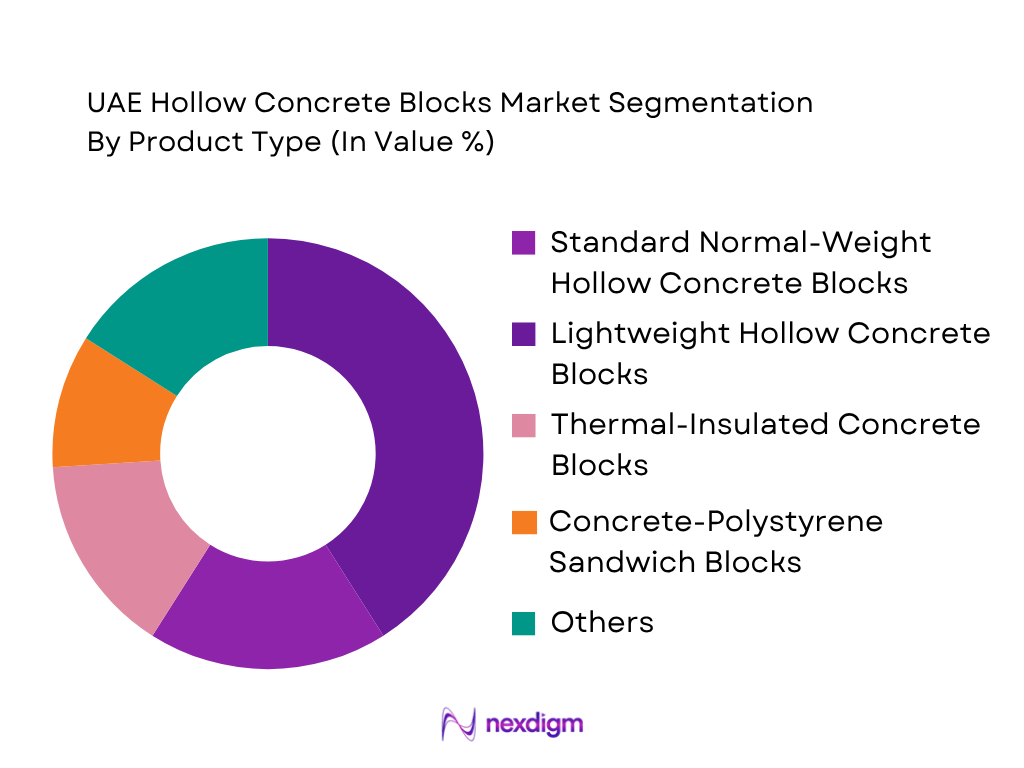
The UAE Hollow Concrete Blocks Market is segmented into standard normal-weight hollow concrete blocks, lightweight hollow blocks, thermal-insulated blocks, concrete-polystyrene sandwich blocks, filler blocks and specialty architectural concrete masonry. Recently, standard normal-weight hollow concrete blocks have a dominant market share in the UAE under product-type segmentation in this report framework because they serve a broad spectrum of external walls, internal partitions, boundary walls, utility structures and infill applications. The UAE has an established network of automated concrete-block factories supplying standard masonry in multiple wall thicknesses. Dubai Municipality separately regulates precast concrete masonry, filler, AAC and concrete-polystyrene sandwich units, reinforcing a specification-driven market. Lightweight and thermal blocks are strategically important where envelope performance or reduced wall loading is required. Concrete-polystyrene sandwich blocks represent a specialized thermal solution, while filler blocks primarily address slab and structural applications rather than general walling.
By End-Use Construction
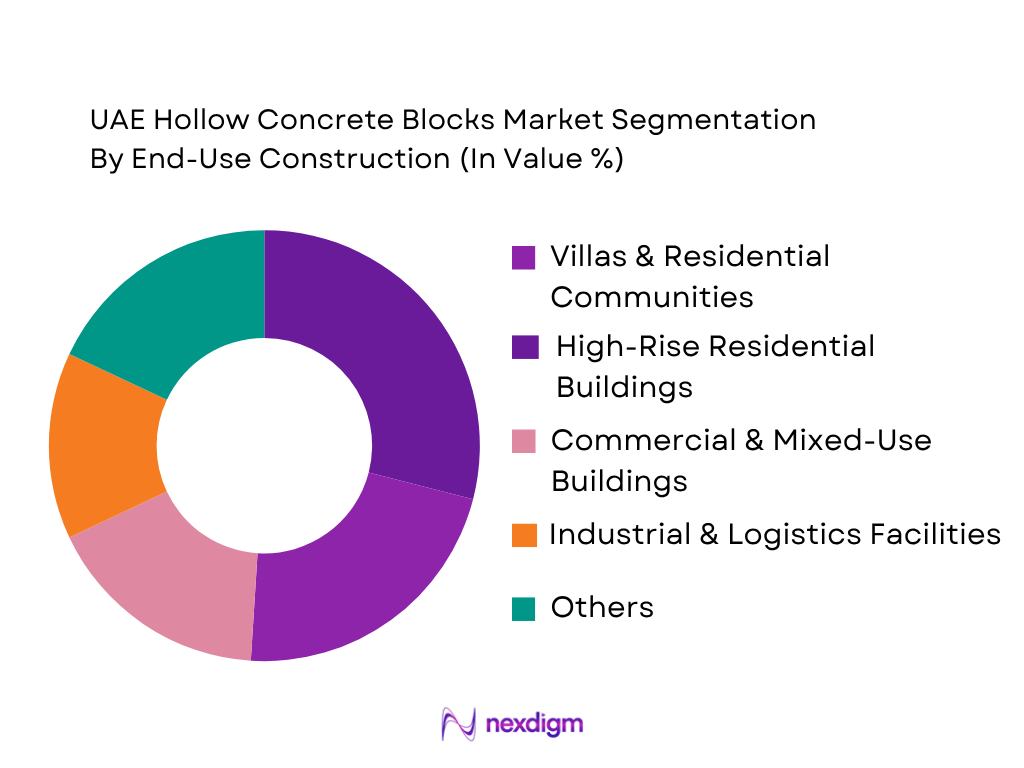
The UAE Hollow Concrete Blocks Market is segmented into villas and residential communities, high-rise residential buildings, commercial and mixed-use developments, industrial and logistics facilities, hospitality projects, and institutional and government construction. Recently, villas and residential communities have a dominant market share in the UAE under end-use segmentation in this report framework because detached and townhouse developments require extensive external masonry, partitions, boundary walls and service structures. Large master-planned communities also allow block manufacturers to secure repetitive project orders through main contractors. High-rise developments generate demand for non-load-bearing infill, partitions and service-area masonry, while industrial and logistics projects require durable blocks for warehouses, factories and utility buildings. Hospitality and institutional developments additionally favor certified masonry products where fire performance, thermal requirements and dimensional consistency form part of consultant specifications and project approvals.
Competitive Landscape
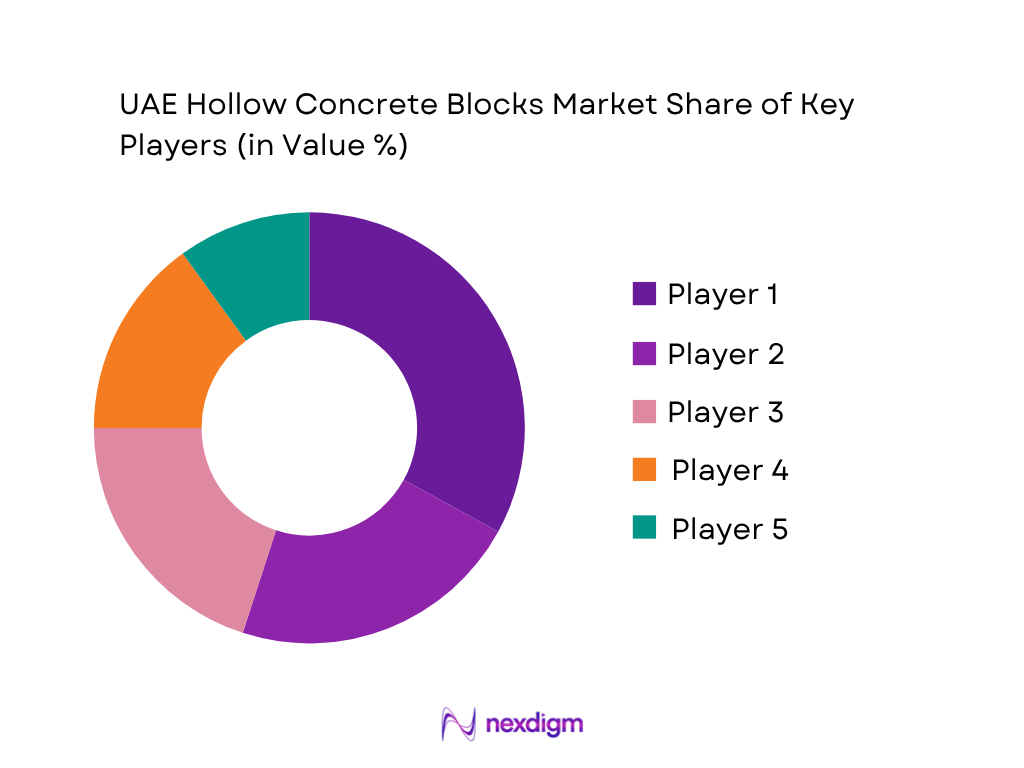
The UAE Hollow Concrete Blocks Market contains established automated manufacturers serving Dubai, Abu Dhabi, Sharjah and the Northern Emirates. Competition is influenced by production capacity, DCL certification, standard and thermal-block portfolios, fleet availability and proximity to major construction clusters. Bucomac Industries, Hard Block Factory, Trans Gulf Cement Products, Al Ghurair Construction Masonry and Al Amaar Block Manufacturing represent important participants in the concrete masonry ecosystem, while numerous certified regional plants create strong project-level competition.
| Major Player | Establishment Year | Headquarters | Hollow Masonry Portfolio | Thermal/Lightweight Capability | Automated Production | Certification Capability | Direct Project Supply |
| Bucomac Industries | 1976 | Sharjah | ~ | ~ | ~ | ~ | ~ |
| Hard Block Factory | 1978 | Dubai | ~ | ~ | ~ | ~ | ~ |
| Trans Gulf Cement Products | 1996 | Dubai | ~ | ~ | ~ | ~ | ~ |
| Al Ghurair Construction Masonry | 1976* | Dubai | ~ | ~ | ~ | ~ | ~ |
| Al Amaar Block Manufacturing | 1999* | Dubai | ~ | ~ | ~ | ~ | ~ |
UAE Hollow Concrete Blocks Market Analysis
Growth Drivers
Residential Community, Villa and High-Rise Construction
Residential development is a primary demand driver for UAE hollow concrete blocks because villas, townhouses, apartment towers and master-planned communities consume masonry across external walls, internal partitions, boundary walls, service rooms and ancillary structures. Dubai recorded 226,000 real-estate transactions valued at AED 761 billion during 2024, while the emirate registered 217,000 real-estate investments valued at AED 526 billion. The scale of activity was accompanied by 110,000 new real-estate investors, strengthening the development environment for new residential inventory. Abu Dhabi simultaneously recorded approximately AED 97 billion in real-estate transactions during 2024, demonstrating that construction demand is distributed across both principal UAE development centers. Federal housing programs reinforce villa and community construction outside private development. The Sheikh Zayed Housing Programme approved 460 housing assistance applications valued at approximately AED 350 million in March 2024, comprising 188 grants, 250 housing loans and 22 combined housing-support decisions. Its housing-policy action plan targeted 3,000 decisions during 2024, maintaining a pipeline of citizen housing construction and completion activity. The macroeconomic backdrop supports this physical development: UAE GDP reached USD 552.32 billion during 2024, while GDP per capita stood at USD 50,273.5. For hollow concrete block producers, this residential ecosystem is particularly relevant because villa communities require substantial quantities of 100 mm, 150 mm and 200 mm masonry for partitions, external walls and boundary structures, while high-rise developments consume non-load-bearing infill units. Dubai’s mandatory conformity framework for precast concrete masonry additionally encourages procurement from controlled factories. Certified suppliers can therefore leverage automated batching, vibro-press production and multiple block configurations to serve large master developments requiring consistent dimensions, predictable compressive performance and continuous scheduled deliveries.
Commercial Real Estate, Industrial-Logistics and Infrastructure Construction
The UAE’s diversified construction pipeline supports hollow concrete block demand beyond housing through commercial buildings, hotels, warehouses, industrial facilities, government infrastructure and logistics developments. Dubai’s 226,000 real-estate transactions valued at AED 761 billion during 2024 demonstrate the scale of the property ecosystem supporting construction and refurbishment, while Abu Dhabi recorded approximately AED 97 billion of real-estate transactions in the same period. Abu Dhabi’s first-half activity alone included 12,439 transactions valued at AED 36.2 billion, comprising 7,088 sales and purchase transactions and 5,351 mortgage transactions, illustrating the depth of development activity around the capital. The national macroeconomic base is also supportive: UAE GDP reached USD 552.32 billion in 2024, while the IMF recorded real non-hydrocarbon economic expansion at 4.9 on its annual growth measure. Non-hydrocarbon expansion matters directly for hollow concrete blocks because logistics, manufacturing, hospitality and commercial construction sit predominantly outside the hydrocarbon economy. Industrial zones including Jebel Ali, Dubai South, Mussafah and Khalifa Economic Zones generate requirements for warehouses, workshops, factories, security structures, utility rooms and perimeter masonry. These applications favor robust concrete blocks because project contractors require standardized dimensions, fire-resistant walling characteristics and reliable large-volume delivery. Infrastructure spending additionally generates demand through substations, pumping facilities, service buildings, maintenance structures and ancillary construction. The UAE’s block manufacturing ecosystem is consequently positioned around large automated plants capable of supplying high-volume projects. Dubai Municipality requires precast concrete masonry blocks to undergo mandatory factory-assessment certification, providing institutional support for standardized production. As commercial and industrial developments become larger and procurement increasingly concentrates among major contractors, block manufacturers with automated lines, large stockyards and dedicated truck fleets can secure recurring project demand across multiple construction phases.
Market Challenges
AAC, Precast and Lightweight Partition Competition with Increasing Performance Requirements
The UAE Hollow Concrete Blocks Market operates within one of the region’s most specification-intensive walling environments, where conventional hollow blocks compete directly against AAC masonry, precast concrete systems, drywall and thermally insulated composite blocks. Dubai Municipality’s mandatory factory-assessment framework separately recognizes 5 major precast masonry categories: conventional precast concrete masonry blocks under DMS 1 Part 1, filler blocks under Part 2, AAC masonry units under Part 3, paving blocks under Part 4 and concrete-polystyrene sandwich masonry blocks under Part 5. This broad regulated product ecosystem gives contractors multiple technically approved alternatives rather than locking projects into conventional hollow concrete masonry. Competition is intensified by the scale of construction procurement. Dubai registered 226,000 real-estate transactions during 2024, while Abu Dhabi recorded approximately AED 97 billion in annual real-estate transactions, creating a sufficiently large project environment for competing wall technologies to establish dedicated manufacturing and contractor networks. High-rise buildings can favor AAC or lightweight systems where wall dead load is critical, while internal commercial partitions can shift toward drywall where rapid installation and services integration are prioritized. Thermal requirements create another competitive dimension because standard normal-weight hollow blocks may need additional insulation or specialized configurations to achieve project envelope requirements. Concrete-polystyrene sandwich blocks are already separately regulated within Dubai’s certification framework, demonstrating the institutional presence of thermally enhanced masonry alternatives. Hollow-block manufacturers therefore need more than commodity production capability. Dubai-certified conventional blocks are available in 400 × 200 mm formats with nominal thicknesses including 100 mm, 150 mm, 200 mm, 250 mm and 300 mm, demonstrating the breadth expected from established suppliers. Producers must control compressive strength, dimensions, density and water absorption while offering lightweight or insulated alternatives where projects require them. UAE GDP of USD 552.32 billion during 2024 and GDP per capita of USD 50,273.5 support a sophisticated construction sector where developers can prioritize total wall-system performance rather than merely basic masonry availability.
Heavy Logistics, Factory Utilization and Quality-Compliance Pressure
Hollow concrete blocks are heavy, high-volume construction products, making manufacturing location, truck utilization and plant capacity management central challenges in the UAE. Demand is geographically dispersed across Dubai, Abu Dhabi, Sharjah and the Northern Emirates, while large projects can require concentrated deliveries followed by abrupt reductions when masonry packages are completed. Dubai’s real-estate system processed 2.78 million procedures during 2024, including 226,000 property transactions, while Abu Dhabi recorded approximately AED 97 billion in real-estate transactions. This large but project-driven construction environment creates substantial demand while simultaneously exposing factories to scheduling volatility. A manufacturer serving Dubai from Jebel Ali or Al Quoz has different transport economics from a supplier serving Abu Dhabi, Mussafah or Northern Emirates projects, meaning block producers cannot treat the UAE as a single frictionless distribution territory. Product compliance adds another operational burden. Dubai Municipality classifies precast concrete masonry blocks as a mandatory-certification product under Local Order 44 and requires factory assessment for conformity. Certified hollow blocks can span 5 principal thicknesses from 100 mm to 300 mm, requiring manufacturers to maintain multiple mould sets, production planning and inventory positions. Dimensional deviations, inadequate compaction, poor aggregate grading or inconsistent curing can affect finished-block strength, density and absorption performance. Cement and aggregate inputs also require careful control because relatively small variations in moisture or grading can affect vibro-press mould filling and unit consistency. The macroeconomic environment remains active, with UAE GDP reaching USD 552.32 billion in 2024 and the IMF recording non-hydrocarbon economic expansion of 4.9 on its annual measure, but active construction does not eliminate plant-utilization risk. Factories must balance production against actual contractor call-offs, maintain sufficient cured inventory and operate delivery fleets efficiently. Consequently, automation, laboratory testing, factory production control, mould maintenance and dispatch optimization are critical for protecting competitiveness.
Market Opportunities
Thermal, Lightweight and Low-Carbon Hollow Concrete Block Development
UAE building-envelope requirements create a significant future opportunity for manufacturers to move from conventional commodity hollow blocks toward lightweight, insulated and lower-carbon concrete masonry. The current regulatory ecosystem already provides a foundation for this transition. Dubai Municipality operates mandatory conformity routes for conventional precast concrete masonry and concrete-polystyrene sandwich masonry, while its 2024 technical framework provides specific certification rules for concrete-thermal sandwich masonry blocks. This means thermally enhanced concrete masonry is already embedded within the UAE’s regulated construction-product environment rather than representing an untested future category. The scale of construction provides an addressable application base: Dubai recorded 226,000 real-estate transactions valued at AED 761 billion during 2024, while Abu Dhabi recorded approximately AED 97 billion. Federal residential construction also continues to create applications, with 460 housing assistance decisions worth approximately AED 350 million approved in March 2024 alone. The UAE’s GDP reached USD 552.32 billion during 2024, while GDP per capita was USD 50,273.5, supporting continued investment in higher-specification buildings. For hollow-block manufacturers, thermal products can combine concrete shells with insulation inserts, lightweight aggregates or optimized cavity structures to improve wall-envelope performance. Low-carbon product development provides a parallel route through technically appropriate GGBS incorporation, clinker reduction and recycled mineral content. Automated vibro-press manufacturing can help maintain the dimensional accuracy required when insulation inserts or specialized cavities are incorporated into block geometries. Producers can consequently build differentiated portfolios spanning conventional 100 mm, 150 mm and 200 mm blocks alongside thermal and lightweight products. The future opportunity lies in supplying a complete masonry system rather than competing solely on conventional block output, allowing manufacturers to address villas, high-rise residential projects, hotels, government buildings and industrial facilities with application-specific products.
Automated High-Capacity Manufacturing for Villa, Industrial, Logistics and Fire-Rated Applications
The UAE’s current development pipeline creates a strong platform for future expansion of automated hollow concrete block manufacturing, particularly for villa communities, industrial buildings, warehouses, data-support facilities and fire-resistant service areas. Residential demand remains tangible: the federal housing program approved 460 housing assistance applications valued at approximately AED 350 million during March 2024, while the national housing-policy plan targeted 3,000 decisions during 2024. The pipeline remains active into 2026, when the Sheikh Zayed Housing Programme issued 759 housing approvals worth more than AED 616 million in the first quarter, including 129 grants and benefits, 583 housing loans and financing solutions, and 47 government-housing loans. The final phase of Al Suyoh 16 in Sharjah also involved 380 homes during 2026, demonstrating continuing community-scale residential delivery. Large-scale real-estate activity provides another demand platform: Dubai recorded 226,000 transactions valued at AED 761 billion during 2024, and Abu Dhabi’s market subsequently reached AED 142 billion across 42,814 transactions during 2025. Automated block plants can capitalize on this environment by producing multiple mould configurations with repeatable dimensions while rapidly switching between partition, external-wall and specialty products. Fire-rated masonry represents a particularly attractive application for industrial facilities, warehouses, plant rooms, electrical spaces and data infrastructure because concrete masonry provides a non-combustible mineral walling platform subject to system-specific testing and approvals. Factory automation also supports tighter batching, vibration control, curing and traceability, which are increasingly important under mandatory conformity regimes. Future competitive advantage should therefore favor UAE manufacturers combining high-capacity vibro-press equipment, certified product families, thermal and lightweight variants, large cured-product inventories and dedicated logistics fleets capable of supplying major contractors across concentrated project schedules.
Future Outlook
The UAE Hollow Concrete Blocks Market is expected to expand at approximately ~% CAGR during 2026–2035, based on the report framework. Future development will be supported by residential communities, high-rise buildings, hospitality projects, industrial zones and logistics facilities. Thermal-performance requirements should strengthen demand for lightweight and insulated masonry. Automated production, low-carbon cementitious blends and greater factory quality control will increasingly shape competition. Residential development will remain an important application because the UAE continues to expand villa, townhouse and apartment inventories around major urban centers. Large master developments create opportunities for manufacturers capable of supplying multiple block thicknesses and maintaining scheduled deliveries across extended construction phases.
Major Players
- Bucomac Industries
- Hard Block Factory
- Consent FZCO
- Trans Gulf Cement Products LLC
- Al Ghurair Construction Masonry LLC
- Al Amaar Block Manufacturing Co. LLC
- Al Nasr Cement Products
- Emirates and Gulf Cement Products LLC
- EMCON LLC
- RAKNOR LLC
- PASCO Paving Stones Co. LLC
- Khaloory Block Factory
- MANCON – Mohammed Al Naseri Concrete Production and Block Factory LLC
- Al Serkal & Assarain Concrete Products LLC
- Spectrum Light Block Factory LLC
Key Target Audience
- Hollow Concrete Block and Masonry Product Manufacturers
- Cement, Aggregate and Supplementary Cementitious Material Producers
- Real Estate Developers and Master Developers
- Main Contractors and Masonry Subcontractors
- Industrial and Logistics Facility Developers
- Building Material Distributors and Traders
- Investments and Venture Capitalist Firms
- Government and Regulatory Bodies (Ministry of Industry and Advanced Technology, Dubai Municipality, Abu Dhabi Department of Municipalities and Transport, Dubai Civil Defence)
Research Methodology
Step 1: Identification of Key Variables
The initial phase involves constructing an ecosystem map encompassing cement producers, aggregate suppliers, block factories, machinery suppliers, building-material traders, contractors and developers within the UAE Hollow Concrete Blocks Market. Critical variables include block dimensions, density, thermal performance, production capacity, certification status, manufacturing technology, project demand, delivery radius and competing wall systems.
Step 2: Market Analysis and Construction
Historical UAE Hollow Concrete Blocks Market information is analyzed using construction activity, building permits, residential development, industrial projects and manufacturer-level indicators. Top-down analysis assesses UAE construction and masonry demand, while bottom-up analysis evaluates individual block factories, installed capacity, product portfolios, DCL-certified products, production capability and direct project supply to construct the market framework.
Step 3: Hypothesis Validation and Expert Consultation
Market hypotheses are validated through CATIs and structured discussions with block manufacturers, main contractors, masonry subcontractors, developers, consultants and building-material distributors. Consultations assess capacity utilization, block dimensions, density requirements, thermal products, contractor procurement, project specifications, transportation constraints and competition from AAC, precast walls and lightweight partition systems.
Step 4: Research Synthesis and Final Output
The final phase triangulates construction indicators, manufacturer information, certification records, regional supply conditions and primary findings. Bottom-up factory assessments are reconciled with top-down residential, commercial and industrial construction demand. Forecast assumptions incorporate master-planned communities, logistics facilities, thermal masonry, automated manufacturing, sustainability requirements and high-performance concrete-block adoption.

- Executive Summary
- Research Methodology (Market Definitions and Assumptions, Precast Concrete Masonry Block Classification, DMS 1 Part 1 Product Mapping, Normal-Weight and Lightweight Block Assessment, Hollow and Solid Block Assessment, Thermal Block Assessment, Concrete-Polystyrene Sandwich Block Assessment, Compressive Strength Mapping, Block Dimension Mapping, Installed Block Manufacturing Capacity, Factory Utilization Assessment, Cement and Aggregate Consumption, Top-Down Construction Demand Analysis, Bottom-Up Factory Assessment, Developer and Contractor Interviews, Supply-Side Assessment, Demand-Side Assessment, Data Triangulation, Forecasting Framework, Limitations and Future Conclusions)

- Definition and Scope
- UAE Hollow Concrete Masonry Industry Evolution
Development of Hollow Concrete Blocks, Normal-Weight Blocks, Lightweight Blocks, Thermal Blocks, Insulated Sandwich Blocks, Filler Blocks and Architectural Concrete Masonry - Concrete Block Industry Value Chain Analysis
- Hollow Concrete Block Supply Chain Analysis

- Growth Drivers (Residential Community Development, High-Rise Construction, Villa Construction, Commercial Real Estate Development, Hospitality Construction, Industrial and Logistics Facilities, Infrastructure Investment, Thermal Building Envelope Requirements, Fire-Resistant Masonry Demand, Government Construction Projects, Data Center Development, Large Contractor Procurement)
- Market Challenges (AAC Block Competition, Precast Wall Competition, Drywall and Lightweight Partition Competition, Cement Input Exposure, Aggregate Transportation, Heavy Block Logistics, Factory Capacity Utilization, Contractor Price Competition, Water Absorption Control, Dimensional Consistency, Thermal Performance Compliance, Project-Cycle Volatility)
- Market Opportunities (Thermal Insulation Blocks, Lightweight Hollow Blocks, Concrete-Polystyrene Sandwich Blocks, Low-Carbon Concrete Blocks, GGBS-Blended Masonry, High-Recycled-Content Blocks, Fire-Rated Masonry, Data Center Walls, Industrial and Logistics Buildings, Villa Communities, Architectural Blocks, Automated High-Capacity Manufacturing)
- Market Trends (Thermal Block Adoption, Lightweight Aggregate Utilization, Higher Thermal Resistance, Automated Vibro-Press Production, GGBS Integration, Lower-Clinker Mixes, Factory Production Control, DCL Conformity Certification, QR-Enabled Product Traceability, Project-Specific Block Design, Direct Developer Procurement)
- Government Regulations and Standards (DMS 1 Part 1 Precast Concrete Masonry Blocks, DMS 1 Part 2 Filler Blocks, DMS 1 Part 3 AAC Masonry Units, DMS 1 Part 5 Concrete-Polystyrene Sandwich Masonry Blocks, Dubai Local Order Requirements, Dubai Central Laboratory Factory Assessment, Mandatory Block Batch Certification, UAE Fire and Life Safety Code, Thermal Insulation Requirements, Factory Production Control, Cement and Aggregate Standards)
- SWOT Analysis
- Porter’s Five Forces Analysis
- PESTLE Analysis
- Stakeholder Ecosystem

- By Market Value (2020-2025)
- By Hollow Concrete Block Production Volume (2020-2025)
- By Hollow Concrete Block Consumption Volume (2020-2025)
- By Installed Block Manufacturing Capacity (2020-2025)
- By Effective Production Capacity (2020-2025)
- By Capacity Utilization (2020-2025)

- By Product Type (In Value %)
Normal-Weight Hollow Concrete Blocks
Lightweight Hollow Concrete Blocks
Load-Bearing Hollow Concrete Blocks
Non-Load-Bearing Hollow Concrete Blocks
Thermal Insulated Hollow Blocks
Concrete-Polystyrene Sandwich Blocks
Fair-Face Hollow Blocks
Specialty Concrete Masonry Units - By Block Size and Thickness (In Value %)
4-Inch Hollow Blocks
6-Inch Hollow Blocks
8-Inch Hollow Blocks
10-Inch Hollow Blocks
12-Inch Hollow Blocks
Custom-Dimension Concrete Blocks - By Performance Class (In Value %)
Standard Non-Load-Bearing Blocks
Load-Bearing High-Strength Blocks
Lightweight Concrete Blocks
Thermally Insulated Blocks
Low-Water-Absorption Blocks
Fire-Resistant Masonry Blocks
Fair-Face Architectural Blocks
Specialty Performance Blocks - By Application (In Value %)
External Walls
Internal Partition Walls
Load-Bearing Walls
Villa Masonry Walls
Boundary and Compound Walls
Industrial and Warehouse Walls
Service and Utility Structures
Fire-Rated Wall Assemblies
Architectural and Fair-Face Walls - By End-Use Construction (In Value %)
Residential Villas and Townhouses
High-Rise Residential Buildings
Commercial and Mixed-Use Buildings
Hotels and Hospitality Buildings
Industrial and Manufacturing Facilities
Warehouses and Logistics Facilities
Educational and Healthcare Buildings
Government and Institutional Buildings
Infrastructure and Utility Facilities - By Manufacturing Technology (In Value %)
Fully Automated Vibro-Press Production
Semi-Automated Vibro-Press Production
Hydraulic Press Production
Automated Batching and Mixing
Automated Block Handling and Palletization
Controlled Curing Systems
Lightweight Aggregate Block Manufacturing
Thermal Insert Block Manufacturing

- Market Share of Major Players (By Market Value, Production Volume, Installed Capacity, Hollow Block Portfolio, Thermal Block Portfolio, Emirate Coverage, Project Supply, Contractor Relationships)
- Cross Comparison Parameters (Installed Concrete Block Production Capacity, Hollow Block Size and Core-Configuration Portfolio, Normal-Weight-Lightweight-Thermal Block Capability, DCL-Certified Masonry Product Coverage, Automated Vibro-Press and Factory Production Control Capability, GGBS-Low-Carbon and Thermal Insulation Product Capability, Manufacturing Plant-Fleet and Emirate Distribution Reach, Residential-Commercial-Industrial Mega-Project Coverage)
- SWOT Analysis of Major Players (Manufacturing Scale, Product Breadth, Certification, Plant Automation, Logistics Fleet, Developer Relationships)
- Detailed Profiles of Major Companies
Bucomac Industries
Hard Block Factory
Consent FZCO
Trans Gulf Cement Products LLC
Al Ghurair Construction Masonry LLC
Al Amaar Block Manufacturing Co. LLC
Al Nasr Cement Products
Emirates and Gulf Cement Products LLC
EMCON LLC
RAKNOR LLC
PASCO Paving Stones Co. LLC
Khaloory Block Factory
MANCON – Mohammed Al Naseri Concrete Production and Block Factory LLC
Al Serkal & Assarain Concrete Products LLC
Spectrum Light Block Factory LLC

- Main Contractor Procurement Assessment
- Developer Specification Assessment
- Architect and Consultant Specification Assessment
- Substitution Assessment
- Block Plant Capacity Assessment
- Raw Material Assessment
- Aggregate Supply Assessment

- By Market Value (2026-2035)
- By Hollow Concrete Block Production Volume (2026-2035)
- By Hollow Concrete Block Consumption Volume (2026-2035)
- By Installed Block Manufacturing Capacity (2026-2035)
- By Effective Production Capacity (2026-2035)
- By Capacity Utilization (2026-2035)


 Request a Sample
 Ask for Customization
 Get a Quote
 Enquire Now
