
 Download PDF
Market Overview
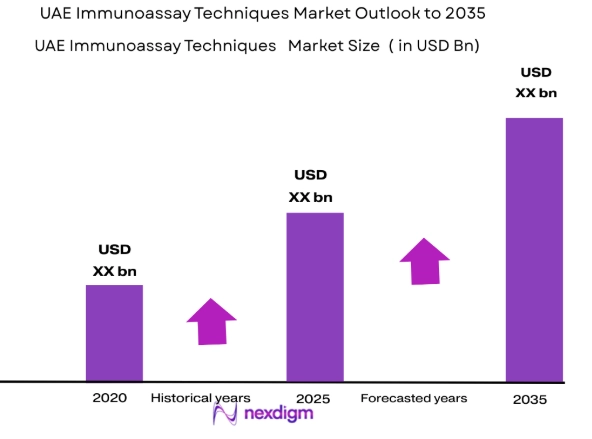
The UAE Immunoassay Techniques market is expected to grow significantly, driven by increasing demand for diagnostic tests across healthcare sectors. The market size is estimated to reach USD ~ million, propelled by advancements in immunoassay technologies and an increased need for precise diagnostic tools. The rising incidence of chronic diseases and the expansion of healthcare infrastructure further accelerate growth in this sector. These factors are transforming the market, making immunoassays an integral part of diagnostic strategies in the UAE.
Key cities like Dubai and Abu Dhabi dominate the UAE Immunoassay Techniques market due to their established healthcare infrastructure, international partnerships, and the adoption of advanced technologies in medical diagnostics. The UAE’s position as a medical hub in the Middle East, along with government initiatives such as Vision 2021, boosts the demand for innovative diagnostic systems. High investments in research and development, combined with strategic healthcare expansion plans, solidify the country’s role as a key player in the region’s diagnostic services market.
Market Segmentation
By System Type
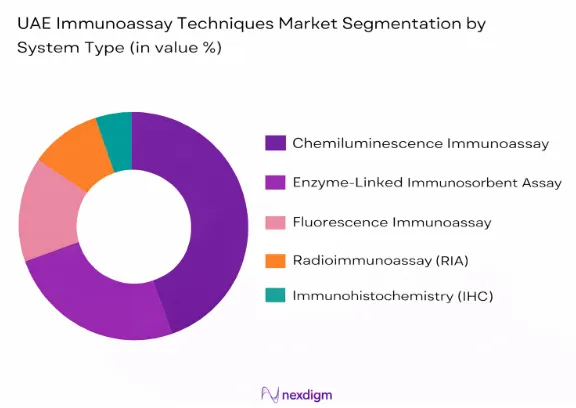
The UAE Immunoassay Techniques market is segmented by system type into various sub-segments, including chemiluminescence, enzyme-linked immunosorbent assays (ELISA), and fluorescence-based systems. Recently, the chemiluminescence immunoassay (CLIA) sub-segment has dominated the market share due to its precision, high sensitivity, and faster results, making it highly preferred in both clinical and laboratory environments. Furthermore, CLIA systems offer high throughput and cost-effectiveness, addressing the growing need for accurate diagnostics in both urban and rural areas. With the increasing prevalence of chronic conditions such as diabetes and cardiovascular diseases, the demand for CLIA systems is expected to continue growing.
By Platform Type
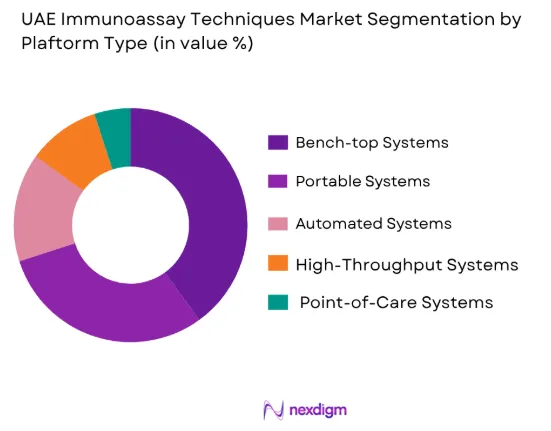
The platform type segmentation in the UAE Immunoassay Techniques market includes bench-top systems, portable systems, and automated platforms. Among these, automated systems have the largest market share due to their capability for high-throughput testing, integration with laboratory management systems, and the increasing preference for automation in healthcare settings. Automated systems ensure faster processing times, reducing human error and increasing operational efficiency, which is crucial as the demand for diagnostic services grows. This system is also supported by regulatory frameworks that push for the adoption of innovative solutions in healthcare facilities.
Competitive Landscape
The UAE Immunoassay Techniques market is highly competitive, with several established companies vying for market leadership through technological innovations and strategic partnerships. Key players dominate the market by leveraging advanced immunoassay platforms, improving diagnostic accuracy, and expanding their product portfolios. Major players in the market are focusing on collaborations with healthcare providers, research institutions, and the government to enhance their market presence and develop next-generation diagnostic solutions.
| Company Name | Establishment Year | Headquarters | Technology Focus | Market Reach | Key Products | Revenue | Additional Parameter |
| Abbott Laboratories | 1888 | USA | ~ | ~ | ~ | ~ | ~ |
| Siemens Healthineers | 1843 | Germany | ~ | ~ | ~ | ~ | ~ |
| Roche Diagnostics | 1896 | Switzerland | ~ | ~ | ~ | ~ | ~ |
| Thermo Fisher Scientific | 1956 | USA | ~ | ~ | ~ | ~ | ~ |
| BioMérieux | 1963 | France | ~ | ~ | ~ | ~ | ~ |
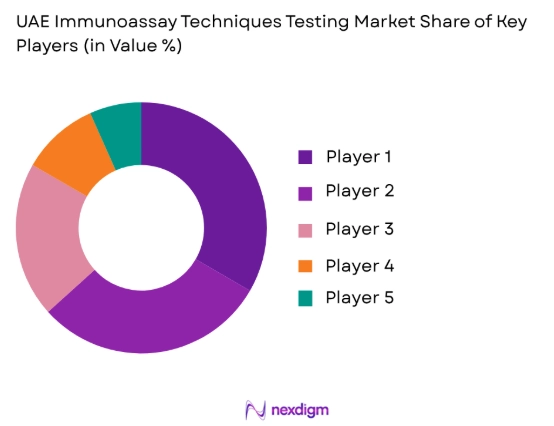
UAE Immunoassay Techniques Market Analysis
Growth Drivers
Technological Advancements in Immunoassay Systems
The rapid evolution of immunoassay technologies is a key growth driver in the UAE market. New advancements such as chemiluminescence, fluorescence immunoassays, and high-throughput platforms are revolutionizing diagnostic testing by providing more accurate, faster, and cost-effective solutions. The improved sensitivity and specificity of these tests allow for earlier detection of diseases, enhancing the quality of care. Furthermore, the integration of artificial intelligence (AI) in immunoassay devices is enabling personalized medicine, which is increasing the adoption of these advanced systems across the region. The demand for precision diagnostics and the growing trend of preventive healthcare are fueling the uptake of state-of-the-art immunoassay platforms, ensuring that the UAE remains a leading market for diagnostic technologies in the Middle East.
Rising Healthcare Investments and Infrastructure Expansion
The UAE’s commitment to improving healthcare infrastructure is a significant growth driver for the immunoassay techniques market. With large-scale investments in healthcare facilities, diagnostic laboratories, and research centers, the UAE is positioning itself as a global medical hub. Government initiatives such as Vision 2021 focus on advancing healthcare technology and ensuring that citizens have access to world-class medical services. This includes the expansion of diagnostic services in hospitals, outpatient clinics, and specialty centers, all of which increase the demand for immunoassay systems. The government’s support for healthcare research and the establishment of international partnerships further promote the adoption of advanced diagnostic technologies, which is expected to drive continued market growth.
Market Challenges
High Costs of Advanced Immunoassay Systems
The initial cost of implementing advanced immunoassay technologies remains a significant challenge in the UAE market. While the demand for these systems is increasing, the high capital expenditure required for procurement, installation, and maintenance of such advanced equipment limits accessibility for smaller healthcare facilities. Moreover, the cost of consumables and reagents required for immunoassay testing further adds to the financial burden. Many diagnostic laboratories and hospitals in the UAE are facing budget constraints, hindering the widespread adoption of cutting-edge immunoassay systems, especially in non-urban areas. This challenge may slow the market’s expansion unless cost-effective solutions or government-backed initiatives are introduced to alleviate the financial impact.
Regulatory and Compliance Challenges
Stringent regulatory standards and compliance requirements for immunoassay systems pose significant barriers to market growth in the UAE. The process for obtaining approval for diagnostic devices, including immunoassays, can be time-consuming and expensive due to the need to meet international standards, conduct clinical trials, and obtain certifications. Moreover, there is a lack of standardized regulations across healthcare providers in the region, which complicates the market entry for new players. These challenges can delay the availability of new diagnostic solutions and limit the ability of local healthcare providers to adopt innovative technologies. As regulatory frameworks evolve, they must adapt to the fast-paced advancements in immunoassay systems to encourage greater innovation and adoption in the UAE.
Opportunities
Expansion of Point-of-Care Immunoassay Testing
One of the key opportunities in the UAE Immunoassay Techniques market lies in the expansion of point-of-care (POC) testing. As healthcare systems worldwide move towards more decentralized care, the demand for POC immunoassay systems has surged. In the UAE, where there is an increasing focus on improving healthcare accessibility in remote areas, POC testing offers a significant opportunity for growth. The development of portable, easy-to-use immunoassay platforms can facilitate early diagnosis and treatment, reducing the burden on hospitals and diagnostic laboratories. The increasing awareness of preventive healthcare, coupled with government initiatives to enhance primary healthcare services, further strengthens the potential for point-of-care immunoassay systems to thrive in the region.
Integration of Artificial Intelligence in Immunoassay Systems
The integration of artificial intelligence (AI) with immunoassay systems presents an exciting opportunity in the UAE market. AI-driven immunoassay platforms have the potential to enhance diagnostic accuracy by analyzing complex data and providing quicker insights. These systems can detect patterns in large datasets that may not be immediately apparent to healthcare providers, enabling personalized medicine and more efficient treatment planning. In addition, AI can help streamline laboratory operations, reducing human error and increasing efficiency in test processing. As the UAE healthcare system continues to adopt digital health technologies, the incorporation of AI in immunoassay systems can play a transformative role in shaping the future of diagnostics in the country.
Future Outlook
The UAE Immunoassay Techniques market is expected to experience steady growth in the next five years, driven by technological advancements, government support, and increasing healthcare investments. The introduction of innovative systems such as automated platforms and AI-integrated immunoassay solutions will likely boost market dynamics. Healthcare facilities are expected to adopt cutting-edge diagnostic systems, aligning with the country’s vision to become a global hub for medical excellence. Regulatory support and demand for personalized healthcare will further create opportunities for growth.
Major Players
- Abbott Laboratories
- Siemens Healthineers
- Roche Diagnostics
- ThermoFisher Scientific
- BioMérieux
- Ortho Clinical Diagnostics
- Danaher Corporation
- PerkinElmer
- Becton Dickinson
- Eppendorf
- DiaSorin
- Alere
- Merck Group
- Hitachi High-Technologies
- Wako Pure Chemical Industries
Key Target Audience
- Investments and venture capitalist firms
- Government and regulatory bodies
- Pharmaceutical companies
- Diagnostic laboratories
- Healthcare providers
- Medical device manufacturers
- Healthcare technology integrators
- Research institutions
Research Methodology
Step 1: Identification of Key Variables
The research begins with identifying the key variables affecting the UAE Immunoassay Techniques market, such as technological advancements, regulatory factors, and healthcare demand.
Step 2: Market Analysis and Construction
The market is analyzed through a combination of primary and secondary research, constructing models based on historical data and market trends to predict future growth.
Step 3: Hypothesis Validation and Expert Consultation
We validate our hypothesis through consultation with industry experts, healthcare professionals, and key stakeholders, ensuring that the market models align with real-world dynamics.
Step 4: Research Synthesis and Final Output
The final output synthesizes all collected data, insights, and expert opinions into a comprehensive market report, focusing on accuracy and actionable insights.

- Executive Summary
- Research Methodology (Definitions, Scope, Industry Assumptions, Market Sizing Approach, Primary & Secondary Research Framework, Data Collection & Verification Protocol, Analytic Models & Forecast Methodology, Limitations & Research Validity Checks)

- Market Definition and Scope
- Value Chain & Stakeholder Ecosystem
- Regulatory / Certification Landscape
- Sector Dynamics Affecting Demand
- Strategic Initiatives & Infrastructure Growth

- Growth Drivers
High Costs of Advanced Immunoassay Systems
Rising Healthcare Investments and Infrastructure Expansion - Market Challenges
High cost of advanced systems
Regulatory and Compliance Challenge - Market Opportunities
Expansion in point-of-care testing
Integration of AI in immunoassays - Trends
Shift towards automated and high-throughput systems
Rising adoption of portable and handheld devices
Integration of digital health solutions - Government Regulations
- SWOT Analysis of Key Competitors
- Porter’s Five Forces

- By Market Value, 2020-2025
- By Installed Units, 2020-2025
- By Average System Price, 2020-2025
- By System Complexity Tier, 2020-2025

- By System Type (In Value%)
Chemiluminescence Immunoassay (CLIA)
Enzyme-Linked Immunosorbent Assay (ELISA)
Radioimmunoassay (RIA)
Fluorescence Immunoassay (FIA)
Immunohistochemistry (IHC) - By Platform Type (In Value%)
Bench-top Systems
Portable Systems
Automated Systems
High-Throughput Systems
Point-of-Care Systems - By Fitment Type (In Value%)
Laboratory-based Solutions
Point-of-Care Solutions
Handheld Devices
Integrated Systems
Standalone Systems - By End User Segment (In Value%)
Hospitals
Diagnostic Laboratories
Pharmaceutical Companies
Academic & Research Institutes
Blood Banks - By Procurement Channel (In Value%)
Direct Procurement
Government Tenders
Private Sector Procurement
Third-party Distributors
Online Platforms

- Market Share Analysis
- Cross Comparison Parameters (System Type, Platform Type, Procurement Channel, EndUser Segment, Fitment Type, Assay Sensitivity, Assay Specificity, Throughput Capacity, Automation Level, Cost Efficiency, Technology Integration, Product Portfolio, Regulatory Compliance, Market Presence, After-sales Support)
- SWOT Analysis of Key Competitors
- Pricing & Procurement Analysis
- Key Players
Abbott Laboratories
Siemens Healthineers
Roche Diagnostics
Thermo Fisher Scientific
BioMérieux
Ortho Clinical Diagnostics
Danaher Corporation
PerkinElmer
Becton Dickinson
Eppendorf
DiaSorin
Alere
Merck Group
Hitachi High-Technologies
Wako Pure Chemical Industries

- Increased demand for diagnostic tools in hospitals
- Research institutes adopting immunoassay systems
- Diagnostic laboratories expanding testing services
- Blood banks upgrading immunoassay techniques

- By Market Value,2026-2035
- By Installed Units,2026-2035
- By Average System Price, 2026-2035
- By System Complexity Tier, 2026-2035


 Request a Sample
 Ask for Customization
 Get a Quote
 Enquire Now