

 Download PDF
 Download PDF
Market Overview
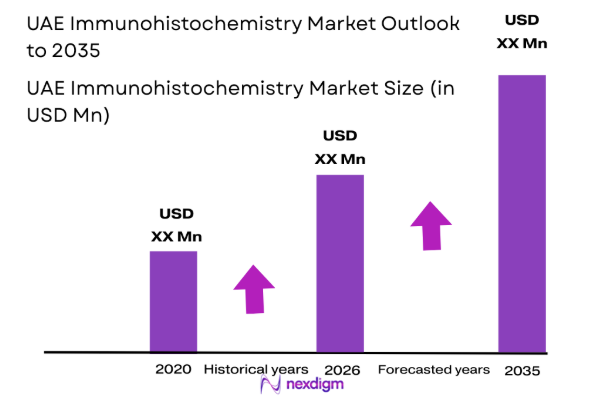
The UAE Immunohistochemistry market is a significant and rapidly evolving segment of the diagnostic industry, with a focus on advanced diagnostic solutions for various diseases. The market size is based on recent assessments of demand for immunohistochemistry products, which is driven by increasing healthcare investments, rising cancer cases, and the growing prevalence of other chronic diseases. The market size for immunohistochemistry in the UAE is estimated to be in the range of USD ~ million, supported by technological innovations and an expanding healthcare infrastructure.
The UAE has emerged as a dominant player in the immunohistochemistry market in the Middle East, primarily due to its advanced healthcare system and strong government support for the medical sector. Cities like Dubai and Abu Dhabi serve as key centers of growth, attracting top-tier healthcare providers and research institutions. The country’s strategic position, coupled with its investments in medical technologies and rising demand for precise diagnostics, further bolsters its leadership in the region, making it a hub for immunohistochemistry advancements.
Market Segmentation
By Product Type
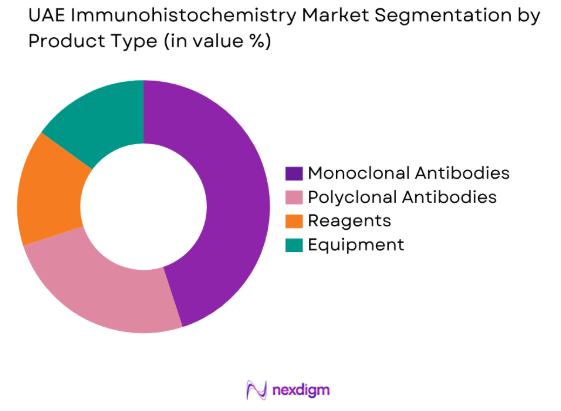
The UAE Immunohistochemistry market is segmented by product type into monoclonal antibodies, polyclonal antibodies, reagents, and equipment. Recently, monoclonal antibodies have seen a dominant market share due to their higher specificity and sensitivity, which are essential in disease diagnostics, especially in cancer detection. Their usage is driven by their effectiveness in targeted therapies and the increasing demand for personalized medicine. Additionally, monoclonal antibodies are extensively utilized in both research and clinical applications, thus strengthening their market presence.
By End User Segment
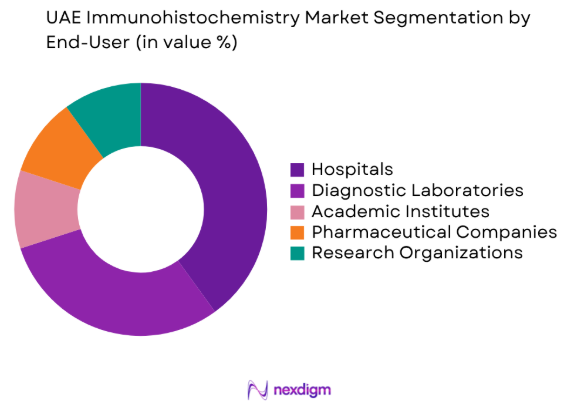
The end-user segment of the UAE Immunohistochemistry market is divided into hospitals, diagnostic laboratories, academic institutes, pharmaceutical companies, and research organizations. Hospitals dominate the market due to their higher demand for immunohistochemistry in diagnostics, especially in oncology departments where precise and early detection of cancer is critical. The availability of advanced diagnostic tools and better healthcare infrastructure in the UAE has made hospitals the largest end-user, followed by diagnostic labs that perform routine testing.
Competitive Landscape
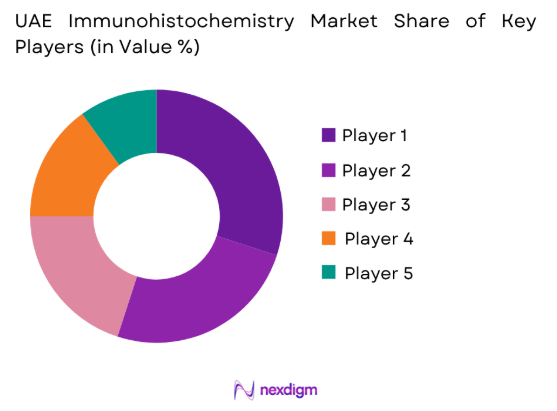
The competitive landscape of the UAE Immunohistochemistry market is marked by the presence of both global and regional players, with companies focusing on expanding their product portfolios and increasing their market share through innovation. The market has experienced consolidation as large multinational companies acquire smaller firms to enhance their product offerings and market reach. Companies such as Roche Diagnostics, Agilent Technologies, and Thermo Fisher Scientific dominate the landscape due to their extensive research capabilities and a broad range of immunohistochemistry solutions.
| Company Name | Establishment Year | Headquarters | Technology Focus | Market Reach | Key Products | Revenue (USD) | Additional Parameter |
| Roche Diagnostics | 1896 | Basel, Switzerland | ~ | ~ | ~ | ~ | ~ |
| Agilent Technologies | 1999 | Santa Clara, USA | ~ | ~ | ~ | ~ | ~ |
| Thermo Fisher Scientific | 1956 | Waltham, USA | ~ | ~ | ~ | ~ | ~ |
| Bio-Rad Laboratories | 1952 | Hercules, USA | ~ | ~ | ~ | ~ | ~ |
| PerkinElmer | 1937 | Waltham, USA | ~ | ~ | ~ | ~ | ~ |
UAE Immunohistochemistry Market Analysis
Growth Drivers
Technological Advancements
Technological advancements in immunohistochemistry are a key growth driver, enhancing the precision and efficiency of diagnostic procedures. Innovations, especially in automation, have improved performance and reduced turnaround times, increasing demand for advanced solutions in clinical settings. Automated staining systems and monoclonal antibodies are becoming increasingly important due to their high sensitivity and specificity in disease detection, particularly in oncology. As healthcare providers, including hospitals and diagnostic laboratories, continue to adopt these innovations, the demand for immunohistochemistry products is expected to rise significantly. This growth is further fueled by the increasing need for faster, more accurate diagnostics and personalized treatments in medical practice.
Government Healthcare Investments
The UAE government’s substantial investments in healthcare infrastructure are a major growth driver for the immunohistochemistry market. These efforts focus on enhancing diagnostic capabilities, lowering treatment costs, and improving patient outcomes, which have led to a rising demand for immunohistochemistry products. With a clear commitment to advancing healthcare services, the UAE aims to become a leading medical hub in the region, fostering further market expansion. The government’s support for healthcare innovation, along with ongoing improvements in medical facilities and research centers, plays a vital role in driving the adoption of advanced diagnostic technologies. This strategic focus on healthcare development boosts the demand for immunohistochemistry solutions.
Market Challenges
High Cost of Immunohistochemistry Products
A major challenge for the UAE Immunohistochemistry market is the high cost of reagents and equipment, which can limit access to advanced diagnostic techniques, particularly for smaller healthcare providers such as clinics and regional hospitals. The necessity of specialized equipment and consumables, coupled with the expensive nature of antibodies and reagents, significantly raises operational costs for diagnostic centers. This financial burden can lead to delays in adopting cutting-edge technologies, particularly for facilities with limited budgets. The high upfront costs and ongoing expenses associated with immunohistochemistry solutions also pose a challenge for healthcare providers looking to integrate these advanced diagnostic tools into their services, affecting the overall growth of the market in certain regions.
Regulatory Hurdles
The UAE Immunohistochemistry market encounters regulatory challenges related to product approval and adherence to strict healthcare standards. Regulatory bodies require extensive testing and validation of new products before they can be marketed, which can be both time-consuming and costly for manufacturers. Additionally, ensuring compliance with the specific regulatory requirements of the UAE healthcare system further complicates market entry and expansion. These stringent processes can delay the introduction of new diagnostic technologies, increasing costs for companies looking to expand in the region. As a result, manufacturers must navigate complex regulatory landscapes, which may deter smaller players from entering the market and slow overall market growth.
Opportunities
Personalized Medicine Growth
The growing shift towards personalized medicine offers a significant opportunity for the UAE Immunohistochemistry market. As targeted therapies and diagnostic tools evolve, immunohistochemistry is pivotal in identifying the most effective treatments for individual patients, particularly in oncology. The demand for personalized medicine is increasing rapidly, driven by advancements in genomics and biomarker identification. Immunohistochemistry plays a vital role in enabling these tailored approaches, ensuring more precise diagnoses and better treatment outcomes. This trend is expected to fuel the demand for immunohistochemistry products, making it an attractive segment for investment. As personalized medicine continues to grow, the market for immunohistochemistry will likely see sustained expansion, offering new business opportunities.
Expanding Diagnostic Capabilities in Emerging Markets
The UAE’s strategic location and advanced healthcare infrastructure present a strong opportunity for market expansion into neighboring countries in the Middle East and North Africa (MENA) region. UAE-based companies can capitalize on their established medical technologies and export immunohistochemistry products to meet the rising demand for accurate diagnostics in these emerging markets. As healthcare systems in the MENA region continue to evolve, the need for advanced diagnostic solutions, particularly in oncology, is growing. By leveraging the UAE’s position as a regional medical hub, companies can tap into this expanding demand, enhancing their market presence and establishing a broader footprint across the MENA region.
Future Outlook
The future outlook for the UAE Immunohistochemistry market is positive, with continued growth driven by technological advancements, increased healthcare spending, and the rising demand for personalized medicine. Over the next five years, the market is expected to witness greater adoption of automated systems, more accurate diagnostics, and higher investments in cancer detection technologies. Additionally, regulatory support and government-backed initiatives to modernize healthcare infrastructure will provide further momentum for the market’s expansion.
Major Players
- Roche Diagnostics
- Agilent Technologies
- ThermoFisher Scientific
- Bio-Rad Laboratories
- PerkinElmer
- Siemens Healthineers
- Dako (Agilent)
- Merck
- Beckman Coulter
- Abbott Laboratories
- Leica Biosystems
- Fujifilm
- VWR International
- LabCorp
- Abbott Molecular
Key Target Audience
- Investments and venture capitalist firms
- Government and regulatory bodies
- Healthcare providers
- Pharmaceutical companies
- Diagnostic laboratories
- Biotechnology firms
- Research institutions
- Medical device manufacturers
Research Methodology
Step 1: Identification of Key Variables
The key variables that drive the UAE Immunohistochemistry market are identified through secondary and primary research, including market surveys and expert consultations.
Step 2: Market Analysis and Construction
Data is analyzed and market trends are constructed through a detailed analysis of the healthcare sector, regulatory frameworks, and technological innovations.
Step 3: Hypothesis Validation and Expert Consultation
Hypotheses are tested and validated through consultation with key market players, regulatory bodies, and healthcare providers to ensure the accuracy of the forecast.
Step 4: Research Synthesis and Final Output
Final market insights and forecasts are synthesized, taking into account all market data, and the report is structured to provide a comprehensive view of the market.

- Executive Summary
- Research Methodology (Definitions, Scope, Industry Assumptions, Market Sizing Approach, Primary & Secondary Research Framework, Data Collection & Verification Protocol, Analytic Models & Forecast Methodology, Limitations & Research Validity Checks)

- Market Definition and Scope
- Value Chain & Stakeholder Ecosystem
- Regulatory / Certification Landscape
- Sector Dynamics Affecting Demand
- Strategic Initiatives & Infrastructure Growth

- Growth Drivers
Increased Healthcare Investments
Technological Advancements in Diagnostics
Rise in Cancer Incidences - Market Challenges
High Capital Costs
Regulatory Compliance Issues
Lack of Skilled Workforce - Market Opportunities
Expansion of Diagnostic Centers
Integration of Artificial Intelligence in Immunohistochemistry
Government Support for Healthcare Modernization - Trends
Rise in Personalized Medicine
Adoption of Automation in Diagnostics
Advancements in Molecular Pathology - Government Regulations
- SWOT Analysis of Key Competitors
- Porter’s Five Forces

- By Market Value, 2020-2025
- By Installed Units, 2020-2025
- By Average System Price, 2020-2025
- By System Complexity Tier, 2020-2025

- By System Type (In Value%)
Immunoassay Systems
Fluorescence Microscopy Systems
Flow Cytometry Systems
Chromogenic Substrate Systems
Automated Staining Systems - By Platform Type (In Value%)
Slide-based Platforms
Plate-based Platforms
Microarray Platforms
Chip-based Platforms
Liquid-based Platforms - By Fitment Type (In Value%)
In-house Solutions
Laboratory-based Solutions
Clinical Solutions
Portable Solutions
Integrated Systems - By End User Segment (In Value%)
Hospitals
Diagnostic Laboratories
Research Institutes
Academic Institutions
Pharmaceutical Companies - By Procurement Channel (In Value%)
Direct Procurement
Government Tenders
Private Sector Procurement
Online Bidding Platforms
Third-party Distributors

- Market Share Analysis
- Cross Comparison Parameters (System Type, Platform Type, Procurement Channel, End User Segment, Fitment Type, Pricing Model, Technology Integration, Service Coverage, Geographic Coverage, Product Quality)
- SWOT Analysis of Key Competitors
- Pricing & Procurement Analysis
- Key Players
Roche Diagnostics
Abbott Laboratories
Thermo Fisher Scientific
Agilent Technologies
Dako (Agilent)
Bio-Rad Laboratories
Becton Dickinson
Siemens Healthineers
Merck
GE Healthcare
F. Hoffmann-La Roche
Lonza Group
PerkinElmer
Johnson & Johnson
Philips Healthcare

- Hospitals’ Growing Diagnostic Needs
- Research Institutes’ Role in Innovation
- Pharmaceutical Companies’ Shift Toward Targeted Therapies
- Demand for Precision Medicine in Diagnostic Laboratories

- Forecast Market Value, 2026-2035
- Forecast Installed Units, 2026-2035
- Price Forecast by System Tier, 2026-2035
- Future Demand by Platform, 2026-2035


 Request a Sample
 Ask for Customization
 Get a Quote
 Enquire Now