
 Download PDF
Market Overview
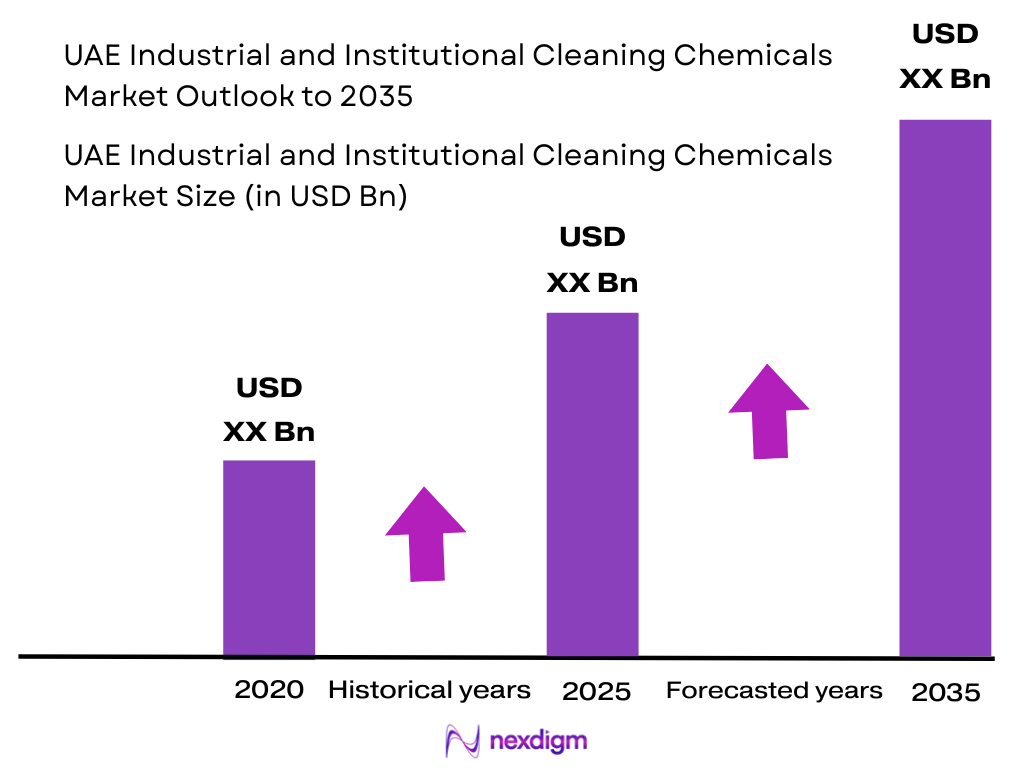
The UAE Industrial and Institutional Cleaning Chemicals Market is estimated at ~USD XX million, supported by the country’s large commercial, hospitality, healthcare, foodservice and industrial base. The UAE generated USD 552.32 billion in GDP in the latest World Bank observation, compared with USD 514.13 billion in the preceding period, while GDP growth reached 4.0, compared with 3.6. Population also reached 10.99 million, creating a sizeable base of commercial facilities and service-intensive establishments requiring professional cleaning, sanitation, disinfection and maintenance chemicals.
Dubai and Abu Dhabi represent the principal demand centres because they combine dense concentrations of hotels, commercial buildings, healthcare facilities, airports, restaurants, retail destinations and industrial assets. Dubai recorded 18.72 million international overnight visitors in the latest full-year observation versus 17.15 million in the preceding year, while its hotel inventory reached 154,016 rooms across 832 establishments, compared with 150,291 rooms across 821 establishments previously. Dubai’s occupied room nights also reached 43.03 million, reinforcing recurring housekeeping, laundry, kitchen and sanitation-chemical consumption.
Market Segmentation
By Product Type
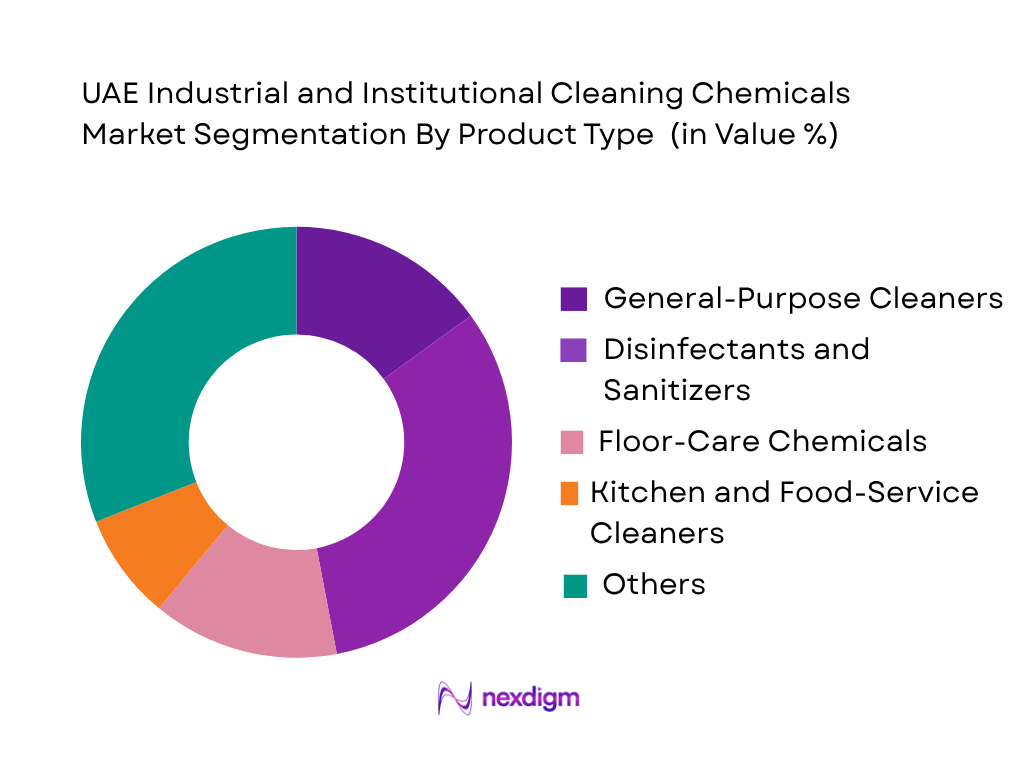
The UAE Industrial and Institutional Cleaning Chemicals Market is segmented by product type into general-purpose cleaners, disinfectants and sanitizers, floor-care chemicals, kitchen and food-service cleaners, laundry chemicals, warewashing chemicals, industrial degreasers, glass and surface cleaners, restroom cleaners and specialty cleaners. Disinfectants and sanitizers are expected to represent the dominant segment at ~XX% market share in 2024, reflecting their broad applicability across healthcare, hospitality, foodservice, commercial buildings and institutional facilities. Demand is supported by requirements for high-touch surface sanitation, healthcare infection-control procedures, food-contact-area hygiene and public-facility maintenance. General-purpose cleaners remain important for routine cleaning, while specialized degreasers and food-processing chemicals address higher soil loads. The UAE’s highly service-oriented hospitality ecosystem further reinforces recurring requirements for housekeeping, kitchen sanitation, laundry and washroom hygiene. Dubai alone had 154,016 hotel rooms across 832 establishments, creating a substantial recurring institutional-cleaning requirement.
By End-Use Industry
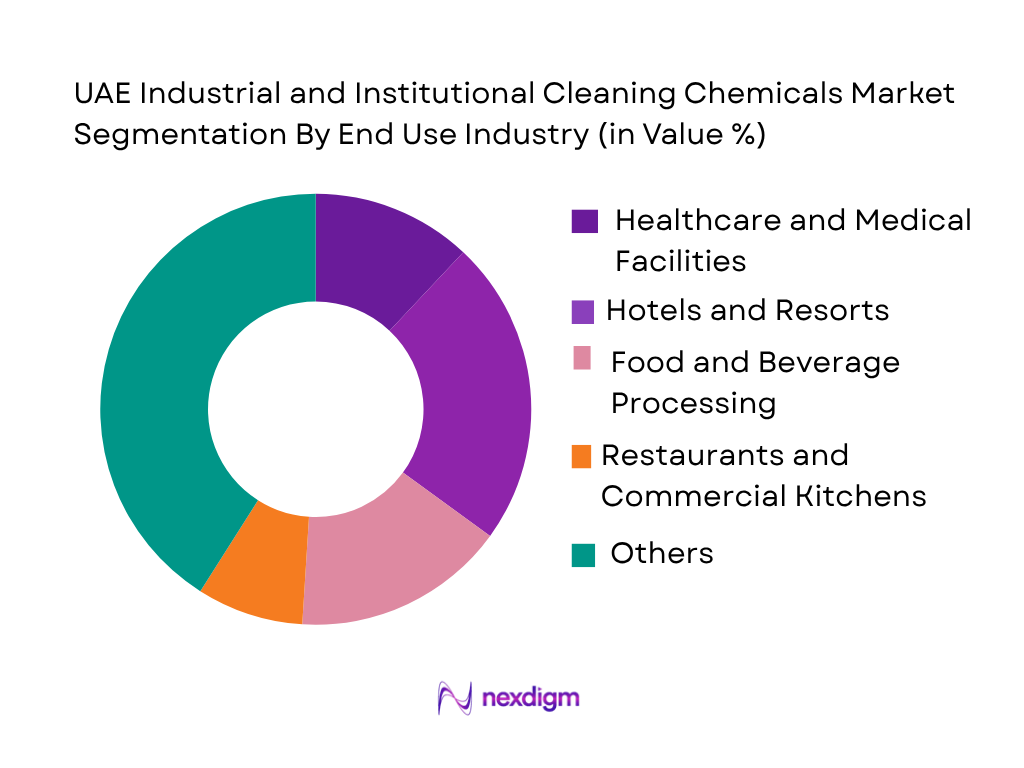
The UAE Industrial and Institutional Cleaning Chemicals Market is segmented by end-use industry into healthcare, hospitality, food and beverage processing, restaurants and commercial kitchens, pharmaceutical manufacturing, industrial manufacturing, commercial offices, retail, aviation and transportation, logistics and warehousing, education and government facilities. Hospitality is expected to represent a leading segment at ~XX% market share in 2024, supported by the scale and intensity of hotel housekeeping, laundry, foodservice and public-area cleaning. Dubai’s hotel inventory reached 154,016 rooms, while occupied room nights reached 43.03 million, demonstrating the scale of recurring cleaning activity within one major UAE demand centre. Healthcare and food processing require more specialized sanitation protocols, while manufacturing facilities create demand for degreasers, machinery cleaners and process-specific formulations. Commercial offices, malls and airports provide additional recurring requirements for floor care, washroom chemicals and high-touch surface sanitation.
Competitive Landscape
The UAE Industrial and Institutional Cleaning Chemicals Market is characterized by the presence of multinational cleaning-chemical suppliers, specialty chemical companies and professional hygiene providers. Major participants compete through broad product portfolios, concentrated formulations, disinfection technologies, industrial cleaning chemistry, automated dosing systems, sustainability positioning and distributor networks. The competitive environment is influenced by the ability to serve large facility-management contracts and technically demanding industries such as healthcare, food processing, hospitality and manufacturing.
| Company | Establishment Year | Headquarters | Product Portfolio | Core Chemistry | Key UAE End Users | Dosing / Dispensing | Distribution Capability |
| Ecolab Inc. | 1923 | St. Paul, USA | ~ | ~ | ~ | ~ | ~ |
| Diversey | 1923 | Fort Mill, USA | ~ | ~ | ~ | ~ | ~ |
| Reckitt | 1819 | Slough, UK | ~ | ~ | ~ | ~ | ~ |
| The Clorox Company | 1913 | Oakland, USA | ~ | ~ | ~ | ~ | ~ |
| Procter & Gamble | 1837 | Cincinnati, USA | ~ | ~ | ~ | ~ | ~ |
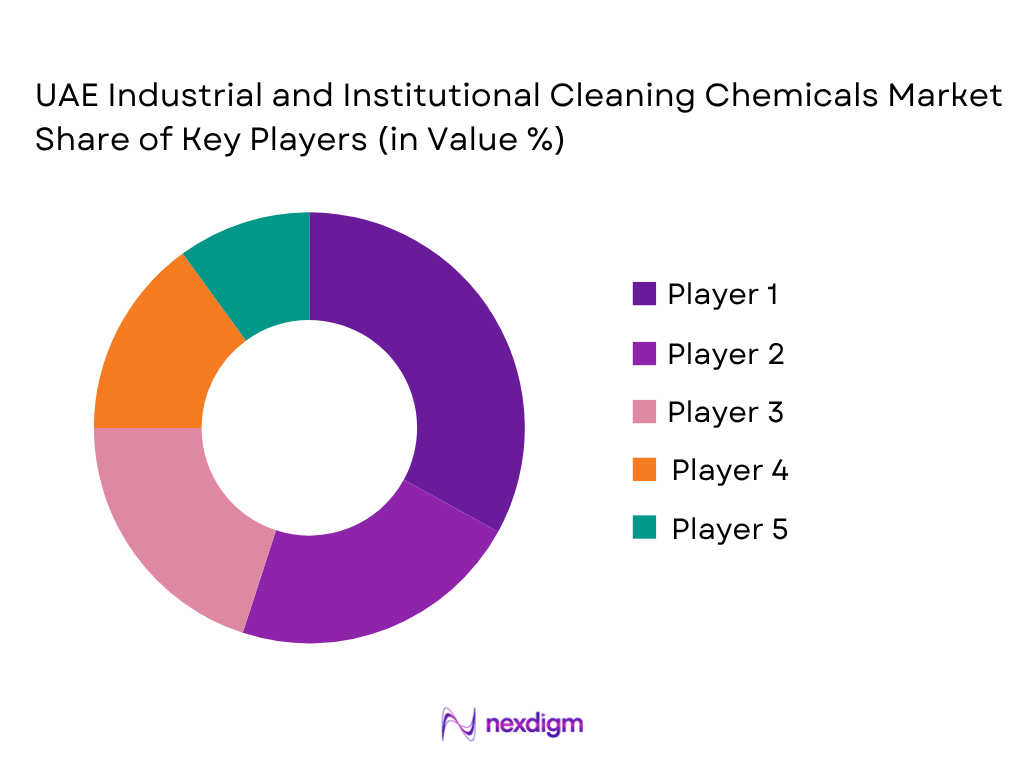
UAE Industrial and Institutional Cleaning Chemicals Market Analysis
Market Growth Drivers
Hospitality and Tourism Expansion
The UAE Industrial and Institutional Cleaning Chemicals Market is strongly supported by the expansion of tourism and hospitality facilities, where housekeeping, laundry, kitchen sanitation, floor care, restroom hygiene and high-touch surface disinfection generate recurring chemical consumption. Dubai welcomed 18.72 million international overnight visitors compared with 17.15 million previously, according to the Dubai Department of Economy and Tourism. Its hotel inventory reached 154,016 rooms across 832 establishments, compared with 150,291 rooms across 821 establishments, while occupied room nights reached 43.03 million, compared with 41.70 million. The scale of hotel operations directly increases demand for professional detergents, disinfectants, laundry chemicals, warewashing products, degreasers and surface cleaners. The wider UAE economic environment also supports this demand: World Bank data records USD 552.32 billion in UAE GDP and USD 50,273.5 in GDP per capita, while GDP growth reached 4.0. IMF analysis identifies tourism, construction, manufacturing and financial services as important contributors to domestic activity, with non-hydrocarbon activity remaining a central component of economic expansion. For professional cleaning-chemical suppliers, continued hospitality activity therefore creates recurring rather than one-time consumption because guestrooms, kitchens, public areas and back-of-house facilities require cleaning throughout their operating cycles. The particularly high volume of hotel room nights makes hospitality one of the most intensive institutional demand environments for cleaning chemicals.
Healthcare Infrastructure Development and Facility-Management Outsourcing
Healthcare infrastructure provides another structurally important demand base for UAE Industrial and Institutional Cleaning Chemicals because hospitals, clinics and medical facilities require routine surface cleaning, disinfection, equipment sanitation, laundry hygiene and infection-prevention procedures. UAE Ministry of Health and Prevention data records 34,912 doctors, 67,931 nurses and 18,685 inpatient beds in 2024, illustrating the scale of healthcare infrastructure requiring continuous professional hygiene operations. MOHAP also maintains dedicated 2024 licensed medical-facility data and a 2024 National Antimicrobial Resistance Surveillance Report, reinforcing the regulatory and operational importance of infection prevention. At the macroeconomic level, UAE GDP reached USD 552.32 billion, while GDP growth reached 4.0, supporting continued investment and operating activity across healthcare and other non-oil sectors. IMF analysis places manufacturing, construction, tourism and financial services among the principal non-hydrocarbon growth areas, while later IMF analysis states that non-hydrocarbon activities represented 75.5 of GDP in 2024, including healthcare-adjacent service and construction activity. Facility-management outsourcing further strengthens chemical demand because hospitals, commercial properties, hotels and institutional buildings can procure standardized cleaning programs through specialized operators rather than managing every cleaning function internally. This favors concentrated formulations, automated dosing, disinfectants, floor-care chemicals and application-specific products capable of supporting standardized protocols across multiple facilities.
Market Challenges
Imported Specialty Chemical Dependency and Specialty Raw-Material Supply
Imported specialty chemical dependency represents a structural challenge for the UAE Industrial and Institutional Cleaning Chemicals Market because advanced professional formulations frequently require specialized surfactants, enzymes, solvents, biocides, chelating agents and performance additives that may originate from international supply chains. The scale of UAE merchandise trade reinforces the importance of external supply availability: the IMF recorded goods imports equivalent to 368 of GDP in its 2024 framework, while central-bank gross foreign assets were equivalent to 199.7 of GDP and covered 8.2 months of the following year’s goods and services imports. These indicators demonstrate both the country’s exceptionally trade-oriented economic structure and its substantial external liquidity, but they also underline the importance of global logistics for imported industrial inputs. For cleaning-chemical manufacturers and distributors, disruption in international shipping, specialty ingredient availability or regional logistics can affect formulation continuity and inventory planning. The challenge is particularly relevant for high-performance products used in pharmaceutical facilities, healthcare, food processing and industrial plants, where substitution between formulations can be technically difficult because products must meet defined cleaning, disinfection, residue and surface-compatibility requirements. IMF data also records UAE private-sector credit growth of 8.6 in 2024, indicating an active financing environment for businesses, but capital availability does not eliminate the operational dependence on imported specialty inputs. Consequently, suppliers need stronger inventory buffers, multiple sourcing arrangements, regional warehousing and localized formulation capabilities to reduce exposure to international specialty-chemical supply disruptions.
Environmental Discharge Controls, Water Constraints and Extreme Climatic Conditions
Environmental and water-management requirements create another challenge because professional cleaning chemicals are used in an environment where water efficiency, wastewater quality, chemical handling and discharge management are particularly important. World Bank data records UAE safely managed sanitation coverage at 98 of the population in 2024, while its environmental database reports annual freshwater withdrawals equivalent to 1,510 of internal freshwater resources in its latest available observation. The figures highlight the importance of wastewater infrastructure and the country’s severe underlying water-resource constraints. For industrial and institutional cleaning operations, this creates demand for formulations that can deliver high cleaning performance at controlled dilution rates while minimizing unnecessary water consumption and reducing problematic residues entering wastewater systems. Extreme climatic conditions also influence product selection and facility-cleaning requirements. High temperatures, dust exposure and intense outdoor environmental conditions can increase cleaning frequency across commercial buildings, logistics facilities, industrial sites, transportation infrastructure and hospitality properties. Cleaning chemicals must therefore perform consistently under demanding operating conditions without creating excessive residue, corrosion or worker-handling risks. UAE economic activity further raises the significance of this challenge: World Bank records USD 552.32 billion in GDP and USD 50,273.5 GDP per capita for 2024, while IMF data places gross domestic investment at 27.5 of GDP in its 2024 framework. Expanding built infrastructure consequently increases the number of surfaces, equipment areas and facilities requiring professional cleaning while simultaneously increasing the need for water-efficient and environmentally controlled cleaning systems.
Market Opportunities
Green Cleaning Chemistry and Water-Efficient Concentrated Formulations
The UAE’s water-resource constraints and expanding institutional infrastructure create a clear opportunity for green cleaning chemistry, concentrated formulations, enzymatic cleaners, low-VOC products and water-efficient professional cleaning systems. World Bank data reports 98 safely managed sanitation coverage in 2024 and annual freshwater withdrawals equivalent to 1,510 of internal freshwater resources in its latest available observation, highlighting the importance of efficient water use and wastewater management. Concentrated formulations can address this requirement by reducing the quantity of product required for each cleaning application while supporting controlled dilution through professional dispensing systems. The opportunity extends across hotels, hospitals, food-processing facilities, commercial buildings and industrial plants, where cleaning occurs repeatedly and chemical consumption is operationally significant. Dubai’s hospitality sector alone recorded 43.03 million occupied room nights and 154,016 hotel rooms across 832 establishments, creating a substantial installed base for concentrated housekeeping, laundry, kitchen and sanitation chemistry. The broader UAE economy provides additional demand capacity, with World Bank GDP reaching USD 552.32 billion and GDP per capita reaching USD 50,273.5. IMF analysis also identifies tourism, construction, manufacturing and financial services as major contributors to domestic activity, while non-hydrocarbon GDP growth has become an important component of economic diversification. These conditions create an addressable opportunity for suppliers offering measurable reductions in chemical and water consumption while maintaining cleaning efficacy. Green formulations can also support sustainability programs operated by hospitality groups, healthcare organizations, facility managers and large commercial-property operators.
Automated Chemical Dosing, Smart Dispensing and Precision Industrial Cleaning
Automated chemical dosing and smart dispensing represent an opportunity to improve chemical-use control across large UAE facilities, particularly hotels, hospitals, food-processing plants, commercial buildings and industrial sites. These systems can regulate dilution, monitor consumption, reduce manual handling and standardize application across multi-site cleaning operations. Dubai’s hospitality infrastructure provides a substantial potential application base, with 154,016 hotel rooms, 832 establishments and 43.03 million occupied room nights recorded in 2024. Healthcare provides another technically demanding application environment: UAE Ministry of Health and Prevention records 34,912 doctors, 67,931 nurses and 18,685 inpatient beds, while its open-data platform maintains licensed medical-facility and antimicrobial-resistance datasets. Such environments require consistent cleaning procedures and make dosing accuracy important for operational control and hygiene protocols. The macroeconomic environment also supports investment in higher-value facility technologies. World Bank reports USD 552.32 billion in UAE GDP and 4.0 GDP growth for 2024, while IMF data records private-sector credit growth of 8.6, indicating continued economic activity and financing capacity. Smart dispensing can therefore move the market beyond conventional chemical supply toward integrated cleaning systems combining chemicals, dosing hardware, monitoring and technical services. Precision industrial cleaning provides an additional opportunity in manufacturing and food processing, where incorrect concentrations can affect equipment surfaces, production efficiency and sanitation outcomes. Suppliers able to combine concentrated chemistry with automated dispensing, digital monitoring and application-specific technical support can differentiate themselves from conventional commodity cleaning-chemical providers.
Future Outlook
Over the forecast period, the UAE Industrial and Institutional Cleaning Chemicals Market is expected to expand through continued development of hospitality, healthcare, commercial real estate, food processing and industrial facilities. Demand is expected to increasingly shift toward concentrated formulations, automated dosing, low-VOC chemistry, bio-based ingredients, water-efficient cleaning systems and specialized sanitation chemistry. Facility-management outsourcing should remain an important route to market because large multi-site operators increasingly require standardized cleaning protocols and centralized chemical procurement. The market’s future development is therefore expected to be shaped not only by chemical consumption but also by formulation efficiency, automation, sustainability and application-specific performance.
Major Players
- Ecolab Inc.
- Diversey
- Reckitt
- The Procter & Gamble Company
- The Clorox Company
- 3M
- SC Johnson Professional
- Zep Inc.
- Spartan Chemical Company
- Betco Corporation
- Kärcher
- Kimberly-Clark Professional
- Christeyns
- Solenis
- Unilever
Key Target Audience
- Industrial Cleaning Chemical Manufacturers and Formulators
- Facility Management Companies and Contract Cleaning Operators
- Hotels, Resorts and Hospitality Procurement Departments
- Healthcare and Hospital Procurement Departments
- Food and Beverage Processing Companies
- Investments and Venture Capitalist Firms (UAE-based and international industrial-chemicals, facility-services and sustainability investors)
- Government and Regulatory Bodies (UAE Ministry of Climate Change and Environment, Dubai Municipality, Abu Dhabi Agriculture and Food Safety Authority)
- Industrial Manufacturing and Pharmaceutical Companies
Research Methodology
Step 1: Identification of Key Variables
The initial stage establishes the UAE industrial and institutional cleaning-chemical ecosystem, covering manufacturers, formulators, importers, distributors, facility-management companies and major end users. Product variables include chemistry, formulation, application, concentration, dosage and end-use industry. Demand variables include facility numbers, cleaning intensity, service activity and industrial output.
Step 2: Market Analysis and Construction
Historical market information is structured through a combination of product-level, end-use and channel-level analysis. The bottom-up framework evaluates chemical consumption across healthcare, hospitality, food processing, manufacturing, commercial buildings, aviation, retail and institutional facilities. The analysis also considers formulation concentration, usage frequency and chemical replacement patterns.
Step 3: Hypothesis Validation and Expert Consultation
Market hypotheses are validated through discussions with chemical suppliers, distributors, facility-management companies, industrial cleaning contractors and institutional procurement professionals. Expert inputs are used to assess product substitution, formulation preferences, procurement practices, dosing systems, customer requirements and competitive positioning.
Step 4: Research Synthesis and Final Output
The final stage triangulates supplier-side and demand-side findings to construct the UAE market model. Product-level assessments are reconciled with facility-level demand indicators and industry activity. Competitive benchmarking is then applied to evaluate product breadth, technical capabilities, distribution reach, sustainability positioning and application expertise.

- Executive Summary
- Research Methodology (Market Definition and Scope, Product Inclusion and Exclusion Criteria, Market Taxonomy, Top-Down Market Assessment, Bottom-Up Market Assessment, Volume-to-Value Conversion, Demand-Side Analysis, Supply-Side Analysis, End-User Validation, Distributor Validation, Primary Interviews, Secondary Data Validation, Data Triangulation, Forecasting Framework, Scenario Analysis, Sensitivity Analysis, Assumptions and Limitations)

- Definition and Scope
- Market Evolution and Development of Professional Cleaning Chemistry
- UAE Industrial and Institutional Cleaning Chemicals Ecosystem
- Industry Value Chain
- Professional Cleaning Services Ecosystem

- Growth Drivers (Hospitality and Tourism Expansion, Healthcare Infrastructure Development, Commercial Real Estate Growth, Foodservice Expansion, Food Processing Development, Industrial Manufacturing, Aviation Infrastructure, Facility Management Outsourcing, High Cleaning Intensity in Commercial Facilities)
- Market Challenges (Imported Specialty Chemical Dependency, Chemical Registration Requirements, Environmental Discharge Controls, Extreme Climatic Conditions, Water-Use Constraints, Hazardous Chemical Handling, Specialty Raw Material Dependency, Skilled Cleaning Workforce Availability)
- Market Opportunities (Green Cleaning Chemistry, Bio-Based Surfactants, Enzymatic Cleaners, Concentrated Formulations, Low-VOC Chemistry, Water-Efficient Cleaning, Automated Chemical Dosing, Smart Dispensing, Sustainable Packaging, Precision Industrial Cleaning)
- Market Trends (Concentrated Chemistry, Sustainable Formulations, Enzyme-Based Cleaning, Low-Residual Disinfection, Automated Dosing, Smart Dispensing, Water Reduction, Refill Systems, Bio-Based Ingredients, Digital Facility Management)
- Government Regulations and Compliance Framework (Chemical Product Registration, Hazardous Chemical Control, Environmental Protection, Hazardous Waste Management, Wastewater Discharge, Occupational Health and Safety, Food Hygiene, Healthcare Infection Control, Product Labelling, Import and Distribution Requirements)
- SWOT Analysis
- Porter’s Five Forces Analysis
- PESTLE Analysis

- By Market Value (2020-2025)
- By Volume Consumption (2020-2025)
- By Product Category (2020-2025)
- By Chemistry Type (2020-2025)
- By Formulation Type (2020-2025)
- By Application (2020-2025)
- By End-Use Industry (2020-2025)

- By Product Type (In Value %)
General-Purpose Cleaners
Disinfectants and Sanitizers
Floor Care Chemicals
Kitchen and Food-Service Cleaners
Laundry Chemicals
Warewashing Chemicals
Industrial Degreasers
Glass and Surface Cleaners
Carpet and Upholstery Cleaners
Restroom and Washroom Cleaners
Specialty and Precision Cleaners - By Chemistry Type (In Value %)
Surfactant-Based Formulations
Acid-Based Formulations
Alkaline Formulations
Enzyme-Based Formulations
Biocide and Antimicrobial Formulations
Chelating-Agent-Based Formulations
Bio-Based Cleaning Chemistry
Low-VOC Cleaning Chemistry - By Formulation Type (In Value %)
Ready-to-Use Liquids
Concentrated Liquids
Powders
Gels
Foams
Tablets and Solid Doses
Wipes and Pre-Moistened Formats - By End-Use Industry (In Value %)
Healthcare and Hospitals
Hotels and Resorts
Food and Beverage Processing
Restaurants and Commercial Kitchens
Pharmaceutical Manufacturing
Industrial and Manufacturing Facilities
Commercial Offices and Business Parks
Retail and Shopping Centres
Logistics and Warehousing - By Cleaning Application (In Value %)
Hard-Surface Cleaning
Floor Cleaning and Maintenance
Equipment and Machinery Cleaning
Clean-in-Place Cleaning
Manual Dishwashing
Industrial Degreasing
Parts and Component Cleaning
Laundry and Textile Cleaning
Restroom Sanitation
High-Touch Surface Disinfection - By Facility Type (In Value %)
Hospitals and Clinics
Hotels and Resorts
Pharmaceutical Facilities
Restaurants and Commercial Kitchens
Factories and Manufacturing Plants
Shopping Malls and Retail Complexes
Office Buildings and Business Parks
Ports and Logistics Facilities
Schools and Institutional Campuses
Government Facilities

- Market Share Analysis of Major Players (By Value, Product Category, Chemistry Type, End-Use Industry, Application, Customer Type, Distribution Channel)
- Cross Comparison Parameters (Product Portfolio Breadth, Professional Cleaning SKU Coverage, UAE Manufacturing or Formulation Footprint, Specialty Chemistry Capability, Sustainable Chemistry Portfolio, Automated Dosing Capability, Distribution Network Reach, Facility Management Customer Coverage)
- SWOT Analysis of Major Players
- Detailed Profiles of Major Companies
Ecolab Inc.
Diversey
Reckitt
Unilever
The Procter & Gamble Company
3M
SC Johnson Professional
The Clorox Company
Zep Inc.
Spartan Chemical Company
Betco Corporation
Kärcher
Kimberly-Clark Professional
Christeyns
Sealed Air

- Consumption Behavior Assessment
- End-User Chemical Consumption Patterns
- Procurement Decision-Making
- Professional Cleaning Frequency Analysis
- Concentrate Versus Ready-to-Use Demand

- By Market Value (2026-2035)
- By Volume Consumption (2026-2035)
- By Product Category (2026-2035)
- By Chemistry Type (2026-2035)
- By Formulation Type (2026-2035)
- By Application (2026-2035)
- By End-Use Industry (2026-2035)


 Request a Sample
 Ask for Customization
 Get a Quote
 Enquire Now