

 Download PDF
Market Overview
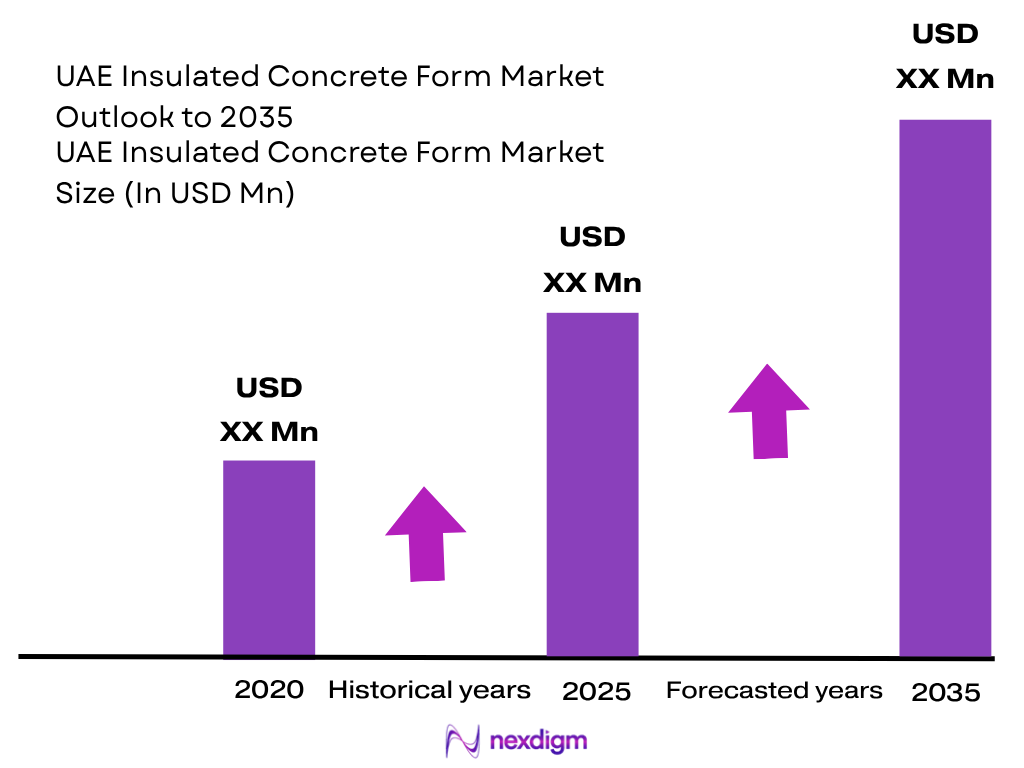
The UAE Insulated Concrete Form Market is valued at approximately USD ~ million, based on a historical market assessment, with construction expansion, thermal-efficiency requirements and villa development supporting demand. Abu Dhabi’s building stock increased from 281,780 buildings to 299,360 buildings, while real-estate units increased from 754,555 to 783,970. The UAE economy generated USD 552.32 billion in GDP, creating a substantial construction base for high-performance insulated wall technologies.
Dubai and Abu Dhabi dominate the UAE Insulated Concrete Form Market opportunity because both contain extensive residential, commercial and infrastructure development pipelines and established building-performance regulations. Dubai recorded 226,000 real-estate transactions valued at AED 761 billion, while Abu Dhabi contained 299,360 buildings and 783,970 real-estate units. Dubai additionally applies dedicated building-code insulation provisions for villas, while Abu Dhabi’s expanding residential building stock creates opportunities for thermally insulated reinforced-concrete wall systems.
Market Segmentation
By ICF System Type
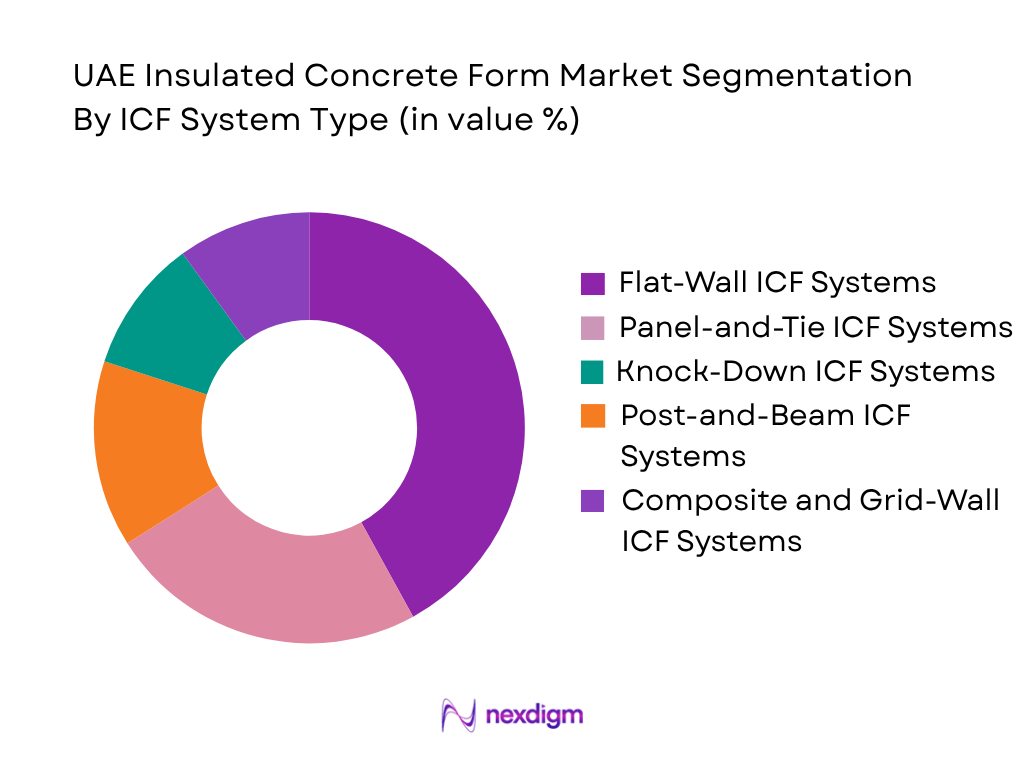
The UAE Insulated Concrete Form Market is segmented by system type into flat-wall ICF, panel-and-tie ICF, knock-down ICF, post-and-beam ICF and composite or grid-wall systems. Flat-wall ICF systems are considered the dominant sub-segment in the report model because their configuration closely matches the structural requirements of villas, townhouses and low- to medium-rise reinforced-concrete construction. Two insulation panels connected by webs create a continuous cavity that receives reinforced concrete, producing a monolithic structural wall with permanent insulation. CEMEX UAE’s locally marketed ICF solution uses this basic two-panel-and-web configuration and supports bearing walls, non-bearing walls and slab-related applications. Its technical specification accommodates concrete strengths of 30-60 N/mm², flows of 550-650 mm, concrete density of approximately 2,400 kg/m³, and maximum aggregate sizes of 10-20 mm. Flat-wall systems also simplify reinforcement detailing compared with more complex grid geometries, supporting broader contractor adoption in villa construction.
By End-Use Construction
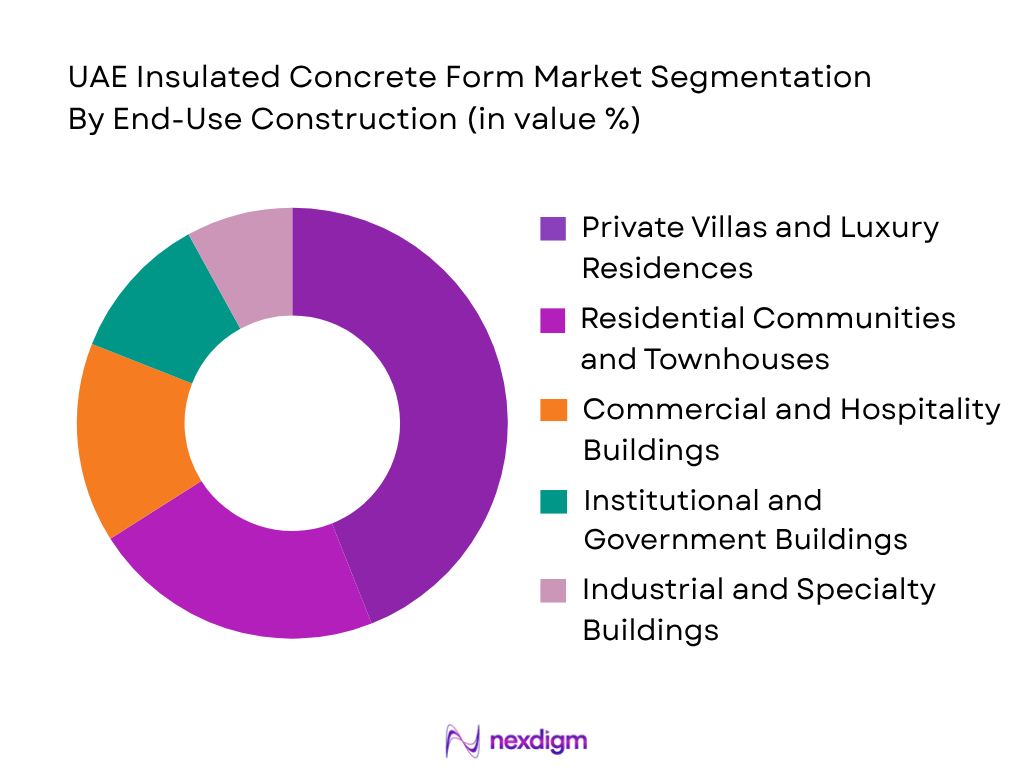
The UAE Insulated Concrete Form Market is segmented by end use into private villas, residential communities and townhouses, commercial and hospitality buildings, institutional and government buildings, and industrial or specialty structures. Private villas are considered the leading application segment because ICF construction aligns particularly well with low-rise reinforced-concrete buildings requiring strong external envelopes, thermal insulation, acoustic control and shorter structural construction cycles. Dubai Municipality maintains dedicated insulation sections specifically for villas within the Dubai Building Code, highlighting the importance of envelope design in this building category. Dubai’s real-estate reporting also identified particularly strong villa demand, supported by lifestyle-oriented suburban and luxury residential development. In Abu Dhabi, residential buildings constitute the majority of the emirate’s building stock, while residential units reached 466,700. These conditions favor ICF suppliers capable of offering reinforced-concrete walls with permanent insulation as an integrated alternative to conventional concrete-frame and masonry-envelope construction.
Competitive Landscape
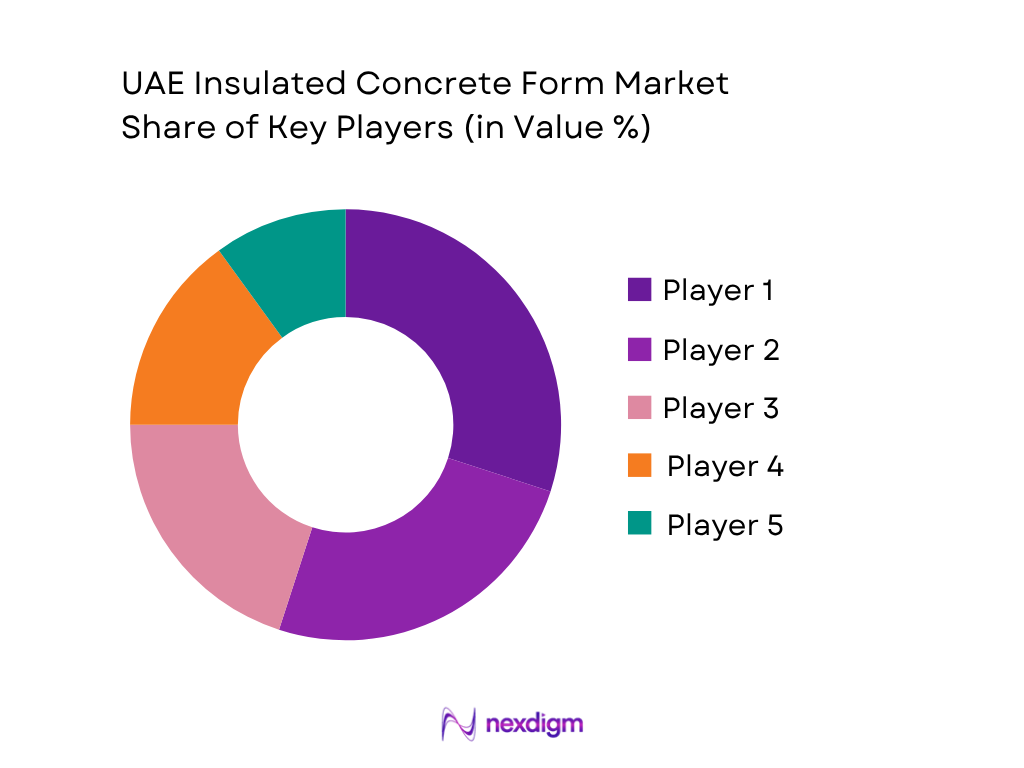
The UAE Insulated Concrete Form Market contains a relatively concentrated local ecosystem comprising EPS manufacturers, specialized ICF installers, ready-mix concrete suppliers and international ICF technology providers. Local companies such as National Polystyrene Packaging Factory and Total Quality Insulation Manufacturing provide domestic EPS capability, while Equi Nox Technical Services contributes specialized ICF project execution. CEMEX UAE integrates ICF with engineered ready-mix concrete, whereas international systems such as Nudura provide product architecture, technical resources and installer training.
| Major Player | Establishment Year | Headquarters | UAE Market Role | ICF / Product Capability | Manufacturing Capability | Concrete Integration | Key Application Exposure | Technical Support |
| National Polystyrene Packaging Factory | 1994 | Dubai, UAE | ~ | ~ | ~ | ~ | ~ | ~ |
| Total Quality Insulation Manufacturing | 2016 | Umm Al Quwain, UAE | ~ | ~ | ~ | ~ | ~ | ~ |
| Equi Nox Technical Services | 2012 | Dubai, UAE | ~ | ~ | ~ | ~ | ~ | ~ |
| CEMEX UAE | 1906 (global company origin) | Monterrey, Mexico | ~ | ~ | ~ | ~ | ~ | ~ |
| Nudura | Not publicly disclosed in current official material | Beachwood, Ohio, USA | ~ | ~ | ~ | ~ | ~ | ~ |
UAE Insulated Concrete Form Market Analysis
Growth Drivers
Expanding Construction and Residential Building Activity
The UAE Insulated Concrete Form Market is supported by sustained construction activity, particularly across Abu Dhabi and Dubai, where residential, villa and mixed-use projects create demand for reinforced wall systems with integrated insulation. Abu Dhabi recorded 299,360 buildings in 2024 compared with 281,780 buildings in 2023, while total real-estate units increased from 754,555 to 783,970. Within Abu Dhabi Region alone, buildings increased from 148,655 to 161,930, demonstrating substantial additions to the addressable construction stock. At the national level, the construction sector expanded strongly during 2024, supported by continuing investment in urban infrastructure and real-estate development. Dubai simultaneously recorded 226,000 real-estate transactions with a transaction value of AED 761 billion, reflecting exceptionally high development and investment activity. These indicators are directly relevant to ICF because villas, townhouses, low-rise communities and specialized buildings can use EPS forms surrounding reinforced-concrete cores to integrate structure and thermal insulation. The macroeconomic foundation is also supportive, with UAE GDP reaching USD 552.32 billion and GDP per capita reaching USD 50,273.5 in 2024. This large construction base increases the potential project pipeline available for industrialized insulated concrete wall technologies.
Increasing Importance of Thermally Efficient Building Envelopes
Thermal-performance requirements are strengthening the business case for insulated concrete forms in the UAE because buildings operate under hot climatic conditions where external-wall insulation directly influences cooling requirements and indoor comfort. Dubai Building Code includes dedicated U-value calculation requirements and provides 6 separate insulation-section configurations for villas, establishing a formal framework for evaluating external-envelope thermal performance. ICF systems are relevant because permanent EPS panels remain around the reinforced-concrete wall after placement, creating continuous insulation while reducing thermal bridges associated with conventional concrete structural elements. This configuration is especially suitable for private villas, residential communities, hotels and institutional buildings requiring high-performance envelopes. The opportunity is supported by the scale of construction: Abu Dhabi contained 299,360 buildings and 783,970 units in 2024, while Dubai recorded 226,000 property transactions valued at AED 761 billion. The UAE’s 2024 GDP of USD 552.32 billion and GDP per capita of USD 50,273.5 indicate strong economic capacity for investment in higher-performance construction methods. As developers place greater emphasis on building-envelope performance, ICF suppliers can position continuous insulation and reinforced concrete as a combined structural and thermal solution rather than competing only as an alternative formwork technology.
Market Challenges
Limited Specialized ICF Installation and Project Execution Capability
The UAE Insulated Concrete Form Market faces a significant execution challenge because successful ICF construction requires specialized capabilities in form stacking, wall bracing, reinforcement placement, opening preparation, concrete pumping, consolidation and alignment control. This requirement becomes material when compared with the scale of conventional construction activity already supported by established blockwork, precast and reinforced-concrete contractor networks. Abu Dhabi contained 299,360 buildings and 783,970 real-estate units in 2024, including 161,930 buildings in the Abu Dhabi Region alone, illustrating the breadth of projects where contractors are accustomed to existing construction methods. Dubai also recorded 2.78 million real-estate procedures and 226,000 transactions during 2024, indicating intense project and property activity but not necessarily equivalent availability of ICF-trained installers. Consequently, suppliers need technical supervision, installer training, concrete-placement guidance and structural engineering support to convert this construction pipeline into ICF demand. The UAE’s economy generated USD 552.32 billion in GDP during 2024, while GDP per capita reached USD 50,273.5, supporting sophisticated construction demand but also creating competition for specialized technical labor across numerous projects. Without broader installer certification and locally available ICF execution teams, adoption may remain concentrated in selected villas and specialized high-performance developments rather than spreading rapidly across mainstream construction.
Competition from Established Concrete Block and Alternative Wall Systems
ICF adoption in the UAE is challenged by strong competition from conventional reinforced-concrete frames, concrete masonry units, thermal blocks, AAC systems, precast walls and other insulated construction solutions already embedded in local design and contracting practices. This competition matters because the UAE construction sector operates at considerable scale, giving architects and contractors extensive experience with established technologies. Abu Dhabi’s building stock reached 299,360 structures in 2024 from 281,780 in 2023, while its unit stock rose from 754,555 to 783,970, demonstrating continued construction without requiring ICF adoption. Dubai recorded 226,000 real-estate transactions worth AED 761 billion, creating a large market in which numerous wall technologies compete for specification. Dubai Building Code also provides 6 villa insulation-section configurations, allowing conventional construction assemblies to meet thermal-envelope requirements through combinations of structural walls and separate insulation materials. This means ICF must prove advantages in construction sequencing, thermal continuity, structural integration and on-site productivity rather than relying solely on insulation performance. The UAE’s 2024 GDP of USD 552.32 billion and GDP per capita of USD 50,273.5 support continued building investment, but this also attracts multiple construction technologies. ICF suppliers therefore face a specification-conversion challenge requiring stronger contractor familiarity, engineering documentation, demonstration projects and locally adapted system designs.
Market Opportunities
Villa and Residential Community Development Creates Future ICF Expansion Potential
Private villas and residential communities provide a strong future growth avenue for the UAE Insulated Concrete Form Market because these projects align closely with the low-rise structural configuration and continuous-insulation advantages of ICF systems. Abu Dhabi recorded 783,970 real-estate units in 2024 compared with 754,555 units in 2023, while total buildings increased from 281,780 to 299,360. The Abu Dhabi Region alone contained 535,925 units and 161,930 buildings, indicating a substantial concentration of addressable residential construction. Dubai’s property sector generated 226,000 transactions worth AED 761 billion, while 217,000 real-estate investments were valued at AED 526 billion, showing significant capital deployment into property development. These current indicators provide a strong platform for future ICF penetration without requiring assumptions about future building volumes. ICF suppliers can target villa developers and community builders with wall systems combining reinforced-concrete structure, permanent insulation and reduced temporary formwork operations. Dubai Building Code’s 6 dedicated villa insulation sections further reinforce the relevance of high-performance external-wall solutions. The UAE’s 2024 GDP of USD 552.32 billion and GDP per capita of USD 50,273.5 provide the macroeconomic capacity supporting premium and energy-conscious residential development, making villas and planned communities an attractive expansion pathway for localized ICF systems.
Localization of EPS-ICF Manufacturing and Integrated Construction Solutions
Localization represents a significant future opportunity for the UAE Insulated Concrete Form Market because rising construction activity can support greater domestic production of EPS forms, custom moulding, reinforcement accessories and project-specific concrete solutions. The construction sector recorded strong expansion during 2024, while the UAE’s nominal economic output reached a substantial scale supported by continued non-oil development. Abu Dhabi added 17,580 buildings between 2023 and 2024, increasing from 281,780 to 299,360, while the emirate added 29,415 real-estate units, reaching 783,970. Dubai simultaneously registered 226,000 real-estate transactions valued at AED 761 billion, creating a sizeable downstream construction ecosystem into which localized ICF manufacturing can sell. Domestic production can reduce reliance on imported finished forms while enabling UAE-specific block dimensions, EPS thicknesses, web configurations and reinforcement layouts aligned with local villa and building practices. It can also support integrated supply packages combining ICF blocks, ready-mix concrete, bracing, engineering and installation assistance. The UAE’s 2024 GDP stood at USD 552.32 billion, while GDP per capita reached USD 50,273.5, providing a strong economic base for construction-product localization. Future market development can therefore be accelerated through local EPS moulding capacity, installer certification, design support and partnerships with concrete producers and building contractors.
Future Outlook
The UAE Insulated Concrete Form Market is expected to expand at a forecast CAGR of approximately ~XX.X% during 2026-2035, supported by energy-efficient building requirements, villa development, higher-performance building envelopes and continued interest in industrialized construction techniques. Future adoption is likely to concentrate initially in private villas, premium residential projects, hospitality developments and specialized institutional structures where thermal performance and construction productivity can justify conversion from traditional wall systems. Localization of EPS moulding and installer capability will remain particularly important.
Dubai presents a favorable specification environment because its Building Code explicitly addresses sustainable development, external-envelope performance, U-value calculations and villa insulation configurations. UAE ICF suppliers can therefore position continuous EPS insulation as part of the building-envelope solution rather than simply selling temporary formwork. CEMEX’s UAE ICF system already demonstrates the local technical proposition, including fire resistance of up to 120 minutes, acoustic performance of up to 50 dB, productivity of approximately 120 m² per day, and structural concrete specifically configured for insulated forms.
Major Players
- National Polystyrene Packaging Factory
- Total Quality Insulation Manufacturing Company
- Equi Nox Technical Services
- CEMEX UAE
- Insulated Concrete Forms LLC
- Nudura
- Amvic Building System
- Fox Blocks
- BuildBlock Building Systems
- Quad-Lock Building Systems
- SuperForm Products
- LiteForm Technologies
- RASTRA
- Faswall
- Polycrete International
Key Target Audience
- Insulated Concrete Form Manufacturers and System Suppliers
- EPS and Thermal Insulation Manufacturers
- UAE Real Estate Developers and Residential Community Developers
- Main Contractors, Specialist ICF Contractors and Construction Companies
- Ready-Mix Concrete and Reinforcement Suppliers
- Investments and Venture Capitalist Firms
- Government and Regulatory Bodies (Dubai Municipality, Abu Dhabi Department of Municipalities and Transport, Ministry of Energy and Infrastructure, UAE Civil Defence Authorities)
- Architects, Structural Engineering Firms and Building-Envelope Design Companies
Research Methodology
Step 1: Identification of Key Variables
The initial phase involves constructing an ecosystem map covering manufacturers, EPS suppliers, concrete producers, contractors, developers, architects and government authorities operating within the UAE Insulated Concrete Form Market. Extensive secondary research is used to identify ICF form consumption, installed wall area, domestic manufacturing, imports, building applications, thermal requirements and emirate-level construction demand as the principal variables affecting market development.
Step 2: Market Analysis and Construction
Historical market information is compiled to assess ICF installations across villas, residential communities, commercial buildings and institutional projects. The analysis combines building-stock trends, construction activity, EPS manufacturing capacity, ready-mix concrete availability and verified ICF project participation. Top-down construction indicators are reconciled with bottom-up supplier, installer and project-level information to develop estimates for market value, installation volume and system demand.
Step 3: Hypothesis Validation and Expert Consultation
Initial market hypotheses are validated through computer-assisted telephone interviews with ICF contractors, EPS processors, ready-mix suppliers, developers, structural engineers and building-envelope professionals. Interviews focus on form types, concrete core dimensions, project conversion rates, installation productivity, contractor capability, imported-system dependence and customer purchasing criteria. Findings are triangulated against government construction statistics, building-code requirements and company-level operating information.
Step 4: Research Synthesis and Final Output
The final phase integrates supplier-side and demand-side findings into a unified UAE Insulated Concrete Form Market model. Company information, project evidence, construction indicators and primary interviews are reconciled to remove inconsistencies and avoid double counting. The resulting analysis supports market segmentation, competitive positioning, installed-wall estimates and forecasting while identifying future opportunities in villas, residential communities, hospitality projects and high-performance buildings.

- Executive Summary
- Research Methodology (Market Definition and Scope, UAE Insulated Concrete Form Market Classification, ICF System Demand Assessment, EPS Insulated Form Consumption Mapping, Installed ICF Wall Area Assessment, Domestic ICF Manufacturing Capacity Assessment, Imported ICF System Dependency Analysis, EPS Feedstock and Moulding Assessment, Reinforced Concrete Core Consumption Mapping, Ready-Mix Concrete Integration Assessment, Building Application-Level Demand Assessment, End-Use Construction Mapping, Primary Industry Interviews, Top-Down Market Sizing, Bottom-Up Company Revenue and Installation Volume Assessment, Project Pipeline Analysis, Data Triangulation, Pricing Assessment, Forecasting Framework)

- Definition and Scope
- UAE Insulated Concrete Form Industry Evolution and Development of EPS-Based Stay-in-Place Formwork, Reinforced Concrete Wall and High-Performance Building Envelope Ecosystem
- ICF Block Manufacturing, EPS Moulding, Reinforcement, Ready-Mix Concrete, Bracing and Installation Industry Structure
- UAE Insulated Concrete Form Value Chain Analysis
- UAE Insulated Concrete Form Supply Chain Analysis
- EPS Raw Material Supplier, ICF Block Manufacturer, Ready-Mix Concrete Producer, Reinforcement Supplier, ICF Contractor, Developer, Architect, Structural Engineer and Building Owner Ecosystem Analysis
- ICF Construction Integration Across Villas, Residential Communities, Commercial Buildings, Hospitality, Institutional Buildings, Basements and High-Performance Building Applications

- Growth Drivers (Expansion of Villa and Low-Rise Residential Construction, Growing Requirement for Thermally Efficient Building Envelopes, High Cooling Load Reduction Requirements, Increasing Adoption of Sustainable Construction, Expansion of Residential Communities, Demand for Faster Reinforced Concrete Wall Construction, Growing Use of Permanent Insulation Systems, Development of High-Performance Building Projects, Ready-Mix Concrete Ecosystem Integration)
- Market Challenges (Limited Specialized ICF Installer Base, Low Contractor Familiarity Compared with Conventional Concrete Block Construction, Dependence on Project-Specific Structural Approval, Competition from AAC and Thermal Concrete Blocks, EPS Fire Safety Compliance Requirements, Concrete Pour and Bracing Control Requirements, Dependence on Imported ICF Systems, Limited Domestic ICF Product Variety, Architect and Developer Awareness Constraints)
- Market Opportunities (Luxury Villa ICF Construction, Energy-Efficient Residential Communities, Basement and Foundation Applications, Hospitality and Resort Projects, High-Performance Government Buildings, Domestic EPS-ICF Manufacturing Localization, Integrated ICF and Ready-Mix Concrete Packages, ICF Swimming Pool Construction, Contractor Certification Programs, High-R Insulation System Localization, GCC Export Opportunities)
- Market Trends (Twin-Wall EPS ICF Adoption, Interlocking ICF Block Systems, Reversible ICF Blocks, Higher Thermal Resistance Forms, Integrated Rebar Holders, Knock-Down ICF Systems, Continuous Building Envelope Insulation, Monolithic Reinforced Concrete Walls, BIM-Based ICF Design, Factory-Moulded EPS Forms, Project-Specific Ready-Mix Concrete Integration)
- Regulatory and Standards Landscape (Dubai Building Code Requirements, UAE National Green Building Requirements, External Wall Thermal Transmittance Requirements, Roof Thermal Performance Requirements, Villa Insulation Requirements, Thermal Bridge Mitigation Requirements, Fire and Life Safety Requirements, Structural Concrete Requirements, EPS Insulation Compliance, Sustainable Building Requirements)
- SWOT Analysis
- Porter’s Five Forces Analysis
- PESTLE Analysis
- Stakeholder Ecosystem
- Competition Ecosystem

- By Market Value (2020-2025)
- By ICF Form Consumption Volume (2020-2025)
- By Installed ICF Wall Area (2020-2025)
- By Domestic ICF Production Volume (2020-2025)
- By Imported ICF Form Volume (2020-2025)
- By EPS Consumption in ICF Applications (2020-2025)
- By Ready-Mix Concrete Consumption Through ICF Construction (2020-2025)
- By Average Selling Price (2020-2025)

- By ICF System Type (In Value %)
Flat-Wall ICF Systems
Panel-and-Tie ICF Systems
Knock-Down ICF Systems
Post-and-Beam ICF Systems
Grid-Wall ICF Systems
Screen-Grid ICF Systems
Vertical ICF Systems
Composite ICF Systems - By Insulating Form Material (In Value %)
Expanded Polystyrene ICF
Graphite-Enhanced Expanded Polystyrene ICF
Polyurethane-Based ICF
Cement-Bonded EPS Composite ICF
Cement-Bonded Fibre ICF
Recycled EPS Composite ICF
Hybrid Insulated Concrete Forms
Other Stay-in-Place Insulated Form Systems - By Building Application (In Value %)
External Load-Bearing Walls
Internal Structural Walls
Basement Walls
Foundation Walls
Retaining Walls
Swimming Pools and Water Features
Utility and Service Structures
Insulated Concrete Floor and Roof Integration - By End-Use Construction (In Value %)
Private Villas and Luxury Residences
Residential Communities and Townhouses
Multifamily Residential Buildings
Hotels and Hospitality Developments
Schools and Educational Facilities
Healthcare Facilities
Commercial Buildings
Government and Municipal Buildings
Industrial and Warehouse Facilities
Specialty High-Performance Buildings - By Emirate (In Value %)
Dubai
Abu Dhabi
Sharjah
Ajman
Ras Al Khaimah
Umm Al Quwain
Fujairah

- Market Share of Major Players (By UAE Revenue, ICF Form Consumption Volume, Installed ICF Wall Area, ICF System Portfolio, Residential Project Exposure, Commercial and Institutional Project Exposure, UAE Manufacturing and Distribution Footprint, Installation and Technical Support Capability)
- Cross Comparison Parameters (UAE ICF Revenue, ICF Block and Panel System Portfolio Breadth, Available Concrete Core Thickness Range, EPS Thermal Insulation and External Wall U-Value Capability, UAE ICF and EPS Manufacturing Capability, Villa-Commercial-Institutional Project Coverage, UAE Contractor and Installation Support Footprint, Structural Design-Training and Technical Service Capability)
- SWOT Analysis of Major Players
- Competitive Positioning Matrix
- ICF System Architecture and Product Portfolio Benchmarking
- Pricing and ICF System Category Benchmarking
- Thermal, Structural and Building Envelope Performance Assessment
- Manufacturing, EPS Moulding and ICF Installation Technology Assessment
- End-Use Construction and UAE Project Exposure Assessment
- Detailed Profiles of Major Companies
National Polystyrene Packaging Factory
Total Quality Insulation Manufacturing Company
Equi Nox Technical Services
CEMEX UAE
Insulated Concrete Forms LLC
Nudura
Amvic Building System
Fox Blocks
BuildBlock Building Systems
Quad-Lock Building Systems
SuperForm Products
LiteForm Technologies
RASTRA
Faswall
Polycrete International

- Private Villa Developer ICF Adoption Assessment
- Residential Community Developer ICF Requirement Analysis
- Luxury Homeowner High-Performance Wall Requirement Assessment
- Hospitality and Resort Developer ICF Adoption Assessment
- Commercial Developer Building Envelope Requirement Analysis
- Government and Municipal Building Procurement Assessment
- Main Contractor ICF Construction Capability Assessment
- Architect and Structural Engineer ICF Specification Assessment
- MEP Consultant ICF Services Integration Assessment
- Building Owner Thermal Comfort and Energy Performance Assessment

- By Market Value (2026-2035)
- By ICF Form Consumption Volume (2026-2035)
- By Installed ICF Wall Area (2026-2035)
- By Domestic ICF Production Volume (2026-2035)
- By Imported ICF Form Volume (2026-2035)
- By EPS Consumption in ICF Applications (2026-2035)
- By Ready-Mix Concrete Consumption Through ICF Construction (2026-2035)
- By Average Selling Price (2026-2035)


 Request a Sample
 Ask for Customization
 Get a Quote
 Enquire Now